
Mastering Your ICP in Sales: B2B Lead Generation Guide
Your team is working hard, but the pipeline says otherwise. Reps are taking calls with companies that look interested, ask for pricing, even book demos, then disappear or stall because they were never a real fit. Marketing keeps handing over leads, sales keeps pushing back on quality, and everyone ends up debating volume instead of revenue.
That’s usually the moment when people say they need an ICP, then treat it like another positioning document. In practice, ICP in sales is much more useful than that. It gives sales and marketing a shared standard for who deserves time, budget, follow-up, and custom outreach.
The problem isn’t only that teams don’t know who to target. It’s that they also haven’t clearly defined who to leave alone.
Stop Wasting Time on Low-Quality Leads
A familiar pattern shows up in underperforming B2B pipelines. Marketing broadens targeting to keep lead flow up. SDRs work large lists because activity is easy to measure. AEs accept meetings that look promising on paper but don’t survive discovery. The calendar stays full, but the meeting quality drops.
That kind of pipeline is expensive even when nobody says it out loud. Reps lose selling time. Managers coach around symptoms instead of causes. Customer success inherits bad-fit accounts that struggle to launch or never fully adopt.
What low-quality lead flow actually looks like
You can usually spot the issue before you run a formal analysis:
-
Meetings sound interested, not committed. Prospects can describe the problem, but they don’t have the structure, urgency, or buying conditions to act.
-
Pipeline coverage looks healthy, but forecast confidence stays weak. There’s activity everywhere and conviction nowhere.
-
Sales and marketing define “qualified” differently. Marketing sees engagement. Sales sees friction.
-
Outbound gets blamed for poor results when the list is the core issue. List quality drives everything from reply quality to call quality.
A lot of teams try to solve this with better copy alone. Better copy helps, but weak targeting poisons strong messaging. That’s why resources like BillionVerify’s lead list insights matter. Clean data and relevant targeting shape the quality of the conversations you create.
Low-quality leads don’t just waste outreach volume. They lower rep judgment because teams start normalizing bad-fit meetings.
Why ICP fixes the root cause
An Ideal Customer Profile gives your team a shared definition of the kind of company most likely to become a high-value customer. That changes how you build lists, how you route leads, and how you decide whether a meeting is worth taking in the first place.
It also sharpens qualification. If your team still relies on vague fit signals, tighten that process before you scale outbound. This practical guide on how to qualify sales leads is useful for translating fit into day-to-day screening criteria.
When ICP is working, sales spends less time hoping weak opportunities improve. Marketing stops optimizing for names that never should have entered the funnel. Meeting quality rises because your team has a clearer answer to one question that matters more than most qualification frameworks admit.
Is this account worth pursuing at all?
What an ICP in Sales Really Means
ICP stands for Ideal Customer Profile. It has become a standard framework for sales and marketing teams to define the type of company most likely to become a high-value customer, and modern practice centers on analyzing your best customers to identify common firmographic, behavioral, and environmental traits such as industry, company size, location, revenue, and technology stack, as described in HG Insights’ ICP sales guide.
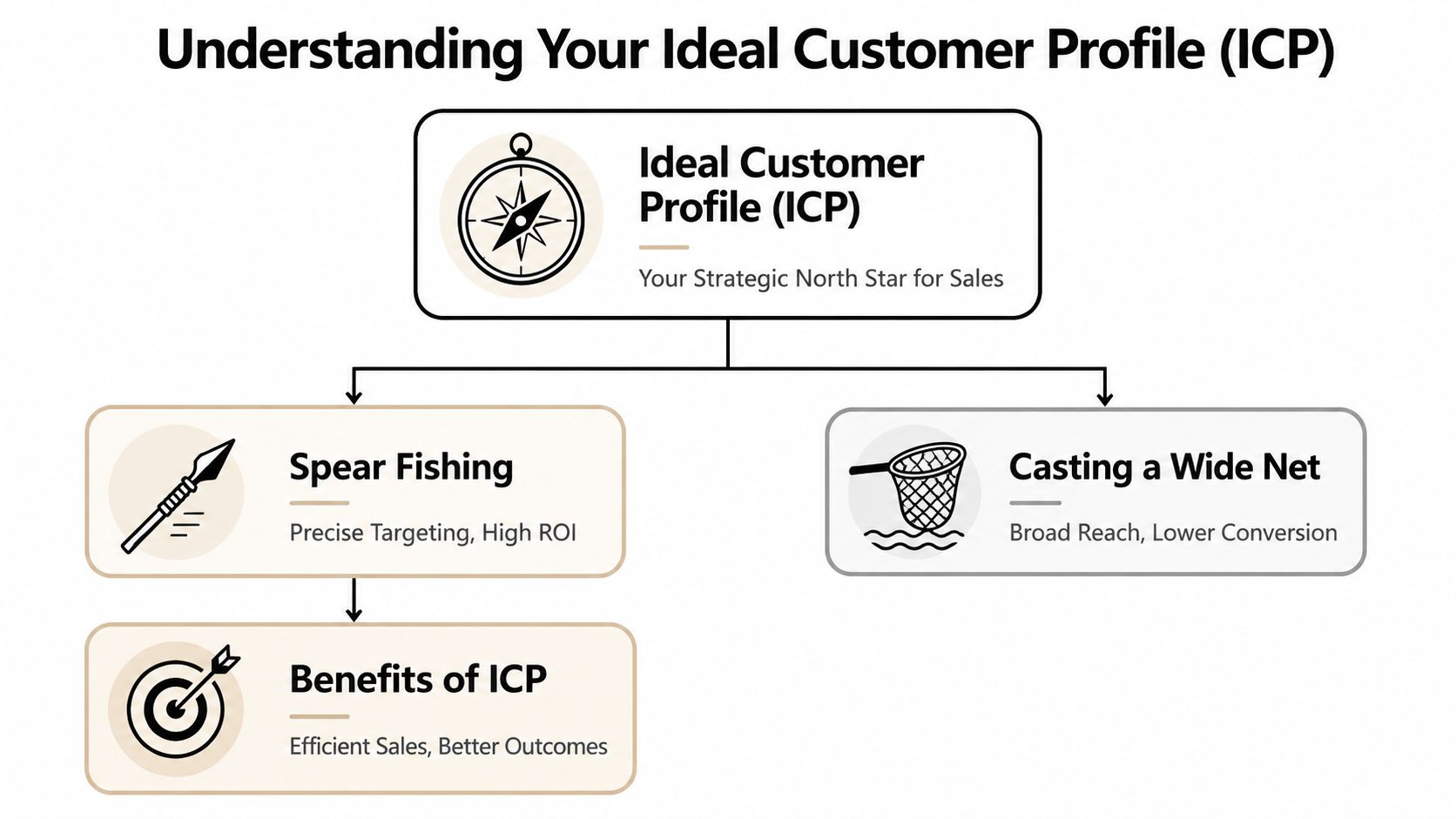
Spear fishing beats casting a wide net
The simplest way to explain ICP in sales is this. Sales organizations often cast a net. They go broad, catch a lot, then spend time sorting through what should never have been caught.
A strong ICP works like spear fishing. You choose targets deliberately. You know why they fit. You know what makes them likely to buy, succeed, and stay.
That doesn’t mean targeting fewer accounts by default. It means targeting with intent.
The components that make an ICP useful
A real ICP is not “mid-market SaaS” written on a slide. It’s a practical pattern built from several layers.
Firmographics
This is the baseline. Industry, company size, geography, revenue, and related company-level traits tell you whether an account even belongs in your market.
Firmographics matter because they shape budget, complexity, procurement style, and operational pain. A product built for structured teams with multiple stakeholders will usually struggle in tiny founder-led companies, even when interest is high.
Technographics
Technology stack tells you whether your solution fits into the account’s current environment. If your product depends on integrations, process maturity, or a specific workflow, this matters early.
Technographics also improve messaging. An outreach email that reflects the systems a prospect already uses feels grounded in reality.
Behavioral signals
Behavioral signals show how companies buy and use solutions like yours. This can include product adoption patterns, sales process behavior, and recurring pains seen across successful accounts.
Many teams improve their ICP by stopping descriptions of who could buy and starting to identify who tends to buy well.
Environmental factors
Market context matters. Growth stage, expansion activity, operational pressure, regulatory change, and internal change all influence readiness and urgency.
Practical rule: If your ICP only describes who exists, it’s incomplete. It should also help you predict who is likely to act.
An ICP becomes valuable when it guides prioritization. It should help marketing choose segments, sales rank accounts, and leadership decide where to invest time. If it can’t influence those decisions, it’s just a description.
How to Build Your Data-Driven ICP Step by Step
The best ICPs don’t come from brainstorming sessions. They come from customer data, pattern recognition, and uncomfortable honesty about which deals were never a fit.
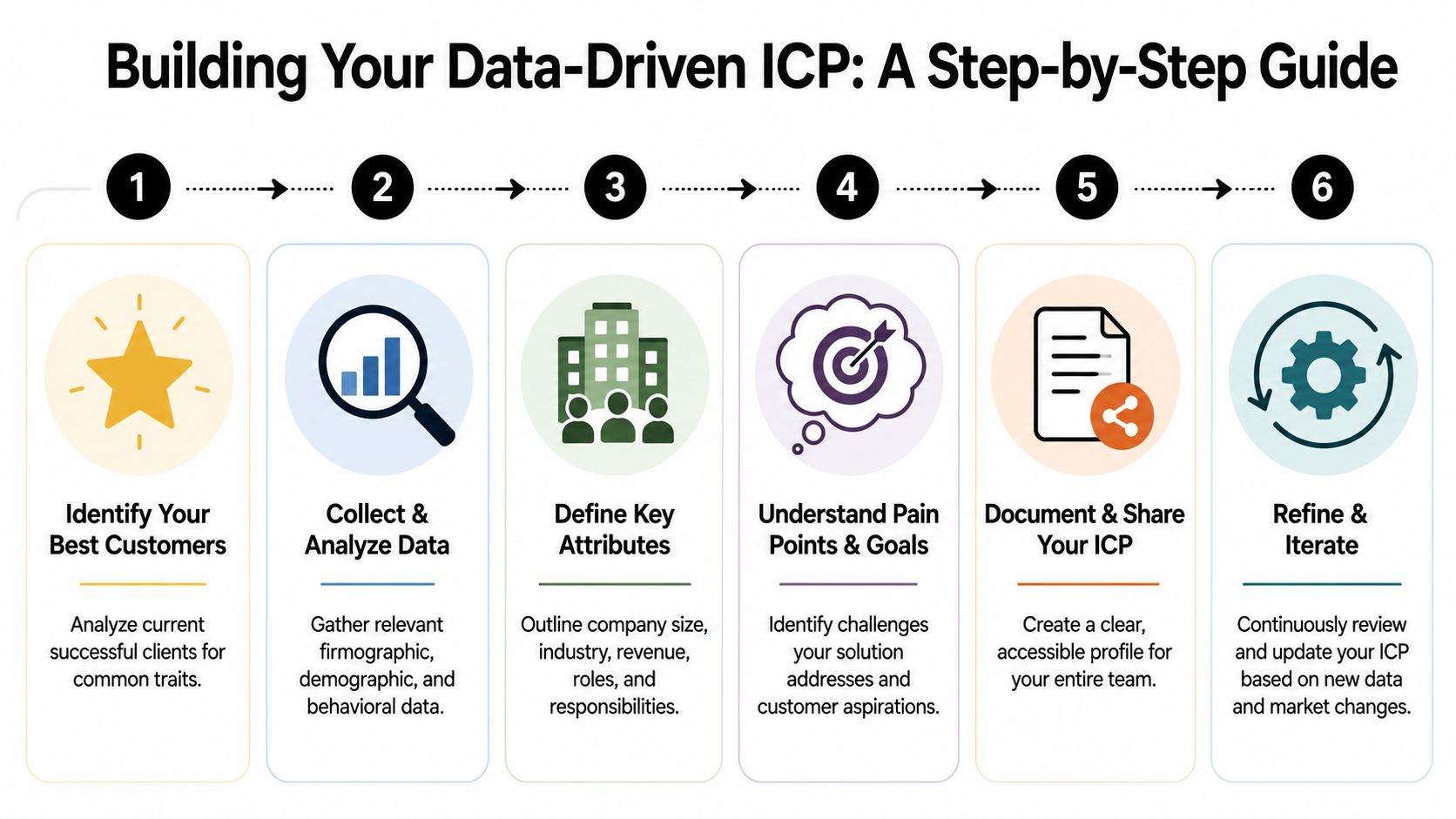
A rigorous ICP in sales is built from quantitative customer data. Gong recommends filtering current customers by revenue, then comparing attributes such as contract length, feature adoption, and pain points to find the highest-value pattern set in this Gong breakdown of ICP development.
Start with your best customers, not your loudest ones
Many teams pick accounts they remember most clearly. That’s a mistake. The accounts you should study are the ones that combine strong fit with healthy commercial outcomes.
Look at customers who are easier to serve, clearer in their use case, and more aligned with your product. You’re looking for repeatable patterns, not isolated wins.
A practical first pass usually includes:
-
Accounts with strong revenue contribution
-
Customers with stable contracts or clean renewals
-
Companies that adopted meaningful parts of the product or service
-
Deals where the sales cycle felt rational rather than forced
Pull the data before you debate the narrative
Before anyone starts describing “our sweet spot,” pull the records. Use CRM, billing, onboarding notes, support patterns, and product usage if you have it.
If you need outside context to connect account-level signals with broader buying conditions, tools that help synthesize market insights can help teams frame patterns beyond raw CRM fields.
What to collect
You do not need perfect data to begin. You do need disciplined categories.
-
Firmographic data Capture industry, employee range, geography, revenue band, and business model.
-
Commercial data Review deal quality signals such as contract characteristics, expansion potential, and sales process smoothness.
-
Usage and adoption signals For SaaS or service-heavy offers, look at adoption behavior, service engagement, and whether the customer used what they bought.
-
Pain points and buying triggers Pull these from call notes, onboarding docs, and proposal records. Repeated pain themes often reveal fit more clearly than generic segmentation.
A lot of teams also benefit from clarifying the difference between the market they can serve and the subset they should actively target. This breakdown of market vs. industry helps when segmentation gets muddy.
Here’s a useful walkthrough if you want a visual explanation of the process:
Build the profile in layers
Once the data is in front of you, don’t rush to a polished one-paragraph ICP statement. First, group traits into layers.
| Layer | What to capture | Why it matters |
|---|---|---|
| Company fit | Industry, size, geography, revenue context | Tells you whether the account belongs in your target pool |
| Operating fit | Team structure, process complexity, tech environment | Shows whether your offer fits how they actually work |
| Buying fit | Pain urgency, internal ownership, adoption readiness | Helps predict whether a deal can move and succeed |
| Expansion fit | Potential for broader usage or deeper engagement | Keeps the ICP tied to durable revenue, not just initial acquisition |
Turn the pattern into rules
At this stage, strategy gets operational. Your ICP should become something a marketer can target and a rep can score.
Document:
-
Must-have criteria that define clear fit
-
Good-to-have attributes that improve priority
-
Risk flags that deserve caution
-
Exclusion signals that push an account out
The strongest ICPs aren’t broad descriptions. They’re decision tools.
That last category matters more than commonly understood. If you don’t document exclusion signals, your pipeline fills with “maybe” accounts that absorb time and lower meeting quality.
Sample ICP Templates for B2B Companies
A startup doesn’t need the same ICP template as an established B2B company with years of CRM history. The mistake is assuming there’s one ideal format. There isn’t. The right template depends on how much real customer data you have and how many teams need to use it.
For early-stage teams, a simpler template keeps everyone aligned without false precision. For mature teams, a layered template supports targeting, qualification, messaging, and account planning.
B2B ICP template examples
| Attribute | Basic ICP Example (e.g., Early-Stage SaaS) | Advanced ICP Example (e.g., Enterprise Software) |
|---|---|---|
| Primary industry | B2B SaaS | Multi-site enterprise services and software-heavy operating environments |
| Company size | Small to mid-sized teams | Mid-market to enterprise organizations with defined departments |
| Geography | One core region | Multiple priority regions with territory rules |
| Revenue context | Growing companies with budget awareness | Companies with established buying processes and strategic software budgets |
| Buying trigger | Need to improve a manual workflow | Active transformation, integration pressure, or operational scaling need |
| Tech environment | Uses mainstream cloud tools | Uses a defined stack with integration dependencies |
| Main decision-maker | Founder or functional lead | Buying committee with executive sponsor and operational owner |
| Sales complexity | Shorter evaluation path | Multi-stakeholder review and procurement involvement |
| Core pain point | Inefficiency and lost team time | Process fragmentation, reporting gaps, or cross-team coordination issues |
| Success indicator | Fast time to first value | Strong rollout potential, adoption across teams, and expansion fit |
| Negative fit | Very small teams with no clear owner | Accounts with weak ownership, high customization demands, or low adoption readiness |
When to use each template
Basic template
Use the basic version if you’re still finding repeatable traction. It’s enough to guide outreach, shape targeting, and stop obvious mismatches.
This works well when your sales motion is founder-led or when your data quality is still uneven.
Advanced template
Use the advanced version when sales, marketing, and customer success all need the same account logic. At that stage, you’re not just deciding who to contact. You’re deciding who to route, how to message them, and whether they belong in expansion plans later.
If your team is also defining who inside the account matters, pair the company-level ICP with persona work. This guide on how to create buyer personas for better outreach is useful for separating account fit from contact-level messaging.
A related challenge comes up when teams target senior roles too loosely. If you’re building high-level contact strategies, this guide to CEO email list building is a practical reference for how executive targeting differs from broader list building.
Validating and Refining Your Living ICP
A documented ICP is only a hypothesis until the market confirms it. Teams often do the hard work of defining one, then stop there. Months later, they’re still using the same targeting rules even though product positioning, buyer urgency, and competitive pressure have changed.
That’s how once-useful ICPs turn stale. The issue usually isn’t that the original profile was wrong. It’s that nobody built a process to keep it honest.
Validate in the field, not only in spreadsheets
The fastest way to test an ICP is to use it in live targeting. Build focused campaigns around accounts that match the profile closely, then compare those conversations to broader or loosely matched segments.
Look for differences in:
-
Reply quality
-
Meeting quality
-
Sales acceptance
-
Progression after first call
-
Objection patterns
You don’t need a massive experiment. A tightly scoped outbound motion often reveals whether the ICP reflects buying reality or internal wishful thinking.
If sales keeps saying “they took the meeting, but they were never serious,” your ICP still isn’t strict enough.
Build a feedback loop with sales
Reps hear the friction first. They know when prospects consistently lack urgency, budget shape, operational readiness, or internal ownership. That input belongs in ICP refinement.
Create a simple review rhythm with sales and marketing around questions like:
| Review question | What it helps uncover |
|---|---|
| Which booked meetings felt like obvious fits? | Positive patterns worth reinforcing |
| Which opportunities stalled for the same reason? | Missing disqualification criteria |
| Which objections came from bad targeting, not bad messaging? | Segment-level mismatch |
| Which accounts looked good in data but failed in discovery? | Gaps between static fit and actual buying behavior |
Keep it live inside your systems
An ICP should live in your CRM, targeting rules, and lead routing logic. It shouldn’t sit in a strategy deck nobody opens after the kickoff.
Salesforce advises that ICPs should be updated continuously using CRM and lifecycle data, which supports using them as dynamic scoring tools rather than static descriptions, as discussed in this Apollo overview of modern ICP use. That’s the right mindset. You’re not preserving a definition. You’re improving a filter.
Teams that treat ICP refinement as routine tend to make better targeting decisions because they remove drift before it shows up as pipeline waste.
Putting Your ICP to Work for High-Quality Meetings
An ICP only matters when it changes behavior. The payoff comes when targeting, list building, messaging, and qualification all start using the same fit logic.

The practical shift is simple. Stop treating ICP as an offensive tool only. Use it defensively too.
Use ICP to build better lists
Good outbound starts before the first email. If the account list is weak, personalization won’t save it.
Use your ICP to filter account pools by fit, then segment by relevant differences inside the fit range. That may include industry, operating model, technology environment, or growth context. Once the account list is clean, contact selection becomes much easier.
For teams running outbound email, segmentation is where meeting quality often rises or falls. This guide to email list segmentation is useful for structuring lists around meaningful differences instead of dumping all “good enough” accounts into one sequence.
Match the message to the pattern
If your ICP is real, your best accounts should share repeatable pain points and buying conditions. Use that pattern in outreach.
A strong message usually reflects:
-
The operating context the account is likely in
-
The business problem you repeatedly solve for companies like them
-
The cost of inaction in terms that matter to that segment
-
The reason now based on an observed trigger or environmental condition
This is also where agencies and tools can fit. Some teams handle segmentation and outbound execution internally. Others use platforms for enrichment and list building. Others use qualified-meeting services to turn a defined ICP into outreach operations. Fypion Marketing, for example, runs cold email programs focused on booked qualified meetings rather than broad lead volume.
Build a negative ICP, not just a positive one
This is the part most guides miss.
Modern B2B revenue teams need ICPs that work across acquisition and expansion. Apollo explicitly recommends defining negative ICP criteria from win/loss and retention data to create a defensible do-not-target list that reduces wasted outreach and improves sales efficiency, as covered earlier in the cited Apollo resource.
Negative ICP means documenting the kinds of accounts that look viable at first but consistently become bad business. These are the companies that churn quickly, require disproportionate effort, resist adoption, or never had the internal conditions to succeed.
What belongs in a negative ICP
Not every exclusion rule is firmographic. Some of the strongest negative signals are behavioral and operational.
-
Weak ownership. No clear internal champion, no accountable team, or no operator who will carry implementation.
-
Chronic customization pressure. Prospects that need your team to redesign the offer before value can appear.
-
Low adoption readiness. The problem is real, but the company lacks process maturity, internal resources, or urgency.
-
Poor expansion fit. They may buy once, but there’s no realistic path to broader value.
The fastest way to improve meeting quality is often not finding more of the right accounts. It’s removing the wrong ones earlier.
Turn negative ICP into a qualification gate
Sales efficiency improves when ICP shifts from a soft preference to an explicit gate.
A workable model looks like this:
| ICP use case | Operational move |
|---|---|
| Strong fit | Prioritize outbound, route quickly, personalize deeply |
| Moderate fit | Nurture selectively or test with lighter-touch outreach |
| Poor fit | Disqualify early or exclude from targeting |
| Negative ICP match | Add to do-not-target list |
When teams do this well, calendars get cleaner. SDRs stop booking meetings just because a prospect replied. AEs spend more time with accounts that can move. Marketing gets better feedback because “bad lead” stops being vague and starts being diagnosable.
That’s what ICP in sales should do. It should improve the quality of attention your business gives out.
From Profile to Predictable Pipeline
A strong ICP changes sales from reactive to deliberate. Instead of chasing any account that shows surface interest, your team works from a clearer view of who fits, who doesn’t, and why that distinction matters for revenue.
That shift improves more than targeting. It improves meeting quality, sales focus, messaging relevance, and the odds that new customers succeed after the deal closes.
The biggest improvement usually comes from the defensive side of the work. Once you define the companies to ignore, your pipeline gets cleaner fast. Reps protect their time. Marketing stops paying for noise. Leadership gets a better read on what’s likely to convert.
If your outbound or demand generation still feels inconsistent, the first fix usually isn’t more activity. It’s sharper fit criteria, backed by real data and enforced in daily execution. A useful next step is reviewing the stack and workflow your team uses for targeted outreach, starting with these sales prospecting tools.
If you want a partner to turn a clear ICP into booked, qualified meetings, Fypion Marketing offers performance-based B2B lead generation built around cold email outreach, targeting research, list building, messaging, and qualification criteria tied to meeting quality rather than lead volume.