
7 Best Performance Marketing Agency Picks for 2026

Your quarter is already mapped out. The board wants pipeline, sales wants qualified meetings, and finance wants attribution that holds up under scrutiny. Then the agency report lands, full of traffic gains and click-through rates, while booked pipeline barely moves. That is usually when B2B SaaS and tech teams start looking for a performance marketing agency, and when they realize the harder question is not service mix. It is commercial alignment.
A long list of capabilities does not solve that problem. Plenty of agencies offer paid media, SEO, creative, web support, and lead generation under one roof. For B2B buyers, the filter is how the agency gets paid and what that pushes them to optimize. A retainer model often rewards activity and channel expansion. A performance-based model can tighten the connection to meetings, pipeline, or revenue, but it also requires clear qualification rules, accurate tracking, and agreement on what counts as success.
That distinction matters in practice because performance marketing should be judged on business outcomes, not reporting volume. B2B teams buying for pipeline should look past channel coverage and ask a simpler question: does this agency’s model match the revenue target we are trying to hit? If you are weighing outside support against building internally, this is also a good time to compare in-house and agency marketing.
This list is built for that decision. It focuses on agencies serving B2B SaaS and tech companies, with attention to both execution strength and business model fit, including pay-per-meeting options for teams that want tighter alignment with qualified pipeline. For a closer look at how compensation structure changes incentives, see how pay-for-performance marketing aligns agencies with real revenue.
1. Fypion Marketing
If your biggest complaint about agencies is simple, “They get paid whether meetings happen or not,” Fypion Marketing is the cleanest fix on this list.
Fypion is built around a pay-per-meeting model for B2B lead generation. Instead of charging an upfront retainer, setup fee, or fixed monthly services package by default, they align fees to booked, qualified meetings that meet pre-agreed criteria. For SaaS and tech companies with clear product-market fit, that structure reduces the usual agency risk fast.
Why the model stands out
A lot of agencies say they care about pipeline. Fypion structures the commercial relationship around it. That changes behavior. When the agency only gets paid on qualified booked meetings, list quality, offer framing, deliverability, and inbox handling stop being side tasks and become the job.
Their process covers the operational work other teams underestimate:
-
Audience research: They validate target accounts, buyer segments, and messaging angles before volume goes live.
-
Cold email infrastructure: They handle technical setup and deliverability foundations that many internal teams skip or misconfigure.
-
Personalized outreach: They build copy and sequences around the ICP instead of sending generic templates at scale.
-
Inbox management and optimization: They manage replies, monitor performance, and adjust based on campaign data.
For buyers comparing compensation models, this is worth reading: why pay-for-performance marketing aligns agencies with real revenue.
Practical rule: If your sales team cares most about qualified conversations, pay for qualified conversations. Don’t buy a reporting layer disguised as growth.
Where Fypion fits best
Fypion is best for B2B companies that already know who they sell to and what pain they solve. That includes SaaS vendors, tech startups with a defined ICP, agencies selling to other businesses, and teams that want outbound to produce meetings without hiring and training a full internal SDR motion first.
The appeal is straightforward. You get an end-to-end outbound engine without owning the cold email stack internally.
There’s also published social proof in the company’s own materials. Fypion highlights a 4.7-star rating from 17+ clients, along with documented results including 220% month-over-month inbound lead growth, 102 positive replies in the first 12 weeks, and 100+ appointments generated for e-commerce brands on the Fypion Marketing website.
Trade-offs to know before you sign
This isn’t the right fit for every company. If you’re still figuring out your market, still changing positioning every month, or don’t yet know what counts as a qualified meeting, pay-per-meeting can expose those gaps quickly.
A few practical cautions:
-
You need product-market fit: Fypion isn’t a substitute for unclear positioning or weak offers.
-
Pricing isn’t published publicly: You’ll need a sales conversation to understand the per-meeting economics.
-
Scope can vary: If you want setup support without full meeting delivery, the model may change.
For B2B teams that want direct alignment with pipeline creation, Fypion is the strongest specialist pick here.
2. Directive
A common B2B SaaS scenario looks like this. Paid search drives demos, content brings in some qualified traffic, Salesforce is full of stage definitions no one fully trusts, and leadership still asks the same question every week: which programs are creating pipeline?
Directive is built for that situation. Its value is not just channel execution. It is the way paid media, SEO, content, creative, and Revenue Operations are tied back to pipeline and revenue goals. For B2B tech buyers, that matters more than raw lead volume because the wrong agency model can produce activity without helping sales create opportunities.
What makes Directive different
Directive stands out because it sells a revenue program, not just channel management. That is a better fit for SaaS companies with long sales cycles, multiple stakeholders, and a real handoff between marketing and sales. If your team already tracks SQL quality, funnel conversion, and CAC payback, this model usually lines up better than hiring one paid search shop, one SEO agency, and a separate RevOps consultant.
The trade-off is complexity. A connected program can improve decision-making, but only if your CRM, attribution rules, and sales feedback loop are good enough to support it.
For teams comparing agency models, this overview of a B2B lead generation agency model is useful because it highlights a real buying choice: do you need demand capture and funnel optimization, or do you need a pay-per-meeting engine that creates conversations directly?
Best fit and limitations
Directive makes the most sense for B2B SaaS and enterprise tech companies that already have a defined ICP, stable positioning, and enough internal discipline to act on RevOps recommendations. It is a strong option when the goal is to improve paid efficiency and tighten the path from click to opportunity.
A few practical pros and cons stand out:
-
Strong fit for revenue-led teams: Good match when marketing is expected to influence pipeline, not just traffic or MQLs.
-
Useful service mix: Paid media, SEO, creative, and RevOps under one partner can reduce channel silos.
-
Relevant client profile: Helpful for buyers selling into complex committees, longer buying cycles, and higher ACVs.
The main drawback is weight. If you only need a narrow campaign build, a basic Google Ads program, or a small outbound pilot, Directive can be more agency than you need. Buyers looking for direct meeting volume on a pay-per-meeting basis will usually want a different model.
Visit Directive.
3. Tinuiti
Tinuiti is the scale play on this list. If your team needs multi-channel media, advanced measurement, marketplace execution, and a partner with platform depth, Tinuiti belongs in the conversation.
This isn’t a boutique B2B operator in the classic sense. It’s a large independent performance agency with broad coverage across search, paid social, streaming, commerce, affiliate, CRO, and lifecycle channels. That matters for buyers who need coordination across several spend buckets rather than one lead source.
Measurement is the main reason to shortlist Tinuiti
A lot of agencies say they’re data-driven. Tinuiti’s pitch leans harder into measurement systems such as media mix modeling and incrementality work. That’s useful now because attribution is less reliable than many agency sales decks imply, especially once you spread spend across multiple platforms and touchpoints.
If you’re also exploring outbound alongside paid acquisition, this overview of a B2B lead generation agency model can help frame whether you need media scale, meeting generation, or both.
Who should hire Tinuiti
Tinuiti is strongest when a company has enough budget and enough moving parts to justify enterprise-style coordination. That could mean a mature B2B SaaS company, a tech-enabled services firm, or a company selling through both direct and marketplace channels.
Its strengths are practical:
-
Cross-channel breadth: Search, social, retail media, affiliate, TV or audio, and CRO can sit under one roof.
-
Platform relationships: Big agencies often get earlier access to betas, support, and inventory guidance.
-
Serious analytics orientation: Helpful when leadership wants answers beyond channel-reported conversions.
The obvious downside is complexity. Smaller teams can get buried in process, and early-stage companies often won’t use the full stack they’re paying for.
Visit Tinuiti.
4. Wpromote
Wpromote is a good fit for buyers who don’t want to separate brand and performance into competing workstreams.
That’s a common B2B mistake. One team runs demand capture, another team runs awareness, and neither owns the connection between message quality, audience strategy, and conversion efficiency. Wpromote’s Brandformance angle tries to solve that by treating creative and media planning as one system.
Why that matters in 2026
Recent industry coverage has pushed a useful point: many “best agency” lists overemphasize channel breadth and underweight creative execution. Darkroom’s 2026 guidance argues agencies need to “turn creative into a repeatable growth lever” and win in retail media and marketplaces, which is a sharp reminder that media buying alone isn’t enough in a weaker targeting environment, as discussed in Darkroom’s 2026 agency perspective.
Wpromote fits that shift better than agencies that still lead with pure media language.
Where Wpromote works well
For mid-market and enterprise buyers, Wpromote can be attractive because it spans paid media, SEO, content, programmatic, CTV, affiliate, and influencer work. If you’re running a broader acquisition portfolio and need one lead partner, that breadth helps.
If you’re deciding whether broad outsourced support makes more sense than hiring in several directions at once, this guide to outsourced marketing services helps frame the trade-off.
A few practical notes:
-
Strong choice for multi-channel growth: Better for companies running several channels at once.
-
Creative plus performance mindset: Useful if ad fatigue and weak messaging are hurting results.
-
Probably too broad for single-channel buyers: If you only need one demand source, a specialist may move faster.
Visit Wpromote.
5. NP Digital
A common B2B SaaS problem looks like this. Paid search is generating demos, SEO is publishing content, sales is working outbound, and none of it feels connected to pipeline quality. NP Digital is a better fit than many large agencies when the job is to run paid and organic as one revenue program instead of two separate workstreams.
The core advantage
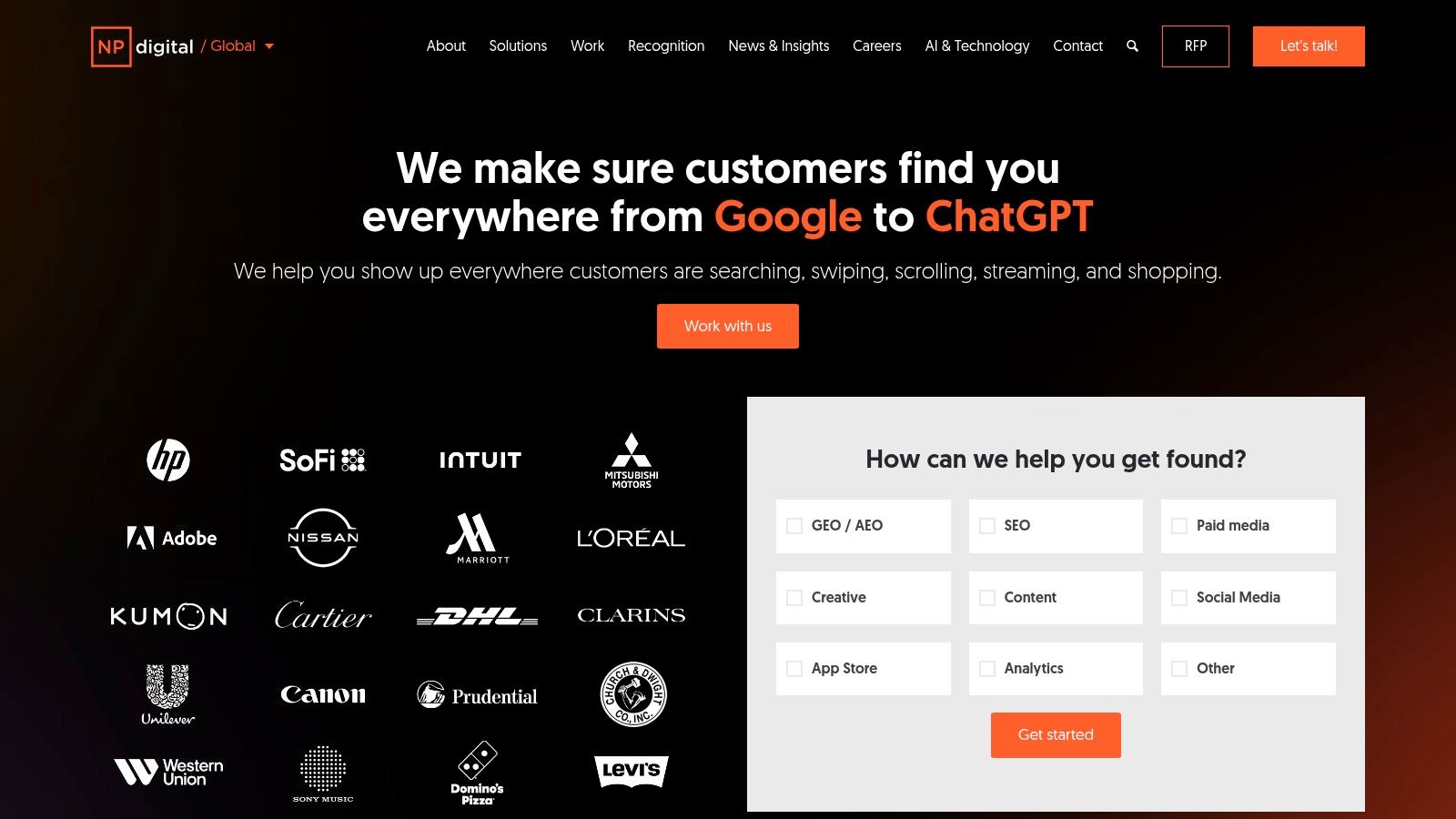
NP Digital covers paid media, SEO, AEO, content, analytics, CRO, marketplaces, and creative. For a B2B tech buyer, that matters less as a menu of services and more as an operating model. One partner can connect category creation content, high-intent search capture, conversion paths, and reporting to pipeline outcomes.
That setup is useful when your team does not need a narrow channel specialist. It helps when paid search data should shape SEO priorities, or when content needs to support both demand capture and sales enablement. Fewer handoffs usually means fewer delays and less channel-level reporting that never turns into a clear revenue picture.
Best fit and trade-offs
NP Digital makes the most sense for companies that want integrated demand generation across paid and organic, especially across multiple markets or business units. It is a practical option for teams that would rather manage one large partner than coordinate separate PPC, SEO, and CRO firms.
The trade-off is speed and specialization. Large agencies usually bring process, layers of account management, and broader capabilities. Boutique firms often move faster in one channel or offer tighter senior-level attention. For B2B SaaS teams that care about business model alignment, that distinction matters. If your priority is sourced pipeline from outbound or a pay-per-meeting motion, a specialist partner may fit better than a full-service agency. If you need paid, organic, and site conversion support under one roof, NP Digital is easier to justify.
If outbound is part of the mix, this guide to outbound cold email and SDR-led demand generation helps frame where an agency like NP Digital ends and a meeting-focused growth model begins.
A few practical takeaways:
-
Strong fit for integrated paid and organic programs: Useful when SEO needs to support pipeline, not just traffic.
-
Better for larger B2B teams: Helpful if you have multiple regions, products, or stakeholders to coordinate.
-
Less aligned with pay-per-meeting buyers: Companies buying strictly for booked meetings may prefer a more specialized model.
Visit NP Digital.
6. Power Digital
Power Digital is a strong option when the biggest issue isn’t launching campaigns. It’s trusting the data behind budget decisions.
That’s where a lot of performance programs break. The agency reports leads, the CRM shows mixed quality, paid social claims influence, search claims conversion, and finance doesn’t trust any of it. Power Digital leans into forecasting, incrementality, and data infrastructure harder than most generalist agencies.
What stands out
Their Nova platform and data-intelligence positioning are useful for buyers who need more than campaign management. If your question is “Which channel gets credit?” a measurement-focused partner can help. If your question is “Which spend creates incremental revenue?” this kind of agency is often a better fit.
Recent expert commentary on choosing a performance agency makes exactly that distinction. Buyers should ask whether the agency is optimizing for revenue or just platform metrics, and they should dig into attribution quality, funnel conversion, analytics, and experimentation, as highlighted in this expert discussion on evaluating performance agencies.
Don’t ask an agency whether they track attribution. Ask how they separate true lift from channel-reported conversions.
When to hire Power Digital
Power Digital is a better fit for companies with enough data maturity to support measurement work. Clean CRM stages, usable revenue data, and stable conversion definitions help a lot. Without that foundation, onboarding can get slow because the agency first has to fix plumbing.
Its strengths include integrated creative, paid media, SEO, and analytics support. Its main weakness is practical. If your internal data is messy, you won’t get the full benefit quickly.
Visit Power Digital.
7. KlientBoost
KlientBoost is the most appealing option here for teams that know their paid channels can work, but suspect the primary leak is post-click.
That’s an important distinction. Plenty of agencies can manage Google Ads or LinkedIn campaigns. Fewer will own the landing page, test the offer, and improve conversion flow instead of blaming the audience. KlientBoost’s combination of PPC, paid social, CRO, and landing-page design is why growth-stage B2B teams keep considering them.
Where KlientBoost is strongest
For buyers focused on cost efficiency, conversion rate and landing page ownership matter. That’s especially true in B2B funnels where traffic is expensive and one weak page can waste months of media spend.
This also lines up with a broader shift in how agencies optimize campaigns. Modern performance operations increasingly use real-time optimization and measurement, including machine learning and predictive analytics to reallocate spend, refine targeting, and adjust creative based on live campaign performance. Some agency case examples cited in industry coverage report up to a 150% lift in conversions from funnel strategy work and a 120% average increase in traffic from web projects, according to Silverspoon’s roundup of performance marketing agencies.
The practical trade-off
KlientBoost is often a smart choice when you want speed, testing velocity, and hands-on optimization. It’s usually less cumbersome than a large enterprise agency.
But there are limits:
-
Great for paid plus CRO: Best when you want one team responsible for both traffic and landing page performance.
-
Good for growth-stage teams: Accessible for companies that need iteration more than massive infrastructure.
-
Not the broadest enterprise option: If you need deep RevOps, marketplaces, heavy analytics consulting, and several global teams, other firms may cover more ground.
Visit KlientBoost.
Top 7 Performance Marketing Agencies Comparison
| Solution | Implementation complexity 🔄 | Resource requirements ⚡ | Expected outcomes ⭐ | Ideal use cases 📊 | Key advantages 💡 |
|---|---|---|---|---|---|
| Fypion Marketing | Moderate, cold‑email infrastructure and deliverability setup | Low internal effort; pay‑per‑meeting model (agency handles execution) | High for qualified meetings and pipeline growth (pay‑for‑performance) | B2B SaaS/tech with proven product‑market fit seeking outbound pipeline | Pay‑for‑performance pricing, full‑service cold‑email stack, disputeable lead qualification |
| Directive | High, multi‑channel + RevOps integration and custom scoping | Significant (CRM/RevOps alignment, multi‑channel buy, custom fees) | Strong pipeline attribution and revenue‑focused outcomes | B2B/SaaS mid‑market to enterprise integrating marketing with RevOps | B2B‑first methodologies, Stratos AI, tight revenue/pipeline alignment |
| Tinuiti | High, enterprise multi‑channel operations and advanced measurement | High media budgets and platform partner requirements | Broad reach with advanced measurement (MMM, incrementality) | Brands with substantial media spend across commerce, retail, CTV | Top partner badges, deep channel depth, scalable measurement suite |
| Wpromote | Medium - High, brandformance coordination across channels | Mid‑to‑large budgets and multi‑channel maturity | Balanced brand + performance growth with creative‑driven ROI | Mid‑market to enterprise seeking unified brand + performance programs | Brandformance framework, award/analyst recognition, integrated creative strategy |
| NP Digital | Medium, global execution with combined SEO and paid stacks | Global scale resources for localization; integration with owned tools | Strong organic + paid acquisition balance and scalability | Global brands or companies prioritizing SEO + paid mix | Large global footprint, proprietary SEO tools, strong organic bench |
| Power Digital | High, data/AI platform setup and measurement integration | Requires clean data, CDP/analytics investment, moderate to high budgets | Accurate forecasting, incrementality insights, revenue‑tied spend | Data‑driven teams wanting revenue forecasting and incrementality testing | Nova/Insights AI, integrated data science + creative, strong measurement focus |
| KlientBoost | Moderate, PPC + in‑house CRO and landing‑page testing | Manageable budgets; needs traffic for rapid testing | Improved CPA/CPL through high‑velocity testing and CRO | Growth‑stage teams needing hands‑on CRO with paid media | Fast testing cadence, landing‑page ownership, focused conversion optimization |
The Buyer’s Checklist: How to Select Your Agency
A B2B SaaS team usually reaches this stage after a familiar problem. Demo volume looks fine, but sales says the meetings are weak. Paid spend is rising, attribution is muddy, and every agency pitch sounds strong until you ask who owns pipeline quality.
That is the real selection test. Choose the agency model that fits how your company creates revenue.
For B2B and tech buyers, the biggest mistake is treating all performance agencies as interchangeable service vendors. They are not. Some are built around retainers and channel execution. Some make money as media spend grows. Some tie pricing more closely to outcomes, including pay-per-meeting models. Those differences shape behavior, reporting, urgency, and how hard the agency pushes on lead quality versus lead volume.
Use this filter in discovery calls:
-
Ask what result they will own. Pipeline, revenue, qualified meetings, CPL, CPA, or channel KPIs are not the same thing.
-
Ask how they define qualification. This matters most when an agency sells SQLs, booked meetings, or pipeline contribution.
-
Ask what they need from your team to succeed. CRM access, sales feedback, landing page control, creative approvals, and clean lifecycle data all affect execution.
-
Ask what happens when performance stalls. Strong agencies show a testing cadence, decision rules, and escalation paths, not just monthly reporting.
-
Ask how pricing lines up with outcomes. Retainer, percent of spend, project fees, hybrid pricing, and pay-for-performance each create different incentives.
The trade-off is straightforward. A broad retainer agency can be the right fit when you need paid media, SEO, creative, and operations working together. A specialist can be stronger when one bottleneck is blocking growth, such as post-click conversion rate or outbound meeting generation. A pay-per-meeting model can make sense when leadership cares most about booked conversations that sales accepts, but that model still needs tight qualification criteria or volume can outrun quality.
I put extra weight on commercial alignment. Channel coverage matters less than whether the agency can connect its work to revenue quality, sales acceptance, and pipeline efficiency. Buyers replace agencies quickly when that connection breaks, as noted earlier.
If you want another lens for evaluating proposals, review AdStellar AI’s hiring guide. Then pressure-test every agency the same way. Ask what they control, what they influence, what they will report, and what they will not own.
If your team wants a model tied directly to booked, qualified meetings, Fypion Marketing is one of the few options built around that structure. For B2B SaaS teams, that can be a better fit than a standard retainer when the immediate goal is pipeline creation, not broader channel management.
The right agency will answer operational questions clearly. They should be able to explain trade-offs, qualification logic, reporting limits, and how their business model supports your revenue goals.