
Brand Voice Guidelines That Convert for B2B in 2026

Your sales team is already writing in different voices.
One rep sends polished, formal emails that sound like a consultancy deck. Another writes like a founder on LinkedIn. Customer success sounds warm and careful. Product marketing sounds dense. The prospect notices all of it, even if nobody on your team does.
That disconnect hurts more in B2B than is commonly understood. Buyers aren’t only evaluating your offer. They’re evaluating whether your company feels coherent, credible, and safe to buy from. If your outbound email sounds sharp, your demo follow-up sounds generic, and your website sounds like it was written by a different company, prospects start filling in the gaps themselves.
Good brand voice guidelines fix that. Not the fluffy kind. The kind that sales reps can use in cold outreach, SDR managers can coach against, marketers can build into campaigns, and AI tools can follow without wandering off-brand.
Why Inconsistent Messaging Is Costing You B2B Deals
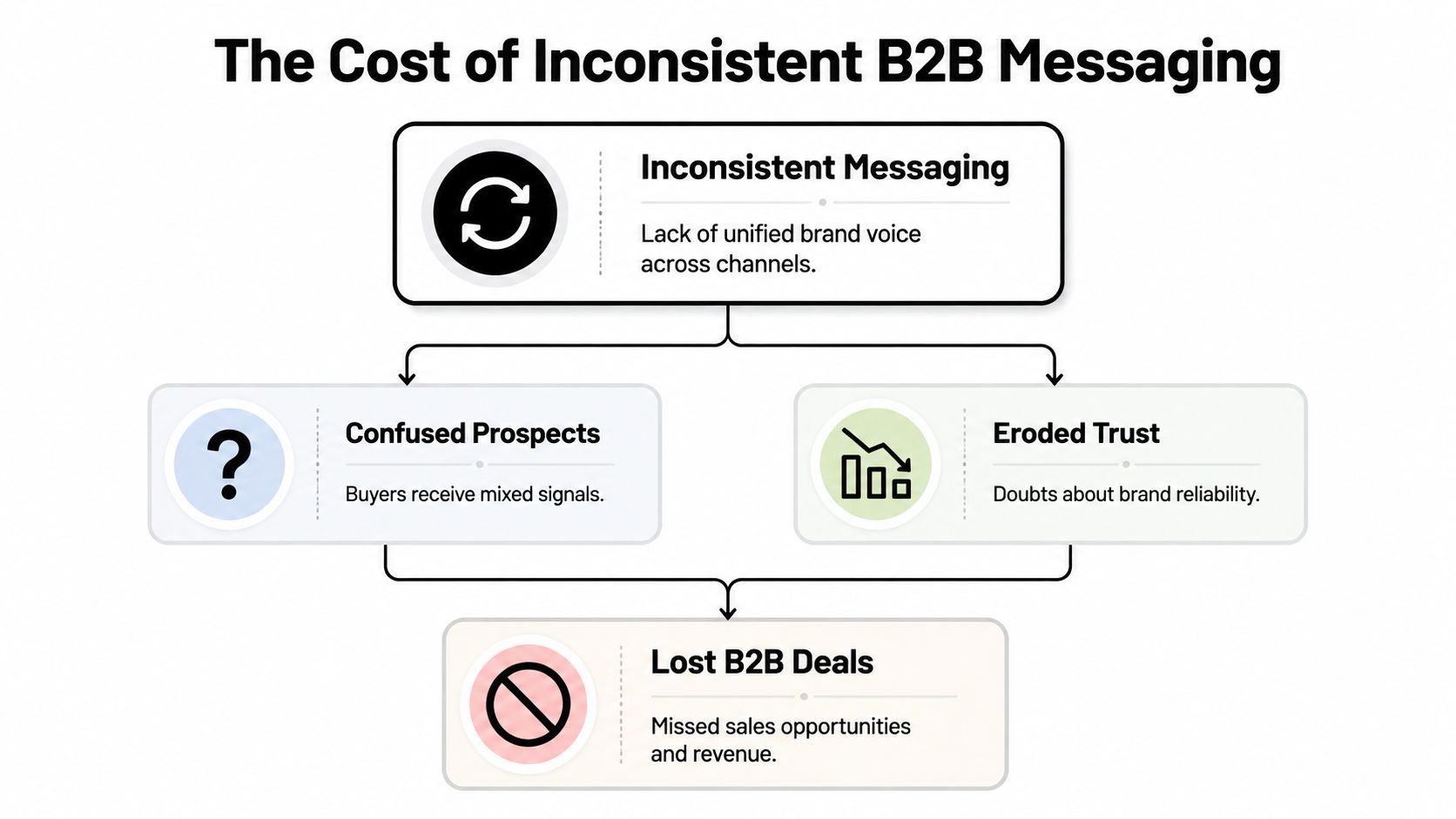
In B2B, inconsistent messaging rarely fails loudly. It fails subtly.
A prospect gets a cold email that sounds direct and confident. They click to your site and land on copy that sounds vague and inflated. Then they see a LinkedIn post from your founder that feels casual and opinionated, followed by a sales follow-up that reads like it came from a legal template. Nothing is individually disastrous. Together, it creates friction.
Brand voice and tone are not the same thing
Brand voice is your company’s consistent personality. Tone is how that personality flexes based on context.
Voice is the person, tone is the mood. Your company might always sound clear, capable, and practical. But a cold email should carry that voice differently than a renewal conversation or a support reply.
Teams get into trouble when they confuse consistency with sameness. They write every message in the same cadence, with the same phrases, for every channel. That doesn’t create trust. It creates stiffness.
Buyers notice mismatch before they articulate it
Most prospects won’t tell you your voice is inconsistent. They’ll just feel less confident.
That shows up in small but expensive ways:
-
Lower reply quality: Prospects respond with caution because your email sounds polished but not grounded.
-
Slower deal movement: Buyers need more reassurance because each touchpoint resets credibility.
-
More internal friction: Sales, marketing, and customer-facing teams argue about copy because no one has a shared standard.
-
Weaker positioning: Competitors sound more focused because their language repeats the same core ideas clearly.
Practical rule: If a buyer can’t tell that your email, landing page, LinkedIn post, and follow-up came from the same company, your message is working against your pipeline.
This is why brand voice guidelines belong in revenue conversations, not just brand meetings. A cohesive brand voice is tied to measurable business impact. Sprinklr notes that consistent voice across platforms can drive a 23% to 33% revenue uplift.
Misalignment between teams makes the problem worse
This usually starts as an organizational issue, not a writing issue. Marketing defines positioning. Sales rewrites it for outreach. Founders improvise on LinkedIn. CS softens everything to reduce friction. Product adds technical language. Every team has a reason, and the end result is drift.
If this sounds familiar, the fundamental fix isn’t another copy review. It’s tighter revenue-side coordination between teams that influence buyer conversations. That’s the same discipline behind stronger sales and marketing alignment, where shared messaging standards reduce handoff friction and improve consistency across the funnel.
A lot of B2B teams treat voice as a creative layer added at the end. In practice, it’s a trust layer that should shape every customer-facing sentence from first touch to closed won.
How to Define Your Core Voice Characteristics
A rep opens your messaging doc before sending a cold email to a CFO. The document says your brand is professional, friendly, and forward-thinking. That rep still has to guess how to write the opener, how hard to push, and which claims will sound credible. Guesswork is how voice breaks down.
Useful voice guidelines give sales and marketing teams choices they can apply under pressure. They help an SDR write a first-touch email, a founder post on LinkedIn without sounding off-message, and an AE follow up after a demo in a way that still feels like the same company.

Pull from three real inputs
Strong voice work starts with evidence, not adjective brainstorming.
**Your internal reality.**Review company values, founder language, sales calls, and the promises your team makes during evaluation. Ask a practical question. What should a buyer consistently feel after reading an email from us or hearing us on a call? Reassured? Challenged? Well guided? Those answers shape voice more usefully than generic traits ever will.
**Your buyers’ language.**Study demo transcripts, loss notes, onboarding feedback, email replies, and call recordings. Look for repeated phrases buyers use when they explain why they responded, where they got confused, or what made your team feel credible. Voice gets stronger when it mirrors the language buyers already trust.
**Your market gap.**Run a category audit. If every competitor sounds polished, strategic, and full-service, adding another polished voice guide changes nothing. Distinct voice often comes from choosing a clearer posture. More plainspoken. More precise. More commercially aware. The point is not to sound different for its own sake. The point is to sound easier to trust in a crowded buying process.
The Content Marketing Institute makes a similar case in its guidance on building a documented brand voice. The strongest voice frameworks are rooted in audience insight and business context, not aspiration.
Narrow your voice to three to five usable traits
Three to five traits is enough for a team to remember and apply. More than that, and the guide turns into a word bank no one uses.
The test is simple. Can an SDR use the trait while writing a prospecting email? Can a marketer use it while drafting a LinkedIn post? Can your AI prompt use it without producing vague filler?
Good examples:
-
Direct, not abrupt
-
Credible, not stiff
-
Warm, not casual
-
Insightful, not showy
-
Confident, not inflated
Weak examples:
-
Human
-
Best-in-class
-
Dynamic
-
Authentic
-
Disruptive
These terms are too broad to guide real writing. They sound good in a workshop and fail in execution.
Build each trait with a boundary
A voice trait only becomes useful when people know how far it goes.
That boundary matters in B2B sales because the same trait can help or hurt depending on how it shows up. Direct language can save a cold email. It can also make a follow-up sound dismissive. Confidence can help on LinkedIn. Too much of it can make outreach sound like category noise.
Use a simple structure like this:
| Trait | What it means in practice | What to avoid |
|---|---|---|
| Direct | Open with the point. Use plain language. | Sounding curt or transactional |
| Credible | Make specific claims and support them with proof. | Overselling or implying certainty you have not earned |
| Helpful | Reduce effort for the buyer. Answer the next question clearly. | Overexplaining or sounding needy |
This works especially well for revenue teams because it gives them a decision rule. If a rep is unsure whether a line fits the brand, the boundary usually answers it.
A useful comparison comes from storytelling in sales. The story works when the tension is clear and the point is relevant. Voice works the same way. The strength comes from control.
Pressure-test traits with live sales scenarios
Workshop exercises get better when they use the writing your team produces.
Instead of asking, “What do we want to sound like?” put real situations on the table:
-
How should we open a cold email to a skeptical buyer who has seen five similar pitches this week?
-
How should an AE summarize business value after a technical demo?
-
What tone should a founder use on LinkedIn when responding to a competitor’s claim?
-
How should AI-assisted drafts be corrected so they sound like us instead of generic SaaS copy?
-
Which phrases from current outreach already sound unmistakably on-brand?
Trade-offs become apparent. A company may want to sound expert, but if expert turns into dense and overqualified, pipeline suffers. A company may want to sound approachable, but if approachable turns into casual and underprepared, larger accounts may not take the team seriously.
By the end of this process, marketing, sales, and leadership should be able to describe the brand voice in one sentence and apply it in actual customer-facing copy. If that sentence still sounds abstract, the traits are not ready yet.
Documenting Guidelines Your Team Will Actually Use
A brand voice guideline buried in a slide deck is dead on arrival.
The document has to work in the middle of real execution. An SDR should be able to open it while drafting a prospecting sequence. A content marketer should use it before publishing a blog. A founder should be able to skim it before posting on LinkedIn. If it only makes sense in a workshop, it won’t survive a quarter.
Build one working source of truth
Keep your voice guidance in one place. Not split across Notion, old decks, Slack threads, and onboarding docs.
At minimum, that single source should include:
-
Core voice pillars: The three to five traits that define how you sound
-
A brand persona summary: A short paragraph that explains who the brand sounds like
-
Do and don’t examples: Side-by-side examples of on-brand and off-brand writing
-
Channel guidance: How voice should flex across email, website, sales calls, LinkedIn, and support
-
Approved language: Preferred words, avoided words, and phrases that reflect your positioning
-
Review rules: What content gets checked, by whom, and before which publish point
Many teams stop too early. They define the traits but skip the translation layer. That’s the part people need.
Turn abstract traits into executable rules
If one of your traits is “clear,” specify what clear means.
Maybe it means short openings, fewer stacked claims, and no filler like “leveraging synergies” or “transformational solution.” Maybe it means every outbound email should state the relevance before the ask. Maybe it means no sentence should try to explain product, pain point, and CTA at the same time.
A useful structure looks like this:
| Voice trait | Do | Don’t |
|---|---|---|
| Direct | Lead with relevance in the first sentence | Start with vague pleasantries |
| Credible | Use grounded, specific language | Use hype phrases and inflated promises |
| Helpful | Offer context or a useful point of view | Ask for time before earning attention |
Working standard: If a new hire can’t rewrite a bad email into a good one using your guide, the document is still too abstract.
Treat your guidelines like a control system, not a manifesto. Fullcast recommends using before-and-after examples, preferred and avoided language, and a “recognition test” that asks whether people can identify your content without seeing the logo. That’s the right benchmark because distinctiveness matters more than internal agreement.
Show how tone shifts by channel
Your brand voice should stay recognizable, but channel expectations are different. A cold email needs compression. A LinkedIn post can carry more personality. Product education needs precision. Support needs calm.
Here’s a simple Tone Modulation Matrix Example.
| Channel | Audience Goal | Tone to Use | Example Snippet |
|---|---|---|---|
| Cold email | Earn a reply | Direct, relevant, low-friction | “Noticed your team is hiring AEs. That usually means pipeline pressure follows fast.” |
| LinkedIn post | Build credibility | Sharp, opinion-led, conversational | “Most outbound doesn’t fail because of volume. It fails because the message sounds borrowed.” |
| Demo follow-up | Reduce uncertainty | Clear, confident, helpful | “Recapping the two workflow gaps you mentioned and how the platform addresses each.” |
| Support email | Preserve trust | Calm, reassuring, specific | “We reproduced the issue and outlined the next steps below.” |
For teams building or revising their positioning, a formal messaging framework helps connect brand voice to claims, proof, objections, and use cases. That matters because voice without message discipline becomes style without substance.
Add examples from real sales situations
This is the part reps use most.
We are a leading end-to-end platform that helps companies enable scalable growth through advanced automation.
Now rewrite it: “We help sales teams automate outbound workflows without making their emails sound automated.”
Same company. Different result. The second one sounds like someone who understands the buyer, not someone filling space on a homepage.
If you want adoption, build your guide around these transformations. That’s how brand voice guidelines stop being theory and start shaping pipeline conversations.
Applying Your Voice to Cold Outreach and Sales
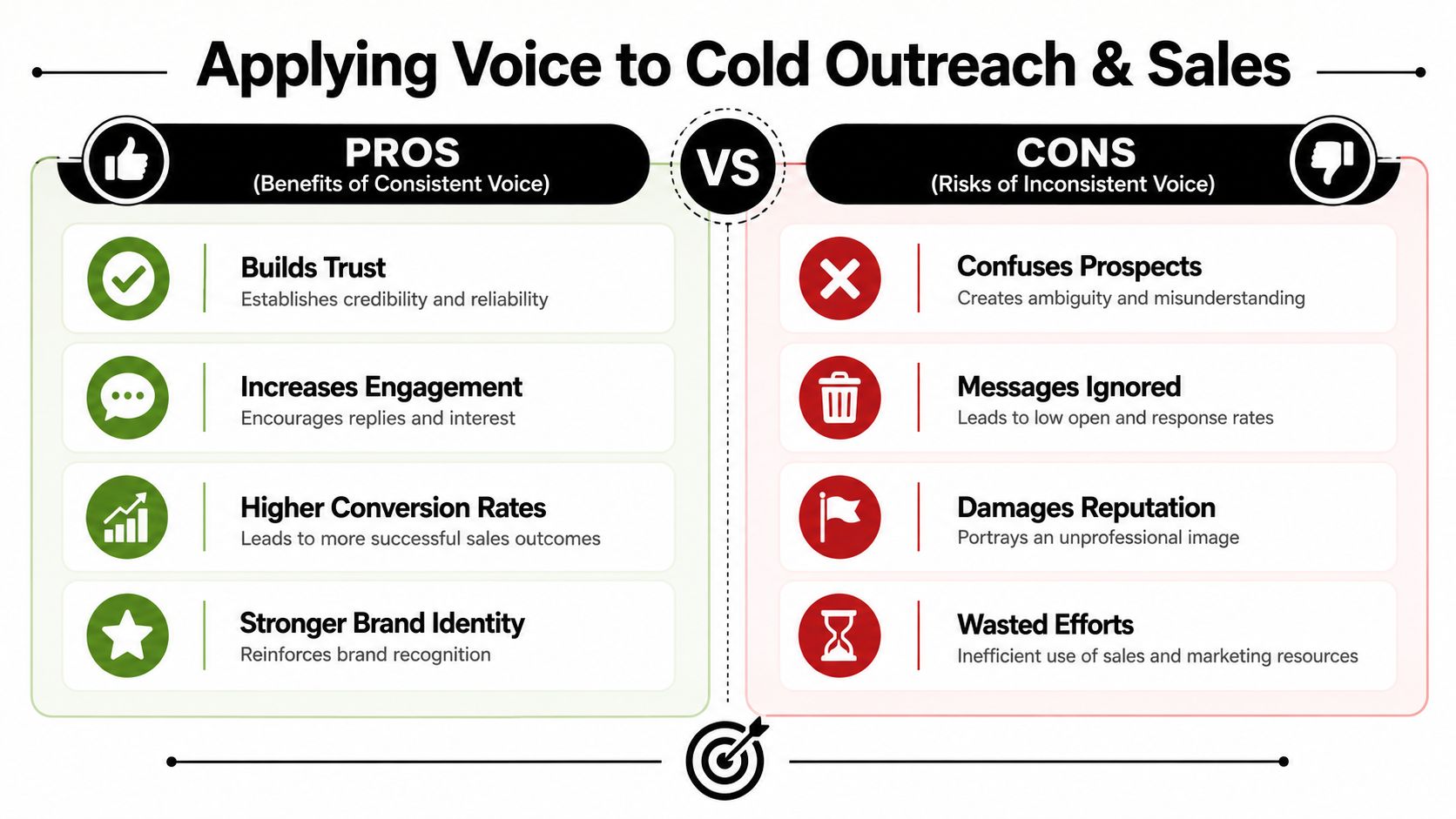
Cold outreach is where weak voice discipline gets exposed fast.
A homepage can hide vague writing behind design. A cold email can’t. In outbound, every sentence carries weight because the buyer didn’t ask to hear from you. If your voice is bloated, theatrical, or inconsistent with the rest of your brand, prospects ignore you.
Keep the voice stable and shift the tone
This is the most important practical distinction for sales teams. Many guides present voice as fixed, but B2B communication works better when tone adapts to context. Lokalise notes that rigid consistency can reduce relevance, while excessive adaptation can dilute brand recognition.
That shows up clearly across outreach motions:
-
Cold email: concise, credible, respectful of time
-
LinkedIn comment or DM: more conversational, still grounded
-
Discovery call: curious and sharp
-
Follow-up after no response: lighter touch, lower pressure
-
Proposal email: more formal, still unmistakably yours
A company that sounds witty on social doesn’t need to force jokes into first-touch outbound. It needs to preserve the same core personality in a form the context can support.
A practical example across channels
Say your core voice is direct, insightful, and calm.
A bad cold email version: “Hope you’re doing well. I wanted to reach out because we offer a revolutionary platform that can transform your sales organization.”
A better version: “Saw your team is expanding outbound. That usually creates two problems fast: inconsistent messaging and rep ramp time.”
Same voice, adapted for channel. It sounds observant, not theatrical.
Now turn that same voice into a LinkedIn post: “Outbound breaks when every rep writes like a different company. Buyers feel that long before leadership does.”
And into a follow-up after a demo: “You mentioned handoff friction between SDR and AE. That’s the workflow gap I’d prioritize first.”
If your cold email sounds like your blog intro and your sales call sounds like your legal terms, your team doesn’t have a voice. It has disconnected habits.
Give reps language patterns, not scripts
Reps don’t need rigid templates as much as they need repeatable patterns.
Useful voice patterns for outbound:
-
Observation first: Start with something the buyer can recognize immediately
-
Specific over broad: Name the likely issue instead of describing your platform
-
Low-friction CTA: Ask for a reaction, not a calendar commitment in every first touch
-
Confident restraint: Avoid trying to sound impressive in sentence one
If you’re refining outreach copy and want additional examples that boost cold email reply rates, that resource is useful because it shows how phrasing choices affect response quality, not just opens.
Train against moments that break voice
The most common breakdowns in sales writing happen in predictable places:
-
The opener gets too generic.
-
The value prop turns into jargon.
-
The CTA becomes needy.
-
The follow-up sounds passive-aggressive.
-
The LinkedIn post starts copying what every other founder in the category says.
A solid cold email writing approach should account for all five. Not just structure, but how your brand should sound in each moment.
The best sales teams don’t memorize one approved message. They learn how to sound like the same company under different conditions.
How to Audit and Optimize Your Brand Voice
A brand voice usually breaks in plain sight.
It happens when outbound emails start sounding like three different companies, LinkedIn posts drift into category cliches, and AI-assisted drafts introduce phrasing your sales team would never say on a call. By the time someone notices, the issue is no longer style. It’s conversion friction across the funnel.
Run a simple audit on live assets
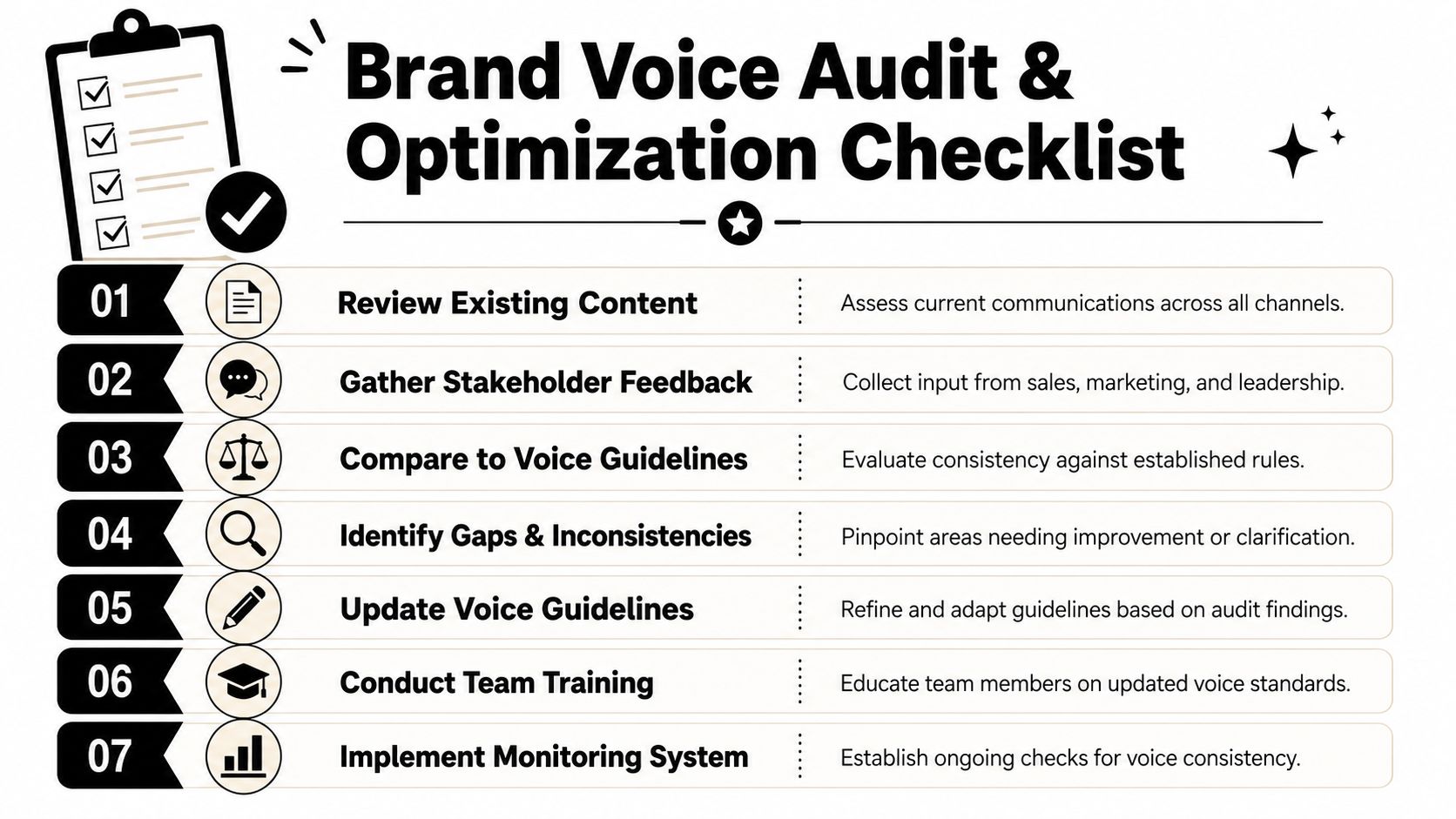
Start with real material, not the guideline doc.
Pull a representative sample from cold emails, LinkedIn posts, landing pages, demo follow-ups, nurture sequences, proposals, and support macros. Include assets from different teams so you can spot where drift is happening. A voice problem often shows up first in the handoff points between marketing, sales, and customer success.
Review each asset against a short checklist:
-
Clarity: Does it get to the point quickly?
-
Consistency: Does it sound like the same company across channels?
-
Buyer fit: Is the tone right for the prospect’s stage and level of awareness?
-
Language control: Are approved phrases used correctly, and are banned phrases successfully avoided?
-
Distinctiveness: If you removed the logo, would a buyer still recognize how your company sounds?
Then score patterns, not isolated misses. If SDR follow-ups are consistently too eager, or LinkedIn posts keep slipping into generic thought-leadership language, you have an operational issue to fix. That is more useful than arguing over one sentence.
Build audits into AI-assisted workflows
At this point, many teams lose control.
They document voice for human writers, then let AI generate first drafts with loose prompts and no review standard. The result is predictable. Messaging gets flatter, claims get broader, and outreach starts sounding like everyone else in the category.
A better setup gives AI structure before it writes. Keep a prompt wrapper that includes:
-
Voice traits: Three to five traits with clear boundaries
-
Words and habits to avoid: Empty claims, inflated adjectives, weak CTAs, and filler phrasing
-
Channel context: Cold email, follow-up, LinkedIn post, webpage, or support reply
-
Review criteria: Specificity, credibility, tone match, and compliance before anything goes live
If you’re using AI heavily and want a process for polishing machine-assisted copy, this Lumi Humanizer workflow for marketing is a useful example of how teams add a humanizing pass without losing strategic control.
Here’s a helpful refresher before the video below.
Refresh the guidelines before they go stale
Voice guidelines should stay stable enough to be recognizable and current enough to stay useful.
Review them on a schedule, and also review them after real changes: a new market segment, a product repositioning, a sales motion change, or a spike in AI-generated content. The point is not to rewrite your voice every quarter. The point is to catch drift before it shows up in pipeline performance.
A practical review cycle looks like this: audit live assets, identify repeated friction points, update the guidance, then retrain the people and systems producing content. For revenue teams, this work belongs next to the same process used to improve conversion rates across key buyer touchpoints.
The teams that do this well treat brand voice as a sales asset. They audit it like one.
Frequently Asked Questions About Brand Voice
How do you get leadership to care about brand voice guidelines
Start with revenue risk.
Brand voice gets budget and attention when leadership sees how inconsistent messaging slows deals. Show the gap in practical terms: an outbound email that sounds sharp and credible, a demo follow-up that sounds generic, and a proposal that reads like it came from a different company. That inconsistency creates doubt at exactly the point where buyers are judging fit and trust.
Use examples from active sales conversations, not abstract branding language. In B2B teams, a side-by-side comparison from a real sequence or sales deck usually lands faster than a long explanation.
What if you have multiple products or sub-brands
Use one core voice and document where each offer can shift.
A company selling both technical software and advisory services should not sound identical in every asset. It should still sound related. The software offer may need tighter, more precise language. The service offer may need more context and a more consultative tone. Shared standards keep the company recognizable. Product-level guidance gives teams room to match buyer expectations without drifting into a different identity.
This is especially important for LinkedIn content and outbound. Buyers often encounter both before they ever talk to sales.
How do you train new hires and freelancers quickly
Train from live examples.
Give new contributors a short guide, then show them what good looks like in cold emails, LinkedIn posts, demo recaps, and objection handling. People pick up voice faster when they can compare approved copy against weak copy and understand why one version works better.
A swipe file helps here.
Keep a small library of approved examples by use case. New SDRs, freelance writers, and AI operators should be able to see the standard for a first-touch email, a follow-up after no reply, a founder post on LinkedIn, and a post-demo recap. That cuts revision time and reduces the usual guesswork.
How should AI fit into the process
AI works best as a drafting tool inside a defined system.
The practical challenge is not whether AI can write. It can. The challenge is getting AI-assisted content to sound like your company across sales emails, LinkedIn posts, nurture sequences, and proposal support copy. That requires clear inputs: approved voice traits, banned phrases, sample rewrites, channel rules, and human review criteria. OpenAI’s guidance on prompting and instruction design is useful for teams building repeatable workflows around those rules.
Use AI to produce first drafts, angle variations, and message options. Keep humans responsible for judgment, buyer context, and final approval. In sales settings, that division matters because the highest-performing message is not always the most polished one. It is the one that sounds credible to the specific buyer reading it.
What if the team says the guidelines feel restrictive
That usually means the guide is either too abstract or too rigid.
Useful brand voice guidelines give people boundaries and examples. They do not force every writer or rep into the same sentence structure. The goal is consistency at the level buyers notice: tone, clarity, point of view, and how the company explains value.
If the team keeps pushing back, review the guide against real work. If reps cannot use it in outreach, or marketers cannot apply it to AI prompts without heavy rewriting, the document needs improvement.
If your team needs brand voice guidelines that hold up in cold outreach, sales messaging, and AI-assisted workflows, Fypion Marketing can help you turn messaging into a repeatable revenue asset. Their team works with B2B companies to tighten positioning, improve outbound copy, and build lead generation systems that sound consistent from first touch to booked meeting.