
B2B Can Spam Compliance: A Practical Guide for 2026
You’re probably sitting on a list of companies you want to reach, a sales team that wants meetings, and a sending setup that feels one bad decision away from trouble. The copy is ready. The ICP is clear. Then legal anxiety creeps in.
Not because cold email is automatically unlawful. Because there is often just enough knowledge of CAN-SPAM to cause concern, but not enough operational detail to ensure confidence.
That gap matters. In B2B, can spam compliance isn’t just a footer, an unsubscribe link, and a mailing address. It’s the way your CRM, sequencing tool, mailbox setup, list sources, and suppression logic work together. If those systems drift out of sync, you can break the rules even while thinking you’re compliant.
The teams that do this well don’t treat compliance as a tax on growth. They treat it as infrastructure. Clean sender identity, clear message intent, fast opt-out handling, and disciplined data flow make outreach safer and more effective at the same time. Good outbound operators learn that early.
If your team is still tightening message-market fit, it also helps to revisit the mechanics of strong outreach copy before scaling. This walkthrough on how to write a cold mail is a useful companion because compliance and clarity usually rise or fall together.
The Cold Email Dilemma Navigating Ambition and Anxiety
A familiar pattern shows up in B2B teams. The founder wants pipeline now. Sales wants volume. Marketing wants control over brand and risk. Ops wants to know which tool owns the truth when someone replies “stop.”
That tension is healthy. It means someone is thinking beyond launch day.
Why good teams hesitate
The fear usually isn’t abstract. It’s specific. Someone worries about misleading subject lines. Someone else asks whether a personal-looking email from a rep counts as deceptive. Another person notices that the sequencer suppresses contacts, but the CRM still leaves them available for the next campaign import.
Those are the actual compliance problems. Not the easy stuff. The easy stuff gets added to the footer in an afternoon.
Compliance breaks in handoffs. A recipient opts out in one system, then another system mails them again because nobody mapped suppression flow end to end.
The problem gets worse when teams use a modern stack. One platform handles lead sourcing. Another enriches records. Another sends sequences. A shared inbox captures replies. The CRM stores account history. RevOps exports lists for special campaigns. Agencies or contractors may touch the same data.
Every extra tool creates one more place where an unsubscribe can fail to propagate.
What ambitious outreach actually requires
Strong outbound programs need two things at the same time. They need speed, and they need restraint. You can move fast on targeting, message testing, and campaign iteration, but your sender identity, opt-out workflow, and data hygiene need fixed rules that nobody bypasses.
That’s where many teams get trapped. They think compliance is the legal team’s concern and deliverability is the email team’s concern. In practice, they’re intertwined. A sloppy setup doesn’t just create legal exposure. It also makes mailbox providers less likely to trust what you send.
The practical answer isn’t to avoid cold email. It’s to run it like an operational discipline instead of a growth hack.
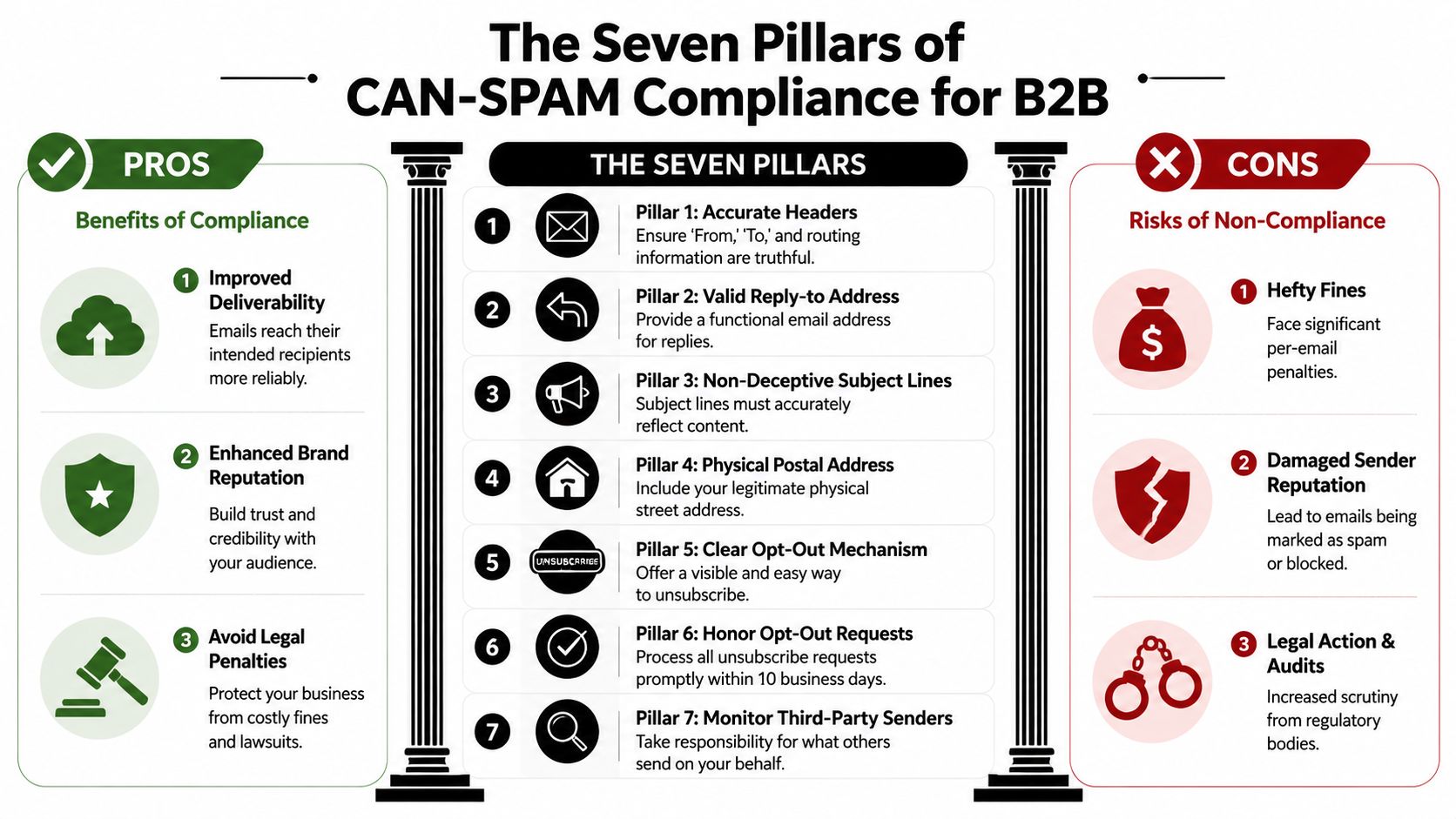
The Seven Pillars of CAN-SPAM Compliance for B2B
A rep launches a new sequence on Monday morning. The copy is sharp, the list is clean, and the targets fit the ICP. By Thursday, someone notices the sender alias masks the company name, one mailbox pool is missing the postal address footer, and opt-outs from a previous campaign never synced back to the outbound tool. That is how B2B teams create compliance risk. Not through one dramatic mistake, but through small operational gaps across systems.
CAN-SPAM gives commercial email senders a clear set of rules. For B2B teams, the challenge is applying those rules consistently across CRMs, sequencing tools, enrichment platforms, shared inboxes, and outside vendors. Violations can lead to serious fines, which we’ll cover later. The real work here is building a sending process that keeps identity, message accuracy, and recipient control intact at every handoff.
A broader compliance mindset helps. Kons Law’s guide to business rules makes the point well. Rules matter only when a business turns them into repeatable controls, assigned ownership, and documented process.
Pillar 1 through Pillar 4
The first four pillars govern identity and honesty. They sound basic. They fail in messy stacks.
-
Accurate headers. Your From, To, domain, and routing information need to reflect the actual sender. If the email comes from your company, the setup should make that obvious.
-
A valid reply path. Recipients need a real way to respond. If replies land in an abandoned inbox or a disconnected alias, the campaign may look compliant in a template review and still fail in practice.
-
Non-deceptive subject lines. The subject has to match the message. Curiosity-based copy is common in outbound, but it crosses the line when it creates a false expectation about the purpose of the email.
-
A physical postal address. Every commercial message needs a legitimate mailing address in the footer, and that address has to stay consistent across templates, domains, and sending teams.
The practical test is simple. A recipient should be able to tell who sent the email, why they got it, and how to respond without guessing.
Pillar 5 through Pillar 7
The last three pillars are where compliance becomes an operations problem instead of a copy review.
-
Clear opt-out mechanism. The unsubscribe path needs to be visible, easy to use, and available in every commercial message.
-
Honor opt-out requests promptly. A legal rule means little if your suppression list updates only inside one platform. The unsubscribe has to flow through the systems that source, enrich, sequence, and export contacts.
-
Monitor third-party senders. Agencies, SDR firms, contractors, and channel partners can all create exposure if they send on your behalf without using your suppression rules, approved templates, and recordkeeping process.
This is also where consent operations start to overlap with CAN-SPAM execution. Teams that already maintain a disciplined consent management process across marketing and sales systems usually have fewer unsubscribe failures because ownership, status fields, and sync rules are already defined.
Here’s the B2B version of each pillar in practice:
| Pillar | What works | What fails |
|---|---|---|
| Sender identity | Real company and rep identity | Alias designed to conceal origin |
| Subject line | Matches the actual offer or ask | Creates false urgency or false familiarity |
| Postal address | Valid address in footer | Missing, stale, or fake address |
| Unsubscribe | Visible and easy | Hidden, broken, or conditional |
| Third-party oversight | Approved templates and suppression sync | “They handle it” with no audit trail |
This explainer is worth watching if you want a quick visual reset on the fundamentals.
B2B outreach teams rarely get into trouble because they intended to mislead. Problems usually start with pressure. A sales team wants higher reply rates, a contractor uploads an old list, a mailbox admin edits one footer but not the others, or RevOps changes a field mapping and breaks suppression sync. The result is the same. Emails go out with inaccurate identity, weak recipient controls, or missing compliance elements.
High-performing outbound teams treat these seven pillars as system requirements. They show up in template governance, inbox configuration, vendor controls, QA checks, and suppression logic. That discipline protects more than legal exposure. It keeps your outreach credible, your sending reputation cleaner, and your process easier to audit when something goes wrong.
Understanding B2B and Transactional Message Exemptions
A common B2B misconception sounds like this: “We’re emailing a business address, so this doesn’t really count as consumer spam law.” That’s the wrong assumption.
In U.S. outreach, the key issue isn’t whether the recipient works at a company. The key issue is the primary purpose of the message. If the message is trying to promote a product or service, it usually falls into the commercial bucket. Most cold outbound does.
The practical difference between commercial and transactional
A cold email from a SaaS company offering a demo is commercial. A renewal notice, password reset, invoice, onboarding instruction, or service interruption alert is generally closer to a transactional or relationship message. Those categories matter because they’re treated differently.
The confusion starts when teams blend them. A customer success email about an account change might also include a pitch for an upgrade. A support follow-up might carry promotional language. A partner update might slide into lead generation.
When mixed-purpose emails go out, don’t rely on wishful labeling. Look at the email the way a recipient would.
-
Commercial example. “We help RevOps teams fix attribution gaps. Open to a short call?”
-
Transactional example. “Your workspace settings were updated.”
-
Gray-area example. “Your usage summary is attached. Also, book time to see our premium analytics package.”
Why implied consent is a risky shortcut
In U.S. B2B circles, operators sometimes act as if a public business email address equals permission. That shortcut creates bad habits. It encourages broad list pulls, weak segmentation, and message relevance that isn’t strong enough to justify the contact.
That doesn’t just raise compliance concerns. It also raises complaint risk.
Teams dealing with consent workflows across markets should think carefully about how permission is captured, stored, and enforced. This overview of consent management in modern marketing systems is useful because it highlights how quickly legal assumptions break down when records move across platforms.
If your outbound message would still look promotional after removing the personalization, treat it as commercial and build your process around that reality.
A better classification test
Use a working test before launch:
-
Ask what the recipient would say the email is for. Not your internal objective. Their reading.
-
Check the dominant CTA. If the call to action is demo, meeting, trial, or sales conversation, it’s usually commercial.
-
Review mixed-purpose templates. If an operational email contains marketing language, legal categories can get messy fast.
The safest operational approach is blunt. If the message promotes the business, run it with commercial-email discipline.
Building Your Technical Foundation for Compliance
Legal compliance lives in policy. Inbox placement lives in systems. Cold email needs both.
The technical side is where many teams undermine themselves. They write careful copy, add a footer, and then send through infrastructure that doesn’t clearly prove sender identity or support clean opt-out handling. That gap hurts trust with mailbox providers and creates avoidable risk.
Authentication is not optional
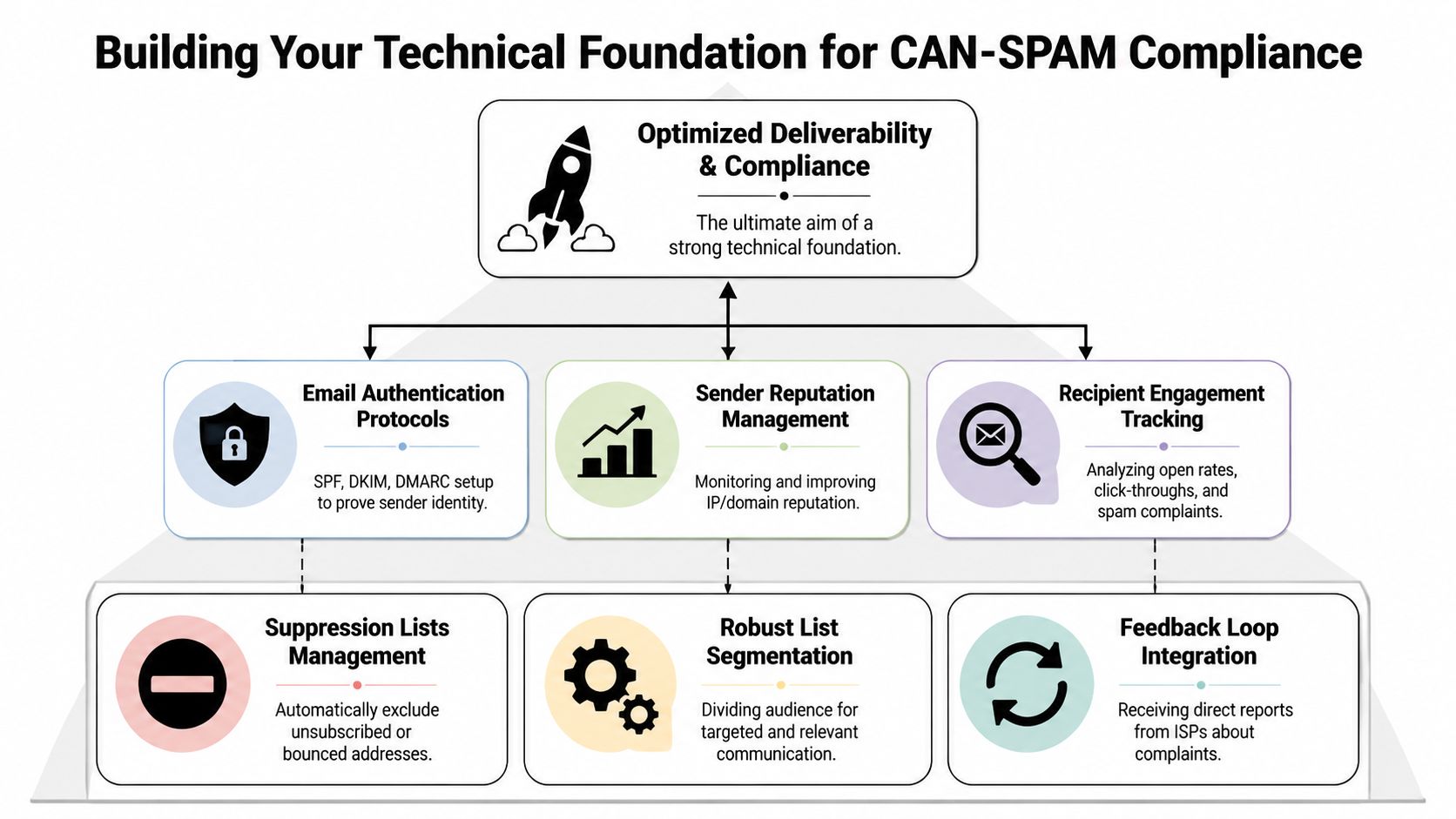
Operational guidance on email infrastructure makes the link explicit. Bulk senders should authenticate mail with SPF, DKIM, and DMARC, use one-click List-Unsubscribe, honor unsubscribes within two days, and keep spam complaint rates under 0.3% to align with major mailbox-provider expectations, according to Litmus in its guide to data privacy foundations in email marketing. The same guidance flags common failure modes such as misleading routing data, disguising ads as personal messages, and poor list hygiene including duplicates, inactive addresses, and invalid emails.
That’s a dense list, but the takeaway is simple. Technical credibility and compliance behavior reinforce each other.
Use this operating model:
-
SPF helps receiving servers verify that the sender is authorized.
-
DKIM helps prove the message wasn’t altered and ties the message to the sending domain.
-
DMARC gives policy and reporting logic around how unauthenticated mail should be handled.
If your team doesn’t understand how these work together, this practical walkthrough on setting up cold email infrastructure for high deliverability is worth reviewing before volume scales.
What mailbox providers notice
Compliance-minded teams often focus on what regulators require. Mailbox providers focus on trust signals. Those aren’t the same thing, but they overlap heavily.
Here’s what operators should monitor:
-
Sender identity consistency. Your From name, reply path, and routing data should align.
-
Complaint pressure. If recipients mark your mail as spam, inbox providers treat that as a strong signal that your targeting or expectations are off.
-
List quality. Old, duplicate, or invalid records increase friction across the system.
-
Unsubscribe usability. A visible one-click route reduces the chance that recipients use the spam button instead.
A useful complement to that work is understanding how recipients and filters perceive your domain over time. NameSnag’s domain reputation article gives a solid overview of the reputational layer many teams only pay attention to after problems appear.
Strong infrastructure doesn’t make bad outreach compliant. It does make compliant outreach more believable to the systems deciding inbox versus spam.
A practical stack standard
If you’re building an outbound engine, set a minimum technical standard before your first serious launch.
| Area | Minimum standard |
|---|---|
| Authentication | SPF, DKIM, and DMARC configured and verified |
| Identity | Accurate From and Reply-To behavior across mailboxes |
| Unsubscribes | One-click where available and synced into suppression logic |
| Data quality | Dedupe, bounce handling, inactive record review |
| Monitoring | Complaint review, inbox placement checks, template QA |
Teams usually over-invest in copy tweaks and under-invest in technical consistency. The latter is what keeps campaigns stable.
Mastering the Operational Workflow of Unsubscribes and Recordkeeping
An unsubscribe link in the footer doesn’t solve much by itself. The real question is what happens after the click.
Can spam compliance evolves from policy into workflow. If the request lands on a confirmation page but never updates the CRM, or if the CRM updates but the sequencer still queues the contact, your compliance posture is weak no matter how polished the email looked.
The unsubscribe process has to survive tool sprawl
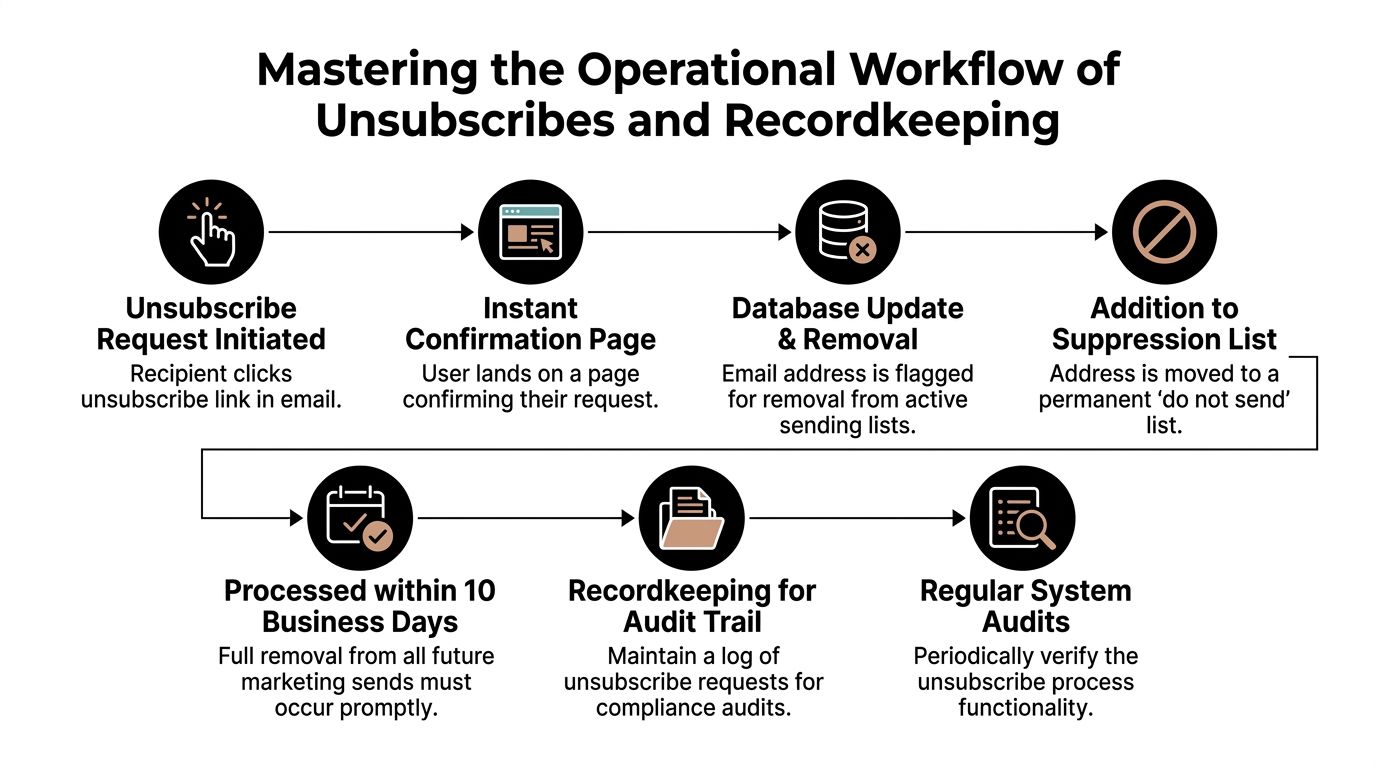
Practitioner guidance highlights a gap many articles skip. In multi-tool cold email stacks, compliance depends on suppression-list propagation across CRMs, sequencing tools, inbox providers, and downstream marketers. The FTC requires opt-out requests to be honored within 10 business days, the opt-out mechanism must remain functional for at least 30 days after sending, and you can’t add extra friction such as requiring more than an email address or a single web step, as summarized in Allegrow’s CAN-SPAM Act compliance guide.
That means “we have an unsubscribe page” is not enough. You need to know where that event goes next.
A workflow that holds up under pressure
A durable unsubscribe process usually looks like this:
-
Capture the request immediately in the sending platform or linked preference system.
-
Write the suppression flag to a master record so the status isn’t trapped in one app.
-
Sync the suppression state outward to the CRM, outbound sequencer, enrichment pipeline, and any downstream export list.
-
Block future imports from reactivating the contact because of stale CSVs or duplicate records.
-
Log the event with timestamp and source so you can verify what happened if a complaint appears later.
Segmentation hygiene helps. Teams that maintain cleaner audience logic are less likely to re-mail suppressed records through side channels. If your internal data model is messy, this guide to email list segmentation for cleaner campaign control is a useful operational reference.
The system of record for opt-outs must be singular, durable, and connected. If three platforms can each decide subscription status independently, one of them will eventually be wrong.
What to keep on file
You don’t need elaborate legal theater. You need evidence that your process works.
Keep records for:
-
Template versions that show footer and unsubscribe language used at send time
-
Suppression events including when and where an opt-out was received
-
Sync rules between CRM, sequencer, and any middleware
-
Exception handling for manual removals, merged duplicates, or imported suppression files
-
Periodic audits showing that test unsubscribes flow through the stack
Common failure points
These are the issues I see most often in B2B outbound operations:
-
CSV recontamination. A rep exports an old lead list and reuploads suppressed contacts.
-
Duplicate records. One email address exists under multiple contact IDs.
-
Disconnected teams. Marketing suppresses a contact, but sales automation doesn’t.
-
Broken reply handling. A recipient writes “unsubscribe,” but nobody maps that to suppression.
-
Vendor drift. An outside sender uses an outdated suppression file.
The fix is procedural, not rhetorical. Pick one source of truth. Connect every sending path to it. Test it regularly.
Expanding Your Reach Global Compliance Beyond CAN-SPAM
Once your outbound targets move beyond the United States, a CAN-SPAM-only mindset stops being sufficient. The biggest shift is philosophical. U.S. rules are often discussed through an opt-out lens. Other regimes can be much stricter about when you’re allowed to send in the first place.
That changes how list building, segmentation, and consent records should work.
The core difference operators need to respect
For European targets, GDPR pushes teams toward a much tighter standard around lawful basis, accountability, and personal data handling. For Canadian targets, CASL is also known for stricter consent expectations. Even if your campaign process was built for U.S. B2B outbound, you can’t assume those same rules travel cleanly.
The practical consequence is that a single global sequence rarely fits every market well. The legal logic is different, but so is the operational burden. You may need different audience criteria, different documentation, and different suppression handling depending on geography.
What to change before sending globally
A sensible international approach includes:
-
Segment by jurisdiction. Don’t mix U.S., EU, and Canadian contacts in one generic outbound workflow.
-
Store consent and source context. If a team member can’t explain why a contact is in the database, that’s a warning sign.
-
Review message purpose carefully. A message that seems acceptable in one market may be treated differently in another.
-
Limit cross-border assumptions. Public availability of a business email address doesn’t mean every regime treats outreach the same way.
Healthcare and regulated industries make this even more sensitive because data expectations and buyer scrutiny are often higher. Teams selling into those environments should think more carefully about targeting logic and message governance. This discussion of B2B marketing in the healthcare industry is relevant because it reflects how outreach strategy changes when regulation and trust play a larger role in the buying process.
A good global compliance posture starts with segmentation, not legal improvisation after launch.
The useful mindset
You don’t need every SDR or marketer to become an international privacy lawyer. You do need your team to stop treating the world as one outbound market.
The mature approach is simple. Segment first. Document why you can contact someone. Use stricter rules when markets demand them. Escalate uncertainty before volume goes out.
Penalties Audits and How to Fix a Broken Process
A compliance problem rarely shows up first as a regulator email. It usually starts with a rep saying opt-outs are still getting replies, a marketer noticing one team is using an old footer, or RevOps finding that suppressions never made it from the CRM to the outbound platform. By the time legal gets pulled in, the actual issue is usually operational drift across tools, owners, and workflows.
As noted earlier, CAN-SPAM violations can carry penalties of up to $53,088 per email. The legal exposure matters, but the day-to-day damage usually hits sooner. Inbox placement slips. Complaint rates rise. Sales and marketing start blaming each other because nobody can point to a clean system of record.

That is why audits need to test behavior, not policy documents.
A fast self-audit
Start with a live send path and trace it end to end. Pick one recent campaign, one opt-out request, and one mailbox pool. Then verify what occurred across the systems involved.
-
Check sender identity. Confirm the From name, reply-to address, and sending domain match the brand and team the recipient would reasonably expect.
-
Review subject line accuracy. Read the subject and body together. If the subject promises one thing and the email delivers another, fix the template, not just the copy.
-
Inspect footer control. Verify the physical address is current and that unsubscribe language appears in every template version, including sequences built by sales reps.
-
Test the unsubscribe path. Click the link, submit the opt-out, and confirm the record is suppressed in every sending tool, not just the platform that generated the email.
-
Map system syncs. Check whether your CRM, marketing automation platform, outbound tool, and list enrichment workflow pass suppression status consistently.
-
Review access and exceptions. Agencies, contractors, founders, and SDR managers often create side workflows that bypass the approved setup.
Here, broken processes hide. The policy says one thing. The stack does another.
How to fix a broken process
Fixes work best in sequence because one loose connection can keep reintroducing the same failure.
-
Pause risky campaigns that rely on old templates, unmanaged mailbox pools, or CSV uploads outside the normal workflow.
-
Set one suppression source of truth. That is usually the CRM or a central suppression table owned by RevOps.
-
Reconnect every sync so opt-outs and do-not-contact flags flow to all outbound and marketing systems.
-
Lock template governance by limiting who can edit footers, sender settings, and unsubscribe language.
-
Audit imports and list sources. Remove stale records, deduplicate contacts, and document where each audience came from.
-
Assign an owner for pre-send checks. If nobody owns approval, nobody owns the failure.
I have seen teams fix the visible issue and leave the root cause untouched. They update the footer but keep manual list uploads. They repair one unsubscribe link but ignore that reps are still sending from a second platform that never receives suppressions. That is how the same mistake returns a month later under a different campaign name.
A healthy outbound program treats compliance as part of production operations. If the process is sound, legal risk drops, deliverability holds up better, and teams can scale outreach without guessing which tool will create the next problem.
If you want help building a cold email program that treats compliance, deliverability, and meeting generation as one system, Fypion Marketing is worth a look. They specialize in performance-driven B2B outreach and can help teams set up the infrastructure, targeting, and campaign operations needed to book qualified meetings without turning compliance into an afterthought.