
Companies That Outsource Sales: A 2026 Guide

A lot of companies hit the same wall. The product is solid. The demo team can close. Customer retention is healthy. But pipeline still swings between overload and drought because nobody has built a consistent outbound machine.
That’s usually the point where sales leaders start looking at companies that outsource sales. Not because they’ve given up on in-house growth, but because they need a reliable way to create qualified conversations without hiring, training, and managing every moving part internally.
The important shift in 2026 is that this isn’t a fringe move anymore. Business Research Insights reports that around 64% of organizations outsource at least one stage of the sales funnel, and projects the outsourced sales service market to grow from USD 3.37 billion in 2026 to USD 4.89 billion by 2035 according to its outsourced sales service market forecast. The practical takeaway is simple. More firms now outsource slices of the revenue engine instead of trying to build every function in-house.
When Outsourcing Sales Makes Strategic Sense
Outsourcing makes sense when the bottleneck is execution, not strategy. If your team knows who it wants to sell to, what problem it solves, and how deals get won, but still struggles to generate enough qualified first meetings, an external sales partner can help.
The mistake is treating outsourcing like a rescue plan for a broken go-to-market motion. It works far better when the company already has some clarity around offer, audience, and handoff process. In that setup, an external team can run focused prospecting while internal leadership keeps control of messaging standards, qualification criteria, pricing, and close strategy.
Signs the timing is right
A company is usually ready to outsource sales when several conditions show up at once:
-
Closers are underfed: Account executives spend too much time prospecting and not enough time in active deals.
-
Hiring feels slow: Building an SDR team internally would take too long or distract leadership.
-
Pipeline quality matters more than raw volume: The company wants booked meetings that match a defined buyer profile.
-
Leadership wants flexibility: Demand may be uneven, or the team wants to test outbound without adding fixed headcount.
Practical rule: Outsource process-heavy work. Keep judgment-heavy work in-house.
That distinction matters. Prospecting, list building, cold outreach, inbox management, follow-up sequencing, and appointment setting are operational disciplines. They benefit from repeatable systems and day-to-day optimization. Positioning, pricing, negotiation, and late-stage deal management usually don’t.
A lot of firms also prefer a model where the partner’s incentives stay tied to outcomes rather than activity. That’s one reason performance-based approaches keep getting attention. Fypion explains the appeal well in its piece on pay-for-performance marketing aligned with real revenue. Buyers want less spend on vague effort and more accountability around pipeline contribution.
Who Typically Outsources Sales and Why
Not every business should outsource the same way. The profile of the company usually determines the right scope, partner type, and pricing model.
Startups with product-market fit but limited sales capacity
Early-stage B2B startups often outsource because they can’t justify a full internal outbound team yet. They may have founder-led sales, a few strong customer wins, and clear signs that the market responds. What they don’t have is the time to build prospect lists, test outbound messaging, manage deliverability, coach SDRs, and review every sequence.
For these teams, outsourcing is less about replacing sales leadership and more about renting execution capacity. It gives them a way to test outbound demand while leadership stays focused on product, fundraising, and closing key deals.
SaaS companies trying to increase pipeline velocity
This is one of the most common patterns. The SaaS company already has a sales motion, but the in-house SDR team is stretched thin or inconsistent. Management doesn’t want to pause growth while recruiting more reps and ramping them.
That behavior lines up with wider spending trends. Fortunly reports that 43% of tech companies increased outsourcing spending in 2025, and 49.6% plan to increase outsourcing levels in its outsourcing statistics roundup. For software companies, outsourcing is often a speed decision. They need more opportunities now, not after another hiring cycle.
Established firms entering a new market
Larger B2B companies outsource for a different reason. They already know how to sell in their core segment, but they want to test a new vertical, geography, or buyer type without rebuilding the entire commercial team.
In that situation, a specialist partner can act like an experimental layer. The company can validate messaging, meeting acceptance, and market interest before making a bigger internal commitment.
What these companies usually have in common
Despite their differences, the best candidates for outsourcing tend to share a few traits:
-
They know their ideal buyer well enough to define targeting rules.
-
They have a real close process once a qualified meeting happens.
-
They care about feedback loops between outreach, discovery, and conversion.
-
They want flexibility more than they want permanent headcount.
Outsourcing works best when the company already knows what a good opportunity looks like.
That’s why the strongest results usually come from firms with proven demand, a clear offer, and internal discipline around sales handoff. Companies that outsource sales successfully don’t hand over strategy. They hand over a tightly scoped execution layer.
The Core Motivations for Outsourcing Sales
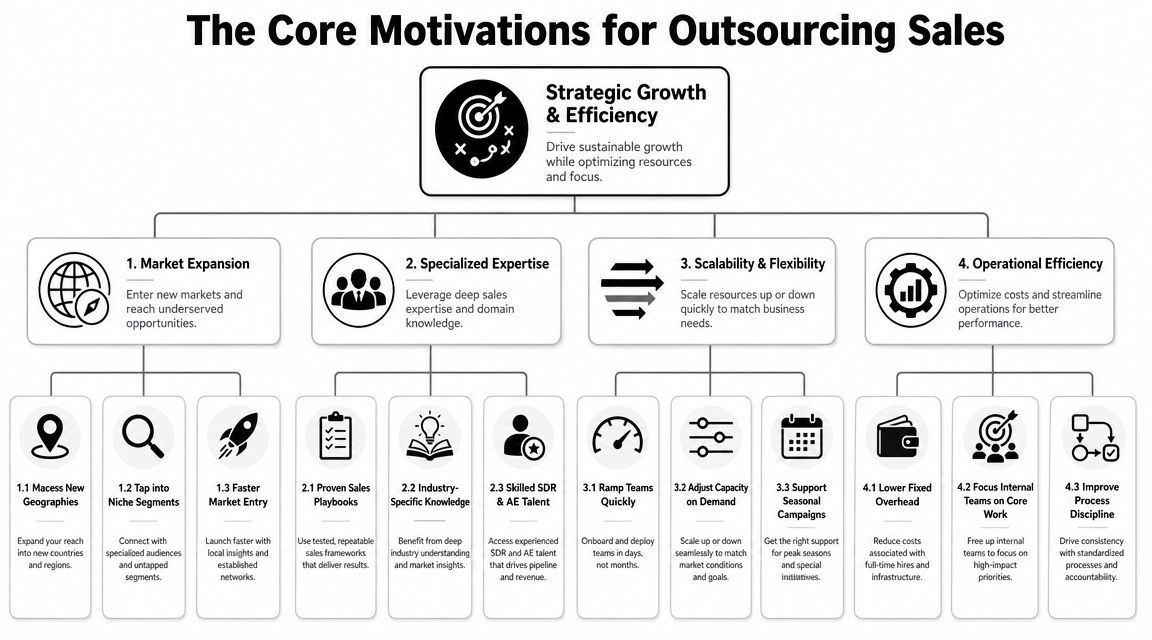
The reason firms outsource sales isn’t just cost. It’s specialization. Leadership wants top-of-funnel work handled by people, systems, and workflows built for volume, consistency, and measurement.
The modular revenue engine
The strongest outsourcing setups treat the vendor as a modular extension of the revenue team. Saleshive makes this distinction clearly in its guide to sales outsourcing functions and structure. The most impactful work to outsource is the process-driven layer: prospect research, list building, outbound email, outbound calling, LinkedIn outreach, lead qualification, and appointment setting. Internal teams keep ownership of pricing, positioning, and closing.
That split solves a very practical problem. High-volume prospecting requires discipline and repetition. Late-stage selling requires context and judgment. Most companies weaken both when they ask the same people to do all of it.
What companies are really buying
An external team usually brings more than labor. It brings operating infrastructure.
That often includes:
-
Targeting workflows: Defined ICP criteria, account research, and segmentation logic.
-
Outreach systems: Sequencing tools, reply handling, reporting cadence, and QA processes.
-
Operational rhythm: Regular list refreshes, message testing, and funnel review.
-
Visibility: Shared CRM reporting and cleaner handoff into the internal sales process.
This is why outsourcing often beats hurried internal hiring. A new in-house SDR team still needs process design, management, tooling, ramp time, and quality control. A capable outsourcing partner starts with a system.
The value isn’t that someone else sends emails. The value is that someone owns a repeatable prospecting process every day.
Four common motivations behind the decision
| Motivation | What the company wants |
|---|---|
| Speed | Faster campaign launch and faster path to booked meetings |
| Focus | Keep internal reps on demos, proposals, and closing work |
| Flexibility | Scale activity up or down without expanding payroll |
| Specialization | Use teams that already know prospecting operations |
This is also where many leaders sharpen their own thinking. If they can’t define which part of the funnel needs help, they probably aren’t ready to outsource it well.
Understanding Common Sales Outsourcing Models
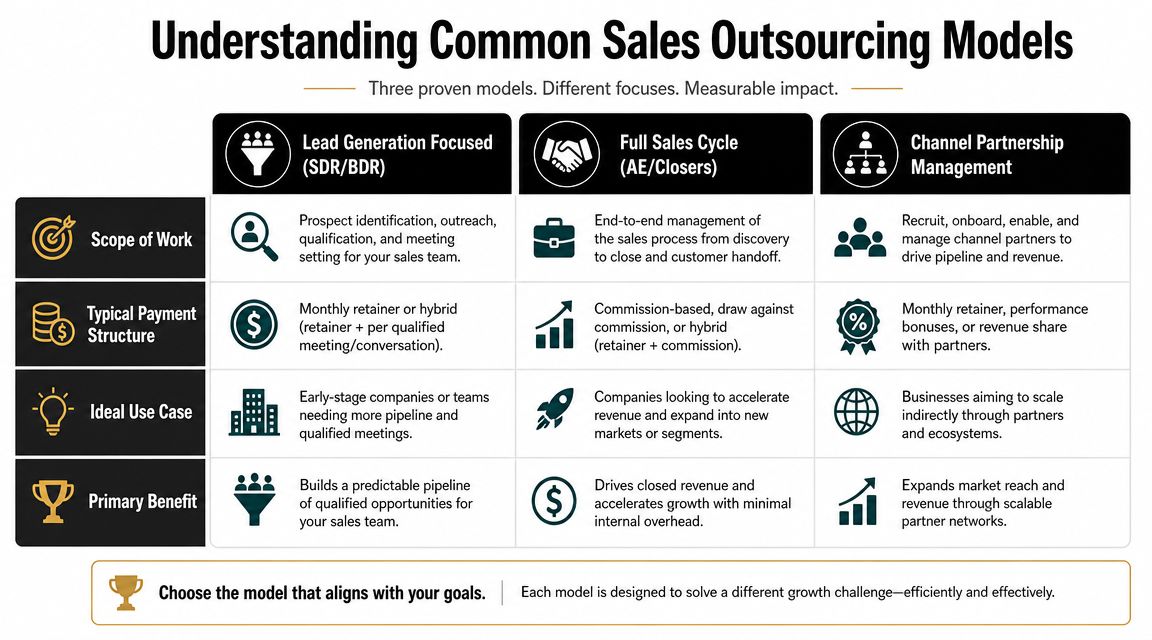
Most problems with outsourced sales start before the campaign launches. They start in the contract structure. The pricing model determines who carries risk, what behavior gets rewarded, and how quickly bad incentives show up.
Traditional retainer models
A retainer model is the simplest to understand. You pay a fixed monthly fee for a defined scope of work. That may include list building, messaging, campaign management, outreach, and reporting.
This can work well when the company wants a strategic partner and understands that ramp-up takes time. It’s also useful when the product is complex and the team expects heavy collaboration before campaigns settle.
The downside is incentive drift. If the agreement pays for effort rather than outcomes, the buyer has to police quality tightly. You’ll need clear definitions for qualified meetings, response handling, exclusions, and reporting cadence. Without that, a retainer can turn into expensive activity.
Commission-only arrangements
These sound attractive at first. Pay only when revenue happens. In practice, they’re tricky.
A commission-only vendor usually needs strong control over the sales process to influence the result. That means they may push for more authority over qualification, discovery, and closing than most companies should give away. This model can also create conflict over attribution. Was the deal created by the partner, by marketing, by founder outreach, or by existing pipeline momentum?
For long, complex B2B cycles, commission-only usually creates more argument than clarity.
Pay-per-meeting and performance-based models
This is the model many buyers now prefer for top-of-funnel outsourcing. The partner gets paid when it delivers meetings that match agreed criteria. That shifts more execution risk toward the vendor and forces everyone to define quality early.
It’s not automatically better. It can still go wrong if the meeting definition is loose. A calendar booking isn’t value by itself. The meeting has to fit the target account profile, buying role, and readiness standard you care about.
Still, the upside is real. Performance models create tighter alignment than broad retainers when the scope is specifically outbound lead generation and appointment setting. They’re also useful for market tests, where the buyer wants variable spend tied to actual traction.
For teams evaluating appointment-setting vendors, this practical guide to appointment setting outsourcing is a useful framework for comparing scope, quality controls, and handoff expectations.
A simple way to compare the models
| Model | Risk to client | Incentive alignment | Best fit |
|---|---|---|---|
| Retainer | Higher upfront spend risk | Medium, depends on KPI discipline | Complex offers needing deeper collaboration |
| Commission-only | Lower upfront cost, higher control risk | Mixed, often messy in B2B attribution | Limited cases with short cycles and clear ownership |
| Pay-per-meeting | More variable, easier to test | High if qualification rules are strict | Outbound pipeline generation and market validation |
Some teams also combine outsourcing with automation to reduce coordination load. If you’re comparing human execution against systemized sales ops, tools like Donely’s unified AI platform can help map which parts of the process should be automated, which should stay internal, and which are better outsourced.
Weighing the Pros and Cons of an External Sales Team
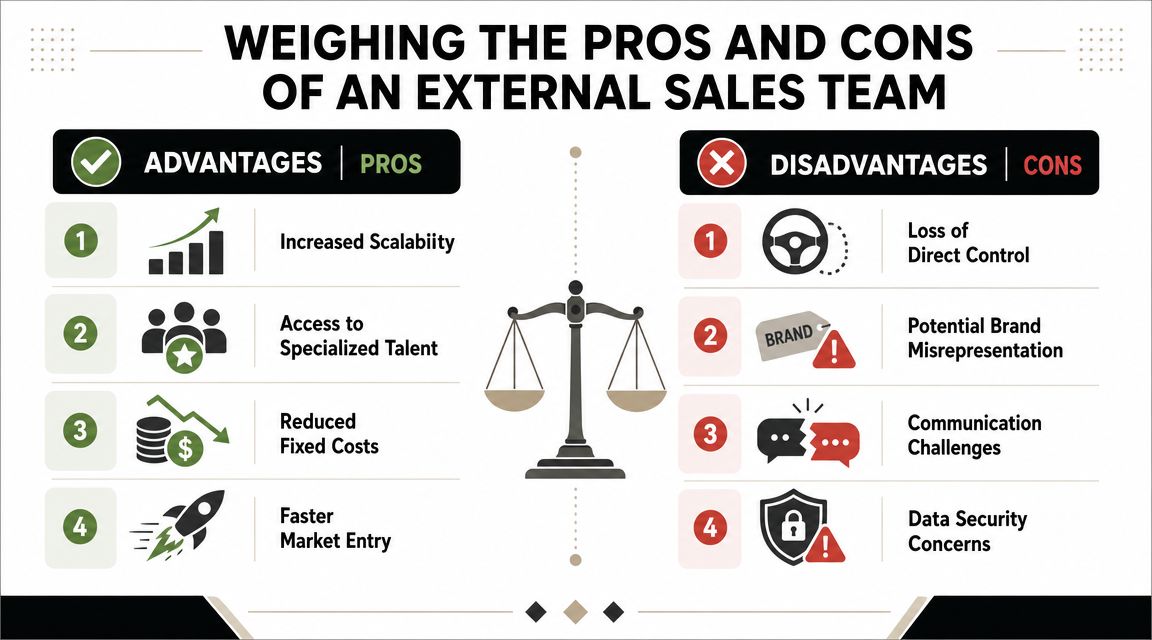
Sales outsourcing has real advantages. It also creates very real management problems if you treat it like a plug-and-play service.
Where external teams usually help
The clearest operational win is speed. Hire With Near notes that some outsourced teams report campaign benchmarks of 10 to 42 qualified meetings per month, as described in its overview of B2B sales outsourcing companies. That doesn’t guarantee success, but it shows why companies use external teams to stand up pipeline faster than internal hiring often allows.
Other benefits tend to follow from that operating speed:
-
Faster launch cycles: A ready-made team can start prospecting sooner than a newly hired internal function.
-
Process maturity: Good providers already have QA routines, sequence testing, and reporting habits.
-
Access to specialist tools: Buyers gain infrastructure without assembling the stack alone.
-
Elastic capacity: Companies can adjust scope more easily than they can rework headcount.
Where external teams often fail
The hardest downside to fix is brand dilution. If the partner doesn’t understand your buyers, outreach starts sounding generic fast. Meetings may still appear on the calendar, but they won’t convert well and they can damage trust.
Another issue is distance from the market. Internal reps hear objections, language patterns, and buying concerns firsthand. With outsourcing, that feedback loop can get weaker unless the partner records calls, shares replies, and participates in regular message review.
A sales partner should never become a black box between your company and your market.
There’s also a management cost that buyers underestimate. Someone still has to review messaging, approve target lists, refine qualification standards, and audit handoffs. If leadership expects to “set it and forget it,” the relationship usually drifts.
A practical trade-off table
| If you value | External team advantage | Likely trade-off |
|---|---|---|
| Speed to meetings | Faster launch and faster prospecting cadence | Less direct daily control |
| Operational leverage | Existing systems and specialists | More dependency on partner discipline |
| Scalability | Easier to expand campaign volume | Harder to maintain brand nuance |
| Flexibility | Less fixed hiring commitment | Requires stronger governance |
If your company is already distributed, some of the coordination issues are manageable. The same disciplines that help with outsourced sales also help with internal distributed teams, especially around meeting cadence, accountability, and handoff ownership. This guide on how to manage a remote sales team is useful because the management principles overlap more than most buyers think.
How to Choose the Right Sales Outsourcing Partner
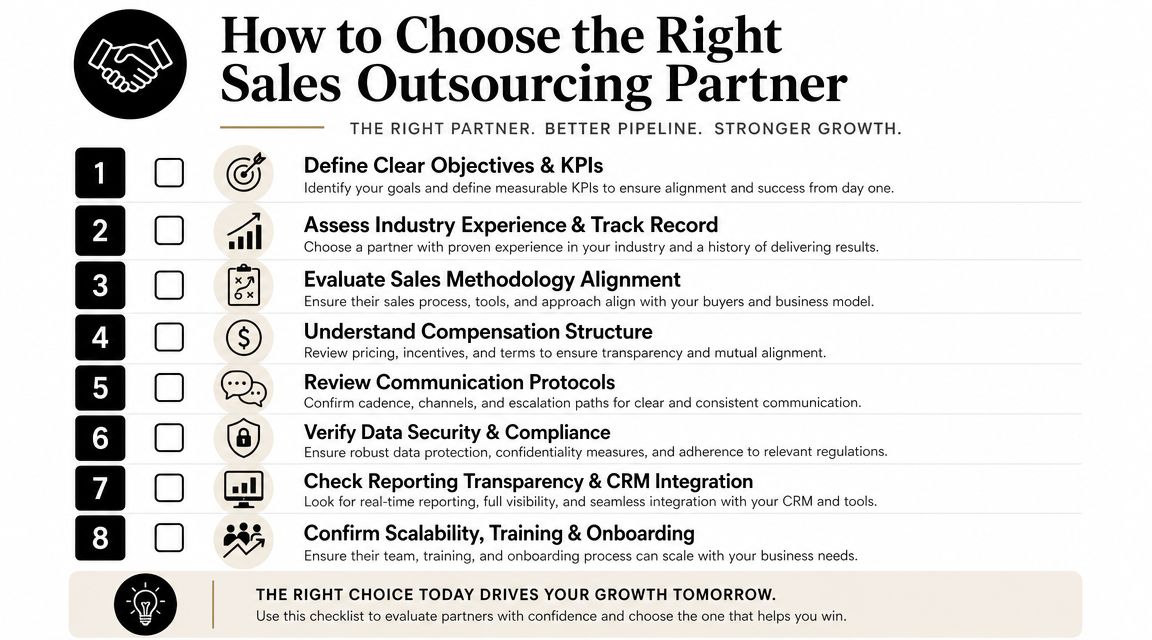
Vendor selection usually determines the outcome more than the campaign brief does. A weak partner with polished sales material can waste months. A disciplined partner with a narrower pitch can become a reliable part of the revenue engine.
What to evaluate before you sign
Start with operational specifics, not promises.
-
Targeting method Ask how they build lists, define exclusions, and handle role accuracy. If the answer stays vague, quality problems will show up quickly.
-
Messaging process Review how they learn your offer, translate it into outreach copy, and update messaging after early replies.
-
Qualification rules Get precise about what counts as a valid meeting. Industry, company fit, title, geography, use case, and buying relevance should all be discussed.
-
Reporting discipline You want visibility into activity, responses, meeting outcomes, and reasons for rejection. Not just a monthly summary.
-
Handoff design Ask what happens after a prospect agrees to meet. Who confirms? Who reschedules? Who owns no-show recovery?
A lot of teams also benefit from reviewing adjacent tooling before they decide what to outsource. For example, some firms compare agency support with AI solutions for sales operations to determine whether repetitive qualification or response workflows should sit with software, a human partner, or a hybrid setup.
Questions that reveal the real quality of the partner
The best questions are uncomfortable because they expose process depth.
-
Show me how you define a qualified meeting.
-
Walk me through your reply-handling rules.
-
How do you decide when copy is the problem versus targeting?
-
What feedback do you need from our closers each week?
-
How do you prevent low-intent meetings from hitting our calendar?
-
What does escalation look like if campaign quality drops?
Here’s a useful video if you want another lens on the selection process before making a decision:
One scoring approach that works
Use a simple scorecard across these categories: targeting accuracy, message quality, process transparency, compliance awareness, reporting cadence, and handoff quality. Don’t let charisma carry the decision.
If you’re evaluating agencies specifically, this lead generation agency guide is a practical companion because it forces buyers to compare methods, not just claims. Fypion Marketing is one example of a provider built around qualified-meeting delivery rather than upfront retainer billing, which can be relevant if your priority is strict top-of-funnel performance accountability.
Key Questions to Ask Before You Commit
Many outsourcing decisions succeed or fail not in the sales pitch, but in the questions buyers ask before launch.
How will they protect your brand and sending reputation
This is the most overlooked issue in outsourced outreach. Sales outsourcing isn’t only a staffing decision anymore. It’s also a compliance and reputation decision.
Saleshive’s glossary notes that Google and Yahoo tightened bulk-sender requirements in 2024, which means buyers need to ask how a partner handles authenticated mail, unsubscribe management, and domain health in its overview of outsourced sales agency considerations. If the vendor can’t explain its governance clearly, don’t let it send on your behalf.
Ask direct questions:
-
Who approves copy before launch
-
Who controls list criteria and suppression rules
-
How are unsubscribe requests handled
-
What happens if complaint patterns rise
-
How often is message quality reviewed
If a partner treats deliverability as a technical side issue, they’re not ready to represent your brand.
Are you buying volume or validating a market
These are not the same objective. Some companies outsource because they already know their ICP and just need more meetings. Others outsource because they want to test whether a new segment responds before hiring internally.
Those are different projects. A volume campaign needs stable process, consistent qualification, and strong handoff. A validation campaign needs tight learning loops. You want detailed feedback on objections, reply themes, role fit, and message resonance.
If your team is still clarifying handoff standards, using a framework like this lead qualification checklist for 2026 helps keep expectations realistic. It’s much easier to judge an outsourcing partner when both sides agree on what qualified means.
For buyers still narrowing their approach, this guide to how to outsource lead generation is helpful because it frames outsourcing as a structured operating choice, not just a vendor purchase.
What should you retain internally no matter what
Even when you outsource execution, keep control of a few things:
-
Your positioning The market-facing promise should stay under internal ownership.
-
Your qualification standard Don’t let the partner define success alone.
-
Your CRM visibility You need direct access to replies, outcomes, and trend signals.
-
Your market learning loop Objections, language patterns, and deal blockers should flow back into leadership.
The best outsourced relationships are tightly integrated and tightly scoped. The worst ones are broad, vague, and poorly supervised. Companies that outsource sales well don’t surrender control. They build a controlled extension of the parts they want to scale.
If your team has proven product-market fit and needs a more accountable outbound engine, Fypion Marketing is one option to evaluate. Its model is centered on qualified booked meetings rather than upfront retainers, which can fit B2B companies that want clearer alignment between sales outsourcing spend and pipeline outcomes.