
Consent Management for B2B Marketing: GDPR & Audit Ready

You’ve got a clean target list, a solid offer, and a sales team ready to launch outreach on Monday. Then someone asks the question that stalls the whole campaign: are we allowed to email these people in the first place?
That’s the point where most B2B teams reduce consent management to a legal nuisance. Cookie banner. privacy policy. unsubscribe link. Done. That view is too small, and in cold outreach it’s risky.
For B2B marketers, consent management is really about controlling how prospect data enters your pipeline, how it gets used, when your legal basis changes, and whether you can prove every decision later. If you handle that well, outreach becomes more durable. Sales and marketing stop stepping on each other. Your CRM gets cleaner. Your deliverability usually benefits because you’re contacting people with a documented rationale instead of blasting a list and hoping compliance sorts itself out later.
Beyond the Pop-Up Banner
Organizations often first encounter consent management through website cookies, because that’s the visible part. The pop-up sits in front of the visitor, legal reviews the wording, and marketing treats it like a design problem.
In B2B outreach, the harder problem happens before any website visit. You source a prospect from LinkedIn, an event attendee list, a company website, or a data vendor. You enrich the record. You add it to Salesforce or HubSpot. Then someone wants to send an email sequence. At that point, the key question isn’t “Do we have a banner?” It’s “What basis do we have to process and use this person’s data, and can we prove it?”
That shift matters because consent management became far more operational after GDPR took effect in May 2018. One market estimate says the category grew from USD 288.4 million in 2020 to a projected USD 1.4 billion by 2035, showing how it moved from compliance task to core privacy infrastructure for modern businesses, as noted by Future Market Insights on the consent management market.
Why B2B teams get this wrong
The common failure pattern is simple:
-
Marketing treats all contacts the same. A webinar registrant, a cold prospect, and a paying customer often end up in the same nurture logic.
-
Sales assumes business email means fair game. Sometimes that assumption is defensible. Sometimes it isn’t.
-
Ops stores status badly. A note in a CRM field like “opted in” tells you almost nothing if you can’t trace when, where, for what purpose, and under which notice.
A good cookie policy matters, but it covers only one slice of the issue. For B2B lead generation, consent management is the operating system behind outreach. It tells your team what they can do now, what they can’t do yet, and what must change when a prospect engages or opts out.
Practical rule: If your team can’t explain why a record is in the database and what communications are allowed, the problem isn’t legal wording. It’s system design.
What Consent Management Really Means for B2B
Consent management is easiest to understand if you treat it like a digital passport for data.
Each person in your system should carry a record that answers a few plain questions. What data do you hold? Why are you allowed to hold it? Who can use it? For which purpose? For how long? And what happens if the person objects, unsubscribes, or withdraws consent?
That’s much more than a checkbox.
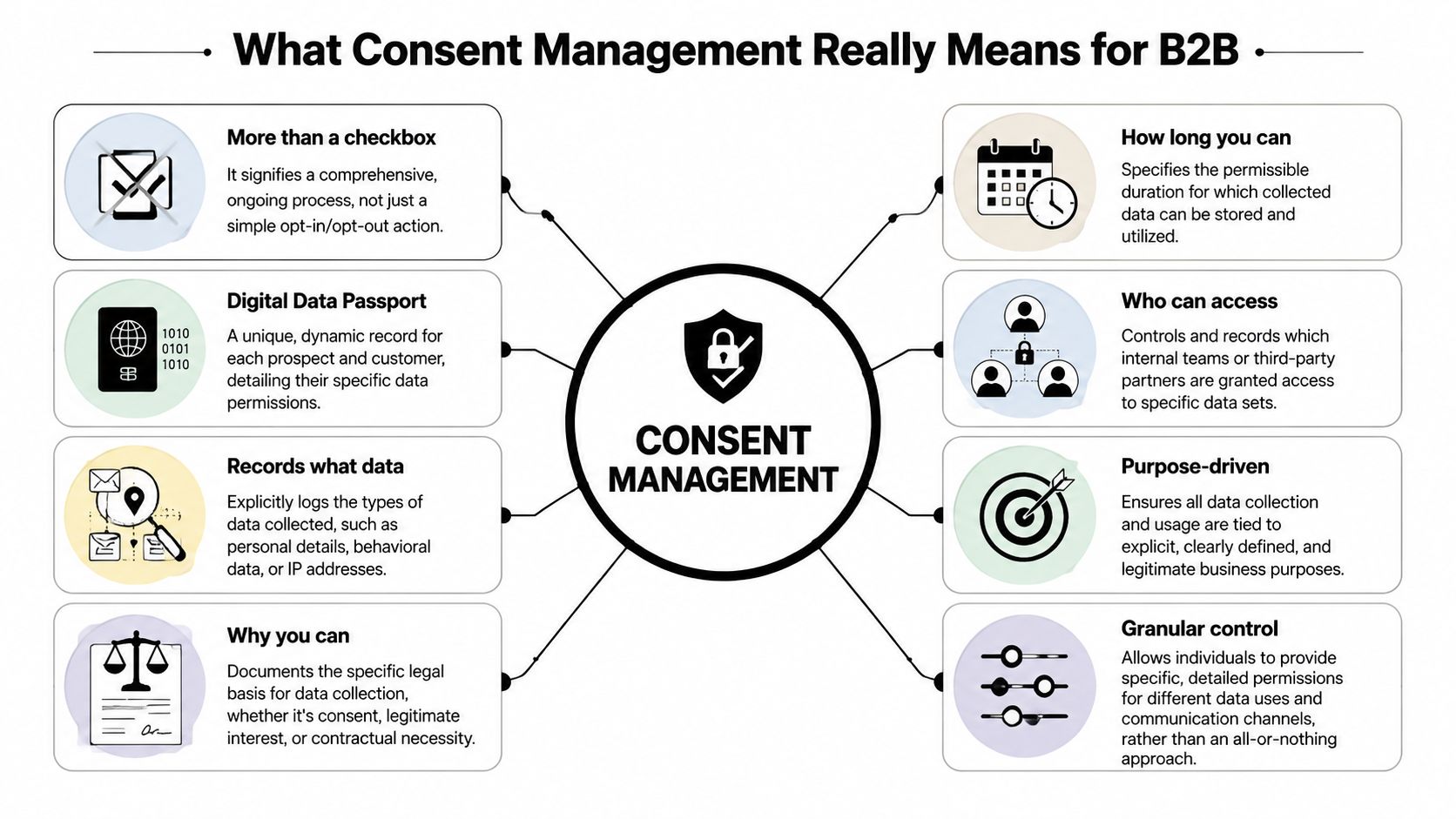
The reason the category has expanded so quickly is that businesses now need systems that document permissions, not just policies that describe them. In the United States, one market report values the consent management market at USD 169.0 million in 2024 and projects USD 970.52 million by 2033, with a 19.1% CAGR from 2025 to 2033, according to Straits Research on the U.S. consent management market.
The B2B version of the problem
Many marketers still think privacy rules apply mainly to consumer data. That’s a mistake. A work email tied to an identifiable person is still personal data in many compliance contexts. “Business contact” doesn’t mean “outside privacy law.”
In practice, B2B teams need to track at least these elements:
-
Identity data: name, business email, phone number, job title.
-
Source data: where the record came from, such as a form, event, referral, vendor file, or manual research.
-
Purpose data: cold outreach, demo follow-up, newsletter, customer communications, partner marketing.
-
Permission data: consent, objection, unsubscribe, suppression, or another lawful basis recorded internally.
-
Retention logic: whether the contact should remain active, be restricted, or be removed from certain workflows.
What actually affects marketers
GDPR and U.S. state privacy rules differ in structure, but marketers don’t need a law school summary to operate well. They need clarity on the pressure points.
Here’s the practical lens:
| Area | What marketers must control |
|---|---|
| Collection | Tell people what you’re collecting and why |
| Use | Limit outreach to the purpose and basis you’ve documented |
| Choice | Offer a clear path to opt out or manage preferences |
| Proof | Keep records that survive an internal audit or regulator question |
| Propagation | Make sure one change updates every connected system |
If a prospect fills out a demo form and asks for follow-up, that permission context is different from a scraped record from public web research. If someone subscribed to product updates, that doesn’t automatically authorize sales cadences, partner promotions, or ad audience syncing.
Consent management isn’t a form element. It’s a permissions ledger.
Why proactive beats defensive
The teams that handle this well usually discover a side benefit. Their outreach becomes more targeted because they stop pretending every record is equally usable.
That forces better segmentation, narrower messaging, and cleaner channel choices. The same discipline you use to protect the company also improves list quality. In B2B marketing, that’s not a trade-off. It’s one of the few compliance disciplines that can make campaigns sharper instead of slower.
The Consent Lifecycle From Prospect to Customer
Consent doesn’t sit still. A contact can move from unknown visitor to cold prospect, from cold prospect to hand-raiser, and from customer to former customer with changing communication rights at each step.
That’s why static fields like “marketing opt-in = yes/no” tend to fail. They flatten a relationship that changes over time.
A better model is to track the lifecycle of permission status the same way you track lifecycle stage in the funnel.
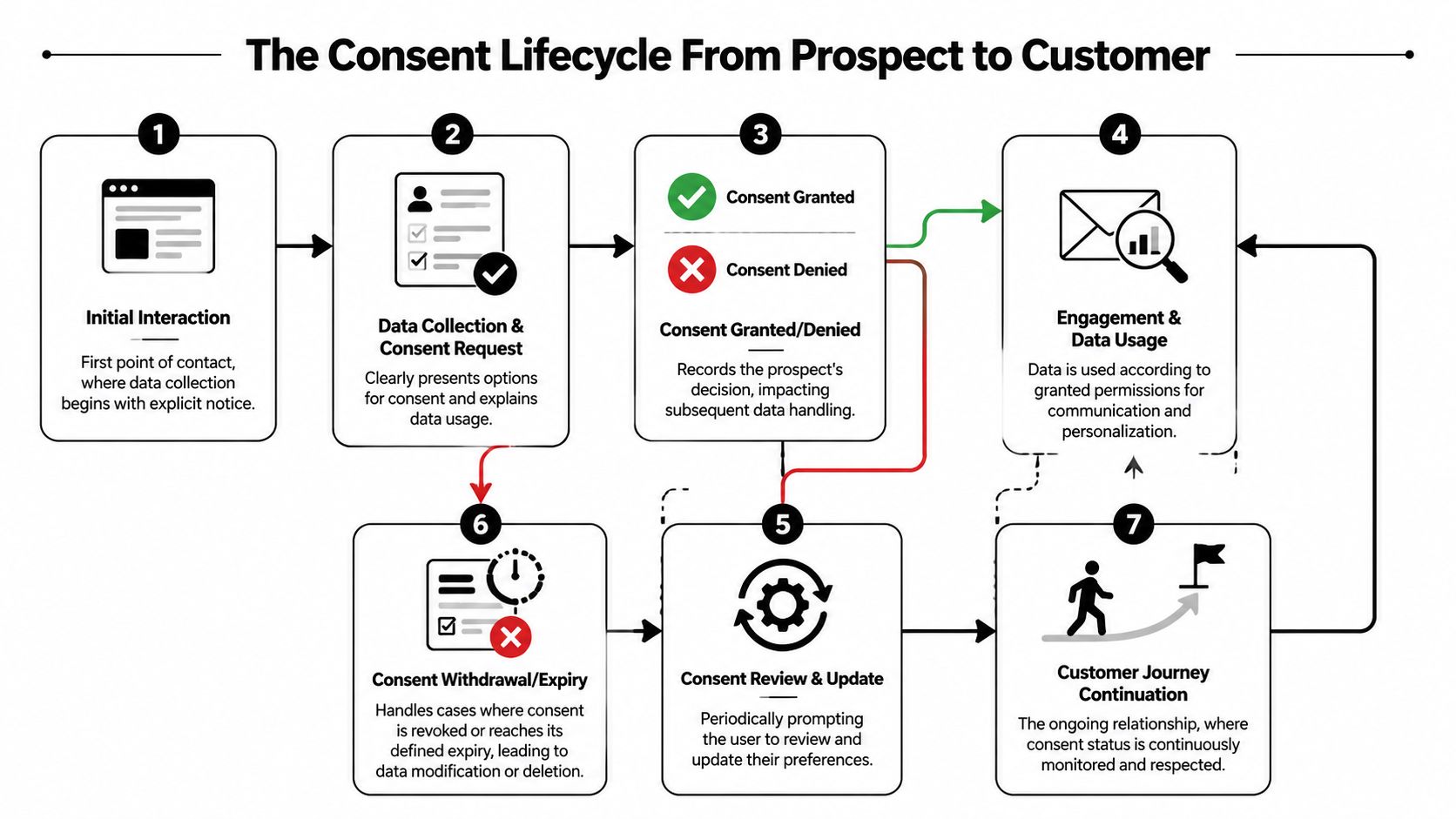
The stages that matter
The cleanest way to think about this is in phases:
-
Cold prospect You have identifying business information, but no direct permission from the person yet. This is the stage where legal basis matters most and assumptions cause the most damage.
-
Contextual engager The person replies to an email, requests information, or books a meeting. That action changes the context. It may support follow-up on that topic, but it still doesn’t mean universal marketing permission.
-
Explicit subscriber The person actively opts in to a newsletter, updates, event invitations, or another defined stream. Here, channel-specific and purpose-specific consent should become visible in your systems.
-
Customer contact Customer communications often include operational, contractual, and account-based interactions. Those should not be mixed carelessly with promotional automations.
-
Withdrawn or restricted contact The person unsubscribes, objects, requests limits, or becomes inactive under your internal retention rules. At this point the system must enforce restraint automatically.
For teams building outbound programs, email marketing lead generation workflows work better when each of those states triggers different automation rules instead of one master nurture stream.
Implicit, explicit, and contextual signals
B2B teams often mix these up.
-
Explicit consent means the person clearly opted in for a defined use.
-
Implicit or inferred permission is weaker and depends heavily on context.
-
Contextual permission often comes from a specific action, such as requesting a proposal or replying to a cold email about a relevant business need.
The mistake is stretching a narrow signal into a broad one. A whitepaper download doesn’t automatically mean the person wants weekly promotions. A reply asking for pricing doesn’t justify adding them to every product announcement list.
This short overview helps teams visualize the moving parts before they build systems around them.
The safest outreach programs don’t ask one giant permission question. They ask smaller ones at the right moments.
Where teams should update status
The handoff points are usually where compliance breaks:
-
Form submissions should stamp source, notice version, timestamp, and intended purpose.
-
Sales replies should update contact status so follow-up is tied to the active conversation, not dropped into generic nurture.
-
Unsubscribes and objections should suppress downstream actions quickly, not wait for a weekly CRM sync.
-
Renewals or plan changes should trigger a preference review if communication scope has changed.
When you model consent as a lifecycle instead of a checkbox, outreach gets easier to govern because each step has its own rules.
Implementing Your Consent Management Framework
A workable framework has two halves. The first is organizational. The second is technical. Most failures happen when a company buys software for the second half without fixing the first.
You can’t automate a policy your teams haven’t defined.
Build the operating rules first
Start with policy decisions that sales, marketing, legal, and operations can all live with. Keep them practical. If a rule can’t survive a real campaign, nobody will follow it.
Define these items clearly:
-
Accepted data sources: public websites, inbound forms, events, referrals, enrichment vendors, partner lists.
-
Allowed uses by source: cold outreach, direct follow-up, newsletter enrollment, retargeting, customer marketing.
-
Escalation thresholds: when a rep can continue a conversation, when legal review is needed, when a record must be suppressed.
-
Ownership: who decides wording, who approves workflows, who manages suppression logic, who handles audit requests.
This is also where teams often need to tighten internal playbooks. Sales shouldn’t import lists into one tool while marketing suppresses contacts in another. Segmentation discipline matters because communication rules differ by source and relationship type. Good email list segmentation practices make consent logic easier to enforce because the list structure already reflects purpose and status.
Then build the technical control plane
Once the rules exist, your systems need to enforce them. The strongest model is to treat consent management as a stateful, auditable control plane. TrustArc describes that architecture as one that captures consent across touchpoints, stores timestamped records, and syncs changes in near real time to downstream systems through APIs and tag managers, creating a single source of truth in TrustArc’s guide to a scalable consent management strategy.
That phrase matters because it fixes a common B2B problem. Outreach teams usually operate across forms, CRM records, enrichment tools, sales engagement platforms, ad platforms, and data warehouses. If each system has its own version of permission, drift is inevitable.
What the system should do in practice
A practical architecture should support these actions:
-
Capture: ingest permission signals from web forms, preference centers, CRM updates, unsubscribe events, and support requests.
-
Store: preserve timestamped records with the notice shown, source, jurisdiction logic, and purpose label.
-
Decide: evaluate whether a contact can receive a given message in a given channel.
-
Propagate: push the latest status into Salesforce, HubSpot, Marketo, your outbound platform, and suppression files.
-
Prove: produce an audit trail without digging through screenshots and Slack threads.
Here’s the simple analogy I use with clients. Your CRM is the filing cabinet. Your consent layer is the traffic light. The filing cabinet stores the person. The traffic light decides whether the next action is green, yellow, or red.
Implementation note: If reps can override suppression by exporting CSVs and sending from a separate tool, your framework isn’t implemented. It’s documented.
What doesn’t work
Three patterns fail over and over:
| Pattern | Why it breaks |
|---|---|
| Spreadsheet tracking | No reliable timestamps, weak version control, no automatic enforcement |
| Single CRM checkbox | Doesn’t capture purpose, source, jurisdiction, or history |
| Tool-by-tool rules | Every platform interprets status differently, which creates drift |
A good framework is boring in the best way. It makes the right action the default action. That’s what reduces compliance risk without crippling lead generation.
Choosing Your Consent Management Platform
Once your framework is defined, the platform choice gets easier. You’re not buying a banner. You’re buying enforcement, records, integrations, and operational fit.
Most B2B teams end up choosing between three paths: build, buy, or bundle.
Build, buy, or bundle
Build in-house works when you have strong engineering support, a clear data model, and unusual workflow requirements. The upside is control. The downside is maintenance. Privacy logic changes, business units change, and the custom system becomes one more internal product to support.
Buy a specialized CMP usually makes sense when you need stronger auditability, preference handling, policy controls, and cross-system integrations than your marketing suite can offer. This route tends to be best for companies with multiple channels, multiple geographies, or stricter governance needs.
Bundle with existing martech is attractive because it looks simpler. If your CRM or automation platform already has preference tools, using them can reduce procurement friction. The trade-off is depth. Native preference modules often cover basic opt-ins well but struggle with broader consent logic, jurisdiction-specific rules, and independent audit trails.
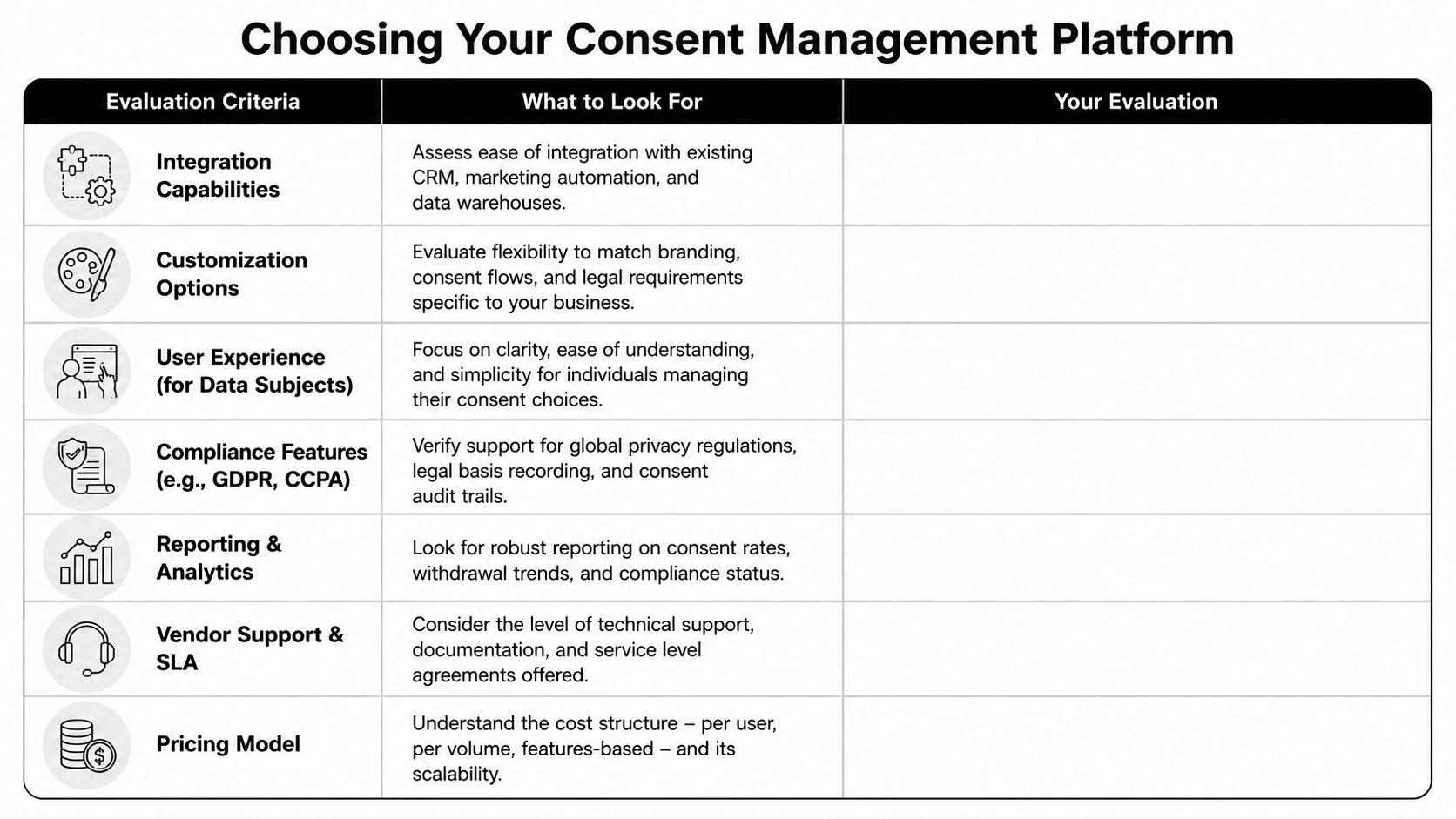
The evaluation questions that matter
Don’t start with vendor demos. Start with your enforcement requirements.
Use a shortlist like this:
-
Integration depth: Can it update Salesforce, HubSpot, your outbound system, support platform, and warehouse without custom patchwork?
-
Audit quality: Does it preserve timestamped history, purpose, and source in a form your legal team can use?
-
Rule flexibility: Can you separate newsletters from sales follow-up, event invites, and partner communications?
-
User experience: Can prospects easily understand choices and withdraw them without hunting through settings?
-
Operational ownership: Can marketing ops manage most of it, or will every change require engineering work?
A practical way to decide
If your outreach program is small and simple, bundling may be enough for now.
If you run outbound, inbound, events, customer marketing, and partner motions together, a dedicated consent management platform usually pays off because it creates one permissions layer instead of five partial ones.
If your legal and data teams want policy enforcement inside the warehouse and downstream tools, custom or specialized options become more attractive than bundled modules.
The wrong buying pattern is choosing a platform based on the banner preview. In B2B lead generation, the visible interface matters far less than whether your systems know when to suppress, when to follow up, and how to prove why.
Consent in Action for B2B Lead Generation
This is the part most generic privacy articles dodge. B2B companies still need prospecting. Pipelines don’t fill themselves. The question isn’t whether outreach stops. The question is whether you can run cold outreach in a controlled way before explicit consent exists.
In many B2B situations, the workable path is to separate initial lawful outreach from ongoing marketing consent. Those are not the same thing, and treating them as identical creates unnecessary paralysis.
Before explicit consent exists
A prospect record can enter your system before the person has opted in to marketing. That’s normal in B2B sales. What matters is restraint.
Your team should document why the contact was selected, why the outreach is relevant to the person’s role, what source produced the data, and what limitation applies. In plain language: you need a reason stronger than “they fit our ICP.”
A balancing test is useful here even if your legal team formalizes it in its own language. Ask:
-
Is the contact’s role closely related to the problem you solve?
-
Is the message specific and business-relevant, or broad promotional spam?
-
Would the person reasonably expect this type of outreach in their professional capacity?
-
Does the email make opting out easy and immediate?
-
Will the record be restricted quickly if they object or ignore further contact?
If the answer to those questions is weak, the campaign is weak, regardless of how good the copy sounds.
The handoff from outreach to consent
The most effective outbound teams don’t force explicit marketing consent in the first touch. That often feels unnatural and reduces response quality. Instead, they earn engagement first and then capture clearer permission when the relationship deepens.
Here’s a practical sequence:
-
Initial outreach stays narrow and relevant to the recipient’s business role.
-
Positive reply or meeting request changes the relationship from cold contact to active conversation.
-
Follow-up asset, demo, or resource becomes the right place to offer specific opt-ins for future updates.
-
Preference capture should be purpose-based, not bundled into one vague checkbox.
-
Automation should move the contact into the right stream only after that permission is recorded.
This is also where deliverability and compliance start to support each other. Tighter relevance, faster suppression, and cleaner routing reduce the bad habits that often hurt inbox placement. Teams focused on email deliverability services already know that list hygiene and complaint prevention are operational, not just technical.
A cold prospect is not a free-for-all record. It’s a restricted record with a narrow allowed use.
Why architecture matters here
Snowflake’s reference architecture makes an important point for B2B data teams: scalable consent systems normalize consent data separately from customer data and use that consent layer to generate governed access policies, so policy enforcement stays decoupled from data processing. That design makes consent changes enforceable without rewriting upstream pipelines, as described in Snowflake’s consent management reference architecture.
That’s exactly what outbound programs need. Your CRM should store the person. Your consent layer should decide what actions each system may take. When someone objects, unsubscribes, or grants a narrower preference, downstream tools should inherit the new rule without manual cleanup in five places.
The companies that struggle with cold outreach and compliance usually don’t have a legal problem first. They have a classification problem. They haven’t separated prospect data, marketing consent, customer communications, and suppression logic into distinct states.
Your Consent Management Audit Checklist
Most companies don’t need another abstract privacy lecture. They need a blunt internal review.
Use this checklist with marketing ops, sales leadership, legal, and whoever owns CRM administration. If too many answers are “not sure,” your consent management program isn’t mature enough for aggressive outreach.
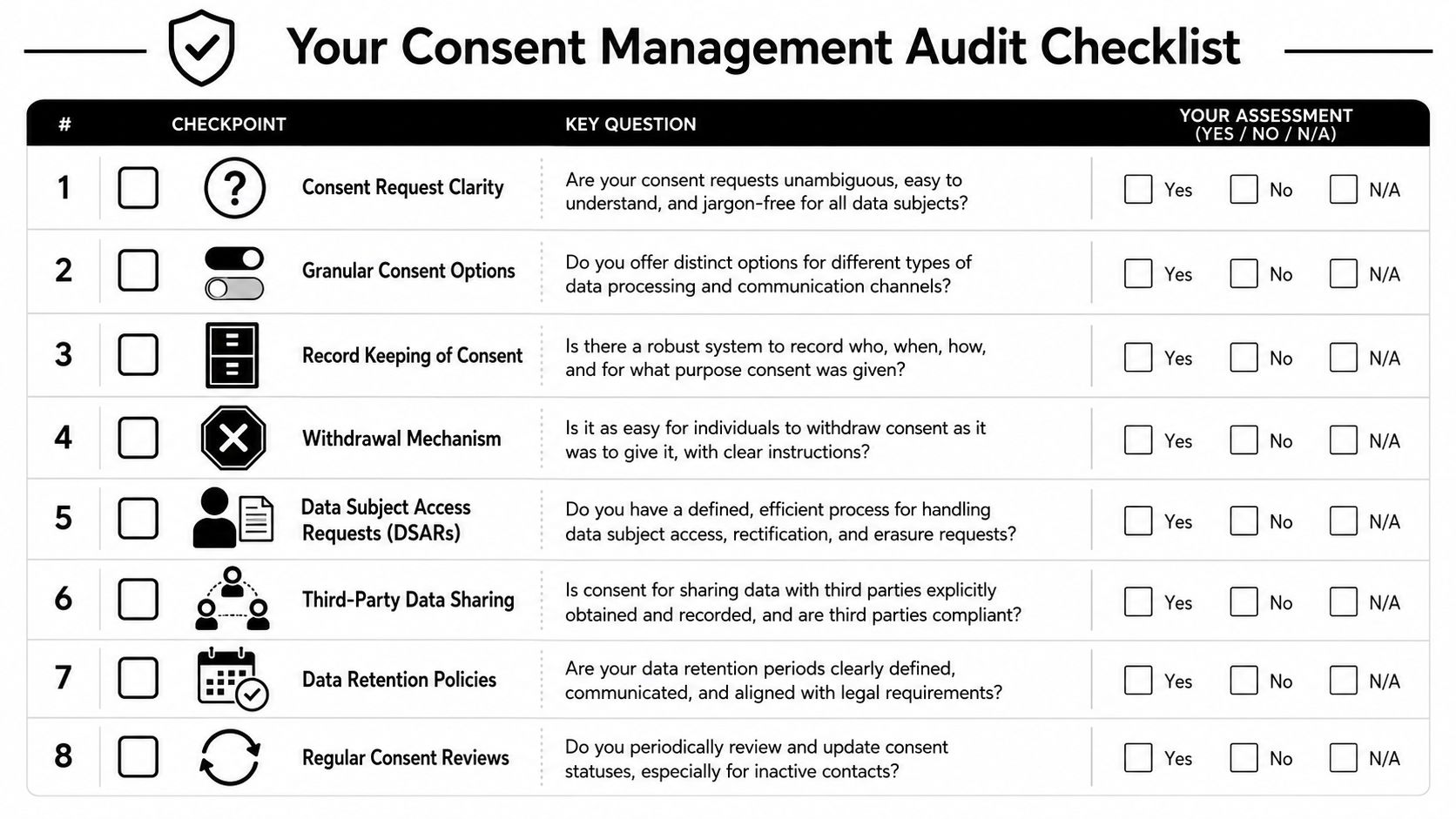
The eight questions to ask now
-
Clarity: Are your privacy notices and consent requests easy to understand without legal translation?
-
Granularity: Can people choose among channels and purposes, or is everything bundled together?
-
Recordkeeping: Can you show who gave what permission, when, how, and for which use?
-
Withdrawal: Is opting out as easy as opting in?
-
Suppression: Do unsubscribe and objection signals reach every outbound and marketing system quickly?
-
Prospecting basis: For cold outreach, do you document the reason for contact and any applicable limitation?
-
Retention: Do you have rules for inactive, unresponsive, or restricted records?
-
Access control: Can internal teams only use the data that fits their role and purpose?
What a “yes” should look like
A real “yes” is evidence, not confidence.
If your team says it can handle GDPR well, test that claim against a practical resource like Implementing GDPR compliance. It’s useful because it forces the conversation out of theory and into actual controls, notices, records, and operational procedures.
Your own published privacy policy should also match what the business does. If the policy promises one thing but the CRM, outbound tools, and suppression workflows do another, the mismatch will surface eventually.
The best audit outcome isn’t “we’re perfect.” It’s “we know exactly where the weak spots are, and the system already prevents the worst mistakes.”
A strong B2B consent management program doesn’t slow growth. It gives growth boundaries. That’s what lets you prospect confidently, convert interested contacts into clearly permissioned audiences, and survive the audit trail if someone asks hard questions later.
If you want help building cold outreach that respects consent boundaries without starving pipeline, Fypion Marketing works with B2B companies to design and run outbound programs that stay focused on qualified meetings, clean data handling, and scalable execution.