
Forecast Accuracy: A Guide to Predictable Sales Revenue

You’ve probably lived this quarter before. The pipeline review looked solid, rep commits sounded reasonable, marketing said campaign volume was on track, and finance built spending assumptions around the number. Then the month closed, bookings came in short, and suddenly every team had a different explanation for why the forecast missed.
That’s the core problem with forecast accuracy. It isn’t a reporting issue. It’s an operating issue. When the forecast is unreliable, hiring gets mistimed, campaign budgets get distorted, territory plans get warped, and leaders start managing by opinion instead of evidence.
In B2B sales and lead generation, forecast accuracy is what turns planning into something you can trust. If you know how wrong your forecast tends to be, where it breaks, and when it decays, you can make better calls on headcount, outbound volume, pipeline targets, and revenue risk. That’s the difference between a forecast that decorates a board deck and one that helps run the business effectively.
The High Cost of ‘Close Enough’ Forecasting
A lot of sales teams don’t have a forecasting problem. They have a false confidence problem.
The quarter starts with an aggressive target. Marketing projects lead flow. SDR managers plan coverage. A VP of Sales approves hiring because the model says pipeline creation will support more reps. Nobody thinks they’re guessing. Everyone thinks they’re being directionally right.
Then the cracks show up. Outbound reply rates soften. A few large deals slip. One channel underperforms. The pipeline still looks healthy in aggregate, but the timing is off, the stage distribution is weak, and conversion assumptions were too generous. “Close enough” turns into a miss that affects payroll planning, board expectations, and rep morale.
That’s why forecast accuracy matters more than is often acknowledged. A forecast miss doesn’t stay inside the spreadsheet. It spills into decisions that cost money and time.
What a miss looks like in practice
In B2B revenue teams, poor accuracy usually creates one of two bad operating modes:
-
Over-forecasting: Leaders hire ahead of demand, expand spend too early, and pressure reps to close deals that were never likely to land in-period.
-
Under-forecasting: Teams hold back on budget, delay hiring, and starve a pipeline that could have supported faster growth.
-
Mixed signals: Marketing hits activity goals, sales misses revenue, and finance loses trust in both because nobody aligned on what the forecast was measuring.
A weak forecast also poisons accountability. When the number keeps missing, reviews stop being analytical and start becoming political. Reps defend their commits. Marketing defends lead volume. Ops defends the model. Nobody fixes the process.
A cleaner pipeline discipline helps, and strong sales pipeline management best practices usually improve forecast quality before you even touch modeling. But pipeline hygiene alone won’t solve the deeper issue. You still need a way to measure how accurate the forecast really is, and where it consistently breaks.
If your forecast can’t help you decide whether to hire, cut spend, or change targets, it isn’t accurate enough to run the business.
What Is Forecast Accuracy Really
Forecast accuracy sounds technical, but the practical idea is simple. It measures how close your forecast was to what occurred.
That sounds obvious until you look at how teams use it. Many leaders reduce it to one question: did we hit the number or miss it? That’s too crude to be useful. A serious revenue team needs to know more than whether the final result landed above or below plan. It needs to know how big the miss was, whether the business tends to overcall or undercall, and whether the forecast becomes less reliable the farther out you look.

Think about it like a weather forecast
A weather report isn’t useful because it says “rain” after the fact. It’s useful because it gives you a decision tool. You learn whether conditions are stable, uncertain, or likely to change. You decide whether to travel, reschedule, or prepare.
Sales forecasting works the same way. A forecast isn’t just a promised outcome. It’s a measurement of uncertainty around revenue, lead flow, or pipeline creation.
If you want a quick glossary-style definition, Grou’s explanation of what is forecast accuracy is a good reference point. In day-to-day operations, though, the useful version is this: forecast accuracy tells you whether your planning assumptions are dependable enough to support real business decisions.
The question leaders should ask
Groups frequently ask, “What’s our forecast?”
Better teams ask questions like these:
-
How far off are we, typically
-
Do we usually over-forecast or under-forecast
-
Which team, region, or lead source breaks the model
-
At what point does the forecast become too noisy to trust for hiring or spend
Those questions matter because a single headline number hides a lot. A forecast can look decent overall while still being dangerous in the places where decisions get made. You might have acceptable accuracy at the total company level and poor accuracy in enterprise outbound, partner-sourced pipeline, or new-market expansion.
A forecast is useful when it improves decisions before the quarter ends, not when it explains the miss after finance closes the books.
That’s the practical mindset shift. Forecast accuracy isn’t about proving that your model was smart. It’s about learning whether the model is reliable enough to run budget, staffing, and go-to-market execution with confidence.
The Essential Forecast Accuracy Metrics Explained
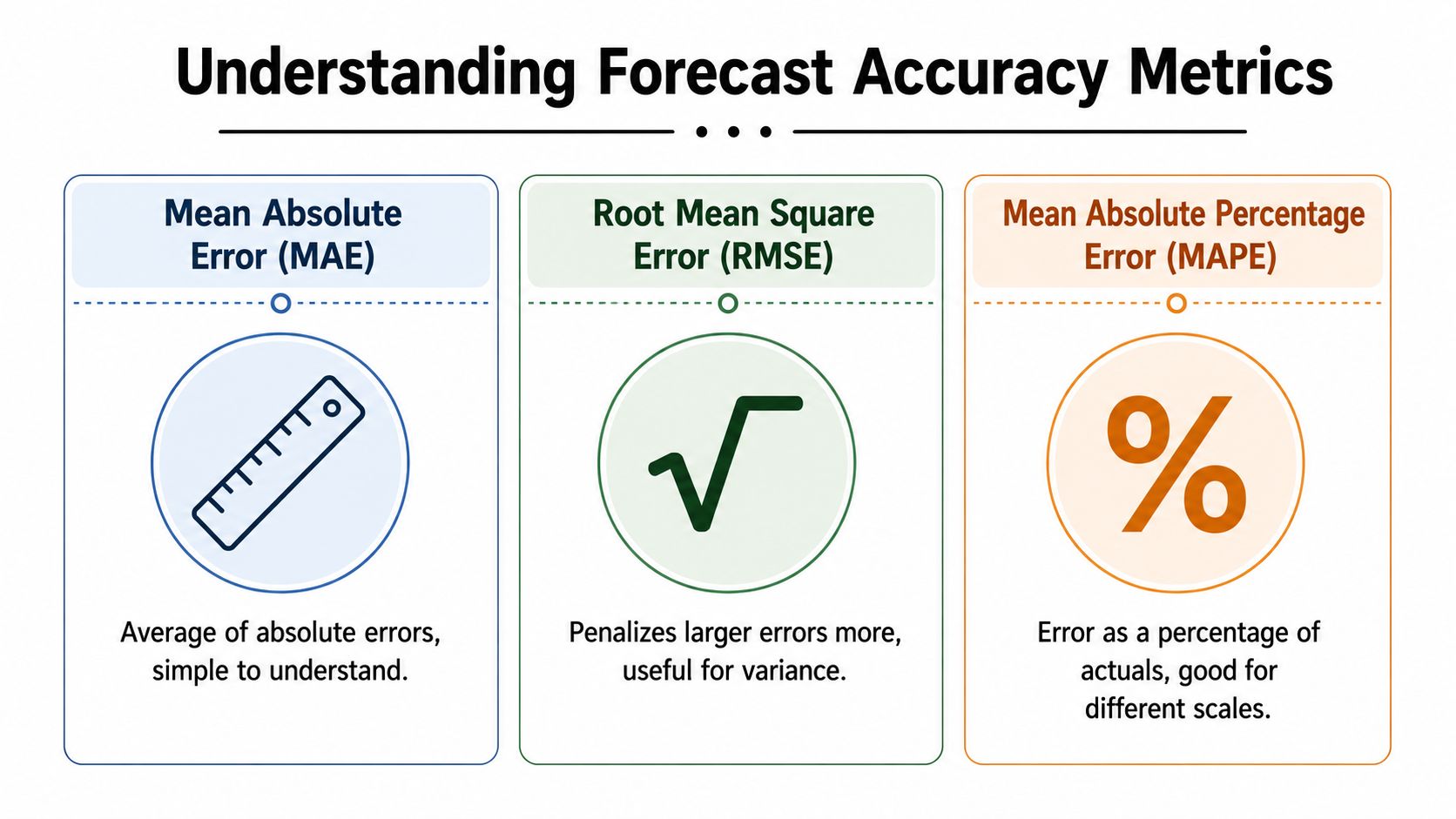
The mechanics matter, but only if they answer a business question. In forecasting practice, a core statistical rule is to test forecasts on new data, not the same data used to build the model. A common rule of thumb is to hold out about 20% of the sample for testing, and common accuracy measures include MAE, RMSE, and MAPE. The same reference notes that MAPE is one of the most widely used cross-series comparison metrics because it standardizes error in a unit-free way, which is why many teams use it to compare performance across products or markets in different units, as explained in the forecasting text at Forecasting Principles and Practice.
MAE tells you the average miss in business terms
Mean Absolute Error, or MAE, answers the most practical question first: how far off are we on average?
If you forecast monthly inbound demos, SQLs, meetings booked, or closed-won revenue, MAE tells you the average size of the miss in those same units. That makes it easy to explain in a forecast review.
For a sales ops leader, MAE is useful because it stays close to operating reality. If the MAE for qualified meetings is high, staffing assumptions for AEs and SDRs will probably be unstable. If the MAE for revenue is high, finance shouldn’t trust narrow planning ranges.
MAE is often the best starting metric because it’s straightforward. It doesn’t exaggerate one ugly miss, and it doesn’t hide behind percentages.
RMSE punishes large misses harder
Root Mean Square Error, or RMSE, also measures error magnitude, but it gives more weight to larger misses.
That matters when a few bad forecast calls can do outsized damage. In B2B sales, one major miss in enterprise pipeline or a major shortfall in high-value campaign output can distort hiring, cash planning, and board guidance more than a string of small misses.
Use RMSE when you want your score to reflect that pain. It helps answer a different question from MAE: not just how wrong are we on average, but how costly are the worst misses.
A good way to think about the difference is this:
| Metric | Best business use | Watch-out |
|---|---|---|
| MAE | Average miss in units you can act on | Can understate the pain of rare large misses |
| RMSE | Surface whether big misses are the real problem | Harder to explain to non-technical stakeholders |
| MAPE | Compare accuracy across teams or categories with different scales | Can mislead when actual volumes are low |
A useful benchmark exercise is comparing your own forecast error by segment against external context from industry benchmarking, not to copy another company’s targets, but to pressure-test whether your assumptions are unusually loose.
Here’s a quick explainer if your team prefers a visual walkthrough before applying the formulas:
MAPE makes cross-team comparisons easier
Mean Absolute Percentage Error, or MAPE, expresses error as a percentage of the actual value. That makes it useful when you want to compare unlike things. A region generating a large volume of pipeline and a niche segment generating a smaller volume can still be evaluated on a unit-free basis.
That’s why MAPE is so common in executive reporting. It helps leaders compare sales territories, campaign types, product lines, and market segments without getting trapped by raw unit differences.
But there’s an important trade-off. Percentage metrics can become misleading for low-volume items. If the denominator is small, the percentage can swing wildly and tell you almost nothing useful. In volatile B2B channels, that can produce fake alarm or fake comfort.
Practical rule: Use MAE when you need operating clarity, RMSE when large misses carry special risk, and MAPE when you need a standardized comparison across very different forecast sizes.
No single metric wins every situation. The right metric is the one that helps your team make a better decision, faster, with less debate.
Putting Theory into Practice with Worked Examples
Forecast accuracy is understood in theory, yet there is a common struggle when opening a spreadsheet. The simplest way to fix that is to calculate it on a small set of familiar sales data.
Use a short run of monthly lead forecasts or meeting forecasts. You don’t need a complex model to learn the discipline. What matters is comparing forecasted values with actual results and measuring the gap consistently.
A simple lead forecast example
Take six months of forecasted qualified meetings:
| Month | Forecast | Actual |
|---|---|---|
| Month 1 | F1 | A1 |
| Month 2 | F2 | A2 |
| Month 3 | F3 | A3 |
| Month 4 | F4 | A4 |
| Month 5 | F5 | A5 |
| Month 6 | F6 | A6 |
This example uses placeholders instead of made-up numbers for a reason. In your own sheet, replace each forecast and actual with real values from CRM, attribution reporting, or your outbound system.
How to calculate MAE
Start with the error for each month.
-
Subtract actual from forecast for each row.
-
Convert every result to an absolute value so over-forecasting and under-forecasting don’t cancel each other out.
-
Add the absolute errors together.
-
Divide by the number of periods.
In plain language:
-
Error = Forecast minus Actual
-
Absolute error = absolute value of Error
-
MAE = sum of all absolute errors divided by total number of months
If your MAE for qualified meetings is consistently large, your hiring plan is built on shaky ground. If it’s tight enough to support staffing and budget decisions, you’re getting somewhere.
How to calculate MAPE
MAPE adds one extra step. Instead of keeping the miss in raw units, it turns each miss into a percentage of the actual result.
The sequence is:
-
Calculate the error for each month.
-
Convert it to an absolute error.
-
Divide that absolute error by the actual result for the same month.
-
Average those percentage errors across all periods.
In short:
-
Percentage error per month = Absolute error divided by Actual
-
MAPE = average of all percentage errors
This helps when you want to compare teams of different sizes. A small outbound segment and a large inbound segment may have very different raw misses, but MAPE gives you a common frame.
A clean companion check is reviewing your sales conversion rates beside forecast error. A forecast may look weak because top-of-funnel volume was wrong, or because downstream conversion changed and nobody updated assumptions.
When leaders say a forecast is “off,” they usually haven’t isolated whether the miss came from volume, conversion, timing, or deal mix. The math forces that conversation.
That’s why worked examples matter. They turn forecasting from a confidence game into a repeatable operating habit.
Why Inaccurate Forecasts Tank B2B Sales Pipelines
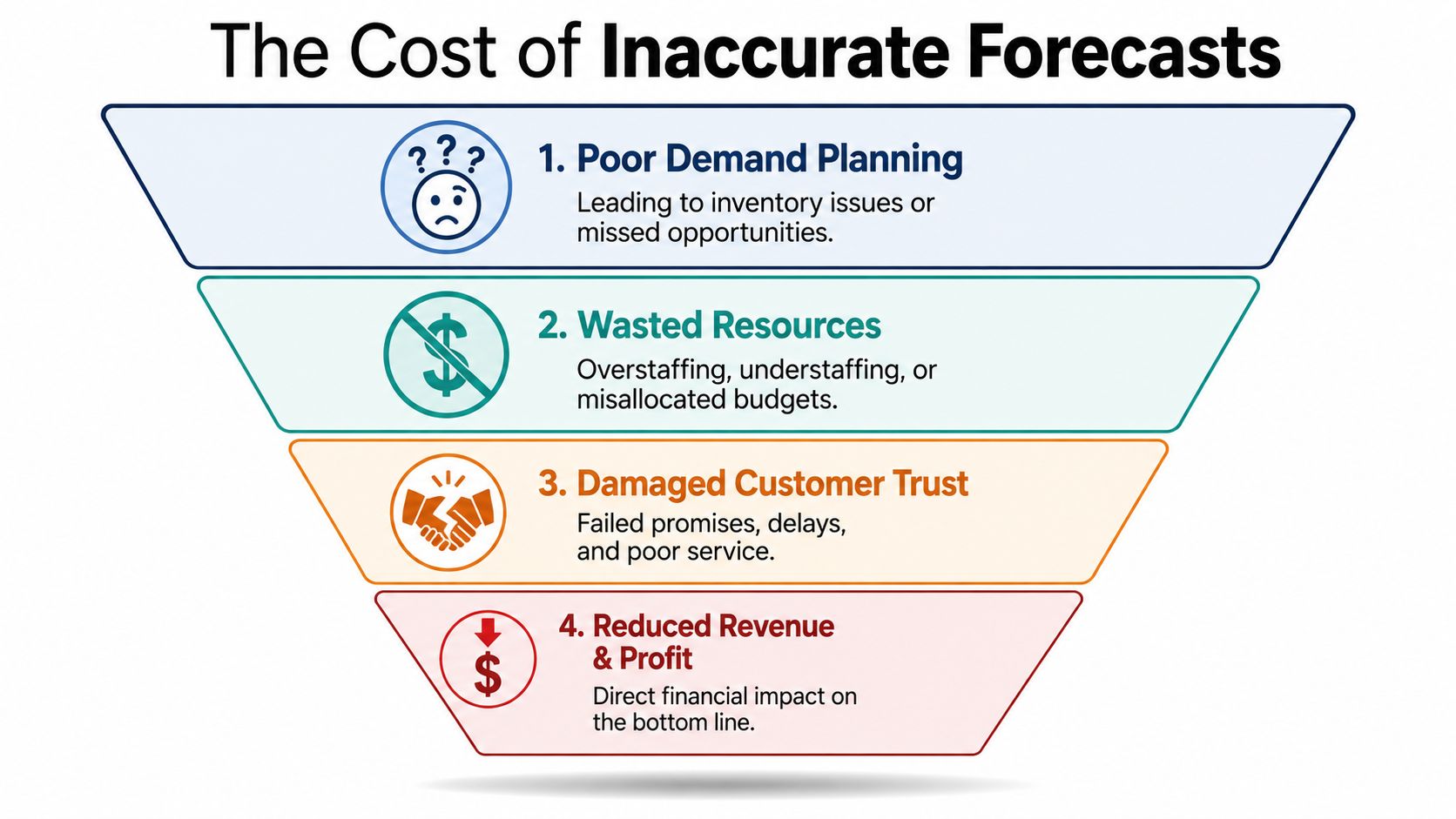
A bad forecast doesn’t just create a bad number. It creates bad decisions in sequence.
When sales leaders overestimate pipeline creation, they often add headcount too early, widen quotas, or expand spend based on demand that never materializes. New reps ramp into weak territory. SDRs chase thin accounts. Managers push activity because the expected volume isn’t there. The forecast miss becomes a productivity problem, then a morale problem, then a budget problem.
Under-forecasting is just as expensive, but in a different way. Teams hold back on hiring, keep campaign budgets too tight, and fail to build enough coverage for demand that exists. Good leads sit untouched. Follow-up slows down. Revenue slips, not because the market was weak, but because the business staffed below the opportunity.
The pipeline damage shows up fast
In B2B lead generation, forecasting errors cascade through the funnel:
-
Top of funnel gets distorted: Marketing and outbound teams set campaign volume against assumptions that don’t hold.
-
Coverage gets misaligned: SDR and AE capacity no longer matches actual lead flow or meeting quality.
-
Conversion analysis gets blurry: Leaders can’t tell whether the issue is poor demand, weak qualification, or timing slippage.
-
Budget turns reactive: Finance starts adjusting spend after the miss instead of planning ahead of it.
This gets worse when teams measure the wrong thing. Industry guidance on forecast accuracy stresses that forecasts should be judged against actual demand, not sales, because stockouts can make sales look artificially low. The example is straightforward: if demand is 1,000 units but only 500 are sold because of a stockout, the forecast should be judged against the 1,000-unit demand. The same guidance notes a common KPI framing where a 20% error rate translates to 80% forecast accuracy, and recommends tracking error in units, dollars, and percentages depending on the decision being made, as outlined by ABC Supply Chain forecast accuracy guidance.
Sales teams make the same mistake in a different form
B2B revenue teams don’t usually have stockouts, but they do have demand distortion. If inbound demand exists and your team couldn’t respond fast enough, or if outbound created interest that the pipeline process failed to capture cleanly, using closed sales alone can mislead you. You end up grading the forecast on what the team processed, not on what the market signaled.
That’s one reason strong sales pipeline management matters. If stage definitions, qualification standards, and handoff rules are messy, forecast error becomes impossible to interpret. You don’t know whether demand was weak or your process failed to capture it.
The most expensive forecast mistake isn’t being wrong once. It’s teaching the company to plan around a number that doesn’t reflect real demand.
For B2B sales leaders, that’s the operational stakes. Inaccurate forecasts don’t just miss revenue. They scramble capacity, blur accountability, and make it harder to tell where the true bottleneck is.
Diagnosing the Common Causes of Poor Accuracy
When forecast accuracy is weak, the model is often blamed first. That’s often wrong. The model may be part of the problem, but the failure usually starts earlier, in the data, the process, or the human incentives wrapped around the forecast.
Data problems come first
Forecasts break when the input data is inconsistent, delayed, or inflated.
CRM stage dates get edited late. Lead sources are tagged loosely. Opportunity amounts stay stale. Campaign attribution changes after the fact. A forecast built on messy inputs can still look polished, but it won’t hold up under scrutiny.
For outbound-heavy teams, one hidden input issue is deliverability. If your cold email program underperforms because messages stop landing properly, lead volume can fall off without anyone updating the forecast assumptions. A practical diagnostic step is running mailX email deliverability checks before treating campaign shortfalls as pure market weakness.
Process and model issues create silent drift
A weak forecasting process often looks normal on the surface. The team uses the same meetings, the same templates, and the same CRM fields. But underneath, assumptions drift.
Common examples include:
-
Wrong aggregation level: Forecasting at the company total when significant variation sits by segment, rep, or source.
-
Static assumptions: Using the same conversion logic even after pricing, targeting, or messaging changed.
-
Bad horizon choice: Evaluating a forecast only at quarter end when key decisions happen weekly or monthly.
-
No holdout discipline: Building and judging the forecast on the same historical run of data.
Each of these issues produces a forecast that feels organized while still being unreliable.
People issues are usually underdiagnosed
Forecasting is never purely technical. Reps sandbag. Managers overcommit. Marketing forecasts campaign volume with optimistic response assumptions. Finance pushes for certainty that the underlying system can’t support.
That human layer matters because the forecast often becomes a negotiation, not a measurement. Once that happens, accuracy degrades fast.
A useful internal audit looks at three questions:
| Diagnostic area | What to check |
|---|---|
| Data integrity | Are CRM fields, source tags, and stage movements reliable enough to support analysis |
| Forecast design | Does the method match how buyers behave and how your sales motion actually converts |
| Behavioral pressure | Are people rewarded for realism, or for telling leadership what it wants to hear |
Poor forecast accuracy usually comes from some combination of all three. Teams that improve fastest don’t hunt for one magic fix. They identify which bucket is creating the biggest distortion, then clean that up first.
Data-Driven Strategies to Improve Your Forecasts
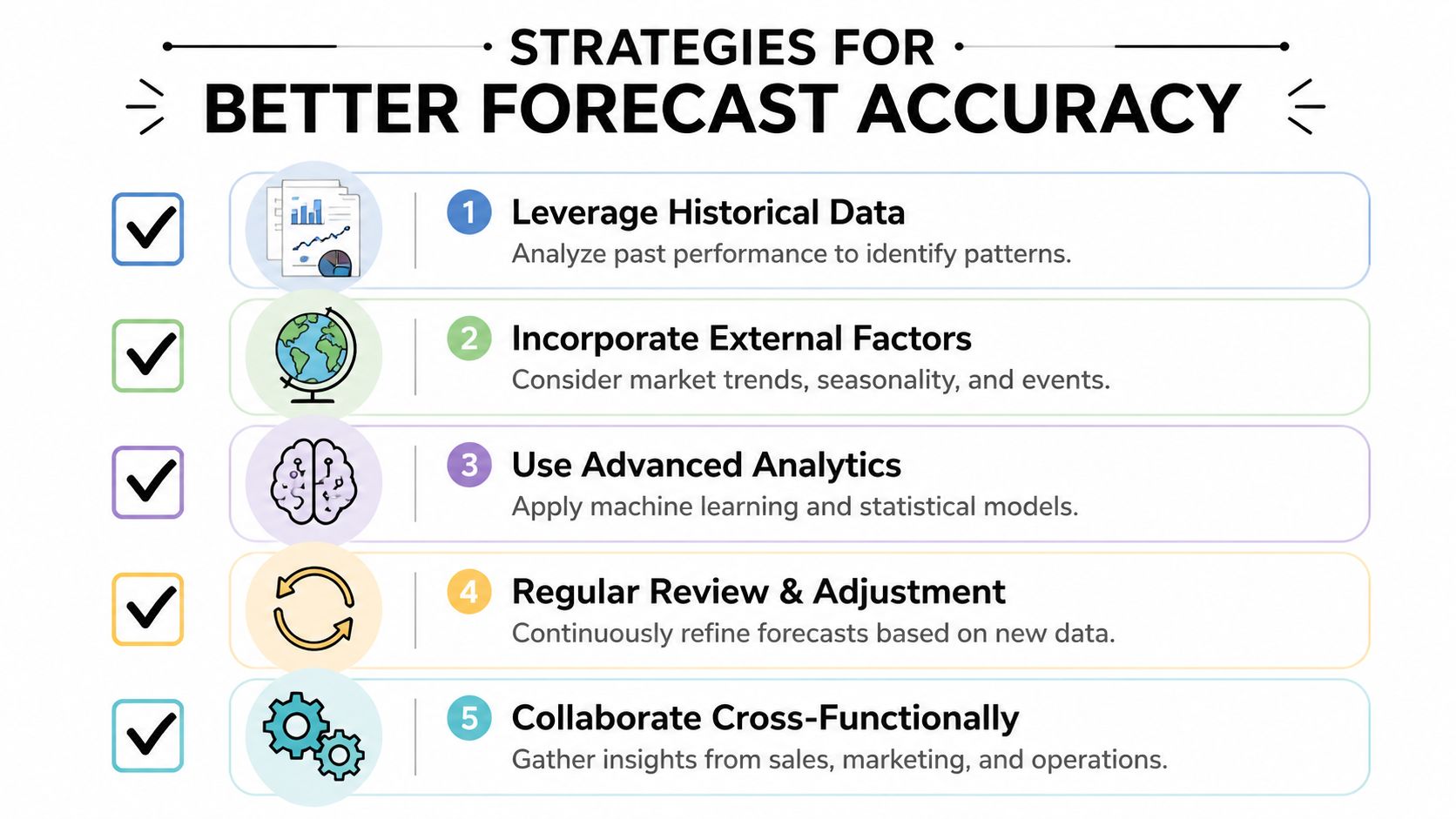
Improving forecast accuracy doesn’t require a heroic rebuild. It requires a tighter operating system. The best gains usually come from better segmentation, cleaner review habits, and choosing metrics that match the decision at hand.
Track the forecast where decisions happen
A single company-wide number hides too much. Segment the forecast by the things that drive action:
-
By lead source: Outbound, inbound, partner, paid, and event-sourced pipeline behave differently.
-
By team or region: One sales pod may be stable while another is volatile.
-
By motion: New business, expansion, and enterprise cycles usually need different logic.
-
By value tier: High-value opportunities deserve separate monitoring because a few misses can change the whole picture.
This is also where tooling choices matter. If your data provider, intent source, or contact database changes, forecast assumptions should change with it. Teams evaluating a Zoominfo alternative for B2B sales should treat source changes as forecasting changes, not just prospecting changes, because list quality and account coverage can alter pipeline creation patterns.
Measure accuracy across different time horizons
One of the most useful ideas in modern forecasting practice is that accuracy gets worse as the horizon extends. SPS Commerce describes this as forecast accuracy degradation and recommends tracking accuracy across standardized horizons such as 1-week, 4-week, and 12-week views so teams can see how quickly reliability decays over time, as described in their article on forecast accuracy degradation.
For B2B sales, this is gold. The forecast you use for next week’s SDR capacity isn’t the same forecast you should use for hiring or annual planning. Different decisions need different windows.
If your headline forecast looks healthy but collapses at the horizon where you make staffing decisions, the forecast isn’t actually healthy.
Build a review loop, not a ritual
Forecast meetings often become status theater. Replace that with a tighter review process:
-
Compare forecast versus actual by segment. Don’t stop at the total.
-
Review error by horizon. Short-range and longer-range accuracy should be separated.
-
Check bias, not just miss size. If you always overcall or undercall, fix that pattern directly.
-
Use the right metric for the job. Percentage metrics can mislead for low-volume or volatile categories.
-
Feed the learning back into systems. CRM definitions, campaign assumptions, and handoff logic all need updates when errors repeat.
Strong forecasting also depends on connected systems. If campaign platforms, CRM, and reporting tools are loosely stitched together, data lags and classification errors will keep creeping in. That’s why disciplined CRM integration has such an outsized effect on forecast quality.
The end goal isn’t a perfect forecast. It’s a forecast you can trust enough to hire with, budget with, and manage performance with. That’s what makes revenue more predictable.
If your team wants a more predictable pipeline without carrying the overhead of building outbound systems internally, Fypion Marketing can help. They run performance-driven B2B lead generation with a pay-per-qualified-meeting model, which makes it easier to align pipeline planning with actual sales outcomes instead of hopeful assumptions.