
Industry Benchmarking: The B2B Growth Playbook
You’re probably looking at a dashboard right now that’s full of motion but short on meaning.
Pipeline created. Cost per lead. Demo rate. Reply rate. SQL volume. Churn. CAC payback. Sales cycle length. Every team has numbers. The hard part is knowing whether those numbers are good, bad, or just normal for a business like yours.
That’s where industry benchmarking becomes useful. Not as a finance exercise for board decks, but as operating context. Without context, teams overreact to normal variance, underreact to real weaknesses, and set targets based on hope instead of evidence. A lead gen team might think reply rates are the problem when the underlying issue is list quality. A SaaS sales team might blame outbound when the actual bottleneck sits between SQL and close.
Most B2B operators don’t need more metrics. They need better comparison points.
That sounds simple until you try to find them. Public benchmarks often skew financial. Generic “industry averages” lump together companies with different deal sizes, sales motions, geographies, and maturity levels. Comparing a bootstrapped niche SaaS company to a category leader with a mature brand and partner channel usually creates noise, not insight. That’s one reason the distinction between market and industry matters so much. Your market shapes buyer behavior. Your industry label alone rarely gives you a clean peer set.
The practical use of benchmarking is this. It tells you where your operating system is misaligned. It helps you spot whether you have a targeting problem, a conversion problem, a follow-up problem, or a positioning problem. It also gives marketing and sales leaders a better way to defend budget, justify process changes, and prioritize fixes.
For SaaS and lead generation companies, the opportunity is bigger because the most valuable benchmarks often aren’t on the income statement. They live in outreach performance, funnel conversion, speed-to-lead, meeting quality, sales handoff quality, onboarding friction, and retention signals.
Introduction
B2B leaders rarely suffer from a lack of data. They suffer from a lack of calibration.
A revenue team can tell you exactly how many leads entered the funnel last month. They can break down open rates by campaign, demos by segment, and opportunities by rep. But when someone asks the simple question, “Are we performing well for a company like ours?”, the room often gets quiet. That silence is expensive.
Without a benchmark, teams make one of three mistakes. They celebrate weak performance because the raw number looks big. They panic over a metric that’s normal for their segment. Or they chase someone else’s standard and distort the business trying to match it.
That’s why industry benchmarking matters in practice. It gives you a reference point for decisions that otherwise feel subjective. It turns a dashboard from a reporting surface into a management tool. For SaaS and lead gen companies, that means you can stop judging your funnel in isolation and start asking better questions. Is your outbound conversion weak because your messaging is off, or because you’re benchmarking against the wrong peer group? Is your SQL rate low because marketing is underperforming, or because sales qualification is unusually strict?
A metric without context is just a number that can still mislead you.
Used well, benchmarking helps you set targets that are aggressive without being detached from reality. It helps you identify where to investigate first. It also helps align teams that often argue from different frames of reference. Marketing talks volume. Sales talks quality. Finance talks efficiency. Benchmarking gives them a common language.
This matters even more in companies where growth depends on outbound, paid acquisition, account-based motions, or high-touch sales. In those environments, small conversion differences compound across the funnel. A weak benchmark can send your team in the wrong direction for months.
The better approach is practical. Compare against relevant peers where possible. Build internal benchmarks where external data is weak. Normalize what you measure so your comparisons mean something. Then use the gaps to decide what to fix next.
What Is Industry Benchmarking and Why It Matters
Industry benchmarking is the disciplined practice of comparing your company’s performance against relevant peers, direct competitors, and high performers. Traditionally, that work started in finance. A long-established definition of benchmarking in financial analysis is comparing a company’s ratios and operating metrics against industry averages, direct competitors, and best-practice firms. One established commercial reference, the Risk Management Association’s Annual Statement Studies, compiles balance sheet and income statement data from more than 240,000 commercial borrowers across over 730 industry categories according to LibreTexts on benchmarking and industry comparison.
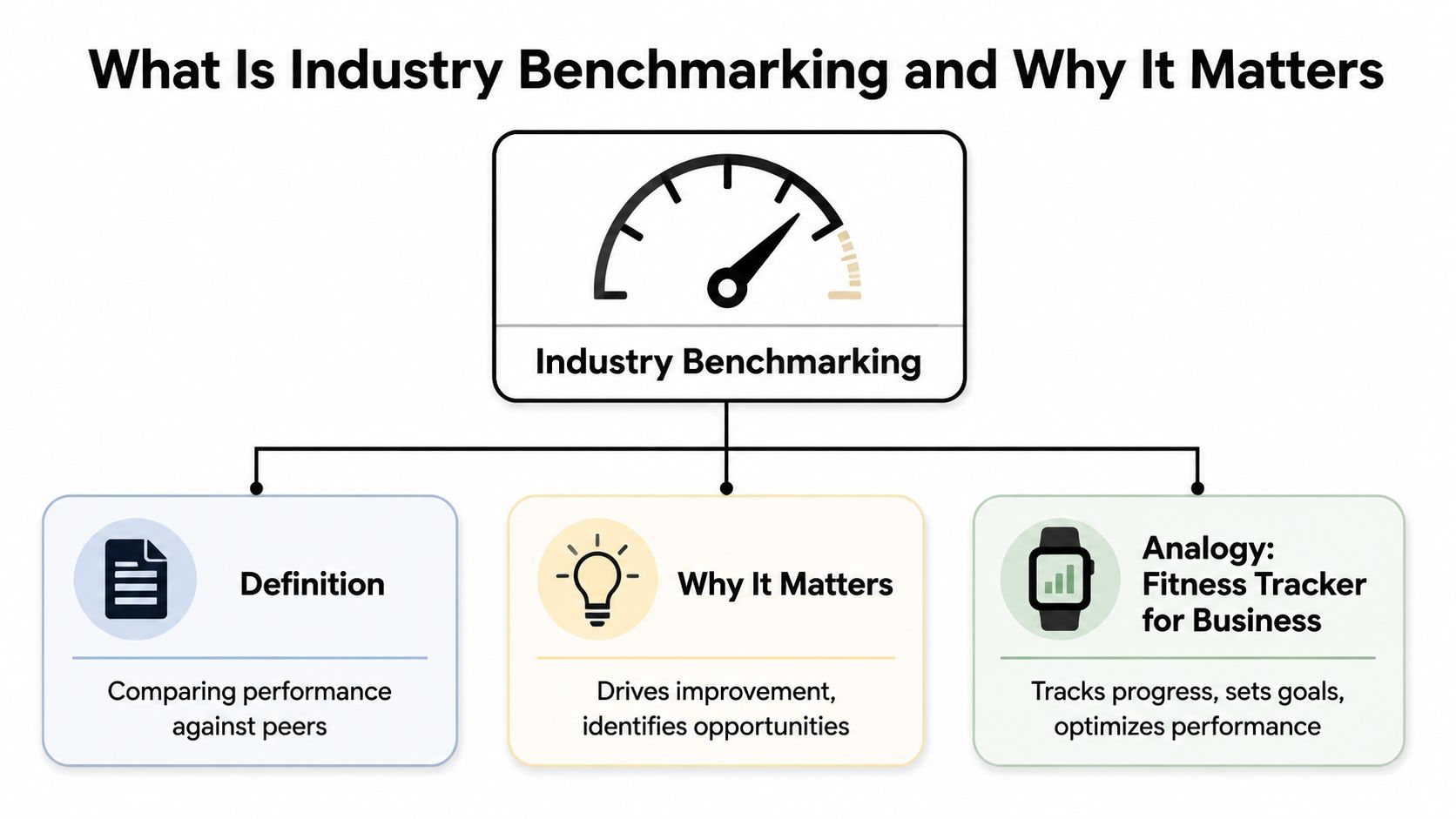
That financial history matters, but most growth teams need to widen the lens. In B2B, benchmarking shouldn’t stop at margin, revenue, or spend. It should include operational metrics like list-to-reply rate, MQL-to-SQL conversion, no-show rate, meeting acceptance quality, proposal velocity, and expansion readiness.
Think of it as a fitness tracker for the business. A tracker doesn’t just tell you your weight. It tracks sleep, heart rate, steps, recovery, and training load. Business benchmarking works the same way. One number never explains performance on its own.
Three useful forms of benchmarking
Process benchmarking compares how work gets done. This comparison frequently yields the fastest wins for sales and marketing teams. You might compare outbound sequencing logic, SDR follow-up timing, enrichment workflows, routing rules, or handoff standards between marketing and sales.
Competitive benchmarking compares outcomes against rivals.That could mean share of search, positioning, response speed, pricing presentation, customer proof density, or how competitors structure outbound offers. Teams that want more visibility into this area often use tools and workflows like those discussed in Riff Analytics on AI competitor tracking.
Strategic benchmarking compares bigger operating choices. It involves examining channel mix, targeting model, ICP definition, product packaging, or whether your peers are growing through outbound, partnerships, content, or product-led acquisition.
The real purpose of benchmarking isn’t to copy competitors. It’s to understand the standards your buyers and market are already reacting to.
Why it matters for B2B growth
First, it gives you objective context. If your reply rate looks low but your meetings booked per qualified account are strong, the issue may be messaging volume rather than market fit.
Second, it sharpens target setting. Teams with no benchmark often choose arbitrary goals. Teams with the wrong benchmark choose impossible ones.
Third, it reveals where innovation is needed. If everyone in your space uses the same outbound motions and your response quality is weak, benchmarking can show that the problem isn’t execution alone. It may be a stale go-to-market approach.
Finally, it helps justify strategic pivots. That might mean changing segments, adjusting qualification, revising campaign structure, or reworking how your funnel is measured. If your team needs a stronger foundation before benchmarking competitors, this overview of market research insights is a useful precursor.
A 6-Step Framework for B2B Industry Benchmarking
Most benchmarking fails because teams jump straight to comparison. They pull a few numbers from dashboards, scan competitors, and declare a gap. That shortcut usually creates false confidence.
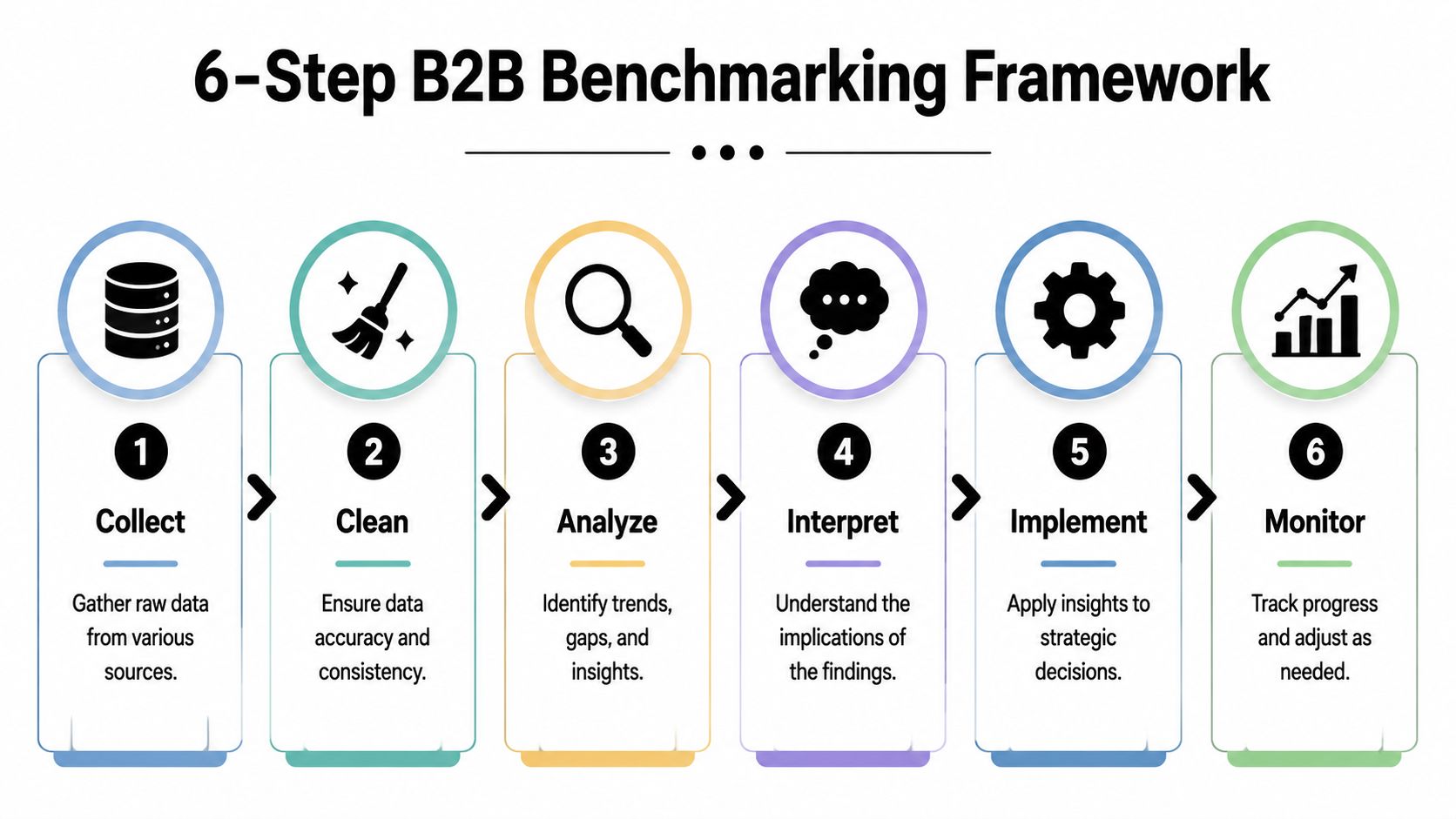
A stronger workflow is collect → clean → compare → analyze gaps → implement improvements → monitor, a sequence also outlined by CoreSignal’s guide to industry benchmarking. That same source also notes common expert metrics such as system uptime, incident response time, mean time to repair, IT spending as a percentage of revenue, and user satisfaction scores. For B2B growth teams, the equivalent is operational funnel data.
A visual summary helps before you build the model.
1. Collect the right data
Start with a narrow scope. Don’t benchmark everything at once.
Pick one business question. Examples include:
-
Outbound efficiency: Are we underperforming in prospecting, messaging, or qualification?
-
Sales conversion: Are we losing too much between meeting held and opportunity created?
-
Customer health: Are onboarding and retention weaker than they should be?
Then gather data from sources that fit that question. Internal systems matter most here. Use your CRM, marketing automation platform, call recordings, support data, and campaign reporting. Add external references where useful, but don’t let public data drive the whole model.
For lead generation teams, a practical collection set often includes:
-
Volume data: Accounts contacted, contacts reached, campaigns launched
-
Conversion data: Positive replies, meetings booked, meetings held, SQLs created
-
Quality data: Show rate, fit rate, acceptance rate by sales
-
Speed data: Response time, follow-up cadence, handoff delay
2. Clean the dataset before comparing
Raw data lies more often than it is admitted.
One rep logs a meeting differently. One campaign includes recycled leads. One region counts reschedules as held meetings. If you compare that data without fixing the definitions, you aren’t benchmarking performance. You’re benchmarking data hygiene.
Use a single definition for each KPI. Align date ranges. Remove duplicates. Separate inbound from outbound. Split branded demand from cold acquisition. If your business sells into different segments, don’t blend enterprise and mid-market into one benchmark.
A lot of this work ties back to ICP design. If your segments are fuzzy, your benchmark will be fuzzy too. This is why clear ICP definition in sales matters before teams start comparing funnel performance.
Practical rule: If two managers would calculate the same KPI differently, don’t benchmark it yet.
Here’s a short explainer before the next steps:
3. Compare against peers, not labels
Teams often become complacent at this stage.
“B2B SaaS average” is too broad to guide decisions. You need a comparison set that reflects your business model, deal motion, geography, maturity, and customer type. A product-led company with low ACV and short cycles isn’t a clean benchmark for a founder-led outbound motion selling into regulated mid-market accounts.
Useful comparison groups often include:
-
Direct competitors with similar offers and buyers
-
Operational peers with similar sales motions, even if their products differ
-
Internal cohorts such as region-to-region, rep-to-rep, or segment-to-segment comparisons
4. Analyze the gaps
A gap only matters if it points to a controllable cause.
Say your meetings booked are healthy but opportunities created are weak. That usually suggests a qualification or targeting issue, not a top-of-funnel problem. If open rates are solid but reply quality is poor, your copy may create curiosity without relevance. If reply rates are decent but meetings don’t hold, your value proposition may be attracting the wrong intent.
Ask three questions:
-
Where in the funnel does performance break?
-
Is the issue volume, quality, speed, or fit?
-
What operational behavior likely causes the gap?
5. Implement one or two changes at a time
Teams often ruin benchmarking by turning it into a giant transformation project.
Don’t rewrite targeting, messaging, routing, qualification, and sales handoff in the same month. Pick the highest-impact fix. For outbound teams, that may be tightening account selection, changing first-line personalization, or improving follow-up logic. For sales teams, it may be call qualification criteria or faster handoff acceptance rules.
6. Monitor trends, not just snapshots
Benchmarking isn’t a one-time audit. It’s a management habit.
The best operating reviews track the same handful of normalized KPIs over time and by segment. That lets you see whether a gap is narrowing, whether a change worked, and whether gains in one area caused trade-offs somewhere else. A higher meeting count means little if sales rejects more of those meetings later.
Key Benchmarking Metrics for SaaS and Lead Gen
Traditional benchmarking guides spend too much time on finance and not enough on what growth teams manage every week. For SaaS and lead generation companies, the useful benchmarks are usually operational. They tell you where the funnel is strong, where handoffs break, and where team behavior needs to change.
The catch is comparability. Effective benchmarking depends on normalizing KPIs so comparisons are apples to apples. That means matching metrics by industry, geography, and business maturity, and cleaning data to remove missing values, duplicates, and inconsistencies before analysis, as explained in Nomitech’s benchmarking data guide.
What to benchmark by function
For marketing and outbound, focus on measures that connect activity to qualified conversations. Vanity metrics can still be useful diagnostically, but they shouldn’t sit alone.
For sales, focus on movement quality. A full calendar can hide weak qualification. A high proposal count can hide poor close readiness.
For customer success, benchmark the early signals that tell you whether growth is sustainable. Retention and expansion are often the truth test for acquisition quality.
Teams that want help turning KPI data into faster analysis workflows may find this overview of AI for performance benchmarking useful, especially when they’re consolidating inputs from CRM, BI, and marketing systems.
Sample benchmarking KPIs for B2B companies
| Category | KPI (Key Performance Indicator) | Why It’s a Good Benchmark |
|---|---|---|
| Marketing and Lead Gen | Cost per lead | Shows acquisition efficiency when compared within the same channel mix and audience type |
| Marketing and Lead Gen | Lead-to-MQL conversion rate | Reveals whether top-of-funnel volume is attracting the right level of interest |
| Marketing and Lead Gen | MQL-to-SQL conversion rate | Helps separate lead quality issues from sales qualification issues |
| Marketing and Lead Gen | Email open rate | Useful as a directional signal for deliverability and subject line relevance |
| Marketing and Lead Gen | Email reply rate | Indicates whether the message creates enough relevance to start conversations |
| Marketing and Lead Gen | Meeting booking rate | Connects outreach effort to actual pipeline creation |
| Marketing and Lead Gen | No-show rate | Exposes weak qualification, poor expectation setting, or weak scheduling process |
| Sales | Speed-to-lead | Useful when response timing affects meeting quality and buyer intent capture |
| Sales | SQL-to-opportunity conversion rate | Shows whether sales is accepting and developing qualified demand effectively |
| Sales | Win rate | A core signal of positioning, qualification, and execution quality |
| Sales | Sales cycle length | Helps compare friction across segments, motions, or rep cohorts |
| Sales | Average contract value | Adds commercial context to conversion performance |
| Sales | Pipeline coverage by segment | Useful for comparing whether the team is building enough qualified pipeline in each target area |
| Customer Success | Onboarding completion rate | Indicates whether new customers reach initial value smoothly |
| Customer Success | Time to value | Helps assess whether the implementation experience supports retention |
| Customer Success | Churn rate | A central benchmark for acquisition quality and product fit |
| Customer Success | Net revenue retention | Shows whether the customer base is contracting, stable, or expanding |
| Customer Success | Expansion rate | Helps identify how much growth comes from existing accounts |
The metrics that usually matter most
Strong benchmarking starts with the handoffs. Marketing to sales. Sales to onboarding. Onboarding to retention.
If I had to narrow the list for most B2B SaaS firms, I’d watch five areas first:
-
Qualified meeting rate: This tells you whether outreach is creating sales-worthy conversations, not just responses.
-
MQL-to-SQL conversion: One of the fastest ways to detect misalignment between lead generation and sales.
-
SQL-to-opportunity conversion: Helpful for spotting qualification drift or weak discovery execution.
-
Sales cycle length by segment: Useful because averages often hide where friction sits.
-
Retention-linked acquisition quality: If churn clusters around one acquisition source, your benchmark work just found a strategic issue.
If your team is still defining the measurement stack, this guide to lead generation KPIs is a practical complement.
Common Industry Benchmarking Pitfalls to Avoid
The biggest benchmarking mistake is assuming an industry average exists, is current, and applies to your business.
In reality, many “benchmarks” are composites built from companies that shouldn’t be grouped together. A SaaS company selling compliance software to enterprise healthcare buyers doesn’t share enough operating context with a broad B2B software average to make that comparison decisive. The label looks useful. The conclusion usually isn’t.
A particularly important issue is what to do when the “industry average” is misleading or unavailable. That problem is often ignored in generic advice. As discussed in Statsig’s perspective on using industry benchmarks, benchmarking can fail when the standard benchmark is not appropriate for the population being measured. A stronger approach is often to build internal benchmarks using enough internal data or best-in-class internal values instead of relying on a weak external average.
Apples-to-oranges comparisons
This is the classic error. Teams compare unlike businesses and then build plans around distorted expectations.
Watch for differences in:
-
Business model: Product-led, founder-led sales, channel-heavy, outbound-led
-
Customer profile: SMB, mid-market, enterprise, regulated sectors
-
Geography: Different buyer behavior, seasonality, and outreach norms
-
Maturity: Early-stage experimentation versus mature go-to-market systems
If those variables differ too much, the benchmark becomes decorative.
Data overload disguised as rigor
Another common failure is measuring everything and learning nothing.
Teams export dozens of metrics, stack dashboards, and create comparison tabs that nobody uses in decisions. The useful benchmark is the one that changes action. If a KPI doesn’t affect targeting, messaging, staffing, sequencing, qualification, or retention work, it’s probably not a first-tier benchmark.
Benchmark fewer metrics, but define them tightly and review them consistently.
Internal benchmarks are often better than weak external ones
When external data is thin, internal benchmarking is usually the smarter move.
That can mean comparing:
-
Rep cohorts: Which reps turn meetings into pipeline most consistently
-
Audience segments: Which industries, titles, or company sizes convert cleanly
-
Campaign types: Which outbound angles create accepted meetings, not just replies
-
Time periods: Whether process changes improved quality or only increased volume
An internal benchmark also makes trade-offs easier to see. You may find one segment books fewer meetings but produces stronger opportunities. Another may generate volume that sales keeps rejecting. Without that internal reference, teams often optimize the wrong layer of the funnel.
Treating strengths as unimportant
Benchmarking shouldn’t only spotlight weaknesses.
If your onboarding speed is stronger than peers, or if one outbound segment consistently creates cleaner sales handoffs, that’s not just nice to know. It tells you where your operating advantage lives. Strong teams protect those strengths, document what causes them, and scale them carefully.
The point isn’t to make every metric average-to-good. The point is to know which areas deserve investment, which areas need repair, and which areas already give you an advantage.
Turning Benchmarking Insights into Measurable Growth
Benchmarking only matters when it changes behavior.
A clean benchmark can tell you that your funnel underperforms in one stage. It can tell you your outbound quality is stronger in one vertical than another. It can tell you your sales cycle stretches when handoffs are weak or when qualification is too loose. None of that creates growth on its own.
Growth happens when a team translates a benchmark into a decision.
That decision might be to narrow the ICP, split one campaign into separate sequences by persona, tighten SDR qualification rules, shorten lead routing time, or stop judging channel performance by top-of-funnel volume alone. Good benchmarking identifies the pressure point. Good execution fixes it.
Use benchmarking to prioritize, not just report
The strongest teams use benchmarks to rank opportunities by their impact.
If one metric is slightly below target but has low business impact, leave it alone. If another metric signals a structural bottleneck between booked meetings and accepted pipeline, attack that first. This is especially important in B2B companies where marketing, sales, and customer success all touch revenue. One benchmark often points to a cross-functional issue, not a single-team problem.
A useful example outside pure lead gen is software utilization. If benchmarking shows operational waste in your stack, the right response is cost control, not more reporting. That’s why practical examples like how to cut Zendesk license waste are helpful. They show the job of benchmarking, which is converting comparison into a measurable operational fix.
Build a feedback loop
Benchmarking works best as a cycle:
-
Identify the gap
-
Choose the likely cause
-
Change the process
-
Measure the result
-
Keep or discard the change
That loop is much more valuable than a one-time benchmark deck. It also pairs well with attribution work. If you can’t connect pipeline outcomes back to touches, channels, and handoffs, your benchmark analysis will stay partial. Consequently, a stronger view of multi-touch attribution can sharpen the picture.
The final payoff is confidence. Not false confidence from generic averages, but grounded confidence from knowing where you stand, what needs attention, and which actions are most likely to move the number that matters.
If your team has identified a gap in outbound performance, meeting quality, or pipeline generation, Fypion Marketing can help turn that diagnosis into execution. They run performance-driven B2B cold email programs built around qualified meetings, with targeting, messaging, list building, infrastructure, and optimization handled for you. If you want a practical next step after benchmarking, start with a conversation about where your funnel is leaking and what it would take to fix it.