
Marketing in Telecommunications: A 2026 Growth Playbook

If you’re leading telecom marketing right now, you’re probably stuck in a loop that feels familiar. Sales wants more pipeline. Finance wants tighter acquisition costs. Product wants you to push new bundles, faster speeds, and another retention offer. Meanwhile, competitors keep dropping prices, copying claims, and turning your message into background noise.
That’s the crossroads. Most telecom teams still market like a broadcast tower. They push the same offer to huge audiences and hope distribution makes up for weak relevance. In a category where many services feel interchangeable, that approach burns budget and teaches buyers to compare on price.
The better path is precision. The telecom sector is large enough to reward disciplined execution, but crowded enough to punish lazy targeting. In 2025, global telecommunications spending reached $1.375 trillion, accounting for 24% of the total global ICT market, with mobile data traffic up by about 20% year over year, according to IDC’s 2025 telecom market transformation trends. That scale tells you two things. First, demand for connectivity isn’t the problem. Second, blunt marketing is.
Many teams also confuse market size with their actual opportunity. If your offer serves mid-market IT teams, regional enterprises, or telecom-adjacent SaaS buyers, you need tighter boundaries than broad industry definitions. This distinction matters, and it’s why a clear view of market vs industry sharpens everything from messaging to channel selection.
Marketing in telecommunications works when it behaves more like a well-designed network. Routing matters. Prioritization matters. Signal quality matters. The firms that win in 2026 won’t be the ones shouting louder. They’ll be the ones sending the right message through the right channel to the right buyer, with enough context to make action easy.
Introduction Navigating the Telecom Marketing Crossroads
Telecom marketers rarely lose because they lack activity. They lose because activity gets mistaken for progress. More campaigns, more sends, more promotions, more channels. The dashboard looks busy, but the pipeline doesn’t improve in proportion.
That problem gets worse when the offer is treated like a commodity. If every campaign leads with lower pricing, unlimited claims, or generalized reliability language, buyers stop seeing distinction. They just wait for the next discount. Marketing becomes a margin-eroding support function instead of a growth engine.
The inflection point comes when you stop asking, “How do we reach more people?” and start asking, “Which buyers are worth routing attention toward?” A telecom marketing program has to work more like traffic engineering on a core network switch. You don’t send every packet down every path. You assign priority, reduce congestion, and protect bandwidth for what matters.
Practical rule: If your best customers and your worst customers receive the same campaign, your segmentation is too shallow.
That shift matters because the category itself has room for disciplined growth. Telecom is foundational infrastructure, and demand continues to rise as usage patterns change. But rising demand doesn’t automatically produce efficient revenue. Buyers still ignore generic outreach. Enterprise committees still delay decisions. Consumers still compare plans in seconds.
The opportunity is real. So is the waste.
A practical telecom growth playbook starts with precision in four places:
-
Buyer understanding: Know who signs, who influences, and who blocks.
-
Channel design: Match the route to the buying motion instead of forcing every lead into the same funnel.
-
Micro-segmentation: Use behavioral and operational data, not just static profile fields.
-
Measurement discipline: Tie outreach to churn, lifetime value, expansion, and qualified pipeline.
The telecom firms that improve fastest usually don’t reinvent everything at once. They tighten targeting first, simplify the message second, and build repeatable outreach around accounts that can move revenue.
Decoding the Telecom Marketing Landscape
Telecom is hard to market because you’re not selling a simple product. You’re selling a mix of infrastructure, service reliability, integration risk, procurement complexity, and future confidence. That’s true whether the offer is enterprise connectivity, UCaaS, managed mobility, fiber, IoT connectivity, or consumer wireless plans.

In many categories, a prospect can evaluate a product by clicking around a trial. Telecom buyers often can’t. They need coverage confidence, implementation certainty, support quality, billing clarity, contract terms, and assurance that your system will fit their environment. That changes the entire job of marketing.
If your team markets telecom like a consumer app, you’ll create interest without trust. If you market it like a procurement document, you’ll create accuracy without momentum. The balance is the craft.
Why telecom buying behaves differently
Three traits shape most telecom buying journeys.
-
Technical complexity: Buyers need plain language around architecture, uptime implications, deployment, and support boundaries.
-
Longer internal review: Legal, finance, IT, operations, and procurement often touch the same deal.
-
Risk sensitivity: Switching providers can affect customer support, field operations, security posture, and employee productivity.
That’s why basic category education still matters. If your prospects don’t share a clean understanding of service layers and terminology, your campaigns will misfire. For teams refining messaging around voice infrastructure, this primer on what is telephony is useful because it translates a technical topic into business language buyers can work with.
Telecom buyers don’t just ask, “Is this better?” They ask, “What breaks if we change?”
That’s the frame your messaging must address.
Practical buyer personas that matter
Most telecom persona work is too soft. It lists goals and frustrations but doesn’t explain what moves a deal forward. Better personas identify decision logic.
B2B telecom buyer one, the IT director
The IT director usually carries operational risk.
They care about integration with existing systems, security implications, implementation disruption, and support responsiveness. They don’t want surprises after signature. They also have low tolerance for fluffy positioning. They want proof that your service will slot into the current environment without creating a migration headache.
Messaging that works:
-
Lead with operational outcomes: Reliability, visibility, easier management, fewer support escalations.
-
Use concrete language: “Integrates with your current CRM and support workflow” beats “transforms communications.”
-
Reduce migration fear: Show the path, not just the destination.
B2B telecom buyer two, the CFO or finance lead
Finance cares less about speeds and feeds. They care about cost structure, contract exposure, payback logic, and total cost over time.
A CFO will often support a telecom purchase if marketing and sales make one thing clear. The offer reduces complexity or produces better economics than the current setup. If your campaign only talks features, finance hears expense.
Messaging that works:
-
Translate technical improvements into financial logic
-
Highlight cost predictability
-
Frame switching as controlled, not disruptive
For teams selling into B2B technology environments, a focused lead generation approach for tech companies maps well to telecom because it centers on account fit, message relevance, and sales-qualified intent rather than vanity engagement.
B2C personas still need precision
Consumer telecom teams often over-index on demographics and underuse behavior. Two common buyer types show why that’s a mistake.
| Persona | What they care about | What usually fails |
|---|---|---|
| Family plan seeker | Simplicity, predictable billing, shared value, support access | Technical jargon, premium upsells too early |
| Power user | Speed, reliability, data-heavy use, device experience | Generic “best network” language without context |
The family-plan buyer wants less friction. The power user wants confidence under load. They shouldn’t receive the same homepage emphasis, email flow, or paid ad copy.
The real lesson
Marketing in telecommunications gets easier when you stop thinking in broad verticals and start thinking in buying conditions. Who feels risk? Who signs the deal? Who hates migration pain? Who wants one invoice instead of six? That’s your map.
Architecting Your Omnichannel Marketing Strategy
A telecom channel mix shouldn’t look like a pile of tactics approved by committee. It should work like a routed network. Each channel has a job. Some generate awareness. Some qualify interest. Some accelerate decisions. Some protect retention.
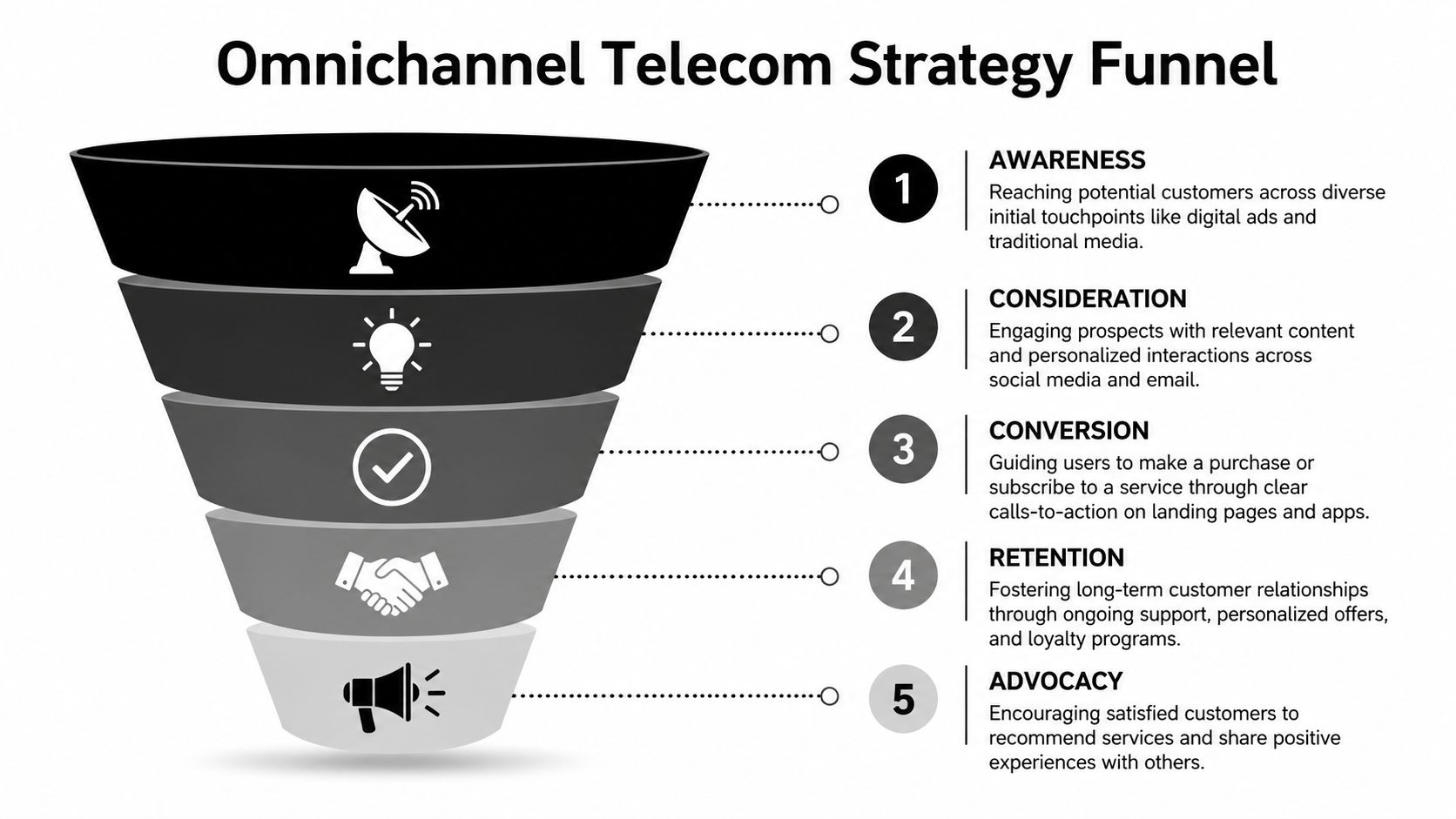
When teams get this wrong, they overload one route. Paid search gets forced to generate enterprise demand. Email gets asked to do the work of product marketing. Sales outreach starts before the account has enough context. The result is friction at every stage.
A stronger approach is to assign channels based on buying motion, urgency, and deal value. If you need a useful framing for how to personalize experiences with omnichannel, think less about “being everywhere” and more about maintaining message continuity across touchpoints.
Which channel fits which job
Here’s the practical comparison.
| Channel | Best use in telecom | Strong fit | Weak fit |
|---|---|---|---|
| SEO | Capturing active demand and building category authority | High-intent solution searches, educational content | Urgent pipeline targets |
| PPC | Fast demand capture around defined commercial terms | Competitive searches, local offers, service-line pages | Broad awareness without a conversion path |
| Content marketing | Explaining technical value and reducing buying risk | Enterprise education, trust building, sales enablement | Generic blog production with no distribution plan |
| ABM | Pursuing named accounts with high contract value | Enterprise telecom, managed services, strategic upsell | Low-value, high-volume consumer acquisition |
| Cold email and SMS | Direct response and follow-up | B2B outreach, reminders, service alerts, targeted offers | Undifferentiated mass blasts |
The mistake isn’t choosing the wrong channel in isolation. It’s expecting one channel to do everything.
SEO and PPC are not substitutes
SEO is a long-route asset. PPC is a fast route with a meter running. Both matter, but they solve different problems.
SEO works best when your buyers actively research categories, vendors, migration questions, security implications, and implementation scenarios. In telecom, those pages often carry more value than top-of-funnel thought pieces because they catch demand that already exists.
PPC is better when intent is clear and the offer is tightly mapped to search behavior. It’s especially useful for local service availability, business internet, managed voice, UCaaS, and competitor-alternative campaigns. But PPC becomes expensive waste when landing pages are vague or when the team hasn’t narrowed the audience enough.
The landing page is your edge router. If it sends every visitor to the same destination, don’t blame the traffic source for poor conversion.
Content marketing and ABM work well together
Content by itself rarely closes complex telecom deals. Content inside an ABM motion often does.
For enterprise accounts, publish and deploy materials that answer objections before sales calls. That can include migration checklists, deployment explainers, billing consolidation pages, integration briefs, and service comparison content written in plain business language. The content does not need to be flashy. It needs to reduce uncertainty.
ABM then wraps distribution around that asset set. Marketing selects accounts, maps buying roles, and serves context-specific messages to each stakeholder. One account might need operations-focused emails for IT, commercial value framing for finance, and procurement-ready summaries for sourcing.
Automation helps. A structured 2026 B2B marketing automation strategy becomes useful when it routes the right asset to the right role instead of merely increasing send volume.
SMS deserves a specific role
Telecom teams sometimes underuse SMS because it feels too tactical. That’s a mistake. By 2025, 84% of consumers globally opted into business texts, SMS click-through rates reached 21% to 35%, conversion rates hit 20% to 30%, and businesses using SMS reported 5.89 times greater digital marketing success, according to SimpleTexting’s 2025 SMS marketing statistics.
That doesn’t mean you should push every offer through text. It means SMS is strongest where immediacy matters.
Use it for:
-
Service updates: Outages, appointment reminders, install windows, account notices.
-
Retention nudges: Timely offers tied to behavior or contract moments.
-
High-intent follow-up: Warm prospects who have already shown clear engagement.
Don’t use it as a substitute for segmentation or message quality. A bad message sent faster is still a bad message.
A workable omnichannel sequence
For a B2B telecom offer, a disciplined flow often looks like this:
-
Awareness through search or paid targeting
-
Consideration through role-specific content
-
Direct outreach to named stakeholders
-
Sales conversation supported by technical and commercial proof
-
Post-sale retention through service communication and expansion messaging
For a B2C offer, the same logic applies but with shorter cycles and tighter behavioral triggers.
The important part is orchestration. Your channels should reinforce one another, not compete for credit.
Unlocking Growth with Advanced Micro-Segmentation
Most telecom databases look complete until you try to use them. You have plan type, geography, maybe device class, maybe billing status. That’s enough for broad reporting. It’s not enough for precision marketing.

That gap is why micro-segmentation matters so much in telecom. Broad segmentation is a radio tower. It throws the same signal across a wide area and hopes the right people tune in. Micro-segmentation is fiber. It delivers a cleaner signal to a specific destination with less loss along the way.
The business case is strong. Telecoms could lift profitability by 15% to 25% through micro-segmentation, according to Eastwind’s analysis of telecom marketing challenges. The same source points to the actual failure mode. Many operators still rely on shallow SIM-purchase data and miss social, geographic, and usage insights that AI-driven analytics can surface.
What shallow segmentation misses
A standard segment might be “business customers in a metro region” or “subscribers on family plans.”
That’s too broad to drive serious relevance. Within those groups, needs differ sharply. One SMB buyer may care about call reliability across field teams. Another may care about billing consolidation across locations. Another may care about backup connectivity because downtime affects transaction volume.
The same issue shows up in consumer programs. Two users can share the same plan but behave differently enough to require different retention offers.
Useful micro-segmentation pulls from multiple signals, such as:
-
Usage behavior: Data intensity, roaming patterns, service mix, support contact frequency
-
Commercial signals: Contract stage, invoice sensitivity, add-on history, bundle adoption
-
Contextual inputs: Geography, business type, branch footprint, device environment
-
Engagement data: Which content they read, which offers they ignore, how they respond to outreach
If you sell into business accounts, this guide to understanding B2B customer behavior is worth reviewing because behavioral segmentation often reveals intent that firmographics alone won’t show.
Broad segments explain who a buyer is. Micro-segments explain what that buyer is likely to do next.
How to build segments people can act on
The goal isn’t to create dozens of beautiful segments in a workshop. The goal is to give marketing, sales, and retention teams clear routing logic.
A useful micro-segment should answer three questions:
-
What makes this group distinct?
-
What message is most likely to matter to them?
-
What action should we ask for now?
Here’s a simple way to think about it.
| Segment type | Signal cluster | Message angle | Likely next action |
|---|---|---|---|
| High-usage mobile professionals | Heavy data use, frequent travel, premium device mix | Reliability, seamless high-speed access, roaming confidence | Upgrade or premium plan consideration |
| Multi-site SMBs | Several locations, service fragmentation, finance involvement | Consolidation, predictable billing, simpler support | Discovery call |
| At-risk support-heavy accounts | Repeated support issues, declining engagement, contract sensitivity | Dedicated resolution path, retention offer, confidence rebuild | Save conversation |
| Underpenetrated business accounts | One service line only, healthy fit, low engagement so far | Cross-sell based on operational need | Expansion outreach |
Now make the segment visible in tools people use. If the sales team can’t filter for it in the CRM, and if automation can’t trigger around it, it’s just strategy theater.
What this looks like in practice
Here’s a useful explainer before you operationalize the model:
In practice, strong micro-segmentation usually starts with one commercial objective, not a huge data project. Pick one. Retention. Cross-sell. Enterprise expansion. SMB acquisition. Then identify the smallest set of signals that meaningfully improves targeting.
A common mistake is waiting for perfect data hygiene. Don’t. Start with the fields you trust, enrich where possible, and test message differences against segment logic.
Where telecom teams get stuck
The obstacles are familiar:
-
Data trapped in silos: Billing, support, product usage, and CRM records don’t speak the same language.
-
Segments too abstract: Marketing creates labels that sales ignores.
-
No offer alignment: Teams identify micro-segments but keep sending generic promotions.
-
No learning loop: Campaign performance doesn’t feed back into segment refinement.
A more disciplined segmentation model often begins with a simple framework and grows from real performance. If you need a tactical starting point, this B2B customer segmentation blueprint is a sensible reference because it forces segmentation to tie back to outreach and revenue, not just analysis.
The Modern Telecom Tech Stack and Measurement Framework
A telecom marketing stack should work like a layered network architecture. Each component has a role. If one layer fails, the whole system degrades. The CRM can’t compensate for weak identity resolution. Marketing automation can’t fix bad audience logic. Analytics can’t rescue campaigns that were poorly structured from the start.
The practical objective is simple. Give your team one version of account truth, one operational path for campaign execution, and one measurement model tied to revenue behavior.
What each system should do
CRM holds commercial memory
Your CRM should answer operational sales questions fast. Who owns the account. What products they use. Which stage the opportunity is in. Which stakeholders are involved. What happened last. What should happen next.
If reps need to search across notes, inboxes, and spreadsheets just to understand account status, the CRM isn’t functioning as a system of record. It’s functioning as storage.
CDP unifies customer behavior
Many telecom teams either overbuy software or underbuild capability. A customer data platform, or CDP, should unify behavioral, transactional, and engagement data across channels and systems. That creates the 360-degree view marketers keep talking about but rarely operationalize.
According to JeffreyAI’s telecom sales and marketing analysis, CDPs integrated with CRM systems enable that 360-degree view of customer behavior. The same source notes that telcos using machine learning in these environments to predict churn achieve 25% better lifetime value and can reduce churn by up to 15% through proactive personalized retention offers.
That’s the difference between seeing what happened and acting before revenue erodes.
Your CRM tells you what the account is. Your CDP tells you how the account behaves. You need both.
Marketing automation runs orchestration
Automation should handle sequencing, suppression, trigger logic, lifecycle routing, and handoff timing. It should not be treated as a machine for sending more emails.
In telecom, the best automation setups usually support:
-
Lifecycle communication
-
Segment-triggered outreach
-
Sales alerts based on meaningful behavior
-
Retention and expansion workflows
When automation gets noisy, buyers feel chased. When it gets precise, it feels helpful.
Analytics makes attribution usable
Most dashboards answer easy questions. Impressions. clicks. opens. leads. Those aren’t useless, but telecom teams need sharper commercial views.
Good analytics should help you answer:
-
Which accounts moved toward revenue, not just engagement
-
Which channels influence retained customers, not just new inquiries
-
Which offers lower churn risk
-
Which segments expand faster after acquisition
The KPIs that matter more than the vanity layer
Not every telecom business uses the same metric mix, but a few measures consistently matter.
| KPI | Why it matters | Which system informs it most |
|---|---|---|
| Churn | Reveals retention failure and service-risk patterns | CDP plus analytics |
| LTV | Shows long-term value by segment and acquisition source | CRM plus CDP |
| CAC | Keeps growth efficient | CRM plus attribution reporting |
| ARPU | Indicates expansion quality and pricing strength | Billing data plus analytics |
| Qualified pipeline | Connects marketing effort to sales reality | CRM |
The trap is watching top-of-funnel metrics while contract value deteriorates, churn worsens, or low-fit deals overload support.
A lean measurement model
You don’t need a massive measurement framework to improve telecom marketing. You need a disciplined one.
Use a three-layer review:
-
Acquisition efficiency - Which channels bring in qualified accounts - Which messages convert to conversations
-
Commercial quality - Which segments generate stronger fit - Which offers create expansion potential
-
Retention health - Which signals predict dissatisfaction - Which interventions hold value
That model forces teams to connect campaign execution to business behavior. If a campaign drives form fills but attracts low-fit accounts that churn early or stall in procurement, it didn’t perform. It just looked active.
Actionable Outreach Playbooks for Telecom Buyers
Telecom outreach fails when it sounds like telecom outreach. Too much jargon. Too many feature lists. Too many messages that feel copied from a vendor brief. Buyers see them and delete them because nothing in the note proves the sender understands their environment.
The better outreach playbooks do three things well. They identify a narrow buyer. They frame one commercial problem clearly. They make the next step easy.
Playbook one for cold email to a B2B telecom buyer
Start with a narrow target. Don’t build a list called “telecom companies.” Build one around specific contexts. Regional carriers expanding business services. Managed service divisions selling voice and connectivity. Telecom-adjacent SaaS firms selling into network operations, support, billing, or field service teams.
Then write to one pain point per sequence.
A solid cold email doesn’t need to explain your whole company. It needs to earn a reply.
| Email Component | Example Content |
|---|---|
| Subject line | Reducing support load across business connectivity accounts |
| Opening line | Noticed your team is expanding business service visibility across multiple product lines. |
| Problem statement | Many telecom teams struggle to market complex service portfolios without pushing generic messages that blur together. |
| Relevance hook | That usually shows up as low response from mid-market buyers who need a clearer business case, not more plan details. |
| Offer | We help teams sharpen account selection and outreach so sales speaks with better-fit buyers. |
| CTA | Open to a short conversation next week to compare notes on what’s converting now? |
A few working rules matter more than templates:
-
Keep the scope narrow: One audience, one pain, one ask.
-
Use buyer language: Say “billing complexity,” “service rollout,” or “multi-site coordination” if that’s what the buyer deals with.
-
Avoid fake personalization: Mentioning a generic company fact isn’t insight.
-
Write for forwarding: The message should make sense when sent internally to another stakeholder.
If your team needs a repeatable framework for list building, copy structure, and sequencing, this guide on how to cold contact is practical because it focuses on clarity and response, not theatrics.
Playbook two for enterprise ABM sequences
ABM in telecom works best when the account is valuable enough to justify multi-threading. If the contract could affect regional growth, product adoption, or long-term retention value, invest in account depth.
A workable ABM sequence often looks like this:
-
Account selection - Identify accounts with strategic fit, not just recognizable logos. - Use service fit, footprint, commercial timing, and organizational complexity.
-
Stakeholder mapping - IT, operations, finance, procurement, business unit leadership. - Don’t assume one champion can carry the deal.
-
Message branching - IT gets migration and integration language. - Finance gets cost structure and risk control. - Operations gets service continuity and team impact.
-
Touch orchestration - Email, LinkedIn, targeted content delivery, follow-up call, meeting ask. - Every touch should add context, not repeat the first one.
-
Sales enablement - Give reps short account briefs, likely objections, and role-specific proof points.
This isn’t about volume. It’s about reducing friction inside a complex buying group.
The best ABM campaigns feel less like promotion and more like informed coordination around a buyer’s internal decision process.
Playbook three for B2B influencer-assisted outreach
This is the most underused play in telecom. B2B buyers in tech consume 3 to 5 pieces of content from influencers before contacting a vendor, and using telecom-specific influencer endorsements in outreach could boost response rates by 30% to 50%, according to Martal’s telecom lead generation analysis.
Most telecom teams hear “influencer” and think consumer social campaigns. Wrong frame. In B2B telecom, the influencer is often a credible analyst, network expert, implementation specialist, or category voice with actual trust among operators and technical buyers.
A good influencer-assisted sequence looks like this:
-
Step one Identify a narrow topic where third-party authority matters, such as 5G use cases, network modernization, enterprise mobility risk, or service delivery quality.
-
Step two Reference a relevant piece of thought leadership from a trusted telecom voice in your outreach. Don’t force a celebrity angle. Use domain credibility.
-
Step three Connect that outside perspective to your offer with restraint. The goal is to show market understanding, not borrow prestige.
Example line:
A lot of teams are rethinking how they position managed connectivity because buyers are hearing more from analysts about operational resilience than raw speed claims. That shift changes what gets attention in outreach.
This works because third-party context lowers defensiveness. The note feels less like a pitch and more like a conversation inside a category the buyer already follows.
What usually does not work
In telecom, the weakest outreach patterns are painfully consistent.
-
Feature dumping: Buyers don’t need every capability in email one.
-
Claim inflation: “Best-in-class” means nothing without context.
-
Mass outreach to mixed personas: Finance and IT do not respond to the same trigger.
-
Weak next steps: “Let me know if interested” is not a real call to action.
A better outreach standard
Every outbound campaign should pass this test:
| Check | Question |
|---|---|
| Audience fit | Is this written for one clear role or account type? |
| Pain clarity | Is there one defined commercial or operational problem? |
| Credibility | Does the message show real category understanding? |
| Friction | Is the ask small enough for a busy buyer to accept? |
If the answer is no to any of those, rewrite before launch.
Conclusion Connecting Your Marketing to Business Growth
The future of marketing in telecommunications isn’t broader reach. It’s cleaner routing.
Telecom firms already operate in a market with enormous demand, but demand alone doesn’t create efficient growth. Precision does. The teams that outperform usually understand their buyers at a deeper level, assign channels to the right jobs, build segments from actual behavior, and measure what affects revenue quality instead of what flatters dashboards.
That’s the core shift. Stop treating marketing like a loudspeaker. Start treating it like network design.
The strongest telecom marketers do a few things differently. They know which accounts deserve direct outreach and which belong in scalable nurture. They stop sending the same message to buyers with different stakes. They use their stack to create operational visibility, not just campaign output. And they build programs that help sales enter conversations with context instead of hope.
There’s also a useful discipline in what they ignore. They don’t chase every new channel because a competitor tried it. They don’t confuse activity with throughput. They don’t assume broad personalization tokens equal relevance. They tighten the path between insight, message, and action.
Better telecom marketing usually starts with one hard decision. Narrow the audience before you widen the channel mix.
If you take one step from this guide, make it concrete. Pick one playbook and launch it in the next 30 days. Not three. One. A micro-segmented retention flow. A tighter ABM sequence for named enterprise accounts. A rewritten cold email campaign for telecom buyers. Any of those will teach you more than another planning session.
That’s how telecom marketing improves in practice. One better route at a time.
If you want help turning this into booked pipeline, Fypion Marketing helps B2B companies run performance-driven cold outreach with a pay-per-meeting model. No upfront fee, no retainer, no setup cost. Just qualified meetings that match pre-agreed criteria, built on targeted research, personalized messaging, customized contact lists, and ongoing optimization.