
Master Natural Language Generation: B2B Outreach 2026
Your team knows generic outreach is dead. Reps can’t keep sending the same three templates and expect senior buyers to respond. But the alternative often feels worse. Manual personalization eats hours, slows the pipeline, and turns outbound into a research project instead of a revenue system.
That’s the trap many B2B teams are in right now. Marketing wants relevance. Sales wants volume. Operations wants consistency. Nobody wants a process where one rep can write five thoughtful emails before lunch, while another sends fifty bland ones that sound copied from a prompt.
Natural language generation proves useful. Not as a buzzword. Not as a generic AI layer. As a practical way to turn prospect data, account context, and message strategy into outreach that sounds specific enough to earn attention and structured enough to scale.
For cold email, that matters. The win isn’t “more content.” The win is better first touches, sharper follow-ups, and messaging that reflects the buyer’s world without forcing your team to handcraft every sentence. If your current process still relies on static templates, a good primer on how to cold contact prospects effectively makes the problem obvious fast. Relevance is the difference between a booked conversation and another ignored sequence.
The End of Generic Outreach
A sales director at a growing SaaS company usually sees the same pattern. The team builds a list, writes a sequence, and launches with confidence. A week later, replies fall into predictable buckets. No response. “Not relevant.” “Why are you emailing me?” Occasionally, one message lands, usually because a rep happened to mention something timely about the prospect’s market, hiring push, product launch, or revenue motion.
That’s the key issue. Most outreach programs don’t fail because teams lack effort. They fail because the process can’t produce relevance at scale.
Where the bottleneck shows up
Manual personalization works, but it doesn’t scale cleanly. A rep can review a prospect’s LinkedIn activity, homepage messaging, job post, and product positioning, then write a strong intro. That approach is good for strategic accounts and terrible for throughput.
Template-heavy outreach scales, but it collapses into sameness. The message may mention an industry or job title, yet still feel interchangeable. Buyers can tell.
Practical rule: If the opening line could be swapped across twenty accounts with no loss of meaning, it isn’t personalized. It’s segmented.
Natural language generation changes that trade-off. It lets teams feed real inputs into a system and generate first drafts that reflect actual context. For outreach, that might include firmographic data, recent company news, CRM notes, pain-point hypotheses, or a prospect’s public content. The result isn’t magic. It’s structured text generation aimed at a narrow business goal.
Why this matters for pipeline, not just productivity
The strongest use of natural language generation in outbound isn’t replacing sales judgment. It’s removing the low-value writing burden that keeps good strategy from reaching enough prospects.
Used well, it can help teams:
-
Write better opening lines that reference a buyer’s role, company motion, or market context
-
Adapt one offer across segments without rewriting every sequence from scratch
-
Keep messaging consistent across SDRs, agencies, and growth teams
-
Speed up iteration when a market angle changes and the sequence has to change with it
That’s the operational shift. Instead of choosing between quality and quantity, you design a system that supports both.
What Is Natural Language Generation Really
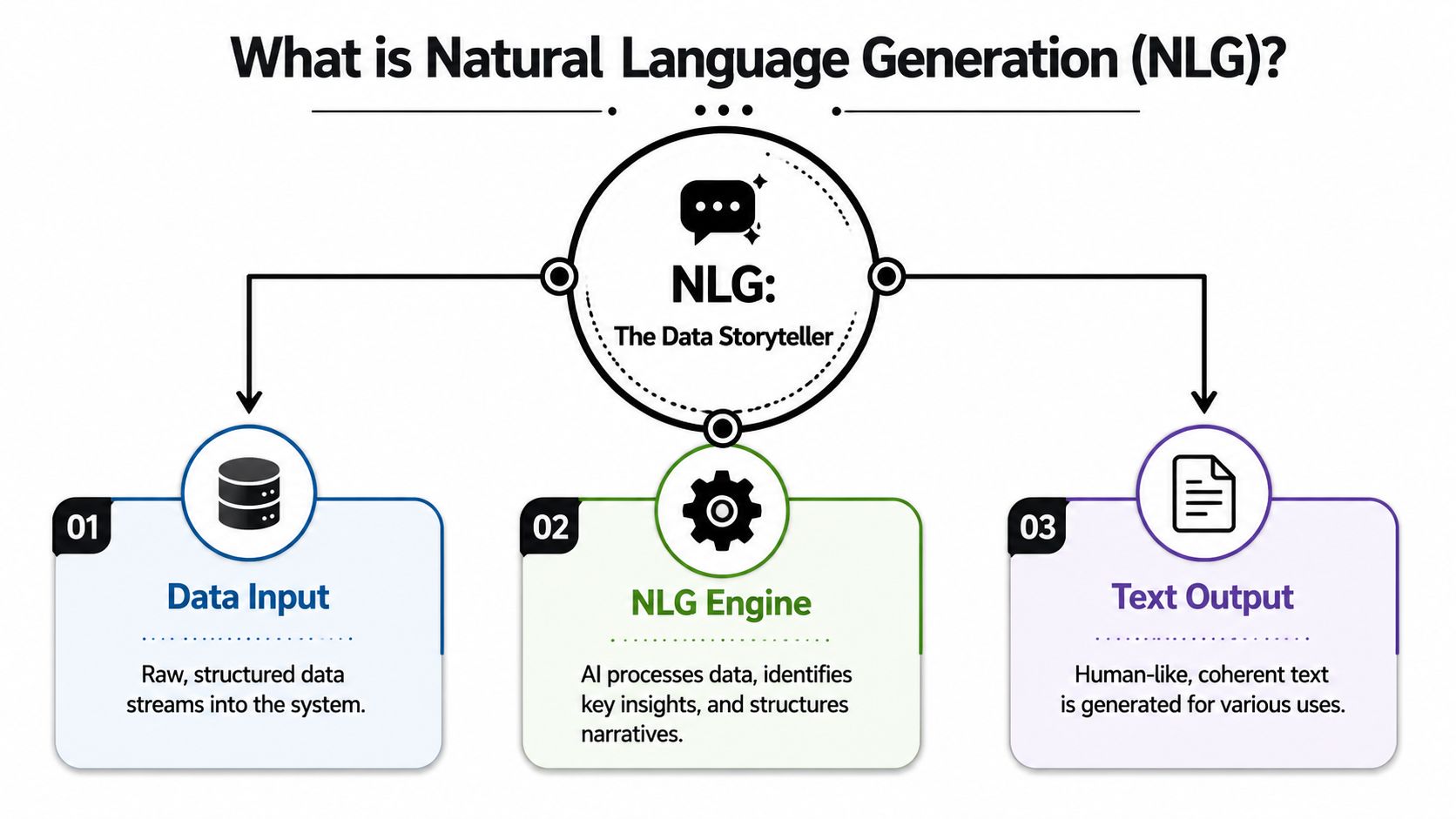
At its simplest, natural language generation is a way for machines to turn data or inputs into human-readable language. For a B2B team, that means taking structured information about a prospect and transforming it into a sentence, paragraph, or sequence that sounds like a person wrote it with intent.
A useful way to think about it is this. NLG is a data translator. It looks at signals such as company size, funding stage, role, category, hiring activity, CRM history, or website copy, then expresses those signals as language a buyer can read. In outreach, that translation might become a custom opener, a customized value proposition, or a follow-up that reflects previous engagement.
Where NLG fits in the AI stack
Teams often blur several terms together. It helps to separate them.
-
Natural language processing is the broad field focused on how systems handle human language
-
Natural language understanding focuses on interpreting meaning, intent, or structure
-
Natural language generation focuses on producing the output
If you’re reviewing LLM applications and business implications, that framing becomes useful quickly. Large language models often power modern generation systems, but the business problem still comes first. You’re not buying “AI.” You’re deciding how a system should write.
Why modern NLG feels different
A foundational milestone for natural language generation was Alan Turing’s 1950 paper Computing Machinery and Intelligence, which helped establish the idea that machines could imitate human thinking and language behavior. The field later moved from symbolic and rule-based methods in the 1950s and 1960s toward statistical approaches in the 1990s, then into deep learning systems that define the current era, including models such as GPT-4, according to this overview of NLG’s evolution.
That history matters because it explains why older automation felt rigid and why newer systems can sound more fluid. Early systems followed explicit instructions. Modern systems can generate more flexible, varied text from broader input.
For outreach teams, this changes what’s possible. You no longer need a giant library of frozen templates to produce variation. You can build workflows that generate language from prompts, account notes, PDFs, CRM fields, and other inputs. That’s one reason so many teams evaluating AI tools for go-to-market work now treat writing systems as part of the revenue stack, not just the content stack.
Natural language generation matters when the business needs language that adapts to context, not just language that fills blanks.
Three Core Approaches to NLG Explained
Not all natural language generation systems work the same way. If you’re deciding how to apply NLG to outbound, it helps to understand the three main approaches because each one creates different trade-offs in control, flexibility, and output quality.
Rule-based systems
Rule-based NLG is the closest thing to an advanced Mad Libs engine. You define the logic, the wording options, and the conditions. Then the system assembles text according to those rules.
In B2B outreach, that might look like this: if the prospect is in fintech, use pain point A. If they recently hired sales leadership, reference scaling motion B. If the company is enterprise-focused, use proof theme C.
This approach is strong when consistency matters more than range. Teams use it when they need compliance, fixed structure, or precise messaging control. The downside is obvious after a while. The output starts to feel narrow, repetitive, and hard to maintain as edge cases grow.
Statistical systems
Statistical NLG came from the shift toward models that learned patterns from data instead of relying only on handcrafted rules. A simple way to think about it is as a master predictor. It estimates what wording is most likely to fit based on prior language patterns.
For outreach, this method improved flexibility compared with rigid templates, but it still depended heavily on observed patterns rather than deep contextual fluency. It was useful, but often less capable in nuanced business messaging than what teams expect today.
Neural systems
Neural NLG is widely understood as modern AI writing. These systems act more like a creative apprentice. They can work from prompts, examples, and source inputs to generate text that feels more natural and varied.
That makes them powerful for personalized outreach. They can take account context and write multiple plausible openings, angle a message toward different stakeholders, or adapt tone for an executive versus an operator. But that flexibility comes with risk. The same system that can produce strong language can also drift off-brief, overstate a claim, or sound polished while missing the actual buyer context.
If your team has struggled with AI copy that sounds smooth but still feels synthetic, this guide on how to fix robotic ChatGPT with Humantext.pro is useful because it gets into the practical writing layer, not just the model layer.
Comparison of Natural Language Generation Approaches
| Approach | How It Works | Pros | Cons | Best For |
|---|---|---|---|---|
| Rule-based | Uses predefined logic, templates, and conditions | Strong control, predictable outputs, consistent phrasing | Limited flexibility, repetitive variation, heavier maintenance over time | Regulated messaging, narrow outbound playbooks, highly standardized follow-ups |
| Statistical | Learns language patterns from data and predicts likely phrasing | More flexible than rigid rules, useful pattern recognition | Less adaptable than newer systems, weaker nuance in complex messaging | Legacy systems, constrained generation tasks, structured summary writing |
| Neural | Generates text from prompts, examples, and contextual inputs | Fluent output, wider variation, better handling of context | Can drift, overgeneralize, or sound polished without being accurate | Personalized outreach, first-draft generation, multivariate message testing |
Which one works for cold email
For most outbound teams, the answer isn’t ideological. It’s operational.
-
Use rules when you need message discipline, hard constraints, and approved language blocks.
-
Use neural generation when you need flexible intros, account-specific framing, or rapid variation.
-
Use hybrid setups when you want both. Fixed value prop, flexible opener. Fixed CTA, flexible body. Fixed compliance language, variable industry framing.
That hybrid model is usually what works in practice. The best cold email systems don’t ask AI to invent the strategy. They ask it to express a strategy across many prospects without flattening every message into the same template.
How an NLG System Actually Works The Pipeline
Generated text is often treated as if it appears in one step. It doesn’t. A workable natural language generation system is a pipeline, and the quality of the final email depends heavily on what happens before a single sentence is written.
The system decides what to say first
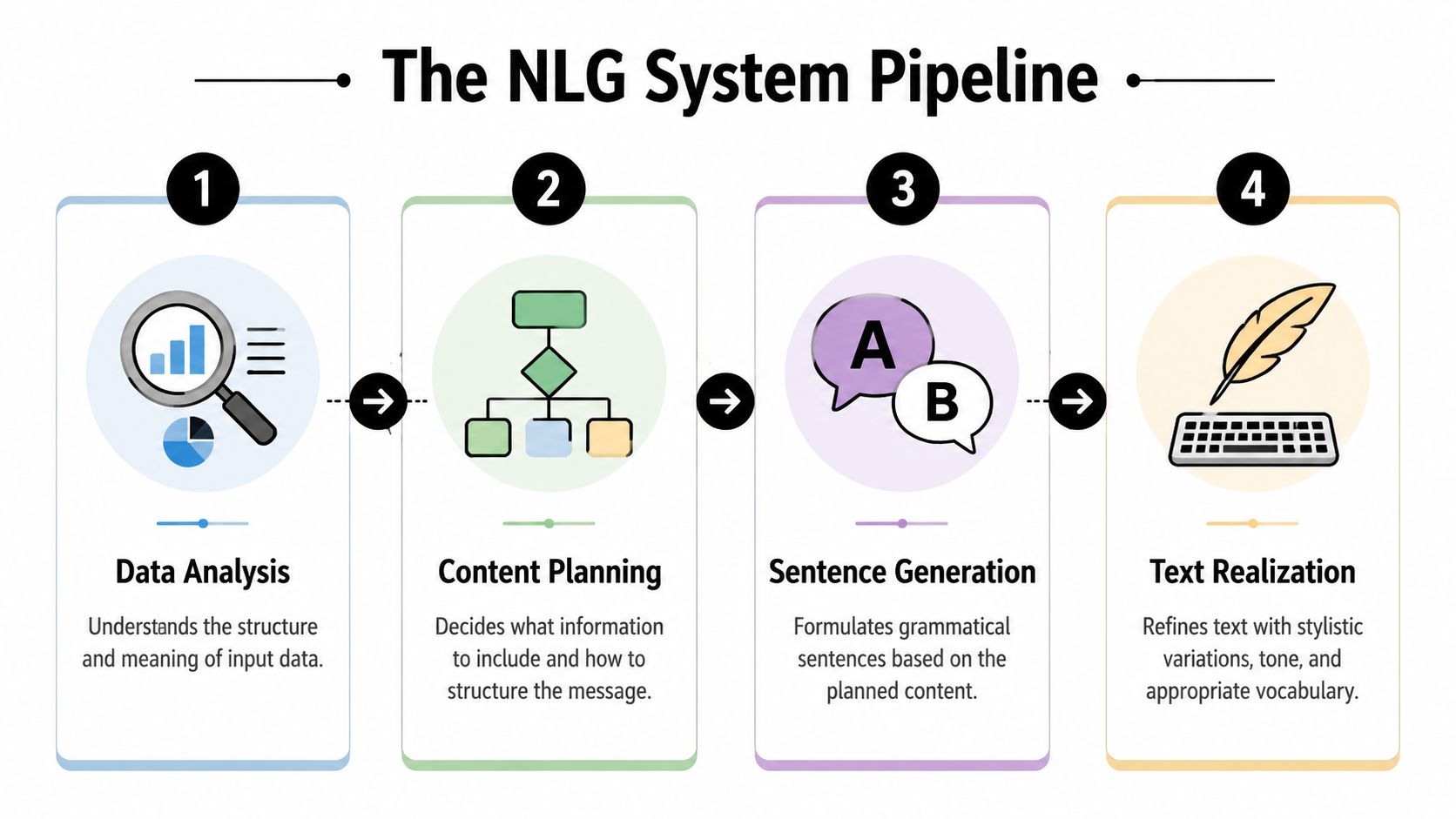
Modern NLG is commonly broken into stages such as data analysis, document planning, sentence aggregation, and grammatical structuring, and the key operational point is that the system must choose what to say before deciding how to say it. When content selection goes wrong early, those errors carry through and weaken the final output, as described in Qualtrics’ overview of the NLG pipeline.
For cold outreach, that means a bad input choice creates a bad email, even if the sentence sounds polished. If the system latches onto the wrong company signal, overweights a generic pain point, or misses the buyer’s actual motion, the draft will feel irrelevant no matter how smooth the wording is.
A practical pipeline for outbound teams
A useful mental model for B2B outreach looks like this:
-
Data analysis The system reads source inputs. That could include company descriptions, CRM fields, website copy, category tags, hiring patterns, case study matches, or notes from prior touches.
-
Content planning The system prioritizes the message. Which idea matters most for this recipient right now? A market challenge, a growth signal, a workflow problem, or a role-specific pressure?
-
Sentence generation The selected content becomes language, with the system producing candidate phrasing for the opener, body, transition, and CTA.
-
Text realization The draft gets shaped for tone, clarity, grammar, and style. At this stage, “clear and direct” becomes “appropriate for a VP of Sales at a cybersecurity firm.”
Strong outreach systems fail less often because they narrow the decision space before generation starts.
Why this matters in implementation
Many teams troubleshoot the wrong layer. They keep rewriting prompts when the underlying issue is input quality or planning logic.
If your generated messages sound off, check these first:
-
Source quality: Are the CRM fields clean, recent, and relevant?
-
Signal hierarchy: Does the system know which account details should matter most?
-
Audience mapping: Is it writing for the actual persona, not a generic business reader?
-
Workflow fit: Does the generated draft connect to your broader sales process flowchart and handoff logic?
That’s the operational truth. Natural language generation doesn’t rescue a weak outbound strategy. It amplifies whatever logic you feed into it.
Putting NLG to Work B2B Use Cases That Drive Leads
The most valuable NLG use cases in B2B aren’t broad. They’re narrow, repetitive, and commercially important. Cold outreach fits that perfectly because teams need high message quality across a large set of accounts, and they need it every week.

Personalized openers without manual research overload
A common outbound problem looks like this. The offer is solid. The target account is a fit. The rep still opens with a sentence that could apply to hundreds of companies.
NLG can improve that first touch by turning account signals into custom lead-ins. For example, instead of “I help SaaS companies improve pipeline,” the system can generate a first draft around a prospect’s recent hiring pattern, positioning shift, or public product emphasis. The rep reviews it, trims the fluff, and sends.
That’s not full automation. It’s guided personalization.
Dynamic proof that matches the buyer
Case studies often go unused in outbound because reps don’t have time to rewrite them for each vertical or persona. NLG solves that by creating customized summaries.
A cybersecurity prospect doesn’t need the same proof framing as a logistics buyer. One cares about trust, internal risk, and complexity. The other may care more about operational bottlenecks and response speed. A generation workflow can take the same underlying customer story and produce different versions of the proof block based on industry, role, or objection pattern.
That kind of adaptation matters in channels where every sentence has to earn space.
Follow-ups that don’t sound recycled
Teams typically underinvest in follow-ups because they’re hard to vary. Reps either resend the first message with minor edits or jump to awkward “just bumping this” language.
NLG helps here because it can generate follow-up drafts with different jobs:
-
Reframe the problem instead of repeating the pitch
-
Introduce a relevant proof point without dropping into brochure language
-
Acknowledge timing when the buyer may be interested later
-
Shift the CTA from meeting request to lightweight reply
For operators trying to reduce writing time around inbox work, this piece on efficient email with artificial intelligence is worth reading because it focuses on workflow shortcuts, not just content generation theory.
LinkedIn plus email is where this gets more interesting
A practical sequence often starts before the email itself. Teams monitor public signals, then use those signals to inform message generation. A prospect posts about hiring. Their company launches a new integration. Their site adds a new enterprise page. Those moments create better reasons to reach out.
That’s where a combined motion becomes powerful. Teams can use LinkedIn for B2B lead generation as a signal layer, then feed those signals into NLG workflows that produce sharper cold email intros and follow-ups.
The best NLG use cases in outbound don’t replace strategy. They let a good strategy show up consistently across more accounts.
Evaluating and Implementing Your First NLG Project
Most first NLG projects go wrong for one of two reasons. The use case is too broad, or the evaluation is too vague. “Let’s use AI in outbound” is not a project. “Generate first-draft openers for one ICP using approved positioning inputs” is a project.
What to evaluate first
You don’t need a research lab scorecard. You need business-facing checks.
Start with questions like these:
-
Accuracy: Does the message reflect the source data correctly?
-
Relevance: Does it speak to the account and role, or only sound polished?
-
Voice: Does it match how your brand writes?
-
Usefulness: Would a rep send this draft with light editing, or rewrite it from scratch?
For efficiency, research on human evaluation shows that carefully selected datapoints can reduce review burden. One TACL study found that a coverage-aware sampling approach needed only about 70% of the test set to preserve evaluation quality, which makes iterative tuning more practical when people still need to review output, as shown in the study on efficient human evaluation for generation tasks.
A clean pilot checklist
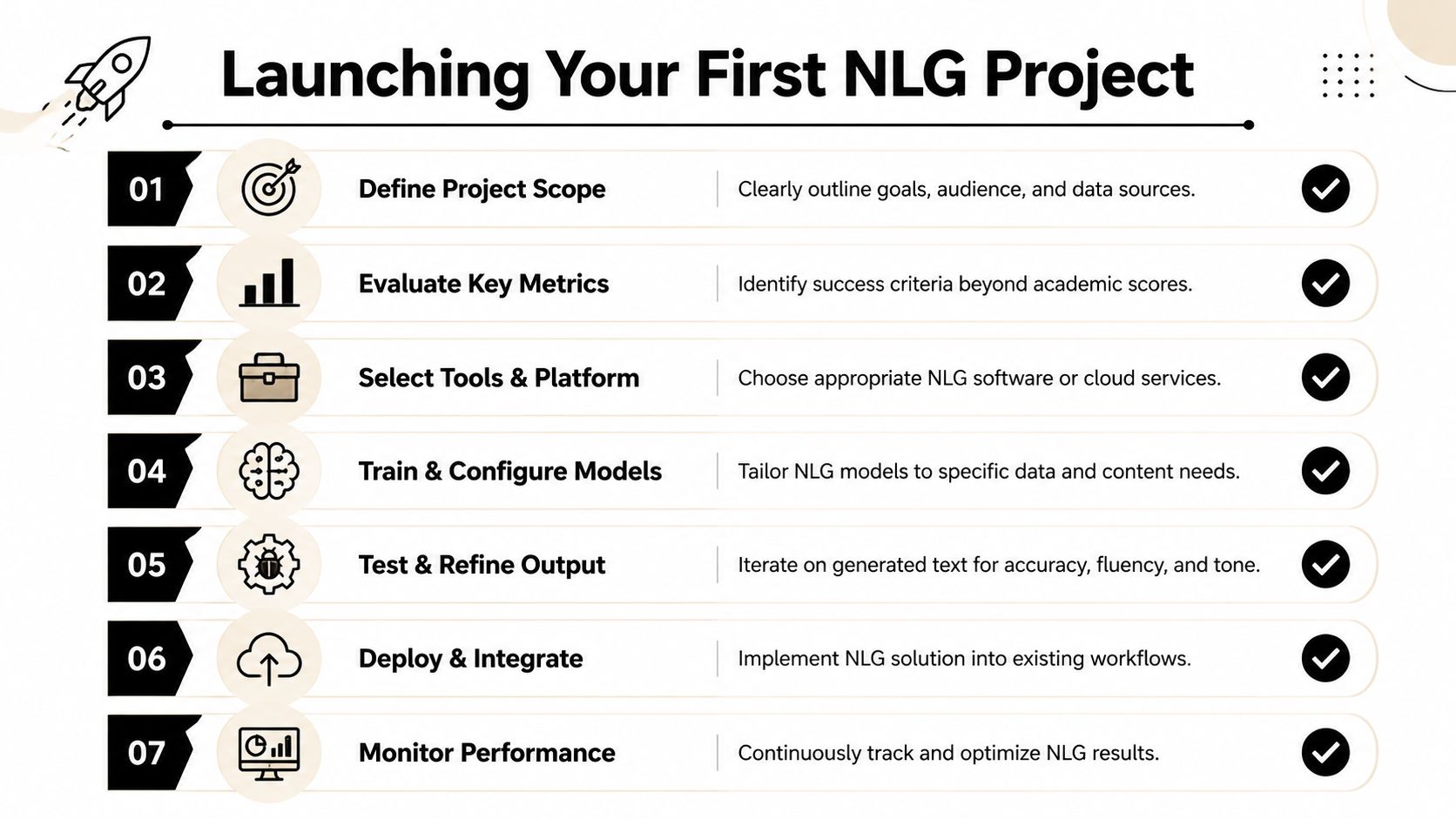
A practical rollout usually looks like this:
-
Pick one narrow job Don’t start with full-sequence generation across every persona. Start with one output, such as opening lines for a single segment.
-
Assemble reliable inputs Pull the data fields, approved claims, customer proof, and audience notes you trust. If the source material is inconsistent, the output will be inconsistent too.
-
Set drafting boundaries Decide what the model may generate freely and what must remain fixed. This matters a lot in outbound where offer language and claims need discipline.
-
Review with humans Have reps, marketers, or enablement leads score drafts for relevance and send-readiness.
-
Integrate with systems If the workflow will touch enrichment tools, sequencing software, or account records, map it into your existing CRM integration process early instead of after the pilot.
What usually works best
Pilot projects succeed when teams define “good” in operational terms. A good draft isn’t one that sounds impressive. It’s one that saves time without lowering quality, gives reps a strong starting point, and helps the team test more messaging angles with less friction.
Managing Risks and Planning Your Next Steps
Natural language generation is useful in outbound, but it isn’t low-risk by default. The biggest mistakes are usually easy to spot after the fact. The system invents a detail, overstates a claim, misses brand tone, or writes in a way that feels subtly wrong for the audience.
Risks worth managing early
The first risk is factual looseness. If the system generates details beyond the approved source inputs, your outreach can become inaccurate fast. The fix is straightforward. Keep high-risk claims locked down, use approved message components, and require human review for sensitive outputs.
The second risk is voice drift. A model can produce fluent language that doesn’t sound like your team. Strong prompt design helps, but a written style guide helps more. Give the system examples of what your brand sounds like, what it avoids, and how direct your CTA should be.
The third risk is fairness. Stanford Human-Centered AI notes performance drops across different English dialects in NLP, which matters for NLG because output quality, tone, and correctness can vary across audiences. For global teams, that creates a real inclusion and reliability issue, as discussed in Stanford HAI’s work on equity and English dialects.
Audit generated outreach across audience types, not just across campaigns.
Next steps that make sense
If you’re evaluating natural language generation for B2B outreach, keep it simple:
-
Start with one use case that sits close to revenue, such as personalized email openers or follow-up drafts
-
Constrain the system with approved inputs, message rules, and reviewer feedback
-
Measure real utility by whether reps use the drafts and whether the output improves workflow quality
Teams that win with NLG don’t chase novelty. They build controlled systems that help sales and marketing communicate with more precision, more consistently, and at a scale manual writing can’t support.
If your team wants to scale outbound without sacrificing personalization, Fypion Marketing can help you build a cold email engine around qualified meetings, not busywork. Their model is built for B2B companies that want sharp targeting, customized outreach, and performance aligned with actual sales outcomes.