
What Is Sales Pipeline Management: 2026 Guide
Revenue looks fine until the last two weeks of the quarter. Then the forecast starts slipping. A deal marked “commit” stops replying. Another one that seemed close turns out to have no budget approval. The CRM still shows plenty of pipeline, but the team can’t explain which opportunities are real and which ones are just occupying space.
That’s the moment many teams realize they don’t have a pipeline. They have a deal list.
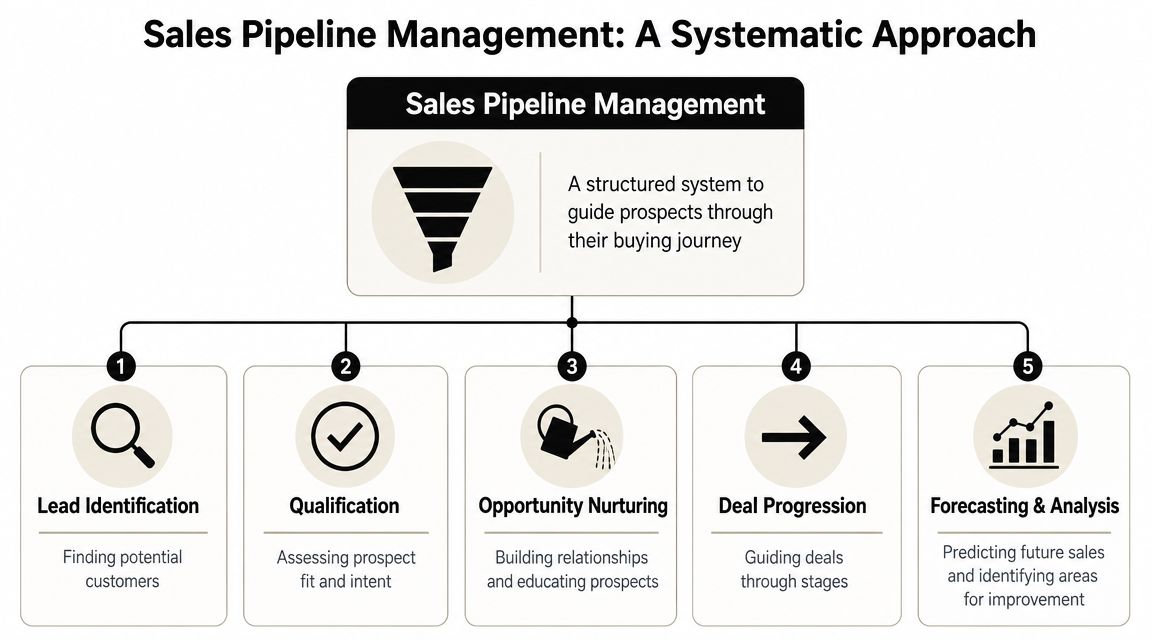
Sales pipeline management is what turns that list into an operating system. It gives leaders a way to track how opportunities move, spot where they stall, and improve the flow before misses show up in the number. It’s less about staring at dashboards and more about building a repeatable revenue machine with rules, gates, and accountability.
If you’re trying to bring order to an uneven quarter, it helps to start with a clear view of how a pipeline should be built. This practical guide to building a sales pipeline that supports revenue growth is a useful companion if your issue starts at the top of funnel.
Introduction From Unpredictable Quarters to a Reliable Revenue Engine
It usually starts in the forecast call. The CRM says coverage is fine, but the room goes quiet when a manager asks a simple question: which of these deals can close this quarter? A few opportunities are marked late stage, yet no one can confirm budget, decision process, or whether the buyer has done anything beyond asking for a price.
That is not a pipeline problem on paper. It is a stage-discipline problem.
In weak pipelines, reps advance deals based on activity. In healthy pipelines, deals advance based on evidence. A pricing request is not the same as a validated buying process. A good discovery call is not the same as access to the economic buyer. If stage exits are loose, the pipeline fills with what sales teams call happy ears. Deals sound promising, occupy forecast space, and then disappear when scrutiny goes up.
I have seen this across SaaS and services teams. Two reps can use the same CRM stage in completely different ways, which makes the forecast look more precise than it is. Once that happens, pipeline review turns into opinion management instead of operational control.
What is sales pipeline management really asking? It is asking how a company turns deal movement into something consistent, inspectable, and coachable.
The answer is broader than tracking opportunities from lead to closed won. Good pipeline management sets clear entry and exit rules for each stage, checks whether opportunities are aging in the right places, and forces the team to prove progress with buyer actions, not rep confidence. That matters even more now because buyers do more research before they talk to sales, and AI tools can flood the top of funnel with volume that looks promising but has not earned a place in the forecast.
A reliable revenue engine works like a production line. Each station needs a quality check before work moves downstream. If qualification is weak, the defect shows up later as a slipped commit, a stalled proposal, or a quarter-end scramble.
If your team needs tighter top-of-funnel structure as part of that fix, this guide to building a sales pipeline that supports revenue growth is a useful companion.
Defining Sales Pipeline Management Beyond the Deal List
A lot of explanations stop at “it’s how you track deals through stages.” That’s incomplete.
A better way to think about sales pipeline management is an assembly line. Leads are raw materials. Qualification is the first inspection station. Discovery, demo, proposal, and negotiation are workstations. Closed won is the finished product. If one station accepts bad input, the defect moves downstream and gets more expensive to fix.
Process beats visibility alone
A CRM gives you visibility. It does not create discipline on its own.
Sales pipeline management is the practice of moving opportunities through defined stages with rules for entry, rules for exit, and regular review of what advances, stalls, or dies. Historically, this discipline grew alongside CRM and data-driven forecasting, replacing judgment-only tracking with measurable stage analysis. Mural notes that standard formulas like opportunity-to-close rate = (closed-won opportunities ÷ total opportunities) × 100 and pipeline coverage ratio = total pipeline value ÷ target quota became part of modern sales operations, and that B2B funnels often convert at only 1% - 3% at the top, 10% - 15% in the middle, and 20% - 30% at the bottom in its overview of essential sales pipeline metrics.
Working definition: Sales pipeline management is the discipline of controlling how opportunities move through a staged selling process so revenue becomes measurable, coachable, and more predictable.
The deal list trap
A deal list answers one question. What opportunities are open?
A managed pipeline answers harder questions:
-
What counts as real progress: Did the buyer take a concrete step, or did the rep just have a promising conversation?
-
Where deals are getting stuck: Is discovery weak, are proposals going out too early, or is legal review slowing everything down?
-
Which forecasts you can trust: Are stage labels tied to evidence, or are they loose categories people interpret differently?
The biggest failure mode is the happy ears pipeline. That happens when teams count deals too early or leave them open too long without real buyer commitment. Salesforce calls out this problem directly in its discussion of sales pipeline management. When that happens, the CRM looks healthy while the business underneath it is not.
That’s why pipeline management isn’t a reporting exercise. It’s a quality-control system.
Anatomy of a Sales Pipeline The Core Stages and Their Gates
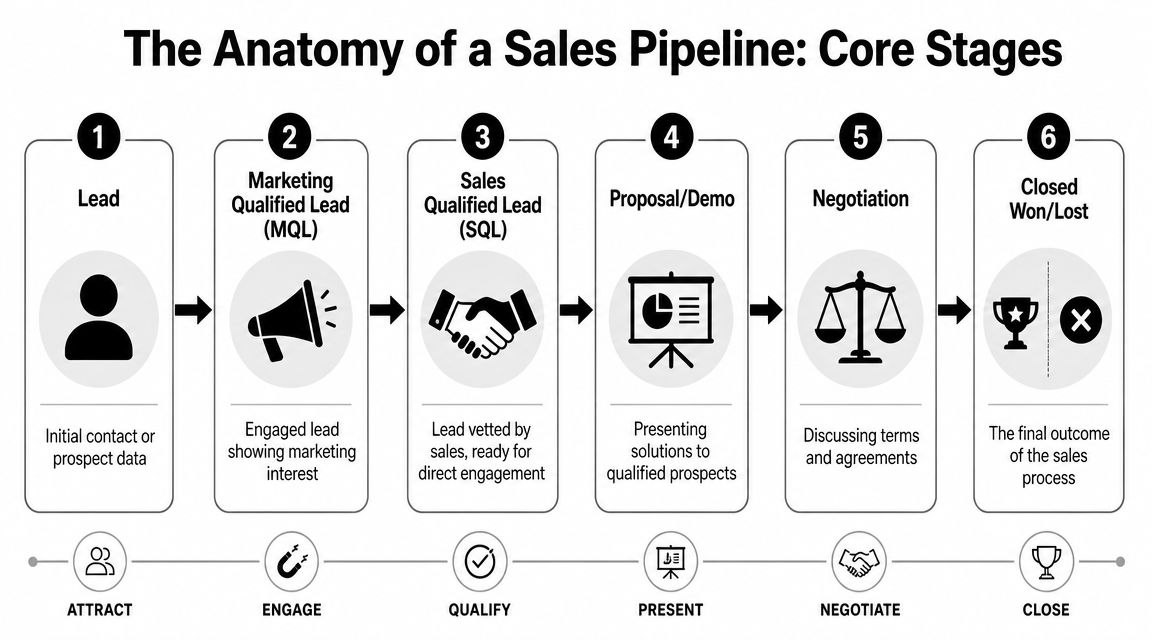
Most B2B pipelines use some version of the same core stages. What separates a useful pipeline from a bloated one is the gate between each stage.
Stage names matter less than exit criteria
You can call the stages Lead, MQL, SQL, Demo, Proposal, Negotiation, and Closed. Or use a simpler model. The labels matter less than whether every seller and manager interprets them the same way.
ZoomInfo’s guidance is the right standard here. Best-practice pipeline management requires clear stages with explicit entry and exit criteria tied to the buyer’s journey, which reduces stage drift and improves forecast integrity in its sales pipeline guide.
Here’s a practical structure that works for many B2B teams:
| Stage | What it means | Exit gate |
|---|---|---|
| Lead | A contact or account entered the system | Fits basic ICP criteria and has a reason to engage |
| MQL | Marketing engagement suggests potential interest | Sales accepts the lead for direct outreach |
| SQL | Sales has validated fit and need | Buyer confirms pain, use case, and a real next step |
| Proposal or Demo | The solution is being presented in context | Buyer reviews tailored solution with relevant stakeholders |
| Negotiation | Commercial terms are being worked through | Mutual path to signature is active |
| Closed Won or Lost | Outcome is final | Contract signed or opportunity formally closed out |
What good gates look like
The exit gate should be based on buyer action, not rep activity.
Bad gate: “Held intro call.”Better gate: “Buyer confirmed problem, relevant use case, and agreed to a scheduled next meeting.”
Bad gate: “Sent proposal.” Better gate: “Buyer reviewed a customized proposal and identified the commercial review path.”
If you want a simple way to tighten stage quality, write a one-line rule under each stage that starts with this phrase: A deal cannot move forward unless…
For example:
-
SQL to Proposal: A deal cannot move forward unless the buyer has validated the problem, the account fits your ideal customer profile, and a defined next step is scheduled.
-
Proposal to Negotiation: A deal cannot move forward unless the buyer has seen the proposed solution and engaged in a real commercial discussion.
-
Negotiation to Commit Forecast: A deal cannot move forward unless the buyer has a documented path to approval.
A visual sales process helps teams keep those gates consistent. If you need a model for mapping that flow, this sales process flowchart guide is useful for documenting stage logic across marketing, SDR, AE, and post-sale handoffs.
A short explainer can help your team align on the idea before you codify it in CRM:
What doesn’t work
Three habits break pipelines fast.
-
Stage inflation: Reps advance deals because the conversation felt positive.
-
Stage hoarding: Managers keep old deals open because removing them hurts the forecast.
-
Generic definitions: Every rep interprets “qualified” in a different way.
A pipeline should occasionally feel strict. That’s a good sign. A stage gate that disqualifies weak deals early saves time, preserves forecast integrity, and makes coaching much easier.
Measuring Pipeline Health The Four Vital Signs
The quarter usually goes off course long before the forecast misses. It starts with a pipeline review where late-stage deals look healthy, managers feel cautiously optimistic, and nobody asks whether those opportunities earned their stage. By the time that gap shows up in bookings, the team has already spent weeks working fiction.
Good pipeline measurement works like a factory control panel. It does not just show output. It shows where the line is slowing down, where bad inputs entered the system, and whether reported progress is real. For modern teams, that also means accounting for AI-assisted selling and buyers who do half their research before a rep gets on a call. A stage may look active in CRM while the buyer has already stalled out in self-service evaluation.
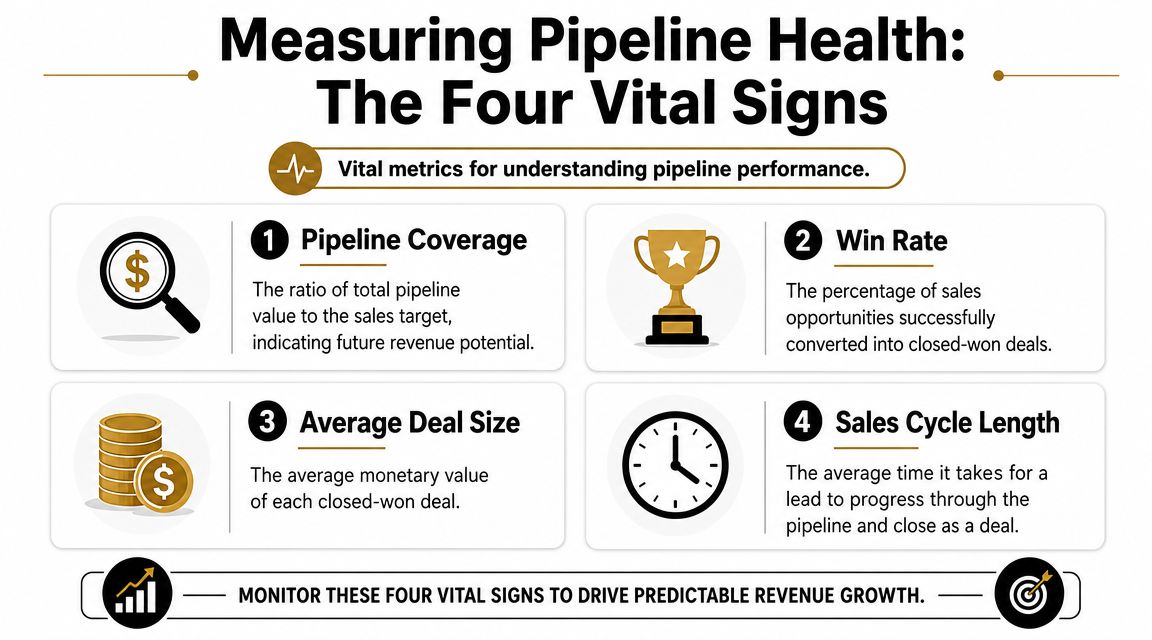
Pipeline coverage
Coverage measures how much opportunity value sits against target. The basic formula is total pipeline value ÷ revenue target.
The mistake is treating coverage as enough on its own. A rep can hit a healthy coverage number with bloated late-stage deals, weak qualification, or opportunities that moved forward on enthusiasm instead of evidence. That is how teams end up with a happy-ears pipeline. The number looks safe. The deals are not.
Review coverage by stage and by credibility. Ask two questions. How much pipeline exists, and how much of it has met the exit criteria for its current stage? If those answers diverge, forecast risk is higher than the headline number suggests.
Win rate and average deal size
Win rate shows whether the team is pursuing deals it can close. Average deal size shows whether those wins are large enough to support the plan.
These metrics need context. A higher win rate can come from selling only into easy, lower-value accounts. A larger average deal size can come from chasing a few oversized deals that rarely close. Neither number means much by itself.
The useful view is segmented. Compare by source, rep, segment, and stage path. If self-educated inbound buyers close at a higher rate but with smaller deal sizes, the response is different than if outbound enterprise deals are large but stuck in approval. Teams that want cleaner interpretation can use this sales conversion rates by pipeline stage guide to evaluate what each stage-to-stage move is telling you.
Sales velocity and cycle length
Velocity answers a throughput question. How much revenue can this pipeline realistically produce over a given period, based on deal count, win rate, deal size, and time to close?
Cycle length is where operators usually find the primary issue. Long cycles are not automatically a problem. Unexplained variation is. If similar deals in the same segment close in 45 days for one rep and 110 for another, the pipeline is exposing a process gap, a qualification gap, or a deal-control gap.
AI changes this metric too. Buyers now consume demos, pricing pages, case studies, and webinars before they speak to sales, which can shorten some cycles and create silent stalls in others. Marketing teams running buyer education programs should connect engagement patterns back to pipeline movement. These webinar best practices for marketing teams are useful if webinars are part of that journey.
A simple operating view
If I were reviewing one dashboard with a sales manager each week, I would want four numbers:
-
Coverage: Is there enough qualified pipeline against target?
-
Win rate: Are the right deals entering and progressing through the system?
-
Average deal size: Are we winning business large enough to matter?
-
Velocity or cycle length: Is revenue moving at the pace the plan requires?
Used together, these four measures show more than performance. They show pipeline truthfulness. That matters because bad stage discipline poisons every metric that sits on top of it.
Improving Pipeline Velocity Strategies to Unclog Your Funnel
Sales velocity doesn’t improve because one rep pulls off a heroic close. It improves when the process stops creating drag.

Start with pipeline hygiene
Most slow pipelines are carrying dead weight. Old opportunities sit in late stages because nobody wants to mark them lost. That creates false security and pulls management attention away from the deals that still have momentum.
Set simple hygiene rules:
-
Aging rule: Flag deals that sit too long in one stage for manager review.
-
Next-step rule: If there’s no scheduled next step, the opportunity doesn’t stay in an advanced stage.
-
Close-out rule: If the buyer goes dark and there’s no evidence of active evaluation, close it and document the reason.
This isn’t harsh. It’s operational honesty.
Fix bottlenecks, not symptoms
The best pipeline work happens at the stage where deals slow down or drop off. SuperOffice recommends focusing on a small set of operational metrics such as stage-by-stage conversion, average deal size, sales velocity, and close ratio, then segmenting by factors like channel or buyer persona to identify where targeted refinements can shorten cycle time in its sales pipeline management tips.
A few examples:
| Bottleneck | What it usually means | What to change |
|---|---|---|
| Lots of MQLs, few SQLs | Weak handoff or poor qualification | Tighten MQL criteria and train SDR discovery |
| Deals stall after demo | Value story isn’t tied to buyer priorities | Standardize demo structure around use case and business pain |
| Proposals go quiet | Proposal sent before real buying process existed | Require stakeholder map and next-step commitment before proposal |
Qualification is where speed begins
Most late-stage problems start upstream. If reps accept weak opportunities early, the pipeline gets crowded with deals that look active but never really had a path.
That’s why standard discovery matters. Use a consistent call framework. Require notes on pain, fit, stakeholders, and agreed next action. Build time-in-stage alerts in your CRM. Review stage conversion weekly, not just at quarter end.
Marketing can help here too. If webinars are part of your demand mix, these webinar best practices for marketing teams are useful because they focus on driving conversations that sales can work, not just collecting registrations.
Clean pipelines move faster because reps spend time on live deals, managers coach against real friction, and forecasts stop rewarding fantasy.
The Modern Pipeline Toolkit From CRM to AI-Powered Lead Gen
A modern pipeline needs two things at once. One system of record for opportunity truth, and one dependable engine feeding qualified conversations into the top.
CRM is the control tower
Your CRM should be the place where stage definitions live, buyer evidence is recorded, and forecast categories are reviewed. Salesforce, HubSpot, Pipedrive, and similar tools all can work if the process is well designed.
Without that discipline, CRM becomes a notes app with stage labels.
The practical setup is simple:
-
Stage criteria live inside the CRM: Reps shouldn’t have to guess what qualifies for advancement.
-
Required fields enforce evidence: Buyer need, next step, stakeholder detail, and fit criteria should be recorded before stage movement.
-
Dashboards focus on decisions: Managers need views for stage aging, stuck deals, conversion by stage, and forecast risk.
Buyer-led journeys change what you monitor
Pipeline management used to center on rep-entered stage updates. That’s no longer enough.
In 2024, Gartner reported that 83% of B2B buyers prefer transacting through digital commerce when possible, a trend highlighted in Monday.com’s write-up on pipeline management and buyer self-service. That means buyers often progress through research, evaluation, and shortlisting before they ever take a live meeting.
So the pipeline has to account for signals beyond rep notes:
-
Digital intent: Repeat visits to pricing, product, or comparison pages
-
Stakeholder activity: Multiple people from the same account engaging at different times
-
Automation cues: Lead scoring, follow-up prompts, and prioritization rules
-
AI assistance: Tools that help reps decide where to spend time and reduce admin drag
If you’re building the marketing side of that motion, these AI marketing strategies for 2026 are worth reviewing because they connect AI usage to campaign execution and prioritization rather than vague hype.
Top-of-funnel quality still decides everything
Even the best CRM can’t fix weak input. If poor-fit leads keep entering the pipeline, your stages clog, your forecast degrades, and your reps spend time on accounts that were never likely to buy.
That’s where performance-based appointment generation can fit. One option is Fypion’s AI tools and outbound workflow support, which sits on the lead generation side rather than the CRM side. The practical value of a pay-per-meeting model is that it pushes qualification discipline upstream. Sales gets conversations that match pre-agreed criteria instead of raw lead volume.
That doesn’t replace internal process. It supports it. A good pipeline still needs gates, hygiene, and inspection.
Start Today A Quick Diagnostic for Your Sales Pipeline
The need is not for a total rebuild, but for an honest diagnosis.
If you want to know whether your pipeline is being managed or merely observed, ask these questions in your next forecast meeting:
Quick diagnostic checklist
-
Do our stages have written exit criteria: Can a rep explain exactly what buyer action is required to leave each stage?
-
Do stage names mean the same thing to every rep and manager: If not, your forecast is already distorted.
-
Can we spot stalled deals quickly: Is time-in-stage visible, reviewed, and tied to action?
-
Can we calculate coverage, win rate, average deal size, and velocity without a spreadsheet fire drill: If not, the process isn’t operational.
-
Do we close dead deals instead of carrying them for comfort: Old pipeline isn’t protection.
-
Are marketing and sales aligned on qualification: If the top of funnel sends noise, the rest of the machine pays for it.
-
Do we account for buyer-led activity, not just rep updates: Modern pipelines need more than stage changes.
-
Are next steps documented on active deals: If there’s no next step, there usually isn’t a deal.
What mature teams do differently
They treat the pipeline like a production system. Each stage has quality standards. Each handoff has evidence. Each metric has an owner. They don’t confuse activity with progress, and they don’t let optimism replace inspection.
If your team needs to tighten qualification before deals ever enter the core pipeline, this lead qualification checklist for 2026 is a good starting point.
A predictable revenue engine isn’t built by adding more deals to CRM. It’s built by defining what counts, measuring what moves, and refusing to let weak opportunities masquerade as future revenue.
If your pipeline is full but your forecast still feels shaky, Fypion Marketing is one option for tightening the top of funnel. They focus on performance-based B2B lead generation and qualified meeting booking, which can help teams feed the pipeline with better-fit opportunities while sales stays focused on advancing and closing real deals.