
Automated Calling Systems: A Practical B2B Guide
Americans received 4.2 billion robocalls in April 2026, approximately 13 calls per person, according to Congressional Research Service reporting. That figure changes how buyers should think about automated calling systems. It represents the scale of automated outbound voice infrastructure, not proof that legitimate B2B automation works.
Scam traffic dominates public attention, but sales teams use a different category of system. They automate dialing, routing, qualification, voicemail, transfers, and CRM updates while keeping a defined business purpose and compliance process. The commercial question isn’t whether a dialer can produce activity. It’s whether it creates more qualified pipeline per rep without damaging caller trust, deliverability, or legal standing.
What Automated Calling Systems Are and Why They Keep Growing
Automated calling systems are software platforms that select contacts, place calls, detect outcomes, route conversations, and record dispositions. The category includes preview dialers, progressive dialers, predictive dialers, IVR workflows, prerecorded notifications, and AI voice agents. A sales team might use one to prioritize prospects, call through a defined queue, leave approved voicemails, transfer interested buyers, and write the result back to its CRM.
Start by separating legitimate business automation from illegal robocalling. Appointment reminders, fraud alerts, customer updates, support triage, and consent-based lead qualification serve an identifiable operational purpose. Scam-driven robocalling abuses scale, spoofing, and weak identity controls to deceive recipients. The volume figures associated with robocalls describe a polluted communications environment, not a recommended B2B acquisition tactic.
The practical distinction: Automation is a force multiplier for a sound workflow. It won’t rescue a weak offer, poor targeting, or stale consent data.
Adoption keeps rising because outbound teams need more productive ways to use finite human attention. A rep can research an account, write a personalized email, handle replies, and speak with a live prospect, but manual dialing also creates wasted time, inconsistent retry behavior, and incomplete records. A dialer handles the repetitive mechanics so the rep can spend more of the hour on conversations and follow-up.
Buyers should assess the system alongside cold calling companies, not as a replacement for strategy. The right first question is, “Which call event should automation improve?” It might be speed to an inbound lead, reactivation of an aged list, a live transfer from a campaign, or a tightly defined qualification step.
The technology also has a long history. Almon Strowger invented the first commercial automatic telephone switching system in the late 1880s, and an automated system entered service in La Porte, Indiana, on November 3, 1892. By 1910, only about 300,000 of more than 11 million telephone subscribers had automatic service, showing that calling automation took decades to spread according to the Federal Reserve Bank of Richmond. Modern platforms inherit that basic idea, then add software logic, data, and conversational controls.
How the Technology Actually Works Behind the Dialer
A useful mental model is restaurant service. A preview dialer is a waiter handling one table at a time, with the menu and customer context ready before service begins. A progressive dialer assigns the next table as soon as a seat opens. A predictive dialer seats several parties based on expected kitchen and staff capacity, then adjusts when actual demand changes.
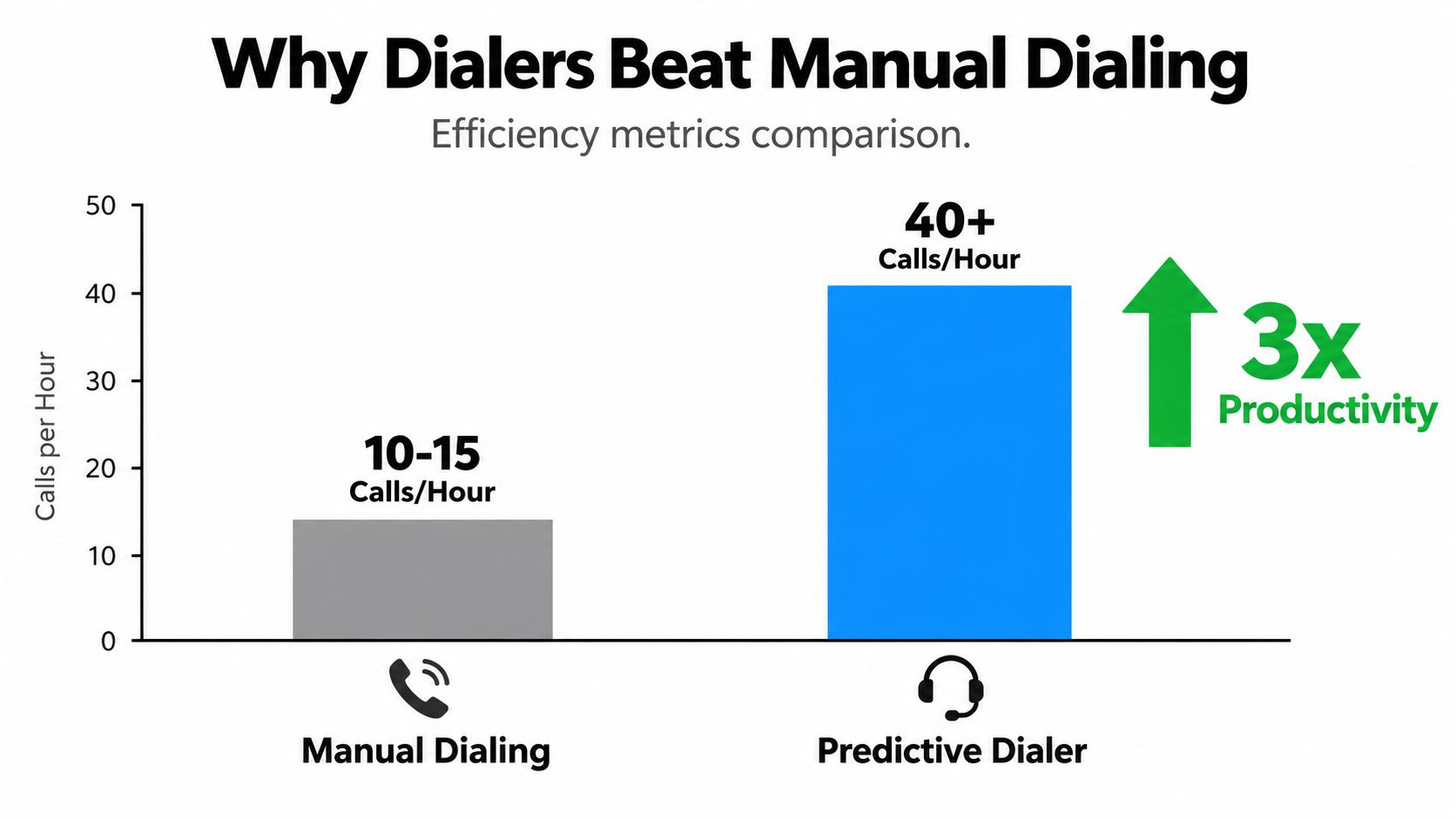
That analogy maps directly to call pacing. The platform pulls contacts from a list, applies lead-priority rules, launches calls at a selected rate, detects whether a person or voicemail answered, and routes the outcome. It may drop an approved voicemail, start a live transfer, or ask the rep to handle the conversation.
The operating layers
A serious deployment connects several layers rather than treating the dialer as a standalone phone:
- Contact intelligence: Lists contain phone numbers, account details, territory, timezone, consent status, and segmentation fields.
- Prioritization: Rules rank leads by account fit, recent engagement, intent, lifecycle stage, or a requested callback.
- Pacing: Algorithms control how quickly the system starts calls relative to rep availability and carrier limits.
- Answer detection: Answering-machine detection, or AMD, attempts to distinguish live answers from voicemail. Poor AMD creates abandoned calls or awkward delays.
- Disposition capture: The rep records outcomes such as connected, no answer, wrong number, not interested, callback, or meeting booked.
- CRM writing: The system pushes the disposition, notes, recording reference, and next task back to the account record.
Teams comparing dialers for insurance agents should apply the same standard as SaaS teams. A vertical label doesn’t make weak routing, poor AMD, or thin reporting acceptable.
AI-driven dialing adds another layer. An AI voice agent can conduct an initial exchange, ask qualification questions, answer routine objections, and schedule a next step. That changes the engineering requirements because latency, interruption handling, escalation, transcript quality, and voice disclosure affect the buyer’s experience. Traditional automation decides what happens to a call. Conversational automation also has to manage what happens inside the conversation.
Your CRM should remain the system of record. CRM integration for outbound workflows matters because a call outcome that never reaches the account record becomes duplicated outreach, missed callbacks, and unreliable attribution.
B2B ROI and Real-World Use Cases
Automated calling earns its place through cost per qualified meeting, not dial volume. Build the business case from your own operating data: hourly labor cost, dials per hour, connect rate, qualification rate, meeting rate, platform cost, and the value of a qualified opportunity. If those inputs are missing, pause the purchase and establish a baseline first.
Track connect rate, call abandonment rate, cost per contact, and calls per hour at campaign and agent level, as recommended in this outbound call center KPI guide. Add qualification rate, meetings booked, show rate, and qualified pipeline to connect activity with commercial outcomes. The model should show how changes in each variable affect cost per meeting and pipeline created.
A working channel comparison
Use the table as a decision framework, not a benchmark. Populate every field with CRM and dialer results before approving spend.
| Channel | Dials/Hour | Connect Rate | Qualification Rate | Cost/Meeting |
|---|---|---|---|---|
| Manual dialing | Your baseline | Your baseline | Your baseline | Labor plus tools divided by meetings |
| Progressive dialer | Pilot result | Pilot result | Pilot result | Labor plus platform divided by meetings |
| Predictive dialer | Pilot result | Pilot result | Pilot result | Labor plus platform divided by meetings |
| AI voice workflow | Pilot result | Pilot result | Pilot result | Platform, oversight, and transfer costs divided by meetings |
| Cold email | Not applicable | Not applicable | Your reply and qualification data | Sending, data, labor, and meetings divided by meetings |
| LinkedIn outreach | Not applicable | Not applicable | Your response and qualification data | Labor, tooling, and meetings divided by meetings |
The strongest use cases have a clear trigger, a reachable audience, and a short path to a useful outcome. Inbound speed-to-lead fits because the contact has already raised a hand. Aged lead reactivation can work when the list is clean and the message explains why the company is calling now. Event follow-up, renewal reminders, and narrowly scoped qualification also benefit from consistent timing.
Calling loses its advantage when each account requires extensive research, several stakeholders must align, or consent restrictions sharply reduce eligible contacts. A researched email and a human-led account plan may produce better economics in those situations. Compare channels with a consistent price-per-lead framework, and define “lead” the same way across every channel.
Automated calling also has a legitimate B2B role that public robocall coverage often obscures. It can enforce routing, timing, suppression, and follow-up rules for opted-in or otherwise permitted business contacts. That operational value should be judged through pipeline and conversion data, not confused with scam-driven robocalling.
ROI guardrail: Optimize for meetings booked per rep per week and qualified pipeline sourced. Raw dial volume is an activity metric, not a business result.
Integrating Automated Calling With Cold Email Outbound
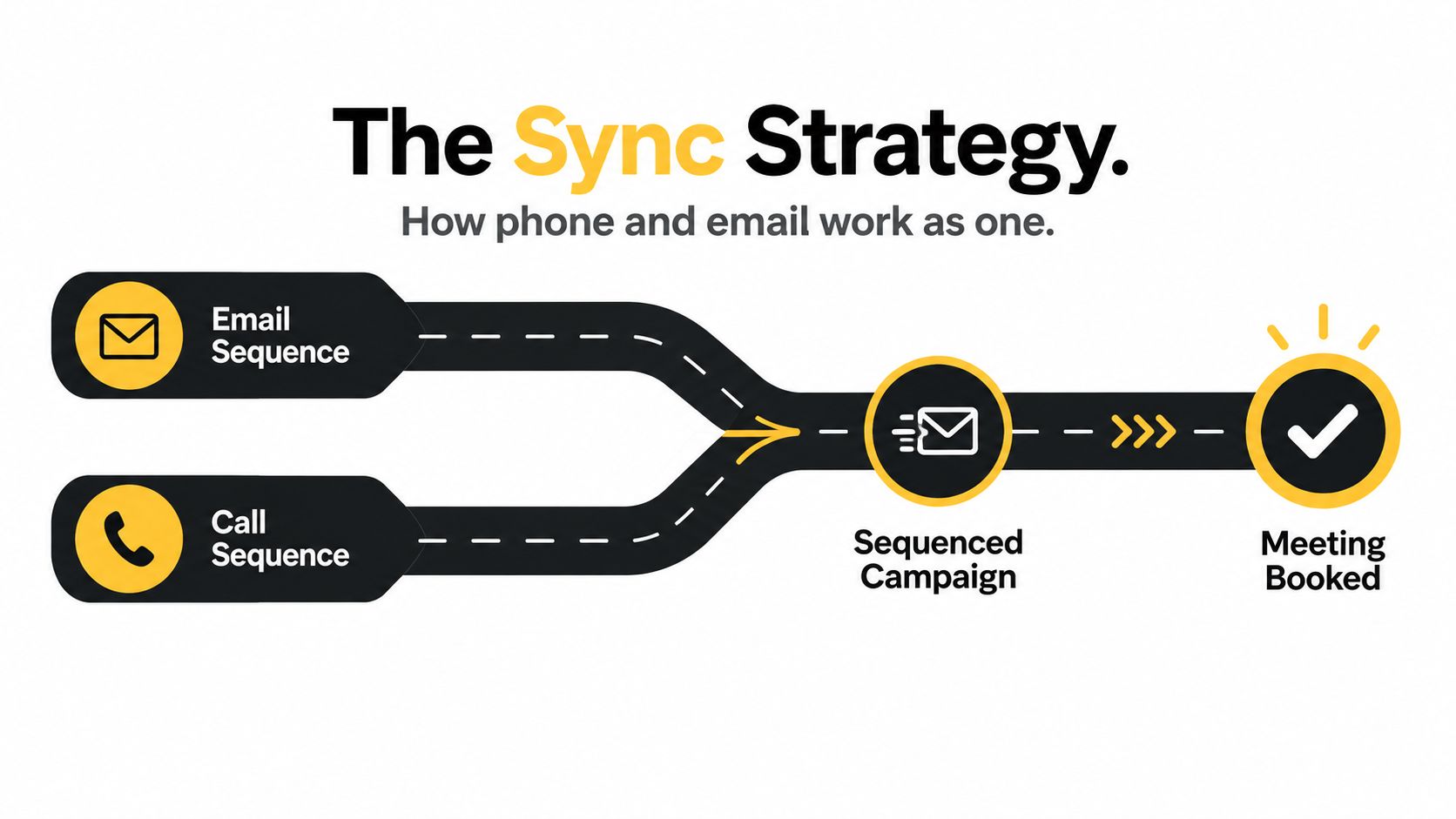
Phone and email should operate as one sequencing layer. Separate queues create duplicate touches, contradictory messaging, and poor timing. A shared CRM record should tell the system what the prospect received, how they responded, whether calling is allowed, and what the next action should be.
Start with a single contact state. The CRM sends eligible records into both email and call workflows, while suppression rules remove contacts who unsubscribed, requested no calls, or entered a do-not-contact status. An email engagement event can increase call priority, but it shouldn’t override consent or local-time restrictions.
Build the sequence around signals
A practical workflow might send an introductory email first, create a voicemail task after meaningful inactivity, and schedule a live call attempt after engagement or a defined account-priority event. The exact cadence should come from your audience and response data, not a universal template. The important design principle is that each touch has a job.
- Email establishes context: Explain the problem, relevance, and reason for contact.
- Phone adds immediacy: Use the call to clarify fit, handle a response, or offer a specific next step.
- CRM records the outcome: Store the disposition, notes, consent state, and follow-up task where every channel can read it.
Avoid stacking multiple touches on the same day unless the prospect’s action justifies it. An email click may warrant a call task. A complete opt-out should trigger suppression everywhere. A scheduled callback should pause generic sequence steps until the callback outcome is known.
Timezone and working-hour controls belong in the orchestration layer, not in a rep’s memory. So do retry windows, call-frequency caps, and escalation rules. Shared disposition notes prevent one rep from calling a prospect who already rejected the offer, while trigger-based tasks keep a positive reply from sitting in an email queue.
Teams building a coordinated motion can use outbound cold email and SDR-led demand generation as a reference point for connecting campaign execution with qualification. The same principle applies to voice: the sequence should produce one coherent buyer experience.
Unified reporting should answer three questions. Which touch created the conversation? Which channel produced the qualified meeting? Which contacts received unnecessary or conflicting attempts? If your reporting can’t answer those questions, adding another dialer will only make attribution harder.
Compliance, Consent, and Data Privacy Essentials
Compliance is a system design requirement, not a final review step. Before a contact enters a campaign, configure suppression, consent records, caller identity, call timing, recording rules, and audit logging. A rep working quickly through a queue should not have to remember which contacts or jurisdictions require special treatment.
For US campaigns, review TCPA requirements, applicable state mini-TCPA statutes, National Do Not Call controls, recording rules, caller identification, and opt-out handling. The Federal Communications Commission classifies AI-generated voices as “artificial” under the TCPA. Certain calls using prerecorded or AI voices require consent, caller identification, and opt-out mechanisms, as stated in its AI robocall ruling. Counsel should map those obligations to the call purpose, audience, technology, and jurisdiction.
Use this vendor test before signing a contract. Ask for a live demonstration and exportable evidence, not a feature checklist:
- Suppress restricted contacts: Apply current DNC data, internal suppression lists, and campaign exclusions before dialing.
- Enforce local timing: Use timezone-aware windows and block calls outside approved hours.
- Record consent context: Store purpose, channel, timestamp, source, and consent-version details instead of a bare yes/no value.
- Handle opt-outs immediately: Stop future attempts across voice, email, and connected workflows.
- Maintain audit trails: Preserve attempts, dispositions, disclosures, transfers, and recording-policy events.
| Requirement | US Federal TCPA | US State Mini-TCPA | EU GDPR | California CCPA/CPRA |
|---|---|---|---|---|
| Consent basis | Depends on call type, technology, and purpose | May add stricter rules | Lawful basis and transparency required | Notice, purpose, and consumer rights requirements |
| Suppression | DNC and internal opt-out controls | State-specific lists and restrictions may apply | Objection and erasure workflows | Opt-out and deletion handling |
| Recording | Review applicable consent and disclosure rules | State recording laws can differ | Inform people and limit processing | Disclose use and manage sensitive data carefully |
| Retention | Keep evidence required for the campaign and legal review | Follow applicable state obligations | Retain no longer than necessary | Apply documented retention and deletion practices |
| Vendor controls | Logs, identity, consent, and opt-out records | Configurable jurisdiction rules | Processor and transfer controls | Service-provider and access controls |
Data quality supports compliance, but it does not create permission. Validate records before routing them into outreach, and use an Email Validation API when email quality is part of the same campaign data process. Validation can reduce mismatches between channel records, while consent still requires its own documented basis.
Build the operating process around consent management for outbound campaigns, then have counsel confirm the rules in each target market. If a vendor cannot export consent evidence and suppression history, exclude it from your voice stack. A compliant system should make the permitted action easy and the prohibited action difficult.
The AI Voice Shift and Why Trust Architecture Matters
AI voice changes the risk profile of outbound calling. A synthetic speaker can sound personal without being a person, and public concern has intensified around deepfake robocalls and impersonation. The European Parliament briefing on AI and robocall fraud describes detection efforts and the threat of real-time imitation of trusted individuals.
Legitimate B2B teams inherit that suspicion. Buyers may screen unfamiliar numbers more aggressively, carriers may label questionable traffic, and an undisclosed synthetic voice can damage trust before qualification begins. AI does not replace a credible reason to call. It raises the cost of getting credibility wrong.
The operating distinction is clear: automate bounded business tasks, never identity deception. With appropriate permission, a conversational agent can answer routine questions, qualify an inbound request, schedule an appointment, or give a human representative suggested responses. A disclosed synthetic introduction can work when the system identifies itself and offers a clear route to a person.
Voice cloning that impersonates an executive, customer, regulator, or known contact creates fraud exposure and harms the wider caller ecosystem. A polished demo proves very little. Approve a workflow only after documenting its identity, consent, disclosure, escalation, and review controls.
Procurement rule: Treat voice identity as part of the product, not as an audio setting.
Make the supplier contract answer these questions:
- Caller identity: Who owns and registers the number? Which party handles branded calling and STIR/SHAKEN responsibilities?
- Disclosure: When and how does the system identify synthetic or automated speech?
- Consent evidence: Can the team export records tied to the specific campaign and purpose?
- Human escalation: What triggers transfer, how long can the system wait, and how are callbacks handled?
- Quality assurance: Are transcripts, redaction controls, sampling, and unsafe-response correction available?
- Incident response: What happens after an incident? Set notification, suspension, investigation, and deletion duties in advance.
Trust architecture can improve the odds that a legitimate call earns attention, but no supplier can guarantee pickup or conversion. Require test results from your target segment and number strategy. Generic product-deck claims should carry no weight in the buying decision.
Vendor Selection Criteria That Predict Performance
Buy the platform that can prove pipeline impact, not the one with the longest feature list. Score each option on deliverability, compliance, integration, and analytics before discussing price. A low-cost dialer that earns spam labels, creates duplicate activity, or loses attribution is expensive in practice.
Use a weighted scorecard, then record the reason for every rating:
| Criterion | Weight | Evidence to Require |
|---|---|---|
| Deliverability infrastructure | High | Carrier relationships, STIR/SHAKEN support, caller-ID reputation tools, local presence options, segment-level answer data |
| Compliance tooling | High | DNC scrubbing, consent logs, timezone controls, quiet hours, opt-out automation, audit exports |
| CRM and workflow integration | High | Salesforce, HubSpot, or Pipedrive sync, webhooks, sequence triggers, reliable disposition writes |
| Analytics depth | High | Connect rate, abandonment, talk time, callbacks, dispositions, meetings, SQL attribution |
| AI conversation controls | Medium | Disclosure, interruption handling, transfer logic, transcript review, fallback behavior |
| Administration and security | Medium | Roles, recording access, retention settings, data controls, incident support |
| Commercial fit | Medium | Transparent usage costs, implementation support, exit terms, segment references |
Apply a 1-to-5 score to each row and multiply it by the agreed weight. Keep the reasoning in the procurement record. Carrier treatment, call quality, and CRM accuracy often matter more than the advertised seat price.
Require a live demonstration using your own operating scenarios. The vendor should show how the system handles conflicting consent records, an opt-out during a conversation, a voicemail followed by a CRM disposition, and a live transfer that carries context and transcript data. It should also produce a report tracing a meeting to the original campaign and call session. A polished demo with generic records proves very little.
Infrastructure belongs in the evaluation. AI calling depends on stable connectivity and responsive handoffs, so teams considering high-speed internet for AI tools should assess network reliability as part of the operating environment. Better connectivity cannot fix weak targeting, while unstable audio and delayed transfers can undermine a sound workflow.
For managed outbound execution, Fypion Marketing provides cold email campaign setup, reply handling, qualification, and meeting booking through performance-based arrangements. Consider it when the team needs coordinated outbound support rather than another standalone calling platform.
Ask reference customers about the KPIs your team will use. Generic logos offer limited evidence. A relevant customer can explain how the supplier handled consent, carrier filtering, CRM reconciliation, and missed attribution under real campaign conditions. Reject any vendor that cannot provide evidence at that level.
Implementation Checklist and Metrics to Track From Day One
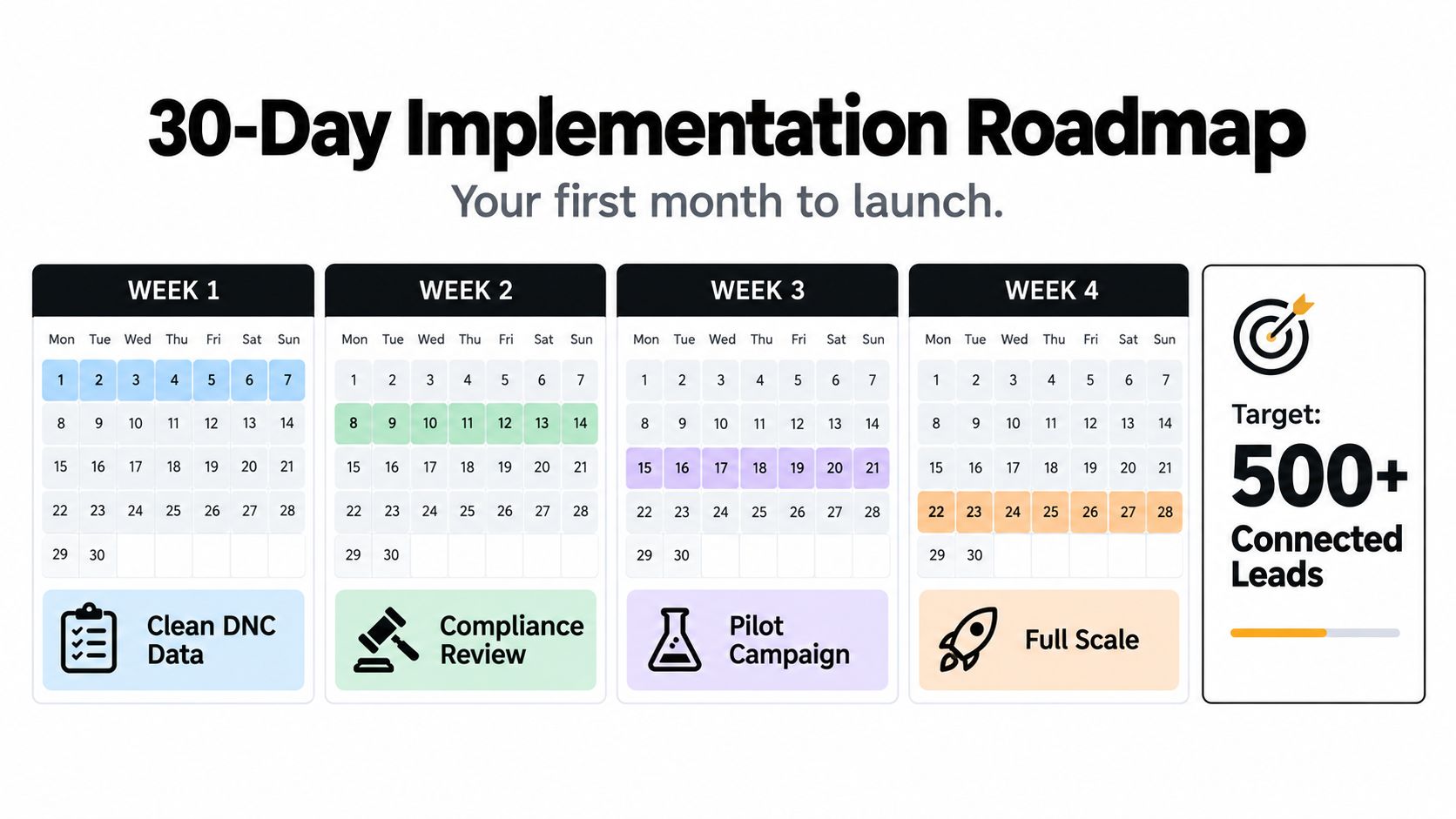
Treat rollout as a 30-day operating project, not a software purchase. The order matters: control the data, configure the workflow, run a measured pilot, then scale only when performance and compliance hold.
Build the operating base first
Week one is data control. Clean the calling list against current suppression records, verify phone fields, identify contacts already engaged through email, and assign account ownership. Remove duplicate records before they trigger repeated calls.
Week two is configuration. Set pacing, timezone rules, voicemail language, call dispositions, retry limits, transfer destinations, and CRM routing. Test every suppression path, including opt-outs and conflicting consent records, before production traffic begins.
Week three is a controlled pilot. Compare manual and automated handling across a defined group of representatives and records. Keep the audience, offer, and qualification standard stable. Otherwise, campaign changes will obscure the system’s actual effect.
Week four is review and scale. Review conversations, dispositions, objections, opt-outs, transfer quality, and CRM attribution before locking the script. Expand only when the workflow performs consistently under real operating conditions.
Track the numbers that control the decision
Build the baseline dashboard around metrics that connect activity to revenue:
- Connect rate: The share of attempts that reach a person.
- Conversation rate: The share of connects that produce a substantive exchange.
- Meetings per 100 dials: A clear productivity measure tied to booked outcomes.
- Cost per meeting: Include labor, platform, data, oversight, and transfer costs.
- Disposition quality: Check whether representatives record usable next steps consistently.
- Script-to-meeting ratio: Compare talk paths and objection outcomes with booked meetings.
- Incremental pipeline: Attribute qualified opportunity value to dialer sessions, not merely assisted activity.
- Abandonment and opt-outs: Pause or adjust campaigns when recipient harm or carrier risk increases.
Track these metrics by campaign and agent. The outbound calling KPI guidance highlights connect rate, abandonment, cost per contact, and calls per hour. Executive decisions should still rely on qualified meetings and sourced pipeline, because high activity without revenue impact is a vanity result.
Launch discipline: Change one variable at a time. Altering list quality, pacing, script, and call window together makes the result impossible to diagnose.
Review calls manually during the pilot. Check for delayed AI responses, incorrect qualification, weak disclosures, repeated attempts after opt-out, and transfers that arrive without context. Feed each correction into scripts, routing rules, and representative coaching before increasing volume.
The final test is operational accountability. Can the team show which contacts were called, why each contact was eligible, what happened, who owns the next step, and how much qualified pipeline the campaign produced? If not, the system is producing activity without control.
Fypion Marketing builds and manages B2B cold email campaigns with market research, personalized messaging, reply handling, qualification, and meeting booking. It can support teams coordinating email follow-up with automated calling workflows. Visit Fypion Marketing to discuss a performance-based outbound program.