
8 Best Follow Up Email Templates for B2B Outreach
A relevant prospect opened your first email, or perhaps never saw it, and now the thread has gone quiet. You’re left deciding whether to add proof, change the angle, switch channels, or stop contacting them altogether. The wrong move is to send another version of “Just checking in.” The best follow up email gives the recipient a new reason to respond and makes the next step easy to understand.
This guide organizes eight templates by the job each message must perform. You’ll find practical subject-line directions, examples for cold outreach and post-demo follow-up, personalization inputs, and guidance on when to use each approach. The sequence also connects each template to useful campaign metrics, including opens, replies, booked meetings, qualified-meeting rate, and unsubscribe rate.
Timing and message purpose should be tested together. Historical analysis of more than 20 million cold emails found that sequences with 4–7 messages achieved about a 27% reply rate, compared with roughly 9% for sequences with 1–3 emails. That benchmark is cited in sales follow-up statistics, but persistence alone isn’t enough. Every touch needs a distinct purpose, relevant context, and a clear boundary.
Teams researching routing and follow-up workflows can also review this guide to sales follow-up routing software. Fypion Marketing is one relevant example of a performance-driven agency that uses market research, campaign data, and ongoing optimization to improve B2B outreach decisions.
1. The Value-Add Follow-Up
A prospect who attended a demo or showed early interest usually doesn’t need another product introduction. They need a clearer connection between your product and a problem they already care about. The value-add follow-up earns attention by narrowing the conversation to one use case, feature, workflow, or business outcome.
Subject line ideas:
A simpler way to handle [specific workflow]The [feature] we discussed for [Company]One idea for improving [priority]
Template:
Hi [First Name],
You mentioned that [specific challenge] is making it harder for your team to [desired outcome]. I wanted to share one relevant part of [Product]: [feature or workflow].
Teams use it to [practical application]. Here’s a short overview: [link].
Would it be useful to see how this would work with [Company’s process]?
The message should focus on one benefit, not a list of capabilities. If the buyer cares about reporting, lead with reporting. If implementation is the concern, show the setup path. A short, relevant proof point is more useful than a large case study library, but only use a metric or outcome you can substantiate.

What to test
Personalization has a measurable effect in industry summaries. Personalized emails have been associated with 29% higher open rates and 41% higher click-through rates, while AI-driven cold outreach is often reported in the 6%–14% reply-rate range, according to email personalization statistics. Treat those figures as directional benchmarks, not promises for your campaign.
Test the benefit, not just the wording. One version can lead with time saved, while another leads with visibility or control. Track replies and booked meetings, then compare qualified-meeting rate. A higher open rate doesn’t help if the message attracts the wrong conversation.
For a practical foundation on message structure, see how to write a cold email.
2. The Social Proof Follow-Up
Silence often means the prospect hasn’t built enough confidence to spend time on a conversation. A social proof follow-up introduces evidence from outside your sales pitch, such as a relevant customer story, review profile, award, analyst mention, or implementation example.
Use proof that matches the recipient’s situation. An enterprise buyer may care about security validation or recognizable customers. A marketing leader may respond better to a relevant use case. A startup founder may want to see how a company with a similar operating model adopted the product.
Template:
Hi [First Name],
I wanted to pass along one piece of context that may be relevant to [Company]. [Customer, analyst, publication, or industry source] recently highlighted [specific capability or outcome].
The reason I’m sharing it is that your team is working on [relevant priority]. Here’s the full [customer story, review, announcement, or award page]: [link].
Is [priority] still on your roadmap this quarter?
Keep the tone matter-of-fact. “We won an award” is less persuasive than explaining why the recognition matters to the buyer’s evaluation. Don’t attach a large presentation if a direct link to the original proof will do.

Make the proof relevant
Before sending, ask three questions:
- Is the source credible? Link to the original review, award, publication, or customer page rather than making an unsupported claim.
- Does the example resemble the buyer? Industry, company stage, workflow, and buying concern matter more than a famous logo alone.
- Does the proof answer a risk? Strong proof reduces uncertainty around adoption, implementation, reliability, or business fit.
A prospect who doesn’t reply to this message may still remember the evidence later. Move them to a suitable nurture path rather than repeating the same proof. If you also use social outreach, adapt the message to the platform. A concise cold LinkedIn message template shouldn’t look like an email copied into a direct message.
Teams that need to organize customer evidence can also find testimonial management tools, particularly when sales and marketing use different proof libraries.
3. The Curiosity Follow-Up
A curiosity message works when the first email blended into a crowded inbox. It doesn’t hide the commercial purpose forever. It opens with a specific observation or question that gives the prospect an easy way to confirm, correct, or reject your assumption.
Template:
Subject:
Question about [workflow] at [Company]Hi [First Name],
I noticed [specific company change, hiring pattern, public initiative, or workflow signal]. That often creates a challenge around [relevant problem].
Is your team currently handling [specific process] through [likely method], or has that changed recently?
If it’s not a priority, no problem. I was curious because [brief reason for relevance].
The observation must be genuine. Review a recent company announcement, role description, product launch, public comment, or job change before writing. Don’t manufacture a “pattern” from weak information, and don’t use industry statistics unless you can link to the original research and verify that it supports the exact claim.
Curiosity should open a conversation, not trap the reader in one.
A yes-or-no question lowers friction, but it should still be meaningful. “Are you interested in improving efficiency?” invites a vague answer. “Is your team still consolidating campaign data manually?” gives the recipient something concrete to correct.
Use the response as a signal
If the prospect answers the question, don’t immediately send a generic pitch. Reflect their answer, ask one useful follow-up, and offer a resource that fits the issue they identified. If they don’t respond, don’t keep escalating curiosity hooks that all ask the recipient to do research for you.
Test a direct subject line against a problem-led subject line. Compare reply quality, not only opens. Best email subjects for sales can help generate variations, but your own audience data should decide which angle remains in the sequence.
4. The Educational Follow-Up
Some prospects aren’t ready to take a meeting, but they may still want to solve the problem. An educational follow-up respects that buying stage by offering a useful guide, checklist, benchmark report, webinar, or implementation resource.
The resource must stand on its own. If it only says “book a call to learn the answer,” it feels like a disguised pitch. Give the reader a practical starting point, then show where your experience adds value.
The resource should solve enough of the problem that sharing it feels generous, not conditional.
Template:
Subject:
A practical checklist for [priority]Hi [First Name],
Since [Company] is working on [relevant initiative], I thought this [guide, checklist, or report] might be useful: [link].
It covers [specific topics] and includes [practical element]. One area teams often overlook is [brief insight].
Would you like me to send over the version tailored to [industry or use case]?
A light gate can help with attribution, but a hard gate adds friction to a cold follow-up. If the prospect downloads the resource, the next email should refer to a specific section or implementation question. Don’t send another unrelated promotion.
Match education to the buying group
A sales director may need a process checklist. A technical stakeholder may need integration documentation. A finance stakeholder may need a way to evaluate operational impact. Use the same core resource selectively, changing the introduction and next step for each role.
Track resource clicks, replies, meetings, and later opportunity quality. A download isn’t automatically buying intent. The useful signal is whether the person engages with the topic and moves toward a relevant business conversation. For longer buying cycles, nurturing B2B leads can help keep educational follow-up separate from meeting-focused outreach.
5. The Competitor Comparison Follow-Up
A buyer comparing several solutions needs a clear way to assess trade-offs. A competitor comparison follow-up reduces evaluation effort by organizing the differences around the prospect’s priorities. Focus on the dimensions that affect the decision, such as workflow, implementation, integrations, pricing, security, or performance. Avoid broad feature lists and negative claims about another vendor.
Template:
Subject:
Comparing options for [use case]Hi [First Name],
If you’re evaluating tools for [use case], the decision usually comes down to [dimension one], [dimension two], and [dimension three].
[Product] is a fit when [specific situation]. Another option may suit a team facing [different situation]. Based on [Company’s priority], I’d compare the solutions most closely on [relevant dimension].
Would a short comparison worksheet help your team evaluate the options?
The message earns trust by recognizing that different solutions suit different situations. If you name a competitor, use neutral language and verify each factual comparison. Statements about implementation, integrations, pricing, security, or performance should rely on current, documented evidence.
Compare outcomes, not feature volume
A feature-by-feature list turns evaluation into a checkbox exercise. Explain what each approach changes in the buyer’s workflow instead. A web-based collaboration product may suit distributed review teams, while another tool may fit a buyer who prioritizes a particular desktop workflow. The appropriate recommendation depends on the use case and the outcome the team needs.
Send this message after the prospect shows evaluation intent, such as visiting comparison content or asking about alternatives. Personalize the comparison around the stakeholder’s stated priority, then test a named-competitor version against a neutral “options” version in cold email campaigns.
Measure positive replies, qualified meetings, and unsubscribe rate. A controversial comparison can attract attention while reducing trust, so meeting quality matters as much as response volume. Keep the broader positioning consistent across the sequence by connecting differentiation to buyer outcomes. This value proposition example provides a useful reference for that approach.
6. The Time-Sensitive Follow-Up
Urgency earns a response only when the deadline is real. An upcoming event, pilot enrollment window, product release, scheduled implementation period, or documented pricing change can justify a time-sensitive follow-up. Manufactured scarcity usually produces short-term pressure and long-term distrust.
Template:
Subject:
Enrollment closes on [date]Hi [First Name],
I’m following up because [specific program, event, or planning window] closes on [date]. The deadline exists because [clear operational reason].
If [priority] is relevant to your plans, the next step is [single action]. If the timing isn’t right, I can close the loop and avoid filling your inbox.
Should I reserve a place for [Company], or leave this for a later cycle?
Name the date and explain why it matters. Don’t use vague phrases such as “last chance” when the recipient can’t verify what changes after the deadline. Urgency should help the buyer make a decision, not force a meeting that doesn’t fit.
A useful cadence often starts with a relevant reminder after the initial email, then gives the recipient enough space to assess it. One sales-email summary reports that waiting about three days before the next email can increase reply rate by about 31%, while waiting more than five days can reduce response rates by 24%, as detailed in follow-up email sequence guidance. Apply such figures as hypotheses to test, not universal rules.
Protect the relationship
Send one deadline message, then close the loop. If the prospect doesn’t respond, don’t keep inventing new deadlines. Test the deadline-led subject line against a value-led version, keeping the offer and audience constant. Compare booked meetings with unsubscribe rate and negative replies, since urgency can increase attention without improving fit.
7. The Permission-Based Follow-Up
A prospect may have a legitimate need but no immediate capacity for a meeting. The permission-based follow-up changes the objective from “book time now” to “earn permission to remain useful.” That lower-pressure move can preserve a relationship without pretending that the buyer is ready.
Template:
Subject:
Should I keep this relevant?Hi [First Name],
It sounds like [priority] may not be active for your team right now. I don’t want to keep sending meeting requests.
Would you be open to receiving an occasional insight on [specific topic], perhaps when we publish something relevant to [Company’s situation]? If not, I’ll close the loop here.
Mean the offer. If you promise occasional insights, decide what counts as relevant and how you’ll manage consent. Don’t turn a permission email into an excuse for indefinite promotional sending.
A good version gives the prospect two comfortable options: permission to receive something useful, or permission to end contact. The message should not ask for a meeting, a download, and a referral at the same time. One decision is enough.
Optimize for future quality
Measure positive permission replies, future engagement, unsubscribe rate, and eventual opportunity quality. Open rate can tell you whether the subject line earns attention, but it can’t tell you whether the relationship is healthy. The recipient may open a message and still prefer not to hear from you.
Same-day behavior is highly concentrated in some email datasets. A Yesware-based summary reports that 91.24% of opens and 89.74% of replies happen the same day, with 1.68% of opens and 3.06% of replies occurring the next day, according to follow-up email timing analysis. Use that as a reason to monitor early engagement, not as a reason to send messages too aggressively.
8. The Multi-Channel Follow-Up
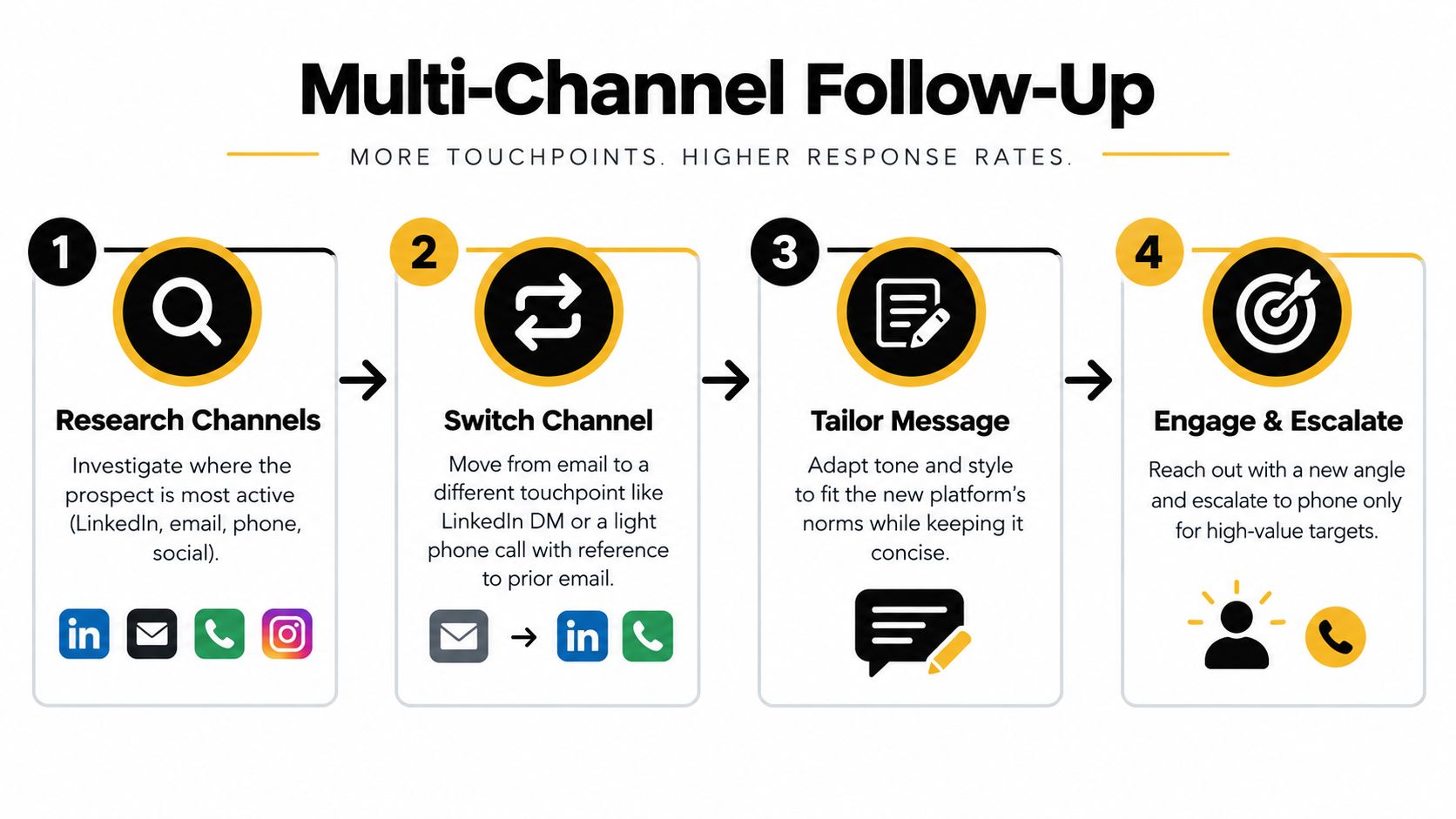
Repeating the same email in the same thread isn’t always persistence. Sometimes it’s channel fatigue. A multi-channel follow-up changes the place and format of the interaction while preserving context, such as a concise LinkedIn message after an email, a thoughtful comment on relevant public content, or a phone call for a high-value account.
Template for a LinkedIn message:
Hi [First Name], I sent a short note about [specific business issue] because of [relevant context]. No need to respond here if it isn’t a priority. I thought [resource or observation] might still be useful for your work on [initiative].
Don’t paste the full email into LinkedIn. Each channel has its own norms, and a direct message should be shorter and more conversational. Start with the channel where the prospect is visibly active. Use a phone call selectively, especially when the account is valuable enough to justify personal research and a respectful voicemail.
Change the context, not the pressure
A channel switch should add convenience or relevance. It shouldn’t become a way to contact the same person repeatedly across every available platform. Reference the original message briefly, offer a new angle, and make it easy to decline.
Large-scale cold-email analysis reported that follow-up emails can account for 58.6% of total replies, while spam complaints rose roughly threefold after four or more sends in one dataset, as summarized by personalized sales email research. That trade-off supports a deliberate sequence. Use different value angles, cap repetition, and monitor complaints and unsubscribes before adding another touch.
Test email-first against LinkedIn-first for comparable segments. Track total contact rate, positive replies, booked meetings, qualified-meeting rate, and channel-specific unsubscribe or opt-out signals. The best channel order is the one that produces relevant conversations without making prospects feel pursued.
8 Follow-Up Email Strategies Compared
| Strategy | 🔄 Implementation Complexity | Resource Requirements | 📊 Expected Outcomes | Ideal Use Cases | ⭐ Key Advantages |
|---|---|---|---|---|---|
| The Value-Add Follow-Up (Product Demo/Feature Focus) | Medium 🔄, targeted research + personalization | Moderate, case studies, product metrics, templates | Higher conversion for qualified leads; clearer ROI signals 📊 | Re-engaging prospects who showed interest; feature-fit pitches | ⭐ Demonstrates ROI and relevance; differentiates from generic follow-ups |
| The Social Proof/Authority Follow-Up (Third-Party Validation) | Low–Medium 🔄, source recent credibility events | Low–Moderate, testimonials, press links, badges | Boosts trust and open rates for skeptical buyers 📊 | Startups building credibility; risk-averse enterprise buyers | ⭐ Leverages third-party validation to reduce buyer skepticism |
| The Curiosity/Pattern Interrupt Follow-Up | High 🔄, deep personalization + creative hooks | Low–Moderate, research, subject-line A/B tests | Significantly higher opens; variable downstream conversion 📊 | Cold outreach, inbox-fatigued prospects, early-stage engagement | ⭐ Breaks inbox fatigue and sparks replies with intriguing hooks |
| The Educational/Resource Follow-Up (Thought Leadership Positioning) | High 🔄, content creation and distribution planning | High, quality resources, landing pages, tracking systems | Builds authority and long-term engagement; slower immediate meetings 📊 | Long sales cycles, multi-stakeholder evaluations, consultative sales | ⭐ Establishes thought leadership and provides reusable assets |
| The Competitor Comparison Follow-Up (Differentiation Angle) | Medium 🔄, accurate competitive research + careful framing | Moderate, comparison tables, validation data, neutral tone assets | Re-engages evaluating prospects; clarifies differentiation 📊 | Crowded markets, technical buyers actively comparing options | ⭐ Directly addresses objections and speeds evaluation decisions |
| The Urgency/Time-Sensitive Follow-Up (Limited Window Offer) | Low–Medium 🔄, must justify and document deadline | Low, defined offer, timeline, communication plan | Highest immediate response rates; prompt decisions ⚡📊 | Time-bound offers, pilot enrollments, event registrations | ⭐ Drives fast action when urgency is genuine and transparent |
| The Permission-Based/Relationship-Building Follow-Up (Low-Pressure Pivot) | Low–Medium 🔄, simple ask but requires consistent follow-through | Moderate, nurtures, content cadence, CRM workflows | Builds long-term trust and inbound; low short-term meetings 📊 | Enterprise/long buying cycles; brand-building and future pipeline | ⭐ Highest trust-building; reduces fatigue and preserves relationships |
| The Multi-Channel Follow-Up (Channel Diversification Strategy) | High 🔄, coordination across platforms and touchpoints | High, multi-channel tools, skilled team, channel-specific content | Dramatically higher contact and engagement rates 📊 | Key accounts, high-value targets, when email alone fails | ⭐ Diversifies reach and breaks inbox barriers; increases contact rates |
Build the Follow-Up Sequence Around Evidence
A strong sequence starts with the prospect’s situation, not with a fixed set of templates. After a demo, use a value-add or proof message that reflects what the buyer discussed. For a cold account with a clear trigger, curiosity or education may be more appropriate. When evaluation is active, comparison content can reduce uncertainty. When the buying window is closing, a genuine deadline may justify urgency.
For each message, personalize one meaningful detail. Use the prospect’s stated priority, a relevant company initiative, a role-specific workflow, or a verified trigger. Avoid adding superficial personalization that doesn’t change the message. A first name and company name won’t compensate for an irrelevant offer.
Then set a deliberate delay and define one action. The recipient might answer a yes-or-no question, review a resource, confirm whether a project is active, or choose a meeting time. Don’t ask them to read, watch, compare, and schedule in one email. Lower friction by making the next step obvious.
Test one variable at a time where possible:
- Subject line: Compare a problem-led subject with a context-led subject.
- Opening angle: Test a business trigger against a use-case observation.
- Proof point: Compare a customer example with a third-party validation link.
- CTA wording: Test a yes-or-no question against a low-commitment resource offer.
- Timing: Compare a shorter delay with a more spaced cadence for the same segment.
- Channel order: Test email followed by LinkedIn against LinkedIn followed by email.
Your measurement framework should follow the full path from delivery to pipeline quality. Monitor delivery and bounce behavior first, then open rate, reply rate, positive-reply rate, booked meetings, qualified-meeting rate, unsubscribe rate, and downstream opportunity quality. Don’t treat an open as success when the campaign produces no useful replies. Likewise, don’t optimize for reply volume if the replies come from accounts that can’t become customers.
A longer sequence can outperform a single message, but repetition creates risk. Independent summaries report that sequences with 4–7 emails can reach about a 27% reply rate, compared with about 9% for sequences with 1–3 emails, while longer sequences can also increase unsubscribe and spam-complaint risk, as discussed in sales follow-up statistics and cadence analysis. The practical lesson isn’t to send a predetermined number of emails. It’s to give each touch a distinct job and stop when the evidence says the sequence is harming sender reputation or recipient trust.
Fypion Marketing can support this process through market research, personalized cold email copy, contact-list building, campaign infrastructure, reply management, and ongoing performance optimization. Its performance-driven model is designed to connect outreach activity with booked, qualified meetings, while a reminder email cadence template resource can help teams document their own follow-up rules before launch.
The most useful next step is to audit one active sequence. Identify where every email repeats the same pitch, replace each repetition with a distinct job, and establish the metric that determines whether that job worked. Then test the revised sequence with one clearly defined audience before expanding it across your pipeline.
Fypion Marketing helps B2B teams research target markets, build personalized cold email campaigns, manage outreach infrastructure, and optimize follow-ups around qualified meetings. Visit Fypion Marketing to discuss a performance-driven approach to improving your next follow-up sequence.