
Cold Email vs LinkedIn Outreach: The B2B Playbook
Most advice on cold email vs LinkedIn outreach asks you to pick a winner. That’s the wrong decision. A channel can produce replies without producing qualified meetings, while a quiet LinkedIn touch can make the next email recognizable enough to earn attention. The question B2B leaders should ask is simpler and harder: which sequence creates qualified pipeline, at acceptable risk, for this specific account universe?
Cold email gives you broad access to an existing professional workflow. LinkedIn gives you stronger identity context, including a prospect’s employer, role, industry, location, and career history. Neither advantage matters if you can’t connect touches across channels or explain how each touch influenced the meeting.
| Decision lens | Cold email | LinkedIn outreach | What leaders should measure |
|---|---|---|---|
| Reach | Broad access across organizations | Concentrated professional network | Qualified accounts reached |
| Identity context | Derived from data and research | Visible before contact | Fit and relevance |
| Response quality | Influenced by targeting, credibility, and inbox placement | Influenced by connection acceptance and social context | Positive replies and qualified meetings |
| Attribution | Delivery, opens, replies, and meetings can be tracked | Platform activity and replies are time-windowed | First-touch, assisted-touch, and opportunity impact |
| Main risk | Bounces, spam placement, and domain complaints | Platform limits and rented-network dependence | Cost per qualified meeting and channel risk |
The operational choices are channel lead, touch sequencing, and credit assignment. That’s the same discipline required to aplicar outreach en ventas B2B when outbound is treated as a coordinated sales process rather than a collection of isolated messages.
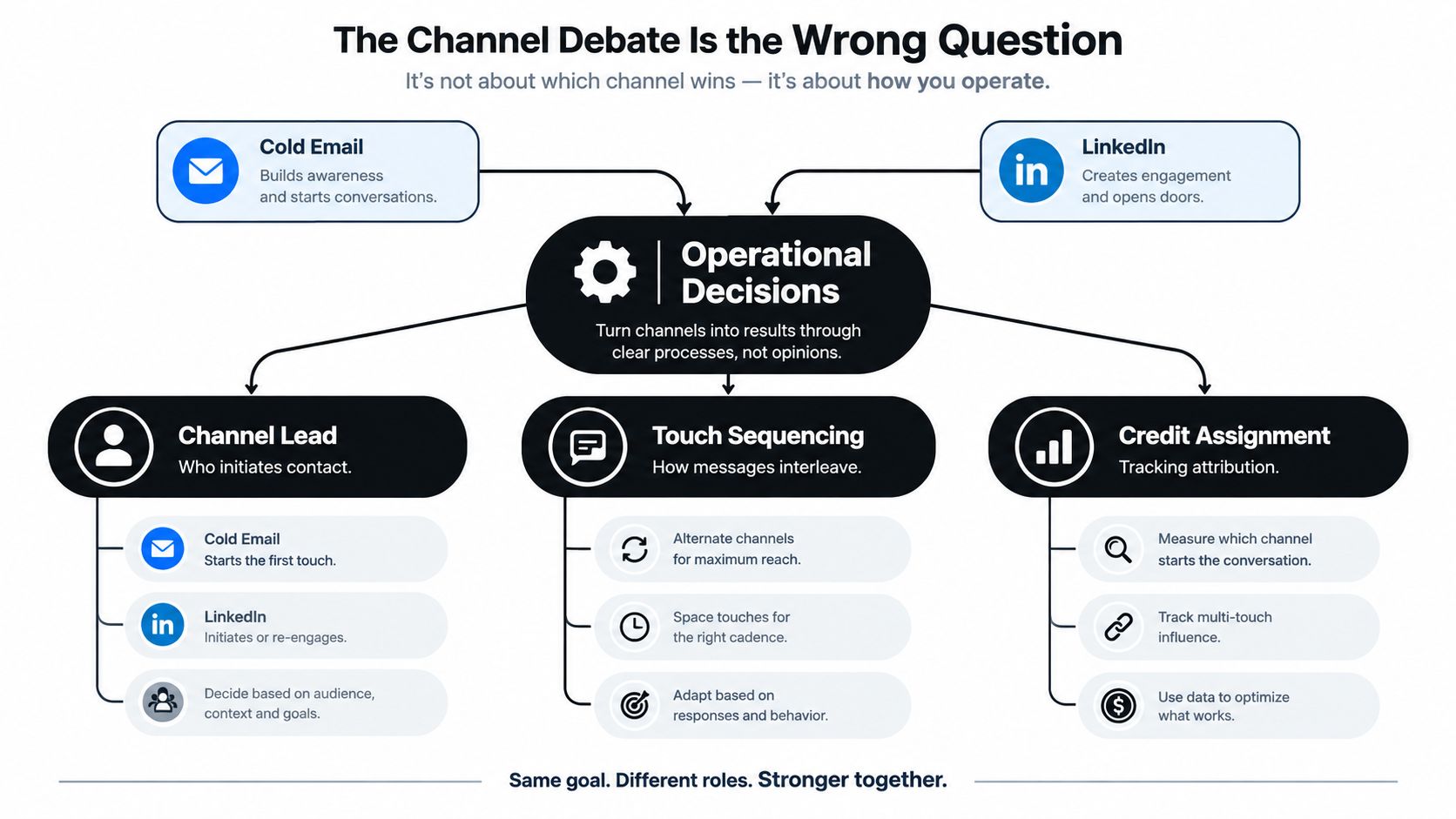
Why the Channel Debate Is the Wrong Question
A benchmark that says LinkedIn gets more replies than email may be accurate and still be useless for your sales plan. It may exclude people who never accepted a connection, count any response as success, or ignore the email that arrived after a prospect recognized the sender. A reply-rate leaderboard doesn’t tell you which sequence produced a sales-qualified conversation.
The right comparison uses four lenses:
- Reach: How many target accounts can your team contact through the channel without creating operational or infrastructure problems?
- Identity context: Can the prospect understand who you are and why your message belongs in their workday?
- Response quality: Does the response indicate buying relevance, or merely acknowledge the message?
- Attribution: Can you distinguish the first touch from the touch that created enough trust to book the meeting?
Practical rule: Don’t ask which channel has the higher reply rate. Ask which channel improves qualified-meeting yield for reachable accounts.
A 2025 sales-engagement benchmark covering 321,000 meetings attributed 85% to phone, 8% to email, and 7% to LinkedIn. Those figures don’t prove LinkedIn is weak. They show why last-touch reporting can undervalue a channel that creates recognition before a call or email closes the loop. The same research cited buyer preference for an average of 2.5 channels, while 88% welcomed vendor contact during research and evaluation. See the benchmark context at MediaPost’s multichannel outreach analysis.
A defensible outbound program therefore assigns roles. LinkedIn can identify and warm a named account. Email can deliver the detailed business case and create a measurable follow-up path. Phone or useful content may still be necessary when neither digital channel creates enough urgency.
How Each Channel Works for B2B
Cold email wins on reach because businesses already run on it. A quantitative survey of 600 employees across 50 U.K. organizations found that nearly all respondents used email daily, more than one-third considered it essential to their jobs, and almost half said it helped them work better. Only 2% viewed email as prohibitive, according to business email research published by Communications of the ACM.
Email does not require a prospect to accept a connection, maintain a public profile, or stay active on a specific platform. It supports delivery, open, reply, and meeting tracking. Those signals need careful interpretation once bounces, spam placement, and automated replies affect the data.
LinkedIn provides a different advantage. In 2025, LinkedIn was reported to have approximately 1.2 billion members, as described in Affinco’s LinkedIn statistics post. Its greater value for B2B outreach is the identity layer. Before sending a message, a seller can often see a prospect’s employer, job title, industry, location, and career history.
The structural trade-off
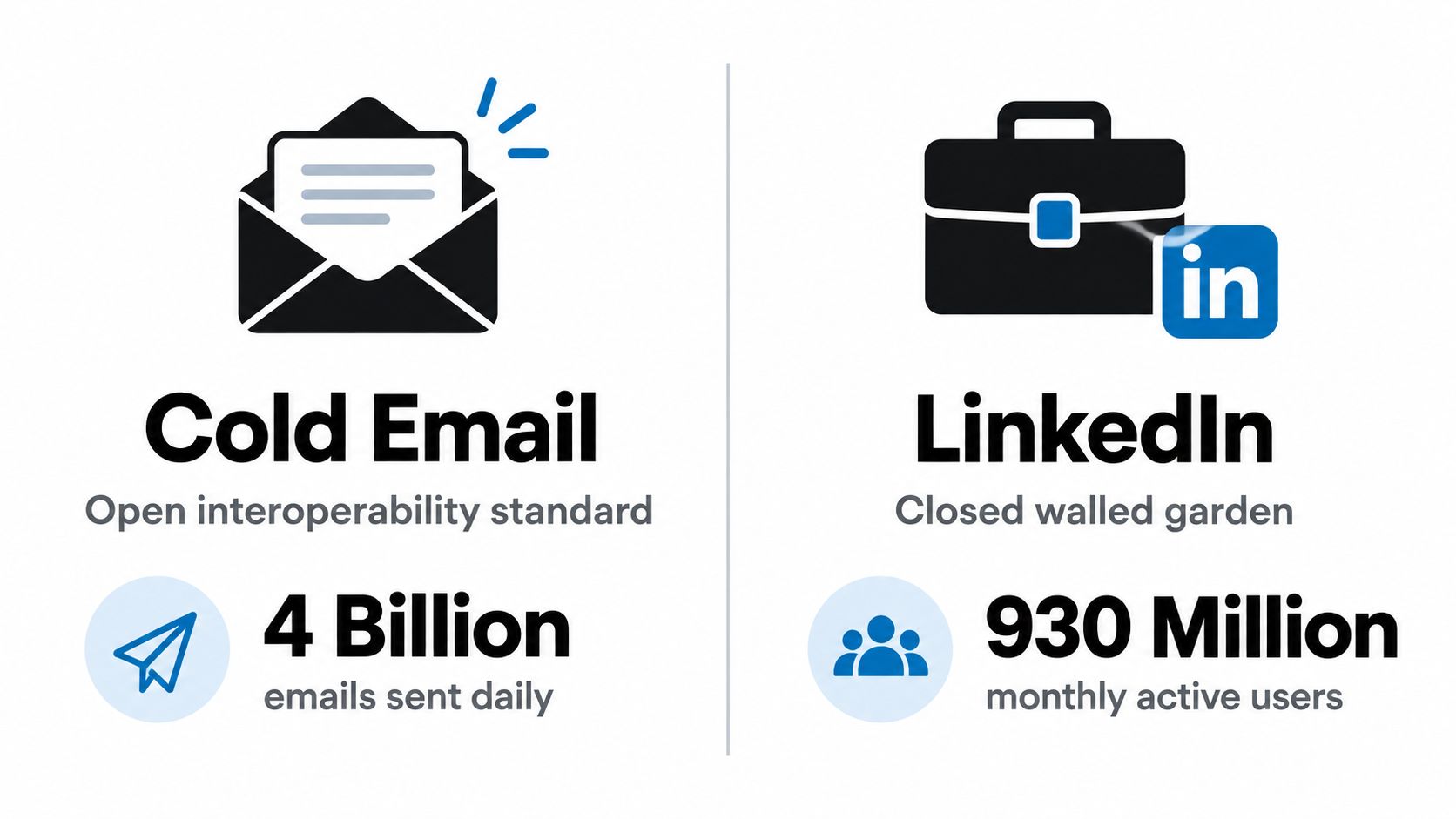
Email is an open interoperability standard. LinkedIn is a platform-controlled professional network. Email usually wins for broad account coverage and repeatable measurement. LinkedIn is stronger when qualified meetings depend on visible professional context, named stakeholders, or credibility tied to a person’s role.
Neither channel creates relevance by itself. Email still needs accurate company and role data. LinkedIn research still needs a credible reason to contact the person, and profile visibility does not guarantee attention.
Use email for addressable-market coverage and detailed business communication. Use LinkedIn for discovery, context, and recognition among high-value prospects. When an account justifies coordinated touches, sequence both and judge the program by qualified-meeting yield, not isolated reply rates. That combination captures email’s interoperability while using LinkedIn’s professional context without surrendering attribution discipline or control to one platform.
What the Reply-Rate Benchmarks Hide
The most quoted comparison is also the easiest to misuse. A recruiting benchmark covering more than 4 million messages reported a 17.08% reply rate for LinkedIn messages, compared with 4.96% for automated cold email and 6.31% for recruiter-written one-off email, according to the outreach benchmark report from PIN. In that dataset, LinkedIn produced an approximately 3.4x higher reply rate than automated email.
A separate benchmark placed typical post-connection LinkedIn replies at 10.4%, compared with 3.4% to 5.1% for cold email. These figures support a useful tactical conclusion: LinkedIn can be valuable for high-priority account engagement. They do not justify replacing email, because reply rate alone says little about qualified-meeting yield.
The denominator changes the result. A LinkedIn reply rate may exclude prospects who never accept a connection. Email performance is shaped by bounces, spam placement, and automated replies. LinkedIn also defines InMail response rate using responses received within 30 days, while its policy references a 13% response-rate threshold for qualifying Recruiter usage. Those rules make direct channel comparisons fragile.
| Metric | Cold email | Better measure | |
|---|---|---|---|
| Raw reply rate | Affected by delivery and automated responses | Affected by acceptance and platform rules | Positive-reply rate |
| Message reach | Broad, but vulnerable to inbox placement | Limited by access and user activity | Qualified accounts reached |
| Engagement signal | Opens and replies | Connection acceptance and replies | Qualified-meeting rate |
| Commercial efficiency | Tooling and data costs vary | Access and message capacity vary | Cost per qualified meeting |
| Sales impact | Can create measurable meeting paths | Can warm or assist later touches | Meeting-to-opportunity conversion |
Track the multi-touch attribution framework alongside channel metrics. Your dashboard should separate positive replies, qualified meetings, cost per qualified meeting, and meeting-to-opportunity conversion. A reply from an unqualified contact is not pipeline. A LinkedIn touch that assists an email-sourced meeting should remain visible in the analysis. Judge each channel by the qualified meetings it helps create, not by attention captured at the top of the funnel.
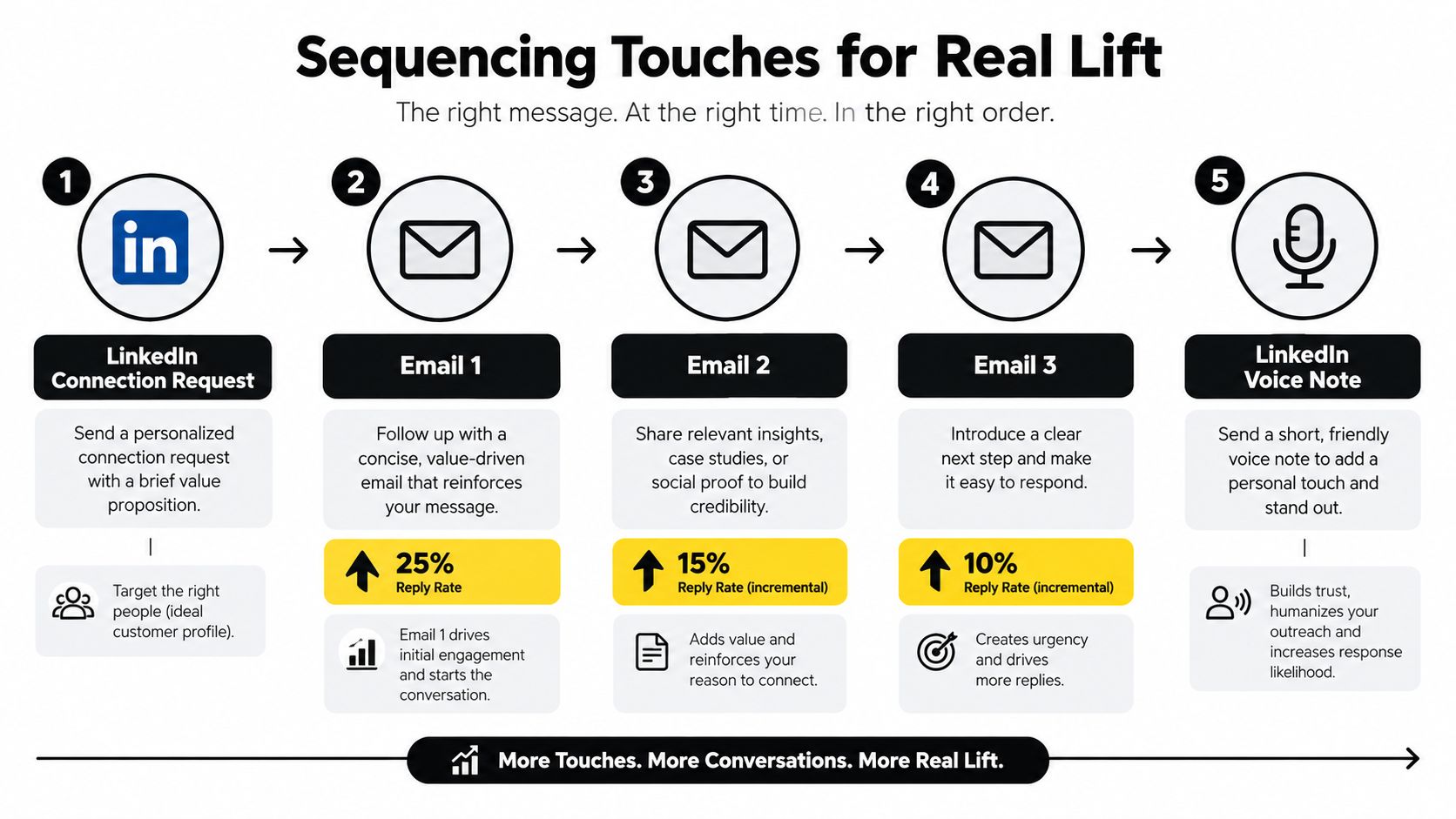
Sequencing Touches for Real Lift
Use LinkedIn first when the account is valuable, the buying committee is narrow, and a visible professional context can make the email feel less anonymous. Use email first when account coverage matters more than individual familiarity and your infrastructure can support responsible sending.
Sequence one for high-value accounts
A practical LinkedIn-first sequence looks like this:
- Day 1: Send a connection request with a specific reason tied to the prospect’s role, company situation, or public work.
- Day 3: Send the first email, referencing the relevant context without pretending the connection created a relationship.
- Day 6: Follow up on LinkedIn after acceptance with one useful observation or question.
- Day 9: Send a second email that addresses a different business problem.
- Day 14: Send a final LinkedIn touch or voice note only when it adds context, not pressure.
This sequence reserves research time for accounts where a meeting is worth the effort. A follow-up system such as the Starward Navigators follow-up system can help teams coordinate touches, but automation shouldn’t replace judgment about timing or relevance.
Sequence two for coverage
For a broader ICP, lead with email and use LinkedIn as reinforcement:
- Day 1: Send a concise email with one problem, one relevant observation, and one low-friction question.
- Day 4: Send a LinkedIn connection request after the first email.
- Day 7: Follow up by email with a new insight, not “just checking in.”
- Day 11: Send a LinkedIn message to accepted connections.
- Day 15: Close the sequence with a clear permission-based email.
The test is more important than the cadence. Randomly divide comparable accounts, expose one group to the LinkedIn touch, and withhold it from the control group. Compare qualified meetings and opportunity creation, not total replies.
Document first-touch, assisted-touch, and last-touch results in the same CRM record. The outbound cold email and SDR-led demand generation model is useful only when the team can connect activity to commercial outcomes.
Matching Channel to Company Stage and ICP
Channel choice should follow the shape of your market, not the preferences of your SDR team. A broad ICP needs coverage. A narrow enterprise market needs account intelligence and credibility. The ICP in sales guide provides the foundation, but the outbound decision comes down to reachable accounts, buyer identity, and sales urgency.
Early-stage SaaS with a broad ICP
Lead with cold email. Your team needs enough coverage to discover which segment responds, and email gives you a cleaner way to compare industries, roles, and pain points. Use LinkedIn selectively for prospects who engage, respond, or sit inside unusually valuable accounts.
A suitable angle is operational: “Teams in your category often lose time when this workflow stays manual. Is that a current priority, or does another process create the bigger constraint?”
Mid-market SaaS with a defined vertical
Run a balanced sequence. Email can introduce the problem and relevant use case, while LinkedIn can reinforce the sender’s credibility with a defined buyer group. Segment the message by role, because a revenue leader and a technical evaluator won’t accept the same proof.
Enterprise ABM with named accounts
Lead with LinkedIn, then move to email. Research the account, identify the buying committee, and create separate messaging for the economic buyer, operational owner, and technical stakeholder. The first touch should demonstrate account understanding, not deliver a product pitch.
Category-creating technology with a narrow market
Protect reach and reputation. Use LinkedIn for the most strategic contacts, email for carefully verified account coverage, and phone or executive-led content when digital touches stall. A small total addressable market leaves little room for careless targeting, so qualified-meeting yield matters more than activity volume.
Don’t assign a universal cost-per-meeting target without your own data. Costs vary with data quality, labor, sales complexity, and the qualification standard. Set a baseline from qualified meetings and opportunity conversion, then compare channel combinations against that baseline.
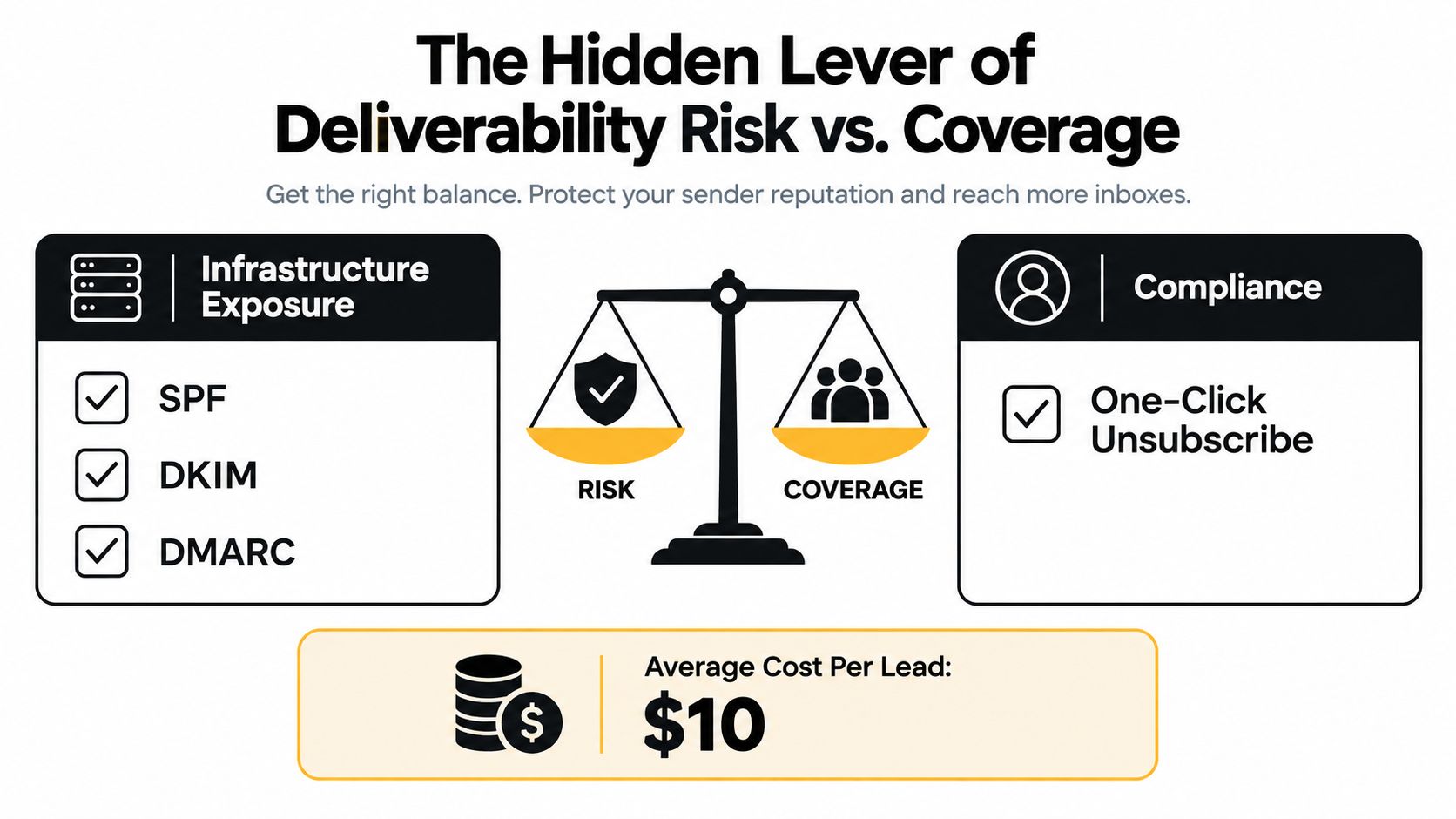
The Hidden Lever, Deliverability Risk vs. Coverage
The main trade-off isn’t personalization versus volume. It’s deliverability risk versus addressable-market coverage.
Gmail and Yahoo sender requirements emphasize SPF, DKIM, DMARC, one-click unsubscribe, and keeping spam complaints below 0.3%, with 0.1% treated as the safer target, according to Mailgun’s deliverability takeaways. A campaign can produce replies and still weaken the sending domain if irrelevant contacts delete messages, mark them as spam, or repeatedly ignore the sender.
That creates a dangerous reporting gap. Sales sees conversations. The infrastructure team sees declining inbox placement. By the time reply rates fall, the domain may already be harder to recover.
Email exposure
Before scaling cold email, check:
- Authentication: SPF, DKIM, and DMARC are correctly implemented.
- List quality: Contacts are relevant, current, and aligned to the ICP.
- Complaint signals: Spam complaints stay below the stated thresholds.
- Unsubscribe handling: One-click removal works and suppresses future outreach.
- Domain health: The team watches inbox placement, bounces, and complaint patterns rather than reply rate alone.
LinkedIn avoids email infrastructure exposure, but it isn’t risk-free. You depend on connection acceptance, platform limits, user activity, visible identity data, and a network you don’t control. A restriction can reduce access to prospects immediately, while a domain problem can affect every legitimate business message your company sends.
Risk rule: Protect the channel that would be hardest to replace.
For a SaaS company selling into a small, high-value market, that often means treating the sending domain as a strategic asset. Use LinkedIn for precision when the account list is narrow, and scale email only when the expected coverage justifies the infrastructure exposure. Review the technical side with a specialist in email deliverability services before increasing volume.
A Four-Question Decision Framework
You can choose a defensible starting channel in minutes by answering four questions.
How many qualified accounts can you reach?
If your ICP includes a broad set of companies and roles, email should usually lead. It gives the team a practical way to cover the market and measure which segments generate qualified conversations. LinkedIn supports research and follow-up for accounts that show promise.
If the list contains only a small set of named accounts, LinkedIn-first outreach deserves priority. Coverage is less important than making each initial touch credible.
How identity-driven is the sale?
Choose LinkedIn first when the buyer needs confidence in the person behind the message, the sale involves senior stakeholders, or the prospect’s professional history shapes the conversation. Choose email first when the problem is easy to explain and the buyer needs a concise business case they can forward internally.
A technical product sold to a visible specialist may benefit from profile context. A repeatable operational service may gain more from email’s direct explanation and follow-up trail.
How exposed is your sending domain?
If your domain is new, strained, or central to customer communication, reduce unnecessary email risk. Tighten targeting, verify the list, and use LinkedIn for high-value accounts while the team protects deliverability.
If the infrastructure is healthy, email can carry more of the sequence, but only while complaint and inbox signals remain acceptable.
How quickly do you need pipeline?
Email-first is the practical choice when the team needs broad testing and fast market feedback. LinkedIn-first is better when the team can spend more time researching fewer accounts.
Neither channel is enough alone when the buyer needs education, multiple stakeholders must agree, or the sales cycle depends on trust. Add phone, useful content, referrals, or executive involvement rather than forcing one platform to solve every problem.
When Outsourcing to a Pay-Per-Meeting Agency Is the Smart Call
Outsourcing outbound makes sense when the problem is execution capacity, not product-market fit. Three triggers are especially clear:
- You have a proven offer but no internal outbound capacity.
- Your sending domain needs a controlled infrastructure rebuild.
- You need to validate a new ICP before hiring a permanent team.
A pay-per-meeting model can align the provider with the outcome that matters, provided the definition of a qualified meeting is agreed in advance. The contract should specify target roles, account fit, attendance expectations, disqualification rules, rescheduling ownership, and how duplicate or existing opportunities are handled.
Fypion Marketing is one option for teams that want managed outbound. Its process includes a consultation, market research, technical infrastructure setup, personalized sequences, targeted contact lists, inbox monitoring, and ongoing optimization, with payment tied to qualified booked meetings. That approach fits leaders who want to test a sequenced cold email and LinkedIn motion without building every operational layer internally.
Some teams also evaluate automation platforms through the lens of how one agent owns the outbound loop. Automation can coordinate research, sequencing, and follow-up, but a provider still needs accountable qualification and transparent reporting.
Before signing with any agency, ask:
- What exactly makes a meeting qualified?
- Which touches and channels will the team use?
- How will first-touch and assisted-touch attribution be reported?
- Who owns the sending infrastructure and data compliance?
- What happens when a meeting cancels or falls outside the ICP?
- Can you inspect the messaging, targeting, and CRM handoff?
For a broader view of managed execution, compare the operating model described in this cold outreach agency guide. The right partner won’t promise a magical channel. They’ll show how targeting, sequencing, infrastructure, qualification, and pipeline reporting work together.
Fypion Marketing helps B2B teams build and manage coordinated cold email and LinkedIn outreach around qualified meetings, from ICP research and infrastructure setup to personalized sequences and optimization. Visit Fypion Marketing to discuss your target accounts, channel mix, and pay-per-meeting outbound plan.