
Financial Advisor Lead Generation Strategies

More website traffic is often presented as the answer to financial advisor lead generation. That advice is incomplete. A busy website can produce little business if prospects don’t understand whom you help, why they should trust you, or what should happen next.
The stronger approach is to treat digital marketing as a trust-transfer system. Referrals, professional relationships, educational content, search visibility, and carefully managed outreach should work together to make a recommendation easier to accept and easier to act on. The objective isn’t maximum attention. It’s a repeatable flow of qualified conversations that can become durable client relationships.
The Reality of Financial Advisor Lead Generation
The most important lead source for many wealth management firms isn’t a search ad or a social post. It’s a person who already has credibility with the prospect. Capital Group’s 2026 growth-trends chart for billion-dollar RIAs reported that client and family referrals were productive for 68% of firms, compared with 36% for referrals from centers of influence and 17% for digital marketing. Third-party lead-generation tools were cited by just 8% of firms in the same chart. Capital Group’s RIA growth-trends analysis places digital activity in context: useful, but not the dominant source of trusted introductions.
Cerulli’s analysis points in the same direction. Referrals from clients, friends, or family accounted for 54.2% of new clients, while centers of influence contributed 13.9%. Cerulli’s advisor growth research suggests that advisors shouldn’t ask whether referrals or digital marketing matter. They should ask how digital systems can make referrals more frequent, more specific, and easier for a prospect to pursue.
Practical rule: Use digital channels to strengthen trust before the introduction, after the introduction, and between conversations.
Why traffic isn’t the strategy
A referral usually transfers more than a name. It transfers confidence, context, and social proof. A prospect may still research your firm, but they begin with a reason to believe that the conversation is worth having.
Your website should support that transfer. It needs focused service pages, clear descriptions of the clients you serve, credible advisor biographies, educational material, and a low-friction next step. A generic homepage with broad promises forces the referred prospect to do too much interpretation.
The same principle applies to search. SEO can help a business owner researching liquidity planning or a family considering a retirement transition find your firm, but ranking alone doesn’t create a relationship. Content must answer a real concern in plain language and show how your firm approaches the problem.
The cost of an undocumented plan
Broadridge’s 2024 Financial Advisor Marketing Trends Report found that advisors with a defined marketing plan generated 168% more monthly website leads than advisors without one. The same report found that the average advisor produced 2.5 website leads per month, while 38% said their website generated no leads at all. Broadridge’s 2024 report demonstrates why occasional website edits aren’t a growth system.
A documented plan should connect audience, offer, channel, follow-up owner, and conversion event. It should also define how client referrals and COI introductions enter the CRM, how digital interactions prepare prospects, and how the firm reports qualified opportunities.
Advisors looking for a practical way to develop that acquisition system can find more clients with Advisor Momentum. The useful takeaway isn’t to chase every available tactic. It’s to build a process that turns existing trust into consistent, measurable introductions.
Choosing the Right Acquisition Channels
More digital traffic does not automatically produce more advisory relationships. Referrals usually begin with borrowed trust, while SEO, paid search, and cold email create opportunities to earn it. Use digital channels to support and scale referral networks, not to chase undifferentiated clicks.
A CPA or estate attorney can introduce an advisor when a client faces a connected planning issue. That timing gives the conversation relevance that a broad advertisement rarely matches. The trade-off is relationship development. COI partnerships require regular education, responsive follow-up, and a clear explanation of whom the firm serves. Digital content can make those introductions easier by giving partners a useful resource to share before or after a conversation.
Seminars and webinars connect professional referrals with digital acquisition. A partner can invite an audience, while the advisor provides useful education and a defined follow-up path. The event creates a reason to engage, but registration and attendance are only early signals. Qualification, booked conversations, and opportunities created after the event determine whether the channel merits more investment.
SEO is slower but can build durable visibility. It suits firms willing to publish useful material for a defined market, such as executives approaching a liquidity event or families managing complex estate decisions. Paid search creates faster visibility, though it demands disciplined keyword selection, controlled budgets, and strong landing-page relevance. For firms testing paid acquisition, PPC audiences with Keywordme provides a useful reference for evaluating audience and intent instead of buying broad clicks.
Cold email reaches business owners, executives, and professional partners without waiting for search demand. It also carries the greatest operational risk. CIENCE’s benchmark reports 23.9% average open rates with properly configured deliverability, falling to 8% to 12% with poor domain health, while 3-to-5-touch sequences averaged an 8.5% reply rate compared with 2.1% for single-touch outreach. CIENCE’s cold-email benchmarks show why infrastructure, list quality, segmentation, and sequencing matter more than sending volume. Used well, outreach can identify potential COIs and create repeatable introductions. Used carelessly, it can weaken the firm’s reputation.
| Channel | Trust Level | Time to ROI | Best For |
|---|---|---|---|
| Client referrals | Very high | Variable | Expanding relationships through existing clients |
| COI partnerships | High | Medium to long term | Accountants, attorneys, and other trusted professionals |
| Seminars and webinars | Medium to high | Medium | Teaching around a defined planning problem |
| SEO and educational content | Medium, rising over time | Long term | Capturing informed search demand |
| Paid search | Variable | Fast to test | High-intent queries with strong message match |
| Cold email | Low at first, higher with relevance | Fast to test | Focused outreach to carefully selected audiences |
A practical channel decision
A firm with strong client satisfaction but weak referral structure should prioritize referral requests, COI enablement, and referral-ready content. A firm with a narrow specialty and publishing capacity can build an SEO asset. A firm with a clear target list and an internal follow-up owner can test cold outreach, but should not scale until bounce and complaint signals remain healthy.
The operating model matters as much as the channel. Assign an owner for qualification, record referral and digital sources in the CRM, and judge channels by qualified opportunities rather than raw inquiries. Firms comparing inbound systems can also review this inbound lead generation framework for ideas on connecting content, forms, and follow-up.
Building High-Converting Campaigns and Messaging
Generic claims such as “personalized wealth management” rarely give a prospect a reason to respond. Strong campaigns start with a specific situation, a defined audience, and a credible next step.

Start with the problem, not the service
Choose a problem your firm can explain better than a generalist. Examples include coordinating concentrated stock risk after a business sale, preparing for a retirement transition, or aligning estate and tax decisions across a family. The message should identify the situation without pretending to know facts the prospect hasn’t shared.
A concise cold email can follow this structure:
- Context: Explain why you’re contacting this person or professional.
- Observed problem: Name a planning issue relevant to the audience.
- Credibility: Describe the firm’s experience or process without unsupported performance claims.
- Low-pressure offer: Suggest a short conversation or useful educational session.
- Permission-based close: Give the recipient an easy way to decline.
For example, a message to a CPA might focus on helping mutual clients coordinate investment and estate decisions. A message to an executive shouldn’t use the same language. Segment by role, likely planning trigger, geography, and relationship context.
The messaging framework for financial services campaigns can help teams turn those distinctions into repeatable positioning. The key is to keep the message specific enough to feel relevant and restrained enough to feel professional.
Design the conversion path before promotion
A landing page should answer five questions quickly:
- Who is this for? State the audience and planning context.
- What problem does it address? Describe the issue in practical language.
- Why this firm? Provide advisor bios, credentials, affiliations, and an explanation of the process.
- What happens next? Show the meeting format, expected preparation, and approximate commitment.
- Can the visitor trust the page? Include required disclosures, privacy information, and clear compliance review.
A webinar invitation needs the same discipline. Lead with the decision the attendee wants to understand, not a list of firm services. Registration fields should collect enough information to route the inquiry, but unnecessary friction reduces completion. After registration, use reminders and a relevant follow-up resource, then offer a meeting to attendees who demonstrate genuine interest.
Use the video as a teaching asset, not as a substitute for clear copy. It should reinforce the audience’s problem and establish the advisor’s communication style.
Measure each handoff separately. A landing page can attract the right audience but lose them through unclear booking instructions. A webinar can earn registrations but fail if the follow-up asks for a sales call before delivering useful context.
Navigating Compliance and Building Trust
Compliance isn’t a final approval stamp applied after the campaign is written. It shapes the promise, evidence, audience, review process, and user experience from the beginning.
Advisor marketing teams need a documented workflow for advertisements, email copy, landing pages, webinar materials, testimonials, endorsements, reviews, and performance-related language. The SEC Marketing Rule affects how investment advisers use testimonials and endorsements, while FINRA rules can apply to broker-dealer communications. The exact obligations depend on the firm’s registration, activities, supervisory procedures, and jurisdiction, so counsel or the firm’s compliance officer should review the operating standard.
Make proof specific and reviewable
A compliant campaign doesn’t have to sound timid. It can explain the firm’s process, specialization, planning philosophy, qualifications, fees, and client experience without implying guaranteed outcomes. Avoid vague superiority claims and unsupported statements about performance or client results.
Reviews require particular care. If a firm displays third-party feedback, it should establish who solicited it, whether compensation or conflicts exist, how negative feedback is handled, and what disclosures accompany the presentation. Keep records of approvals and the version that was published.
Trust signal: A clear explanation of fees, services, affiliations, and limitations often reassures sophisticated prospects more effectively than polished promotional language.
Paid ads need concise copy, but brevity doesn’t eliminate disclosure responsibilities. Build compliant language into the destination page, preserve required disclosures where applicable, and ensure the ad doesn’t create an impression the landing page can’t support. Don’t hide material information behind a difficult navigation path.
Treat consent as part of conversion
Lead forms should explain what the prospect is requesting and how the firm will use submitted information. Consent language should match the actual follow-up process, especially when campaigns include email, calls, text messages, or third-party scheduling tools. Review the firm’s consent management process before launching a new acquisition workflow.
This discipline protects more than the firm. It signals that the advisor handles sensitive information carefully, respects boundaries, and operates with institutional rigor. In wealth management, that experience can influence whether a prospect accepts the first meeting.
Qualifying Leads and Nurturing the Pipeline
A contact becomes an opportunity only after the firm confirms fit and a credible reason to engage. Qualify early, while keeping the exchange conversational. The goal is a useful first interaction, not an interrogation.
Capture the acquisition source, audience segment, stated concern, service interest, location, and preferred contact method. Add criteria tied to the firm’s capacity, including planning complexity, relationship type, and investable-asset suitability. A score can prioritize attention, but it cannot replace professional judgment.
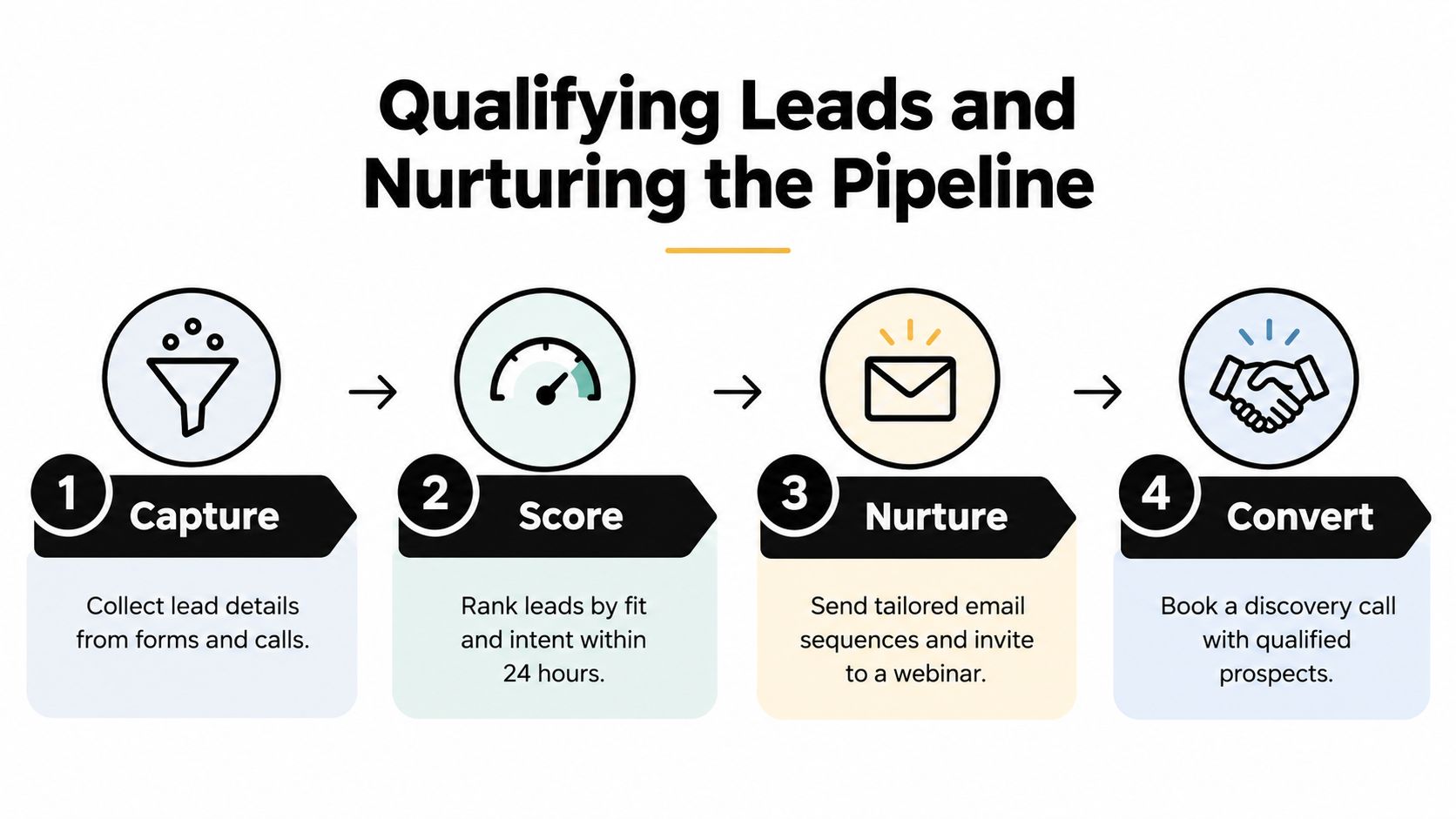
Route by intent and fit
Use a workflow the team will maintain:
- Capture: Log the source and stated need in the CRM.
- Score: Apply agreed fit and intent criteria, then assign an owner.
- Nurture: Send education and invitations related to the prospect’s concern.
- Convert: Offer a discovery call once interest and fit are clear.
Automation can handle routing, reminders, segmentation, and repeatable follow-up. Referrals still deserve priority because trust arrives with the introduction. Digital forms, email, and cold outreach work best when they help identify potential connectors, support referral partners, and extend relationship-led growth. The objective is a qualified conversation, not a larger list of low-intent clicks.
AI can identify engagement patterns, summarize submitted information, suggest follow-up tasks, and route contacts to the appropriate advisor. It should not make suitability decisions independently, produce unreviewed financial guidance, or manage sensitive conversations without human oversight.
Build a white-glove sequence
Start with confirmation and the promised resource. Follow with education tied to the original concern, then offer a webinar or meeting when the prospect has shown relevant interest. Trigger human follow-up after a direct reply, detailed form submission, or educational-event attendance.
Response speed matters, but context matters too. Qualified prospects should receive consistent ownership and follow-up history. Poor-fit inquiries still warrant a respectful reply and a clear alternative where appropriate.
Firms with limited internal capacity can assess a Hire Appointment Setter for scheduling and qualification. Review the provider’s scripts, permissions, escalation rules, and compliance controls before assigning access to prospects.
Use a defined B2B lead nurturing guide to map messages to intent, timing, and ownership. Review reply rates, meeting acceptance, and referral introductions by sequence so the team can remove weak steps. Automation provides consistency. Advisors remain responsible for trust, judgment, and the relationship.
Measuring Success and Optimizing the Funnel
Website visits and raw lead counts can create a misleading sense of progress. A financial advisor lead generation dashboard should show the quality of each handoff, from the first response through the signed relationship.
The practical benchmark model from Select Advisors Institute expects 5% to 15% landing-page conversion, 20% to 35% webinar-attendee-to-meeting conversion, and 10% to 25% meeting-to-client conversion. Select Advisors Institute’s advisor funnel benchmarks are directional ranges, not promises. They become useful only when your firm separates channel, audience, campaign, and cohort.
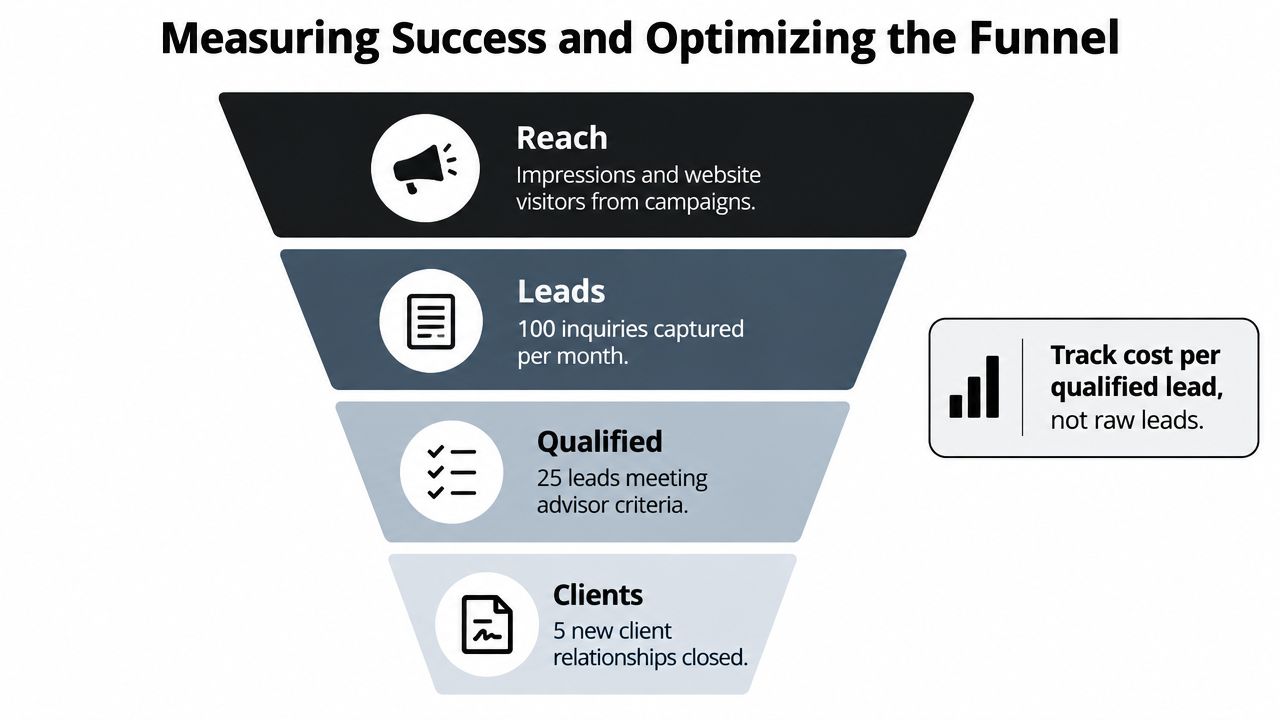
Track the weakest handoff
Start with a source-level view:
- Reach: Record qualified visits, referral introductions, event registrations, and outreach deliveries.
- Lead: Track completed forms, inbound calls, replies, and consented contacts.
- Qualified: Record accepted opportunities using the firm’s fit criteria.
- Meeting: Measure booked, held, and advisor-accepted conversations.
- Client: Track signed relationships and the originating source.
The dashboard should answer a management question, not merely display activity. If landing-page conversion is weak, investigate message match, page clarity, form friction, and trust evidence. If webinar attendance is healthy but meetings are scarce, improve the event promise, qualification, and follow-up. If meetings happen but clients don’t sign, examine fit, expectations, service design, and advisor communication.
Calculate economics by cohort
Calculate customer acquisition cost by channel using total channel spend divided by acquired clients, then include labor, technology, creative, events, and compliance review. For cold outreach, account for list preparation, sending infrastructure, campaign management, and appointment qualification. For referrals and COIs, include relationship-development time and event costs rather than treating introductions as free.
Use cohort reporting to compare not just acquisition cost, but qualified-lead rate, held-meeting rate, close rate, time to client, and retained relationship value. The result may show that a lower-volume referral source deserves more attention than a high-volume campaign.
Multi-touch attribution for B2B marketing can help firms assign credit across content, email, events, referral introductions, and advisor conversations. Avoid pretending that one touch explains a relationship that took months to build. Use attribution to improve decisions, not to manufacture precision.
Optimize one weak stage at a time. Keep the audience and offer stable while testing the page, sequence, qualification question, or follow-up owner. That gives the firm a clearer explanation for changes in pipeline quality.
Fypion Marketing provides cold email outreach and appointment setting for B2B firms, including contact-list development, deliverability setup, campaign management, and qualification against agreed meeting criteria. If your wealth management firm wants to test targeted professional outreach as a complement to referral growth, visit Fypion Marketing to discuss the audience, message, and pipeline process.