
Financial Services Lead Generation: A B2B Playbook for 2026

Average customer acquisition costs in financial services are approximately $336 per customer, so generic, high-volume lead generation can become economically dangerous for B2B providers. The practical answer is to qualify prospects before optimizing volume, with consent, regulatory fit, buying intent, and downstream opportunity value built into the funnel.
That changes the operating model. A form submission isn’t automatically a lead, a reply isn’t automatically buying intent, and a booked call isn’t automatically a sales opportunity. Financial services lead generation works when marketing, sales, data collection, and compliance operate as one trust architecture.
The pressure is already visible in channel investment. U.S. digital advertising spending across financial services and insurance grew by 3.9% in 2023, after growing 18.1% in 2022, while insurance attracted more than $10.12 billion in digital advertising expenditure and banking and lending exceeded $7 billion, according to IQuanti’s BFSI digital media insights. Firms aren’t short of channels. They’re short of disciplined systems that distinguish useful demand from expensive noise.
Why Traditional Lead Gen Fails in Financial Services
The approximately $336 customer-acquisition cost reported in a 2024 industry-statistics compilation makes careless volume especially risky in financial services. The same financial-services marketing statistics compilation reports that referrals accounted for 21% of new customer acquisitions, digital onboarding improvements increased conversion rates by 19%, and first-party-data targeting increased conversion rates by 33%. These figures point to a commercial reality: better qualification and better customer experience can matter more than adding contacts.
Traditional lead generation fails because it treats every response as interchangeable. A personal-loan inquiry, a regulated investment prospect, a fintech procurement conversation, and an unverified contact on a purchased list don’t carry the same intent, eligibility, risk, or sales value. When teams report only clicks, opens, and form fills, they hide the costs created by poor fit, missing consent, slow follow-up, and compliance rejection.

Why volume creates operational risk
Broad targeting creates four predictable problems:
- Low intent: Prospects download educational material but have no active project or budget.
- Weak eligibility: The contact may sit in the wrong jurisdiction, product category, or regulatory environment.
- Poor handoff: Sales receives incomplete context and spends time rediscovering the basic need.
- Attribution gaps: Phone conversations and assisted conversions disappear when reporting relies on last-click forms.
The answer isn’t to abandon digital acquisition. Paid search, referrals, email, social, and landing pages can all contribute, but each channel needs its own qualification rules and economic reporting. A useful internal view of the market should also distinguish a broad industry from the specific market segment your offer can serve, as explained in this guide to market versus industry.
Practical rule: Count a lead only when your team can explain why the prospect fits, what problem they have, what permission exists to contact them, and what action should happen next.
That discipline should extend to professional social selling. Teams that want to improve prospect research and profile-based outreach can use this practical resource to optimize your LinkedIn for leads. The objective isn’t more activity. It’s a clearer connection between the prospect’s context and the reason for contacting them.
Building an Ideal Customer Profile That Actually Converts
Lead generation in financial services becomes expensive when every contact receives the same treatment. A useful ideal customer profile (ICP) works as a qualification system, connecting trust, eligibility, buying conditions, and the people who can approve a commercial conversation. Each acquired record should earn further attention by showing a plausible fit, not merely matching a title.
Start with the account. Record its jurisdiction, business model, size, product category, technology environment, and restrictions that affect eligibility. A provider serving banks will need different criteria from one serving insurers, investment platforms, payment companies, or financial-software vendors. “Finance” describes an industry, not a campaign-ready market.
Build the profile around buying conditions
Firmographic fit only establishes permission to investigate the account. Add evidence that the organization may have a current need, such as visiting a product-specific page, responding to a problem-led message, requesting technical documentation, registering for a webinar with explicit consent, or discussing an active implementation. A senior title can identify authority, but authority without need and timing usually creates a courteous exchange rather than a qualified opportunity.
Build the profile by answering five operational questions:
- Who can buy? Name the economic buyer, operational owner, compliance stakeholder, and likely internal champion.
- What problem is urgent? Describe the trigger in the buyer’s language, such as inefficient qualification, weak attribution, or difficulty reaching a defined segment.
- What makes the account eligible? Check jurisdiction, product need, consent status, and internal restrictions before outreach.
- What action demonstrates intent? Separate passive content consumption from behavior that suggests a live business need.
- What disqualifies the account? Record unsuitable sectors, unsupported regions, missing permission, conflicts, and requirements your team cannot meet.
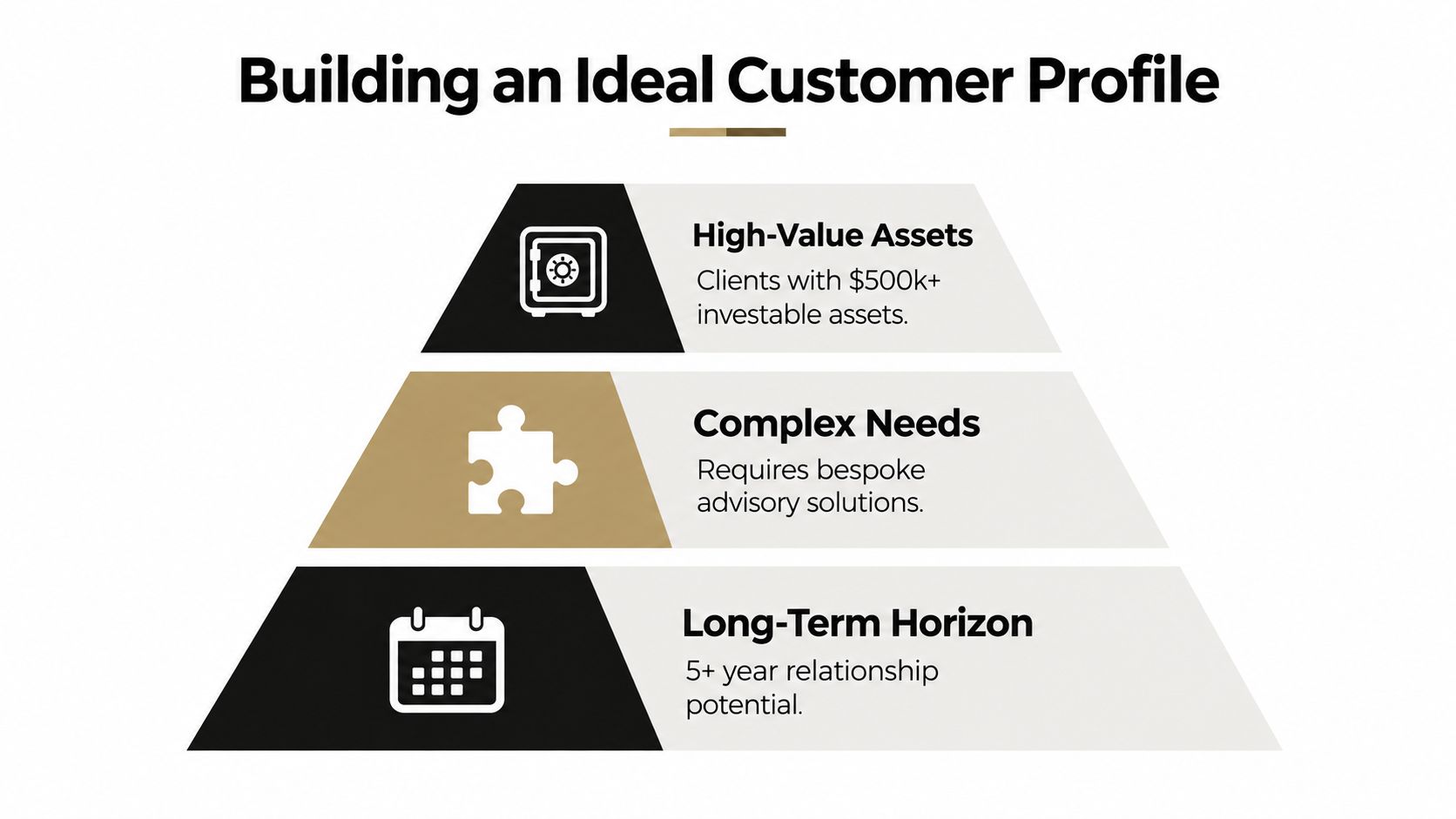
Define the handoff between a marketing-qualified lead and a sales-accepted lead inside the profile. Industry benchmark compilations report a 21.5% average nurture-email open rate, 45.6% MQL-to-sales-accepted-lead conversion, and 21% SQL-to-closed-won conversion, with nurture-touched SQLs reaching 28%, according to this lead-generation benchmark compilation. Treat those figures as directional because teams define stages and attribution differently. The practical lesson is to qualify before distribution and nurture contacts that show a credible path to a conversation.
Keep scoring transparent enough for sales to challenge and improve. Strong firmographic fit combined with an active product need should outrank a larger list of people who share only a job title. Teams refining the method can compare their criteria with this ICP framework for sales, then adapt the model to their compliance environment and buying committee.
The Technical Foundation for Compliant Cold Email Outreach
Cold email in financial services begins with infrastructure, not copy. A polished sequence can’t compensate for an unauthenticated sending domain, poor list hygiene, missing suppression controls, or a process that can’t prove why a person was contacted.
Set up authentication and monitoring before sending. Your team should verify the domain’s email authentication, separate campaign sending from critical corporate mail where appropriate, monitor bounce and complaint signals, and warm new inboxes gradually. Keep campaign volume controlled until the sending reputation is stable. A deliverability problem can affect future outreach long after a single campaign ends.
Treat data provenance as part of the offer
A compliant contact record needs more than a name, title, and email address. Store the source of the record, collection date, jurisdiction, lawful basis or consent status where applicable, permitted communication purpose, suppression status, and the reason the account matches the ICP. Keep those fields connected to the CRM so sales can’t accidentally reintroduce a suppressed contact.
TD’s 2026 survey found that protecting customer data and privacy was the leading consideration in how banks use AI, selected by 31% of respondents. Industry reporting also indicates that first-party data was the most widely used customer-insight source among BFSI marketers, with 39.02% relying on data collected through owned platforms such as websites and apps, as reported in the TD AI Insights report.
That has a direct implication for outbound strategy. Use owned behavioral signals where possible, explain why information is requested, minimize unnecessary fields, and give contacts a clear way to update preferences or withdraw. More data doesn’t automatically create a better lead. Opaque collection can reduce trust before a salesperson makes contact.
Minimum controls before launch
- Authentication: Confirm the sending infrastructure is configured and monitored by someone accountable for deliverability.
- List hygiene: Remove invalid, duplicated, role-based, outdated, and suppressed contacts before they enter a sequence.
- Consent governance: Record permission, purpose, region, and opt-out status in a system sales and marketing both use.
- Message review: Check claims, disclosures, personalization, and regulatory language before approval.
- Routing controls: Make sure replies, opt-outs, complaints, and high-intent signals reach the right queue quickly.
For teams adapting general outbound practices to a privacy-sensitive market, this guide to outreach advice for SaaS startups offers useful context on privacy-first prospecting. The principles still need to be reviewed against the relevant financial-services rules. A practical CAN-SPAM compliance guide can support the operational checklist, but it shouldn’t replace legal review for the markets in which you operate.
Crafting High-Response Outreach Messages for Finance Buyers
Finance buyers respond to evidence, not broad promises about “revealing growth.” A credible message shows that you understand their operating environment, can address a defined business problem, and will not introduce avoidable compliance or reputational risk. In financial services, that trust architecture matters more than sending a larger volume of generic emails.
Build each message around four elements: a specific observation, its likely business consequence, a concise explanation of your approach, and a low-friction next step. For example, refer to the segment the prospect serves and the acquisition constraint visible in its public positioning. Ask whether that constraint is active. Do not present an assumption as a diagnosis.
Match the message to the buying situation
A sequence should develop a case rather than repeat the same pitch. The opening message can identify the observed issue and explain why it may affect the recipient’s role. A follow-up can distinguish qualified meetings from raw inquiries, which connects the conversation to acquisition cost and pipeline quality. The next email might offer a short diagnostic, checklist, or conversation without assuming the prospect accepts your premise. The final message should close the loop respectfully and provide a clear opt-out path where required.
Personalization must be factual. Use a recent product launch, market focus, public hiring signal, or service category only when it is current and relevant. Automated compliments and invented familiarity weaken credibility. A senior buyer can usually identify them before reaching the second sentence.
AI can support account research, problem grouping, and draft variations. It should not make unsupervised financial recommendations or fabricate context. Deloitte found that 72% of U.S. banking customers are concerned about sharing financial information with generative-AI tools, only 46% trust the accuracy of AI-generated banking recommendations, and 83% would feel anxious if an AI agent acted on their finances without approval, according to Deloitte’s research on banking customers and generative AI.
That boundary applies to B2B outreach as well. State where automation assists research or routing, where a person reviews the interaction, how errors are corrected, and who remains accountable. A concise messaging framework for outbound campaigns can organize those decisions without turning every email into a product brochure.
Before launch, read the message as a qualified buyer would. They should understand the business problem, the reason for contact, and the next step without guessing. Clever wording is secondary to that clarity.
Defining and Tracking Qualification Criteria for Meetings
A reply shows interest. It does not prove that a meeting belongs on the sales calendar. A qualified meeting needs a shared definition that marketing, sales, and compliance can apply consistently. Without one, the CRM records activity while the pipeline absorbs conversations with little commercial value.
Write the acceptance rule before the campaign starts. An MQL may match the target account and complete a meaningful action. An SQL needs stronger evidence: an eligible organization, a relevant business problem, buying influence or a credible path to the buying group, and willingness to discuss the issue in a realistic commercial context. The rule should also specify who can reject a meeting and why, so qualification decisions remain auditable.
Conversion rate provides context, not a verdict on lead quality. Unbounce reports a median financial-services landing-page conversion rate of 8.4%, compared with 6.6% across industries, and notes that complexity materially affects performance in its financial-services landing-page conversion benchmark. A simple quote or prequalification offer will behave differently from a complex investment product. Compare similar offers, audiences, and buying stages before changing the campaign.
Bring form submissions and phone conversations into the same opportunity record. Capture:
- Fit: Does the company meet the intended firmographic and jurisdiction requirements?
- Need: Has the prospect described a problem the service can address?
- Authority: Is the contact a decision-maker, evaluator, or credible route to the buying group?
- Permission: Can the team continue the conversation under the applicable rules?
- Next action: Is there a confirmed meeting, responsible owner, agenda, and response-time record?
Report lead-to-qualified-opportunity and qualified-opportunity-to-client rates separately. Add cost per accepted lead, opportunity rate, revenue per lead, and compliance rejection rate. These measures expose trade-offs that a top-line conversion rate hides. A campaign with fewer form completions can produce more value when its accepted opportunities fit the sales process and survive compliance review.
High-intent submissions need a defined sales queue. Record the time from receipt to the first human action, then review whether slow handling or weak qualification caused the opportunity to stall. Prospects without immediate buying intent can enter nurture, but an opt-out or changed preference must remove them from automated outreach.
The operating goal is accurate acceptance, not the largest meeting count. That standard protects expensive acquisition spend, gives sales a cleaner pipeline, and turns qualification into part of the trust and compliance architecture rather than a reporting afterthought.
Scaling Your Pipeline with a Performance-Based Approach
A financial-services campaign earns the right to scale only after its workflow is repeatable. The team should know which accounts fit, why the message earns replies, where conversations belong, and whether outreach creates opportunities that sales can use. More sending volume cannot repair weak data, unclear ownership, or a compliance process that fails under pressure.
A performance-based partner such as Fypion Marketing can organize B2B outbound around market research, technical setup, personalized cold email, segmented contact lists, campaign management, and SDR-led qualification. Its stated model avoids upfront fees, retainers, and setup costs, with payment tied to booked, qualified meetings that meet agreed criteria. That arrangement can align incentives, but only if the acceptance rules define the required account, contact, meeting, and follow-up conditions clearly enough to prevent disputes.
Scaling works best as a controlled operating cycle. Start by researching the segment, including buying roles, triggers, restrictions, and the language prospects use. Approve the infrastructure before increasing volume by checking sending domains, authentication, list provenance, suppression workflows, and CRM routing. Build segment-specific messages with reviewed claims, relevant proof, and a clear call to action. During launch, change one variable at a time, such as the audience, offer, proof point, or follow-up sequence. Read replies, classify objections, inspect accepted meetings, and remove personalization that is inaccurate or misleading. Expand into adjacent audiences only after the current segment produces consistent, compliant conversations.
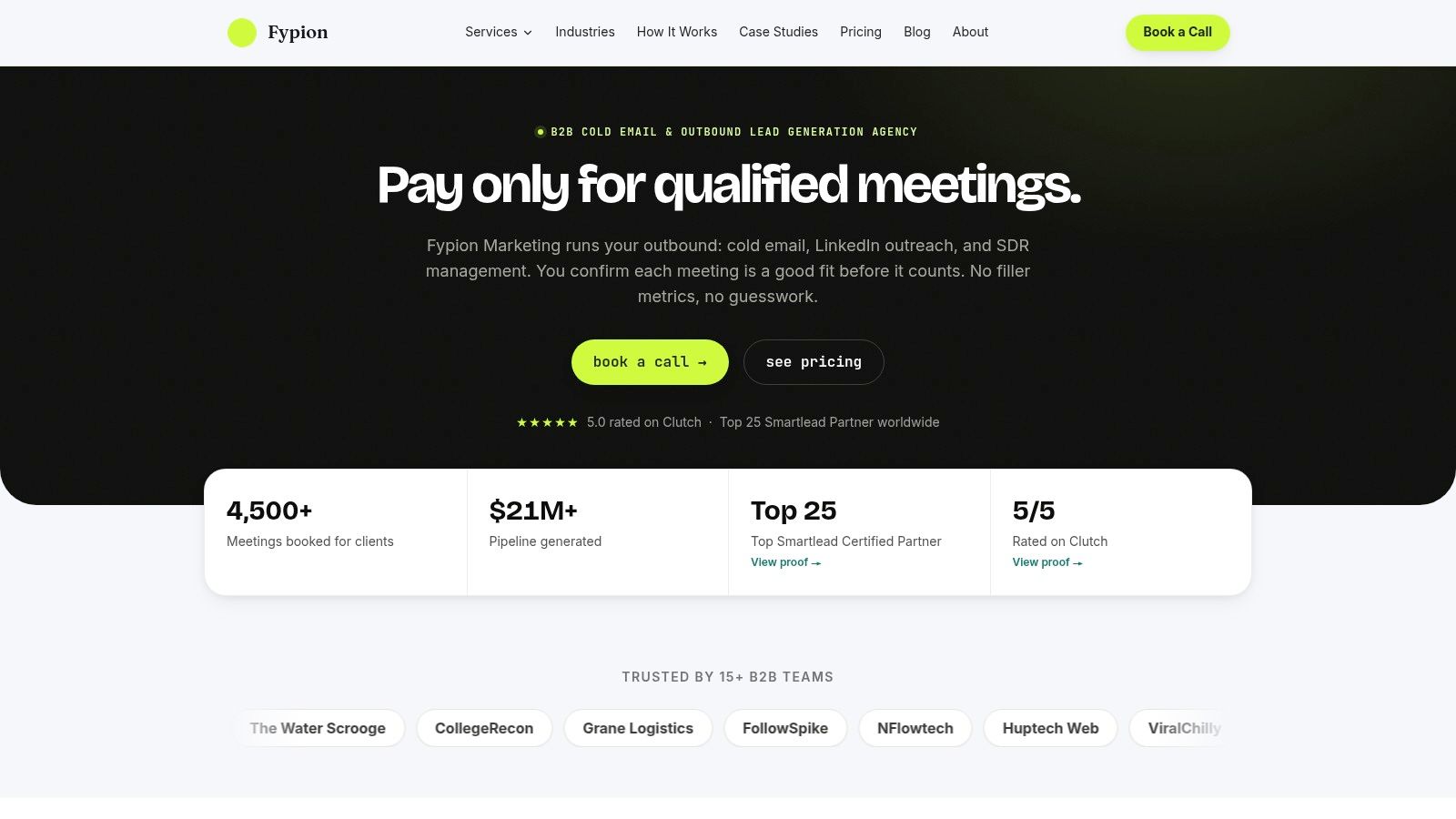
Company-reported performance results should be treated as directional evidence, not a promise for every financial-services campaign. Before comparing providers, ask how each provider defines a lead, qualified meeting, attribution, and reporting period.
Review more than response rate. Monitor inbox placement, bounce patterns, complaint signals, positive-reply quality, accepted-meeting rate, show rate, opportunity creation, and compliance rejects. A weaker result may call for a narrower audience, a clearer offer, stronger proof, faster routing, or messaging aimed at a different buying-group role. Sending more is only one possible response, and often the least useful one.
Internal teams can run the same cycle while bringing in specialist support at the actual bottleneck. A focused outbound B2B lead-generation process should connect research, outreach, qualification, and feedback, rather than separating them into disconnected vendor tasks.
Turning Insights into Sustainable Revenue Growth
Financial services lead generation becomes durable when every stage answers a practical question. Does the account fit? Is the contact eligible to reach? Is the need real? Can a human explain the offer clearly? Did the conversation become an accepted opportunity?
Audit the system against those questions. Tighten the ICP where sales repeatedly rejects accounts, remove data fields that prospects don’t need to provide, review claims with compliance, connect calls to CRM opportunities, and judge campaigns by accepted pipeline rather than raw response volume.
The central trade-off is simple. Broad reach can create activity quickly, but disciplined qualification protects budget, trust, sender reputation, and sales capacity. In a high-cost acquisition environment, compliant outreach and precise qualification aren’t administrative extras. They’re the foundation of sustainable growth.
Fypion Marketing helps B2B companies build targeted cold email campaigns through market research, technical infrastructure, personalized messaging, verified contact-list development, and SDR-led meeting qualification. Visit Fypion Marketing to discuss a financial-services lead generation program built around agreed qualification criteria and measurable sales outcomes.