
How to Generate Leads for Sales: B2B Guide
Most advice on how to generate leads for sales starts with channel selection. Should you use cold email, LinkedIn, paid search, webinars, or referrals? That question matters, but it’s rarely the first constraint. A weak list, slow routing, poor inbox placement, and generic follow-up can turn any promising channel into an expensive activity machine.
The better question is operational: which prospects show a credible reason to buy now, can you reach them reliably, and can your sales team respond before intent fades? Modern B2B lead generation works when targeting, timing, infrastructure, messaging, and measurement operate as one system. Raw activity creates records. A well-engineered process creates qualified conversations.
Rethinking the B2B Lead Generation Funnel
More leads don’t automatically produce more revenue. They often produce more sorting, more duplicate records, more unanswered tasks, and more frustration for sales representatives who are asked to work a pipeline with little buying intent.
A widely cited B2B waterfall model illustrates the problem. 1,000 leads may narrow to about 390 marketing-qualified leads, 148 sales-qualified leads, 62 opportunities, and 23 closed deals, which means roughly 2.3% of the original leads become customers (Callbox’s summary of the B2B lead generation model). The exact movement will vary by market and offer, but the operating lesson is durable: value leaks at every stage.
Replace volume targets with signal quality
A sales team that measures success by contact creation can easily optimize for the wrong outcome. A scraped database may contain thousands of names, yet very few may fit your ideal customer profile, have an active problem, or hold influence over a purchase.
Qualification should combine account fit, role relevance, observable behavior, and timing. A senior hire in a target function, a funding announcement, a visit to a pricing page, or a public complaint about a competitor gives a representative a reason to start a conversation. None of these signals guarantees a deal. They do, however, create a more defensible prioritization rule than “contact everyone in this industry.”
Signal-based timing also changes the message. A company that has just hired a sales operations leader may care about workflow efficiency. A company that has announced expansion may be dealing with capacity, reporting, or hiring pressure. The outreach becomes relevant because it reflects a current business event, not because a template inserted the prospect’s first name.
Practical rule: Don’t ask whether a prospect can receive your message. Ask what changed that makes the message useful today.
Preserve value between stages
The funnel needs explicit handoff rules. Marketing should define what makes an engaged prospect worth sales attention, sales should record why a lead was accepted or rejected, and both teams should agree on what happens next. Without those rules, marketing celebrates acquisition while sales absorbs the cost of poor qualification.
A practical operating model looks like this:
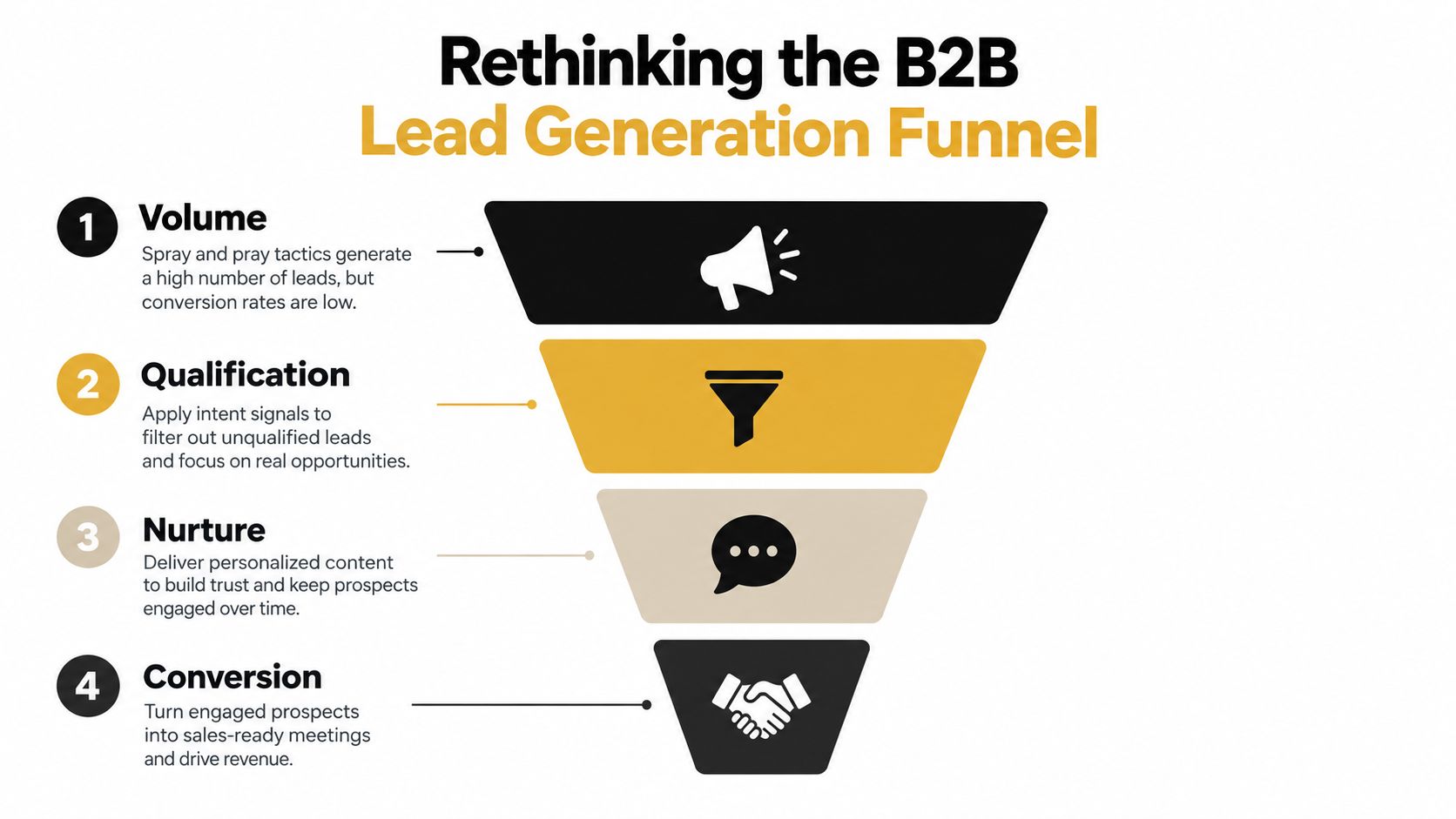
- Volume: Build reach inside a tightly defined market, but treat contact creation as input rather than success.
- Qualification: Filter by fit and intent before assigning expensive human attention.
- Nurture: Give prospects useful context when their timing isn’t immediate, instead of forcing a premature sales call.
- Conversion: Route qualified responses to a representative who has the signal, account context, and next step.
Teams building this system from scratch can use a detailed guide on how to build a predictable B2B lead engine as a planning reference. The important distinction is between a collection of channels and a process that preserves information as a lead moves toward a meeting.
Engineering Your Outbound Deliverability Architecture
A persuasive email that lands in spam has generated no sales lead. Deliverability belongs at the beginning of the build, before copywriting, list expansion, or campaign scaling.
Benchmarks commonly treat 95% or higher deliverability as good and 89% or higher inbox placement as strong, while industry testing has reported average deliverability around 83.1%, with approximately 10.5% of messages landing in spam and 6.4% disappearing entirely (Saleshandy’s email deliverability benchmark overview). Those figures make one point clear: delivery and inbox placement aren’t interchangeable.
Build the sending environment first
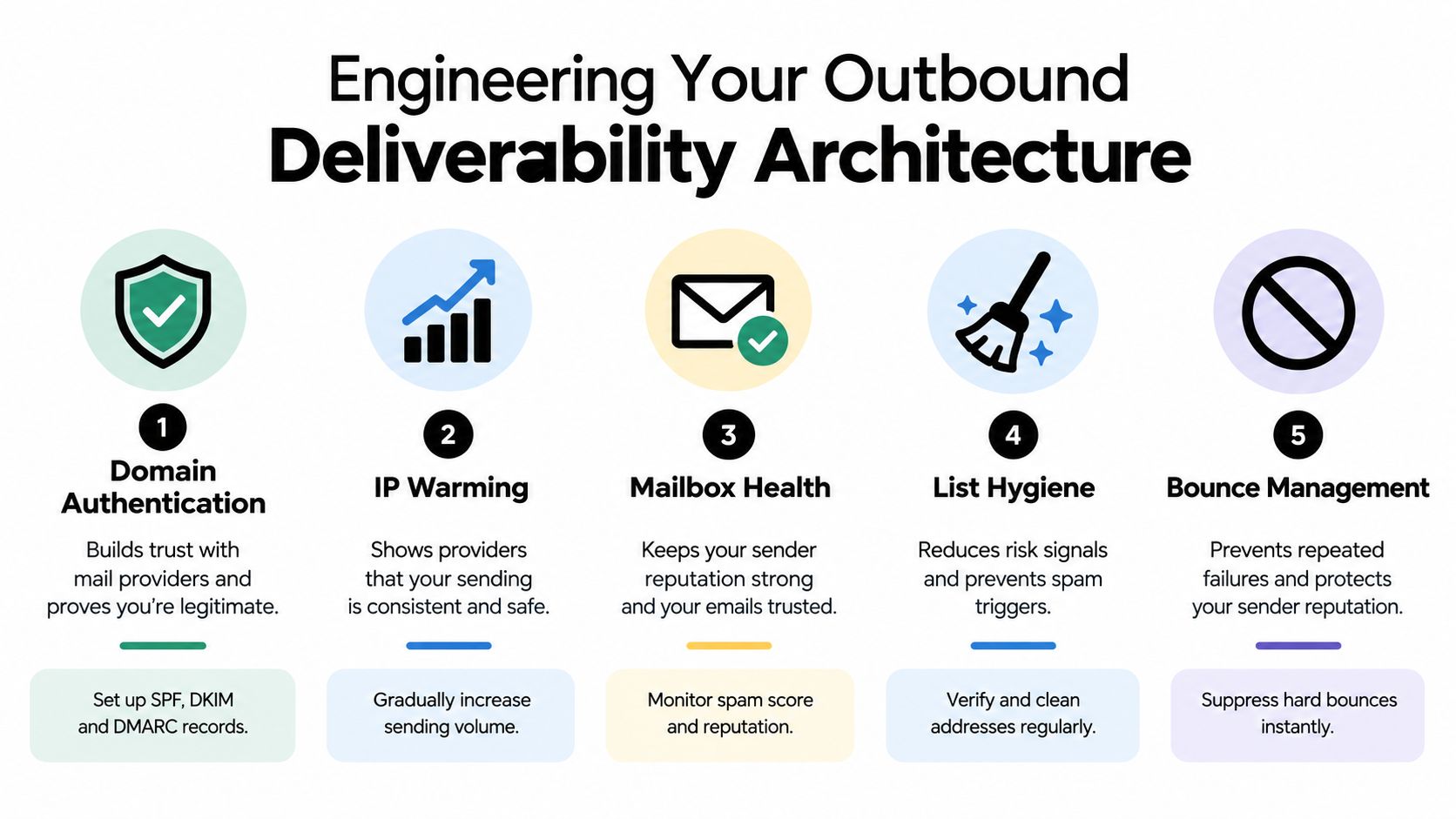
Use secondary sending domains for outbound rather than putting your primary corporate domain at unnecessary risk. Set up SPF, DKIM, and DMARC correctly, then verify that the domain and mailboxes authenticate before sending campaign traffic. The purpose isn’t technical decoration. Authentication helps receiving providers establish whether your messages come from an authorized sender.
Review the relevant email authentication protocols with whoever manages your domain and mailbox environment. Keep ownership clear, document changes, and avoid launching from accounts that already have an uncertain reputation.
Warm the sending environment gradually over 2 to 4 weeks, as current cold-email guidance recommends (Unify’s guidance on domain setup, deliverability, and sequences). A warm-up period gives mailbox providers time to observe normal sending behavior. It also gives your team time to catch authentication errors, bad addresses, complaint patterns, or poor copy before volume increases.
Protect mailbox reputation
Modern outbound infrastructure needs operating limits. Guidance for cold outreach commonly recommends 30 to 50 emails per mailbox per day, with multiple mailboxes rotated rather than forcing one inbox to carry the entire campaign (Unify’s cold email infrastructure recommendations). Treat those limits as safeguards, not targets. Sending less to a clean, relevant list is usually preferable to exhausting a mailbox with low-quality traffic.
Run a simple health checklist before every scale-up:
- Authentication: Confirm SPF, DKIM, and DMARC are passing.
- List hygiene: Verify addresses and remove risky, outdated, or duplicate contacts.
- Bounce control: Suppress hard bounces immediately and investigate unusual bounce clusters.
- Reputation monitoring: Watch spam complaints, inbox placement, and mailbox performance by domain.
- Blacklist checks: Teams can use a resource such as check IP blacklist Spamhaus when investigating reputation problems.
Delivery is only the first gate. A message can arrive in the inbox and still fail because the list is broad, the offer is weak, or the timing is irrelevant. Don’t scale until infrastructure and response quality are both stable.
Designing High-Converting Email Sequences
A cold email rarely earns a reply on its own. One message must establish relevance, overcome skepticism, explain the next step, and arrive at a time when the prospect can act. Prospects miss emails, postpone decisions, or need a different reason to engage later. A sequence gives each touch a defined role instead of forcing one message to do everything.
Cold-email benchmark data puts the average reply rate at 3.43%, while top performers exceed 10.7%. About 58% of replies come from the first email and 42% from follow-ups, supporting a sequence of 4 to 7 touchpoints. The same report found that campaigns sent to fewer than 50 recipients average a 5.8% reply rate, compared with 2.1% for campaigns sent to more than 1,000 recipients (Instantly’s 2026 cold email benchmark report). Treat these figures as diagnostic reference points, not guarantees. Track positive replies, qualified meetings, and opportunities, because total response volume can hide weak commercial intent.
Segment before you write
Broad lists produce generic copy because the writer lacks a specific problem to address. Smaller cohorts support a clearer hypothesis about the account, a more credible proof point, and a more relevant next step. The goal is not to make every campaign tiny. It is to make the audience narrow enough that the sequence reflects a shared business situation.
Create a segment only when you can answer three questions:
- Why this account? Define the firmographic or strategic fit.
- Why this person? Identify the role connected to the problem.
- Why this moment? Record the event or operating change that justifies contact.
Give every touch a job
A sequence should develop a conversation, not repeat one pitch with different subject lines. The first email can connect a known business context to a plausible problem. A second touch can add a useful observation or clarify the cost of leaving that problem unresolved. Another can offer a practical example or a low-commitment conversation. The final message can close the loop respectfully and make future contact easier.
Sequence logic should also reflect live response data. Stop outreach when someone replies, suppress contacts who opt out, and route positive replies quickly while the context is still fresh. If a prospect opens without responding, do not treat that activity as buying intent. Use it to review timing, relevance, and the next message rather than adding more volume.
Keep follow-ups short and distinct. “Just bumping this” repeated several times gives the recipient no new reason to act. A specific operational question, relevant observation, or permission-based close can create a better opening. For varied nurture structures and timing ideas, review these email drip campaign examples. Judge the sequence by qualified conversations and pipeline created, not by how many automated touches it sends.
Crafting Signal-Based Outreach Messaging
Personalization isn’t adding a first name to a template. It’s explaining why your message belongs in this person’s inbox at this point in the company’s operating cycle.
More than 70% of buyer research is described as happening in the dark funnel, before a prospect fills out a form or identifies themselves directly (CIENCE’s coverage of B2B lead generation trends). That makes observable intent especially useful. Teams can trigger research and outreach from funding rounds, new hires, website visits, competitor mentions, and other public or first-party events instead of relying on an aging static list.

Turn a signal into a business hypothesis
A signal is not the message. It’s the starting evidence for a hypothesis about what the account may need.
Suppose a target company hires a revenue operations leader. The outreach shouldn’t say, “I saw you hired someone.” That observation is superficial and can feel intrusive. Instead, connect the event to a plausible operating challenge: new leadership often reviews data quality, routing, reporting, and the handoff between marketing and sales. The email can ask whether those workflows are part of the person’s current priorities.
Use this structure:
- Observed event: State the relevant change without overexplaining how you found it.
- Likely implication: Connect the event to a specific business pressure.
- Relevant capability: Explain the problem your offer addresses, without listing every feature.
- Proof of understanding: Add a concise observation about the prospect’s market, role, or process.
- Low-friction next step: Ask a focused question or offer a short conversation.
The same pattern works for a website visit, but avoid pretending to know the visitor’s identity or intent with certainty. A visit can indicate research, curiosity, or an accidental click. Treat it as a prioritization clue and write with appropriate restraint.
Write for the decision-maker’s context
Senior buyers usually don’t need a product tour in the first email. They need to understand the business consequence, the reason to investigate, and the effort required to continue the conversation.
Keep the opening concrete. “Your team may be reviewing lead routing after the new sales leadership hire” gives the recipient something to confirm or reject. “We help companies grow through a flexible platform” gives them nothing useful to respond to.
Teams that want to understand the weakness of broad databases can review this analysis of static list limitations for B2B. Then document the messaging logic in a reusable messaging framework, so representatives can adapt the core argument without reverting to empty personalization.
Measuring Pipeline Velocity and Lead Quality
Open rates can help diagnose delivery or subject-line problems, but they don’t tell you whether the business is generating revenue. The operating dashboard should follow the lead from first response to accepted meeting, attended meeting, qualified opportunity, and closed business.
Track each stage separately. A high reply rate with few positive replies may indicate curiosity rather than demand. A healthy meeting-booking rate with poor attendance may indicate weak qualification or unclear expectations. Strong meeting volume with little pipeline creation usually points to an offer, targeting, or sales-conversion problem.
Use a revenue-connected scorecard
A useful scorecard includes:
- Positive reply rate: Measures whether prospects express relevant interest, not merely whether they respond.
- Qualified meeting rate: Shows whether booked meetings meet the agreed account, role, and need criteria.
- Show rate: Separates calendar activity from actual conversations.
- Sales acceptance rate: Reveals whether representatives trust the qualification and context.
- Opportunity creation: Connects meetings to real pipeline movement.
- Pipeline velocity: Measures how quickly accepted opportunities progress through defined stages.
- Source contribution: Compares channels by qualified pipeline, not lead count.
- Cost per qualified meeting: Makes different acquisition approaches easier to compare.
Use one CRM definition for each stage. If marketing calls a contact “qualified” after a content download while sales requires a confirmed business problem, the dashboard will create disagreement rather than clarity. A shared definition for acceptance, rejection, recycling, and nurture protects the numbers from internal interpretation.
Treat response time as a conversion variable
Inbound intent decays quickly. Industry benchmarks frequently report that companies responding within five minutes are dramatically more likely to convert than those waiting longer, with one summary citing a 100x conversion advantage compared with waiting 30 minutes (CIENCE’s lead generation statistics summary). The exact impact varies by market and lead source, but the operational conclusion is straightforward: routing cannot depend on someone checking a spreadsheet later.
Connect forms, chat, reply inboxes, and calendars to an automated workflow. Assign the lead to the right representative, include the source and activity context, and trigger an immediate acknowledgement where appropriate. For planning teams, forecast accuracy guidance is useful because reliable forecasting depends on clean stage definitions and timely updates, not optimism about unqualified volume.
Measure the handoff, not just the acquisition. The lead becomes commercially useful when a qualified human conversation starts.
Scaling Predictably with Pay-Per-Meeting Models
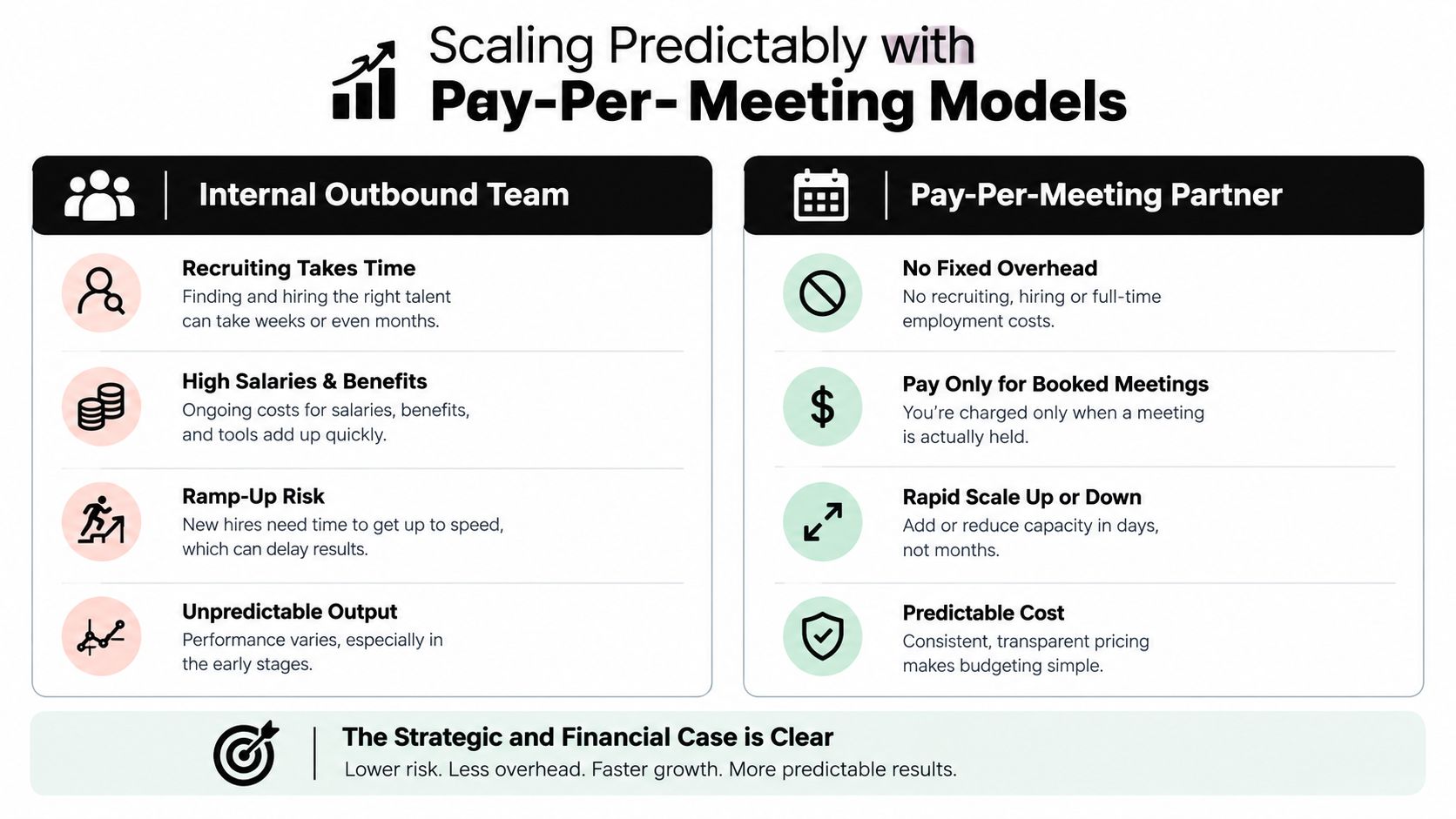
An internal outbound team gives you control, but control comes with operating cost. You need recruiting, management, training, data sourcing, mailbox infrastructure, quality assurance, copy development, reply handling, and a process for replacing people or systems that underperform. For a company still proving its market, that fixed commitment can arrive before the sales motion is repeatable.
A pay-per-meeting partner changes the risk allocation. Instead of paying primarily for activity or reserved capacity, you agree on what counts as a qualified meeting and pay when that outcome is delivered. This model doesn’t eliminate risk. It moves the central question from “How many tasks did the team complete?” to “Did the meeting meet the criteria that sales can work?”
Compare the economics honestly
An internal model can make sense when the company has stable demand, enough management capacity, a repeatable sales process, and a long-term need for dedicated institutional knowledge. It also gives the business direct control over data, experimentation, and daily coaching.
Outsourcing is more attractive when the product has proven market fit but the company wants to avoid building every operational layer at once. A specialist can bring established research, list verification, domain setup, sequencing, inbox monitoring, reply handling, and optimization processes. The internal sales team can then focus on discovery, demonstrations, proposals, and closing.
| Internal outbound team | Pay-per-meeting partner |
|---|---|
| Recruiting and onboarding take management time | Specialist execution reduces internal setup work |
| Salaries and tools create fixed overhead | Cost is tied to an agreed meeting outcome |
| Ramp-up and turnover affect continuity | Capacity can be adjusted as demand changes |
| Managers own infrastructure and quality control | The partner owns campaign operations within the agreement |
| Output may fluctuate during hiring or testing | Delivery is evaluated against qualification criteria |
The model only works when the definition of “qualified” is precise. Put the agreement in writing:
- Account criteria: Industry, size, geography, technology, or other fit requirements.
- Contact criteria: Relevant seniority, function, and buying influence.
- Meeting criteria: A real calendar acceptance with the agreed attendee and business context.
- Exclusions: Existing opportunities, customers, competitors, duplicates, and unsuitable accounts.
- Feedback loop: A process for rejecting poor-fit meetings and improving targeting.
A performance-driven provider such as Fypion Marketing offers cold email outreach, market research, list building, infrastructure setup, sequence writing, reply handling, and booked qualified meetings through a pay-per-meeting approach. Before choosing any provider, ask how it handles consent and compliance, list hygiene, domain protection, qualification disputes, no-shows, and reporting.
Outsourcing works when accountability is measurable. “More activity” isn’t a deliverable. A qualified conversation with agreed criteria is.
The embedded video provides another perspective on building an outbound process:
For teams evaluating the broader operating model, this guide to outbound B2B lead generation can help clarify which work belongs with sales, marketing, or an external specialist. The decision should follow the bottleneck. If your team has strong closing capability but lacks targeting, infrastructure, and consistent meeting creation, external execution may deliver greater return. If qualification is unclear or the offer doesn’t resonate, outsourcing more volume will only expose those problems faster.
Fypion Marketing builds and manages signal-based cold email campaigns for B2B companies, including ICP research, verified list building, deliverability infrastructure, multi-touch sequences, reply handling, and qualified meeting booking. Visit Fypion Marketing to discuss your target market, agree on meeting criteria, and assess whether a pay-per-meeting outbound engine fits your sales process.