
8 Ideal Customer Profile Examples for B2B SaaS
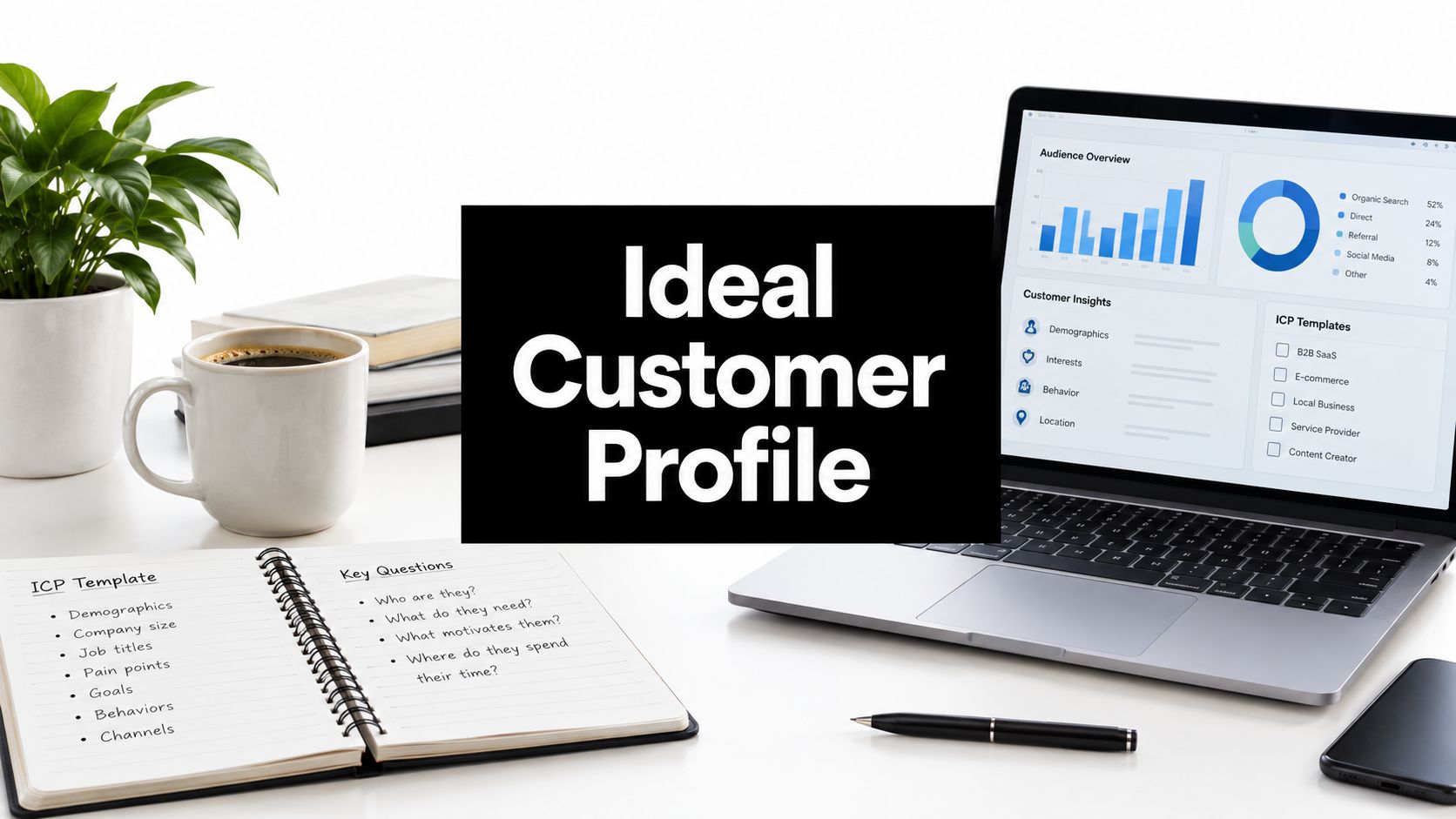
A strong ideal customer profile makes every outreach decision easier. It identifies more than an industry label. It describes the organizations most likely to have the problem, budget, urgency, technical environment, and buying conditions your B2B offer requires. That distinction matters because a benchmark of B2B companies found that 71% of businesses exceeding revenue and lead goals had documented buyer personas, compared with 37% of companies meeting goals and 26% of those missing goals. The same B2B buyer persona and ICP benchmark reported that documented ICPs were much more common among high-growth companies than no-growth firms.
The eight ideal customer profile examples below turn that idea into outbound campaign logic. Each one connects firmographics, technographics, buying signals, pain points, qualification rules, sales-cycle realities, and cold-email hooks. Use the examples as starting models, then replace assumptions with evidence from your CRM, customer interviews, win-loss data, product usage, and retention patterns. A useful B2B ideal customer profile guide can help structure that research.
This framework also suits performance-based cold-email programs such as Fypion Marketing when a company already has product-market fit and wants qualified meetings without adding fixed acquisition overhead. The important condition is fit: an outreach partner can improve list quality and execution, but it can’t compensate for an unclear market, weak offer, or vague qualification standard.
1. Mid-Market SaaS Companies with Proven Product-Market Fit
A SaaS company with proven demand is a stronger outbound prospect than one still searching for its audience. The right account already knows which customers benefit, has repeatable evidence from existing users, and needs a reliable way to reach similar companies. Look for a defined use case, a sales leader responsible for pipeline, product capacity for additional customers, and staff who can follow up promptly.
Start with firmographics: growth stage, department structure, customer segment, operating geography, and likely contract value. Then review technographics. Salesforce, HubSpot, Slack, Microsoft Teams, or a competing category product can reveal how the prospect currently manages sales, communication, or the problem your offer addresses. The targeting decision should connect your service to an established workflow, not introduce an abstract promise.
Qualification signals that matter
Prioritize accounts with a commercial reason to act:
- Sales hiring: A growing SDR or account executive team may need more qualified conversations to support added capacity.
- Market expansion: New industry pages, regional launches, or vertical-focused product updates can indicate a need for sharper account selection.
- Leadership change: A new VP of Sales or revenue leader may be reviewing pipeline channels, conversion rates, and acquisition costs.
- Customer proof: Relevant case studies and repeatable use cases give sales teams material for vertical-specific messaging.
- Operational readiness: Confirm that someone owns meeting acceptance, routing, qualification, and follow-up.
Set qualification rules before building the list. Require a matching customer segment, a relevant use case, an accountable sales contact, and capacity to work booked meetings. Exclude companies with unclear positioning, low deal value, or no owner for follow-up. A smaller list often produces better economics when research time and average contract value matter more than raw activity.
Practical rule: Define success with the VP of Sales before launch. Agree on target titles, company fit, use case, minimum qualification standard, and follow-up ownership, rather than measuring booked meetings alone.
Expect a considered sales cycle. SaaS buyers compare tools, involve multiple departments, and often research independently before accepting a sales conversation. Use multi-touch outreach, and review the company’s customer base alongside its product-market-fit validation process before writing copy. Fypion Marketing can support performance-based cold-email programs when the offer, market, and qualification standard are already clear.
Cold-email hook: “You’ve already built traction with [customer type]. We’re seeing SaaS teams in [vertical] create a more focused meeting pipeline by targeting [role] when [specific trigger] appears. Is expanding that segment a current priority?”
2. Enterprise Software Vendors Entering New Verticals
Entering a new vertical changes the sales problem. Enterprise buyers assess industry knowledge, compliance exposure, integration risk, and implementation capacity alongside product capability. Salesforce entering vertical cloud markets, Microsoft positioning Azure for healthcare and finance, ServiceNow developing industry solutions, and Workday expanding beyond human resources all reflect the move from horizontal functionality to vertical relevance.
Define the ICP at the account level before selecting contacts. Record the target industry’s firmographics, including organization size, regional footprint, regulated activities, and operating model. Add the department that owns the problem, the systems already in place, and the business outcome the solution must support. Technographic research should identify incumbent platforms, cloud environment, integration requirements, security processes, and whether the prospect has the resources to manage an enterprise implementation.
The account qualifies when four conditions align: the organization operates in the target vertical, the relevant use case is visible, the buying group can be mapped, and an implementation owner has capacity to act. Exclude accounts with no clear business owner, limited integration readiness, or a use case too small to justify an enterprise sales cycle.
Buying groups rarely fit a one-contact campaign. Map each role to a different concern:
- Economic sponsor: Owns the business outcome and budget.
- Functional owner: Experiences the operational problem and defines practical requirements.
- Technical evaluator: Reviews architecture, security, integrations, and procurement constraints.
- Risk stakeholder: Assesses legal, privacy, compliance, or governance exposure.
- Implementation partner: Manages migration, adoption, or internal coordination.
Buying signals help determine timing. Look for a vertical-specific product page, industry conference activity, executive hiring, a new partnership, a compliance initiative, or public investment in modernization. These events indicate a plausible reason to start a conversation, not proof that a purchase is imminent.
The main trade-off is authority versus relevance. A C-suite contact may influence budget but ignore a generic feature pitch. A functional leader may understand the pain yet lack approval power. Build an account-level sequence that gives each person a specific reason to respond, then allow time for technical review, governance checks, and cross-functional approval.
Clarify whether the campaign addresses a broad market need or a specific market versus industry positioning. That decision sets the vocabulary, proof points, exclusions, and landing page.
Cold-email hook: “Your [vertical] customers may be weighing [business outcome] alongside integration and governance requirements. We mapped the operational teams involved in that decision. Would a short exchange about your [vertical] expansion plans be useful?”
3. High-Growth Tech Startups Post-Series A Funding
Series A funding creates a sales opportunity only when the startup can convert momentum into a repeatable commercial process. The strongest ICP is a technology company with a validated product, a defined segment, and leadership pressure to build customer acquisition beyond founder-led selling. A fast-growing startup can still be a poor fit if its positioning changes constantly, onboarding cannot support new accounts, or founders must approve every lead.
Set account filters around funding stage, growth direction, target market, sales model, and leadership structure. Then inspect the operating stack. A CRM, marketing automation, enrichment system, sales engagement platform, and usable analytics indicate whether the team can act on outbound demand rather than just collect contacts. These filters distinguish a startup with urgency from one with the capacity to follow through.
Read the signals in context
Use the following signals to form a qualification hypothesis, not to assume a purchase is imminent:
- Commercial hiring: New sales, partnerships, or demand-generation roles suggest investment in a repeatable motion. Confirm that the roles have defined ownership and an active hiring plan.
- New market language: A website shift from a broad product story toward a specific vertical or use case may reveal sharper positioning. Compare the new messaging with current customer evidence.
- Leadership goals: A new revenue leader may need channels that can be tested, measured, and adjusted quickly. Ask which segment and outcome the leader owns.
- Investor-facing milestones: The team may value customer quality and repeatability more than a large lead count. Qualify against its reporting priorities.
- Customer success capacity: Early accounts require implementation support, references, and ongoing attention. Check whether the team can serve additional customers before creating demand.
The central trade-off is speed versus learning quality. Rapid list deployment creates activity, while weak targeting produces noisy feedback and pulls attention away from the strongest segment. A smaller campaign built around explicit hypotheses can test which roles, triggers, and pain points merit further investment.
Define the operating rules before outreach begins. Agree on what qualifies as a meeting, where outcomes are recorded, and which feedback changes the next iteration. Keep the commercial arrangement flexible as priorities change, while retaining clear ownership and review points. Practical guidance on lead generation for startups is more useful when paired with those rules.
Cold-email hook: “You’re expanding from [initial use case] into [new segment]. We help teams identify accounts showing that problem now, rather than building a broad technology list. Is [segment or trigger] part of your current growth plan?”
4. E-Commerce and Marketplace Companies Pursuing B2B Sales
A consumer brand entering B2B needs more than recognition, transaction data, a marketplace network, or a large user base. Those assets create an opening, not an enterprise partnership. Buyers still need a clear commercial model, integration path, service commitment, procurement process, and reason to prioritize the relationship.
Start by defining the B2B motion. Wholesale partnerships target retailers and distributors. Enterprise integrations focus on companies with compatible systems, technical resources, and a shared customer use case. Corporate purchasing requires procurement controls, account management, and dependable fulfillment. Channel relationships depend on partner economics and market coverage. Each motion needs different firmographic and technographic filters.
Build the ICP around the account’s ability to create and support that motion. Useful firmographics include partner category, geographic reach, customer base, transaction volume, fulfillment model, and strategic fit. Technographic signals can include commerce platforms, payment systems, logistics tools, APIs, and existing marketplace integrations. A marketplace seller with demand but limited operational capacity may need a different offer from an enterprise buyer with an established procurement team.
Translate the consumer proposition into a business result:
Retailers may value differentiated assortment or a simpler supplier relationship. Platforms may seek more transaction depth, stronger retention, or relevant inventory. Enterprise buyers need dependable purchasing and administrative controls. Integration partners need a defined technical scope and shared customer value. Marketplace sellers may want access to demand without adding unnecessary operational work.
Use buying signals to prioritize outreach. A new B2B page, partner announcement, API documentation, wholesale hiring, enterprise pricing, or integration-directory listing suggests active investment. Qualification should confirm two points early: the account has a named partnership owner, and its team can support implementation after the first conversation. If either is missing, keep the account in nurture rather than treating interest as sales readiness.
Brand-led outreach creates recognition, while buyer-led outreach gives the recipient a reason to respond. Lead with the operational gap, such as limited distribution, inefficient procurement, missing integration capacity, or restricted customer access. A campaign should also reflect the requirements of B2B lead generation websites, including clear use cases, proof, contact paths, and role-specific conversion points.
Cold-email hook: “Your consumer brand already has traction with [audience]. We’re assessing whether [partner type] could extend that value through [wholesale, integration, or corporate use case]. Who owns that partnership conversation at [company]?”
5. B2B Service Providers Scaling Client Acquisition
A service firm’s ideal customer profile should identify the conditions that make outside expertise timely. “Companies that need growth” is too broad to guide outreach. A usable ICP names the client problem, the executive accountable for the result, the provider’s delivery capabilities, and the evidence that the buyer can support the engagement.
Start with the client situation, then define the account.
A cloud implementation firm might target organizations running a specific legacy environment and preparing for a migration. A cybersecurity consultancy could focus on companies approaching an audit or expanding their security program. A specialist agency may prioritize businesses with an internal marketing team, an established channel mix, and a clear gap in one channel. These firmographic choices reduce market size, but they make the message and qualification process more credible.
Build qualification around delivery conditions
Use rules that show whether an account can become a workable engagement:
- Defined business problem: The prospect can describe the operational, commercial, or compliance issue in concrete terms.
- Relevant owner: The contact controls the outcome or can introduce the responsible executive.
- Delivery fit: The provider has the people, credentials, and experience needed for the work.
- Change capacity: The client can provide access, data, approvals, and internal collaboration.
- Commercial seriousness: The prospect accepts that specialized work requires a defined scope and engagement.
Buying signals help prioritize accounts. Watch for a new executive, a major technology rollout, service expansion, hiring for a supported capability, or public evidence of a transformation initiative. Technographic research should identify the platforms, workflows, and systems that shape delivery, so outreach addresses the prospect’s actual environment rather than naming generic expertise.
The central trade-off is specialization versus market volume. A narrow offer produces fewer potential accounts, yet it gives sales teams clearer qualification rules and more relevant reasons to contact buyers. A broad offer reaches more companies but often turns each message into a list of capabilities. For professional services, a case study that matches the prospect’s situation usually carries more weight than a long service catalog. Lead with the client’s condition and intended outcome.
A provider that lacks a repeatable acquisition process can work with a lead generation agency. The agency should apply the firm’s qualification rules, delivery constraints, and target systems, rather than optimize for meetings that cannot become viable engagements.
Cold-email hook: “Teams responsible for [business function] often bring in specialists when [specific trigger] creates a delivery gap. We help with [defined outcome] for organizations using [relevant system or process]. Is that challenge on your roadmap?”
6. Financial Services and FinTech Growth-Stage Companies
Financial services and FinTech companies require an ICP built around the buying motion, not just the product category. A promising account may need a partnership, enterprise integration, institutional relationship, or distribution arrangement. Each path brings different risk owners, approval steps, and sales-cycle constraints. Qualification must therefore cover commercial fit and the prospect’s ability to complete regulatory, security, legal, and operational review.
Begin with the business model. Separate payment providers, lending platforms, banking infrastructure, financial wellness products, wealth technology, and institutional services. Add firmographics such as customer type, regional permissions, operating model, growth direction, and partnership maturity. These details indicate whether the account has the right market access, operating complexity, and reason to evaluate an external solution.
Technographic research should identify core banking systems, payment rails, fraud tools, data platforms, identity systems, and integration methods. Use that information to test technical fit before outreach. A solution that cannot work with the existing environment will struggle regardless of executive interest.
Qualify the buying path before booking a meeting
Map the people who can approve, delay, or reject the initiative. Compliance, legal, information security, operations, procurement, board members, and partner teams may all influence the decision. Ask who owns risk review, which approvals are required, and whether the current systems can support the proposed relationship.
Then connect qualification to a specific trigger. Product launches, geographic expansion, new distribution, API expansion, integration documentation, a new compliance leader, or changing regulatory expectations can create urgency. A funding announcement or new product page alone provides weaker evidence. Require a defined initiative, an accountable owner, and a credible implementation path before treating the account as sales-ready.
The main trade-off is reach versus trust. Narrow targeting produces fewer contacts, but it gives outreach room to address the prospect’s risk concerns and evaluation process. Broad campaigns may create more replies while attracting companies without the permissions, systems, or approval capacity to proceed.
Keep claims within what the team can verify. Do not promise outcomes that depend on licensing, legal interpretation, or technical assessment. A useful cold email names the trigger, the affected stakeholders, and the operational result:
Cold-email hook: “Your move into [product, market, or partner channel] likely brings compliance and integration stakeholders into the conversation. We help [similar role] evaluate [specific operational outcome] without treating risk review as an afterthought. Is there a team working on that now?”
7. Healthcare Technology and Medical Device Companies
A healthcare ICP is defined by its care setting, buying authority, and ability to implement the solution, not by a broad interest in innovation. Provider networks, hospital systems, payers, specialty clinics, and medical groups can face similar problems while using different systems, funding models, approval processes, and success measures. Specify the organization type, clinical use case, reimbursement context where relevant, technology environment, and person accountable for implementation.
Start qualification with the operating environment. Check the electronic health record, interoperability requirements, telehealth or analytics platforms, security posture, and integration partners. These details show whether the product fits the account and reveal which stakeholders will shape the purchase. Map clinical leadership, IT, finance, operations, procurement, compliance, and the owner of patient or provider outcomes.
Use five questions to decide whether an account deserves outreach:
Clinical relevance: Does the solution address a defined care, workflow, or patient-access problem?
Executive sponsorship: Is a clinical, operational, or technology leader accountable for the initiative?
Integration feasibility: Can the product work with current systems and processes without creating an unplanned technical burden?
Evidence requirements: Will the buyer require clinical, operational, financial, or safety proof before approval?
Implementation ownership: Who will manage rollout, training, adoption, and ongoing measurement?
The strongest buying signals connect to a live initiative. Look for a digital health program, a new clinical technology leader, provider-network expansion, a virtual-care partnership, an interoperability project, or a public operational challenge. A signal earns attention, but the account becomes sales-ready only when research identifies a relevant problem, an accountable owner, and a plausible evaluation path.
Personalization depth limits campaign scale. Generic efficiency language is fast to send and easy to ignore. Clinical and operational relevance takes more research, yet it gives each stakeholder a specific reason to respond. Plan for several stakeholders, longer nurturing, and a handoff that respects evidence and evaluation requirements.
Cold-email hook: “Your work on [care setting or operational initiative] appears connected to [specific workflow problem]. We’re speaking with [role] teams evaluating ways to improve [outcome] while fitting existing clinical systems. Who would be the right person to compare notes with?”
8. Industrial, Manufacturing, and Supply Chain Companies Digitizing Operations
Industrial digital transformation becomes a qualified opportunity only when an operational problem has an accountable owner and a workable path to change. A plant, warehouse, or distribution network may have outdated systems, but that alone does not create buying intent. Define the ICP by its operating environment, production model, asset complexity, geographic footprint, legacy technology, and current leadership priority.
Firmographics should capture facility type, manufacturing process, supply chain structure, ownership model, and expansion plans. Technographics then show how work gets done: enterprise resource planning, manufacturing execution, industrial control, warehouse, sensor, and automation systems. That combination gives salespeople a basis for discussing integration and adoption rather than presenting transformation as an abstract goal.
Qualify the trigger before building the account list
Start with the event that could change priorities. A Modernization initiative may involve a plant, warehouse, or systems upgrade. Operational pressure can appear through hiring, expansion, delays, quality concerns, or supply constraints. A Leadership change may put a new operations, supply chain, plant, or technology leader in charge of reviewing priorities. Technology investment in automation, connected equipment, analytics, or enterprise software can create related needs. Risk exposure around safety, reliability, compliance, or business continuity can make a project more urgent.
Treat these signals as entry points, not qualification by themselves. Confirm that the company has an internal project owner, access to relevant operational data, a realistic integration path, and a clear reason to replace or revise the current process. Also test implementation capacity. A technically strong solution may still stall if the plant cannot pause operations, train users, or maintain the new system.
The central trade-off is broad transformation messaging versus a low-risk starting point. Executive buyers may respond to a larger operating vision, while plant and warehouse teams often focus on disruption, training, and accountability. Build outreach around one workflow, asset class, or facility problem, then explain how the first project fits existing processes.
A practical qualification sequence is:
- Identify the affected facility or workflow.
- Name the system, process, or constraint involved.
- Confirm the owner and evaluation path.
- Establish what operational change the team can support now.
The strongest message respects the old system. It shows where the new capability fits, what changes first, and who owns the risk.
This six-stage visual can help teams discuss the industrial digital transformation sales cycle without reducing a complex purchase to a single demo.
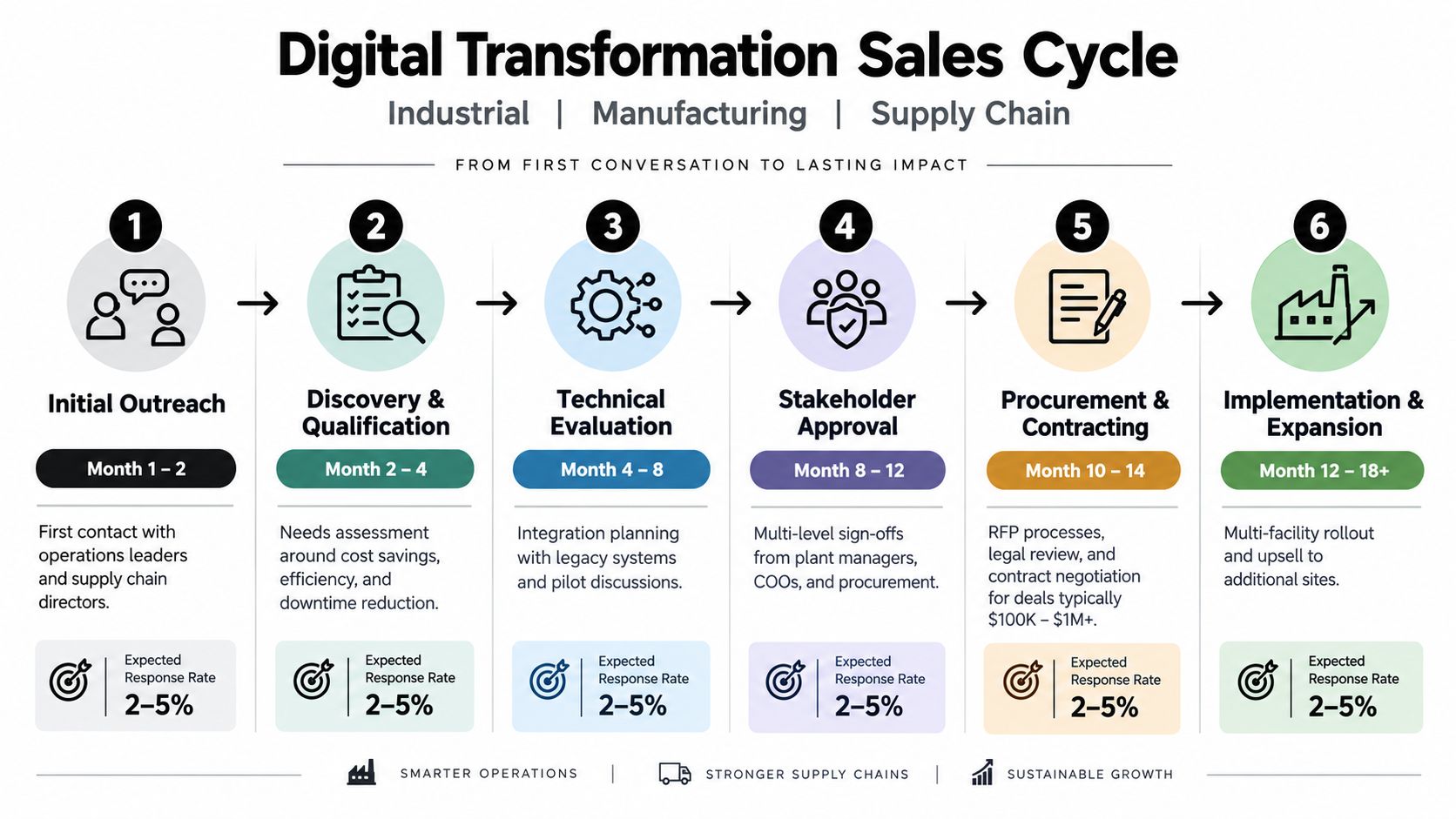
Cold-email hook: “Operations teams using [relevant system or process] often review [specific workflow] when [trigger] creates pressure on efficiency, reliability, or safety. We help identify a focused starting point without replacing everything at once. Is that under consideration at [company]?”
8 Ideal Customer Profiles Compared
| Segment | Implementation Complexity 🔄 | Resource Requirements ⚡ | Expected Outcomes 📊⭐ | Ideal Use Cases 💡 | Key Advantages ⭐ |
|---|---|---|---|---|---|
| Mid-Market SaaS Companies with Proven Product-Market Fit | Moderate 🔄, integrate with existing CRM, multi-touch nurture | Moderate ⚡⚡, sales team alignment, marketing assets | Strong pipeline growth; response rate ~3–8% 📊, ⭐⭐⭐ | Scale appointment-based outbound; incremental campaign scaling | Immediate ROI on pay-per-meeting; validated PMF; higher close rates |
| Enterprise Software Vendors Entering New Verticals | High 🔄, deep market research, vertical positioning | High ⚡⚡⚡, enterprise sales resources, compliance checks | Very high-value opportunities; response rate ~2–5% 📊, ⭐⭐⭐ | New-vertical entry requiring qualified introductions and thought leadership | Large deal sizes; predictable acquisition budgets; premium pricing |
| High-Growth Tech Startups Post-Series A Funding | Low–Moderate 🔄, fast iterations, quick approvals | Low–Moderate ⚡⚡, outsourced lead gen; flexible spend | Rapid customer acquisition; response rate ~4–9% 📊, ⭐⭐⭐ | Hit growth milestones quickly; support fundraising narratives | Fast decision cycles; flexible experimentation; performance pricing |
| E-Commerce and Marketplace Companies Pursuing B2B Sales | Moderate 🔄, translate B2C brand to B2B messaging | Moderate ⚡⚡, B2B team, partnership materials | Diversified revenue streams; response rate ~3–7% 📊, ⭐⭐ | Wholesale, enterprise integrations, reseller partnerships | Strong brand equity; clear partner ROI; logistics/fulfillment strengths |
| B2B Service Providers Scaling Client Acquisition | Moderate–High 🔄, systematize relationship sales into scalable flows | Moderate ⚡⚡, case studies, senior-expert involvement | High-value engagements; response rate ~2–6% 📊, ⭐⭐⭐ | Consulting, agency, and managed services scaling beyond founder-led sales | High deal sizes; strong ROI storytelling; long-term client LTV |
| Financial Services and FinTech Growth-Stage Companies | Very High 🔄, heavy compliance and legal vetting | Very High ⚡⚡⚡, security, legal, extended sales resources | Large recurring contracts; response rate ~2–4% 📊, ⭐⭐⭐ | Institutional partnerships, enterprise integrations, regulated markets | Very high deal value; long contracts; switching costs via compliance |
| Healthcare Technology and Medical Device Companies | Very High 🔄, regulatory approvals, clinical validation | Very High ⚡⚡⚡, regulatory, clinical, long pilots | Very large but slow deals; response rate ~1–3% 📊, ⭐⭐ | Health system partnerships, payer integrations, clinical deployments | Large dedicated budgets; defensible advantage from compliance; mission alignment |
| Industrial, Manufacturing, and Supply Chain Companies Digitizing Operations | High 🔄, legacy integration, multi-site pilots | High ⚡⚡⚡, technical pilots, operations stakeholders | Significant ROI on efficiency; response rate ~2–5% 📊, ⭐⭐ | Digital transformation, IoT rollouts, multi-facility deployments | Quantifiable operational savings; long-term expansion potential |
Turn the Right ICP into a Repeatable Campaign
The best ideal customer profile examples aren’t scripts to copy. They’re operating models that show how company attributes, technology, urgency, buying roles, and qualification rules work together. Choose the example closest to your business, then remove any field that doesn’t help your team decide whether an account belongs in the campaign.
Start with firmographic fit. Define the industries, operating models, company stages, regions, and organizational conditions where your offer has a credible use case. Don’t stop at company size or revenue. A smaller organization with a strong trigger may be more valuable than a larger organization with no urgency, no owner, and no clear path to implementation.
Add technographic fit next. Identify the platforms, systems, integrations, and workflows that make your solution useful or necessary. Technographics should do more than personalize a sentence. They should help you decide whether the prospect can adopt the product, whether a competitor is embedded, and which technical stakeholder belongs in the buying group.
Then document buying signals. Use observable events such as hiring, leadership changes, market expansion, new product launches, partnership activity, technology investment, or a stated operational initiative. A signal doesn’t guarantee intent, so pair it with a relevant pain point and a plausible reason to contact the account now.
Define the rules before list building
Write the qualification framework in language a researcher, SDR, and account executive can apply consistently:
- Include: The firmographic and technographic conditions required for a good-fit account.
- Prioritize: The triggers that justify earlier outreach or deeper personalization.
- Disqualify: Industries, systems, use cases, regions, or organizational conditions that create poor fit.
- Route: The role responsible for accepting, working, and reporting on a qualified meeting.
- Measure: Meeting acceptance, opportunity creation, sales-cycle movement, retention, and expansion by ICP segment.
Retention belongs in the profile. Static firmographics can identify companies that look attractive but don’t stay, expand, or realize value. One independent analysis of ICP development argues that the segment should be validated against retention outcomes, including net revenue retention above 100% or at least no increased churn inside the segment, as described in this guidance on ideal customer profiles.
Your evidence should also shape the commercial case for segmentation. A benchmark reported 1.7x higher marketing-sourced pipeline conversion among teams with documented ICP-based segmentation, while ICP-fit accounts had a 14-month median CAC payback period, compared with 26 months for non-ICP accounts. It also reported that ICP-fit deals closed 1.7x faster. Those figures come from the B2B ICP and buyer persona benchmark, and they support a practical point: fit should be evaluated through commercial outcomes, not only list accuracy.
Finally, turn each buyer role into a cold-email hook. The economic buyer needs a business case, the functional owner needs a workflow outcome, the technical evaluator needs integration clarity, and the risk stakeholder needs a credible path through review. A shared ICP helps marketing and sales coordinate that message. Another B2B customer-profile benchmark found that 67% of the buying journey was completed digitally before sales contact, and 77% of buyers described their most recent purchase as very complex or difficult. Your first message has to earn relevance before a salesperson gets a chance to explain the product.
Review the qualification rules with sales before launch. After the campaign begins, compare replies, accepted meetings, opportunities, sales-cycle behavior, retention, and disqualifications by segment. Keep the ICP specific enough to guide list building and messaging, but flexible enough to improve when customer evidence contradicts an assumption. If the team needs help with research, infrastructure, personalized copy, verified lists, and ongoing campaign optimization, Fypion Marketing is one option to evaluate for a qualified-meeting program built around those criteria.
Fypion Marketing helps B2B companies define an ICP, build targeted prospect lists, and run personalized cold-email campaigns around relevant pain points and buying signals. If you want to turn one of these ideal customer profile examples into a research-led outbound campaign, visit Fypion Marketing to discuss your target accounts and qualification requirements.