
Inbound vs Outbound Leads: Which Works for B2B in 2026
Inbound leads cost $84 per lead, compared with $220 for outbound, giving inbound a 61% lower cost per lead. That makes inbound more efficient on acquisition cost, but it doesn’t make it the automatic winner for every B2B pipeline.
The problem is that most comparisons put entirely different opportunities into the same spreadsheet. An inbound prospect may have searched for a solution, read your content, and requested a conversation. An outbound contact may have been selected because they fit your ideal customer profile, even though they haven’t shown active intent. Comparing their conversion rates without accounting for that gap produces confident, useless conclusions.
The right question isn’t “Which channel is better?” It’s “Which funnel stage is empty, and which motion can fill it profitably?”
Inbound vs Outbound Leads in Practice
HubSpot’s foundational survey reported an average cost per sales lead of $84 for organizations allocating at least half of their lead-generation budget to inbound, compared with $220 for organizations allocating at least half to outbound. That equals approximately a 61.8% lower cost for inbound, often summarized as a 61% advantage in HubSpot’s original survey report. The survey is old, so use this figure as a directional benchmark, not a current planning assumption.
The channel comparison remains useful only when the funnel stage is clear. Inbound typically captures existing interest through search, content, social media, and other permission-based channels. Outbound gives sales access to selected accounts through proactive email, calling, advertising, or direct outreach, including buyers who have not yet searched for a solution.
Practical rule: Use inbound to build a reusable demand asset. Use outbound to reach priority accounts before they find a vendor.
Inbound requires content, search visibility, conversion paths, and nurturing before it reliably produces qualified demand. Its advantage is cumulative value. A strong article, comparison page, or buyer guide can continue generating discovery after publication.
Outbound gives the team tighter control over account selection. Reps can define an ideal customer profile, identify relevant roles, and start conversations with accounts that match strategic priorities. The trade-off is execution risk. List quality, message relevance, deliverability, follow-up discipline, and sales skill determine whether activity becomes pipeline.
The trade-off behind the headline number
Cost per lead does not equal cost per customer. An outbound campaign may produce fewer leads while reaching accounts with greater commercial potential or strategic importance. Inbound may produce lower-cost leads that still require significant work before research becomes a sales opportunity.
Use a hybrid decision matrix: choose inbound when the priority is durable discovery and lower acquisition efficiency over time; choose outbound when the priority is immediate access to named accounts. For a practical foundation, review Fypion’s guide to inbound lead generation, then compare each motion at the same funnel stage rather than forcing both into one benchmark.
How Inbound and Outbound Lead Gen Work
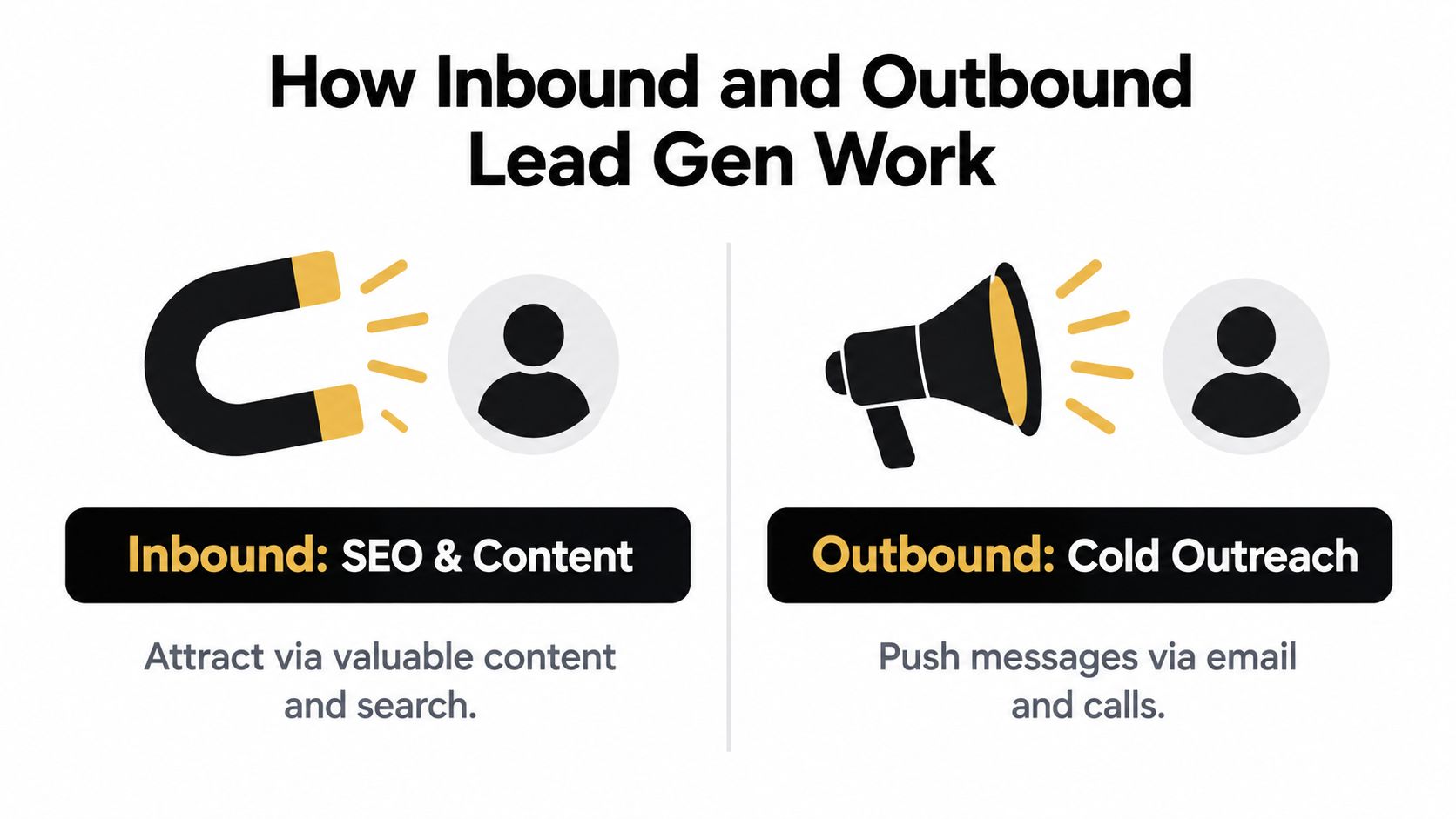
Inbound and outbound start at opposite ends of the attention problem.
Inbound pulls. A prospect searches for an answer, finds an article, watches educational content, engages with a social post, or discovers a company through organic reputation. The company earns attention by helping before asking for a sales conversation. SEO, editorial content, webinars, calculators, case material, and conversion pages all support this motion.
Outbound pushes. A company selects a defined audience and initiates contact through cold email, sales calls, LinkedIn outreach, targeted advertising, or direct sales activity. The prospect may have a relevant problem, but they haven’t necessarily declared it publicly or searched for a vendor.
The operating difference
An inbound workflow generally moves from attention to engagement to conversion. Marketing creates material for a defined audience, attracts visitors, offers a relevant next step, and gives sales context about what the prospect consumed. The quality of the conversion path matters as much as the content. A high-ranking article with no useful next action creates awareness, not pipeline.
An outbound workflow moves from selection to relevance to conversation. Sales or marketing defines the account list, identifies relevant contacts, writes a message tied to business context, and follows up without becoming repetitive or intrusive. The campaign succeeds when the prospect recognizes a credible reason to respond.
Teams building a campaign library can also find lead generation examples to compare different approaches and execution patterns. Use examples to sharpen your thinking, not to copy messages without understanding the audience.
The distinction is simple but consequential. Inbound waits for evidence of interest before the conversation starts. Outbound starts the conversation before interest is visible. That’s why each channel needs different benchmarks and different operating habits.
Cost Benchmarks and Quality Metrics
The $84 versus $220 baseline above is only the starting point. Acquisition cost means little until the comparison reaches the same commercial stage. Inbound usually enters measurement after a prospect has shown interest. Outbound often enters as a selected account or contact, before interest is visible. Comparing their raw lead costs or first-stage conversion rates can therefore produce a false verdict.
The historical budget split also needs context. Inbound activities received 37% of lead-generation budgets, compared with 30% for outbound activities. That allocation shows where organizations invested at the time, not which channel created the most revenue.
Lead-quality perception adds a different signal. HubSpot’s 2016 State of Inbound report found that 73% of inbound marketers identified inbound practices as the source of their best leads, compared with 18% of outbound marketers. The 55-percentage-point difference points to stronger perceived fit for inbound, but it does not prove that outbound accounts have lower commercial value. The finding is reported in HubSpot’s 2016 State of Inbound findings.pdf).
| Metric | Inbound | Outbound |
|---|---|---|
| Reported average cost per sales lead | $84 | $220 |
| Marketers identifying the channel as their source of best leads | 73% | 18% |
| Historical lead-generation budget allocation | 37% | 30% |
Define quality in financial terms
Perception belongs in the analysis, but pipeline economics decide the budget. An inbound lead may consume content without matching the target account profile. An outbound contact may show no immediate interest while fitting the company’s industry, contract requirements, and buying environment.
Track each channel through its actual handoff:
- Inbound: visitor to lead, lead to qualified opportunity, opportunity to close.
- Outbound: contact to reply, reply to qualified meeting, meeting to opportunity, opportunity to close.
- Both: cost per qualified opportunity, pipeline created, customer acquisition cost, and revenue by source.
Use Fypion’s guide to calculate price per lead when setting the cost model. Choose the channel that reaches the next valuable stage efficiently. A cheap inbound lead source is a poor investment if it creates weak opportunities, while outbound deserves evaluation on qualified pipeline and account value, not reply rate alone.
The Conversion Rate Reality Check
The core comparison fails before conversion rates enter the spreadsheet. Inbound and outbound leads usually arrive at different funnel stages, so one blended percentage cannot judge both channels fairly.
Commonly cited benchmarks report approximately 14.6% lead-to-close for SEO-generated inbound leads versus about 1.7% for outbound leads. They also report that inbound-qualified leads can exceed 60% qualified-to-booked-meeting conversion, compared with roughly 2% to 5% from initial outbound contact. These figures appear in the available inbound and outbound benchmark analysis, which summarizes secondary benchmark material rather than presenting a single primary study. Before trusting any blended percentage, review the baseline math in Fypion’s guide to sales conversion rates.
The stages explain the gap. An SEO-generated lead has often identified a problem, searched for a solution, and completed an action that reveals intent. An initial outbound contact has not necessarily done any of those things. Comparing them as identical funnel entries makes outbound appear weaker than it may be, while implying that inbound scales efficiently in every market.
Measure the handoff, not just the first response
Inbound earns credit when captured demand becomes qualified pipeline. Outbound earns credit when targeted access becomes a relevant conversation, then a commercial opportunity. Track those handoffs separately instead of compressing them into one conversion rate.
| Funnel question | Inbound measure | Outbound measure |
|---|---|---|
| Did the prospect engage? | Content conversion or form completion | Reply or conversation |
| Did the prospect fit? | Qualification rate | Positive fit after response |
| Did sales earn a meeting? | Qualified lead to booked meeting | Reply to qualified meeting |
| Did the motion create revenue? | Opportunity to close | Opportunity to close |
Campaign pages should turn campaign pages into leads through clear, intent-based conversion paths. A form alone produces a contact record. A focused page gives sales clues about the problem, buying context, and fit.
Use a decision matrix for channel choices: inbound for known demand and education, outbound for defined accounts and time-sensitive access, and both when content can support targeted conversations. Judge the selected motion by qualified opportunities and revenue, not by the earliest response metric. That approach exposes the trade-off: inbound often improves efficiency after intent appears, while outbound creates access before intent is visible.
When Buyers Prefer No Outreach
The modern B2B buyer doesn’t reject every sales conversation. They reject conversations that make them do work without adding useful context.

Consider three situations.
A buyer is researching a known problem. A finance team searches for ways to improve reporting and finds a detailed comparison page. Inbound should lead because the buyer wants self-service education first. The sales team earns its place later by answering questions about implementation, fit, and risk.
A company fits your target account profile but shows no visible intent. You know the industry, operating model, and business trigger align with your product, but the account hasn’t downloaded anything or requested a demo. Targeted outbound can introduce the problem and offer a relevant perspective. Generic product promotion will probably feel like noise.
Several people at one account engage with related material. Marketing sees meaningful activity, while sales has a reason to act. The best motion is hybrid. Sales reaches out with context tied to the business problem, and the inbound content gives the prospect a low-friction way to verify the company’s expertise.
The useful outbound message doesn’t interrupt research. It accelerates a decision the buyer already has a reason to consider.
Gartner’s findings support a sharp distinction between irrelevant interruption and useful proactive guidance. Buyers prefer seller involvement when they need judgment about organizational fit, not when they only need general information. That means an outbound sequence should earn attention through relevance, not activity volume.
A practical qualification rule includes four checks:
- ICP fit: The account has a credible reason to be eligible.
- Business context: The message connects to an observable role, market, operational, or strategic issue.
- Specific value: The outreach offers a useful point of view, not only a meeting request.
- Easy refusal: The prospect can decline without friction or repeated pressure.
For a visual explanation of modern B2B buying behavior, this video adds useful context:
Choosing the Right Strategy for Your Stage
Channel choice should follow the business constraint, not the preference of the marketing team.
An early-stage company with a narrow target market and urgent revenue needs may need outbound to reach its first credible accounts. Waiting for search visibility can leave the sales team without enough conversations. At the same time, the company should publish enough useful material to help prospects validate the product after an initial contact.
A mature SaaS company with established demand should prioritize inbound infrastructure. Search content, product education, comparison pages, and conversion assets can capture buyers already looking for answers. Outbound still has a role when the company wants to enter a named-account segment or reach buyers who aren’t actively searching.
A company with proven product-market fit but weak enterprise penetration should use both motions deliberately. Inbound establishes credibility. Outbound identifies and activates high-fit accounts. The handoff depends on signals such as account engagement, business triggers, role relevance, and buying-committee involvement.
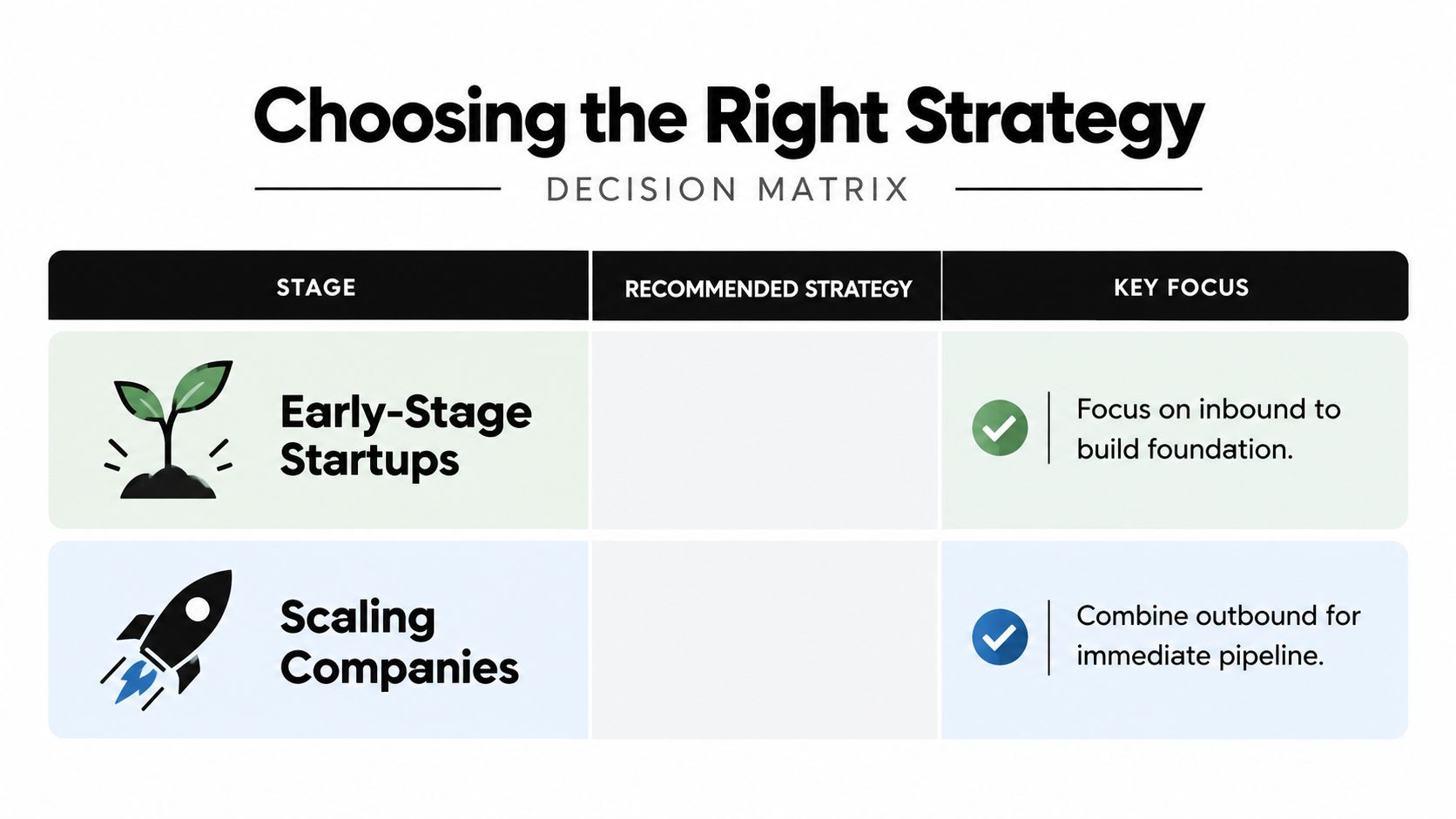
A practical decision matrix
| Business condition | Primary motion | Supporting motion | Main objective |
|---|---|---|---|
| Search demand exists and buyers self-educate | Inbound | Sales follow-up | Capture active demand |
| Target accounts are known but inactive | Outbound | Proof-oriented content | Create access and context |
| Product category needs explanation | Inbound education | Contextual outbound | Build understanding |
| Sales team needs immediate account coverage | Outbound | Inbound validation assets | Generate qualified conversations |
| Product-market fit is established and growth must scale | Hybrid | Shared measurement | Balance reach and efficiency |
Build a hybrid pipeline in a deliberate order:
- Define the ICP and buying problem. Don’t start with channels. Start with the account, role, trigger, and outcome you’re trying to reach.
- Create validation assets. Publish pages that answer the questions an outbound prospect will ask after receiving your message.
- Launch targeted outbound. Use small, relevant account segments and personalized reasons to engage.
- Route intent quickly. When an account interacts with content or responds to outreach, sales should receive the context, not just a name.
- Measure opportunity economics. Compare cost per qualified opportunity and pipeline progression by source.
A product-market-fit review, such as Fypion’s guide to product-market fit validation, can help determine whether the company is ready to scale acquisition or still needs to refine its offer and audience.
Building a Hybrid Pipeline with Outbound Support
The strongest B2B pipeline usually combines two jobs. Inbound captures demand that already exists, while outbound reaches high-fit accounts that haven’t raised their hands. The mistake is treating hybrid growth as a vague “do both” instruction. Each motion needs a defined job, handoff rule, and financial measure.
Start with the inbound layer. Build content around the problems your ideal customers actively research, then give each asset a clear next step. Product comparisons, implementation guidance, objection handling, and proof pages are especially valuable because they help prospects evaluate your offer without requiring a sales call.
Then add outbound where inbound has a blind spot. Target accounts that fit your ICP but aren’t engaging with your content, strategic segments that require direct access, and business situations where a timely trigger matters more than organic discovery. The message should explain why the account is relevant, what problem the sender recognizes, and what useful conversation could follow.
The operating model
A disciplined hybrid program uses three loops:
- Demand capture: Inbound content attracts and educates buyers who are already researching.
- Demand activation: Outbound contacts selected accounts with a specific, credible reason to engage.
- Revenue feedback: Sales conversations reveal objections, language, and buying criteria that improve both content and outreach.
Track performance at the same commercial endpoint. Don’t compare inbound cost per lead with outbound emails sent. Compare the cost of producing qualified opportunities, the rate at which those opportunities progress, and the revenue they generate.
For companies with proven product-market fit, a specialized partner can extend outbound capacity without requiring the entire internal SDR function to be built at once. Fypion Marketing, for example, provides cold email outreach, prospect-list building, campaign management, and SDR-led qualification, with its model focused on booked, qualified meetings rather than a generic lead count. Its outbound cold email and SDR-led demand generation approach fits best when the ICP, offer, and qualification criteria are already clear.
The decision framework is straightforward. Choose inbound first when you need durable demand capture. Choose outbound first when you need targeted access or faster pipeline creation. Choose hybrid when inbound gives prospects confidence but outbound is required to reach the accounts that matter most.
Fypion Marketing helps B2B companies build targeted cold email campaigns, verify prospect lists, qualify responses, and book meetings that match agreed criteria. If your company has proven product-market fit and needs outbound support alongside inbound demand capture, visit Fypion Marketing to request a consultation.