
Marketing Agency Leads: The Actionable Growth Playbook

You’ve probably seen this movie before. An agency buys a contact list, spends days writing a sequence, and waits for the calendar to fill. A few replies arrive, but they’re from companies outside the niche, prospects without budget, or people who wanted a free audit and disappeared before the sales call. The pipeline looks active, yet revenue barely moves.
That’s the uncomfortable truth about marketing agency leads. The hard part isn’t creating more names. It’s identifying the small portion of prospects with a relevant problem, authority to act, and a reason to respond now. The playbook below treats qualification and reply quality as the operating system, not as cleanup work after a campaign launches.
Why Most Agencies Chase Ghost Leads
An agency owner launches outbound after a slow month. The list contains hundreds of companies, the copy mentions “full-funnel growth,” and the call to action asks for a meeting. Replies arrive slowly, if at all. When one does come through, the prospect wants services the agency doesn’t offer, operates in a market the team doesn’t understand, or has no clear buying trigger.
That owner hasn’t necessarily made a copywriting mistake. The failure happened earlier, when the campaign treated every contact as equally valuable.

Volume hides the qualification problem
Email is still the dominant B2B lead-generation channel. 88% of businesses use email for lead generation, while B2B sales representatives spend 28% of their time researching targets and sourcing contact details, according to B2B lead-generation statistics from Email Vendor Selection. That time is often spent finding names, not deciding whether those names fit the agency’s commercial reality.
The result is a busy but weak pipeline. A large list can create the appearance of momentum while forcing salespeople to sort through irrelevant replies, unqualified inquiries, and contacts who were never likely to buy.
Practical rule: A lead only becomes useful when your team can explain why the account fits, why the problem matters, and what should happen next.
Cold email benchmarks make the gap visible. The average reply rate is 3.43%, with top-quartile campaigns reaching 5.5% or more and elite campaigns exceeding 10.7%, according to Instanly’s cold email benchmark analysis. Campaigns below the baseline don’t automatically need more volume. They usually need better account selection, clearer relevance, stronger deliverability, or a smaller first ask.
Ghost leads are usually system failures
Buying a broad lead list doesn’t solve positioning. Adding more automation doesn’t solve a vague offer. Hiring an SDR before validating the audience often scales the wrong message.
The agency needs a filtering system before it needs another sending tool. Start by separating:
- Fit: Does the company match your service, market, size, and delivery capability?
- Problem: Is there a visible business issue your team can address?
- Authority: Can this person approve the next step or introduce the person who can?
- Timing: Is there a trigger that makes the conversation relevant now?
- Reply quality: Did the prospect show genuine interest, or merely ask for information?
This approach changes the purpose of outreach. You’re not trying to make every recipient respond. You’re trying to make the right prospects recognize themselves in the message, then respond with enough context for a useful qualification conversation.
Defining Your Ideal Customer Profile
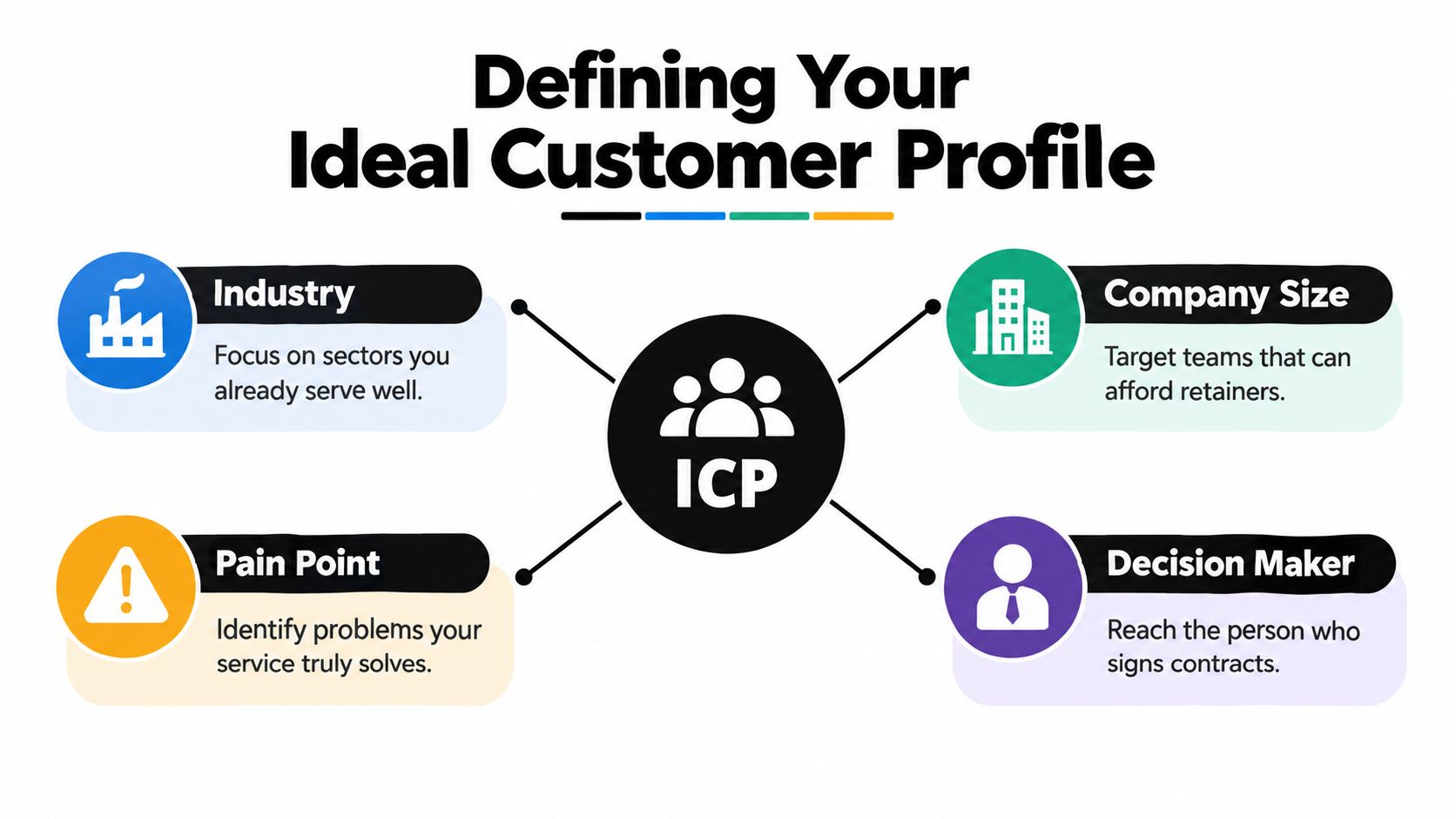
Before writing another email, define the account you can serve profitably and repeatedly. “B2B companies that need marketing” is not an ICP. It’s an audience so broad that every message becomes generic.
A usable ICP combines firmographic fit with a problem your agency can solve and a signal that the problem is active. The profile should be specific enough for a researcher to build a list without asking you what “good fit” means.
Start with evidence, not preference
Review your strongest existing accounts. Look for repeated patterns:
- Industry: Which sectors already understand the value of your service?
- Company size: Which teams have enough complexity and budget for your engagement?
- Business model: Does your process work better for SaaS, professional services, technology, ecommerce, or another category?
- Existing stack: Which platforms, channels, or workflows create problems you know how to fix?
- Buying event: What happened shortly before the client hired you?
- Delivery fit: Which clients can your team support without custom work consuming the margin?
Then write the profile as a sentence a researcher can apply: “Marketing leaders at established B2B software companies using outbound sales, hiring demand-generation staff, and struggling to convert activity into qualified meetings.”
That sentence is more useful than a list of job titles because it describes the situation behind the purchase.
Add intent signals and exclusion rules
Job titles help you locate people, but they don’t prove urgency. Add observable signals such as a new market launch, a relevant hiring pattern, a product release, a change in positioning, or visible investment in a channel your agency manages.
Use exclusion rules just as aggressively. Remove companies outside your service area, businesses with no plausible budget, agencies that compete directly with you, and accounts where your offer would require unsupported expertise.
Lead quality remains a major industry bottleneck. 61% of B2B marketers identify high-quality lead generation as their biggest challenge, while only 27% of marketing-generated B2B leads are contacted by sales, according to CIENCE’s lead-generation statistics summary. Qualification has to happen before outreach, not after a salesperson has spent time chasing a poor fit.
For a deeper framework, use this ICP guide for sales teams to document firmographics, pain points, buying roles, and disqualifiers in one place.
Build a practical scoring model
Keep the first version simple. Assign internal labels rather than pretending the score is scientific:
- Priority: Strong fit, active trigger, reachable decision-maker, clear service match.
- Review: Good account fit, but weak timing or incomplete evidence.
- Exclude: Poor fit, unclear need, or delivery risk.
A good ICP should influence the offer, list, sequence, qualification call, and reporting dashboard. If the profile only sits in a strategy document, it isn’t doing any operational work.
Channel Strategy and List Building
The right channel depends on how your buyers evaluate agency expertise. Email gives you control over account selection and follow-up. LinkedIn can help you validate roles and engage decision-makers in a visible professional context. Referrals and partnerships transfer trust, but they’re less predictable and take relationship-building.
Treat channel selection as a trade-off between speed, control, trust, scale, and qualification depth.
Match the channel to the buying situation
| Channel | Where it helps | What can break |
|---|---|---|
| Cold email | Direct access and repeatable testing | Poor data and weak relevance damage replies |
| Role validation and relationship context | Manual work and platform dependence limit scale | |
| Referrals | Strong trust and warmer conversations | Flow is difficult to control |
| Partnerships | Access to adjacent client bases | Requires a clear mutual value exchange |
| Paid advertising | Reach and message testing | Weak offers attract low-intent inquiries |
| Content marketing | Proof of expertise and long-term discovery | Authority takes time to build |
Email remains a sensible starting point for many B2B agencies, but it shouldn’t operate in isolation. Use LinkedIn to verify that the person owns the relevant function, engage with a specific business development signal, or support a thoughtful follow-up. Use partners when another provider already has credibility with your target buyer.
The average cold email reply rate is 3.43%, while top-quartile campaigns reach 5.5% or higher, according to Instanly’s 2026 cold email benchmark report. Those benchmarks are useful for diagnosis, not as a promise. A strong reply rate from the wrong audience still produces bad marketing agency leads.
Build the list around accounts
Start with accounts, then add contacts. A list built person-first often contains several unrelated individuals from companies that don’t fit your offer.
Use tools such as Apollo, ZoomInfo, Crunchbase, and LinkedIn Sales Navigator according to the information you need. Apollo can support prospect discovery and enrichment. ZoomInfo may be useful when coverage and firmographic detail matter. Crunchbase helps with company context and business events. Sales Navigator is valuable for role confirmation and account research.
For every account, capture:
- Business context: What does the company sell, and to whom?
- Relevant trigger: What makes outreach timely?
- Likely owner: Who feels the problem directly?
- Economic buyer: Who approves the engagement?
- Service hypothesis: What specific issue might your agency solve?
- Disqualifier: What would make the account a poor fit?
If you’re building an outbound team, a resource such as Best place to hire SDRs can help you evaluate whether to add prospecting capacity internally or through an external specialist.
Use a two-channel operating model
A practical model is controlled outbound plus trust-building distribution. Email creates a repeatable test environment. LinkedIn, content, referrals, and partnerships give prospects more evidence before they decide to respond.
Your list should also determine your message. A technical SaaS buyer may care about pipeline quality and attribution. A founder may care about sales consistency and time. A marketing leader may care about channel performance, internal capacity, and reporting credibility. Same agency, different business case.
For more detail on combining professional-network outreach with B2B prospecting, see this LinkedIn B2B lead-generation guide.
Crafting High-Reply Email Sequences
A cold sequence shouldn’t feel like a campaign assembled from interchangeable templates. It should read like a short argument built around one account type, one problem, and one low-friction next step.
The first email earns attention through relevance. The follow-ups earn consideration by adding context, removing friction, or giving the recipient an easy way to decline.
Use a sequence with a job for every touch
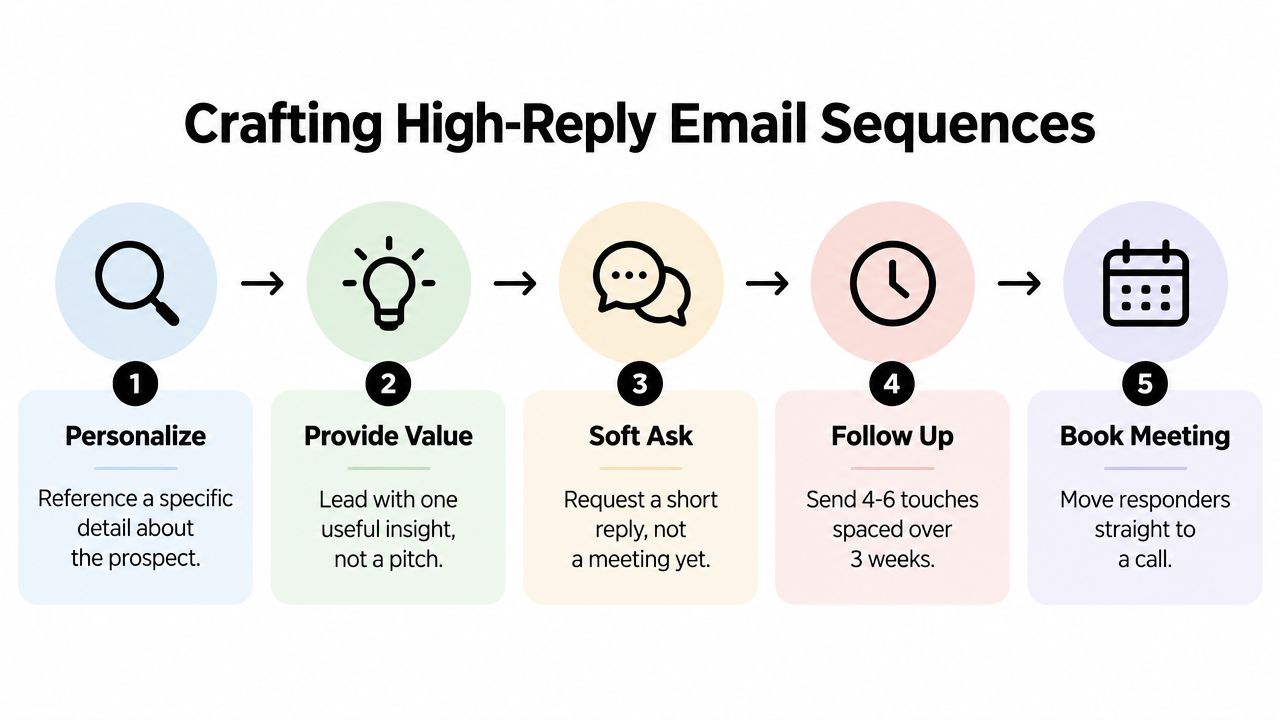
A practical sequence can contain 4 to 7 emails, which benchmark guidance associates with stronger sustained engagement than relying on a first touch alone, as described in Snov.io’s cold email statistics. The exact cadence matters less than the information each message contributes.
Email one, establish relevance. Reference one verifiable detail, connect it to a specific problem, and ask a small question.
Example: “I noticed you’re hiring for demand generation while expanding your outbound motion. Agencies often hit a measurement gap at that stage. Is improving qualified-meeting flow on your roadmap?”
Email two, add a useful observation. Share a short teardown point, process idea, or diagnostic question. Don’t repeat the pitch.
Email three, clarify the outcome. Explain what changes after the prospect engages with you. Keep the promise operational, such as a clearer qualification process, a reviewed campaign structure, or a defined testing plan.
Email four, handle uncertainty. Address a common objection, such as internal ownership, past agency disappointment, or concern about lead quality.
Email five, close the loop. Give the recipient a simple choice: continue the conversation, point you to the correct owner, or leave the topic for later.
Personalize the reason, not every sentence
Dynamic fields rarely create meaningful personalization on their own. A first name and company name can be accurate while the message remains irrelevant.
Use a three-part relevance structure:
- Observed detail: A hiring page, product change, service page, or public positioning signal.
- Business implication: Why that detail could create a demand-generation or qualification issue.
- Specific question: A reply that can be answered without booking a call.
Avoid praising a prospect’s website when you can’t explain why it matters. Avoid stacking several personalized details that make the email look machine-generated. One checkable detail is usually stronger than a paragraph of forced research.
Average cold outreach open rates sit around 27.7%, and benchmark guidance recommends keeping bounce rates below 2% while using multi-touch sequences, according to Snov.io’s benchmark guidance. Open data is directional, not a sales outcome. A reply that says “send pricing” may be less valuable than a reply that explains the prospect’s current acquisition constraint.
Test the parts that change decisions
Test one variable at a time:
- Audience: Narrow industry segment versus broader category.
- Trigger: Hiring signal versus product or market signal.
- Offer: Audit, diagnostic, planning session, or direct service conversation.
- CTA: One question versus a meeting request.
- Length: Short note versus a more developed explanation.
- Follow-up angle: Additional insight, objection handling, or permission to close the loop.
Tag replies by quality. Useful labels include positive intent, referral, objection, timing, wrong person, negative, and irrelevant. Then compare segments by qualified conversations, not just opens or total responses.
This cold email writing guide is useful when you need to tighten structure, relevance, and calls to action. For list hygiene and sending discipline, the CleanMyList cold email playbook provides another practical reference.
The point of a sequence isn’t to pressure someone into a meeting. It’s to make the next decision easy and to reveal whether the account belongs in your pipeline.
Pricing Models and Outsourcing Options
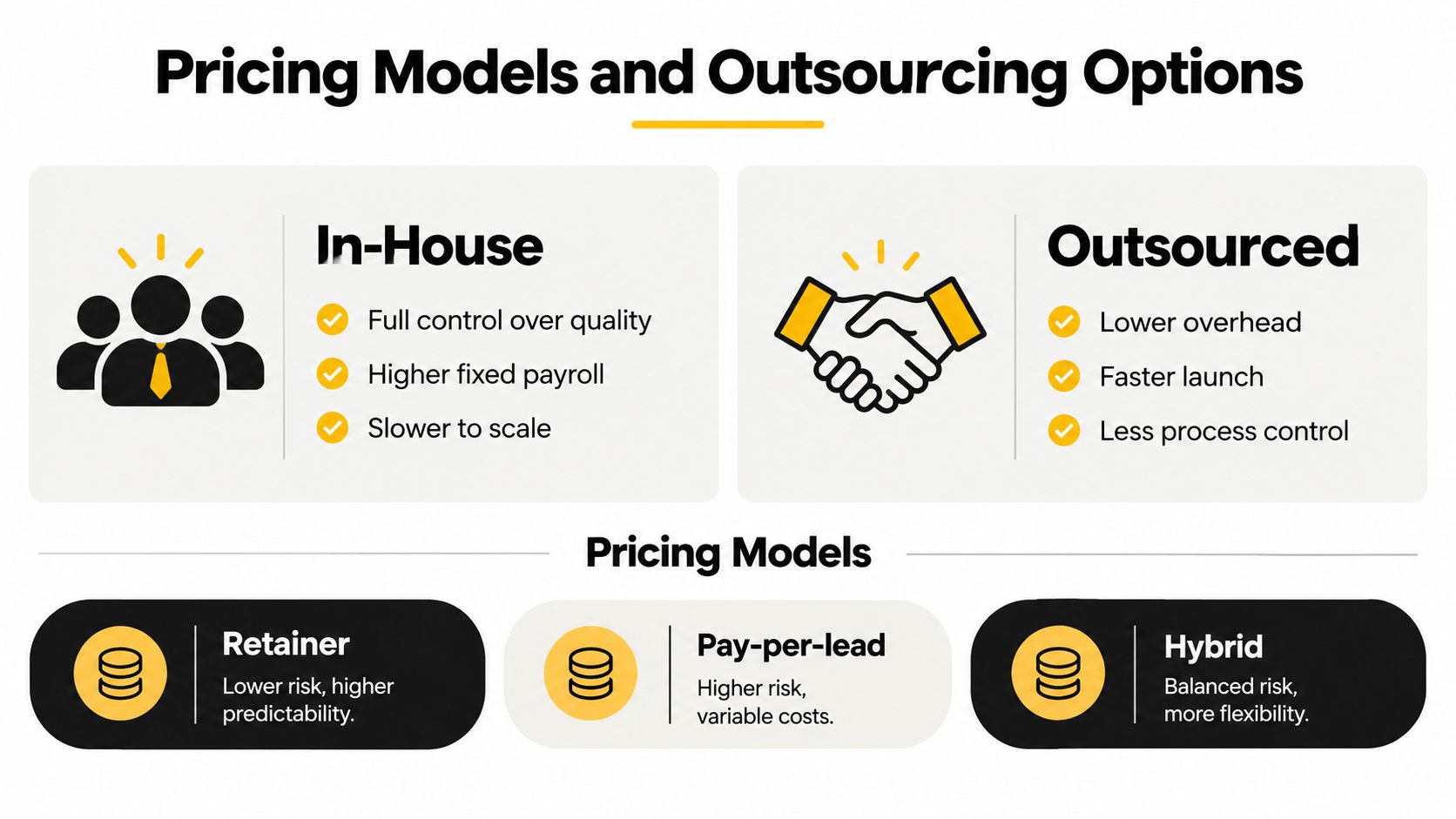
Pricing determines which leads you can afford to pursue and how much risk sits with your agency. A retainer creates predictable revenue, but it can hide delivery inconsistency. Pay-per-meeting aligns payment with a visible sales event, but it creates pressure around definitions, attendance, qualification, and factors outside the lead-generation team’s control.
The right model depends on how clearly you can define a qualified meeting and how much of the sales process you own.
Compare the commercial trade-offs
Retainer pricing supports planning and gives the agency room to invest in research, infrastructure, and iteration. The downside is misalignment when the client measures success by booked meetings but the contract rewards activity.
Pay-per-lead pricing sounds simple, but “lead” can mean a form fill, a response, a booked call, or a qualified opportunity. If the definition is vague, disputes are inevitable.
Pay-per-qualified-meeting pricing puts greater emphasis on appointment quality. It can work when both parties agree on the ICP, required authority, business problem, meeting attendance, replacement rules, and acceptance process.
Hybrid pricing combines a base commitment with an outcome component. It can balance operational predictability with accountability, especially when the agency controls outreach but the client controls sales follow-up.
Commercial safeguard: Define qualification before launch. Don’t negotiate whether a meeting was qualified after the calendar invitation is accepted.
Decide what to keep in-house
Keep strategy, offer design, qualification criteria, and sales feedback close to the agency. These elements shape positioning and shouldn’t be delegated to a provider that doesn’t understand your delivery model.
Outsource execution when list building, enrichment, inbox management, or sequence operations are consuming founder time without creating a strategic advantage. A specialist can accelerate implementation, but you’ll need clear access to campaign data and a process for rejecting poor-fit meetings.
Watch for partners that:
- Promise volume without defining fit
- Refuse to share reply categorization
- Use generic copy across unrelated industries
- Hide list sources or verification practices
- Treat every booked calendar slot as a success
- Avoid discussing negative replies and disqualifications
Fypion Marketing is one performance-driven option that operates without upfront fees, retainers, or setup costs. Its published profile includes a 4.7-star rating from 17 clients and documented 220% month-over-month lead growth, as stated in the provided company information. Those figures should be evaluated alongside the agreed qualification rules, reporting process, and fit for your market.
For a focused explanation of outcome-based structures, review this guide to price per lead models. The contract should also specify ownership of data, compliance responsibilities, meeting replacement terms, response-time expectations, and what happens when the client changes the ICP mid-campaign.
Scaling Your Lead Engine
Scaling isn’t sending more emails. It’s increasing useful conversations without degrading list quality, inbox placement, or sales capacity.
The first safeguard is operational consistency. Document how researchers select accounts, how they verify contacts, how writers identify triggers, how sales labels replies, and how the team decides whether a segment deserves another test.
Create a weekly operating rhythm
Monday, inspect the pipeline. Review qualified replies, meetings booked, meetings held, and reasons for rejection. Separate positive intent from neutral engagement.
Tuesday, improve the list. Remove bad-fit accounts, verify uncertain contacts, and add prospects that match the strongest-performing segment. Don’t refill volume just to keep a sending target alive.
Wednesday, test one message variable. Change the offer, opening observation, CTA, or follow-up angle, but keep the audience stable enough to learn from the result.
Thursday, review conversations. Listen to sales calls where possible. The language prospects use during qualification is usually more valuable than a dashboard’s open-rate trend.
Friday, allocate resources. Keep investing in segments that create qualified meetings. Pause sequences that generate activity without commercial relevance.
Automation can handle repetitive routing, reminders, enrichment, and reporting. A resource on automation for agency profitability can help teams map those handoffs without replacing human qualification.
Measure movement, not motion
Track positive reply rate, qualified meeting rate, meeting attendance, opportunity creation, and revenue progression. Total sends and opens are diagnostic signals. They don’t tell you whether a prospect has a problem your agency can solve.
Use the outbound cold email and SDR-led demand-generation framework to connect campaign activity with sales ownership. The operating principle is simple: automate administration, not judgment. Your team should spend less time sorting names and more time deciding which conversations deserve attention.
Fypion Marketing manages end-to-end cold email outreach, including market research, contact-list building, personalized copy, campaign infrastructure, response management, and qualified appointment setting. If you want to replace low-quality activity with a defined pay-per-meeting process, visit Fypion Marketing to discuss your ICP, qualification criteria, and next campaign.