
What Is a Performance Marketing Agency?
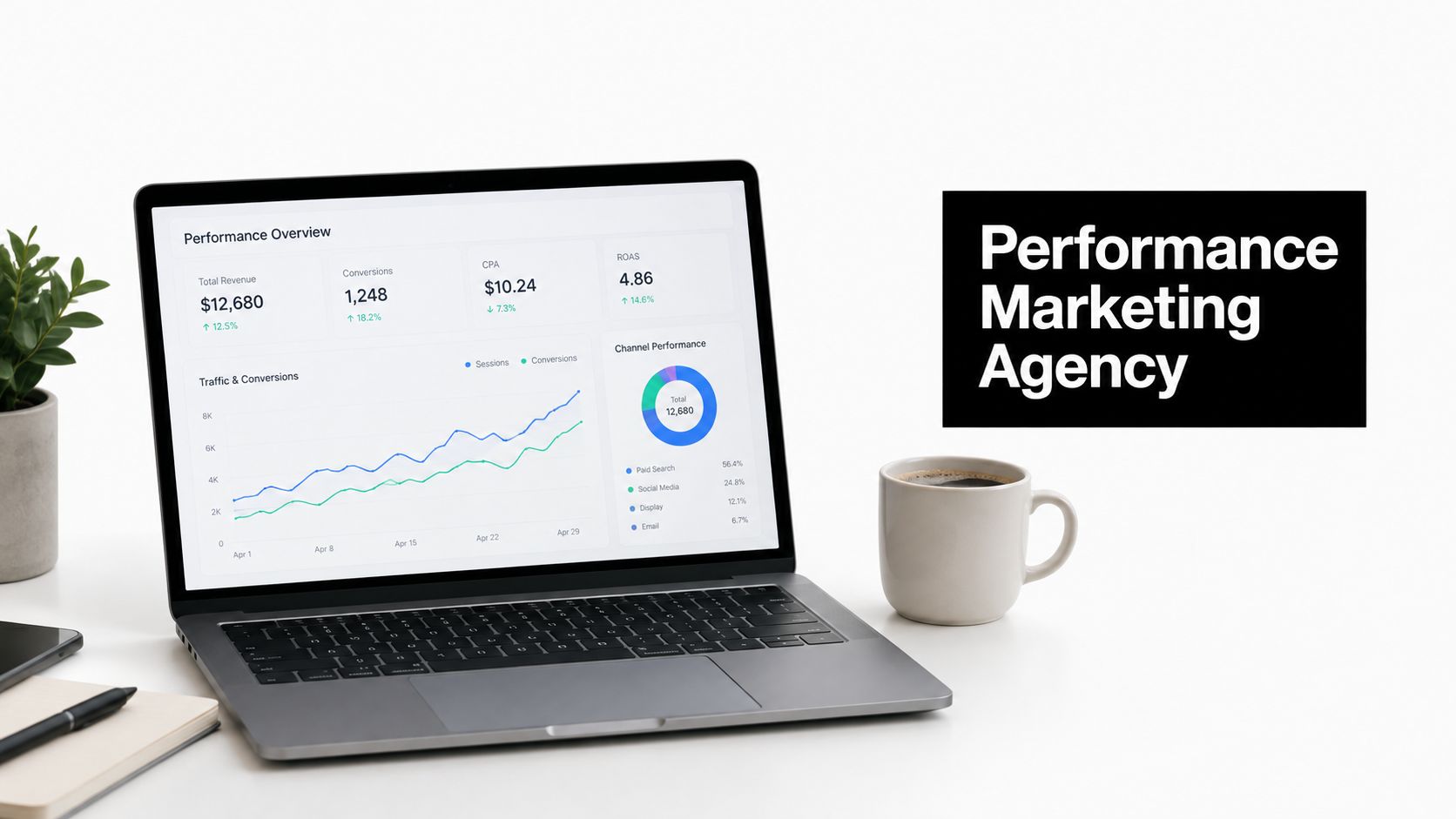
If an agency books a meeting, but your sales team can’t turn that meeting into a real opportunity, did the marketing work? Most definitions of a performance marketing agency stop at clicks, leads, and booked calls. The useful definition follows accountability all the way to pipeline quality, sales follow-up, and revenue.
Performance marketing grew from measurable advertising into a major budget category as digital media made clicks, leads, conversions, and revenue easier to track. Industry estimates place projected global performance marketing spend at $640.7 billion, while another estimate projects the broader industry at $750 billion by 2026, up from $480 billion in 2021. These figures are projections and estimates, not guarantees for any individual campaign. (World Metrics performance marketing statistics)
What a Performance Marketing Agency Actually Is
What should a performance marketing agency be accountable for when a booked meeting fails to become a sales opportunity?
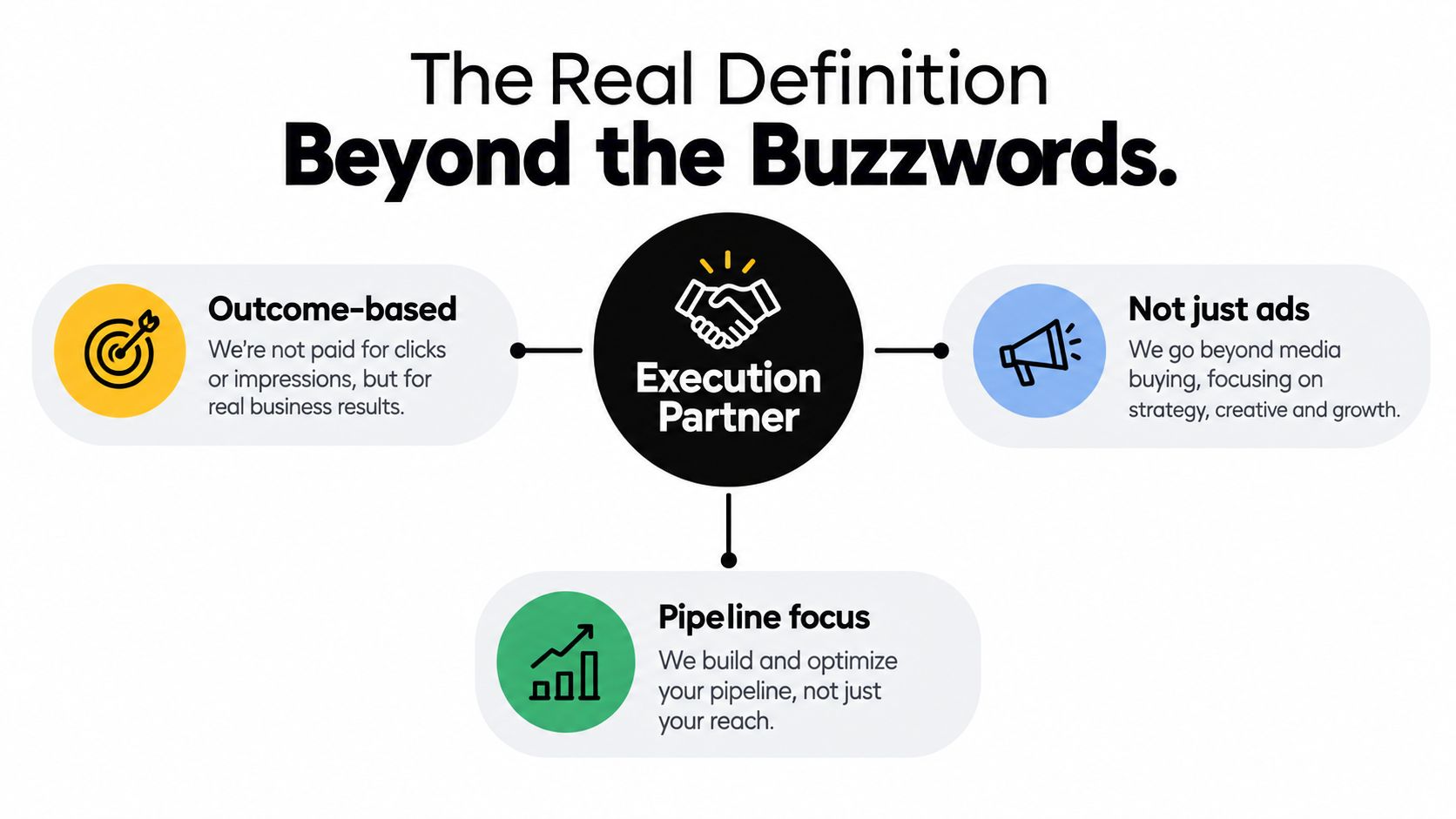
It should be an execution partner accountable for measurable business outcomes, such as qualified leads, sales opportunities, booked meetings, or revenue. The dashboard is only useful if the agency’s work improves the commercial result.
That standard changes how the agency operates. Targeting, offer design, copy, channel selection, qualification, handoff, and follow-up must answer one question: did this activity create a credible revenue-stage conversation? A media buyer can reduce cost per click while sending irrelevant contacts to sales. That is efficient media buying, not effective performance marketing.
Brand agencies may be paid for creative deliverables, campaigns, reach, or strategic support. Those services have value, but payment does not always depend on what happens after someone responds. Performance work carries a tighter operating expectation. List selection is judged by lead quality, ad copy by conversion economics, and follow-up by whether the meeting takes place.
Accountability runs through the funnel
The model works best when the client gives the agency access to its ideal customer profile, CRM stages, sales feedback, conversion definitions, and follow-up capacity. The agency must operate inside the revenue process, not send activity reports from outside it.
Define the outcome in the contract. “More leads” tells nobody what success means. “A meeting with a senior buyer at a company that fits the agreed account profile, confirms a relevant problem, and accepts the meeting invitation” gives marketing and sales a shared operating definition.
Demand creation only earns its place when it produces sales conversations that deserve attention. This B2B demand generation explanation connects the marketing activity to that handoff.
The market reflects growing demand for this model. One estimate valued the global performance marketing agency market at $27.4 billion in 2021 and projected it to reach $62.3 billion by 2027. The same source estimated the U.S. market at $18.7 billion in 2022, while ZipDo performance marketing agency statistics counted 24,241 U.S.-headquartered performance marketing agencies as of August 2026. Treat these estimates and database figures as indicators of market scale, not evidence that any agency can produce quality pipeline.
Rent execution capacity if you need it. Keep accountability attached to the point where a meeting either advances revenue or wastes everyone’s time.
Core Services and the KPIs That Prove They Work
Performance agencies usually combine several capabilities, but the service menu matters less than the measurement discipline behind it. Each activity should have a job, an owner, and a KPI that shows whether it deserves continued investment.
What specialists actually do
Cold outbound means researching target accounts, identifying relevant decision-makers, writing sequences, monitoring replies, and routing interested prospects. Reply rate matters, but positive reply rate and qualified meetings booked matter more.
Paid acquisition covers search, social, and display campaigns. Specialists manage audiences, bids, queries, creative, landing pages, and conversion tracking. The useful measures are cost per lead, cost per meeting, and channel-level ROAS, not impressions alone.
SEO and content build owned demand. The work includes technical fixes, topic selection, briefs, publishing, internal linking, and conversion paths. Organic traffic and rankings indicate reach, while marketing-qualified leads sourced from organic search indicate commercial value.
Marketing operations keeps the system from lying. That means list hygiene, lead routing, CRM fields, attribution, lifecycle stages, and speed-to-lead monitoring. A beautiful campaign still fails if the right salesperson never receives the lead.
SDR augmentation places trained outbound representatives inside the client’s playbook. Their output should be judged by qualified opportunities handed to account executives, not by activity volume.
| Service | What It Actually Does | Primary KPI | Secondary KPI |
|---|---|---|---|
| Cold outbound | Researches accounts, writes sequences, manages replies, and books conversations | Qualified meetings booked | Positive reply rate |
| Paid acquisition | Runs and improves search, social, and display campaigns | Cost per meeting | ROAS by channel |
| SEO and content | Builds organic visibility and conversion paths | MQLs sourced | Organic traffic growth |
| Marketing operations | Maintains routing, CRM fields, and attribution | Data accuracy | Speed to lead |
| SDR augmentation | Executes outbound and qualifies responses for sales | Qualified opportunities | Meetings held |
Cross-channel reporting matters because native platform reports rarely show the entire customer journey. AgencyAnalytics says its benchmark system uses anonymized data from over 150,000 digital marketing campaigns run by agencies, and its 2026 benchmark report centers on whether teams can connect marketing performance to revenue. (AgencyAnalytics benchmark platform)
Use multi-touch attribution to understand the path across channels, but don’t confuse a model with perfect truth. Attribution helps allocate decisions. It doesn’t remove the need for sales feedback and CRM reconciliation.
Pricing Models and Where Pay Per Meeting Fits
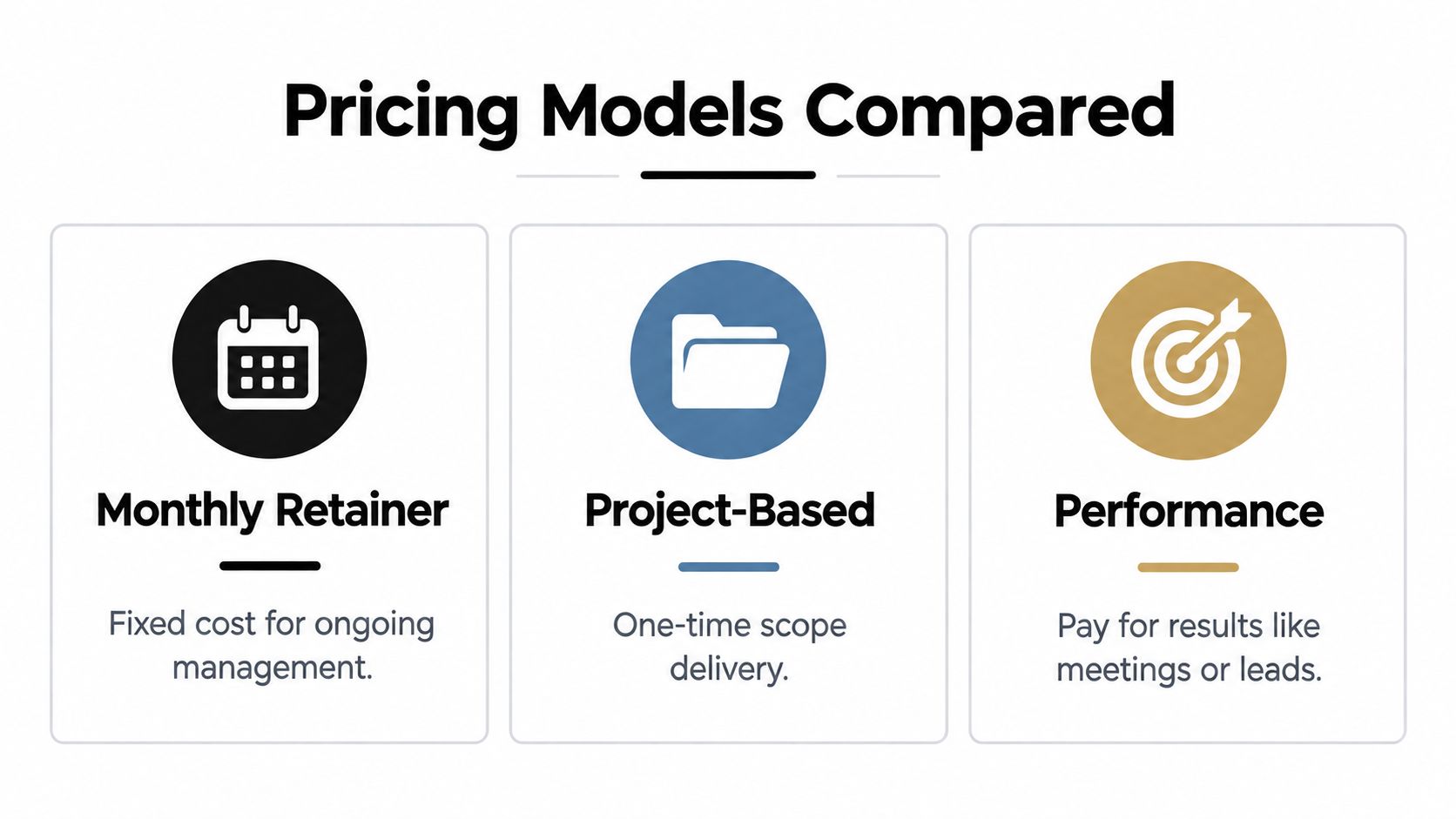
Pricing determines who carries risk. A monthly retainer puts most delivery risk on the client. A performance arrangement puts more risk on the agency, but it also creates sharper disputes about what counts as a result.
| Model | How It Works | Best Fit | Main Trade-off |
|---|---|---|---|
| Monthly retainer | Fixed recurring fee for agreed services or capacity | Teams with established demand operations | You pay even when pipeline output is weak |
| Project-based | Fixed fee for a defined initiative | Website rebuilds, audits, or one-time launches | Poor fit for continuous optimization |
| Performance-based | Payment tied to leads, meetings, or revenue outcomes | Teams seeking measurable acquisition output | Higher unit cost and qualification disputes |
| Hybrid | Retainer combined with bonuses or outcome fees | Mature teams with internal sales capability | Requires careful attribution and governance |
Retainers provide continuity. They make sense when an agency is managing a complex system that needs consistent strategy, creative production, media operations, and reporting. They also make sense when the client already understands its funnel and wants experienced capacity.
Project pricing works for a landing-page rebuild or analytics implementation. It breaks down when the job requires ongoing testing because nobody can know the final winning message before the work begins.
Pay-per-meeting is different. The agency earns when a meeting meets agreed conditions. Those conditions should cover seniority, company fit, relevant pain, meeting acceptance, and treatment of no-shows. “Qualified” must be a contract definition, not a sales adjective.
Practical rule: If the agency and client can’t agree in writing on what makes a meeting billable, they aren’t ready for performance pricing.
Pay-per-meeting often suits an early-stage or stalled B2B team that needs pipeline visibility before committing to a broad retainer. A SaaS lead generation agency may offer this structure when the client has a clear audience and a sales team ready to handle conversations. Mature organizations with internal SDRs usually have more bargaining power with a hybrid model, combining a base fee for operations with a bonus for accepted opportunities.
Inside a Cold Outreach Workflow
A sales director at a mid-stage SaaS company wants a dependable flow of meetings with heads of RevOps. The agency doesn’t begin by writing clever emails. It starts by testing whether the target market, problem, and offer are specific enough to earn a response.
Research comes before sending
The team studies the company’s customer profile, sales objections, existing wins, competitor positioning, and the operational problems a RevOps leader owns. It drafts an initial account profile, then asks the client’s sales team to challenge it. A list that looks correct in a spreadsheet can still be useless if it targets the wrong segment or seniority level.
The agency then prepares the sending infrastructure, inbox management, tracking, and reply-routing process. The goal isn’t to create technical complexity. It’s to protect deliverability, preserve clear ownership, and make sure interested prospects reach a human quickly.
Copy is a commercial test
The sequence needs a credible reason for contact, a focused problem, and a low-friction next step. Personalization should reflect account context, not insert a first name into a generic paragraph. Before launch, the agency stress-tests the offer against likely objections and removes claims the sales team can’t support.
Once the campaign runs, the team watches reply rate, positive intent, meetings booked, and meeting-to-show conversion. If bookings slow, the answer isn’t automatically more volume. Specialists revisit the audience, subject line, opening problem, call to action, and qualification rules.
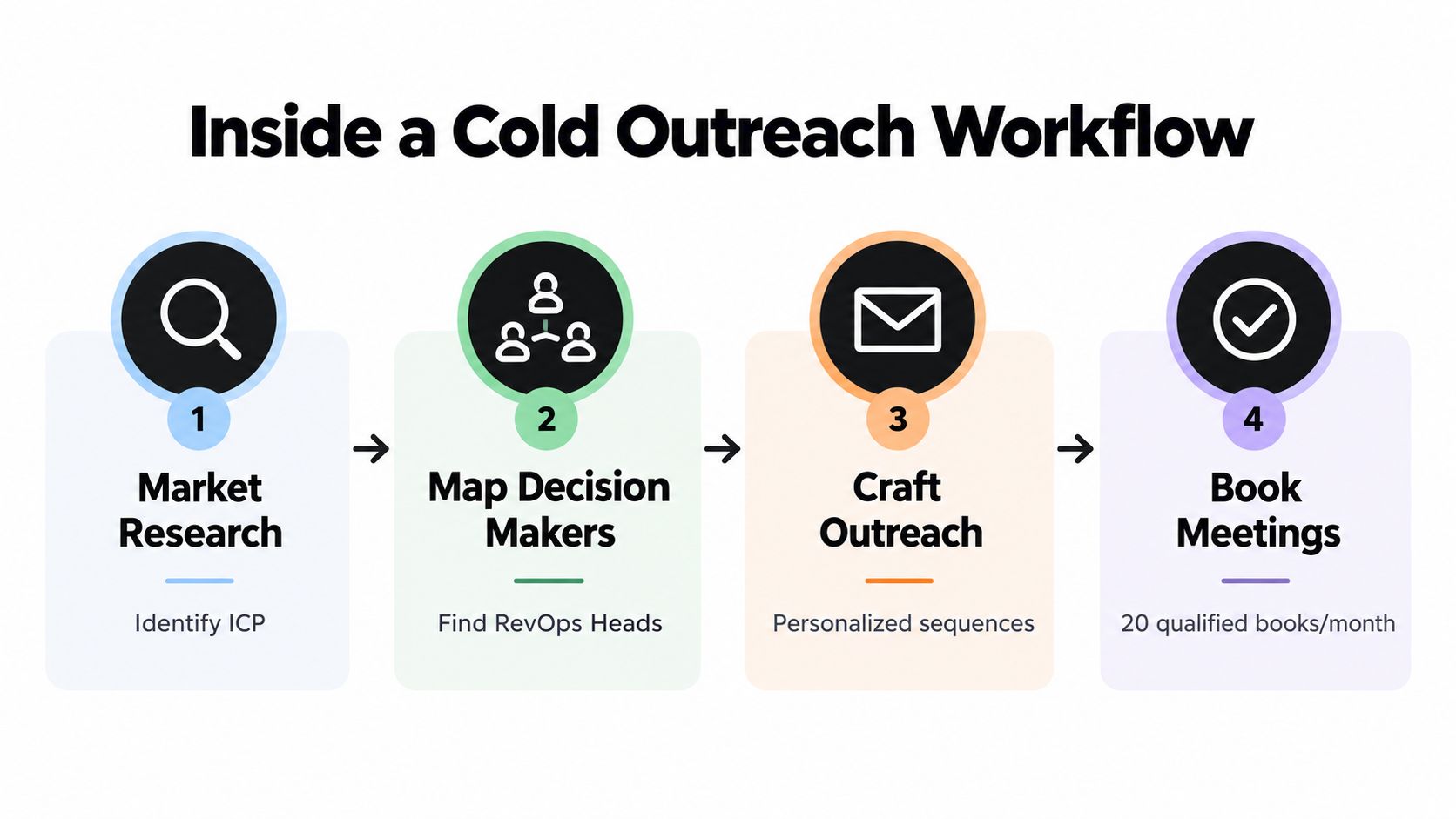
The sales director should review the quality of conversations, not just the booking count. A meeting with the wrong account creates calendar activity but consumes sales capacity. A smaller stream of relevant meetings can create more useful pipeline than a larger stream of poorly matched calls.
The broader workflow is described in outbound cold email and SDR-led demand generation. The agency earns trust when it explains why performance changed and what it will test next.
This video provides a visual overview of the workflow:
Benchmarks Worth Acting On
A benchmark earns its place when it changes a budget, targeting, or sales decision. Otherwise, it is decoration in a proposal.
Independent 2026 benchmark data reports median Google Ads performance for performance marketing agencies at 4.44% CTR, $9.84 CPC, a 5.0% conversion rate, and $148.00 CPA. The same cohort reports 1.04% CTR and 2.4x ROAS for Meta Ads. Treat these figures as a comparison point, not a forecast for your account. (BenchMarketing performance agency benchmarks)
At a fixed CPC, conversion rate changes acquisition economics sharply. Moving from 3% to 5% conversion lowers CPA by roughly 40%, because the same click cost produces more conversions. The report also lists broader agency Google Ads benchmarks of $5.44 CPC and a 3.44% conversion rate. That gap shows why account structure, audience selection, and vertical context matter more than a headline average.
Read every metric at three levels
| Metric | Reported Average | What It Means at $15K ACV |
|---|---|---|
| Google Ads CTR | 4.44% | Indicates whether the ad earns attention, not whether sales can close |
| Google Ads CPC | $9.84 | Shows the auction cost of a visit |
| Google Ads conversion rate | 5.0% | Connects visits to tracked conversions |
| Google Ads CPA | $148.00 | Shows acquisition cost for the defined conversion |
| Meta Ads ROAS | 2.4x | Indicates reported return against tracked ad spend, not necessarily closed revenue |
A serious proposal connects operating activity to commercial results.
- Activity metrics: Sends, impressions, clicks, and opens show whether the system is running.
- Engagement metrics: Positive replies, meetings booked, and meetings held show whether prospects care.
- Revenue metrics: Qualified opportunities, pipeline contribution, sales acceptance, and closed-won revenue show whether the work matters commercially.
Ask what each conversion represents before accepting the number. A 2.4x ROAS may reflect a form submission or modeled revenue rather than closed business. A 5.0% conversion rate may count a page view, demo request, or sales-qualified opportunity. The agency should show the event definition, CRM handoff, and revenue calculation. If it cannot connect targeting and spend to accepted pipeline, the benchmark has limited value.
When a Performance Agency Pays Off and When It Doesn’t
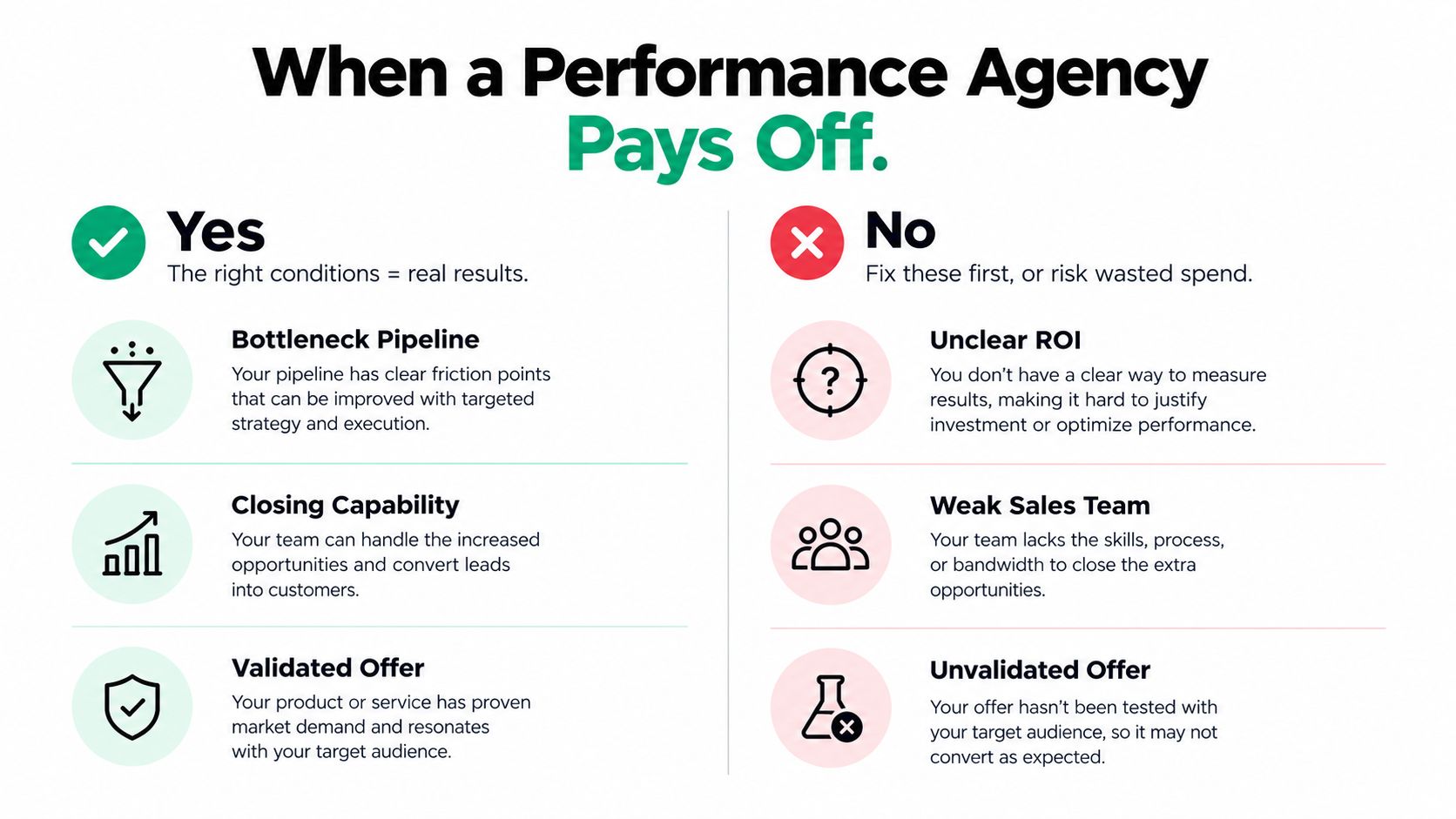
A performance agency earns its keep when pipeline is the bottleneck, the sales team can close what arrives, and the offer has already received some market validation. In that environment, the agency adds execution capacity where the company has a real constraint.
The model works especially well when the buyer profile is clear, the sales team responds quickly, and the client can judge a meeting by business value. Payment tied to qualified meetings or opportunities can reduce idle spending on activity that never reaches sales.
The common failure conditions
The agency can’t manufacture product-market fit. If prospects don’t understand the problem, the agency will either generate weak responses or spend time rewriting an offer that the client hasn’t validated.
The model also fails when nobody owns follow-up. A booked meeting that sits untouched in a CRM isn’t a marketing success or a sales success. It’s a handoff failure.
Be cautious when the market is extremely narrow, when compliance rules restrict outreach, or when the target list is too small to support sustained testing. The more constrained the audience, the more important message quality, account selection, and realistic expectations become.
A performance contract won’t repair a leaky revenue process. It will expose the leak faster.
Audit the foundations before signing. If the website converts poorly, fix the page and offer. If nurture is absent, build a basic follow-up path. If sales rejects every lead, agree on qualification criteria before launching. Agencies can improve targeting and execution, but the client still owns the product, sales motion, proof, and customer experience.
Questions to Ask Before You Sign
Treat the sales call as an interrogation, not a presentation. The agency should be able to answer these questions without hiding behind a dashboard or a vague definition of quality.
Pricing and qualification
- What triggers payment? Is the fee tied to a booked meeting, a held meeting, an accepted opportunity, or revenue?
- What happens after a no-show? Does the agency replace it, credit it, or bill it?
- Who defines qualification? Specify seniority, company profile, geography, problem confirmation, and acceptable meeting conditions.
- Who owns recycled leads? Decide whether the agency, client, or sales team manages prospects who aren’t ready now.
Reporting and access
Ask whether you’ll receive a live dashboard or a monthly PDF. Insist on channel-level detail, campaign and audience breakdowns, meeting status, sales acceptance, and CRM outcomes. Reporting should help you decide what to stop, scale, or change.
Two questions founders often forget are operationally critical:
- Will the agency work inside our CRM, or push data into its own system?
- Do no-shows count toward the invoice?
The answer affects data ownership, sales visibility, and the reliability of every future analysis. A lead generation agency should explain how it handles contact data, copy, campaign history, and reporting access when the relationship ends.
Exit terms and ownership
Check the notice period, list ownership, copy ownership, tracking access, and treatment of meetings booked before cancellation. You should know whether your company can keep using the assets and data created during the engagement.
Put the qualification rules, replacement policy, reporting obligations, and exit process in the contract. If the agency refuses to define them, the risk isn’t shared. It has been transferred to you.
Key Takeaways and Common Questions
Use four decision rules.
- Value the meeting: Know what a qualified meeting is worth before choosing a price model.
- Support the handoff: Make sure your sales team can respond, run discovery, and follow up.
- Outsource a real gap: Hire for missing outbound infrastructure, specialist execution, or measurement discipline.
- Allow a fair evaluation window: Keep enough runway to judge targeting, messaging, sales acceptance, and pipeline quality over a meaningful operating period.
Common questions
How long does it take to see results? Early activity can appear quickly, but reliable judgment requires enough time to test the audience, offer, copy, qualification, and sales follow-up. Ask the agency what milestones it expects before launch, after initial testing, and during optimization.
Can an early-stage startup use a performance agency? Yes, if the startup has a specific buyer, a credible offer, and someone available to handle sales conversations. An agency shouldn’t be the substitute for discovering who wants the product.
What is a realistic first-month meeting volume? There is no universal number. It depends on audience size, offer strength, channel, compliance limits, list quality, and the client’s ability to accept meetings. A responsible agency will forecast from those inputs instead of guaranteeing a number without context.
Does a performance agency replace in-house marketing? Usually, it complements internal teams. The agency can provide execution and operating capacity, while internal leaders supply product knowledge, sales feedback, positioning decisions, and customer insight.
The cleanest reframe is this: a performance agency is rented execution capacity with skin in the game, not a strategic outsourced CMO. Judge it by the quality of decisions and revenue-stage outcomes it helps create, not by the volume of activity it reports.
Fypion Marketing provides end-to-end cold email outreach, including market research, list building, personalized copy, inbox management, campaign optimization, and appointment setting, using a pay-per-qualified-meeting model with criteria agreed in advance. If you need measurable B2B pipeline execution rather than another activity report, visit Fypion Marketing to discuss your target market and sales goals.