
What Is Competitive Intelligence and How B2B Teams Use It

Competitive intelligence is the structured practice of collecting, analyzing, and applying information about competitors, customers, technologies, and market conditions to improve strategic decisions. Market research describes a market, while competitive intelligence turns that kind of evidence into a decision-ready recommendation about what your team should do next.
You’ve probably opened a rival’s pricing page on a Monday, screenshotted the change, dropped it in Slack, and watched the thread die by Tuesday. Nobody owned the follow-up, nobody checked whether the change was real packaging or a temporary promotion, and your next cold email batch went out with the same claim as last month. That gap between noticing something and acting on it is where most B2B teams lose the value of outside information.
A Working Definition and Why It Matters for B2B Teams
A SaaS founder staring at a competitor’s new pricing page isn’t doing research for its own sake. She’s trying to answer a practical question, should we change our offer, our target segment, or our pitch this week? That’s the right starting point for understanding what competitive intelligence is.
Working from ScienceDirect’s overview of competitive information and its strategic use, competitive intelligence is a decision-support process that converts publicly available and ethically obtained information into assessments of competitor intent, market movement, threats, and opportunities. It isn’t copying a rival, scraping whatever you can find, or doing casual prospecting.
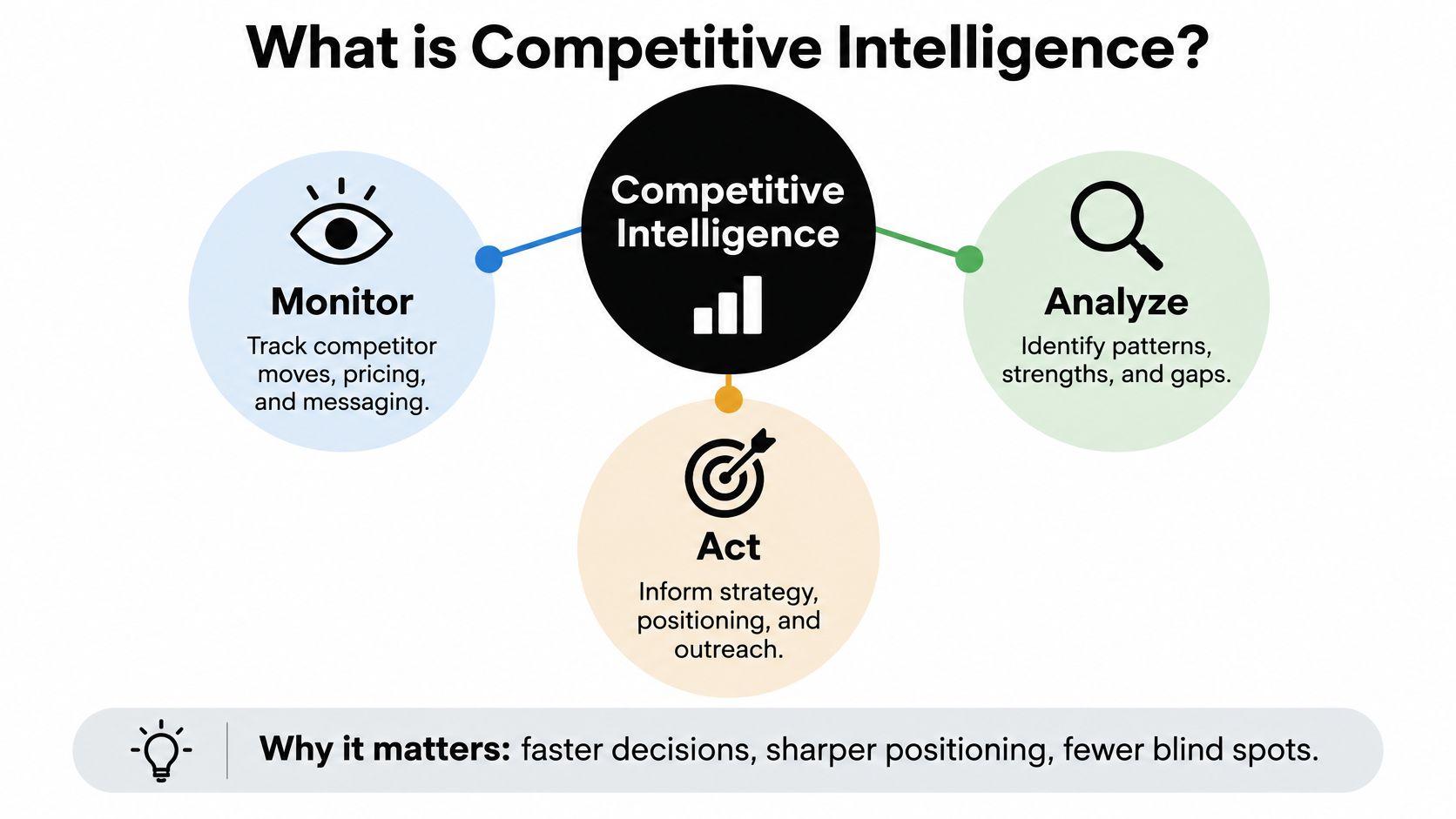
Think of competitor monitoring as radar and competitive intelligence as the map plus route. Radar tells you something moved. CI tells you whether that movement matters, why it probably happened, and which road you should take in response.
Three Jobs CI Does for a B2B Team
- Sharpen positioning: Compare how rivals describe outcomes, buyers, and proof, then find a claim you can own without sounding identical.
- Prioritize target accounts: Use hiring, expansion, and product signals to rank accounts by likely need, not just firmographic fit.
- Stress-test outreach messages: Turn a rival’s weakness or a market shift into a hypothesis you can test in a subject line or opening line.
You’ve likely done a version of this informally when you checked a rival’s customer logos before building a list. CI makes that habit repeatable. When you log terms like headcount growth or segment definitions, a reference for workforce statistics terminology helps your team use the same labels in every brief, so a signal means the same thing to sales and marketing.
If you can explain CI in one sentence to a colleague, it’s this. You gather ethical outside evidence, you interpret it, and you change a decision because of it.
How Competitive Intelligence Became a Formal Discipline
CI didn’t start as a software category. It started as a management habit that got a name, a literature, and eventually a profession.
The visual timeline below condenses that path from early corporate tracking to current automated practice.
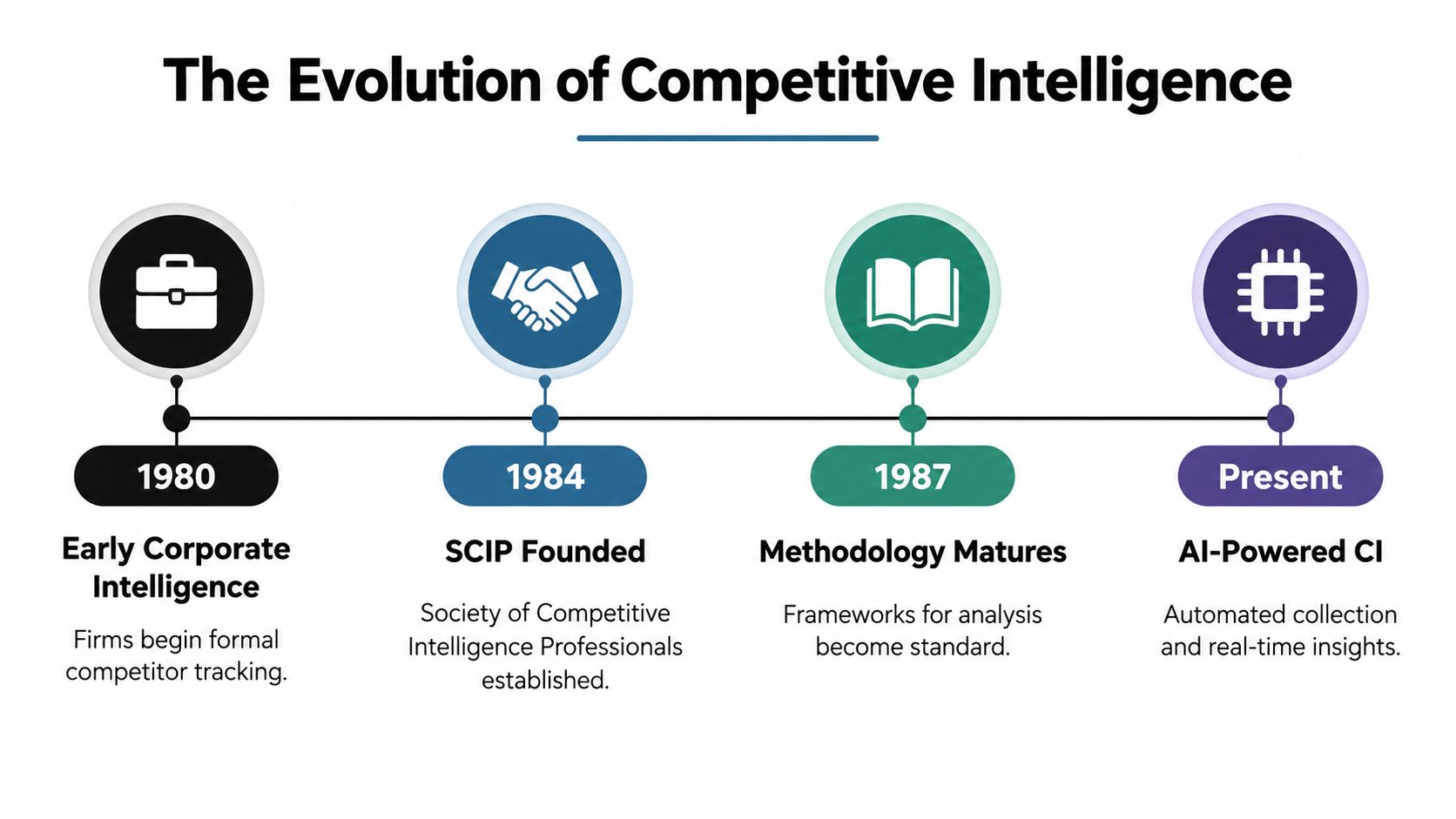
Michael Porter’s 1980 book, Competitive Strategy, established systematic industry and competitor analysis as a core part of strategy. Research tracking the field’s development, summarized in the history of the Fuld-Gilad-Herring Academy of Competitive Intelligence, identifies 1980 to 1987 as the era focused on analyzing industries and competitors, followed from 1988 onward by more formal organizational models and wider adoption.
Three people turned that thinking into an operating function. In 1982, Jan Herring created at Motorola what is described as the first formal corporate competitive intelligence function. In 1985, Leonard Fuld published Competitor Intelligence, one of the first major books dedicated specifically to the subject. In 1988, Ben and Tamar Gilad published an organizational model for a formal corporate CI function that multiple U.S. companies subsequently adopted.
The short video below gives additional context on how those early models evolved into a recognized discipline.
Professionalization followed quickly. The Society of Competitor Intelligence Professionals was founded in 1986 in Washington, D.C., and later adopted the broader name Society of Competitive Intelligence Professionals. By September 1995, membership had reached approximately 2,800, up from 1,800 only one year earlier, a gain of roughly 56%.
That history matters for a practical reason. Companies were investing in dedicated CI roles before modern B2B SaaS existed because ad hoc googling didn’t produce reliable decisions. A named function, with an owner and a model, did.
The Competitive Intelligence Lifecycle from Collection to Action
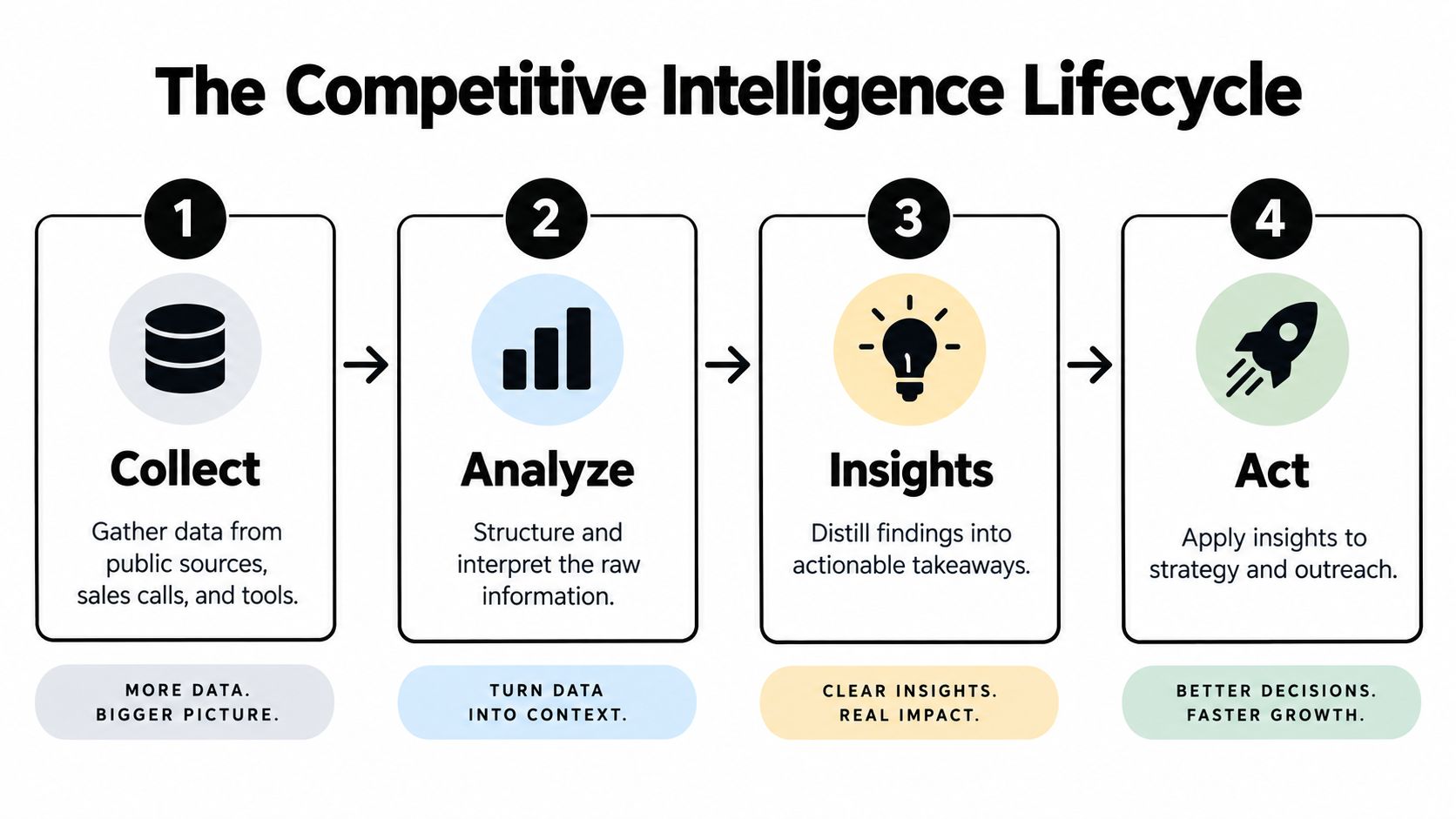
A useful CI system runs as a loop, not a folder of screenshots. The framework in the USC Marshall competitive intelligence framework on organizing, searching, and sense-making describes three interdependent phases, organizing the function, searching for information, and sense-making. For an operator, that translates into four teachable steps.
Collect With a Decision in Mind
Start by naming the decision owner and the question. Are you choosing accounts for next month’s outbound, or deciding whether to match a rival’s packaging? Then gather from traceable sources such as public filings, pricing pages, product documentation, job postings, patents, reviews, and hiring activity. Record where each item came from and when you found it. That’s source provenance, and it’s what lets you trust the finding later.
Analyze Up the Ladder
Don’t confuse three different things.
- Data: A competitor changed a price on Tuesday.
- Information: A time-series comparison shows the change restructured packaging toward larger teams.
- Intelligence: A validated conclusion that the shift targets a specific segment, paired with a recommended response for your team.
Many teams stop at level one and call it insight. CI requires validation, comparison, and interpretation before anyone briefs leadership.
Practical rule: If a finding doesn’t include an implication and a confidence level, it’s still raw information, not intelligence.
Turn Analysis Into Insights and Action
Score each signal by source reliability, recency, corroboration, and likely business impact. Write down a competing hypothesis, too, because a hiring spike could mean upmarket expansion or simple backfilling. Then attach one action, revise an ideal customer profile, test a differentiated message, build an objection map, or reprioritize an account segment.
Close the loop by feeding the result back in. If the CI-informed email variant wins, keep the assumption. If it loses, downgrade the signal. Intelligence improves only when outcomes update the next cycle.
Competitive Intelligence vs Market Research vs Competitive Analysis
These three terms get used interchangeably, and that confusion is why many programs stay stuck in research mode. Each discipline answers a different question, and your workflow should reflect that.
Market research asks whether a market is attractive. Competitive analysis asks what a specific rival is doing. Competitive intelligence asks what you should do next given rivals, customers, suppliers, regulators, and market movement together. Our market research insights guide covers the first of those questions in depth, which frees CI to own the decision layer.
| Dimension | Market Research | Competitive Analysis | Competitive Intelligence |
|---|---|---|---|
| Core question | Is this market worth entering? | What is this rival doing? | What should we do next? |
| Typical output | Market size, segments, buyer needs | Feature and pricing comparison | Recommendation with confidence level |
| Time horizon | Periodic study | Point-in-time snapshot | Ongoing cycle |
| Primary user | Strategy and product teams | Product marketing | Sales, marketing, product, leadership |
| Success test | Accurate description | Complete comparison | Better, faster decision |
Overlap is normal. A market-sizing project will surface competitor names, and a competitive analysis will feed a CI brief. The boundary is the output. Research describes, analysis compares, and intelligence recommends.
Risk tolerance shapes how aggressively you act on an incomplete signal, a tension explored in this guide for executives on AI risk. That’s a CI question, not a research question, because it involves judgment under uncertainty and a decision threshold. If your team can’t state what evidence would change its mind, you’re collecting descriptions, not producing intelligence.
Practical Applications for B2B SaaS and Cold Email Outreach
CI pays off when it changes a list, a message, or a meeting. Cold email is a clean test case because you can measure the effect of a better hypothesis within days, using a structured messaging framework for B2B outreach to keep variants comparable.

Start with your ideal customer profile. Map a rival’s public customer logos, review language, and integration partners. If their happiest customers cluster in one segment and complaints cluster in another, you’ve found a segmentation hypothesis and an objection map at the same time.
A Worked Example You Can Run Next Week
Your team notices a rival hiring several mid-market account executives and announcing a new enterprise integration. One hypothesis is that they’re repositioning upmarket and will serve smaller accounts less attentively. A competing hypothesis is that they’re only backfilling churn on their own sales team.
You corroborate with their pricing page and recent customer reviews, then act on the stronger reading. You build a list of smaller accounts in their segment, test an email angle about hands-on onboarding, and give reps a talk track for prospects who feel deprioritized. That’s CI producing pipeline work, not a slide deck.
Applications extend beyond outbound.
- Product positioning: Claim the outcome rivals describe vaguely or ignore.
- Content differentiation: Write to the questions reviews show buyers ask.
- Sales enablement: Turn validated rival weaknesses into discovery questions, not attack lines.
- Partnership scouting: Spot integration gaps your product can fill.
Public visibility also feeds the system. Directory presence, for example through AI visibility through directory submissions, creates public signals competitors and buyers can both find, so track your own footprint the way you’d track a rival’s. Agencies such as Fypion Marketing apply this logic by researching competitor positioning and buying signals before building contact lists and outreach copy, which is one operational model among several.
Ethics, Legality, and the Governance Layer Most Teams Skip
CI is not corporate espionage. That distinction, explained in Hootsuite’s guide to competitive intelligence boundaries and sources, rests on using public and ethically obtained inputs such as websites, filings, job postings, patents, reviews, and published documentation. Misrepresentation, stolen credentials, confidential documents, unauthorized access, and inducing someone to breach a contract are unacceptable.
The harder problem is governance. Public doesn’t automatically mean appropriate to use. A profile can be publicly accessible yet personally identifying, scraped at scale, sourced from a questionable database, or inconsistent with local privacy rules. Automated enrichment can amplify an error into a misleading picture of a person or company, and your outreach then carries that error into someone’s inbox.
A Four-Part Governance Frame
- Source provenance: Log where every claim came from and when.
- Data minimization: Collect only what’s needed for the named decision.
- Human review: Require a person to check sensitive findings before use.
- Escalation rules: Define who decides when a source feels borderline.
Respect site terms and access controls, verify claims through independent public sources, and align collection with your consent management practices for B2B data before any signal touches a campaign.
If you wouldn’t explain your source comfortably to the prospect, don’t use it in the email.
Apply a simple do and don’t test weekly. Do use published pricing, documentation, and reviews. Don’t pose as a customer to extract nonpublic terms, buy data you can’t trace, or store personal details your decision doesn’t require.
A 30-Day Playbook to Embed CI in Your Outreach Strategy
You don’t need a dedicated CI department to start. You need one decision question, a small competitor set, and four disciplined weeks.
Week 1 Define and Scope
Pick one question, such as which segment a key rival is prioritizing this quarter. Name the decision owner, list the direct rivals you’ll track, and build a source register with columns for source, date, claim, and reliability. Agree now on what evidence would trigger a change to your account list or message.
Week 2 Collect and Tag
Gather pricing, hiring, product, and review signals for each rival. Tag every item by segment, theme, and confidence. Resist briefing anyone yet. A tagged, dated pile beats a dramatic early conclusion built on a single job posting.
Week 3 Analyze and Brief
Produce no more than three briefs. Each brief follows the same template.
- Signal: What changed, with source and date.
- Interpretation: Your hypothesis and the competing one.
- Confidence: Reliability, recency, and corroboration.
- Recommended test: The list, message, or talk track you’ll change.
- Owner and review date: Who acts, and when you’ll judge the result.
Week 4 Wire Into Outreach and Measure
Turn each brief into one cold email variant, one revised account segment, or one sales script update. real-time personalization in B2B outreach helps, because a timely trigger is only useful if it reaches copy while it’s still current.
Track a small KPI set qualitatively at first, your signal-to-action ratio, response on CI-informed variants versus control, and whether prioritized accounts progress. Record outcomes in the register so week five starts smarter than week one.
Key Takeaways and the KPIs That Prove CI Is Working
Remember one model. Competitive intelligence turns weak public signals into confident, ethical business moves. It’s neither spying nor a set of alerts, and its most common failure mode is hoarding data without making a decision.
Empirical work supports treating CI as decision infrastructure rather than a guaranteed return. In research summarized by RePEc’s record on CI practices in 123 publicly listed Malaysian companies, strategic uncertainty was positively related to CI practices, and CI practices were positively related to firm performance. A separate 2025 study of 409 SME employees reported a relationship of β = 0.760, p < 0.01, with intellectual capital showing a variance-accounted-for value of 47%. Read those as associations that reward better judgment, not promises.
Track whether CI is working with a short list.
- CI-informed decisions per quarter: Count real changes, not briefs sent.
- Share of outreach tests using CI inputs: Shows adoption in daily work.
- Win rate movement on CI-prioritized accounts: Connects intelligence to revenue.
- Time from signal to action: Measures loop speed.
Use industry benchmarking methods for B2B teams to set sensible baselines for those measures. AI tools can accelerate collection and summarization, as outlined in Wikipedia’s overview of competitive intelligence practice, but human judgment and governance still own the final call. The habit that separates strong teams is simple. Every signal either triggers a test or gets deliberately parked with a reason.
If you want competitor signals turned into segmented lists, tested cold email copy, and qualified booked meetings without building the whole system in-house, that’s the work we do at Fypion Marketing. Start with a free consultation, and we’ll map your rivals, your sharpest messaging angles, and the accounts worth contacting first, with payment tied to meetings that meet your agreed criteria.