
What Is Lead Qualification and Why It Matters in 2026

A reply lands in your inbox: “Interested. Can you send over some times?” You book the meeting, add the account to your forecast, and start preparing a custom demo. Then the prospect misses the call, says the problem isn’t urgent, or reveals that they can’t influence the purchase. The reply looked promising, but it never represented a real sales opportunity.
That gap is what lead qualification addresses. Lead qualification is the process of deciding whether a contact and account are a worthwhile use of sales time, based on fit, intent, data quality, and buying readiness. In modern B2B sales, it isn’t a single question or a mandatory CRM field. It’s a filter that helps your team separate polite interest from a credible path to revenue.
The Calendar Full of Meetings That Never Close
Your calendar has twelve meetings this week. On paper, that’s a productive schedule. Every prospect replied positively to a cold email, accepted the invitation, and appeared interested enough to keep the conversation alive.
By the third follow-up, however, most of them have disappeared. One contact was researching the market but had no active project. Another liked the product but had no access to the decision-maker. A third worked at a company outside your ideal customer profile. You spent time researching each account, preparing slides, and writing recap emails, yet the pipeline barely moved.
A colleague booked only four meetings during the same period. The difference was that each prospect passed a relevance check before reaching the calendar. The rep confirmed that the account matched the target market, the contact had a meaningful role, and the problem was connected to a current business priority. Fewer conversations entered the funnel, but the meetings had a clearer reason to exist.
That doesn’t mean you should celebrate an empty calendar. Discovery work still benefits from healthy activity and enough conversations to reveal patterns. The problem is unfiltered volume. Unqualified meetings consume preparation time, distort forecasts, delay responses to better prospects, and make reps question their own ability when the close rate stays weak. Teams reviewing their funnel can use resources such as sales conversion rates to connect meeting quality with downstream outcomes.
Practical rule: A positive reply earns a qualification conversation. It doesn’t automatically earn an AE meeting.
Cold email makes this distinction especially important. A prospect may answer because your message was relevant, because they want more information, or because they want to be helpful. Those are useful signals, but they aren’t interchangeable. Qualification asks what the reply means in context.
The right question isn’t “Did this person respond?” It’s “Does this account have a problem we can solve, does this person connect to the buying process, and is there enough evidence to justify the next sales action?”
Defining Lead Qualification in Modern B2B Sales
Lead qualification is a structured decision about whether a lead is fit, reachable, relevant, and likely to progress toward a purchase. The process typically sits between marketing activity and active sales pursuit. Marketing may identify a lead as an MQL, or marketing-qualified lead, because the account or contact meets a baseline of profile or engagement criteria. Sales then determines whether that lead should become an SQL, or sales-qualified lead.
The handoff is a measurable gate. Industry summaries report that about 13% of MQLs become SQLs, meaning roughly 87% don’t meet sales criteria for active pursuit (Landbase’s lead qualification benchmark summary). The same source reports an average B2B funnel conversion from website visitor to lead of 2.3%, followed by 31% of leads becoming MQLs and 22% to 30% of opportunities becoming customers. Another widely cited benchmark in that summary says only 25% of marketing leads are sales-ready when passed to sales.
These figures don’t mean every business should copy the same threshold. They show why the handoff needs an explicit definition. Without one, marketing optimizes for activity while sales evaluates leads by instinct, and both teams use the word “qualified” to describe different things.
The bouncer test
Think of qualification as a capable bouncer at a busy venue. The bouncer doesn’t admit everyone who walks up, but they also don’t reject every unfamiliar person. They check identity, relevance, behavior, and whether the venue can accommodate another guest.
Your qualification process performs a similar job:
- Fit: Does the company resemble your ideal customer profile?
- Role: Does the contact influence the problem, evaluation, or purchase?
- Intent: Has the account shown meaningful interest or urgency?
- Timing: Is there a reason to act now rather than someday?
- Data quality: Can your team trust the contact and account information?
A practical reference for the commercial conditions behind this decision is the guide to conditions from PreSales Unleashed GmbH. Your own criteria should reflect your product, sales motion, customer segment, and ability to serve the account.
An MQL helps fill the room with plausible interest. An SQL protects the sales team’s calendar by confirming that the prospect belongs in an active conversation. For a plain-language foundation, it also helps to distinguish a prospect from a lead in business. A lead is an initial signal. A qualified lead has passed a deliberate test.
Comparing the Frameworks B2B Teams Actually Use
Qualification frameworks are useful because they give reps a shared vocabulary. They become harmful when a rep treats them as an interrogation script and asks questions before understanding the prospect’s situation.
BANT, or Budget, Authority, Need, and Timeline, is the familiar starting point. It works well when price is clear, the purchase is relatively direct, and budget is a genuine early constraint. In modern SaaS, it can fail when the buyer hasn’t established a budget, the contact is one member of a committee, or the need must be developed through discovery.
CHAMP, or Challenges, Authority, Money, and Prioritization, begins with the prospect’s problem rather than the budget question. That makes it more natural for discovery and cold outreach. It can still underweight the complexity of enterprise authority if the rep identifies one interested contact and assumes that person represents the entire buying process.
MEDDIC, or Metrics, Economic Buyer, Decision Criteria, Decision Process, Identify Pain, and Champion, is designed for complex opportunities. It forces the team to understand business value, the person who controls economic approval, the evaluation process, and the internal advocate. Its depth is valuable in enterprise sales, but a mid-market SDR may not need every field before deciding whether to hold an initial conversation.
GPCTBA-C&I, or Goals, Plans, Challenges, Timeline, Budget, Authority, Consequences, and Implications, offers a broad discovery lens. It helps a rep connect the prospect’s goals with the cost of inaction. The risk is overloading a first conversation with questions that should be answered progressively.
A team selling several products may also need a multi-product account strategy, because qualification can depend on the account’s wider needs rather than the first product mentioned.
| Framework | Core Criteria | Best Fit | Common Weakness | Cold-Email Suitability |
|---|---|---|---|---|
| BANT | Budget, authority, need, timeline | Direct, price-sensitive sales | Budget can be unknown too early | Useful as a light screen |
| CHAMP | Challenge, authority, money, prioritization | Consultative mid-market discovery | Can miss committee coverage | Strong when the reply names a problem |
| MEDDIC | Metrics, economic buyer, decision criteria, process, pain, champion | Complex enterprise opportunities | Heavy for high-volume outreach | Best after initial interest |
| GPCTBA-C&I | Goals, plans, challenges, timeline, budget, authority, consequences | Broad business discovery | Requires careful tailoring | Useful for account research and follow-up |
Use these models as question banks, not pass-or-fail rituals. Your ICP should determine the first filter, which is why reps need a clear ICP in sales. A cold-email reply may only justify checking fit, problem relevance, and next-step access. A later discovery call can test economic approval and the decision process.
Fit, Intent, and Data Quality as a Multi-Signal Filter
A single positive signal creates false confidence. A senior title is not buying authority, a pricing-page visit is not vendor evaluation, and a perfect-looking account record is not proof that the contact’s email or job title is current.
A stronger model uses three lenses together.
- Fit checks whether the account belongs in your target market. Look at industry, company size, geography, use case, and relevant technology.
- Intent checks whether the account is moving toward a problem or decision. Useful signals include pricing-page visits, repeated return sessions, demo requests, trial activity, reply language, and relevant company events.
- Data quality checks whether the evidence is trustworthy. Verify the business email, current role, seniority, account ownership, and CRM record before assigning sales effort. Teams can also use email list cleaning services to keep contact data trustworthy.
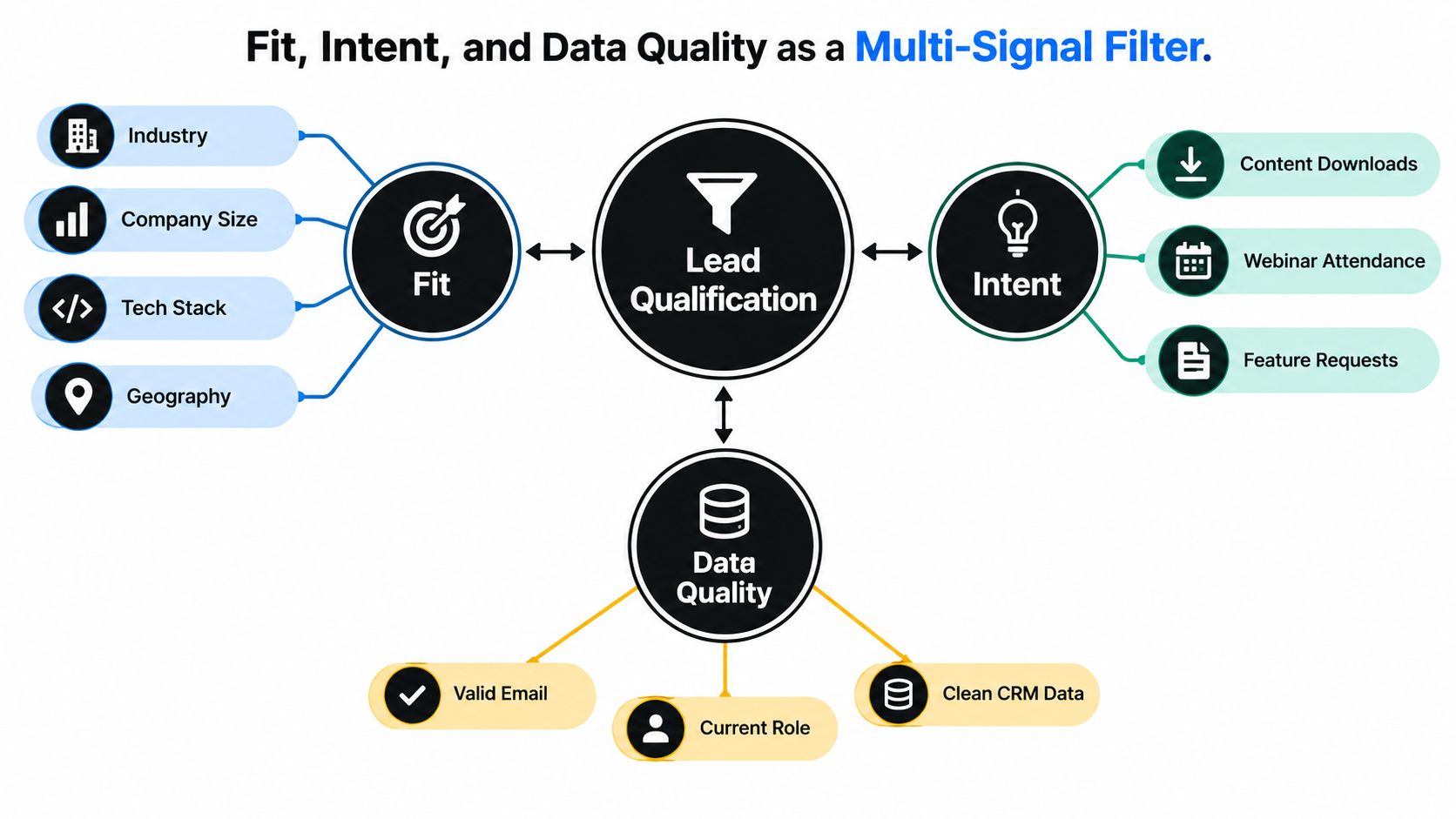
Independent B2B guidance recommends combining firmographic fit, intent signals, and reliable contact information instead of relying on one checklist item (Zeliq’s qualified-lead guidance). Fit reduces wasted outreach. Intent helps you judge readiness. Data quality keeps a rep from chasing a stale record that looks strong in the CRM but cannot produce a conversation.
Use AND and OR deliberately
Use AND logic for required conditions. An account may need to fit the ICP and have a reachable business contact before it enters an active sequence. Use OR logic for supporting signals. A qualified account might show intent through a pricing visit, a direct reply, or a relevant operational change.
Do not add points just because a signal is easy to collect. Five weak email opens should not outweigh a wrong industry, and a senior title should not excuse an invalid address. Teams building automated workflows should apply the same clarity to effective prompt structure tips, especially when AI summarizes replies or recommends routing.
Keep a disqualification reason in the CRM. “No fit,” “no current project,” “wrong role,” and “unreachable contact” are more useful than a generic closed status. If data is incomplete, route the account for verification rather than treating missing information as a negative signal. A clean process separates unknown from unqualified.
Building a Qualification Checklist and Scoring Model
A scoring model should make rep judgment more consistent, not replace it. Start with the conditions your sales team can verify from account research, enrichment, CRM activity, and a cold-email exchange.
Use four groups:
- Fit: Industry, company profile, geography, use case, and role relevance.
- Intent: Direct reply, request for a demo, pricing interest, repeat account activity, or a clear trigger.
- Engagement: Whether the contact answers a question, accepts a relevant next step, or introduces another stakeholder.
- Timing: A stated project, renewal, launch, operational change, or other reason to evaluate now.
The sample model below uses relative weights rather than pretending that one universal score works for every business. You can translate the levels into numbers inside your CRM, then compare the score with actual meeting and opportunity outcomes.
| Criterion | Category | Points | Signal Source |
|---|---|---|---|
| Account matches the ICP | Fit | High | CRM and enrichment |
| Relevant seniority or role | Fit | Medium | Contact research |
| Clear use case or business problem | Fit and intent | High | Email reply or call |
| Pricing, demo, or trial interest | Intent | High | Website and CRM activity |
| Repeated relevant engagement | Intent | Medium | Marketing and website activity |
| Verified business contact data | Data quality | Medium | Validation and enrichment |
| Current project or trigger | Timing | High | Reply, company research, or conversation |
| Willingness to involve another stakeholder | Buying process | High | Email or discovery call |
Apply the model to a real reply
Suppose a VP of Sales Operations at a target SaaS account responds to your third cold email. The company fits your market, the contact owns a relevant process, and the reply mentions a current reporting problem. The account has also returned to the pricing page and agrees to discuss how the team handles the issue.
That lead should rank above a director at the right type of company who opened several emails but never replied. The first prospect has fit, intent, engagement, and timing. The second has mostly passive activity.
Set three outcomes instead of one magical threshold:
- Route: The lead has strong fit and a verified buying signal. Give the AE or appropriate seller a clear next step.
- Verify: The lead looks relevant, but one critical field is missing. Assign an SDR to confirm the gap.
- Nurture or disqualify: The account lacks fit, urgency, or a reachable path to the buying group. Record the reason and preserve the relationship where appropriate.
Review the model against closed-won, closed-lost, and no-decision opportunities. If high-scoring leads repeatedly fail to attend or progress, reduce the value of the signals that inflated their scores. If good opportunities arrive with low scores, add the missing signal. Revisit the rules on a regular operating cycle rather than letting an old model govern a changed market.
Qualifying Buying Groups Instead of Single Contacts
A cold-email rep often stops qualifying when one person says, “Yes, this is a problem.” That person may be a strong champion, but a champion isn’t the whole opportunity.
Complex B2B purchases involve several roles. Users experience the workflow. A technical evaluator checks requirements and integration risk. Finance or an economic buyer examines the business case. Procurement and security may control the final path. A decision-maker may approve the project without using the product personally.
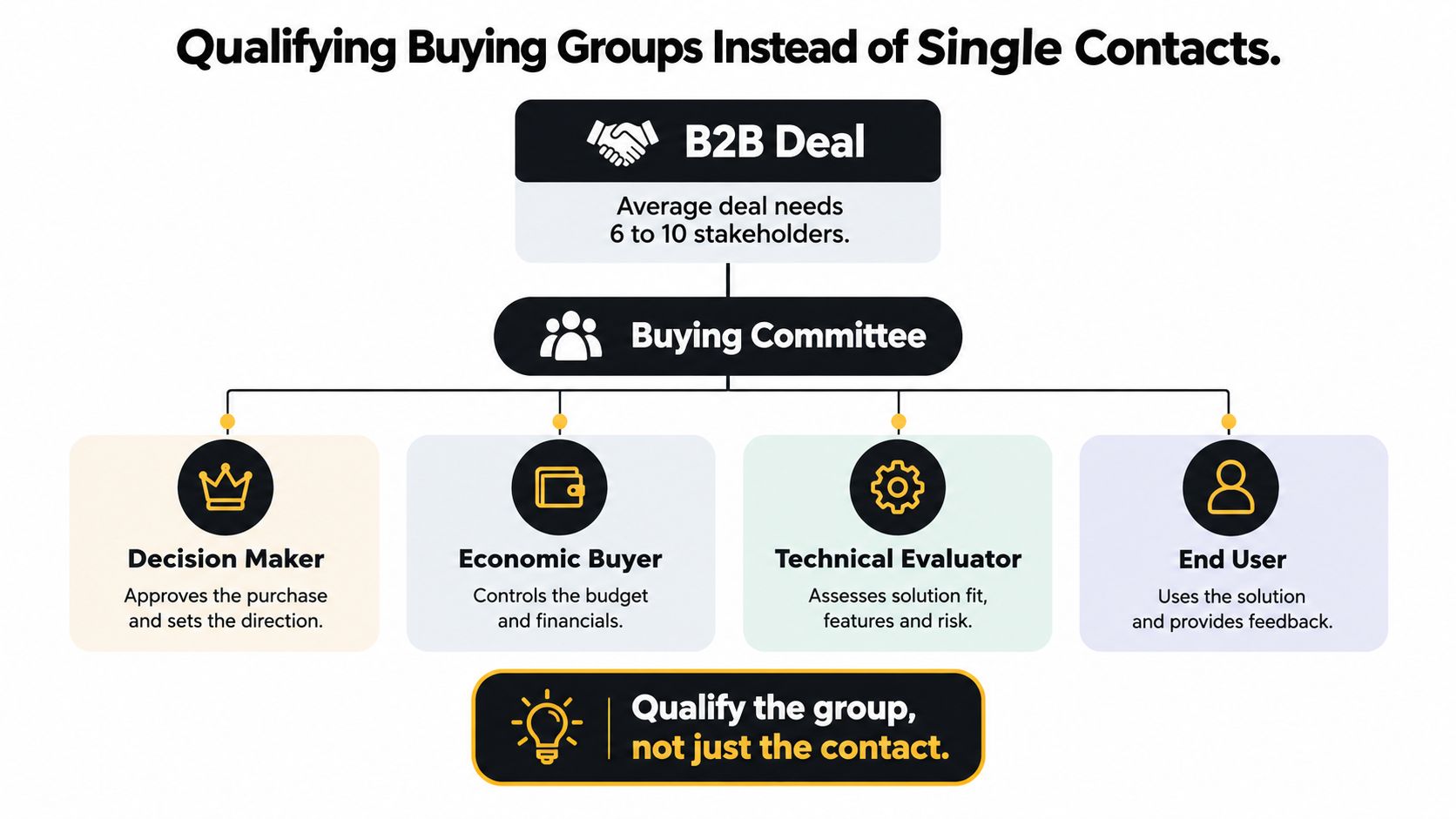
A neutral account-based perspective frames qualification around buying groups, not isolated contacts (Infuse’s qualified-lead guidance). That changes the question from “Is this lead interested?” to “Does this account show enough coordinated evidence that the buying group may act?”
Map evidence by role
For every active opportunity, record the role, the person, the evidence, and the gap:
- Champion: Can explain the problem, supports the project, and guides you through internal channels.
- End user: Describes the workflow and confirms that the proposed change matters in daily work.
- Economic buyer: Connects the purchase to budget, business impact, or executive approval.
- Technical evaluator: Tests integration, security, data, or implementation requirements.
- Procurement: Explains commercial steps, vendor onboarding, and purchasing conditions.
Consider a mid-market SaaS conversation. The champion has described the operational problem, an end-user group has attended a relevant demonstration, the economic buyer has been identified by role, and a security review is scheduled. That account has stronger coverage than one where only the original champion is engaged and the person responsible for approval has never acknowledged the project.
You don’t need every role confirmed before an initial meeting. You do need to know which missing role could stop progression. Add a coverage status to the opportunity, such as single-threaded, partially mapped, or multi-role confirmed. This gives managers a better view than a contact-level score alone.
The practical rule is simple: qualify the contact for the next conversation, but qualify the account for the opportunity. Those are different decisions.
Metrics That Tell You If a Meeting Was Truly Qualified
A qualified meeting should produce evidence after it reaches the calendar. If meetings show up but fail to create opportunities, the problem may sit upstream in fit, intent, routing, or the rep’s confirmation process.
Track the full chain:
- Speed to lead: How quickly does someone respond after a new signal? The well-known 2007 MIT Sloan and InsideSales.com research found that contacting a web lead within five minutes made companies about 100 times more likely to make contact and 21 times more likely to qualify the lead than waiting 30 minutes (the response-speed summary from The Growth Syndicate).
- Response latency: Compare your actual response time with the behavior of your best opportunities. One industry summary reports that only 7% of companies respond within five minutes, while average response time is about 42 hours, from the same source.
- Show rate: Measure whether the person who accepted the meeting attends and participates. A high no-show rate can indicate weak intent, poor confirmation, or an unclear meeting promise.
- Meeting-to-opportunity conversion: This reveals whether the meeting met your sales-readiness standard. Separate inbound and cold-outbound sources because the signals and expectations differ.
- Pipeline value per meeting: This is the cleanest downstream test. A meeting that produces no credible opportunity may have been a calendar event, not a qualified sales conversation.
| Metric | What It Measures | Healthy Outbound Benchmark | Healthy Inbound Benchmark |
|---|---|---|---|
| Speed to lead | Time from signal to meaningful response | Use a defined rapid-response SLA | Prioritize immediate routing |
| Show rate | Attendance and participation | Compare by sequence and persona | Compare by form, source, and intent |
| Meeting-to-opportunity conversion | Discovery quality and sales readiness | Track by account segment | Track by qualification path |
| Pipeline value per meeting | Commercial value created per slot | Review by campaign and ICP tier | Review by source and routing rule |
| MQL-to-SQL conversion | Marketing and sales alignment | Compare accepted versus rejected leads | Compare criteria with sales outcomes |
A later benchmark cited in sales literature says contacting a lead within the first hour can make a company nearly 7 times more likely to qualify that lead, again as summarized by The Growth Syndicate. The exact benchmark matters less than the operating principle: a relevant lead can lose momentum while it waits.
Review these metrics together. A fast response with poor opportunity conversion suggests weak qualification. Strong show rates with low pipeline value may indicate that the meeting promise is attractive but the account fit is wrong. Slow response with good conversion may mean the team is finding quality leads but missing the moment when intent is strongest.
For broader funnel context, compare these outcomes with your leads and conversions, then adjust the filter rather than judging reps on meeting count alone.
Best Practices and Common Mistakes to Avoid
Qualification improves when sales, marketing, and operations agree on what “qualified” means and record the evidence behind each decision.
Use this operating checklist:
- Qualify in the reply: Ask one relevant question before offering a calendar link. A prospect who answers about the problem gives you better evidence than a prospect who only says yes.
- Log the reason: Record why the lead advanced, stalled, or was disqualified. This helps managers identify repeated false positives.
- Refresh the list: Remove stale contacts, outdated titles, and accounts that no longer fit the market.
- Align the SQL definition: Marketing and sales should agree on the minimum fit, intent, role, and timing conditions for an accepted handoff.
- Weight account fit: A friendly response from the wrong account isn’t more valuable than a quiet but highly relevant target account.
- Use budget carefully: BANT-style budget questions can be useful, but asking for a number before establishing the problem can shut down an otherwise productive conversation.
- Review the last meetings: For each recent meeting, ask whether the account fit, problem, role, timing, and next step were documented before booking.
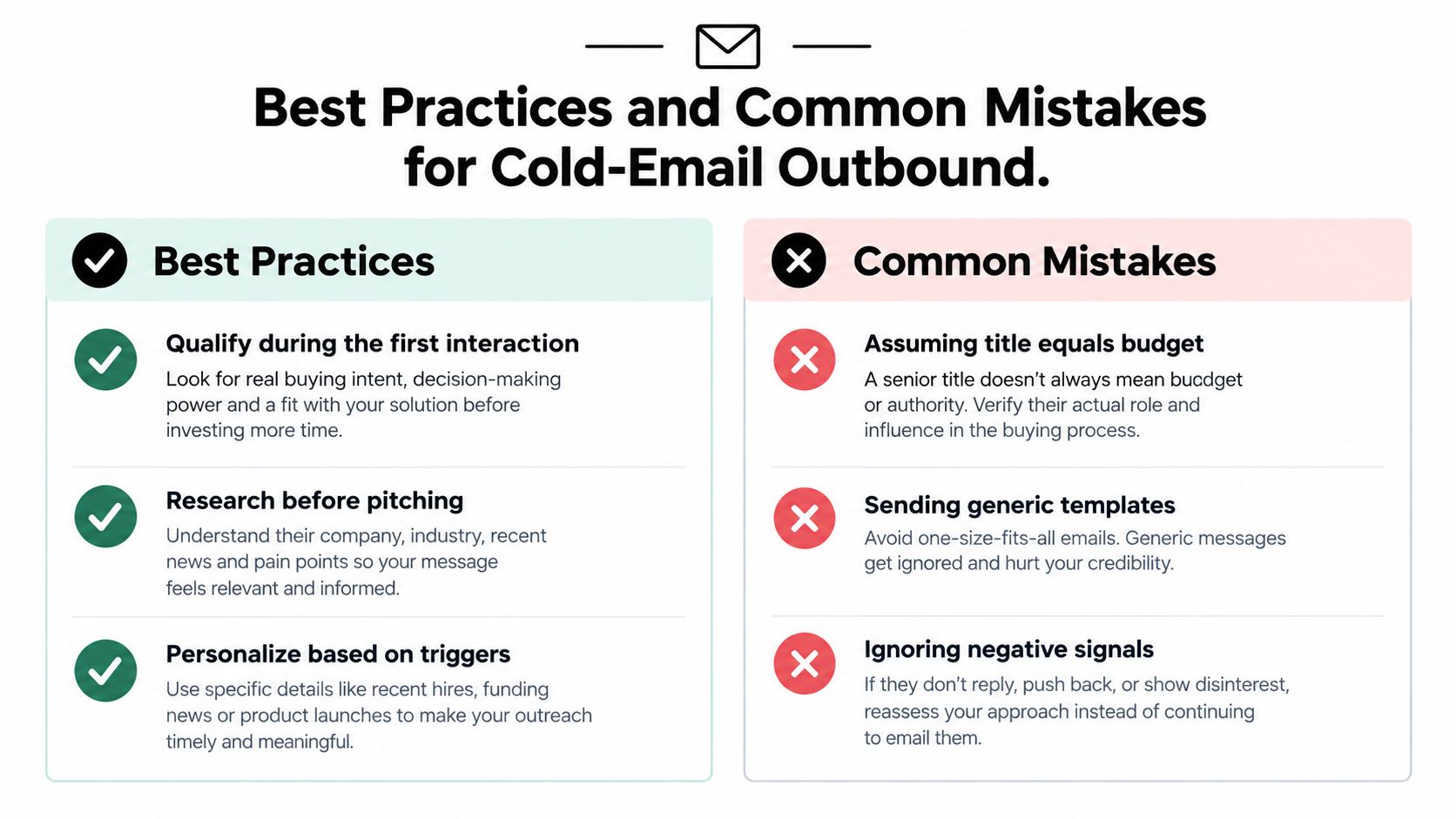
The most common mistake is treating every reply as qualified. Others include scoring a lead from job title alone, assuming one champion represents the buying group, and allowing stale CRM data to feed an automated model. AI can summarize conversations and prioritize signals across email, chat, calls, forms, and CRM activity, but automated scoring still needs human review when context is ambiguous. Recent guidance describes qualification as moving toward real-time, multi-channel evaluation rather than a one-time gate (Landbase’s guide to lead qualification tools).
A simple self-audit will expose gaps quickly: take your last ten booked meetings and mark whether each had confirmed fit, a stated problem, a relevant contact, a timing signal, and a documented next step. If several meetings lack the same evidence, update the checklist and retrain the team on that specific failure.
Fypion Marketing helps B2B teams build cold-email campaigns, research target accounts, create personalized outreach, and book meetings against agreed qualification criteria. Visit the site to discuss a campaign that filters for fit and buying intent before a meeting reaches your sales calendar.