
What Is Zero Party Data and Why B2B Marketers Need It

Zero-party data is information a customer intentionally and proactively shares with a brand, while first-party data is observed through actions such as browsing, clicking, or buying. For B2B marketers, that distinction means a prospect’s stated need or buying timeframe can guide outreach directly instead of being guessed from activity.
You may be looking at a familiar cold-email problem: the team has a large prospect list, a scoring model, and a sequence ready to go, yet replies keep getting harder to earn. Some contacts came from scraped lists; others look promising because they visited a page or clicked an email. But those signals don’t necessarily tell you what a person needs, whether they’re in market, or how they want to be contacted. When outreach treats those guesses as facts, even a carefully written message can feel off-target.
Zero-party data offers another starting point. Rather than infer every need from observed behavior, invite prospects to state what matters to them, then use those answers with care. That can make cold outreach more relevant, but it also raises practical questions about data quality and consent.
Why Cold Outreach Needs a Better Source of Truth
A sales director reviews the latest campaign and sees the familiar pattern: the audience was selected using job titles, company details, and signals such as site activity, but too many messages failed to start a useful conversation. The list may be accurate in a narrow sense, yet the team still doesn’t know what each prospect is trying to solve or whether the timing is right.
That gap matters in B2B cold outreach. A prospect might have visited a product page while researching a competitor, helping a colleague, or just exploring. The visit is an observed action, not a direct statement of intent. Treating it as a clear buying signal can push a sales team toward a confident but mistaken message.
A stronger process separates what the company observes from what the prospect declares. A person who says they’re comparing software, describes a workflow problem, or asks for a particular follow-up channel gives the team information it can use without pretending a click reveals the full story. That shift doesn’t make behavioral data useless. It changes the role of behavior, from stand-in for intent to context that can support or challenge what someone has shared.
For teams building or refining outbound programs, a practical guide to outbound B2B lead generation can help connect audience selection, messaging, and campaign execution. It’s also useful to clarify where each data point lives in the operating model. A practical guide to data system roles can help teams distinguish the system that stores information from the source they trust to guide a decision.
A useful starting question: Did the prospect tell us this, did we observe it, or did we obtain it from somewhere else?
That question is the doorway to zero-party data. Once a team can answer it consistently, it can decide when a stated need should replace a probabilistic lead score, when behavior should provide context, and when neither signal is strong enough to justify a sales handoff.
Defining Zero-Party Data From Origin to Attributes
Forrester Research introduced zero-party data as a formal customer-data category in 2018. It describes information a customer intentionally and proactively shares with a brand, such as stated preferences, personal context, and communication choices (overview of zero-party data and its origins).
The plain-language version is simple: zero-party data is what someone chooses to tell you directly. A preference card that says “send me product updates by email” is zero-party data. A company noticing that the person repeatedly opened a product page is observing behavior instead.
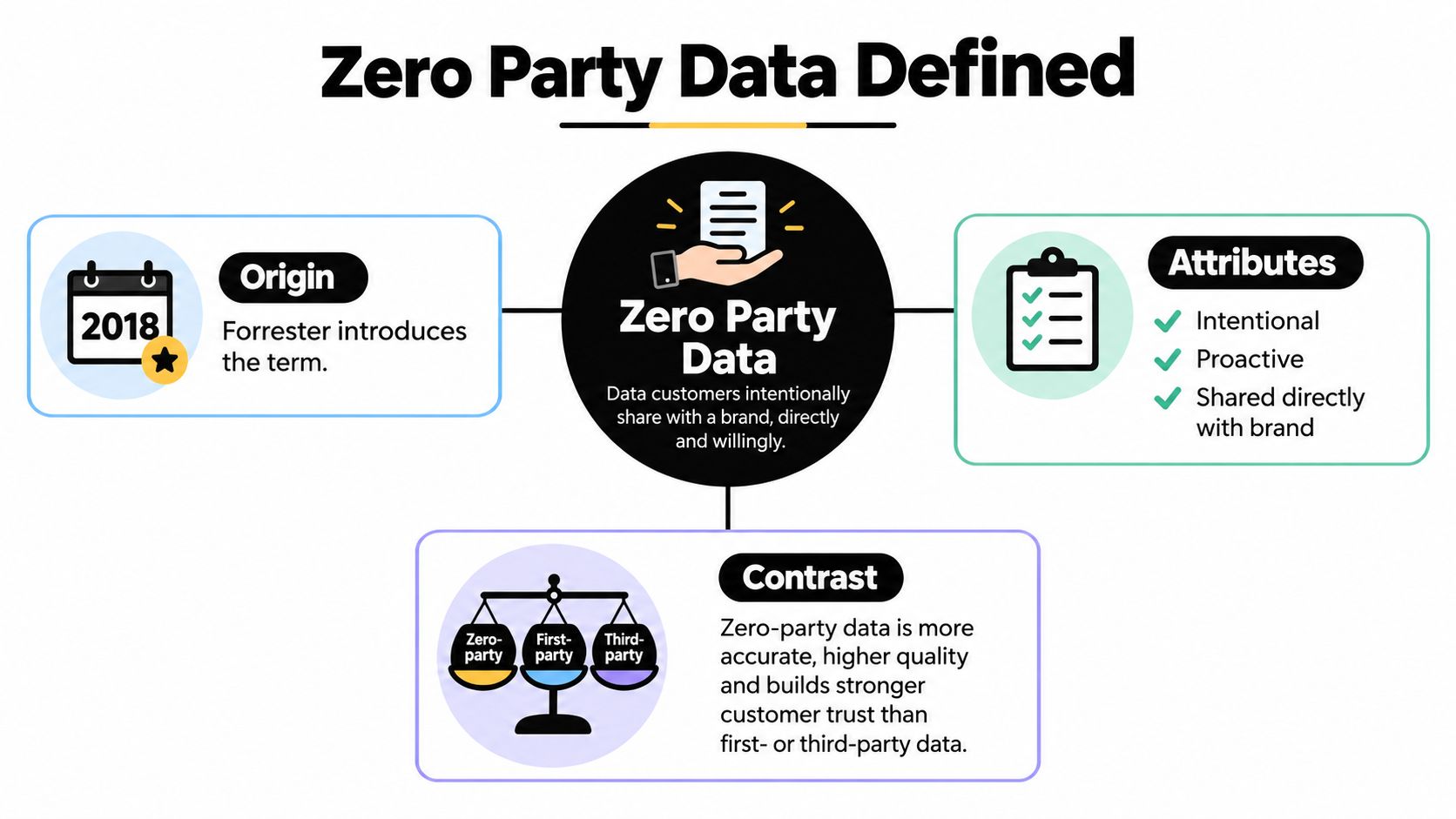
The information can show up in several forms. Someone may name a product preference, explain what they intend to buy, share context that helps a brand respond appropriately, or select a preferred way to hear from the company. In B2B, the same principle applies when a prospect directly identifies their organization’s size, software needs, buying timeframe, budget range, or preferred follow-up channel.
The key test is the origin of the information, not the format. A survey answer, a preference-center selection, a quiz response, a submitted form, or a written reply can all qualify if the person deliberately supplied the information. An answer doesn’t stop being zero-party data because it’s stored in a CRM. The record should still preserve where and when the person shared it, what it was collected for, and what permissions apply.
This distinction can also help teams think carefully about who controls the information and how it’s handled. For a related perspective on identifying customer-owned data in deals, consider both the relationship to the data and the reason the organization is using it.
A concise explanation to share with a colleague is: zero-party data is declared by the person; it isn’t inferred from their behavior. That definition makes it easier to recognize the data in a campaign workflow and avoid treating an observed signal as if a prospect stated it.
Zero Party vs First Party vs Third Party Data
The difference between zero-party, first-party, and third-party data comes down to how the information reaches your team. The categories can coexist in one prospect record, but they shouldn’t be treated as interchangeable evidence.
| Dimension | Zero-Party Data | First-Party Data | Third-Party Data |
|---|---|---|---|
| How it’s obtained | A person deliberately shares it | A company observes activity through its own channels | An organization obtains it from an external source |
| Example | A prospect states their buying timeframe in a form | A prospect views a product page or clicks an email | A vendor supplies an external contact or company record |
| What it tells you | What the person says about their needs or preferences | What the person did on your properties | What an outside source reports or provides |
| Best treated as | A direct, self-reported attribute that may need validation | An observed signal that can inform a hypothesis | External information to assess and use with appropriate scrutiny |
Consider a prospect who answers a qualification question by saying they plan to buy within 30 days. That answer is an explicit intent attribute. If the same prospect repeatedly views a product page, the activity may be relevant, but it supports an inference rather than proving the person’s timeframe. A response and a sequence of page visits can inform the same decision, but they aren’t the same kind of evidence.
In B2B demand generation, a form field asking for company size, a qualification survey about an active pain point, or a reply naming an incumbent provider all capture declared information. Website visits and email engagement are observed behaviors. A contact record supplied by an external provider is third-party data, even if it later sits beside the prospect’s direct answers in a CRM.
This classification affects how teams score and route leads. If someone directly states a need and timing, that information may be more useful than a score based only on clicks. But it shouldn’t automatically erase other checks. A declared answer can be incomplete, out of date, or inconsistent with the company’s fit. The practical benefit is clarity: your team can see whether a segment is based on what prospects said, what they did, or what another source supplied.
Why B2B Marketers and Cold Email Teams Should Care
Declared information can change how a cold email team selects an audience. Instead of treating every signal as evidence of intent, marketers can segment by what prospects have shared: their industry, team needs, pain point, buying window, or preferred follow-up method. That gives the sender a clearer reason for choosing a message and an offer.

In a pay-per-meeting campaign, that distinction affects the handoff. If a prospect explicitly describes a relevant problem, provides a suitable timeframe, and identifies who should join the conversation, the team has a stronger basis for routing the lead than a score built only from page visits. The declared details can also shape the email’s opening and offer, reducing reliance on generic personalization based on a title or company name.
That doesn’t mean every declared field should go straight into copy. A response needs context: what question prompted it, when the person answered, and whether the planned use matches what they were told. A useful CRM record includes provenance metadata such as source, timestamp, purpose, consent status, and confidence. Research discussing zero-party data similarly distinguishes declared variables from information inferred through browsing and engagement, and emphasizes recording that provenance (peer-reviewed analysis of declared customer data).
Replace the guess when the declaration is stronger
Probabilistic lead scoring can still help teams prioritize behavior, especially when they lack direct answers. But it needn’t dominate a record when a prospect has clearly stated a need or timeframe. In that situation, a team can use the declared attribute as the primary routing signal, then validate it against firmographic fit, authority, and a real conversation.
This is a useful way to rethink an ideal customer profile as well. A resource on how ICPs work in sales can help teams connect audience criteria to the questions they ask prospects. The point isn’t to collect every possible field. It’s to ask for information that changes a decision, such as whether a particular use case fits the product or whether the prospect wants sales contact now.
A simple workflow keeps the distinction visible: record the declared answer, retain its source and collection date, and use behavior as corroboration rather than silently converting it into stated intent. That lets sales teams act on useful information while recognizing that self-reporting still needs validation.
This video provides additional context on zero-party data and how teams can think about using it.
How to Collect Zero Party Data in Practice
The most useful collection method is the one that asks a relevant question at a moment when the prospect can see why answering helps. A long form full of optional questions can feel like a hurdle. One well-chosen question can make the next interaction more relevant and give your team a usable attribute.
Start with a question tied to a decision
A SaaS company might ask, “What problem are you trying to solve in the next 90 days?” before offering a discovery call. The answer can guide the call agenda and become a segmentation tag, such as a workflow challenge or integration need. The question earns its place because the team can explain how it will use the response.
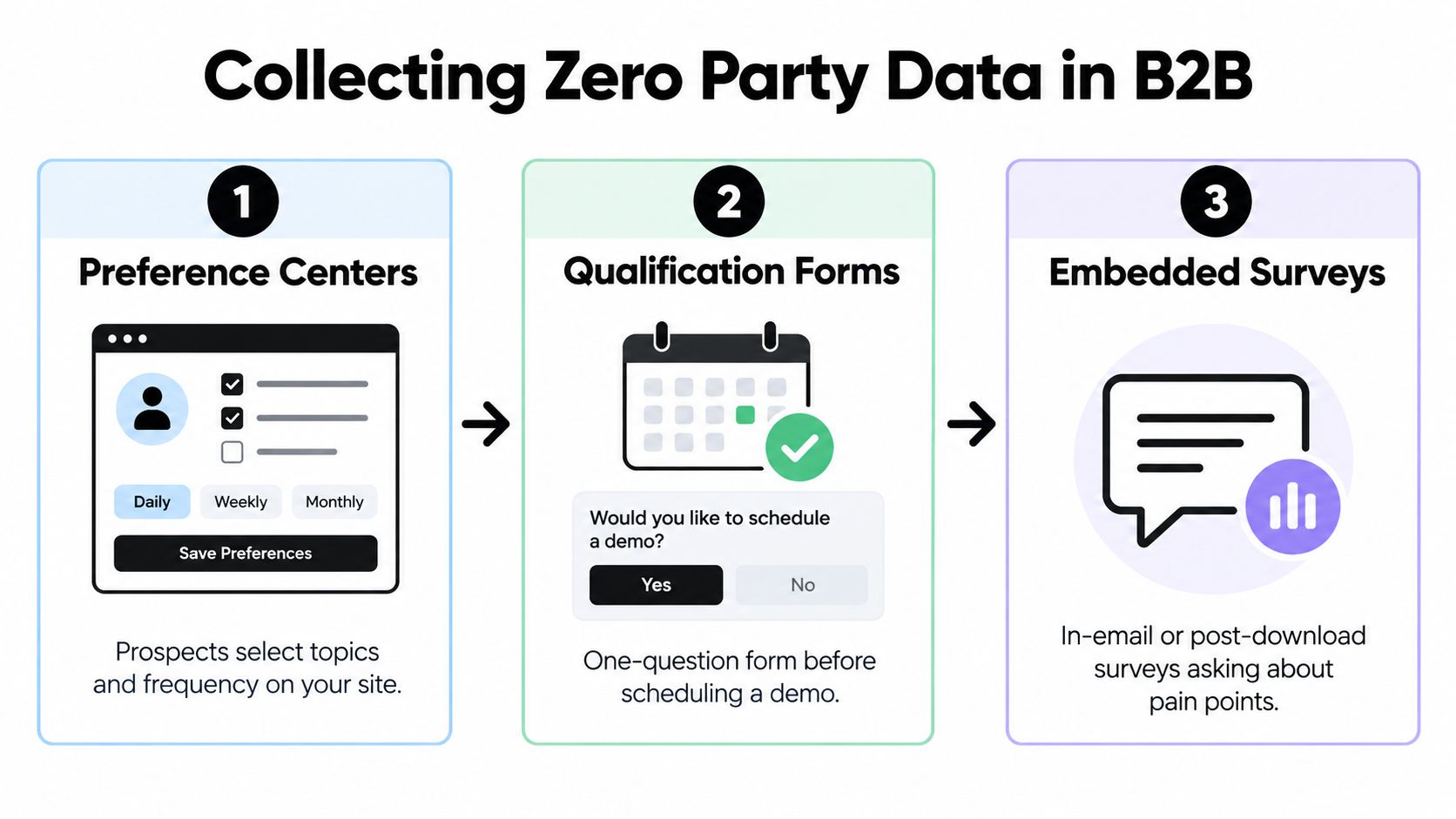
A preference center is another straightforward option. Let prospects choose which topics they want to hear about or which channel they prefer. Keep the choices understandable and make it possible to update them. A landing page or resource download can include a brief, optional question about the role the prospect is exploring or the business problem they want to address.
Interactive surveys and online forms can be especially suitable for active disclosure. In a UK study of 1,885 working-age consumers, interactive surveys were the preferred information-collection method for 48% of respondents, compared with 20.2% for cookies and 15.2% for social-media monitoring (UK consumer research on zero-party data collection preferences). The useful lesson for a B2B team isn’t that a survey fits every interaction. It’s that an explicit question gives someone a visible way to share information, unlike passive observation.
Put collection into the workflow
- Before a calendar booking: Ask one optional qualification question about the use case or buying timeframe. Keep it short enough that the prospect can answer without turning scheduling into an application.
- Inside a nurture sequence: Embed a brief survey that asks which topic or challenge is most relevant. Use the response to adjust the next message, rather than sending every contact the same follow-up.
- After a sales call: Ask whether the conversation addressed the stated need and whether the prospect wants a particular next step. This can update preferences and help improve handoffs.
- In replies: When prospects volunteer details in an email, capture the substance and source in structured fields. Don’t treat an automated interpretation as more precise than the original response.
The questions should be specific enough to produce useful answers, but not so narrow that they push prospects toward a response that serves the seller. For more on using declared attributes to organize audiences, see this guide to email list segmentation.
The Compliance and Trust Layer Most Articles Skip
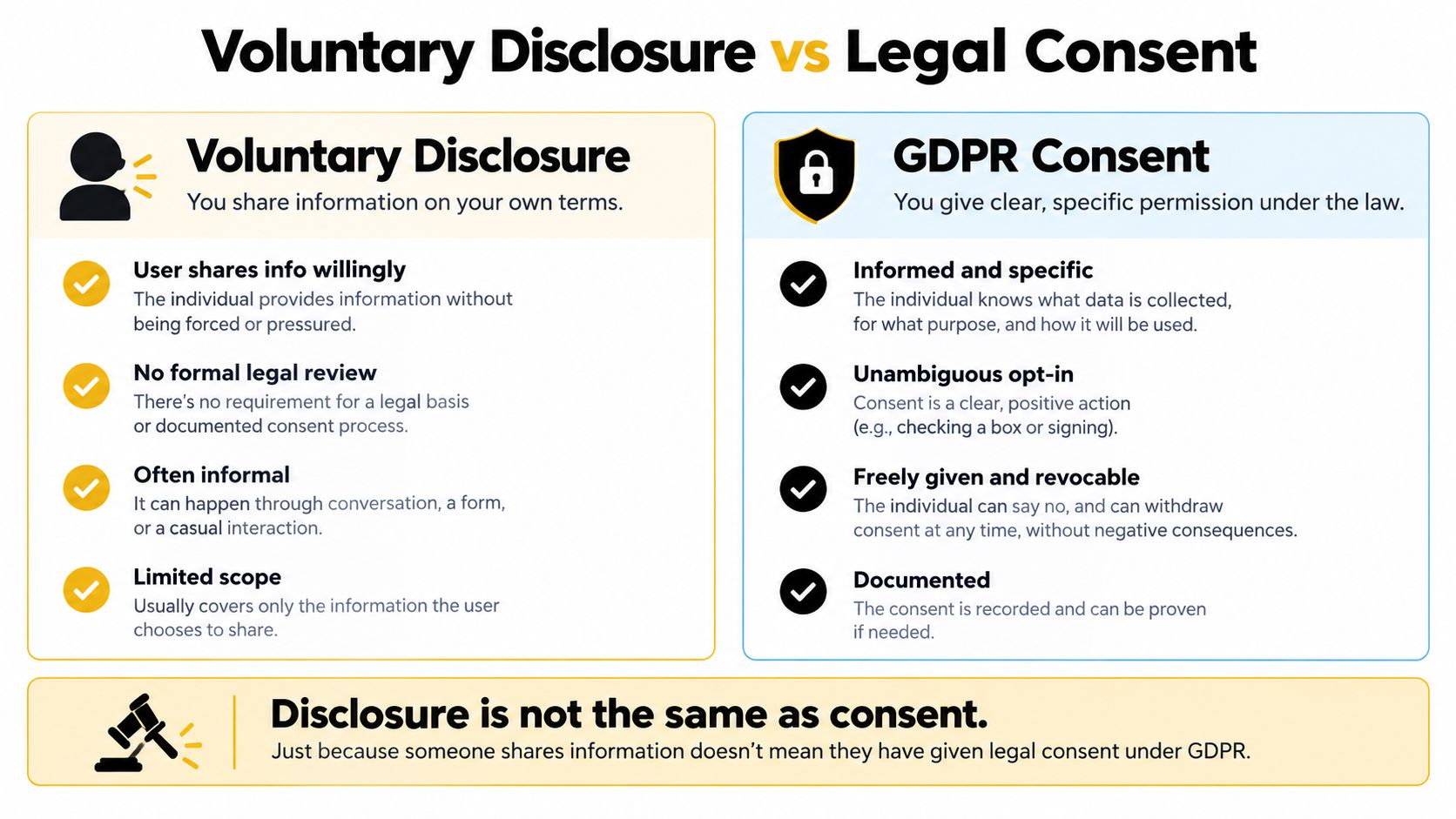
A person sharing information voluntarily doesn’t, by itself, mean they’ve agreed to every use of it. Data origin and lawful processing basis are different questions. Origin tells you how the information arrived; the processing basis tells you why the organization is permitted to use it for a particular purpose.
That difference matters in B2B forms and qualification tools. Someone who types a job role or budget range into a form may have supplied zero-party data, but that action doesn’t automatically authorize sharing the answer with sales partners, enriching a CRM profile, or using it for automated targeting. Where consent is required, it must be obtained before processing, and GDPR consent must be informed, specific, freely given, and withdrawable.
Ask only what you can justify
Before adding a field, decide what it will inform and how the answer will be used. If the team can’t explain the purpose, the question probably doesn’t belong in the form. Avoid making unnecessary disclosure a condition of accessing a service or resource, and make it clear when an answer is optional.
The distinction is especially useful when data flows into automated outreach. A prospect’s answer may be appropriate for segmenting a message but not for an unrelated purpose. Clear notices, suitable controls, and a way to update or withdraw preferences help teams respect the context in which the person shared the information. A practical resource on consent management can help marketers think through how permissions should be captured and maintained.
There’s a second limitation: a direct answer isn’t guaranteed to be accurate or current. People may misunderstand a question, offer an aspirational response, change priorities, or answer strategically when an incentive is involved. Treat self-reported intent as a valuable signal, not unquestionable truth. A prospect who selects “ready to buy” still needs validation through fit, authority, timing, and conversation.
Practical rule: Ask what you need, explain why, and keep the answer’s date and purpose attached to it.
Trust depends on the value exchange as well as the collection method. One consumer-research summary reports that 50% of consumers said they’d be more likely to trust brands that seek zero-party data instead of relying on passive collection, while 86% said the need for their data must be extremely obvious before they’ll share it (consumer findings on the value of clear data requests). For marketers, the implication is concrete: tell prospects why a question matters and what they’ll get in return.
As teams automate data-driven outreach, it helps to keep permissions and message logic connected. This overview of sales outreach automation workflows offers a relevant perspective on how campaign processes can be structured without losing sight of the people behind the records.
Measuring, Validating, and Putting It to Work
Treat every declared attribute as a hypothesis, then measure whether it earns its keep. Track three numbers per question: the share of records carrying the attribute, the reply rate for segments built on it versus segments built on behavioral scores, and the meeting-to-opportunity rate after handoff. If a declared “ready to buy” answer converts no better than a click-based score, the question is not earning its place in the form.
Here is what that comparison looks like in practice. Split your next campaign into two groups: Group A built on a stated buying window of “this quarter,” Group B built on page-visit frequency. Run both through the same sequence and compare qualified meetings booked. If Group A wins, the declared attribute has replaced probabilistic scoring for that motion. If it loses, rewrite the question or drop it.
Validation has a shelf life. Check each declared attribute within 30 days: confirm the stated timeframe against what the prospect says on the call, and re-date or retire anything that no longer matches, so a stale “ready to buy” tag cannot keep routing a contact as hot.
If those fields need to move between marketing and sales systems, a guide to CRM integration can help teams plan the handoff.