
B2B Marketing in Healthcare Industry: Ultimate 2026 Guide
You probably know this situation too well. Your team has a strong product, your demos land well, and your sales reps can hold a serious conversation with healthcare buyers. But pipeline still feels uneven. One quarter you get traction with a few health systems, then the next quarter stalls because legal review drags, IT goes quiet, or the person who loved your solution turns out not to control budget.
That’s what makes b2b marketing in healthcare industry different from ordinary B2B. You’re not just generating demand. You’re managing risk perception. Every message gets filtered through compliance, procurement, data security, clinical credibility, and internal politics.
A lot of advice in this space stays too high level. It tells you to build trust, educate the market, and align sales and marketing. All true. None of it helps if your SDR team is sending the same email to a CFO and a clinical director, your webinar topics are too broad to earn attention, or your content is disconnected from the buying questions prospects are asking before they talk to sales.
The companies that win here don’t market louder. They market with more control. They segment harder, document claims more carefully, and build campaigns that respect how healthcare organizations buy. They also treat operations as strategy. List quality, role-specific messaging, inbox health, legal review workflows, CRM hygiene, and meeting qualification standards matter just as much as brand positioning.
If your current motion feels messy, that’s fixable. Healthcare buyers are difficult to reach, but they’re not impossible to engage. They respond when your outreach sounds informed, your content reduces uncertainty, and your sales handoff is clean. If your stack also has to support secure communications and regulated workflows, resources like HIPAA compliant cloud solutions for healthcare help frame the infrastructure side of that operational reality.
Navigating the High-Stakes World of Healthcare B2B Marketing
Healthcare is hard for reasons that generic B2B playbooks usually ignore. The buyer committee is larger. The language has to be tighter. The consequences of a sloppy claim or careless workflow are higher. And even when interest is real, momentum can die between evaluation, compliance review, and procurement.
That frustrates marketing leaders because the usual fixes don’t work well here. More email volume rarely solves a credibility problem. More paid traffic doesn’t help if your landing pages speak in broad software language while the buyer is asking clinical, operational, or privacy questions. A polished campaign can still fail if sales gets meetings with the wrong stakeholders.
The upside is that healthcare rewards disciplined operators. If you build campaigns around the actual buying process, you can create a pipeline that is slower to win but stronger once it starts moving. That means better-fit meetings, cleaner handoffs to sales, and fewer opportunities wasted on accounts that were never structurally able to buy.
Practical rule: In healthcare, relevance beats reach. A narrower campaign with sharper messaging usually outperforms a broader campaign with generic positioning.
Three habits separate strong teams from everyone else:
-
They define the account before they define the channel. Hospital system, regional clinic group, payer, and health IT vendor each require a different motion.
-
They map stakeholder priorities early. Finance wants commercial logic. Operations wants implementation clarity. IT wants security and integration confidence.
-
They treat compliance as part of go-to-market execution. Legal review, approved claims, data handling, and outreach rules are built into the campaign before launch.
That shift matters because healthcare marketing isn’t only about creating interest. It’s about reducing enough uncertainty that a risk-conscious buying group agrees to keep talking.
Understanding the Healthcare B2B Ecosystem
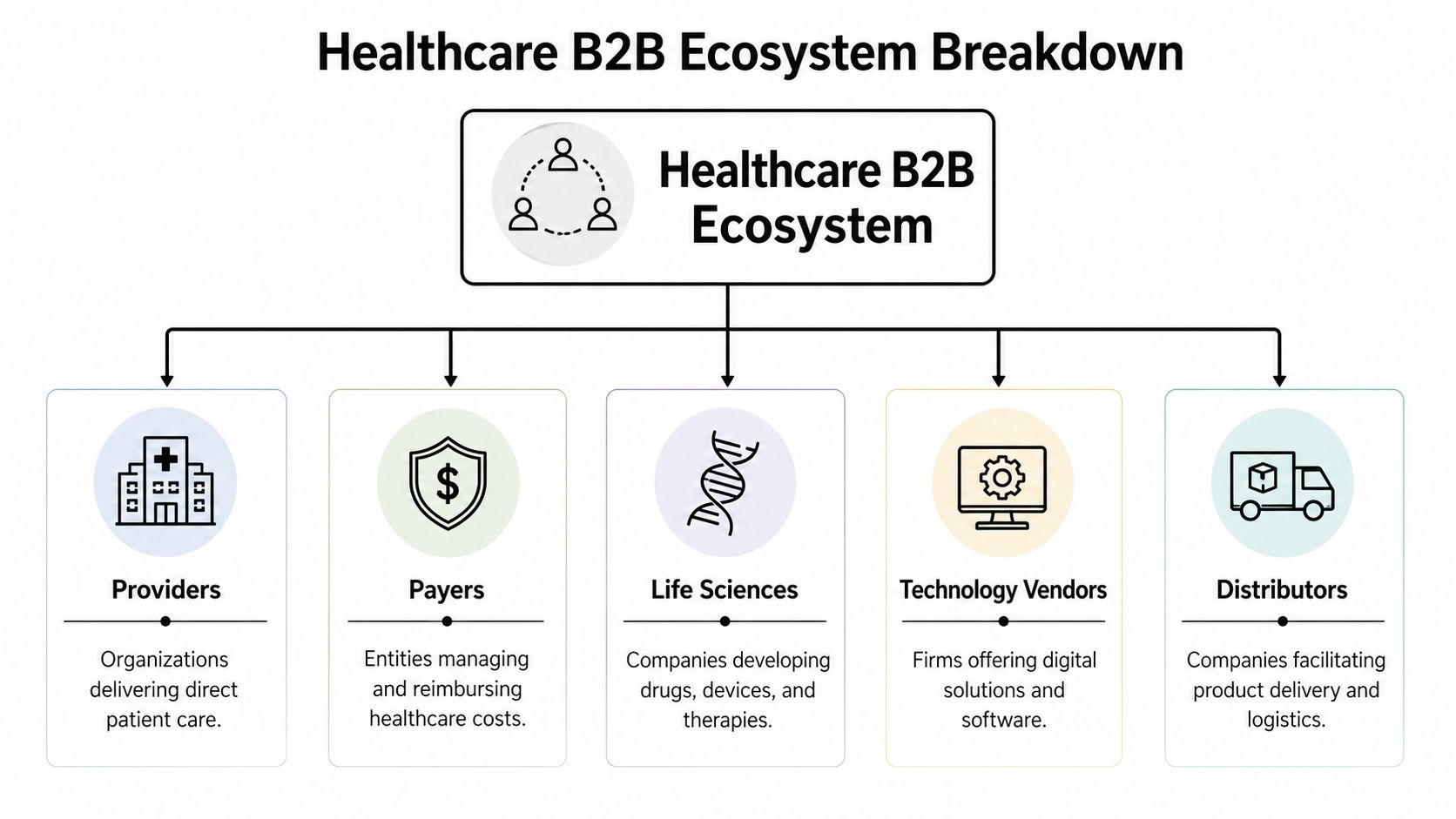
The healthcare market isn’t one market. It’s several overlapping ones with different incentives, buying paths, and internal politics. If your messaging treats them as one audience, your campaign usually gets ignored for the simple reason that your buyer doesn’t see their world reflected in it.
In the U.S., healthcare and pharmaceutical digital advertising spending reached $24.77 billion in 2025, up 13.3% year over year, with digital channels accounting for over 72% of total ad budgets, according to Taylor Scher SEO’s healthcare marketing statistics roundup. That tells you where attention is going. It does not mean every healthcare segment behaves the same once you earn that attention.
Providers and what they actually buy for
Providers include hospitals, health systems, ambulatory groups, specialty clinics, and physician organizations. They usually buy against a mix of clinical, operational, financial, and technical criteria.
A hospital administrator may care about throughput, staffing pressure, and margin protection. A department head may focus on workflow friction and adoption burden. A CIO may care less about your front-end features than whether your team can handle integration, access controls, and implementation support without disrupting existing systems.
For provider marketing, broad claims usually fail. You need proof that you understand the environment where your product will live.
A simple way to keep this straight is to separate provider messaging into three questions:
| Buyer lens | What they ask first | What your marketing should answer |
|---|---|---|
| Clinical | Will this help care delivery or reduce friction? | Show workflow fit and evidence-based reasoning |
| Operational | How hard is this to implement? | Show rollout path, training burden, and ownership |
| Executive | Why should we prioritize this now? | Show strategic relevance and business case |
If your internal team still mixes up market definitions, this short explainer on market vs industry is useful because healthcare planning often goes wrong at that basic framing step.
Payers and enterprise health IT
Payers buy with a different logic. They tend to care about administrative efficiency, data accuracy, reporting, member experience, fraud reduction, and cost control. They still care about compliance, but their purchase process can be less clinically centered and more process centered.
Enterprise health IT buyers sit in another lane entirely. That group includes EHR-adjacent vendors, security teams, interoperability leaders, and digital transformation functions. Here, the bar for technical credibility is higher. Marketing has to answer integration questions earlier, because the buyer assumes that every vendor will promise ease and speed.
That creates a common mistake. Teams write one version of the story and try to reuse it across provider, payer, and health IT audiences. The result is vague positioning that sounds polished but says nothing concrete.
Buyers in healthcare don’t just ask whether your product works. They ask whether it fits their environment, risk posture, and internal approval process.
Compliance as a trust protocol
Compliance is often treated as the department that slows marketing down. That’s the wrong frame. In healthcare, compliance is part of the product you’re selling, even if you don’t sell compliance software.
If your outreach is careless, your forms are loose, your claims are unsupported, or your content sounds exaggerated, the buyer assumes the same sloppiness will show up in onboarding, data handling, and support. That’s why good healthcare marketing feels measured. It is measured.
A practical compliance posture for marketing includes:
-
Approved claims language. Keep a shared library of what sales and marketing can say.
-
Role-based content review. Product, legal, and clinical reviewers should not all review everything. They should review what matches their expertise.
-
Clean data discipline. Segment by professional role, account fit, and intent signals. Don’t build campaigns that depend on sensitive personal data.
-
Documentation. Keep records of messaging versions, approvals, and content sources.
That discipline doesn’t make your marketing weaker. It makes your campaign safer to scale.
Building Your Precision Targeting and Messaging Framework
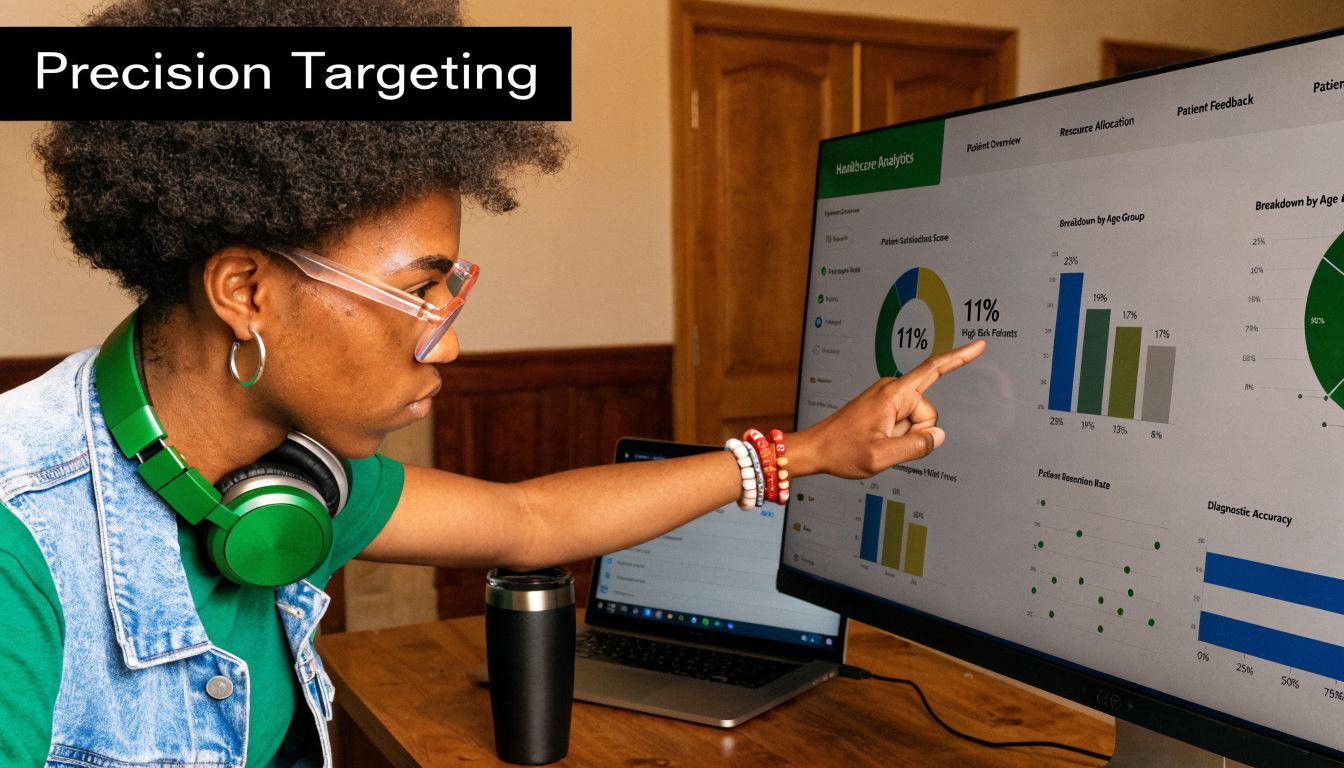
The biggest execution gap in healthcare marketing is usually not channel choice. It’s message design. Teams know there are multiple stakeholders, but they still write one blended value proposition and hope everyone sees their own priority inside it.
Research summarized by LuxSci points to the core problem. Finance prioritizes commercial logic, operations focuses on implementation burden, and IT examines data management, yet most campaigns still use one-size-fits-all outreach, as noted in LuxSci’s healthcare B2B marketing analysis.
Start with the account map
Don’t build your first sequence around the company. Build it around the decision unit inside the company.
For most healthcare deals, that means identifying at least these roles:
-
Economic buyer. Often finance, senior operations, or executive leadership.
-
Technical evaluator. CIO, IT director, security, interoperability lead.
-
Operational owner. Department manager, operations lead, implementation stakeholder.
-
Clinical influencer. Clinical director, physician champion, nursing leader.
-
Compliance or privacy reviewer. In some deals this appears late, in others early.
Your first task is not writing copy. It’s deciding who should hear which argument first.
Build one product story with multiple entry points
You do not need five different brand positions. You need one core product story translated into stakeholder-specific language.
Here’s a practical message map:
| Role | What they care about | What to emphasize | What to avoid |
|---|---|---|---|
| Clinical director | Adoption, workflow fit, outcomes relevance | Reduced friction, staff usability, practical evidence | Heavy ROI language as the opener |
| CIO or IT lead | Integration, data handling, system fit | Architecture clarity, security posture, implementation process | Vague claims like “seamless” with no support |
| CFO or finance lead | Cost logic, payback confidence, risk | Business case, operational efficiency, contract clarity | Feature-heavy detail without commercial framing |
| Operations leader | Rollout burden, staffing impact, ownership | Onboarding plan, support model, process changes | Abstract strategy talk with no execution detail |
A useful planning resource if you need to formalize this work is how to create buyer personas for better outreach. In healthcare, the key is to keep personas tied to buying behavior, not just demographics or job titles.
How to write cold outreach that doesn’t collapse into generic copy
Cold outreach in healthcare should sound narrower, calmer, and more informed than standard SaaS outreach. Your message has to earn the right to continue.
Use this sequence logic:
-
Lead with a credible problem frame. Name an operational issue, implementation concern, or market shift the role already recognizes.
-
Connect your solution without overselling it. Show fit. Don’t rush to claim transformation.
-
Reference proof carefully. Use approved evidence, product facts, or category-specific experience.
-
Offer a low-friction next step. Short call, feedback request, or content asset relevant to that stakeholder.
Here’s the trade-off. If you make the copy too soft, it reads like thought leadership with no reason to reply. If you make it too direct, it sounds like every other outbound email in their inbox. The middle ground is context plus specificity.
The best healthcare cold emails don’t try to close the deal. They prove that the sender understands the job the recipient is trying to do.
Validate priorities before launch
This step is often skipped because there’s a rush to send. Don’t.
Before launching a sequence, check public signals that tell you which role is likely to care first. Review leadership pages, current initiatives, job posts, tech stack clues, expansion plans, service line priorities, compliance announcements, and integration partners. Even a short pre-campaign review can tell you whether the first hook should be financial, technical, or operational.
That work is slow compared with uploading a giant list and blasting a sequence. It also produces better conversations.
Executing Your Omnichannel Healthcare Marketing Strategy
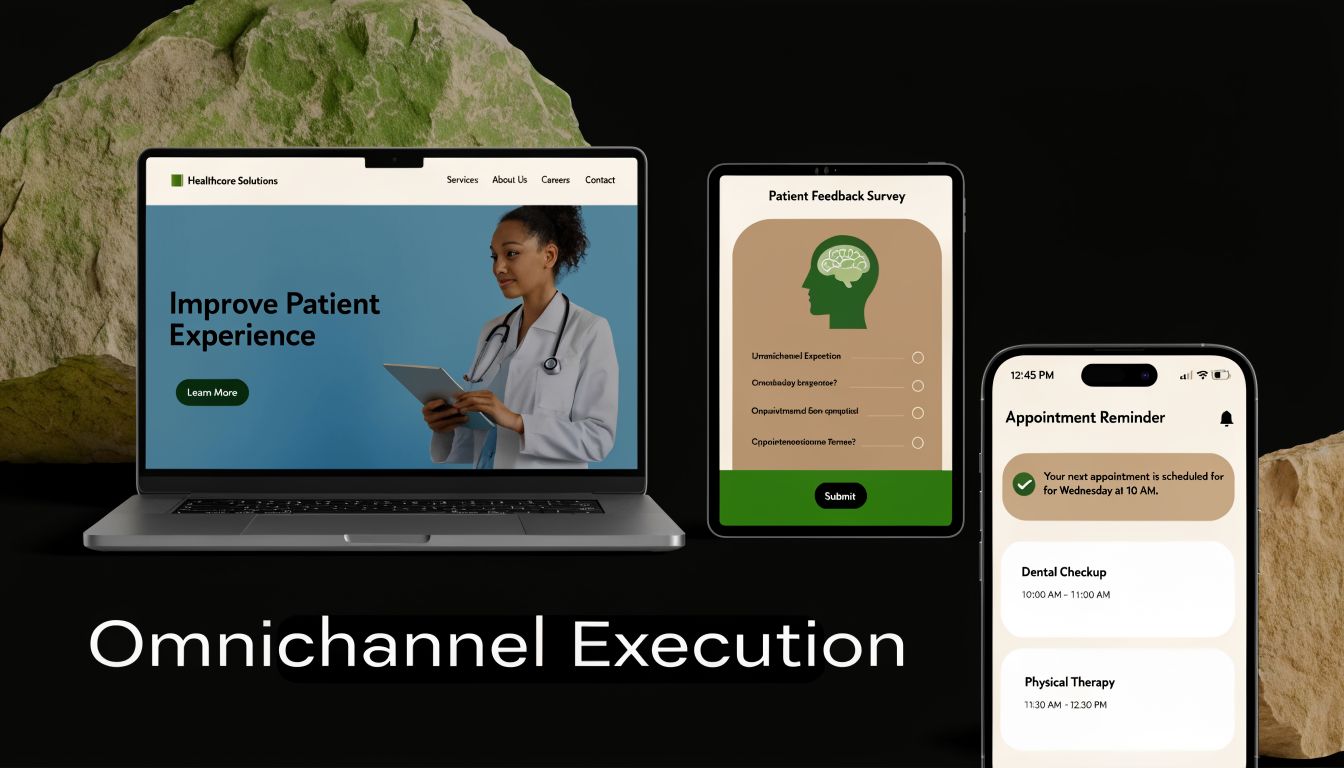
Once targeting and messaging are solid, channel choice becomes much easier. The mistake here is assuming omnichannel means being active everywhere. It doesn’t. It means each channel has a job, and each touchpoint moves the account one step closer to a sales conversation.
Healthcare buying is often invisible early. 61% of buyers use industry websites and 60% use vendor websites before contacting sales, according to Health Launchpad’s healthcare buying playbook. That should change how you think about outbound. Cold email isn’t interrupting a blank slate. It’s often reaching someone already researching the problem privately.
Cold email works when it acts like a bridge
Healthcare cold email performs best when it connects independent research to a next conversation. That means the message should feel like a continuation of what the buyer is already trying to understand.
A strong healthcare cold email usually includes:
-
A role-specific subject line. Short, direct, and tied to the buyer’s responsibility.
-
A first line with situational relevance. Reference a challenge common to their environment, not a generic personalization token.
-
A low-ego body. Focus on the problem and fit. Keep adjectives under control.
-
A useful asset or reason to engage. Webinar invite, implementation brief, category guide, or short perspective specific to the role.
-
A respectful CTA. Ask for a quick reaction, not an immediate deep demo.
What doesn’t work:
-
Leading with hype.
-
Writing one sequence for all stakeholders.
-
Asking a clinician for a thirty-minute meeting in the first email.
-
Using marketing language that sounds detached from care delivery or operational reality.
Content has to carry part of the sales burden
In healthcare, content isn’t a brand side project. It reduces the burden on outbound and sales by answering objections before a call happens.
The strongest asset mix usually includes:
| Asset type | Best use | Best audience |
|---|---|---|
| Executive brief | Commercial framing | CFO, COO, executive sponsor |
| Implementation guide | Operational reassurance | IT, operations, project owner |
| Webinar | Education and soft conversion | Mixed stakeholder groups |
| Case-oriented narrative | Trust and proof | Clinical and executive audiences |
| Comparison page | Mid-funnel evaluation | Buyer committee during active review |
If you want a broader perspective on audience-centered healthcare messaging, this patient-centric growth guide is useful because it reinforces the importance of relevance and clarity even when the audience is institutional rather than consumer.
A smart supporting motion is to connect content with inbound capture. A focused inbound lead generation approach is helpful, especially when your outbound campaigns are driving prospects back to high-intent pages and gated assets.
Use webinars and digital events with more discipline
Many healthcare teams run webinars that are too broad, too promotional, or too disconnected from pipeline goals. A webinar should be built like a meeting-generation asset, not a vanity event.
Good webinar topics in healthcare are narrow and practical. Think implementation lessons, workflow challenges, privacy considerations, or role-specific market shifts. The goal is to attract people with active interest, not casual registrants.
Here’s a useful reference point before you plan your next event:
After the event, the follow-up matters more than the registration list. Split your attendees by role and by engagement level. Someone who registered and never joined should not receive the same sequence as someone who stayed for most of the session and clicked into a related resource.
Your channels should not compete with each other. Email should point to content. Content should support sales. Webinars should create role-based follow-up paths.
That is what operational omnichannel execution looks like in healthcare. Fewer disconnected tactics. More deliberate movement from touchpoint to touchpoint.
Designing and Measuring High-Impact B2B Campaigns
A campaign in healthcare should be designed backward from the meeting you want sales to have. Not just any meeting. A qualified one with the right role, account fit, and context attached.
That means campaign planning has to do two jobs at once. It has to create demand, and it has to screen for seriousness. This matters in long sales cycles because you need evidence that your marketing is building a real pipeline before deals close.
Content marketing is the most effective channel for qualified lead generation in B2B healthcare, cited by 71% of marketers, and one HealthTech company achieved a 177% increase in webinar attendance by concentrating 80% of its promotion on titles and messaging, according to Active Marketing’s healthcare trend analysis.

Campaign example one for a healthtech SaaS platform
Say you market a care operations platform to multi-site hospital groups.
The campaign should not start with “book a demo.” It should start with the friction your buyer already feels. Operations leaders may care about adoption burden. IT may care about system fit. Finance may care about whether this solves a priority worth funding.
A practical structure looks like this:
-
Primary audience. COO, VP operations, IT leadership, service line director
-
Core message. Operational improvement with controlled implementation risk
-
Channel mix. Cold email, role-specific landing pages, webinar, sales follow-up
-
Offer. Short implementation brief or workflow assessment
-
Sales handoff standard. Meeting only counts if the contact matches role criteria and confirms an active problem
The strength of this campaign comes from consistency. Your email opens the problem. The landing page deepens it. The webinar proves you understand the work required. Sales picks up the conversation without resetting the context.
Campaign example two for a medical device aimed at specialty clinics
This motion is different. Specialty clinic campaigns usually need tighter segmentation and more evidence-focused positioning.
Try this structure:
| Component | Clinic campaign execution |
|---|---|
| Target account set | Specialty groups with clear service-line fit |
| Message angle | Workflow efficiency, staff usability, operational fit |
| Proof vehicle | Evidence-backed product materials and peer-relevant examples |
| Conversion path | Consultation request or product discussion with defined use case |
| Follow-up logic | Clinical path for adopters, admin path for decision support |
In this kind of campaign, content still matters, but the sequencing often needs more direct coordination with sales because specialist buyers can move from curiosity to evaluation quickly if the fit is obvious.
What to measure in a long cycle
Healthcare marketers lose credibility when they overreport shallow metrics. Opens, clicks, and registrations matter, but only as directional signals. Your reporting should center on whether marketing is producing qualified conversations and helping pipeline advance.
The metrics that deserve management attention include:
-
MQL quality. Did the lead fit the role and account criteria you defined?
-
SQL progression. Did sales validate need, fit, and next-step potential?
-
Pipeline velocity. Are qualified accounts moving or stalling?
-
Cost per qualified meeting. How much effort and spend are required to create real sales conversations?
-
Sales feedback quality. Are reps getting meetings with decision-makers or with peripheral contacts?
If you need a cleaner scorecard, this guide to lead generation KPIs for 2026 is a useful framework for deciding what belongs on the dashboard and what doesn’t.
One operational point matters more than teams admit. Your qualification criteria should be agreed before launch. If marketing counts every booked call as a win but sales only values meetings with budget and active need, you will spend months arguing over results instead of improving them.
Scaling Lead Generation with Performance-Based Outreach
Scaling healthcare lead generation in-house sounds straightforward until you list the work involved. Account research, role mapping, copy development, compliance review, list building, inbox management, deliverability monitoring, meeting qualification, CRM hygiene, and campaign iteration all have to run together. If one part breaks, performance drops fast.
This is why many internal teams hit a ceiling. They don’t lack strategy. They lack operational bandwidth and specialized execution.
Data-driven segmentation matters even more at scale. Sales teams using AI-powered lead targeting and buyer intent signals are 43% more likely to connect with high-fit medical prospects, according to Martal’s B2B healthcare marketing overview. The practical lesson isn’t that AI magically fixes outreach. It’s that precision beats volume when the market is regulated, committee-driven, and selective.
Why healthcare outreach gets harder as volume increases
At small volume, a strong internal marketer can manually review accounts, adjust copy, and preserve quality. As volume grows, quality tends to slip in predictable ways:
-
Targeting drifts. Lists get broader because the team needs more names.
-
Messaging flattens. Copy gets reused across roles and segments.
-
Compliance review becomes reactive. People approve after launch instead of before.
-
Sales loses trust. Meetings get booked, but not with the right stakeholders.
That’s the hidden cost of scaling without a system. You don’t just waste spend. You damage confidence between marketing and sales.
Why a pay-per-meeting model fits healthcare better than a generic retainer
In healthcare, the cost of bad pipeline is high. You can lose months chasing the wrong accounts or talking to people who can’t influence the purchase. A performance-based model changes the commercial structure around that risk.
The logic is simple:
| Model | Main risk for client | Incentive alignment |
|---|---|---|
| Traditional retainer | You pay whether meetings are qualified or not | Activity-focused |
| Performance-based outreach | You pay for agreed qualified meetings | Outcome-focused |
That structure matters because healthcare outreach requires patience and precision. You want the partner optimizing for account fit, stakeholder quality, and handoff readiness, not just send volume.
A deeper look at pay for performance marketing and agency alignment with real revenue explains why this model works especially well when the sales cycle is long and qualification standards need to stay high.
What to demand from any outreach partner
If you do outsource, don’t buy generic outbound dressed up with healthcare language. Ask direct questions.
-
How do you segment by stakeholder role?
-
How do you validate list quality before launch?
-
What claims or proof points are allowed in copy?
-
How do you qualify a meeting before it reaches sales?
-
How do marketing and SDR feedback loops work week to week?
If an agency can’t explain its qualification standard in concrete terms, it will eventually optimize for booked calendars instead of pipeline quality.
The right model should give you more than activity. It should give you control, visibility, and reduced downside while preserving room to scale.
Your Blueprint for Sustainable Growth in Healthcare
Strong b2b marketing in healthcare industry doesn’t come from one channel, one campaign, or one quarter of better execution. It comes from building a system that respects how healthcare organizations evaluate risk, gather internal support, and make buying decisions slowly.
That system has four working parts.
First, you need a clear view of the ecosystem. Provider, payer, and health IT audiences don’t buy for the same reasons. If you collapse them into a single ICP, your messaging loses force before the campaign even launches.
Second, you need role-specific targeting. Healthcare deals are won inside committees, not with abstract personas. If your outreach doesn’t speak differently to finance, operations, IT, and clinical stakeholders, you’ll create interest without direction.
Third, you need channels that work together. Cold email should open the conversation. Content should reduce uncertainty. Webinars should create warm paths to sales. Sales should continue the same narrative instead of restarting it.
Fourth, you need reporting that tells the truth. Qualified meetings, stakeholder quality, pipeline progression, and handoff standards matter more than vanity engagement numbers. If your dashboard hides weak qualification, the pipeline problem doesn’t disappear. It just surfaces later.
There’s also a mindset shift that matters. Healthcare growth doesn’t reward the most aggressive marketer. It rewards the most credible operator. The teams that win are the ones that can communicate clearly, prove relevance, support claims, and stay disciplined through long buying cycles.
If you’re refining your own operating model, this resource on scaling lead generation strategies is a useful companion because it highlights the process side of sustainable growth rather than just the promotion side.
You don’t need a louder go-to-market motion. You need one that is more aligned. Better segmentation. Better proof. Better handoffs. Better campaign control. Once those pieces are in place, healthcare stops feeling unpredictable. It starts feeling structured.
If you want a lead generation partner built for accountability, Fypion Marketing offers a performance-driven model focused on qualified booked meetings instead of upfront retainers. That makes it a practical option for healthcare and B2B teams that want tighter alignment between outreach effort and real sales outcomes.