
Hiring a Cold Email Marketing Agency That Delivers
A cold email marketing agency is a team of specialists who design and run targeted outreach campaigns to land you qualified sales leads. They do a lot more than just send emails. Their real job is to build a predictable pipeline of meetings with your ideal customers, handling everything from the nitty-gritty research and list building to the copywriting and campaign management.
What Does a Cold Email Marketing Agency Actually Do
Think of it this way: you could walk into a packed stadium, grab a megaphone, and shout about your product, hoping the right person hears you. Or, you could hire a team of expert scouts who know exactly who to approach, what to say, and how to get their full attention. A cold email agency is that expert team.
Their main job is to systematically generate qualified sales conversations. This frees up your own sales team to do what they do best: actually closing deals. They aren’t just sending emails; they’re building a custom-fit growth engine for your business.
To give you a quick overview, here’s what an agency brings to the table.
Cold Email Marketing Agency at a Glance
| Core Service | Key Benefit | Ideal For |
|---|---|---|
| End-to-end campaign management | Creates a predictable pipeline of sales meetings | B2B companies with a proven product |
| Technical setup & deliverability | Protects your brand and ensures emails hit the inbox | Businesses wanting to scale without technical headaches |
| Expert copywriting & list building | Engages high-value prospects with relevant messaging | Teams that need to focus on closing, not prospecting |
This table sums it up, but the real value is in the structured process they follow to get you from zero to a calendar full of meetings.
From Strategy to Booked Meetings
A professional agency never just “blasts” emails. Instead, they use a structured, multi-stage process that’s built from the ground up to get consistent results. This methodical approach is what separates a strategic partner from an amateur just hitting “send.”
Here’s a breakdown of what a cold email marketing agency typically handles:
-
Market Research and Strategy: They start by digging deep into your business, your ideal customer profile (ICP), and what makes you unique. This initial discovery is crucial - it ensures every single step that follows is aimed at attracting the right kind of prospects.
-
List Building and Verification: Agencies use a mix of sophisticated tools and good old-fashioned manual research to build super-targeted contact lists. These aren’t generic lists you can buy online; they’re lists of real people who fit your ICP, which is critical for getting replies. They also verify every email to keep deliverability high.
-
Technical Infrastructure Setup: To keep your messages out of spam folders and protect your main domain’s reputation, they build a secure technical foundation. This means setting up and “warming up” new domains and email accounts so your outreach actually lands in the inbox.
-
Compelling Copywriting: Getting replies is both an art and a science. The agency’s writers create personalized, multi-step email sequences that speak directly to a prospect’s problems. The goal is to offer real value, not just pitch a product.
In essence, a cold email agency takes the entire top-of-funnel prospecting process off your plate. They aren’t just another vendor; they become a true extension of your sales team, with the specific task of keeping your calendar filled with valuable appointments.
The Engine of Predictable Growth
By taking over these complex and time-consuming tasks, a cold email agency gives you more than just outreach - they deliver a predictable system for generating leads. For B2B companies, especially in SaaS or tech with a solid product, this is an incredibly powerful way to scale up.
Instead of waiting around for inconsistent inbound leads, you get a proactive channel that goes out and finds your next customers. You can learn more about how Fypion puts this into practice with our comprehensive cold email management process. At the end of the day, the goal is simple: to turn cold outreach from a guessing game into a reliable source of revenue.
What a Cold Email Agency Actually Does, Step-by-Step
A great cold email marketing agency does a lot more than just blast out messages. They build the entire engine, from strategy all the way to getting qualified meetings on your calendar. It’s a structured process that turns complete strangers into warm conversations.
Let’s walk through exactly how it works.
This isn’t just random outreach; it’s a well-oiled machine designed to turn research into actual sales opportunities for your team.
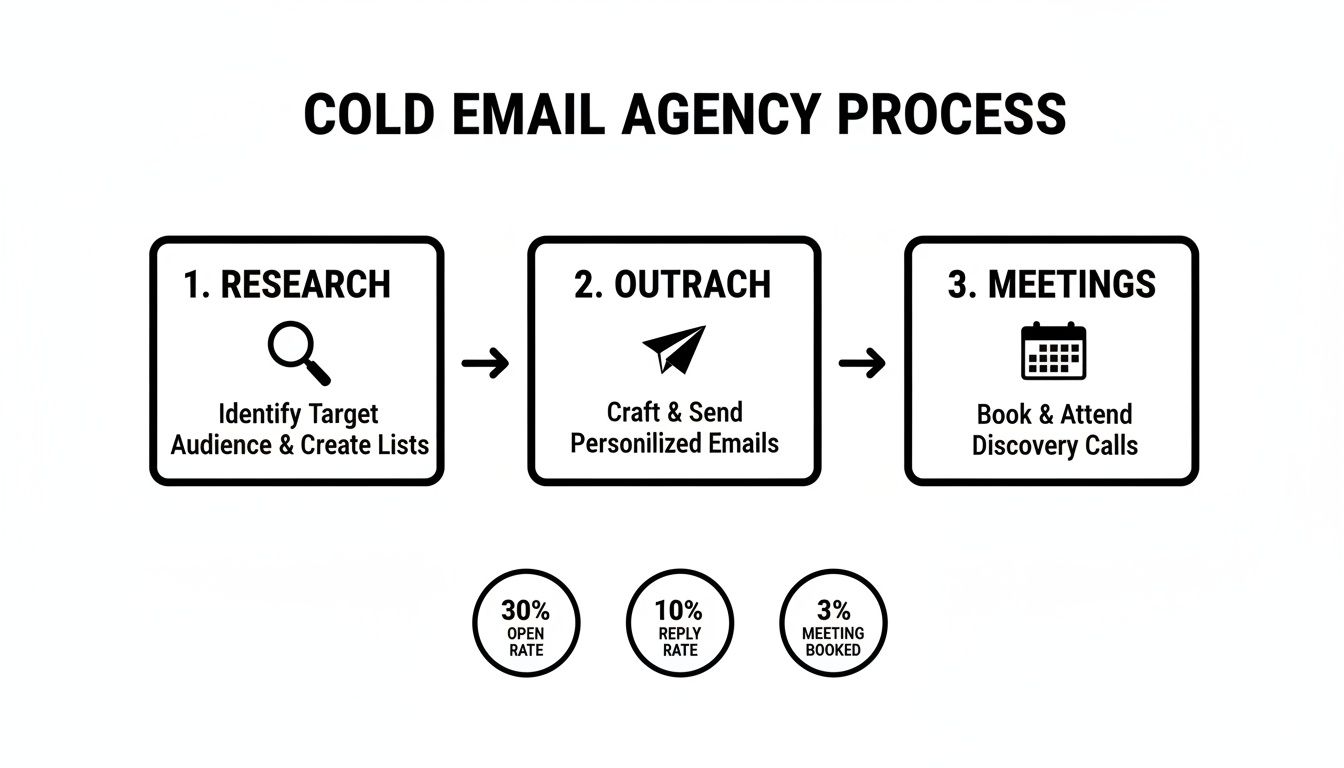
As you can see, everything starts with deep research. That insight fuels the targeted outreach, which in turn leads directly to the end goal: booked meetings.
Step 1: Strategy and Deep Dive
The whole thing falls apart without a solid foundation. That’s why the first step is always getting a deep understanding of your business. This is more than a quick kickoff call; it’s about the agency digging into your Ideal Customer Profile (ICP), what makes your offer unique, and where you fit in the market.
We need to answer a few critical questions right away:
-
Who is the exact person we need to be talking to?
-
What’s the one big problem they have that we can solve?
-
How do we talk about our solution so it doesn’t sound like everyone else?
Getting this clarity upfront means every other step is focused on attracting high-value prospects, not just filling the calendar with anyone who will talk to you.
Step 2: Building the Technical Foundation
Before a single email goes out, we have to build the plumbing. This is a non-negotiable step that protects your main company domain and makes sure your emails actually land in the inbox, not the spam folder.
This means setting up brand new domains and email inboxes just for outreach. We then “warm up” these accounts by sending a small number of emails and slowly increasing the volume over a few weeks. It’s all about mimicking real human behavior to build trust with providers like Google and Microsoft. We have a full guide covering the step-by-step instructions for technical setup for cold emailing if you want to see the nitty-gritty details.
Step 3: Hyper-Targeted List Building
With the strategy and tech ready, it’s time to build the contact list. This isn’t about buying some generic, outdated list of 10,000 names. It’s a painstaking process of finding individuals who are a perfect match for your ICP. We use a combination of advanced tools and manual digging to find and verify their contact info.
The success of any campaign comes down to the quality of the list. Knowing how to generate B2B leads that convert is the difference between an effective outreach strategy and just making noise.
Every single email address is then run through verification tools. This keeps our bounce rate low, which is absolutely critical for keeping our sender reputation high.
Step 4: Writing Email Sequences That Get Replies
Now for the creative part. Our copywriters get to work crafting personalized, multi-step email sequences. The goal isn’t to sell in the first email; it’s to start a conversation.
The real magic is often in the follow-ups. These are not just “bumping this up” emails. Each one offers a new angle, a bit of social proof, or a different way of looking at the problem.
And in a market that’s ballooned to $13.2 billion and is expected to hit $36.3 billion by 2033, you have to be smart. AI helps with the heavy lifting - handling up to 80% of research tasks - so we can focus on crafting messages for smaller, hyper-targeted lists. A micro-list of under 50 contacts can see a 5.8% reply rate, while mass sends barely crack 2.1%.
Step 5: Campaign Management and Optimization
Once a campaign is live, it’s not set-it-and-forget-it. We’re actively managing everything. That means watching key metrics like open and reply rates, and most importantly, monitoring deliverability to make sure we’re staying in the inbox.
Our team also handles all the positive replies. When someone shows interest, we jump on it, answer their questions, and get a meeting booked on your sales team’s calendar.
Finally, the process is always evolving. We constantly A/B test subject lines, the email copy, and the call-to-action to see what’s working best. This data-driven approach is how a campaign goes from good to great, turning into a predictable growth engine for your business.
Understanding Agency Pricing: Retainers vs. Pay-Per-Meeting
So, you’re ready to bring in a cold email agency. One of the first things you’ll talk about is money. How you pay an agency isn’t just a line item on your budget; it shapes the entire relationship, dictating your risk and what the agency actually cares about.
The two main ways this works are the old-school monthly retainer and the newer pay-per-meeting model. Figuring out which one is right for you is crucial. You need a partner whose financial interests are locked in with your own.
The Traditional Retainer Model
The most common setup you’ll find is the monthly retainer. You pay the agency a flat fee every month, which can be anywhere from $2,000 to $10,000+. This payment covers all their work: the strategy, the list building, the writing, and running the campaigns.
The big plus here is predictable costs. You know exactly what you’re spending each month, which makes your finance department happy. The agency dedicates a certain amount of their time to you, so you get consistent effort.
But here’s the catch: you’re paying for their time, not necessarily for results. Whether they book one meeting or twenty, that monthly check is still due. This can create a massive gap between what you’re paying for (effort) and what you actually want (sales meetings).
The Pay-Per-Meeting Performance Model
The alternative that’s really gaining traction is the pay-per-meeting (or pay-for-performance) model. It’s simple: you only pay for qualified sales meetings that land on your calendar. No big upfront retainer, just a set price for each appointment that meets your criteria.
This model completely flips the script on the client-agency relationship.
-
You Have Less Risk: If the agency doesn’t get you meetings, you don’t pay. It’s that straightforward. All the pressure to perform is on them, not your wallet.
-
Everyone Wants the Same Thing: The agency only makes money when you do. Their revenue is directly tied to filling your sales pipeline, so their goals are perfectly aligned with yours from day one.
-
Quality Over Quantity: They only get paid for qualified meetings. This means they’re laser-focused on finding prospects who are a genuine fit, not just booking calls with anyone who has a pulse.
The secret sauce to making the pay-per-meeting model work is how you define a “qualified meeting.” Before a single email goes out, you and the agency have to agree on the exact criteria - like company size, industry, or the person’s job title - that makes a meeting a payable success.
This performance-based approach is a game-changer for B2B companies trying to scale sales without a huge upfront gamble. It makes sure every dollar you spend on your cold email marketing agency turns into a real sales opportunity. If you want to dive deeper into how this aligns agency incentives with actual revenue, check out our pay-for-performance marketing in our detailed guide.
Ultimately, the choice between a retainer and pay-per-meeting comes down to what you value most. A retainer gives you a predictable budget. A performance model gives you lower risk and an agency that’s just as hungry for results as you are. For businesses focused on growth, it’s an incredibly powerful option.
Setting Realistic Expectations for Your Campaign
Let’s get one thing straight: cold email isn’t a magic wand. Anyone promising you a flood of meetings overnight is selling you a fantasy. Real success is built over time through careful testing, data analysis, and steady refinement.
A good cold email marketing agency will be upfront about the timeline. The first two to four weeks aren’t for sending emails - they’re for laying the foundation. This is where we handle strategy, build hyper-targeted lead lists, and take care of the crucial technical setup.
That includes warming up new domains. It’s a non-negotiable step to make sure your emails actually land in the inbox, not get flagged as spam. This setup period is what makes a predictable pipeline possible down the road.
Once the campaigns go live, don’t sit there hitting refresh on your inbox. The initial sends are all about gathering data. We need to see what works and what doesn’t before we can start optimizing for performance.
The Metrics That Truly Matter
It’s easy to get distracted by vanity metrics. A huge open rate means nothing if nobody replies. A top-tier agency ignores the fluff and zeroes in on the key performance indicators (KPIs) that actually lead to sales opportunities.
These are the numbers that tell us if a campaign is healthy or needs a tune-up:
-
Deliverability Rate: What percentage of your emails hit the inbox? We aim for 98% or higher. Anything less tells us there’s an issue with the list or the technical setup.
-
Bounce Rate: This is the opposite - the emails that failed to deliver. You need to keep this under 2-3% to protect your sender reputation. High bounce rates are a major red flag.
-
Open Rate: While not the end goal, a good open rate confirms your subject lines are grabbing attention and you’re avoiding spam filters. For a targeted B2B campaign, a healthy range is 40% to 60%.
These are your campaign’s vital signs. But the real proof is in the conversations you start.
From Replies to Revenue
The entire point of cold email is to get a response. That’s it. The reply rate is the single most important metric because it shows how well your message is actually connecting with people.
To give you an idea of what’s possible, let’s look at some benchmarks.
Cold Email Performance Benchmarks 2026
The table below shows what you can typically expect versus what’s achievable with a highly refined, personalized approach. The gap between “average” and “top-performing” is where a skilled agency makes all the difference.
| Metric | Industry Average | Top-Performing Campaigns |
|---|---|---|
| Deliverability Rate | 90-95% | 98%+ |
| Open Rate | 20-30% | 40-60%+ |
| Reply Rate | 1-3% | 5-15%+ |
| Positive Reply Rate | 0.5-1% | 2-5%+ |
| Meetings Booked Rate | 0.2-0.8% | 1-3%+ |
As you can see, the numbers for highly personalized campaigns are in a different league. Average reply rates might hover between 1% and 8.5%, but finely-tuned campaigns can hit 15% or even higher in the right niche. That massive jump comes from a few key things: intense personalization can boost replies by 32%, and solid follow-ups often account for around 42% of all responses.
A positive reply is the first step toward a sale. The goal of a cold email marketing agency is to maximize these positive interactions, turning initial interest into qualified meetings for your sales team.
It’s also important to remember that not every reply is a “yes.” You’ll get “not right nows,” “check back in six months,” and plenty of unsubscribe requests. A professional agency manages all of it, nurturing the warm leads while respectfully handling the rest to keep your brand’s reputation intact.
For a deeper dive into what to expect, check out our guide to the average cold email response rate. By focusing on reply rates and the quality of meetings booked, you get a clear picture of your true return on investment.
How to Vet and Choose the Right Agency Partner

Picking a cold email marketing agency can feel like a roll of the dice. Get it right, and you’ve built a predictable growth engine for your business. Get it wrong, and you’re left with a burned budget, a damaged brand reputation, and a pipeline full of leads who have no idea who you are.
The trick isn’t falling for the flashiest website or the smoothest sales pitch. It’s about knowing exactly what to ask and which answers separate a strategic partner from a low-quality lead mill. You need a solid framework to cut through the noise.
Key Questions to Ask Any Potential Agency
Before you even think about signing a contract, you need to put any potential agency on the spot. Their answers to these questions will tell you everything you need to know about their process, expertise, and whether they’re the real deal.
1. Where do you get your contact data? This is the single most important question you can ask. A top-tier agency builds its lists from scratch, digging into data sources and doing manual research based on your Ideal Customer Profile (ICP). If you hear the words “we buy lists,” it’s a giant red flag. Run.
2. How do you ensure email deliverability? A pro will immediately dive into their technical setup. They should be able to explain, in plain English, how they set up and warm up new domains and inboxes. This process is what protects your brand and ensures your messages actually land in the primary inbox, not the spam folder.
3. Can I see examples of your email copy? Ask to see anonymized examples from past campaigns. Are they personalized? Do they have a clear point? Do they sound like a real person wrote them? If the copy feels generic, stuffed with buzzwords, or overly “salesy,” it’s not going to work.
4. What’s your process for A/B testing and optimization? Great agencies don’t just “set it and forget it.” They should have a clear, disciplined process for testing everything - subject lines, email body, calls-to-action - to constantly dial in performance. Ask them what specific metrics they use to make those adjustments.
Great cold email campaigns don’t just happen; they’re the result of a disciplined process. Effective agencies understand that strategic hooks - like promotional offers (46.2% engagement driver) and intriguing subjects (42.6%) - are key to achieving open rates of 40% to 60%, crushing the general email marketing average of 26.76%. With 38% of consumers preferring email for marketing, picking a partner who masters these details is essential for success. You can explore more about these impactful cold email statistics and benchmarks to see what’s possible.
Major Red Flags to Watch Out For
Just as important as asking the right questions is knowing the warning signs. If you see any of these, it’s a strong signal to walk away.
-
Guaranteed Results: No one can guarantee a specific number of meetings or a fixed ROI. There are just too many variables in cold email. A realistic partner will talk about benchmarks and expected ranges, not make ironclad promises they can’t keep.
-
A “Secret Sauce” They Can’t Explain: If an agency is cagey about its process, it’s usually because they don’t have one or they’re using shady tactics. Real experts are proud of their strategy and are happy to walk you through it.
-
Reliance on Purchased Lists: We can’t say this enough. Using pre-packaged lists is a recipe for high bounce rates, a ruined sender reputation, and leads that go nowhere.
-
Lack of Reporting Transparency: You should get clear, regular reports on the metrics that matter: deliverability, open rates, reply rates, and positive replies. If an agency is vague with its reporting, it’s probably because the results aren’t good.
Beyond that, make sure any agency you consider understands the legality of web scraping practices to keep your business clear of any data compliance headaches.
Choosing an agency is a big decision, and it’s helpful to see how it fits into your wider sales strategy. If you want to zoom out, check out our guide to a top B2B lead generation agency for the bigger picture. By being thorough, you can confidently find a partner that will actually help you grow.
Clearing Up the Common Questions About Cold Email Agencies
Even with all the details laid out, you probably still have a few lingering questions. Deciding to bring on a cold email marketing agency is a big move, and it’s smart to want a straight answer on a few key points before you jump in.
Let’s cut through the noise and tackle the most common concerns we hear from businesses. We’ll cover effectiveness, cost, and timelines with no fluff, so you can make your decision with confidence.
Is Cold Email Still Effective in 2026?
Yes, absolutely. But let’s be clear: it’s a completely different game than it was a few years ago. The old “spray and pray” tactic of blasting thousands of generic emails is officially dead. Today, winning with cold email is all about precision and delivering real value.
Modern cold email is a highly focused B2B channel. The best agencies have thrown out the mass-blasting playbook. Instead, we focus on hyper-targeted, deeply personalized messages. Think of it less like old-school marketing and more like an intelligence operation - finding the right person and delivering the right message at the perfect time.
The biggest proof that it works is the rise of pay-per-meeting agencies. These firms are so confident in their ability to get results that they’re willing to bet their own income on it.
Think about it for a second. An agency that only gets paid when they book a qualified meeting for you couldn’t survive if the channel was dead. By focusing on quality over quantity, top agencies see impressive open rates of 40-60% and reply rates that blow older, untargeted methods out of the water.
How Much Does a Cold Email Marketing Agency Cost?
Agency costs generally fall into two categories, and each has its own set of pros and cons.
-
Monthly Retainer: This is the classic model. You pay a set fee every month, typically anywhere from $2,000 to $10,000+. It gives you a predictable budget, but the fee isn’t directly tied to the number of meetings you get.
-
Pay-Per-Meeting: This is the newer, performance-first approach. You have little to no upfront cost. You only pay an agreed-upon fee for each qualified sales meeting the agency puts on your calendar.
The pay-per-meeting model drastically lowers your financial risk. It also guarantees the agency is 100% invested in your success. Their bottom line is tied directly to yours, which creates a powerful partnership focused on one thing: generating real sales opportunities.
Agency vs. In-House Team or Freelancer
Choosing the right path - agency, in-house, or freelancer - really comes down to your resources, goals, and how fast you want to move. An in-house team gives you the most control, but it also means dealing with hefty salaries, benefits, and pricey software subscriptions. You’re also on the hook for a massive learning curve in a very specialized field.
A freelancer might seem like a more budget-friendly choice, but they often don’t have the robust systems, proven processes, or ability to scale that an agency brings. You’re relying on one person, which can create bottlenecks and limit how much you can actually do.
A specialized cold email marketing agency is a turnkey solution. You instantly get access to:
-
An entire team of experts (strategists, copywriters, data specialists)
-
Established technical infrastructure built for maximum deliverability
-
A data-backed strategy that’s been tested and refined over hundreds of campaigns
This lets you tap into elite-level expertise and scale your lead generation fast, without all the overhead and slow ramp-up time of trying to build it from scratch.
How Quickly Can We Expect to See Results?
While cold email is much faster than long-term plays like SEO, it’s not an overnight fix. Any professional agency will follow a structured timeline to make sure your campaigns are successful for the long haul and, just as importantly, to protect your brand’s reputation.
The first 2 to 4 weeks are all about building a solid foundation. This means deep-dive strategy sessions, building out your initial prospect list, and - the most crucial part - the technical setup and warming of new email domains. That warming period is non-negotiable for hitting the inbox and staying out of spam folders.
After that initial setup, the campaigns go live. You can typically expect to see the first qualified meetings land on your calendar within 4 to 6 weeks from day one. A good agency will give you a clear timeline, manage your expectations, and show you how performance steadily climbs as they collect data and optimize the campaigns.
Ready to see how a performance-based approach can fill your sales pipeline without the upfront risk? Fypion Marketing specializes in just that. We handle the entire cold email process, and you only pay for the qualified meetings we book. Let’s start a conversation about your growth. Learn more at https://www.fypionmarketing.com.