
Lead Generation for Marketing Agency: 2026 Playbook
You’re probably in one of two situations right now.
Your agency does solid work for clients, but your own pipeline depends on referrals, founder networking, and random bursts of outreach when revenue feels tight. Or you’ve already tried outbound, bought data, sent sequences, maybe even got some opens, and still ended up with too few real conversations to trust the channel.
That gap usually isn’t a copy problem. It’s a system problem.
A lot of advice on lead generation for marketing agency growth is stuck in an older playbook. It treats cold email like a template game and lead generation like a volume contest. That doesn’t hold up anymore. Inbox providers now care about authentication, spam rates, and sender behavior. Buyers care less about “more leads” and more about whether the meeting is relevant, timely, and worth taking.
The agencies that build predictable pipeline in 2026 don’t start with templates. They start with positioning, infrastructure, list quality, and a clear definition of what a qualified meeting means. Then they build outreach around that foundation.
Laying the Strategic Foundation for Agency Growth
Most agencies rush into channel execution. They buy data, connect an outreach tool, write a few emails, and hope volume will make up for weak targeting. It rarely does.
That’s expensive. Lead generation is now one of the most important parts of marketing for 50% of marketers, organizations generate an average of 1,877 leads per month, and the mean cost per lead across industries is $198.44 according to Exploding Topics’ lead generation data. If acquisition is that important and that costly, your system can’t begin with guesswork.
Define the ICP by economics, not by preference
A useful ideal customer profile isn’t “B2B companies” or “SaaS founders.” It’s the slice of the market where your agency can win repeatedly, profitably, and without excessive hand-holding.
Start with four filters:
-
Industry fit Look at the verticals where your work naturally maps to a clear commercial outcome. A demand gen agency might fit SaaS, B2B services, or tech-enabled firms. A creative agency might fit funded startups, ecommerce brands, or product launches.
-
Company size and complexity Small companies often move fast but may lack budget or internal process. Larger teams may have budget, but decisions involve more stakeholders. Pick the range where your sales cycle and delivery model still work cleanly.
-
Buying role Define who feels the pain your service solves. That could be a founder, VP Marketing, Head of Growth, demand gen leader, or sales director. Don’t target titles because they look senior. Target titles that own the problem.
-
Operational readiness Some companies want pipeline but aren’t ready for it. They don’t have offer clarity, sales follow-up, or product-market fit. Those leads create meetings that never close.
For a deeper process, this guide on building a B2B ideal customer profile is useful because it turns ICP work into a practical filter instead of a branding exercise.
Practical rule: If you can’t explain why a prospect should buy now, they’re not in your ICP yet.
Turn your service into a sharp buying argument
Most agency messaging is too broad. “We help brands grow.” “We build performance-driven campaigns.” That language says nothing a buyer can act on.
Your core message needs three parts:
-
The problem you solve
-
The type of company you solve it for
-
The mechanism you use to solve it
A stronger positioning statement sounds like this:
-
We help B2B SaaS companies turn outbound into booked sales meetings without putting the primary domain at deliverability risk.
-
We help growth-stage companies fix the gap between traffic and pipeline by improving conversion paths, qualification, and follow-up.
That message should feed every asset you use. Website copy. Sales deck. Email intros. LinkedIn profile. Discovery calls.
Choose one growth thesis and commit to it
Agencies that grow consistently usually commit to a clear commercial model before they scale channels. That means deciding whether your lead engine supports retainers, project work, or performance-based revenue.
A useful reference here is Samskit’s strategy for revenue growth, especially if you’re aligning sales and marketing around one measurable pipeline objective instead of treating lead gen as a standalone tactic.
Use this simple test to pressure-check your strategy:
| Question | Weak answer | Strong answer |
|---|---|---|
| Who do we target? | Any business that needs marketing | A narrow segment with shared pain and budget |
| What do we sell? | Marketing services | A clear commercial outcome |
| Why us? | We care more | We solve a specific problem with a repeatable process |
| What counts as success? | More leads | Qualified meetings that sales actually wants |
When this foundation is fuzzy, every campaign feels harder than it should. When it’s clear, outreach gets simpler, qualification gets tighter, and the sales conversation starts at a higher level.
Building Your Bulletproof Outreach Infrastructure
Most cold outreach fails before the first prospect reads a word.
The common mistake is obvious in hindsight. Agencies spend days tweaking subject lines and personalization while sending from weak infrastructure, poor domain setup, and unmonitored inboxes. Then they blame the market when replies don’t come.
That’s backwards. As noted in Involve.me’s discussion of lead generation for digital marketing agencies, many guides still over-focus on tactics while buyers are asking a more practical question: how to generate leads when email deliverability is much harder. Google, Yahoo, and Microsoft’s 2024 sender requirements pushed bulk senders toward authentication and low spam rates, which made inbox monitoring a core operating issue.
Build outreach on separate assets
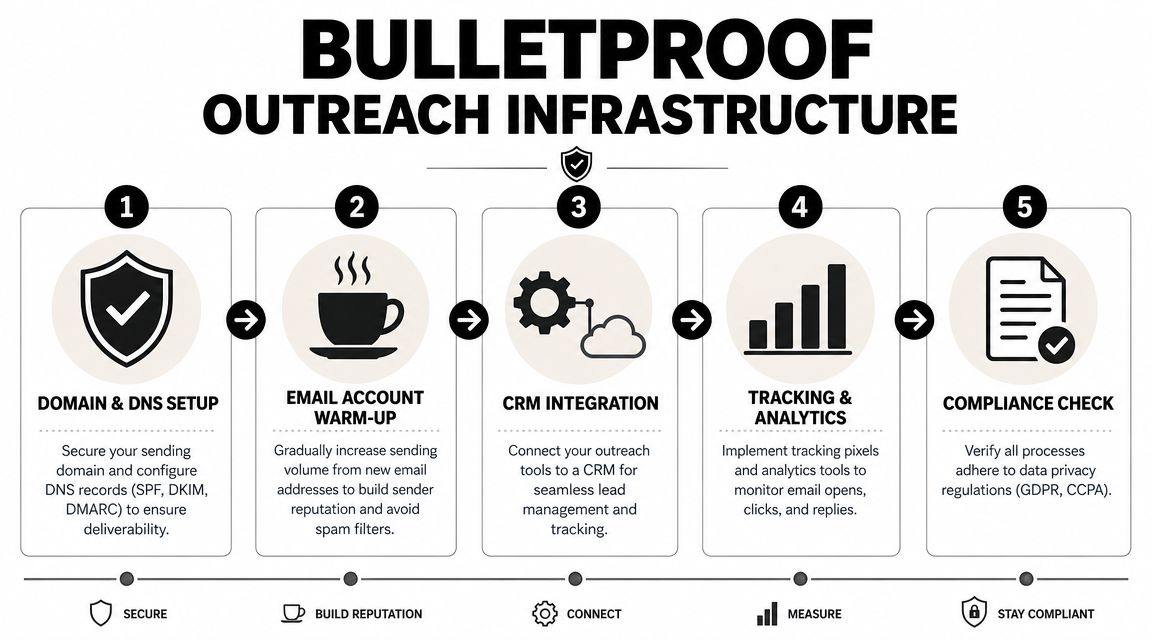
Your primary domain should protect your brand. Outreach should run on separate sending assets that isolate risk.
That usually means:
-
A secondary sending domain that closely matches your brand
-
Dedicated inboxes used only for outbound
-
A sending tool such as Instantly, Smartlead, Woodpecker, or Lemlist
-
A mailbox monitoring process so you catch reputation issues early
-
CRM sync so replies and handoffs don’t disappear into spreadsheets
If you need a full operational walkthrough, this article on setting up cold email infrastructure for high deliverability covers the underlying setup in more detail.
Get the technical basics right
You don’t need to become a deliverability engineer, but you do need to understand what good setup looks like.
| Infrastructure layer | What it does | Why it matters |
|---|---|---|
| Domain separation | Keeps outreach off your main brand domain | Protects your core reputation |
| SPF, DKIM, DMARC | Authenticates sending identity | Helps inbox providers trust the sender |
| Warm-up period | Gradually builds mailbox reputation | Reduces early filtering risk |
| Reply handling | Routes responses to the right owner | Prevents missed opportunities |
| Monitoring | Flags placement and sender health issues | Lets you fix issues before campaigns stall |
A lot of teams treat authentication as a one-time checkbox. It isn’t. You need to monitor whether messages are landing, whether replies are coming from the right inboxes, and whether sender behavior still looks healthy after campaign changes.
Bad infrastructure makes good copy invisible.
Warm up slower than you want to
New mailboxes are fragile. Agencies often ruin them by pushing volume too early because they want results fast.
A better approach is disciplined patience:
-
Start with light activity and real conversational behavior.
-
Increase volume gradually.
-
Watch reply quality, bounce behavior, and inbox health.
-
Pause expansion if placement looks unstable.
-
Only scale what’s already landing cleanly.
This is one of the least glamorous parts of lead generation for marketing agency growth, and it’s one of the most important. If you skip it, every later metric becomes noisy. You won’t know whether targeting is weak, copy is weak, or the email never had a fair chance to be seen.
Assembling High-Intent Prospect Lists
List quality decides whether outreach feels precise or annoying.
A weak list creates three problems at once. Deliverability gets worse because bad data increases bounces and non-engagement. Messaging gets harder because the audience is too mixed. Qualification breaks because the people replying were never good buyers to begin with.
Start with platforms, not scraped chaos
B2B prospecting has moved decisively toward digital channels. One report found that 88% of businesses use email as a lead generation channel, 97% of marketers use LinkedIn for lead generation, and LinkedIn is cited as 277% more effective for lead generation than Facebook and X in Leadspicker’s review of B2B lead generation channels. That’s why the modern list-building stack starts with platform-based data and intent signals, not bulk databases alone.
Use tools for different jobs:
-
LinkedIn Sales Navigator for job title, company, industry, seniority, and hiring context
-
Apollo.io for contact discovery and enrichment
-
Clay for workflows, enrichment logic, and signal combination
-
Crunchbase for funding and company activity context
-
BuiltWith or similar tools for technology signals when your offer depends on stack fit
The goal isn’t to build the biggest list. It’s to build a list where a high percentage of contacts share the same problem and can realistically buy.

Move from broad filters to buying signals
Start broad, then narrow aggressively.
A practical workflow looks like this:
-
Pull the market slice Example: B2B SaaS companies in a specific size band.
-
Add role filters Focus on titles tied to pipeline, growth, or revenue accountability.
-
Layer timing signals Hiring for sales or demand gen. Launching a new category. Entering a new market. Recently refreshed website. Visible ad activity. New content push.
-
Check service fit manually Look at the website, offer clarity, funnel maturity, and whether your agency could help.
-
Verify and clean Remove duplicates, role mismatches, generic addresses, and stale records.
A more detailed framework for that narrowing process is in this post on how to identify a B2B target market with precision.
Treat list cleaning as deliverability work
Many teams think of list hygiene as admin. It’s not. It directly affects sender health.
Use this checklist before a list enters a campaign:
-
Role relevance Remove people who don’t own the problem.
-
Company fit Exclude businesses outside your service range, pricing fit, or geography.
-
Data validity Check that the contact and company information still line up.
-
Signal freshness Prioritize records with recent and visible business activity.
-
Segment clarity Keep each campaign tight enough that one message angle still fits the whole group.
A high-intent list is smaller than many might initially seek. That’s fine. Smaller and tighter usually beats larger and blurry because it improves reply quality, protects sender reputation, and makes every optimization decision clearer.
Writing Cold Emails That Actually Get Replies
Copy starts mattering after the infrastructure and list are sound.
That’s where most agencies get the order wrong. They look for a winning template before they’ve earned the right to use one. Once targeting is sharp and inbox placement is stable, the writing can do its job.
The standard changed, too. As highlighted in Outfunnel’s overview of lead generation, the goal is shifting from more leads to qualified meetings that convert, and LinkedIn’s B2B research points to the same thing: decision-makers respond better to outreach that matches their role and stage. Broad relevance isn’t enough anymore.
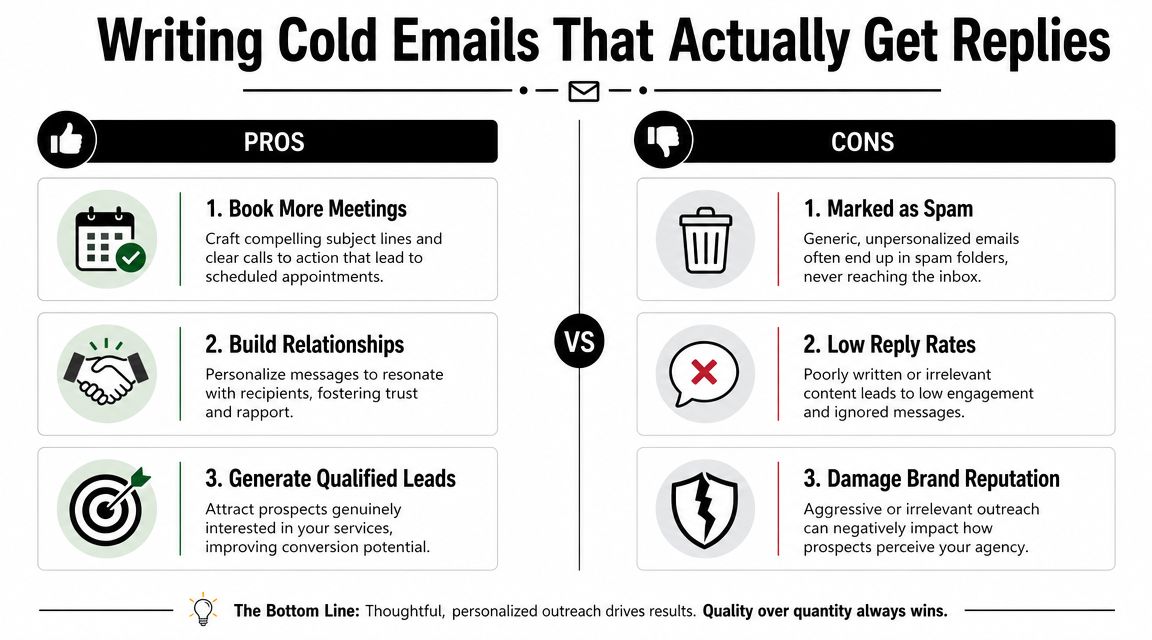
Why generic emails fail
Most weak cold emails share the same pattern:
-
They open with the sender’s credentials
-
They pitch services too early
-
They ask for a call before creating interest
-
They sound like they were sent to everyone
Here’s a bad version:
Subject: Growth opportunity for your companyHi Sarah, I’m the founder of a digital marketing agency that helps businesses scale through full-service solutions across SEO, PPC, social media, and web design. We’ve worked with many companies and would love to show you how we can help your brand grow.Are you available for a quick call this week?
Nothing in that email proves Sarah is a fit. Nothing shows the sender understands her situation. The CTA asks for time before earning attention.
Use a simple structure that respects context
A better cold email usually follows a lighter version of AIDA:
| Part | What it should do | What to avoid |
|---|---|---|
| Attention | Show relevance fast | Clever hooks with no context |
| Interest | Name a real issue, priority, or trigger | Long backstory |
| Desire | Suggest a credible outcome or angle | Vague promises |
| Action | Ask for a low-friction next step | Heavy ask too early |
Here’s a stronger version:
Subject: Quick question about outbound at [Company]Hi Sarah, I noticed your team is pushing into enterprise and hiring on the sales side. That usually means outbound volume goes up fast, and inbox performance starts affecting pipeline more than most teams expect.We help B2B teams tighten list quality, sending setup, and messaging so meetings are qualified before sales gets involved.Worth comparing notes on whether your current outbound setup is holding up?
It’s short. It’s role-relevant. It connects to a likely operational issue. It asks for a conversation, not a commitment.
Personalize with judgment, not trivia
Bad personalization feels invasive or lazy. Mentioning that someone “loves coffee” because you saw it on LinkedIn adds nothing. Referencing a visible business trigger does.
Useful personalization angles include:
-
Recent hiring tied to growth
-
A shift in product or market focus
-
Funnel friction visible on the website
-
Messaging gaps between ads, landing pages, and positioning
-
Signals that the company is ready to scale a working motion
Subject lines should follow the same rule. Clear beats clever.
If you want examples of cleaner approaches, this roundup of email subject lines for sales outreach is a good reference point.
A short visual breakdown can help here:
Write for the reply you want
A lot of agencies say they want replies, but their copy attracts the wrong kind. Curiosity replies. Vendor-shopping replies. Low-fit replies from people with no buying authority.
Write toward the meeting quality you want later.
“If sales wouldn’t want the meeting, marketing shouldn’t count it as a win.”
That means your CTA should stay simple and qualification-aware:
-
Worth a quick discussion?
-
Open to comparing notes?
-
Should I send over a short breakdown?
-
Relevant enough to explore, or bad timing?
These are easier to answer than a hard calendar request, and they create room for qualification before booking.
Good cold email writing feels restrained. It doesn’t try to close in the inbox. It creates just enough relevance for the right person to continue the conversation.
Tracking Performance and Optimizing for Meetings
Once a campaign is live, most agencies watch the wrong scoreboard.
They stare at opens, celebrate activity, tweak subject lines, and still can’t explain why booked meetings are weak. That happens because open rate tells you almost nothing about business quality on its own. A revenue-focused system needs to measure movement toward qualified conversations.
HubSpot’s inbound framework, summarized in this beginner guide to inbound lead generation, recommends a staged funnel: attract, capture, qualify, nurture, and convert only when buying signals appear. It also points toward behavior-based scoring and delayed handoff until repeated intent shows up. That logic matters just as much in outbound as it does in inbound.
Build a dashboard around decision-making
Your dashboard doesn’t need to be complicated. It needs to tell you what to do next.
Track these categories:
| KPI category | What to review | Why it matters |
|---|---|---|
| Delivery health | Bounces, spam complaints, inbox stability | Tells you if the channel is healthy |
| Engagement quality | Positive replies, neutral replies, objections | Shows whether the message fits the audience |
| Pipeline progress | Conversations started, meetings booked, meetings qualified | Connects outreach to sales value |
| Sales outcome | Show rate, opportunity creation, close feedback | Validates meeting quality |
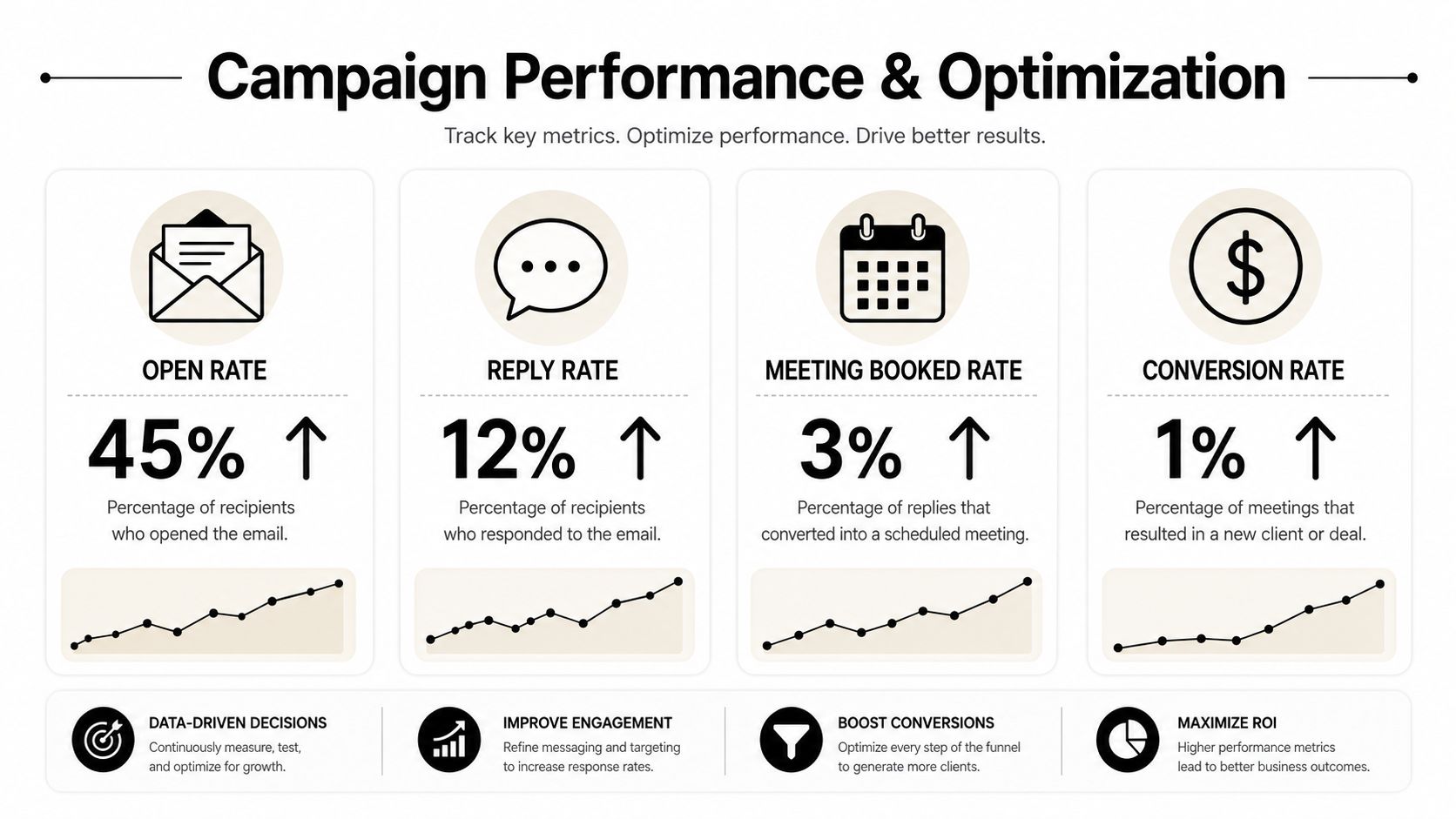
The infographic above is useful as a visual prompt, but in practice, don’t lock yourself to generic benchmarks. Your own funnel quality matters more than a public number.
Diagnose by layer, not by guess
When results drop, agencies often change too many variables at once. That hides the actual problem.
Use this order instead:
-
Check infrastructure first If deliverability slipped, copy changes won’t fix it.
-
Review list fit second If the audience is too broad or too cold, relevance falls no matter how good the email is.
-
Then review the message Look at whether the opening, angle, and CTA match the buyer’s stage.
-
Only then review handoff quality If meetings are booked but don’t convert, qualification may be too loose.
Score intent before sales spends time
The most impactful change most agencies can make is tightening what counts as sales-ready.
A practical model:
-
Low intent Opened, clicked, or replied vaguely. Keep in nurture.
-
Moderate intent Asked a question, referenced a pain point, or requested more context.
-
High intent Confirmed a need, timing, or ownership of the problem.
-
Sales handoff Only after repeated signals line up with your qualification criteria.
That mirrors the staged workflow above and keeps sales from chasing noise.
Field note: If a prospect engages with the topic but avoids specifics about need, timing, or ownership, keep nurturing. Don’t rush the handoff.
Optimize one variable at a time
The fastest way to ruin learning is to rewrite the whole system after a slow week.
Instead, isolate changes:
-
Test a new subject line against the same segment
-
Try a different opening angle with the same CTA
-
Split a broad segment into two narrower ones
-
Compare one pain-point-led sequence against one trigger-led sequence
What matters is not just whether reply volume changes, but whether meeting quality improves.
A provider like Fypion Marketing can assist teams that want outsourced cold email execution tied to booked meetings rather than broad lead volume. The model is factual and simple: it focuses on pre-agreed qualified meetings, handles infrastructure, list building, outreach, and optimization, and aligns campaign reporting with pipeline outcomes rather than vanity metrics.
The point isn’t to outsource blindly. It’s to build a feedback loop where campaign data helps sales make better decisions.
Systemizing Your Growth to Scale Revenue
One campaign can create momentum. Only a system creates predictable growth.
A lot of agencies hit an early patch of success, then stall because the whole motion still depends on founder energy. One person approves lists, rewrites copy, checks inboxes, follows up on replies, and books meetings. It works until client work gets heavy. Then pipeline disappears again.
Document the parts that repeat
If you want lead generation for marketing agency growth to become reliable, document the operating system behind it.
That playbook should include:
-
ICP rules so list building stays consistent
-
Segment definitions by industry, size, role, and trigger
-
Messaging angles that match each segment
-
Qualification criteria for what counts as a real meeting
-
Handoff steps from outreach to sales
-
Review cadence for campaign health and iteration
This is also the point where outsourcing becomes a strategic choice, not a panic move. If you’re evaluating support, this guide on B2B lead generation outsourcing for scalable growth is a practical starting point.
Add automation where judgment is low
Automation is useful when the task is repetitive and the rules are clear. It’s dangerous when the task requires positioning judgment.
Good candidates for automation:
-
Data enrichment
-
Sequence scheduling
-
CRM syncing
-
Reply tagging
-
Reminder workflows
-
Lead routing
Bad candidates for blind automation:
-
ICP definition
-
Core offer positioning
-
Final qualification decisions
-
Sensitive follow-up to nuanced replies
Some agencies use operational tools or AI assistants to support those repeatable tasks. For example, Donely’s AI employee solution is the kind of resource teams look at when they want to reduce manual load across admin-heavy workflows without adding full-time headcount to every function.
Build around meetings, not activity
The mature version of this system doesn’t reward sends, leads, or replies by themselves. It rewards qualified meetings that sales accepts and can close.
That changes how you price, hire, and manage delivery.
A project-based agency often lives with unstable revenue because pipeline and fulfillment pull against each other. A meeting-based or retainer-supported acquisition engine creates a steadier operating rhythm. Sales sees cleaner opportunities. Delivery can forecast staffing more confidently. Leadership can tell whether growth is real or just temporary activity.
The agencies that keep growing don’t treat outreach as a side project. They treat it like productized business development with clear inputs, clear quality standards, and constant refinement.
That’s the difference between “doing some prospecting” and owning a pipeline machine.
If you want a partner to build and run that machine, Fypion Marketing offers performance-driven B2B lead generation centered on qualified booked meetings rather than upfront retainers. If your team already has product-market fit and needs a cleaner, more predictable outbound system, it’s a practical next step to explore.