
Manufacturing Industry Email List: Power Your Sales

You can spot the problem before the campaign even finishes sending. Bounce notifications start piling up. Replies, if they come at all, say the contact left months ago or never handled that category in the first place. Sales blames messaging. Marketing blames deliverability. The underlying issue usually sits beneath both of them: the list.
A manufacturing industry email list isn’t just fuel for outreach. It’s the targeting layer that decides whether your campaign reaches plant leaders, procurement teams, operations heads, and owners who can buy. If that layer is weak, every downstream metric gets worse. Open rates drop. Reply quality collapses. Calendar slots stay empty.
That matters because email still works in this market when the data is right. Manufacturing email campaigns posted an average 19.82% open rate, 2.18% click-through rate, and $36 ROI for every dollar spent based on MailChimp benchmark data cited by New North’s breakdown of manufacturing email performance (manufacturing email benchmarks). Those numbers don’t prove every campaign will perform. They do prove the channel is worth taking seriously.
The practical question isn’t “How many contacts can we buy?” It’s “What will this list cost us per qualified meeting?”
Teams that ask the second question build pipeline faster, because they treat list quality as a revenue asset rather than a commodity purchase.
The Foundation of Your Sales Pipeline
A lot of sales teams waste weeks on campaigns that were dead on arrival. The copy looks fine. The offer is relevant. The sequencing tool is configured. Then the first send reveals the truth: the list was built from stale records, generic titles, and companies that don’t match the ICP.
That kind of failure is expensive because it doesn’t just lose one campaign. It burns sender reputation, wastes SDR time, and creates false lessons. Teams start rewriting offers when the fundamental fix is to rebuild the data foundation.

Why the list comes first
A strong manufacturing industry email list does three jobs at once:
-
It narrows the market: You stop sending to “manufacturing” as a vague category and start targeting specific buyers.
-
It improves campaign economics: Better records usually mean fewer wasted sends and more relevant conversations.
-
It supports cleaner forecasting: When outreach reaches the right people consistently, pipeline becomes easier to manage.
That’s why list quality sits upstream of everything in sales pipeline management best practices. If top-of-funnel targeting is wrong, no amount of CRM discipline fixes the leak.
Revenue follows contact quality
Manufacturing is broad. It includes contract manufacturers, OEMs, industrial distributors with manufacturing divisions, specialty processors, and highly regulated operators. A generic file with names and emails doesn’t help much. A usable list ties each contact to a company, role, and business context that your offer can map to.
Practical rule: If you can’t explain why a person belongs on the list, they shouldn’t be on the list.
That shift changes how you evaluate list vendors and internal research. You stop asking whether the spreadsheet is big enough. You ask whether it can produce conversations with buyers who match your sales process.
A weak list creates activity. A strong list creates meetings.
What Defines a High-Quality Manufacturing Email List
The easiest way to understand list quality is to compare two tools. A good list is a precision-engineered blueprint. It tells your team exactly which companies fit, which people matter, and what context should shape the message. A bad list is an old paper map with roads that no longer exist. You can still travel with it, but you’ll waste time, miss turns, and arrive late.
That distinction matters more in manufacturing than in broad-market outbound. Many offers only fit certain plant sizes, production models, compliance environments, or equipment setups. If the data doesn’t capture that, your targeting collapses into guesswork.
What a good list actually contains
A high-quality manufacturing industry email list isn’t defined by email addresses alone. It includes enough context to let an SDR, founder, or agency write to a specific business problem.
Useful records usually include:
-
Role clarity: Titles that indicate buying influence, such as operations, procurement, engineering leadership, or ownership.
-
Company detail: Revenue band, employee size, location, and industry codes when available.
-
Market relevance: Sub-sector information that separates plastics from food processing, metal fabrication from pharmaceuticals.
-
Supplementary fields: LinkedIn profiles, phone data, and company identifiers that help with verification and multichannel follow-up.
When teams need a framework for thinking about market selection beyond simple title filters, resources like the Company Import Export Lead Generation Playbook are helpful because they force you to think in terms of commercial fit, not just contact volume.
What low-quality lists usually get wrong
Cheap data fails in predictable ways. It bundles irrelevant firms into the same export. It overstates title seniority. It misses operational context. Sometimes the email is technically valid but belongs to a person who has no buying role for your offer.
Here are the most common warning signs:
-
Broad titles with no specificity: “Manager” tells you almost nothing.
-
No segmentation fields: If you can’t sort by sub-sector, geography, or company type, personalization gets thin fast.
-
Missing enrichment: Without business context, reps fall back on generic first lines.
-
No evidence of refresh cycles: Stale data gradually destroys deliverability over time.
A list becomes valuable when it helps you disqualify quickly, not when it gives you more names to chase.
Relevance beats size
List quality also determines whether lead qualification happens before or after the first reply. If the data is rich, you can screen accounts before launch and protect rep time. If the data is weak, your team has to do qualification in the inbox, which is slower and more expensive.
That’s why a solid manufacturing list should line up with the filters you’d normally use in a lead qualification checklist. The list shouldn’t be a raw dump. It should already reflect who you want to speak with, which accounts you want to avoid, and where your offer has the highest chance of landing.
The Critical Choice Buying vs Building Your List
Teams often frame this decision the wrong way. They ask which option is cheaper. The better question is which option gets you to qualified meetings with the least waste.
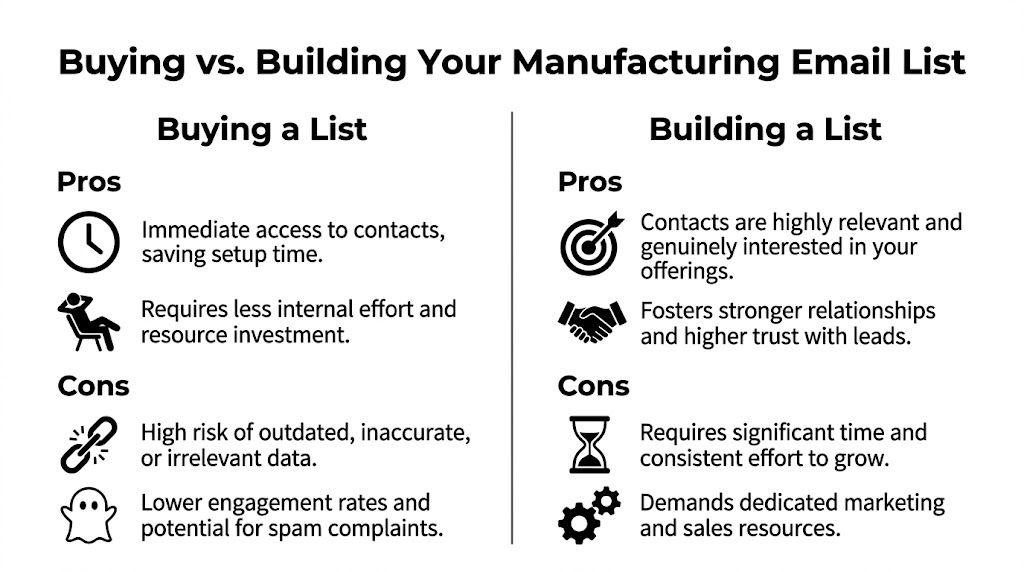
Buying and building both work. Both also fail for predictable reasons. Buying fails when teams assume vendor data is campaign-ready without scrutiny. Building fails when teams underestimate how much labor it takes to source, clean, enrich, and maintain records at scale.
Buying a list when speed matters
Purchased data makes sense when the market is large enough, the ICP is already defined, and the business needs pipeline quickly. A vendor can give you immediate coverage across geographies, titles, and manufacturing sub-sectors that would take an internal team much longer to compile.
That speed is real value. If your sales team is idle, the cost of waiting can be higher than the cost of buying data.
Buying works best when:
-
You know the target account profile: The narrower your criteria, the easier it is to evaluate whether vendor data matches.
-
You need market access now: Launch timelines matter when a team is trying to validate messaging or open a new segment.
-
You have a review process: Purchased records still need filtering, spot checks, and campaign-specific cleanup.
The catch is obvious. You inherit someone else’s sourcing logic. If the provider classified firms poorly or failed to refresh records aggressively, your team pays for that mistake in bounce rates and missed conversations.
Building a list when precision matters
Building often wins when the target market is narrow, specialized, or poorly represented in standard databases. If you’re selling into a specific manufacturing niche, broad vendor datasets can feel bloated. Internal research can produce a smaller but sharper list.
Building gives you more control over:
| Decision area | Buying a list | Building a list |
|---|---|---|
| Speed to launch | Fast | Slow |
| Custom fit | Moderate unless heavily filtered | High |
| Internal workload | Lower at the start | Higher from day one |
| Data logic | Vendor-defined first, then refined | Team-defined throughout |
| Best use case | Broad outbound with urgency | Niche targeting with strict criteria |
That control comes with operational cost. Someone has to identify companies, verify contact ownership, enrich fields, standardize naming, and keep records updated. If no one owns that workflow, list-building turns into a half-finished spreadsheet that never becomes campaign-ready.
The hidden cost is rep time
Teams typically overlook the trade-off. They compare vendor pricing to internal labor only at the research stage. They don’t calculate what happens after launch.
A poor purchased list wastes sends. A poorly built list wastes people.
The costliest list is the one that forces your reps to figure out, contact by contact, whether a company ever belonged in the campaign.
If an SDR has to manually investigate every positive reply to confirm plant type, company fit, or decision authority, your cost per qualified meeting climbs. The same happens when a founder-led outbound motion spends nights cleaning spreadsheets instead of selling.
A practical way to choose
Use these questions before deciding:
-
How narrow is the ICP? The narrower it is, the stronger the case for building or heavily customizing.
-
How quickly do you need meetings? Tight launch windows often justify buying.
-
Who will maintain the data? A list without an owner degrades fast.
-
Can your team verify what you buy? If not, purchased data becomes risky.
-
What matters more right now, speed or precision? Most companies lean too hard toward one and ignore the other.
Some teams also use a hybrid model. They buy a base dataset, then refine it around role fit, sub-sector, and account priority. That’s often the most practical route for outbound teams that need both coverage and control.
The right answer isn’t ideological. It’s operational. Choose the path that reduces wasted sends, wasted labor, and low-quality meetings.
How to Source and Verify High-Value Contacts
Sourcing manufacturing contacts is easier than it used to be. Sourcing the right ones is still a craft. The best lists usually come from combining multiple inputs, then forcing each record through a verification process before it enters a campaign.
A list should earn its place in your sending tool. It shouldn’t get there because someone exported names quickly.
Where strong manufacturing data comes from
There are three practical sourcing lanes.
Professional data providers give you scale. According to ReachStream, leading B2B data providers offer over 9 million verified manufacturing contacts worldwide, with 95% data accuracy through a 7-step AI and manual verification process and 90% email deliverability rates (verified manufacturing contact coverage). That kind of scale matters when you’re targeting multiple manufacturing segments across regions.
LinkedIn Sales Navigator is useful when title nuance matters. You can isolate company headcount ranges, seniority bands, geography, and sometimes operational clues from the company profile itself. It won’t give you a finished list on its own, but it’s strong for account discovery and role validation.
Industry directories and company websites help when a niche segment is underrepresented in standard databases. They also help confirm whether a business manufactures, distributes, imports, or only resells.
A solid workflow often mixes all three.
How to qualify records before verification
Before you validate an email, validate the account. A technically valid address is worthless if the company doesn’t fit your offer.
Start with these filters:
-
Business model fit: Is this company a manufacturer?
-
Role relevance: Does the contact plausibly influence the buying decision?
-
Offer alignment: Does your solution map to this plant type, production model, or operating challenge?
-
Geographic usefulness: Can your team serve this region?
When social context is thin, guides on finding and verifying social media profiles can help your team confirm identity and role consistency across public sources before outreach starts.
The verification layer you can’t skip
Verification isn’t one tool. It’s a sequence.
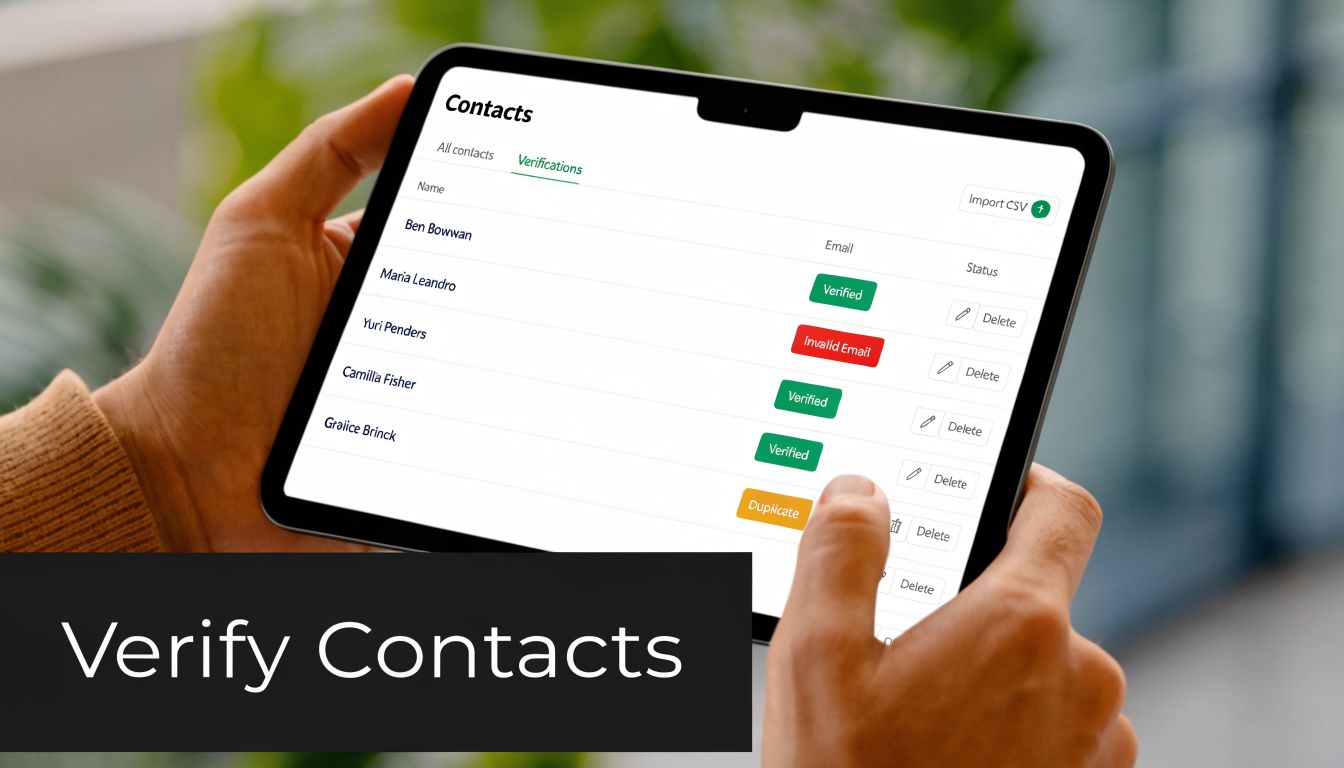
First, check format and syntax. Then confirm the company domain is active and matches the business you’re targeting. After that, use an email verification platform to screen for invalid, risky, and catch-all records. If the domain accepts all mail, treat those contacts carefully and route them through the process described in this guide to verify accept-all emails.
Later in the workflow, it helps to review a visual walkthrough like this one before final upload:
A practical sourcing workflow
Many teams overcomplicate this. Keep it tight:
-
Define the ICP first. List sub-sectors, titles, company types, and exclusions.
-
Pull accounts from one primary source. Use a provider or Sales Navigator for the first pass.
-
Cross-check the company. Review site language, product pages, and operating footprint.
-
Attach the right contact. Prefer role fit over title vanity.
-
Run verification before enrichment goes live. Bad records shouldn’t move downstream.
-
Tag uncertainty. If a record is promising but not fully confirmed, separate it from the main send group.
Clean sourcing beats aggressive volume. A smaller launch set with verified fit usually teaches you more than a large send built on assumptions.
If you want fewer bounces and better reply quality, verification can’t be an afterthought. It’s the gate between prospecting activity and campaign performance.
Segmentation and Enrichment for Precision Outreach
A raw list gets emails out the door. An enriched list gets the right message in front of the right buyer. That’s the difference between mass outreach and controlled pipeline generation.
Manufacturing buyers don’t all respond to the same framing. A plant manager cares about throughput and disruption. A procurement lead cares about supplier reliability, savings logic, and risk. An owner at a smaller manufacturer may care most about cash flow, implementation burden, and how quickly the change pays off. If all three receive the same message, one generic campaign underperforms where three focused micro-campaigns could have worked.

The fields that make outreach sharper
The most useful enrichment fields are the ones your copy team can use. Fancy data that never enters the email or qualification logic doesn’t help much.
Prioritize fields like:
-
Job function and seniority: Operations, procurement, engineering, quality, ownership.
-
Sub-sector classification: Automotive, plastics, electronics, food processing, pharmaceuticals, fabricated metals.
-
Company size indicators: Employee band and revenue range where available.
-
Industry coding: SIC and NAICS categories for cleaner segmentation.
-
Profile context: LinkedIn URL, ownership type, and regional footprint.
-
Technographic clues: Signals about systems, platforms, or tooling when relevant to your offer.
These fields let you change both the messaging and the CTA. That matters. The best outbound sequences don’t just personalize the first line. They personalize the business case.
Why segmentation lifts engagement
Thomson Data states that manufacturing email lists enriched with fields like LinkedIn profiles and segmented by NAICS/SIC codes increase multi-touch engagement by 35%, and decision-makers in sub-sectors such as pharmaceuticals or plastics respond 2x better to personalized sequences (segmentation impact in manufacturing outreach). That matches what most practitioners see in the field. Relevance compounds across touches.
In practice, it looks like this:
| Segment | Messaging angle | Better CTA |
|---|---|---|
| Mid-market plastics manufacturer | Scrap reduction, throughput consistency, scheduling efficiency | Short call to compare current workflow |
| Food manufacturer with multi-site operations | Process visibility, supplier coordination, compliance support | Share current process and discuss fit |
| Founder-led metal fabricator | Margin pressure, quoting speed, leaner ops | Quick conversation about current bottlenecks |
What enrichment changes operationally
Segmentation does more than improve copy. It changes campaign structure.
Instead of one long sequence to every record, you can run small campaigns by plant size, sub-sector, or use case. That gives you cleaner feedback on what resonates. It also helps sales handle replies because context is built into the campaign from the start.
For teams trying to formalize this, a framework like B2B customer segmentation your growth blueprint helps turn a flat contact file into a workable outbound system.
The list becomes strategic when your team can tell, before launch, which pain point each segment is likely to care about.
What doesn’t work
Batch-and-blast campaigns usually fail for two reasons. First, the copy becomes vague enough to fit everyone and persuasive enough for no one. Second, reply handling gets messy because the SDR has to rediscover the account context after the prospect responds.
Enrichment fixes both. It gives marketing sharper inputs and gives sales cleaner conversations.
If your current list can’t support segmented campaigns, it isn’t finished yet. It’s only a contact dump.
Activating Your List in a Cold Email Campaign
A clean manufacturing industry email list doesn’t book meetings by itself. It gives your campaign a real chance. What happens next depends on execution.
The pattern is familiar. A company finally assembles a solid target list, loads it into a sequencer, writes one broad message, and sends too much volume too fast. The campaign then underperforms, and everyone assumes cold email doesn’t work in manufacturing. Usually the issue isn’t the channel. It’s activation.
Start with infrastructure, not copy
Before the first email goes out, make sure the sending environment is ready for outreach. That includes mailbox setup, pacing, inbox monitoring, and reply routing. Teams that skip this part often misread technical issues as messaging issues.
Once sending is stable, write the campaign around the segment, not around your product deck. The first email should answer one silent question quickly: why is this relevant to this company, in this role, right now?
Strong first touches usually do three things well:
-
They use segment logic: The message reflects plant type, sub-sector, or role priorities.
-
They stay narrow: One problem, one angle, one next step.
-
They avoid heavy pitch language: Manufacturing buyers respond better to clarity than hype.
If your team needs a simple framework for writing messages that don’t sound automated, this guide on how to write a cold mail is a useful reference.
A sequence that respects the buyer
Most cold email campaigns fail in follow-up, not the opener. The first email might be decent, but every touch after that repeats the same value proposition with different wording. Buyers tune it out.
A better sequence changes the reason to reply.
One touch might reference a problem common to a sub-sector. Another might offer a specific observation based on company context. A later follow-up can reduce friction with a light ask instead of another pitch for a demo.
Here is a practical structure:
-
First email: Relevance and fit. Keep it brief.
-
Second touch: Add context the buyer might care about.
-
Third touch: Reframe with a different operational angle.
-
Final follow-up: Make the CTA easy to answer with a yes, no, or redirect.
This is also the point where one managed option can fit. Some teams build the list, infrastructure, and sequencing in-house. Others use agencies or partners. For companies that prefer a pay-per-meeting model, Fypion Marketing handles list building, cold email setup, copy, and optimization as part of a managed outbound process.
Send fewer assumptions and more specifics. A short email that reflects the recipient’s world usually beats a polished paragraph full of generic benefits.
What usually kills response quality
The most common mistakes are boring and expensive.
-
Generic first lines: If the opener could apply to any manufacturer, it won’t hold attention.
-
Weak calls to action: “Let me know if you’re interested” creates work for the prospect.
-
Feature-heavy copy: Buyers care about operational implications, not your category language.
-
No segmentation carry-through: Teams segment the list, then send the same sequence to everyone anyway.
-
Reply friction: If the email asks for too much commitment too early, buyers ignore it.
What works better in manufacturing outreach
Manufacturing buyers tend to respond when the email feels grounded in operations. That doesn’t mean writing long technical notes. It means using language that signals you understand how these businesses make decisions.
Good messages often include:
-
Role-aware framing: Procurement, operations, and ownership don’t evaluate the same way.
-
Specific business tension: Downtime, supplier complexity, quoting delays, backlog strain, compliance burden, production visibility.
-
Low-friction CTAs: A brief conversation, a quick fit check, or a request to point you to the right person.
One useful discipline is to review every email and ask, “Could this be sent to a software startup with no changes?” If the answer is yes, the copy probably isn’t grounded enough for manufacturing.
The list gives you the raw material. Campaign activation is where that raw material turns into qualified conversations. If your list is strategic, your emails should prove it.
Maintaining Compliance and Measuring List Quality
A manufacturing industry email list can create pipeline or create risk. The difference comes down to governance. Teams that treat list maintenance as a side task usually feel the damage later through lower inbox placement, messy CRM data, and avoidable compliance issues.
Compliance doesn’t need to paralyze outbound. It needs to shape process. That means documenting where contacts came from, respecting opt-outs, keeping suppression lists current, and making sure your outreach is relevant to the audience you’re contacting. Legal review matters, especially when you’re sending across jurisdictions, but practical discipline matters just as much.
Compliance is part of list hygiene
For GDPR, CCPA, and related privacy expectations, the safest operational habit is straightforward: collect only what you need, keep records organized, and honor objections fast. If a prospect asks how you found them or asks not to be contacted again, your team should be able to answer clearly and act immediately.
A few habits reduce risk:
-
Track source and import date: Every record should have provenance.
-
Maintain suppression logic: Unsubscribed contacts shouldn’t reappear in future exports.
-
Limit unnecessary fields: More data isn’t always better if it serves no campaign purpose.
-
Review messaging relevance: The narrower and more role-appropriate your outreach is, the easier it is to defend as legitimate business communication.
Measure the list, not just the campaign
A lot of teams only watch opens, replies, and meetings. Those metrics matter, but they don’t tell you whether the list itself is getting healthier or worse.
List quality review should include:
| Metric area | What to watch | Why it matters |
|---|---|---|
| Deliverability health | Whether emails reliably reach inboxes | Poor list quality can damage sending performance |
| Bounce behavior | Patterns in invalid or unreachable contacts | High bounce clusters usually indicate sourcing or refresh problems |
| Engagement by segment | Which sub-sectors and roles respond | Helps separate data issues from messaging issues |
| Positive reply quality | Whether replies come from plausible buyers | Protects cost per qualified meeting |
| Decay over time | Records that age out, change roles, or become irrelevant | Prevents old data from poisoning future sends |
A list is never finished. It either gets cleaner through use or worse through neglect.
Protect the asset
The best outbound teams treat the list like owned infrastructure. They remove bad records quickly, feed reply outcomes back into segmentation, and keep qualification standards tight. They also separate campaign learnings carefully. If a segment underperforms, the issue might be the offer, the message, or the data. Those aren’t the same problem.
A healthy list lowers risk and keeps cost per qualified meeting under control. That’s the primary objective. Not more sends. Better sends.
If you want a partner that treats the manufacturing industry email list as a revenue asset rather than a commodity file, Fypion Marketing runs cold email programs on a pay-per-qualified-meeting model. That means the work stays tied to booked meetings, list quality, and sales outcomes instead of retainer-driven activity.