
Messaging Framework for Cold Email: A B2B Guide
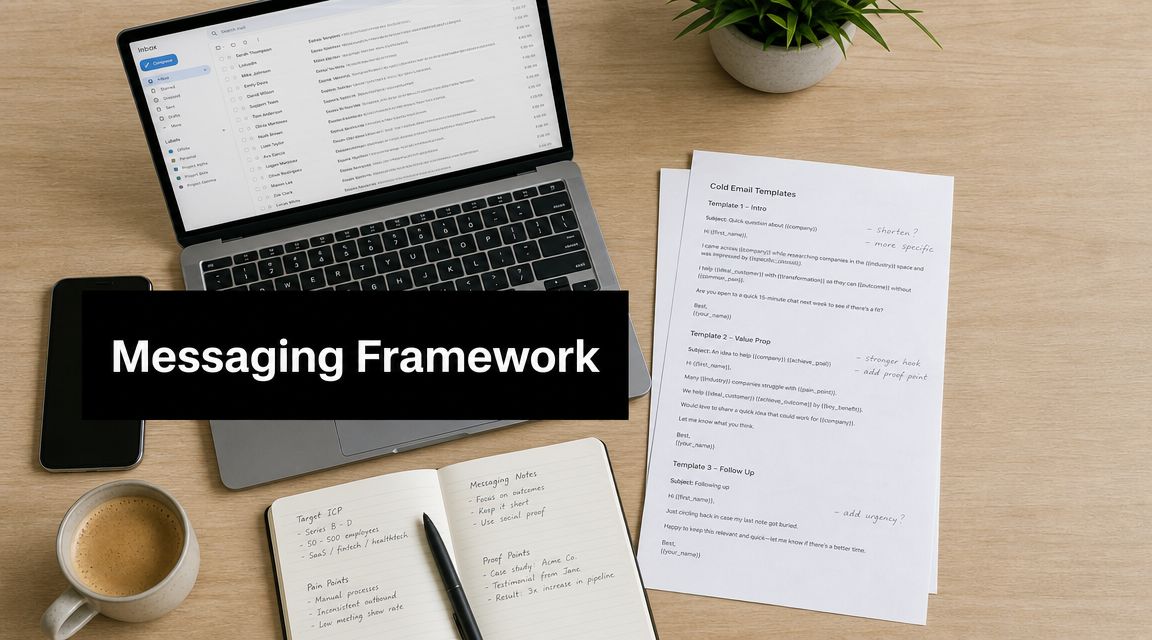
Teams frequently don’t have a cold email problem. They have a messaging framework problem.
You see it when outbound starts slipping. One rep leads with a cost angle. Another pushes features. Marketing writes web copy around category language that sales never uses. Founder-led emails sound sharp because they come from real conviction, then the sequence gets handed to SDRs and turns into generic automation sludge. Prospects don’t know what you do, why it matters now, or why they should trust you.
The result isn’t just weak reply rates. It’s inconsistent conversations, confused objections, and a pipeline that’s hard to scale because every good result depends on one person improvising well.
A proper messaging framework fixes that. Not as a brand exercise. As a working system for outbound.
Why Your Cold Emails Fail and How a Framework Helps
Cold emails usually fail for a simple reason. The team is sending copy without a shared message architecture.
One campaign says the product saves time. Another says it improves visibility. A third talks about replacing manual work. Each point might be true, but if you rotate angles without structure, the market hears noise instead of a clear position. That confusion shows up fast in outbound because cold prospects won’t do the work of connecting your story for you.

A lot of teams assume the answer is better copywriting. It usually isn’t. Better copy on top of weak positioning just gives you more polished inconsistency. If your team hasn’t agreed on the core message, the main differentiators, and the proof behind each claim, every sequence becomes a fresh guess.
If that sounds familiar, this breakdown of Why Cold Email Fails is useful because it frames the common execution problems buyers feel, from irrelevant outreach to poor targeting.
What ad hoc outreach looks like in practice
You can spot a weak system quickly:
-
Different reps use different promises. One email pitches speed, another pitches quality, another pitches cost.
-
Personalization overwhelms positioning. The opener is personalized, but the body could describe ten other vendors.
-
Claims arrive without evidence. The prospect gets asked to believe you before they have a reason to.
-
Sequences repeat without building. Every follow-up restates the same idea in slightly different words.
That approach creates a hidden tax. Sales spends time rewriting copy. Marketing reviews one-off drafts. Founders jump in to “fix messaging” every few weeks. None of that compounds.
What a framework actually does
A messaging framework gives the team one top-line message and a compact set of repeatable pillars. One source describes a strong framework as three to five messaging pillars, each with a headline, value proposition, and proof points, all laddering to one top-line message that summarizes the solution. It also notes that modern frameworks connect messaging to the buyer journey, including the passive state, buying trigger, evaluation stage, and purchase decision according to Cascade Insights.
That matters in cold email because you’re not writing one email. You’re building a system that has to work across subject lines, body copy, follow-ups, landing pages, and sales calls.
Practical rule: If two reps can describe your offer in two completely different ways, you don’t have a messaging framework. You have talking points.
Messaging has also changed. Earlier guidance leaned heavily on stakeholder interviews. More recent practice adds surveys, analytics, dashboards, real-time feedback, and A/B tests, which means frameworks are now expected to be measurable and iterative rather than static as described by MarketingProfs.
For outbound teams, that’s the shift that matters most. A messaging framework isn’t the document you present in a workshop. It’s the operating system behind campaigns that need to produce meetings predictably.
Pinpoint Your Ideal Customer and Their Deepest Pains
Most ICP work is too shallow for cold email.
“Mid-market SaaS” isn’t an ICP. Neither is “heads of marketing” or “operations leaders.” Those labels are filters, not strategy. Good outbound starts when you know which buyer has a problem they already feel, how they describe it internally, and what changed recently that makes the problem urgent enough to discuss.
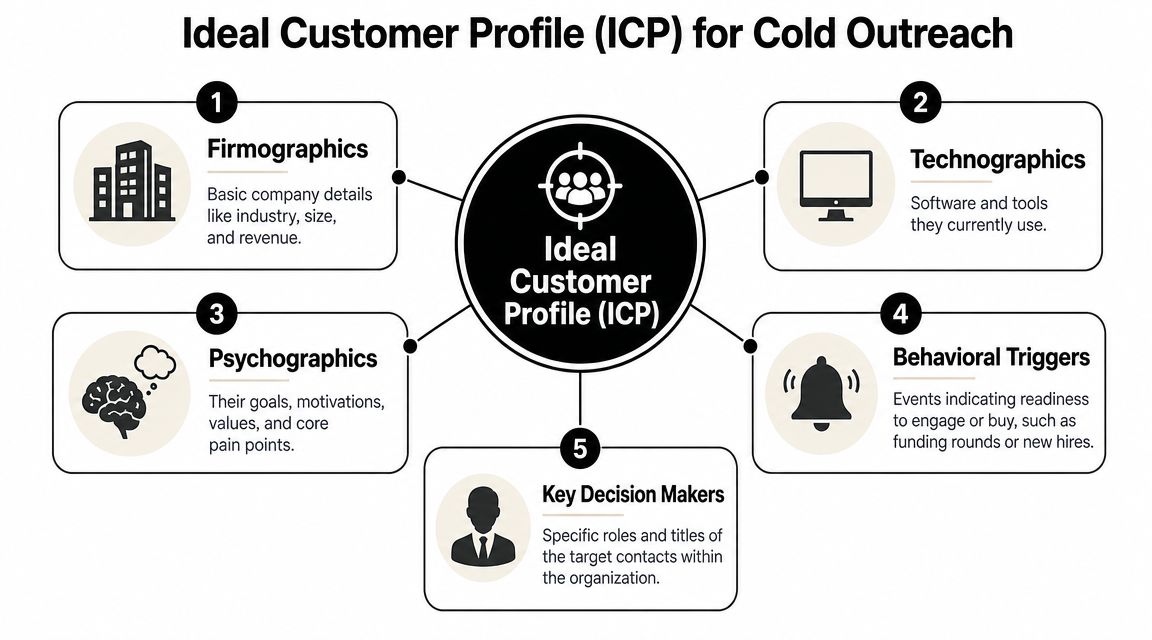
A useful way to tighten this is to treat the ICP as a buying situation, not a demographic bucket. If you need a practical primer on building that lens, this guide on ICP in sales is a solid reference point.
Start with the buyer’s job, not your product
Focus on the person who owns the pain, not just the person who can approve a budget.
For example, if you’re selling a workflow tool, don’t stop at “operations manager.” Ask:
-
What are they measured on. Speed, accuracy, utilization, response time, pipeline quality?
-
What breaks their day. Handoffs, reporting gaps, missed follow-ups, tool sprawl, bad data?
-
What creates urgency. New leadership, missed targets, hiring pressure, territory changes, product launches?
These details change the angle completely. A VP may care about consistency and visibility. A manager may care that the team is wasting hours fixing avoidable problems. Same company. Different message.
Pull language from real places
Good cold email doesn’t sound like a positioning workshop. It sounds like the prospect’s internal conversation.
Use a few direct inputs:
| Research input | What to look for | Why it matters |
|---|---|---|
| LinkedIn profiles | Priorities, team changes, hiring language | Shows what the buyer wants to be known for |
| Job descriptions | Process gaps, required tools, responsibilities | Reveals what the business expects from the role |
| Sales calls and demos | Objections, recurring pain language | Gives you phrases buyers already use |
| Support tickets and onboarding notes | Friction after purchase | Exposes operational pain your copy can mirror |
Don’t overcomplicate this. You’re looking for repeated patterns in plain language. Prospects rarely say, “We need strategic transformation.” They say, “Our reps are chasing bad-fit accounts,” or “We’re losing time cleaning lists,” or “No one trusts the numbers.”
Use the phrases buyers already use to describe the problem. That’s usually more persuasive than a clever headline.
Build around pain plus trigger
The strongest outbound angles usually combine a standing pain with a current trigger.
A standing pain is persistent. Slow lead qualification. Low meeting quality. Poor handoff between marketing and sales.
A trigger makes the pain actionable now. New SDR hires. A fresh funding announcement. Expansion into a new segment. A spike in hiring for outbound roles.
Here is a simple working structure:
-
Target company pattern Define the business type where your offer fits.
-
Target role Name the function that owns the problem.
-
Persistent pain State the operational problem in the buyer’s language.
-
Trigger event Identify what makes that problem more urgent now.
-
Desired outcome Clarify what “better” looks like from their side.
If you skip this step, the rest of the messaging framework gets built on assumptions. Then every email sounds polished but vaguely off.
Define Your Core Message Pillars and Value Proposition
A framework usually starts to break here.
The team agrees on the market, the buyer, and the pain. Then someone adds every feature the product has, someone else adds brand language, and sales ends up with a doc that looks polished but is useless in a live campaign. Reps do not need more words. They need a clear argument they can adapt across hundreds of emails without losing the thread.
That is the fundamental job of message pillars. They turn positioning into repeatable outbound inputs. If the framework cannot be used to write subject lines, first lines, body copy, and follow-ups at scale, it is still a draft.
Start with a top-line value proposition
Write one sentence that answers a buyer’s real question: why take this meeting instead of ignoring the email?
Use a format like this:
We help [specific buyer] get [specific outcome] without [common cost, delay, or risk].
Good value propositions create direction. They tell your team which claims belong in the campaign and which ones do not. They also make review easier. If a sequence drifts into generic claims or feature dumping, you can trace it back to whether the copy still supports the core promise.
If your team struggles to separate a real promise from a feature list, these value proposition examples are useful for tightening the statement before it gets pushed into outbound.
Build three to five pillars that support the buying case
Each pillar should do one job in the sales argument.
For cold email, strong pillars usually map to the reasons a buyer would reply, forward the email internally, or take a call. Weak pillars read like website copy. Strong pillars give sales and growth teams angles they can test across segments, offers, and triggers.
For a company selling outbound infrastructure, the pillars might look like this:
| Pillar | What it means | What it does in email |
|---|---|---|
| Deliverability control | Campaigns reach inboxes more consistently | Reduces concern about wasted send volume |
| Workflow efficiency | The team spends less time fixing manual process issues | Speaks to operators who own execution |
| Meeting quality | Targeting and messaging improve relevance | Appeals to leaders who care about pipeline quality |
These pillars support the same promise from different directions. They are not alternate taglines.
Make each pillar operational
A usable framework needs more than a pillar name. Teams need a message map they can turn into copy fast. Big Moves Marketing outlines a practical structure that includes the audience or persona, the core value proposition, three to five messaging pillars, supporting points, proof points, and an “as opposed to” differentiator for each message angle as outlined by Big Moves Marketing.
That last field matters in outbound because your real competition is often the buyer’s current workaround. It might be a spreadsheet, a junior hire, a patchwork process, or simple inaction.
For each pillar, define:
-
A clear headline the team can reuse in campaign planning
-
A short value statement tied to business impact
-
Supporting points that explain how the value shows up in practice
-
An “as opposed to” differentiator that clarifies the alternative you replace
This is where the article’s operational angle matters. The framework is not finished when the document looks clean. It is finished when different SDRs, copywriters, or campaign managers can use the same pillar and still produce consistent emails.
Cut anything a rep cannot use
Bad pillars usually fail in predictable ways.
Some are too broad. “Better performance” leaves too much interpretation. Some are too product-heavy and describe capabilities instead of buyer outcomes. Others overlap so much that three angles collapse into one vague message.
A simple test helps. Put the pillar in front of a rep and ask for two cold email angles and one follow-up idea. If they cannot do it quickly, the pillar is too abstract.
Good frameworks feel narrower than internal teams expect. That is usually a sign the messaging is getting stronger. In outbound, clarity beats coverage.
Assemble Undeniable Proof Points for Every Claim
An SDR sends a strong first line, names a real problem, and ties it to a business outcome. The prospect reads it and thinks, “Maybe. Prove it.”
That gap decides whether the email gets a reply or gets ignored.
In outbound, every claim creates a burden of proof. If you say a client reduced manual work, improved conversion quality, or shortened ramp time, the buyer wants evidence fast. They will not go looking for it. Your framework has to carry it with the claim so the team can use it in campaigns without rewriting the story every time.
Proof also needs to match the kind of promise you’re making. A logo helps with trust. It does not prove a workflow result. A customer quote helps with credibility. It does not carry as much weight as a clear before-and-after outcome when you’re making a performance claim.
| Claim type | Stronger proof option | Weaker proof option |
|---|---|---|
| Efficiency claim | Before-and-after process example | Generic line about saving time |
| Credibility claim | Known customer, award, or direct quote | Self-described expertise |
| Outcome claim | Case study with a clear result | Feature explanation |
Frameworks often fail in practice. B2B marketing teams often build one proof bank, then reuse the same asset across every angle. The result is loose copy. The message sounds supported, but the evidence does not answer the buyer’s doubt.
A working framework assigns proof at the claim level, not just at the brand level.
Build a proof library your team can actually use
Store proof by message pillar and by proof type. That makes it usable in live campaign production, not just in a strategy doc.
A simple structure works well:
-
Pillar-specific proof tied to each core claim
-
Outcome proof such as short case examples or measurable business changes
-
Trust proof such as customer names, testimonials, awards, or category expertise
-
Objection-handling proof for common concerns like implementation time, switching cost, or internal bandwidth
Keep each entry short and usable. One sentence on the claim, one sentence on the evidence, and one note on where it fits in a sequence. If a rep has to open three folders and skim a deck to find support for one line, the framework is not operational yet.
For a real example of proof supporting an outreach narrative, this case study on building a $6.7M pipeline in a tough market shows the kind of evidence that can support a commercial claim without overloading the email.
Use proof in the right place
Cold email does not need every receipt upfront.
The first touch usually needs just enough evidence to make the claim believable. Follow-ups can carry more weight. That sequencing matters because proof has a job beyond credibility. It helps move the conversation forward.
A practical way to use it:
-
First touch: Pair the pain with a restrained proof cue
-
Second touch: Add a specific customer example, quote, or result
-
Later follow-up: Use a short story that answers a likely objection
For example, “We helped a similar team cut manual list cleanup” is often enough in email one. A tighter customer story belongs later, once the prospect has shown some interest.
Strong proof makes claims easier to accept.
If a pillar cannot be backed by a clear example, customer evidence, or observable result, keep it out of outbound until you can support it. A framework only scales when the team can turn every promise into a believable sentence on demand.
Translate Your Framework into a Cold Email Playbook
A messaging framework becomes useful when it turns into sequence logic.
That’s where teams often stall. They finish the document, everyone nods in the meeting, then the SDR team goes back to writing emails from scratch. The framework exists, but it doesn’t control execution.
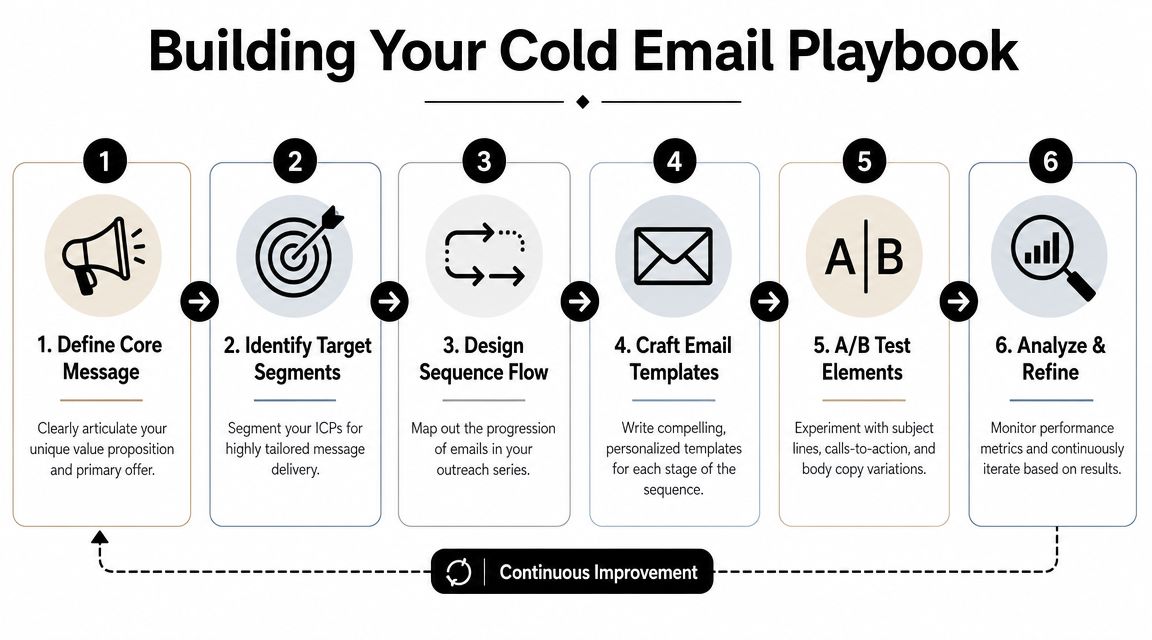
The playbook should tell the team exactly how to use each pillar, when to use it, and what kind of personalization belongs around it.
Turn pillars into sequence roles
A good sequence doesn’t repeat the same argument. It advances the buying conversation.
One practical structure looks like this:
| Job in the sequence | Messaging input | |
|---|---|---|
| First touch | Earn relevance | Lead with the pain tied to one pillar |
| Second touch | Add credibility | Introduce proof linked to that claim |
| Third touch | Reframe or broaden | Use a second pillar for a different stakeholder concern |
| Fourth touch | Reduce resistance | Address the status quo or “as opposed to” angle |
| Final touch | Create easy next step | Restate value simply and ask for a low-friction reply |
That approach keeps the sequence cohesive without becoming repetitive. The prospect sees one story unfold, not five disconnected emails.
A strong cold email sequence also needs practical writing discipline. This guide on how to write a cold mail is useful if your team has the message right but still struggles to translate it into clean email copy.
Personalization should wrap the framework, not replace it
Many teams confuse personalization with messaging. They aren’t the same.
Personalization is the context layer. The framework is the persuasion layer.
If you notice a prospect hired new SDRs, launched a new product line, or expanded into a new market, that observation should help you introduce the right pillar. It shouldn’t become the whole email.
A simple formula works well:
-
Context from the account or contact
-
Pain hypothesis tied to the ICP
-
Relevant pillar from the framework
-
Proof that supports the claim
-
CTA that asks for a small commitment
That structure scales because only the context changes heavily across segments. The strategic message stays stable.
A short walkthrough can help your team visualize this process before they build templates:
Validate with live campaigns
A framework isn’t done when everyone agrees it sounds good internally. It has to survive contact with real prospects.
Product marketing guidance recommends validating messaging through stakeholder feedback and live-message testing, including A/B tests on landing pages or in email campaigns, because the framework’s job is to improve response and conversion, not just sound strategic according to Product Marketing Alliance.
That means your playbook should include testable variables such as:
-
Opening angle tied to one pillar versus another
-
CTA style based on direct ask versus softer diagnostic ask
-
Proof placement in the first touch versus a follow-up
-
Persona variation for leaders versus managers
One practical option for teams that want execution support is Fypion Marketing, which runs performance-based cold email campaigns and handles research, messaging, list building, copy, and ongoing optimization as part of outbound execution.
The key point isn’t who runs it. It’s that the framework has to become campaign logic, not a forgotten slide.
Operationalize and Optimize Your Messaging at Scale
The biggest mistake teams make is treating the messaging framework like a one-time deliverable.
They build it, present it, save it to a folder, and move on. A month later, sales is improvising again, marketing is testing unrelated angles, and no one knows which message is creating meetings. That’s not a framework. That’s documentation.
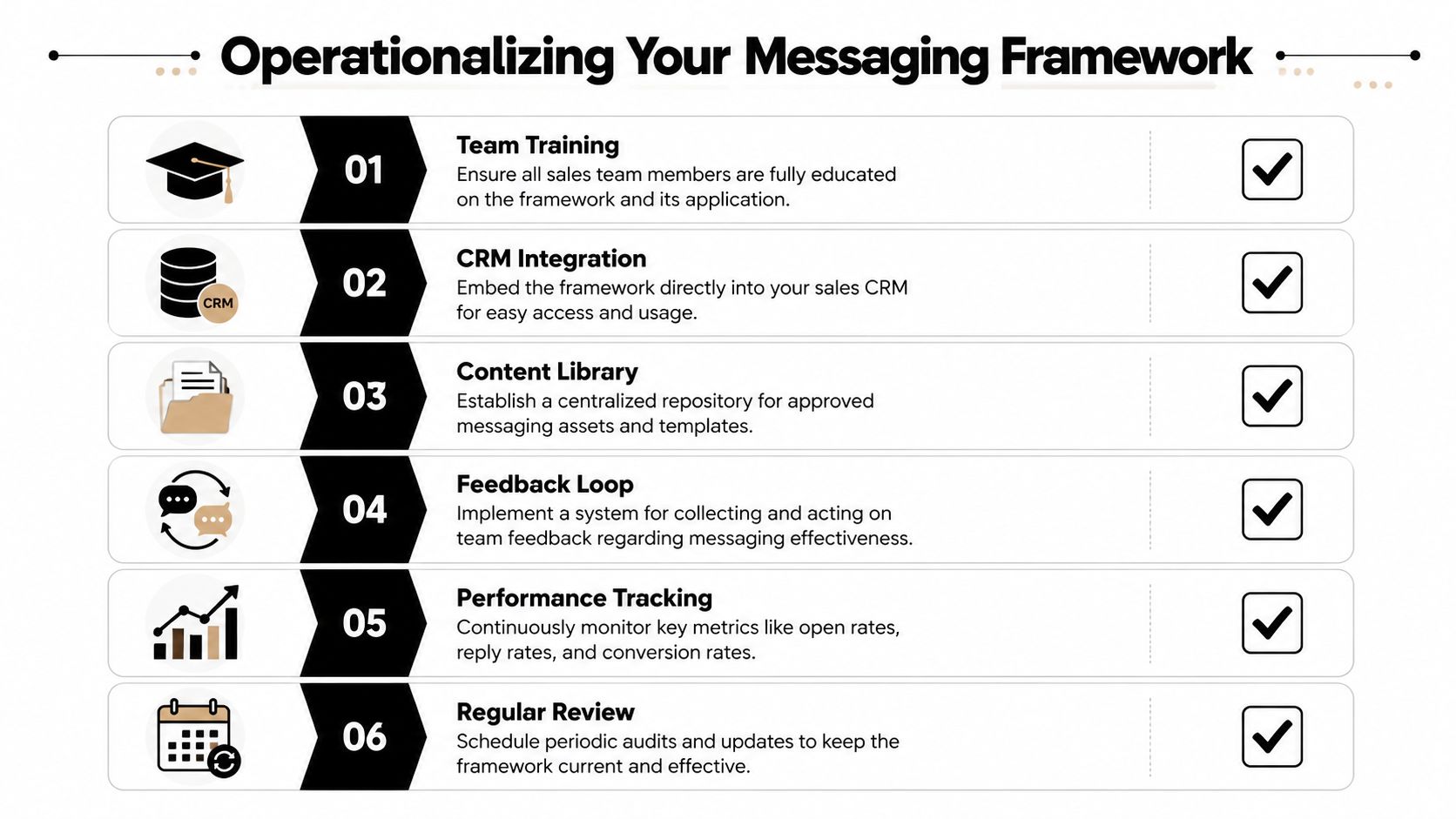
A more useful view is to treat messaging as a cross-functional workflow. One industry source points out that most public guidance explains the parts of a framework but rarely shows how to turn it into repeatable execution across teams, channels, and sales motions. It argues that this operational gap matters because a modern framework should function as a cross-functional operating system, not just a document from Reply.
Put the framework where the team works
If the framework lives in a deck no one opens, adoption will die quickly.
Embed it into the systems people already use:
-
CRM fields and notes so reps can match pillars to persona or segment
-
Sequence templates so approved language appears inside daily workflow
-
Content library with proof points, objections, and approved claims
-
Call prep docs that connect email language to discovery questions
If your outbound engine is growing, infrastructure matters too. This guide on cold email infrastructure for high deliverability is worth reviewing because even strong messaging won’t help if the emails don’t consistently land and get seen.
Create a review rhythm
Operationalization needs rhythm, not occasional cleanup.
A practical review loop includes:
| Review area | What the team checks |
|---|---|
| Segment performance | Which ICPs respond to which pillars |
| Message quality | Whether claims are clear, differentiated, and credible |
| Proof usage | Which evidence supports replies versus which gets ignored |
| Sales feedback | Which lines open conversations on calls |
This isn’t about rewriting everything all the time. It’s about tightening what the market is already telling you.
Good messaging governance is simple. Decide what language is approved, what proof supports it, and who updates it when campaigns start drifting.
Train for consistency, not scripts
The goal isn’t robotic repetition. It’s controlled variation.
Reps should know the core promise, the pillars, the approved support points, and the boundaries around claims. Then they can adapt by persona and context without inventing a new narrative every week.
That balance matters because outbound teams need both consistency and flexibility. If you force scripts, copy gets stiff. If you allow total freedom, message drift returns.
The best messaging framework sits in the middle. Clear enough to standardize. Flexible enough to personalize. Measurable enough to improve.
If your team has product-market fit but outbound still feels inconsistent, Fypion Marketing can help turn your messaging framework into a working cold email system, from research and message development to campaign execution and qualified meetings.