
SaaS Lead Generation Agency: Your 2026 Guide
A lot of SaaS teams hit the same wall. The product is solid, churn is under control, customers say good things on calls, but the pipeline still feels random.
One month the calendar has demos. The next month it does not. Inbound slows down, founder-led outbound stalls, and the sales team starts working old lists because there is nothing new to work.
That is usually the moment a company starts looking for a saas lead generation agency. Not because outreach is mysterious, but because doing it well takes specialized execution, tight feedback loops, and a level of operational discipline most SaaS teams do not have time to build internally while also shipping product and closing deals.
Your SaaS Product is Great But Your Calendar is Empty
You know the pattern.
The product solves a real problem. Early customers stay. Referrals happen often enough to prove there is demand. But pipeline creation still depends on luck, founder energy, or one sales rep having a good month.

I have seen this most often in SaaS companies that did the hard part first. They built something useful. Then they assumed demand generation would become easier once the product improved.
It rarely works that way.
Why good products still struggle to create pipeline
Inbound alone is inconsistent for many B2B SaaS companies. Content takes time. SEO compounds slowly. Paid can create interest, but not always qualified sales conversations.
At the same time, ad hoc outbound usually falls apart for boring reasons:
-
No real ICP definition: Teams target companies that look plausible, not accounts with a high likelihood to buy now.
-
Weak messaging: Emails describe features instead of tying pain to a commercial outcome.
-
No infrastructure discipline: Outreach gets launched before inbox health and deliverability are handled.
-
No ownership: Marketing writes copy, sales sends it, nobody manages the full system.
That is why a specialist partner can matter. Not as another vendor to manage, but as a dedicated team responsible for turning a target market into booked conversations.
A useful reality check comes from RevenueZen. Only 19% of SaaS companies currently collaborate with marketing agencies, yet SaaS firms that partner with agencies experience 2.3x faster organic traffic growth compared to those relying solely on in-house teams. Freelancers are still the dominant choice among 67% of SaaS companies, but agency-supported businesses show stronger results (RevenueZen SaaS content marketing statistics).
What this means in practice
Many teams are still trying to stitch growth together internally. That creates an opening for companies willing to use outside specialists with tighter execution.
If your pipeline is inconsistent, the issue is usually not effort. It is system design.
A saas lead generation agency makes sense when you already have product-market fit signals and need a more predictable path to qualified meetings.
If you want a broader view of how outbound, content, and conversion work together, this lead generation for SaaS growth playbook is a useful companion. The core idea is simple. Pipeline should be built intentionally, not hoped for.
What a SaaS Lead Generation Agency Does
A specialist agency is not just a group of people sending cold emails. The good ones function more like an outsourced R&D unit for your pipeline.
They test market segments, sharpen positioning, identify buying signals, and build repeatable outreach systems that your internal team can learn from. Generalist agencies usually sell activity. A specialized saas lead generation agency sells learning, pipeline, and decision-quality feedback from the market.
Generalist agency versus specialist operator
A generalist digital marketing firm often offers SEO, paid media, design, web work, and outbound under one roof. That can work if you need broad support.
It usually fails when you need consistent appointment setting in B2B SaaS. Outbound is too operationally demanding to be a side service.
A specialist agency focuses on a narrower set of jobs:
-
ICP research: who should you target, and who should you ignore
-
List strategy: which roles, accounts, buying triggers, and segments deserve outreach
-
Message testing: which pain points generate replies from your market
-
Deliverability management: whether your emails land in the inbox or disappear
-
Meeting qualification: whether booked calls are worth your AE’s time
If you want an outside perspective on channel design, this modern playbook for SaaS lead generation gives a useful overview of how current SaaS teams think about acquisition beyond generic lead volume.
What they own day to day
The best agencies take responsibility for the part most internal teams underestimate. The boring middle.
That includes inbox setup, list hygiene, sequence writing, testing, reply handling, calendar coordination, and feedback loops with sales. None of it is glamorous. All of it matters.
Here is the practical difference between a weak partner and a strong one:
| Agency behavior | What it usually means |
|---|---|
| Talks about impressions, awareness, and activity | They may not be accountable for meetings |
| Asks detailed questions about ICP, deal size, and objections | They understand revenue context |
| Wants access to call feedback and CRM outcomes | They plan to optimize from closed-loop data |
| Pushes back on broad targeting | They care about fit more than volume |
The work is operational, not theoretical
A lot of SaaS leaders hire agencies expecting strategy and underestimate execution. Strategy matters, but pipeline is created by disciplined repetition.
That is why outsourced support only works when the agency has a clear operating system. If you are comparing options, this overview of outsourced marketing services is helpful because it frames the bigger outsourcing decision, not just outbound in isolation.
A real lead gen partner should be able to explain who they target, how they test messaging, how they protect sender health, and how they define a qualified meeting without using vague language.
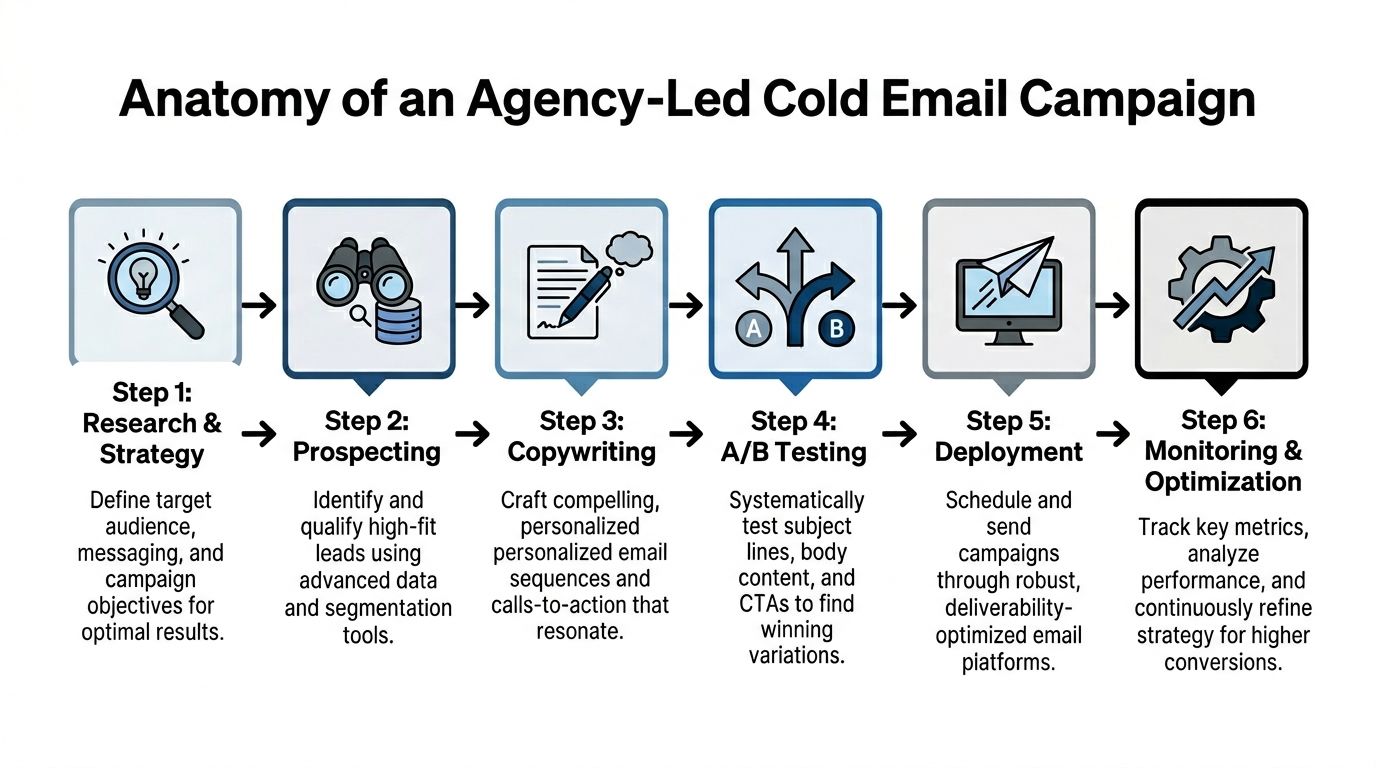
Anatomy of an Agency-Led Cold Email Campaign
Cold email works when the agency treats it like a system, not a blast.
Most failed campaigns break long before the first email goes out. The targeting is sloppy, the message sounds generic, the inbox setup is ignored, and the team starts measuring success by opens instead of meetings.
A competent campaign follows a sequence of work that is much more structured than most SaaS teams expect.
Research starts before copy
The first job is not writing emails. It is deciding who should receive them.
That usually means pressure-testing your ICP, segmenting by company profile and buyer role, and identifying the problem that is painful enough to justify a meeting now. Many agencies rush this stage because clients want motion. That is a mistake.
A solid agency will usually ask questions like:
-
Which customer cohort closes fastest: Not your favorite customers. The ones with the shortest path from first call to signed deal.
-
Which use case has urgency: Pain that already has budget beats hypothetical interest.
-
Which buyer can say yes: Outreach to the wrong title can generate replies and still produce no pipeline.
-
Which message angle reflects buyer language: Demo requests rarely come from clever copy. They come from relevance.
Deliverability is part of go-to-market
This is the part many founders never see.
Before launch, the agency has to make sure the technical side of outbound is sound. If they skip that work, good copy will still fail. Outreach teams that know what they are doing treat sender reputation and inbox health as core campaign assets.
That discipline includes list quality, sending behavior, reply management, and ongoing deliverability monitoring. It is not flashy, but it is the difference between real testing and bad data.
For teams building or auditing this process internally, this guide to a modern playbook for B2B cold email outreach covers the mechanics in more detail.
Prospecting and list building decide campaign quality
List building is where many agencies lower standards. They pull broad contact data, add loose filters, and rely on volume to make the numbers work.
That creates expensive noise.
A better process narrows the list before launch. Good agencies usually define account criteria first, then role criteria, then disqualifiers. They would rather send fewer emails to higher-fit prospects than flood the market with mediocre outreach.
That means the list should reflect things like current relevance, product fit, role authority, and whether the account matches the buyer profile that closes.
Sequence writing is about friction, not persuasion tricks
Strong cold email copy does not try to sound impressive. It reduces friction.
That usually means short messages, clear relevance, one idea per email, and a CTA that asks for a low-commitment next step. Agencies that write like ad copywriters often miss the mark. SaaS buyers do not need hype. They need a reason to engage.
A typical sequence has several touches. Each one should do a different job. One introduces the problem. Another reframes timing. Another adds context. Another checks if the issue is even relevant.
Here is where agencies earn their fee. They do not just write one sequence and hope. They test:
-
Targeting variations across segments or buyer roles
-
Messaging angles tied to different pains or priorities
-
Subject lines to improve initial engagement
-
Calls to action that lower the barrier to reply
A useful visual overview of agency workflow sits below.
Launch is the beginning, not the finish line
Inexperienced teams think the campaign is done at this point. Experienced teams know launch only creates the first layer of feedback.
Once replies come in, the agency should categorize them, identify objections, refine copy, tighten targeting, and improve qualification rules. Every booked meeting should feed insight back into the campaign.
That feedback loop usually answers practical questions:
-
Are the right personas replying?
-
Are prospects interested but too early?
-
Are meetings booking but not showing?
-
Is the problem compelling but the CTA weak?
-
Is sales rejecting meetings for fit reasons?
One provider that uses this operating model is Fypion Marketing, which runs cold email on a pay-per-qualified-meeting basis rather than charging setup fees or retainers. That structure only works if the agency can handle research, list building, messaging, inbox management, and qualification as one integrated system.
The best campaigns get sharper after launch. The weak ones just send more volume.
Agency Pricing Models Retainer vs Pay-Per-Meeting
Pricing tells you how an agency thinks about accountability.
Most SaaS buyers focus on cost first. That is understandable, but it misses the more important question. Who carries the risk when campaign quality is weak?
For many companies, this is the dividing line between a generic vendor relationship and a performance-driven one.
Why retainers create misalignment
The traditional retainer model is easy to understand. You pay a fixed monthly fee for effort, access, and deliverables.
The problem is not that retainers are always bad. The problem is that they often pay for motion without guaranteeing useful outcomes. An agency can stay busy, send reports, hold meetings, and still produce a calendar full of weak calls or no calls at all.
Belkins notes that most agencies operate on retainers, but this model often lacks direct outcome alignment. Performance-only models, where payment occurs solely for booked meetings, can reduce CAC by 40-60% by eliminating payment for poor-quality leads. The same source also points to cases documenting 220% month-over-month lead growth when sales teams focus on closing qualified deals instead of chasing poor-fit leads (Belkins on SaaS lead generation agencies).
That does not mean every retainer agency is ineffective. It means you should understand what the model rewards.
The cleaner logic behind pay-per-meeting
In a pay-per-qualified-meeting model, the agency gets paid when it produces a meeting that fits pre-agreed criteria. The core appeal is obvious. Incentives are tied more closely to pipeline outcomes.
That changes behavior on both sides.
The agency has to care about targeting, message-market fit, and qualification quality because poor meetings do not help. The client has to define qualification clearly and give timely feedback because ambiguity breaks the system.
Here is the practical comparison.
Agency Pricing Model Comparison Retainer vs. Pay-Per-Meeting
| Criterion | Traditional Retainer Model | Pay-Per-Meeting Model |
|---|---|---|
| Primary payment logic | You pay for ongoing service scope and activity | You pay for qualified meetings that match agreed criteria |
| Risk allocation | More risk sits with the client if output is weak | More risk shifts toward the agency |
| Incentive alignment | Can reward effort even when pipeline quality is mixed | Ties compensation more directly to meeting outcomes |
| Cash flow predictability | Predictable monthly expense | Variable spend tied to delivery |
| Pressure on qualification | Sometimes lower if reporting centers on activity | Usually higher because bad meetings create disputes |
| Best fit | Teams that want broad support and can manage performance tightly | Teams with proven offer-market fit that want tighter ROI accountability |
| Common failure mode | Paying for deliverables that do not convert into sales conversations | Poor qualification definitions causing friction between sales and agency |
Which model works better for SaaS
It depends on the stage and the problem.
A retainer can make sense when you need broad go-to-market support, you have internal operators who can police quality, and you are comfortable funding experimentation. It can also work when outbound is only one part of a larger engagement.
A performance model usually makes more sense when:
-
You already know who buys: The agency is scaling a known motion, not searching for basic fit.
-
Your sales team needs meetings, not reporting: Activity metrics are not the bottleneck.
-
You want tighter CAC discipline: You do not want to fund poor-fit outreach.
-
You care about speed of feedback: Bad targeting becomes visible faster when payment depends on meeting quality.
If you are evaluating this through a finance lens, this breakdown of pay-for-performance marketing and agency alignment is worth reading because it frames the commercial logic more clearly than most agency pricing pages do.
The trade-off often missed
Performance pricing sounds cleaner, but it is not magic.
If your ICP is fuzzy, your sales process is weak, or your market message is still changing every month, even a pay-per-meeting model can struggle. The model does not fix a broken offer. It just exposes it faster.
Pay-per-meeting works best when your SaaS company already has evidence that the market buys. Then the agency’s job is to create more of the right conversations, not manufacture demand from nothing.
Retainers are not always wrong. They are just easier to hide behind. That is why pricing should be evaluated as a question of risk, incentives, and how quickly weak execution becomes visible.
The KPIs That Signal Real Pipeline Growth
Most agencies report too many metrics and too little insight.
Open rates, click rates, sends, and reply counts can all be useful diagnostics. None of them should be the main scorecard. If they are, you are probably paying attention to campaign activity instead of pipeline momentum.
The metric that deserves more attention in SaaS is Lead Velocity Rate, or LVR.

Why LVR matters more than raw lead volume
Lead volume is static. LVR measures acceleration.
The formula, as defined by SaaS Hero, is ((This Month’s Qualified Leads - Last Month’s Qualified Leads) / Last Month’s Qualified Leads) × 100. The same source states that 15%+ month-over-month signals sustainable growth, while elite agency performance reaches over 20% month-over-month. It also connects strong execution to 98%+ inbox placement and 25-40% open rate uplift from A/B testing subject lines, and notes examples of 220% month-over-month lead growth in performance-oriented setups (SaaS Hero on SaaS GTM metrics).
That matters because an agency can book meetings one month through brute force or luck. LVR tells you whether the system is gaining momentum.
How to read the full KPI stack
A healthy outbound program needs a chain of metrics, not one number in isolation.
Use them in order.
-
Inbox health and placement This tells you whether the campaign is being seen at all. If inbox placement drops, every downstream metric becomes misleading.
-
Positive reply rate This is not the same as total replies. Positive replies indicate whether your targeting and message are resonating.
-
Qualified meetings booked This metric is where many agency reports should start, not where they end.
-
Show-up rate A booked meeting that never happens is not pipeline. It is admin work.
-
Meeting-to-opportunity conversion This is one of the clearest ways to judge lead quality. If meetings happen but opportunities do not form, the problem is usually in targeting, qualification, or expectation-setting.
-
LVR This shows whether the system is compounding or flattening.
A practical dashboard should show the relationship between these metrics, not just the metrics themselves.
What vanity metrics hide
Agencies love reporting what looks active. Clients often let them. Consider this cleaner way to approach it:
| Metric type | Useful for | Dangerous when used alone | |---|---| | Opens | Deliverability checks and subject line testing | Apple Mail privacy and weak correlation with revenue | | Replies | Early signal of message resonance | Includes low-quality or irrelevant responses | | Meetings booked | Operational output | Can hide poor qualification | | Opportunities created | Sales relevance | Still needs context from volume and trend | | LVR | Forward-looking growth signal | Needs stable qualification criteria |
If an agency sends a long report and cannot explain why meeting quality improved or worsened, the reporting is decoration.
For teams that want a more practical KPI framework, this guide on mastering lead gen KPIs for business growth is a strong reference.
Ask your agency to show trend lines, not snapshots. One good month can happen by accident. A rising LVR with stable qualification standards is much harder to fake.
How to Choose the Right Agency and Avoid Common Pitfalls
Most agency sales calls sound polished. That is not the same thing as being a good operator.
The fastest way to avoid a bad hire is to stop evaluating confidence and start evaluating process. A strong saas lead generation agency should be able to explain exactly how it targets, tests, qualifies, reports, and adjusts.
If they cannot, the odds are high that you are buying presentation quality, not pipeline quality.
Questions worth asking on the first call
You do not need a giant procurement process. You need sharp questions.
Ask things that expose how the agency works.
-
How do you define a qualified meeting? If they answer vaguely, your sales team will pay for it later.
-
What happens when sales rejects booked calls? Good agencies have a dispute and feedback process. Weak ones get defensive.
-
How do you refine messaging after launch? You want a partner that learns from replies, objections, and call outcomes.
-
Who owns inbox management and reply handling? This work cannot sit in a blind spot.
-
What do you need from us weekly? Strong partners know the cadence required to keep quality high.
-
What types of SaaS motions do you support best? Sales-led, founder-led, product-led with outbound assist. Their answer should be specific.
Red flags that usually show up early
Bad agencies often reveal themselves fast if you know what to watch for.
They talk about volume before fit
If the first solution is more contacts, more sends, or more channels, be careful. Volume hides weak targeting for a while.
They avoid qualification detail
Some agencies love booking meetings and hate discussing what makes a meeting worth paying for. That gap becomes expensive.
They report activity, not progression
If their sample reporting is mostly email sends, open rates, and generic reply totals, expect a lot of noise.
They promise they can target anyone
Specialists know every market is not equally easy to penetrate. Generalists say yes to everything.
Good agencies narrow scope. Weak agencies broaden promises.
How to vet operating depth
A practical shortcut is to ask what tools and workflows they rely on across prospecting, sequencing, CRM visibility, and reporting. Not because the specific tool list guarantees quality, but because serious teams usually have clear opinions about their stack and process.
If an agency serves other firms, directories built around dedicated resources and solutions for agencies can help you understand how mature agency operations are supposed to look behind the scenes.
You should also ask for evidence of how they manage campaign learning:
-
Do they revise targeting based on closed-lost reasons?
-
Do they rewrite sequences after enough real reply data comes in?
-
Do they separate curiosity replies from buying-intent replies?
-
Do they coordinate with sales on no-show patterns and objection trends?
The best choice is rarely the cheapest or the loudest
A low-cost agency that fills calendars with weak calls is not cheaper. A famous brand that gives you junior execution after the deal closes is not safer.
What usually works is simpler. Hire the team whose incentives, process, and communication style match how your sales team operates.
That means:
| What to evaluate | What a strong answer sounds like |
|---|---|
| Qualification | Specific, measurable, and co-defined with sales |
| Feedback loop | Weekly or recurring review tied to outcomes |
| Reporting | Pipeline-focused, not vanity-heavy |
| Targeting approach | Narrow, justified, and testable |
| Commercial model | Clear on what you pay for and what happens when quality slips |
The wrong agency creates more meetings for your calendar software. The right one creates more meetings your account executives want.
Frequently Asked Questions About SaaS Lead Gen Agencies
How important is global coverage if we want to expand beyond the US
It matters more than most agency websites suggest.
Profitbl highlights a common gap in the market. Many top lead generation agencies are over 80% focused on US/English campaigns, even though SaaS growth in APAC and EMEA is significant. Buyers in those regions need localized touchpoints, and agencies without multilingual SDRs or cultural expertise often fail to produce positive ROI (Profitbl on outbound lead generation agencies for B2B SaaS).
If international growth is part of your plan, ask very direct questions:
-
Which non-US markets have you actively prospected into
-
How do you adapt messaging for local buying expectations
-
Who handles language nuance and reply management
-
How do you qualify meetings across different buying committees
An agency that only knows US SaaS outbound can still be useful. It just may not be the right partner for expansion.
How long does onboarding usually take
The honest answer is that it depends on complexity. A narrow ICP, clear offer, and clean approval process move faster. A broad market, multiple personas, or unclear qualification rules slow everything down.
What matters more is whether the agency has a visible sequence of work. Research, account selection, messaging, inbox preparation, list build, launch criteria, and feedback cadence should all be mapped before outreach starts.
If a partner promises instant launch without doing that groundwork, they are probably skipping the work that protects performance.
What counts as a qualified meeting
This should never be left vague.
A qualified meeting usually combines firmographic fit, role relevance, and genuine interest in the problem you solve. In many SaaS teams, that means agreeing in advance on target company type, target titles, disqualifiers, and what level of intent makes a meeting billable or accepted.
The simplest rule is this. If your sales team would consistently take the call seriously, it is likely qualified. If reps keep calling the meetings bad, the criteria are too loose or not being enforced.
Should we hire an agency if our message is still evolving
Sometimes yes, but with caution.
If you have clear customer value and a defined buyer, an agency can help sharpen messaging through market feedback. If the product, buyer, and use case are all still moving, even a good agency will struggle to build repeatability.
Agencies scale what is already directionally working. They are not a substitute for basic market clarity.
If you want a partner that runs cold email on a pay-per-qualified-meeting basis instead of locking you into upfront fees or a monthly retainer, Fypion Marketing is built for that model. They support B2B companies, including SaaS teams with proven product-market fit, by handling research, targeting, outreach execution, and optimization around one outcome: qualified meetings your sales team can close.