
Storytelling in Sales: How to Win Deals and Influence Buyers

Your team writes the email. The subject line looks solid. The copy explains the product clearly. It lists the features, mentions the integration, names the dashboard, and closes with a polite call to action.
Then nothing happens.
No reply. No forward. No meeting. Just another well-intended cold email dropped into a crowded inbox beside ten others that all sound roughly the same. That’s where most sales outreach breaks down. The message is logical, but it doesn’t give the buyer a reason to care right now, remember it later, or repeat it internally.
Feature-led outreach usually assumes the prospect will connect the dots on their own. In complex B2B sales, they rarely do. Buyers are screening for relevance, risk, and credibility in seconds. If your email reads like a product sheet, it gets treated like one.
The Unread Email and the Missed Opportunity
A common cold email sounds like this:
Hi Sarah, we help revenue teams streamline lead routing, improve data enrichment, and increase outbound efficiency through AI-powered workflows. Our platform integrates with your existing stack and helps teams save time while improving pipeline quality. Open to a quick call next week?
Nothing is technically wrong with that message. It’s just forgettable. It starts with the seller’s offer, not the buyer’s problem. It uses broad claims instead of a concrete situation. It asks for a meeting before earning enough trust to justify one.
Most reps have sent some version of that email. Most buyers have deleted some version of it.
What the buyer sees
A busy operations leader isn’t reading your email like a marketer reviewing copy. They’re scanning for three things:
-
Relevance: Is this about a problem I have?
-
Credibility: Does this sound grounded in reality or polished beyond belief?
-
Effort: Can I understand the point without rereading it?
When the email opens with product language, the buyer has to do the mental work. They have to translate features into business impact. They have to guess whether you understand their environment. They have to decide whether your claim is specific enough to trust.
That’s too much friction for a cold touch.
What changes when you tell a story
A better email doesn’t get longer. It gets sharper. Instead of saying, “we improve outbound efficiency,” it says, “teams often hit a point where reps spend more time sorting accounts and fixing list quality than starting conversations.” That’s the beginning of a story. It names a real situation. It creates recognition.
A story in sales outreach doesn’t mean drama. It means giving the buyer a sequence they can follow. Here’s the problem. Here’s what changes. Here’s why it matters. That structure earns attention because it mirrors how buyers make sense of risk.
If your subject lines are getting ignored before your story even starts, it’s worth tightening that first layer too. This breakdown of sales email subject line approaches pairs well with story-led outreach because relevance starts before the body copy.
Why Stories Sell More Than Spreadsheets
Data matters. In B2B sales, it matters even more when the buyer has to defend the purchase to finance, procurement, or a technical reviewer. But data without narrative often lands as disconnected proof. It informs without moving the conversation forward.
Stories give the proof a frame.
Research on narrative transportation suggests that stories can materially shape persuasion outcomes. A 2020 meta-analysis of 186 effect sizes found a positive overall effect of narrative persuasion on beliefs, attitudes, intentions, and behaviors, with the strongest effects typically appearing when the audience is absorbed in the story, as summarized in ZoomInfo’s discussion of storytelling in sales.
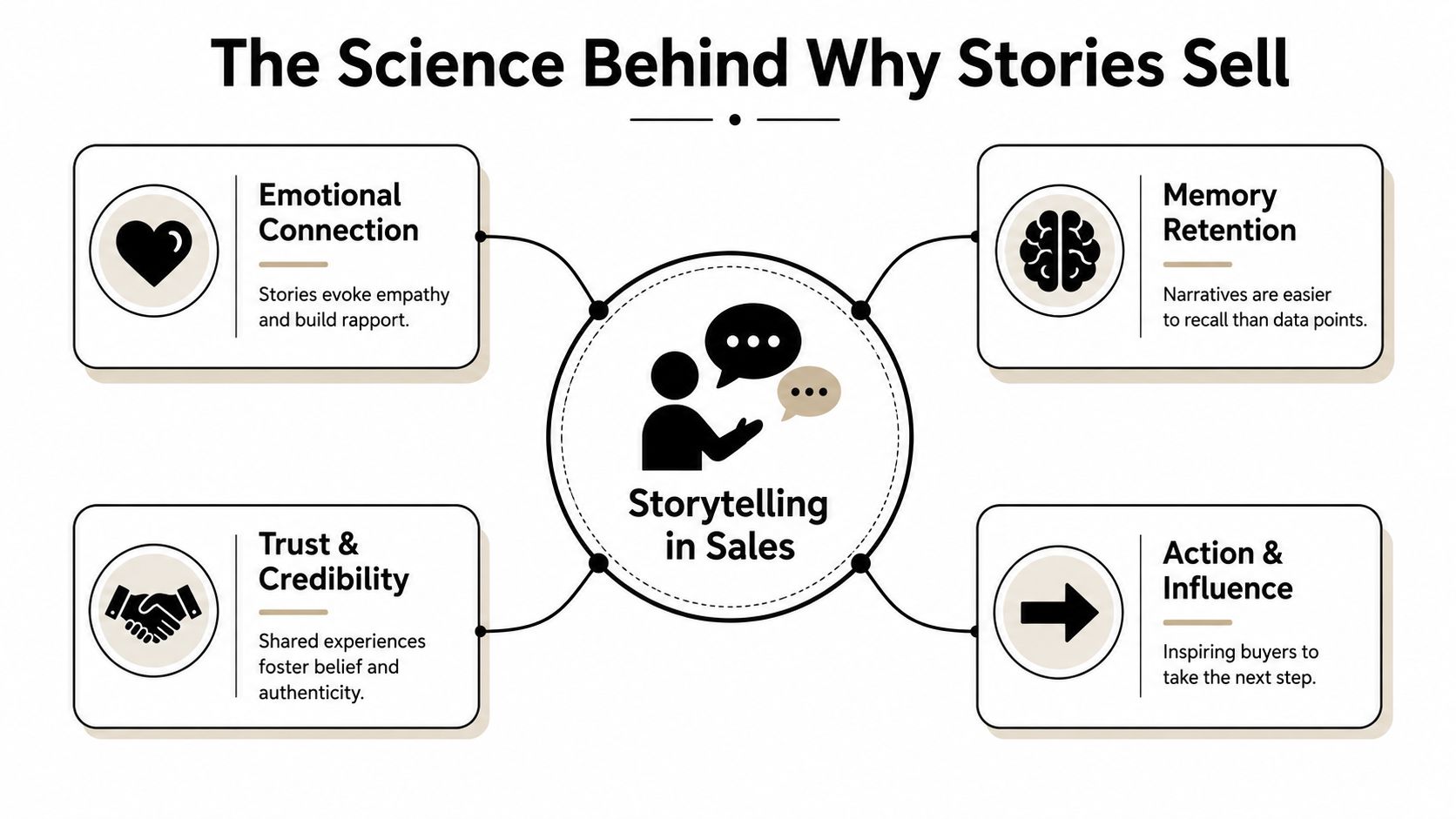
Story gives data meaning
A spreadsheet can tell a buyer what happened. A story helps them understand why it matters and whether it applies to them.
If you tell a prospect, “our platform improves reporting visibility,” they may agree that visibility is useful. If you say, “revenue leaders often find out too late that rep activity looks healthy while opportunity quality is slipping underneath it,” the buyer can place your message inside a business problem they recognize.
That’s the difference. Raw claims stay abstract. Stories make the risk feel operational.
Stories reduce interpretation work
Every cold email competes with the buyer’s existing priorities. They don’t want to decode your message. They want to know whether it belongs in the small pile of things worth revisiting.
Storytelling in sales works because it reduces the amount of interpretation the buyer has to do. Instead of forcing them to connect feature to pain to impact, you do that work for them in a compact sequence.
Three effects usually follow:
-
Faster comprehension: Buyers grasp the relevance quickly.
-
Better recall: A situation is easier to remember than a list.
-
Stronger internal retelling: The message can travel beyond the first recipient.
That last point matters more than most reps realize. In committee-driven deals, your first contact often isn’t your final decision-maker. Your email has to survive internal retelling.
Practical rule: If a buyer can’t summarize your message to a colleague in one or two sentences, the outreach is too complex.
Storytelling is not the opposite of rigor
Some sales teams resist storytelling because they associate it with polish, hype, or vague emotional language. That’s a mistake. Strong sales stories are concrete. They use tension, but the tension comes from the buyer’s operating reality, not from theatrics.
A useful way to think about it is this:
| Approach | What the buyer hears | Likely reaction |
|---|---|---|
| Feature-first | “We have capabilities” | “Maybe useful, not urgent” |
| Data-only | “We have proof” | “Interesting, but what’s the point?” |
| Story with proof | “This looks like a problem we may need to solve” | “Worth a reply or internal share” |
A clear value proposition framework for B2B messaging becomes much stronger when it’s delivered inside a real buyer scenario instead of as a polished slogan.
Simple Frameworks for Powerful Sales Stories
Most reps don’t need to become gifted storytellers. They need a repeatable structure they can apply under pressure. Good outreach is usually built from a small number of reliable patterns.
One of the most useful is the problem-solution-impact sequence. Domo describes data storytelling as combining data, narrative, and visuals, and recommends starting with context, then the problem, then the solution and insights in its explanation of data storytelling principles. That maps directly to strong sales messaging.
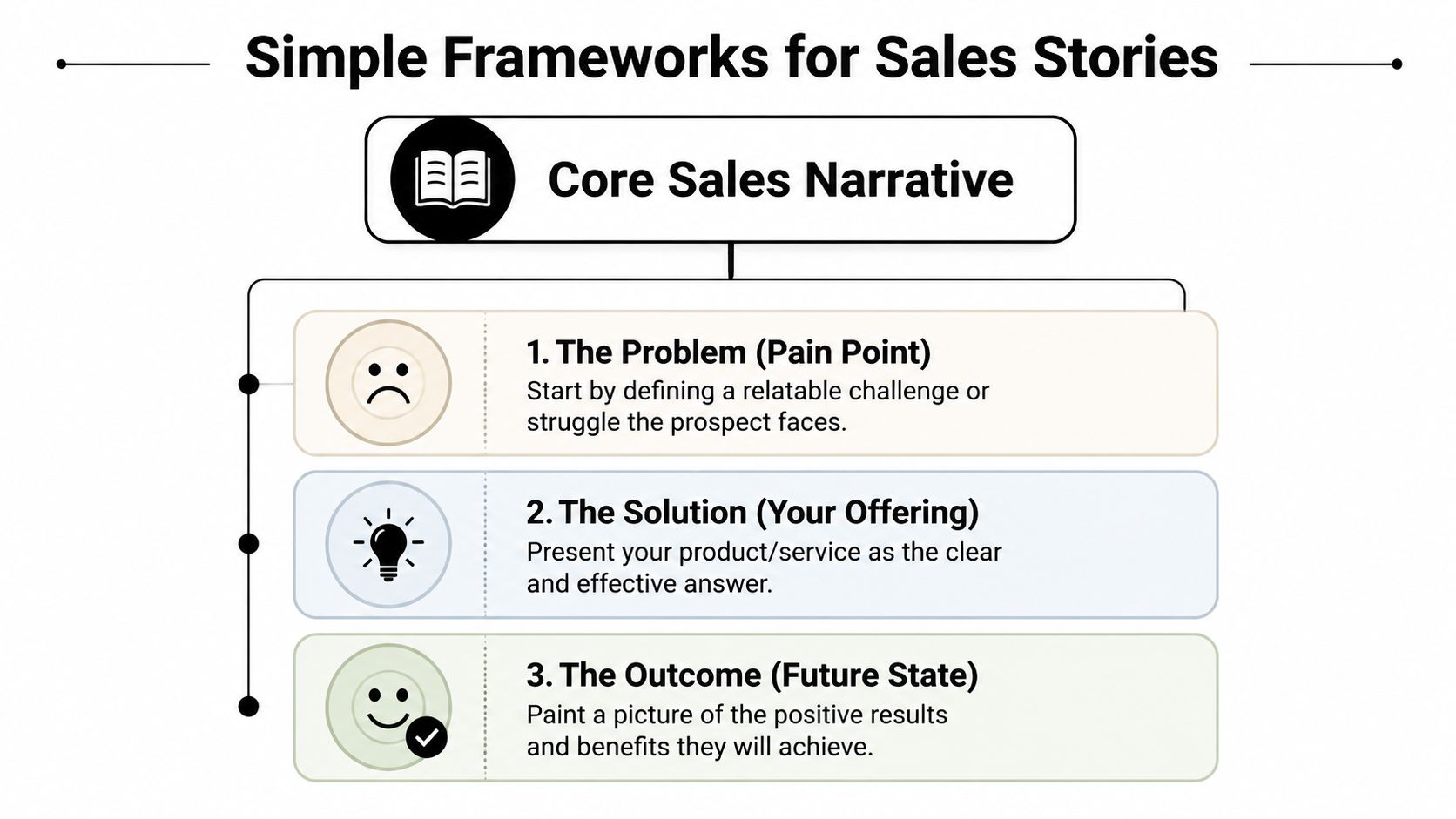
Problem, solution, impact
This is the cleanest framework for cold outreach because it mirrors how business buyers evaluate change.
Problem
Start with the buyer’s current state. Not a generic industry challenge. A specific operational drag, reporting gap, handoff issue, or growth blocker they’re likely to recognize.
Example:A demand generation leader may not need “more pipeline” in the abstract. They may need fewer wasted touches caused by weak targeting and disconnected outreach.
Solution
Introduce the category of change, not a full product pitch. In email, the solution should feel like a plausible next step, not a product demo compressed into two lines.
Example:Instead of listing every capability, say that some teams fix the issue by tightening account selection, rewriting messaging around buyer pain, and sequencing touches around one clear story.
Impact
Show the future state. At this point, the buyer decides whether the issue is worth discussing. The impact should sound useful, not inflated.
Example:The result might be cleaner conversations, better-qualified replies, and more confidence when the message reaches other stakeholders.
A second option for colder audiences
When the buyer is skeptical or heavily regulated, use obstacle, proof, next step.
This structure works well when credibility is the main hurdle.
-
Obstacle: Name the condition that makes change difficult.
-
Proof: Add a grounded example, data point, or observable pattern.
-
Next step: Offer a narrow conversation, audit, or comparison.
That helps you avoid sounding like you’re skipping past the buyer’s constraints.
Stories for enterprise buyers should sound audit-friendly. If procurement or a CFO read the email later, the language should still hold up.
The micro-story formula for email
Cold email needs compression. You don’t have room for a case study. You do have room for a believable shift.
Use this formula:
-
Current pain
-
Why it persists
-
What changes
-
Low-friction CTA
A simple version looks like this:
-
Current pain: “Many RevOps teams hit a point where routing logic looks fine on paper but reps still lose time working around it.”
-
Why it persists: “The issue usually isn’t one broken rule. It’s the accumulation of small process gaps.”
-
What changes: “Once those gaps are mapped, handoffs become easier to trust.”
-
CTA: “Worth comparing notes?”
If your team needs a more formal system for turning positioning into outreach copy, this messaging framework guide is useful because it forces tighter alignment between audience pain and the story you tell.
Putting Stories to Work in B2B Cold Outreach
The biggest mistake in cold email isn’t bad writing. It’s trying to say too much before the buyer has any reason to listen. Storytelling in sales fixes that by replacing the feature dump with a compact, credible sequence.
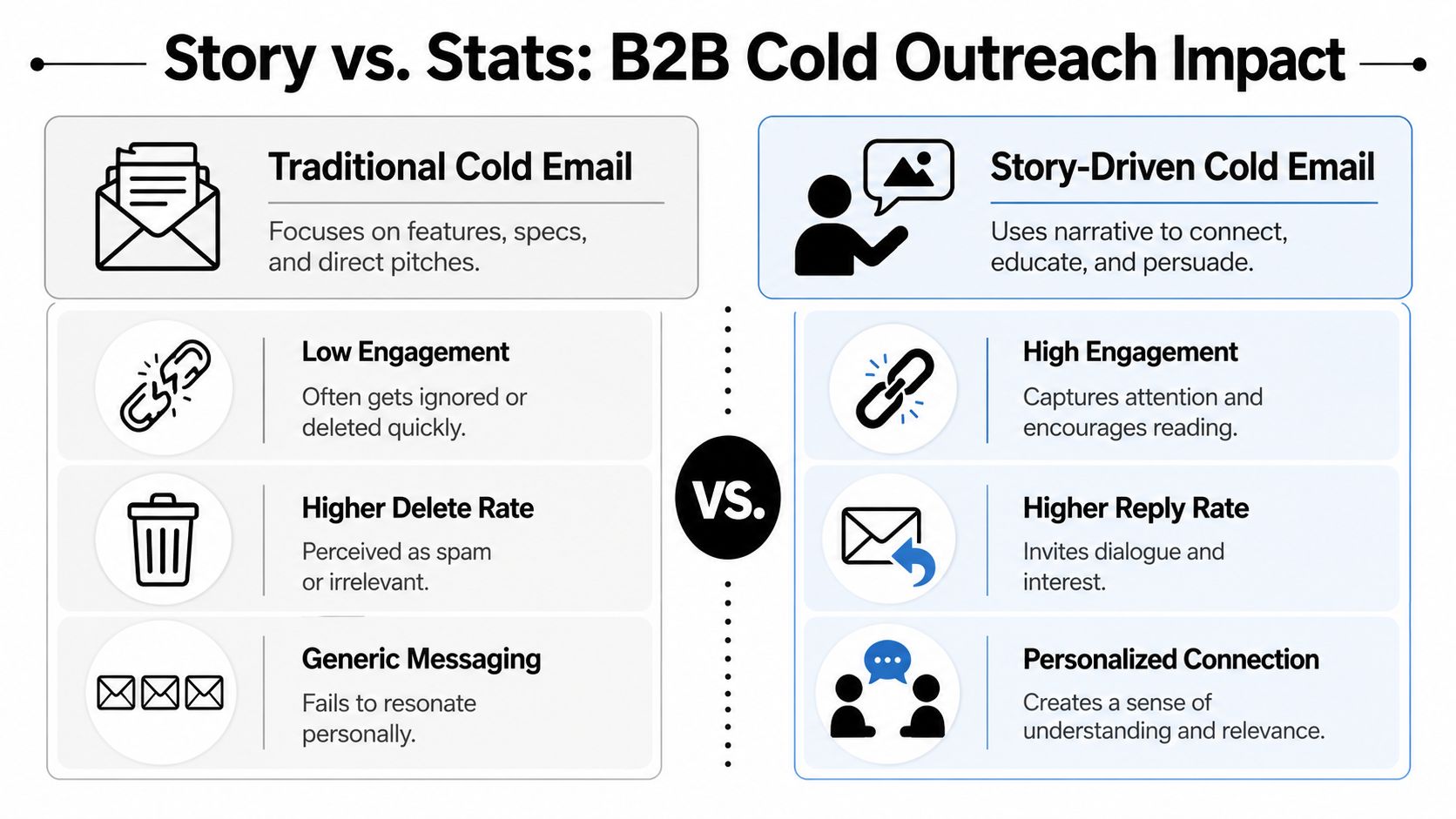
Guidance on modern outreach keeps pointing to the same challenge. The issue isn’t whether stories belong in sales. It’s how to compress them for email-first campaigns. Prezent’s sales storytelling guidance emphasizes that outreach stories need to be concise, relevant, and grounded in the buyer’s context so they can cut through short attention spans without losing credibility.
Before and after
Here’s a typical feature-led email.
| Version | |
|---|---|
| Before | Hi Amanda, we help B2B companies improve outbound results through advanced personalization, data enrichment, deliverability optimization, and campaign management. Our team works with SaaS brands to generate more qualified meetings. Open to a quick intro call? |
That email explains the offer. It doesn’t create urgency, recognition, or trust.
Now compare it to a story-led version.
| Version | |
|---|---|
| After | Hi Amanda, a lot of outbound teams don’t have a volume problem. They have a relevance problem. Campaigns go live, messaging sounds polished, but buyers don’t see their own situation in the first few lines, so the email gets ignored. We work with teams that want to tighten targeting and build cold email around buyer-specific stories instead of generic value claims. Worth a brief comparison? |
The second email still sells. It just sells through recognition.
Why the second version works
It earns attention in three ways:
-
It starts with the buyer’s world. The first line names a real issue.
-
It avoids inflated language. Nothing sounds exaggerated or overproduced.
-
It makes the service feel like a response to a problem, not a pitch in search of one.
That matters in committee-based B2B sales. A polished claim can trigger skepticism. A concrete situation lowers it.
A fill-in-the-blanks cold email template
Use this when you need a short first touch that still feels human.
Subject idea: Quick question about [process/problem]
Email body:
Hi [First Name],
Many [role/team] teams hit a point where [specific pain] starts slowing down [business outcome].
Usually it’s not because [obvious explanation]. It’s because [deeper operational cause].
We help teams address that by [brief solution category], so [practical impact].
Would it be unreasonable to compare notes on whether that’s showing up in your team?
This works because it creates movement. Sentence one sets the problem. Sentence two adds insight. Sentence three introduces change. Sentence four asks for a small step.
Here’s a useful walkthrough if you want to see outreach systems built around that kind of message logic rather than generic sequencing. This modern B2B cold email outreach playbook is closely aligned with how story compression works in appointment-setting campaigns.
A practical video can also help teams hear the rhythm of a tighter narrative:
How to adapt for risk-averse buying groups
If you’re selling into finance, healthcare, enterprise IT, or procurement-heavy environments, trim the emotional language and raise the proof threshold.
Use these filters before sending:
-
Remove adjectives you can’t defend. Words like ‘game-changing’ usually weaken the email.
-
Keep examples traceable. If you mention an outcome, be ready to explain how it happened.
-
Sound like an operator. Buyers trust language that reflects process, trade-offs, and constraints.
One option for teams that want outside execution is Fypion Marketing, which runs cold email lead generation around booked qualified meetings and handles research, targeting, copy, infrastructure, and optimization as part of that process. That model fits companies that want a story-driven outbound motion without building every workflow internally.
How to Know If Your Stories Are Working
Storytelling only matters if it changes pipeline behavior. If the message feels sharper but doesn’t improve response quality, meeting quality, or sales velocity, it’s not doing its job.
A useful benchmark from marketing is often cited to show how strongly narrative framing can influence buying behavior. Storytelling can increase the perceived value of a product by up to 2,706%, according to the benchmark discussed in Sarah Long Erbo’s article on storytelling in marketing. In B2B sales, the right way to think about perceived value is practical. Does the outreach earn a response, create a better conversation, and make the offer feel worth exploring?
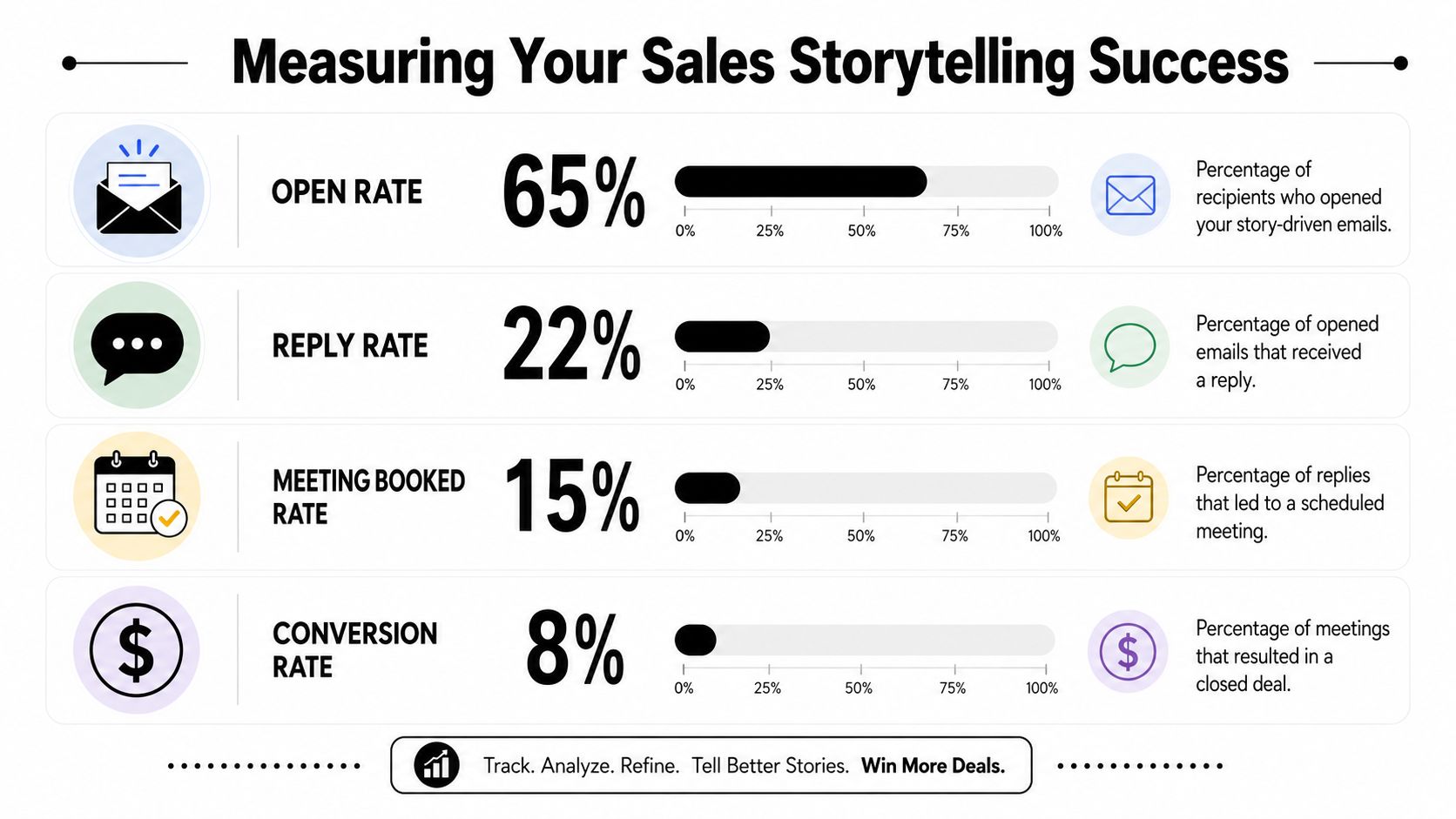
Track response quality, not just volume
Open rate matters less than commonly believed, especially when the body copy is the primary obstacle. The metrics that usually tell the truth are these:
-
Reply rate: Are buyers responding at all?
-
Positive reply rate: Are they showing interest rather than brushing you off?
-
Meeting booked rate: Are replies becoming scheduled conversations?
-
Show-up rate: Are the meetings strong enough that buyers keep the commitment?
These are the places where story quality shows up. If your emails get opens but weak replies, the subject line may be fine while the body lacks relevance. If you get replies but poor meetings, the story may attract curiosity without enough qualification.
Test one story variable at a time
Don’t A/B test five changes in one sequence and call the result insight. Change one narrative element and observe the downstream effect.
Good variables to test include:
| Story element | Version A | Version B |
|---|---|---|
| Opening tension | Operational bottleneck | Missed revenue opportunity |
| Buyer lens | Team workflow | Executive visibility |
| CTA style | Compare notes | Worth a quick discussion |
| Proof style | Peer example | Process insight |
That gives you cleaner feedback. If the executive-visibility angle books more meetings with senior leaders, you’ve learned something reusable. If the workflow angle gets more replies from managers, that’s also useful.
The point of measurement isn’t to prove that stories are elegant. It’s to learn which buyer narrative consistently creates qualified conversations.
Review the meetings, not just the inbox data
Some of the strongest signals appear after the reply. Listen for what prospects repeat back in meetings. If they open with the same problem framing you used in the email, the story landed. If they say, “I wasn’t sure exactly what you meant, but I was curious,” the story may have been too vague.
A good extension of this discipline is building a content library around repeatable buyer narratives. Audio can help there because spoken format forces clarity. If your team wants examples of turning business positioning into a stronger narrative format, this B2B brand storytelling podcasting guide is a useful resource.
From Pitch to Pipeline Your Story Begins Now
The practical version of storytelling in sales has very little to do with performance and a lot to do with clarity. You aren’t inventing drama. You’re organizing truth so a buyer can understand it quickly, trust it, and carry it into the next conversation.
That matters even more in enterprise sales, where the first reader is rarely the only evaluator. Effective stories for B2B need to work with risk-averse buying groups that want proof, traceability, and plain language. Harvard Business Review’s guidance on sales pitches and story makes the point well. The strongest pitches begin with the buyer’s obstacles and use story to create shared understanding.
What to do next
Don’t rebuild your entire outbound motion today. Start smaller than that.
Pick one segment. Choose one recurring buyer problem. Rewrite one email so it follows a clean sequence:
-
State the obstacle clearly
-
Show why it persists
-
Describe the change
-
Ask for a low-friction next step
That’s enough to begin.
What to avoid
The fastest way to ruin storytelling in sales is to overproduce it. Buyers don’t want a polished monologue in their inbox. They want evidence that you understand what slows them down and that you can discuss it without hype.
Skip these habits:
-
Generic transformation language: It sounds like marketing copy.
-
Long anecdotes: They add friction in cold outreach.
-
Claims without grounding: They create doubt, especially in multi-stakeholder deals.
The goal is simple. Send emails that feel like they were written by someone who understands how companies operate.
If you’re tightening outbound process alongside messaging, these sales pipeline management practices are worth reviewing because stronger stories work best when follow-up, qualification, and meeting handling are equally disciplined.
If your team wants a cold email program built around qualified meetings rather than vanity activity, Fypion Marketing is one option to evaluate. They work with B2B companies on research, targeting, copy, campaign setup, and optimization in a performance-driven model tied to booked meetings.