
Unlocking Growth with B2B Lead Generation Services
So, what exactly are B2B lead generation services? Think of them as an outsourced, specialized crew for your sales pipeline. Their entire job is to keep a predictable flow of qualified meetings hitting your calendar, freeing up your sales team to do what they do best: close deals.
What Are B2B Lead Generation Services

You wouldn’t try to build a skyscraper without a dedicated crew to pour the foundation, right? Trying to do it yourself would be slow, risky, and a massive distraction from actually designing the rest of the building. B2B lead generation services are that foundational crew for your sales efforts.
At the end of the day, these services are much more than just a tool for blasting out generic emails. They’re an engine for scalable growth, built to solve the painful, chronic problem of an empty or unpredictable pipeline that so many companies face.
They Do the Heavy Lifting of Prospecting
A good lead gen partner takes on all the time-consuming grunt work that can bog down even the most talented sales reps. This lets your expert closers focus their energy on conversations that lead to revenue.
Here’s a look at the key tasks they typically handle:
-
Deep-dive market research to nail down your ideal customer profile (ICP).
-
Building laser-focused prospect lists based on company size, industry, job titles, and even buying signals.
-
Running multi-channel outreach campaigns that actually engage prospects with personalized, relevant messaging.
-
Qualifying every interested lead to make sure they’re a legitimate fit before they ever get a meeting on your calendar.
This kind of strategic partnership is becoming non-negotiable. The global lead generation market is expected to balloon to $295 billion by 2027, growing at a 17% compound annual rate.
Why the explosion? Businesses are desperate for scalable pipelines, especially with 58% of B2B companies reporting that sales cycles got even longer in 2024. These numbers show a clear demand for efficient, performance-based solutions.
It’s About More Than Just Leads
The real value here goes way beyond just filling a pipeline. It’s about building a sustainable, repeatable system for growth. When you partner with experts, you get immediate access to proven strategies and expensive tools without the headache and overhead of building an in-house prospecting team from scratch.
Want to go deeper on this? Check out our ultimate modern guide on lead generation for B2B.
A top-tier service shifts your growth strategy from reactive to proactive. Instead of sitting around waiting for the phone to ring, you’re actively starting conversations with your dream customers. You never have to worry about running out of opportunities again.
Within the world of lead generation, specialized tactics like B2B SEO services also play a huge role in attracting the right kind of inbound interest.
Ultimately, the right partner acts as a true extension of your team, completely focused on one thing: delivering real, tangible results that drive your business forward.
Comparing Lead Generation Agency Models And Pricing
The way a B2B lead generation agency charges for its service tells you everything you need to know about its philosophy. Their pricing model isn’t just a number; it reveals how they think about risk, value, and what “success” actually means to them. Picking the right one is crucial for finding a real partner, not just another vendor.
Let’s break down the common ways agencies structure their fees. Once you understand the mechanics behind each, you can confidently choose the model that fits your budget, risk tolerance, and growth goals.
The Traditional Retainer Model
The monthly retainer is the oldest model in the book. You pay a fixed fee every month for the agency’s time, effort, and expertise. This approach gives you predictable monthly costs, which is a big plus for companies that need to lock in their budgets.
The major downside? You’re paying for effort, not outcomes. The agency is certainly busy, but there’s no direct financial guarantee that their work will translate into qualified meetings or actual revenue. Success here really depends on the agency’s integrity and how closely you manage them.
-
Pros: Highly predictable monthly costs and a dedicated team focused on your account.
-
Cons: You take on all the financial risk. There’s a potential gap between what you pay and the results you see.
The Performance-Based Model
A performance-based, or pay-per-lead, model flips the entire script. Under this structure, you only pay the agency when they deliver an agreed-upon result, like a sales-qualified meeting booked directly on your calendar. This approach gets rid of upfront retainers and setup fees, creating a powerful alignment.
An agency on a performance model only wins when you win. Their compensation is directly tied to delivering a tangible business opportunity, which forces them to be incredibly efficient and results-focused.
This model is a fantastic fit for businesses that want to de-risk their investment in lead generation. You’re paying for a specific, valuable outcome - a real conversation with a potential customer - not a list of activities. If you’re curious about the nuts and bolts, we’ve got a complete guide to pay-per-lead B2B marketing that breaks it all down.
The Hybrid Model
A hybrid model, just as it sounds, mixes elements of the retainer and performance-based structures. An agency might charge a smaller monthly retainer to cover their basic operational costs, then add a performance bonus for each qualified meeting they book.
This can be a solid middle ground. It gives the agency some financial stability while still giving them a strong incentive to drive real results. The key is making sure the retainer portion is reasonable and the performance bonus is big enough to actually motivate the agency.
Choosing the right pricing structure comes down to understanding the trade-offs between risk, cost, and results. The table below lays out a simple side-by-side comparison to help you weigh your options.
B2B Lead Generation Agency Pricing Models Compared
| Model Type | How It Works | Best For | Key Advantage | Potential Risk |
|---|---|---|---|---|
| Retainer | Fixed monthly fee for services and effort. | Companies with large, stable marketing budgets that need a dedicated team. | Predictable costs and budget stability. | Paying for activity, not guaranteed results. |
| Performance | Pay only for specific, qualified outcomes (e.g., booked meetings). | Businesses wanting to minimize risk and ensure ROI. | Directly ties cost to results. No payment without delivery. | Can have a higher cost-per-lead, reflecting the agency’s risk. |
| Hybrid | A smaller monthly retainer plus a bonus for each lead/meeting. | Companies wanting to balance budget predictability with performance incentives. | A shared-risk approach that motivates results. | The retainer fee may not be fully tied to performance. |
At the end of the day, the best pricing model really hinges on your goals. If your top priority is to make sure every dollar you spend generates a direct sales opportunity, the performance model offers the clearest and most measurable path to a positive ROI.
Inside The Engine Room Of A Modern Outreach Campaign
What really separates a top-tier outreach campaign from the junk clogging up your spam folder? It’s not about blasting out thousands of generic emails and hoping for the best. It’s a carefully built process, a system designed to do one thing consistently: book sales meetings with people who are actually in a position to buy.
Let’s get past the usual buzzwords and look at the actual mechanics of turning a cold prospect into a warm introduction for your sales team. Every single step here is critical. If one part breaks, the whole machine grinds to a halt.
The Invisible Foundation: Technical Setup
Before we even think about writing an email, the most important work happens behind the scenes. This is the technical setup - the invisible foundation that decides if your messages land in the inbox or get sent straight to spam.
The process involves buying new domains and setting up email accounts completely separate from your main business domain. Why? To protect your company’s reputation. If a campaign doesn’t go as planned, it won’t hurt your day-to-day email deliverability with your existing clients and partners.
These new domains are then “warmed up.” We do this by sending a small number of emails and slowly increasing the volume over a few weeks. This signals to providers like Google and Microsoft that you’re a legitimate sender, not a spammer, building a positive reputation from the ground up. Skipping this step is the number one reason outreach campaigns fail before they even get started. For a closer look at the nuts and bolts, check out our step-by-step instructions for technical setup for cold emailing.
Building The Blueprint: Hyper-Targeted Lists
With the technical side sorted, we shift our focus to finding the right people. This is hyper-targeted list building, and it’s a world away from just scraping names off LinkedIn. A generic list is like fishing with a giant net in the middle of the ocean; a targeted list is like spearfishing in a specific cove where you know your ideal fish are swimming.
Expert B2B agencies build lists based on real buying signals. We use advanced data tools to pinpoint companies that are actively looking for solutions just like yours. This could mean finding:
-
Technology usage: Companies using a competitor’s software or a technology that works well with yours.
-
Hiring trends: Businesses hiring for specific roles, which often signals growth or a new project.
-
Company news: Monitoring press releases or funding announcements that point to a new need.
This way, you’re not just talking to people who fit a certain profile. You’re reaching out to companies that have a timely, relevant reason to hear from you.
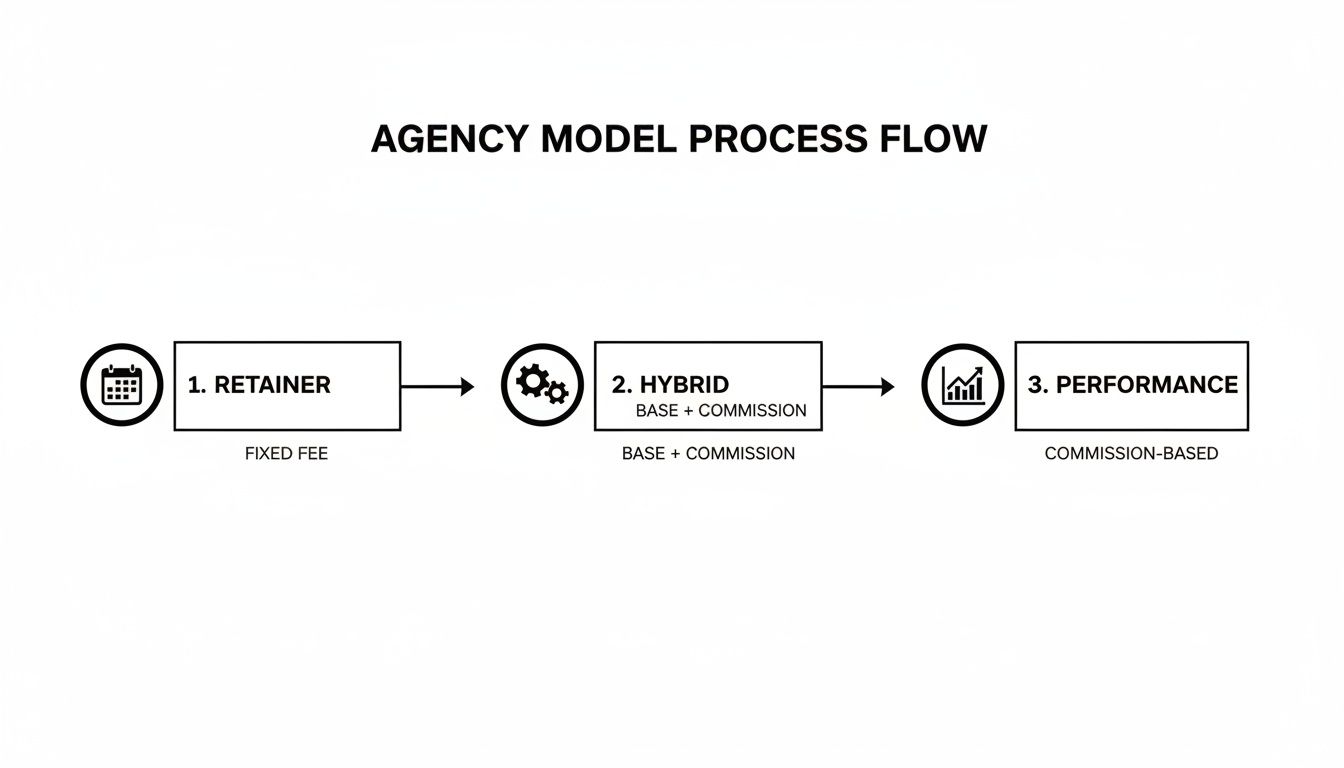
The diagram above shows how different agency models - from retainers to performance-based partnerships - execute these complex processes. You can see how the risk and incentives shift, with performance models tying payment directly to the results you get.
Crafting The Message: Personalized Copywriting
Once you know who you’re talking to, you have to say something that actually gets their attention. This is where personalized copywriting comes in. It’s the difference between a form letter and a personal note. Generic templates are written for everyone, which means they’re really written for no one, and they get deleted instantly.
Real personalization goes way beyond sticking and into a template. It’s about writing copy that speaks directly to the prospect’s job, their industry’s specific problems, and the buying signals you uncovered.
For example, instead of a generic line like, “We help companies increase efficiency,” a personalized message might say, “I saw on LinkedIn your team is hiring three new logistics managers. Scaling a supply chain like that often creates new inventory tracking headaches, which is an area we know inside and out.”
This simple change proves you’ve done your homework. It immediately makes your email stand out from the other 99% that are purely self-serving.
Steering The Ship: Campaign Management And Optimization
Launching the campaign isn’t the end; it’s just the beginning. The real results come from ongoing campaign management and optimization. This isn’t a “set it and forget it” activity. It’s an active, data-driven process of steering the ship.
This phase is all about constant monitoring and A/B testing. A good agency will test different subject lines, email copy, and calls-to-action to find what drives the highest positive reply rate. They analyze open rates, click-throughs, and reply sentiment to make smart, informed changes on the fly.
This continuous improvement loop is what makes a campaign predictable and scalable. All the pieces - technical setup, list building, copywriting, and optimization - have to work together. When they do, you get a reliable system for generating a steady flow of qualified opportunities for your business.
How To Choose The Right Lead Generation Partner
Trying to vet a B2B lead generation service can feel overwhelming. Everyone makes big promises, but picking the right partner is a massive decision for your sales pipeline. Get it right, and they become a genuine extension of your team. Get it wrong, and you’ll burn through months of time and budget with nothing to show for it.
Let’s cut through the sales pitches. I’m going to give you a simple framework to help you figure out what really matters. We’ll walk through five critical areas to look at so you can spot a true growth partner and dodge the ones that will just waste your money.
Evaluate Their Proof Of Performance
The first thing you need to see is proof. A serious agency should have detailed case studies and client testimonials ready to go. Don’t fall for vague success stories - you need to see hard evidence that mirrors what you’re trying to achieve.
Ask for case studies from companies in your industry, of a similar size, and targeting the same kind of customer. When you read them, look for real numbers. How many qualified meetings did they actually book each month? What was the client’s return on investment?
A partner you can trust won’t just say they “boosted leads.” They’ll give you specifics, like: “We generated 15 qualified meetings per month for a Series B SaaS client, contributing over $750k in new sales pipeline within the first six months.”
Even better, ask to talk to one or two of their clients, past or present. An agency that’s confident in its work will have no problem with this. It’s the best way to get an unfiltered look at what it’s actually like to work with them day in and day out. You can find more tips on this process by reading our guide on finding a top lead generation agency for B2B.
Demand Absolute Process Transparency
You should never feel like you’re handing your brand over to a “black box” operation. A good partner can walk you through their entire process, from A to Z, without hesitation. They should be an open book.
Here are the key things you need to dig into:
-
List Building: How exactly do they find and source contacts? What tools do they use to make sure the data is accurate and a good fit for your ideal customer?
-
Technical Setup: Ask them to explain how they protect your domain’s reputation when sending outreach. If they can’t explain this clearly, run.
-
Outreach Strategy: What channels are they using? How do they personalize messages so they don’t sound like every other piece of spam out there?
-
Handover Process: At what point does a lead get passed to your sales team? What information comes with it?
If they get cagey or give you vague answers on any of this, it’s a huge red flag. When you’re checking out different options, like Leadblaze, pay attention to how clearly they explain what they do.
Align On The Definition Of Quality
This is probably the single most important conversation you’ll have. The word “lead” means a hundred different things to a hundred different people. You and your partner need a crystal-clear, shared definition of what a “qualified meeting” or a “sales-ready opportunity” actually is.
Get specific. For your company, a qualified meeting might be a call with a C-level exec at a 500+ employee fintech company. For someone else, it could be a VP of Operations in manufacturing who has a specific problem to solve.
Write this definition down and make sure both sides agree to it before you sign anything. This is what holds the agency accountable for delivering opportunities your sales team will actually value.
Scrutinize Communication And Reporting
A good partnership is all about the feedback loop. You need to know exactly how the agency will report on progress, share what they’re learning, and - most importantly - listen to feedback from your sales team.
Ask them direct questions about their reporting:
-
What metrics will we see? Make sure they focus on what matters, like positive reply rates, meetings booked, and meeting show-up rates - not just vanity stats like open rates.
-
How often will we receive reports? Weekly or bi-weekly reporting is pretty standard and lets you make adjustments before it’s too late.
-
Who will be our main point of contact? A dedicated account manager is a must. It keeps communication clear and consistent.
Clear, regular, and useful reporting is the sign of a professional team that’s genuinely invested in seeing you succeed.
Measuring Success With The Right KPIs

How do you know if your investment is actually paying off? It’s a simple question, but the answer isn’t always obvious. You have to look past vanity metrics like open rates and focus on the numbers that translate directly to revenue.
A good partnership isn’t about the sheer volume of “activity.” It’s about producing tangible business results. When you track the right Key Performance Indicators (KPIs), you stop seeing lead generation as a marketing cost and start seeing it for what it is: a predictable engine for sales growth.
The Metrics That Actually Matter
Don’t let yourself get buried in a mountain of data. When we evaluate a campaign, we zero in on a few core KPIs that paint a clear picture of what’s working and what isn’t. These are the numbers that connect outreach activity to real money.
Here are the essential metrics we always track:
-
Positive Reply Rate: This is the first signal that your message is hitting the mark. It tells you what percentage of prospects are responding with genuine interest.
-
Lead-to-Meeting Conversion Rate: Of those interested replies, how many turn into a booked meeting on your sales team’s calendar? This is where you measure how effective the handoff and booking process is.
-
Cost Per Qualified Meeting: This is the ultimate bottom-line number, especially for performance-based pricing. It tells you exactly what you’re paying for each sales-ready opportunity, making your ROI calculation crystal clear.
From Meetings To Revenue
Getting meetings booked is a huge win, but the real value comes when those meetings feed your sales pipeline. This is where we bring in sales-focused KPIs to connect the dots between your investment and closed deals.
These numbers give you the full story:
Contribution to Sales Pipeline: This is the total potential deal value from all opportunities your campaign generates. For instance, if your agency books five meetings that lead to qualified opportunities with an average deal size of $50,000, you’ve just added $250,000 to your pipeline.
Another key metric is Sales Accepted Lead (SAL) Velocity. This tracks how fast an opportunity goes from that first meeting to being officially accepted by your sales team. High velocity is a great sign - it means you’re delivering high-quality meetings that your team is excited to run with.
Tracking these sales-centric numbers is non-negotiable for understanding a campaign’s true impact. For a closer look, check out our guide on the 8 essential KPIs for lead generation in 2026.
Calculating A Clear Return On Investment
Focusing on the right KPIs shows you just how efficient specialized outreach can be. The average website converts a measly 2-5% of visitors into leads. In stark contrast, a well-run email campaign can generate an incredible £36-40 ROI for every £1 spent.
By concentrating on these high-performance channels, you sidestep the trap of wasting money on broad, low-yield tactics. It’s a strategy that’s being confirmed by the latest industry trends.
With performance-based lead generation, the ROI calculation is simple. You can draw a straight line from your spend to the sales opportunities it creates. That clarity gives you the confidence to not only justify the investment but to scale it up when you’re ready to pour fuel on the fire.
Answering Your B2B Lead Generation Questions
If you’re thinking about bringing on a B2B lead generation service, you probably have a lot of practical questions. As a decision-maker, you need straightforward answers to feel good about the investment. We get it.
This section tackles the most common questions we hear, cutting through the jargon to give you a clear picture of how this all works from day one.
How Long Does It Take To See Results?
This is always the first question, and for good reason. While everyone wants meetings booked tomorrow, a professional cold outreach campaign follows a very predictable, structured path. Results aren’t instant because they’re built on strategy, not just guesswork.
The process typically breaks down into a few key phases:
-
Month 1: The Foundation Phase The first 30 days are all about laying the groundwork. This is where we do the heavy lifting: strategy sessions, deep market research to lock down your ideal customer, and the full technical setup of new domains and inboxes. You won’t see meetings booked here, but this work is absolutely essential for what comes next.
-
Months 2-3: The Launch and Optimization Phase With the foundation solid, we launch the first outreach campaigns. This period is all about collecting real-world data, seeing what messaging hits home, and fine-tuning the approach. The first qualified meetings will start popping up on your calendar as we steadily optimize the campaigns.
-
Month 4+: The Scaling Phase By this point, we have a proven formula. We know which customer segments are responding and which messages get replies. Now, it’s all about scaling up. We can ramp up the volume to deliver a consistent, predictable number of qualified meetings for your team every single month.
This methodical approach makes sure that the results you get aren’t just a flash in the pan - they’re sustainable and built to last.
What Is The Difference Between A Lead And A Qualified Meeting?
Getting this distinction right is everything. So many companies get burned by confusing these two terms, leading to mismatched expectations and a sales team wasting time on dead ends.
A lead is usually just raw contact information. It could be a name from a list you bought, someone who downloaded an ebook, or a website visitor. There’s no confirmed interest, no verified role, and no clue if they’re actually a good fit for you.
A Sales Qualified Meeting, on the other hand, is a confirmed appointment booked directly on your sales team’s calendar. This is a real conversation with a prospect who has been carefully vetted against a set of criteria you’ve approved beforehand.
When you partner with a performance-based agency, you aren’t paying for a list of names. You’re paying for a confirmed conversation with a potential buyer who fits your exact customer profile. This ensures your sales team spends its time on high-value activities, which boosts both efficiency and morale.
That qualification process is a huge part of the value.
What Criteria Define A Qualified Meeting?
The criteria for a qualified meeting aren’t set by the agency - they are set by you. A real partner will sit down with you to hammer out a detailed definition of your ideal prospect.
This usually includes concrete data points like:
-
Company Size: A specific range for employee count or annual revenue.
-
Industry: The exact verticals you sell into (e.g., SaaS, Manufacturing, Healthcare).
-
Geography: The countries or regions you serve.
-
Job Title/Role: The specific decision-makers you need to talk to (e.g., VP of Sales, CTO, Director of Operations).
-
Acknowledged Need: The prospect confirms they have a challenge that your service can help solve.
This alignment is non-negotiable. It guarantees that every meeting we deliver is with someone your sales reps are genuinely excited to talk to.
Do I Need To Provide My Own Email Lists?
Generally, no. In fact, it’s almost always better if you don’t. A huge part of what a good lead generation service does is build fresh, hyper-targeted prospect lists from scratch.
Using your own existing lists often creates more problems than it solves. They are typically:
-
Outdated: Contact info gets stale fast. B2B data degrades by over 30% every year as people change jobs.
-
Inaccurate: The list might have been built for a different purpose and isn’t a good fit for a targeted cold outreach campaign.
-
Non-Compliant: Old lists can be a compliance minefield if you don’t have a clear record of how you got the information.
A professional agency uses a mix of advanced data tools and manual verification to build clean lists based on your Ideal Customer Profile (ICP). It’s a time-consuming process, but it’s critical for getting your message to the right person and protecting your brand’s reputation. A quality partner handles all of this for you.
Ready to see how a performance-based approach can fill your sales pipeline with genuinely qualified meetings? Fypion Marketing operates on a pay-for-results model, meaning you only pay for booked appointments that meet your criteria. Schedule your free consultation today and let us build a predictable growth engine for your business.