
B2B Appointment Setting Pricing: A Practical Guide
B2B appointment setting pricing typically ranges from $150 to $2,500 per meeting depending on seniority and complexity. That headline number is the wrong place to start, because the central question is what you’re paying for in an attended, qualified meeting that can produce pipeline.
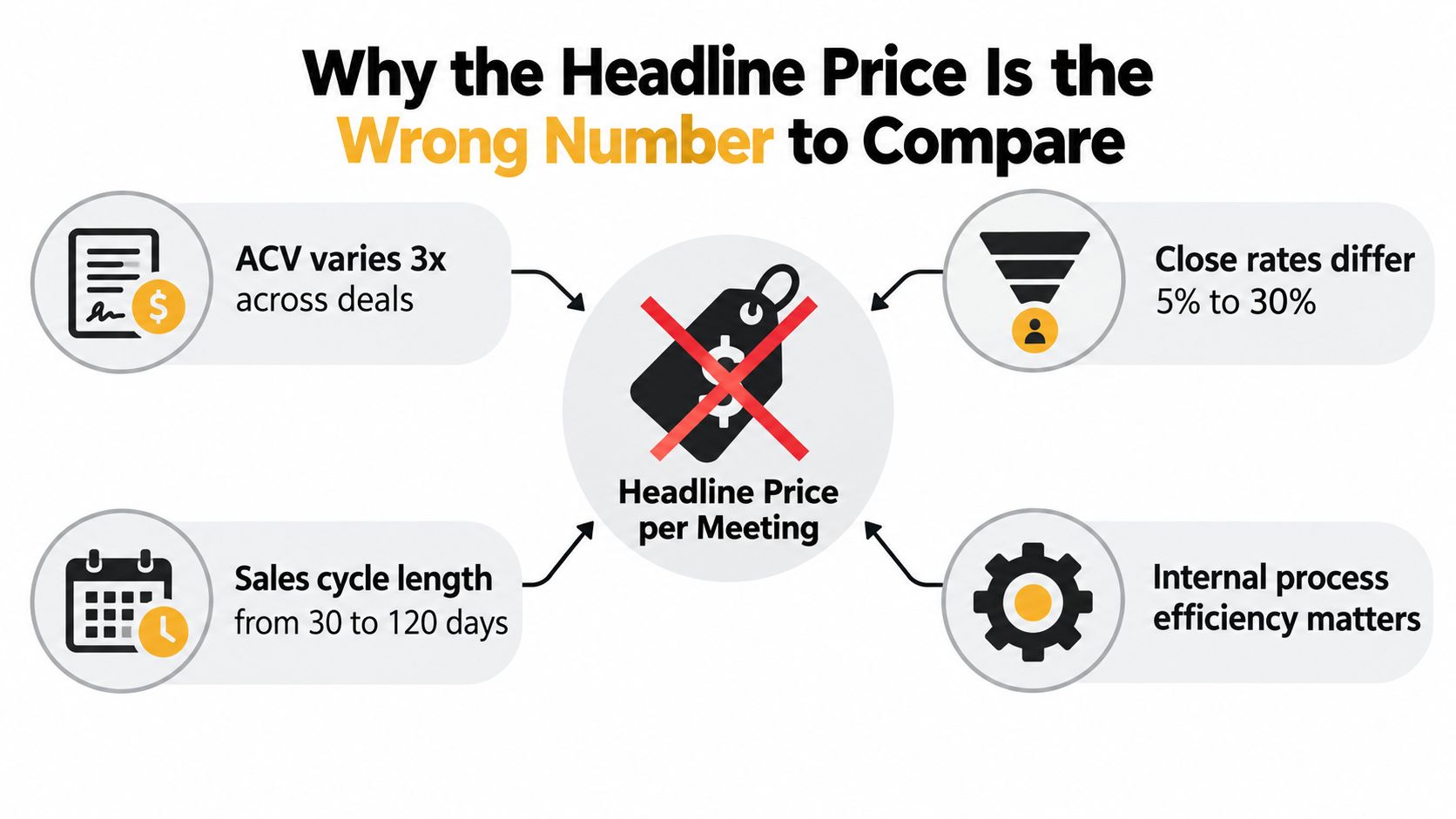
Why the Headline Price Is the Wrong Number to Compare
Most buyers compare vendor quotes like they’re buying the same product. They’re not. A booked slot on a calendar, an accepted meeting, and a sales-qualified conversation are different assets, and the price should change accordingly.
Booked does not mean valuable
A cheap booked meeting can be expensive if the prospect never shows, the contact is junior, or the account is a poor fit. Recent benchmark data shows booked-to-occurred rates vary materially by region and company size, which is exactly why a simple price-per-booked-appointment comparison breaks down. A vendor quoting one number can look cheap on paper and still cost you more per real sales conversation.
Practical rule: compare vendors on attended, qualified meetings, not raw bookings.
The other trap is buyer context. A junior operations contact in a familiar market is not the same as a verified enterprise decision-maker in a new geography. The effort to source, qualify, and secure those conversations is different, so the commercial value is different too.
If you want a cleaner way to frame the problem, use the same logic that drives other performance pricing models, including the cost-per-lead thinking in this price per lead framework. The point is simple, price only matters after you define the unit you’re buying.
A fair quote should tell you what counts as qualified, who the meeting is for, what happens with no-shows, and whether the provider replaces weak meetings. If that isn’t in writing, the headline rate is just marketing.
The Four Pricing Models Explained in Plain English
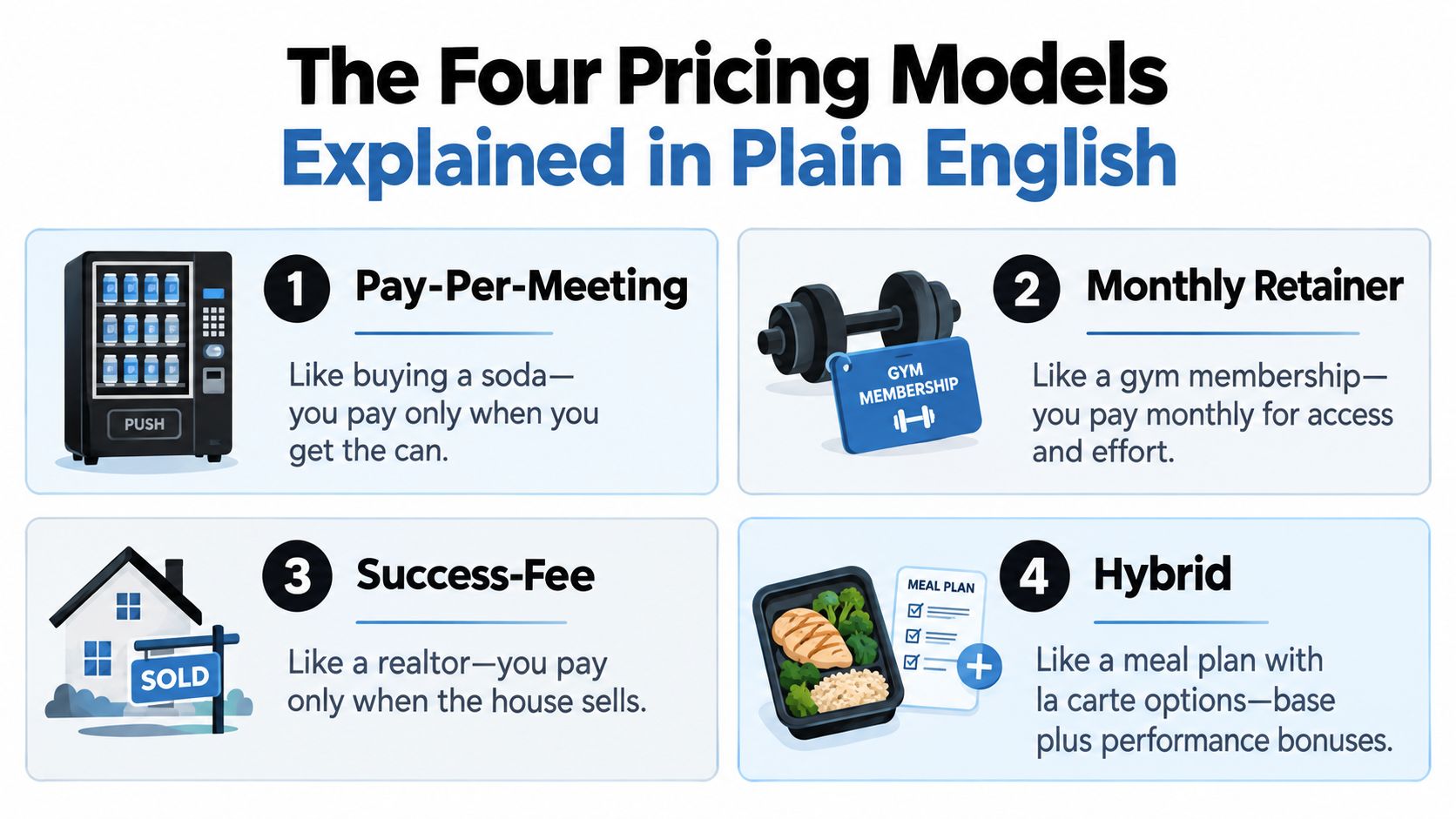
Pay-per-meeting sounds clean, but only if the meeting definition is clean. You pay when a meeting is booked or held, depending on the contract. That makes this model attractive for buyers who want a visible unit price and tight spending control. It also creates the strongest incentive to maximize volume, so you need hard rules on attendance, qualification, replacements, and who counts as the right buyer.
Monthly retainer buys ongoing execution. A retainer pays for the ongoing engine: research, data work, messaging, and follow-up, whether or not meetings land this month. That usually fits companies entering a tougher market, selling to senior stakeholders, or testing messaging that needs iteration before volume shows up. If you expect strategic input, list building, channel testing, and steady optimization, a retainer is usually the honest model.
Success-fee structures tie payment to an agreed outcome. The closest real-world comparison is a realtor’s commission. The provider gets paid when the result happens, but the negotiation is over what result counts. In appointment setting, that might be a qualified booking, an attended meeting, or a sales-accepted opportunity. Buyers should push this model toward attended and qualified outcomes, otherwise the cheap headline rate can hide weak commercial value.
Hybrid pricing combines a base fee with variable payout. In practice, this is often the best fit because it shares risk properly. The base fee covers the fixed work required to source and persuade the right accounts. The variable piece rewards output. If your sales team follows up fast and your qualification rules are clear, hybrid pricing usually produces better behavior on both sides than a pure retainer or pure pay-per-meeting deal.
Service pricing across categories follows the same logic: scope, speed, and output quality drive the number, as the affordable AI video production rates page from LunaBloom AI illustrates.
Use one rule. Match the pricing model to what is hardest in your motion. If sourcing and messaging are the hard part, pay for the engine with a retainer or hybrid. If qualification is objective and easy to audit, output-based pricing can work well. For buyers comparing outsourced demand generation more broadly, this performance marketing agency guide is a useful reference for how commercial risk shifts between fixed and variable pricing.
What B2B Appointment Setting Actually Costs in 2026
The cleanest benchmark is simple. Available 2025 to 2026 market data puts the average cost of a qualified B2B appointment at roughly $550 to $1,700 per meeting, with lower-complexity SMB and mid-market work around $150 to $600, and enterprise or C-suite appointments from $800 to $2,500 or more. Retainer programs generally fall between $2,500 and $15,000 per month. These are not interchangeable products, they are different levels of targeting, qualification, and labor intensity. Source benchmark
![No image markdown was assigned for this section.]
Typical campaign profiles and price bands
| Campaign Profile | Typical Cost Per Meeting | Engagement Model |
|---|---|---|
| SMB, straightforward offer, limited qualification | $150 to $600 | Pay-per-meeting or light retainer |
| Mid-market, moderate targeting and multi-touch outreach | Around the middle of the benchmark range | Retainer or hybrid |
| Enterprise, senior buyers, tighter qualification | $800 to $2,500 or more | Retainer, hybrid, or premium pay-per-meeting |
That table isn’t a promise. It’s a map. If your buyer is senior, your list needs better data, more personalization, and more patience, so the price climbs. If your geography is complex or your qualification rules are strict, the cost rises again because every false positive becomes expensive.
The issue is not whether a vendor is “cheap.” It’s whether their definition of a qualified meeting matches your sales process. A lower nominal price can be a worse deal if the provider is booking weak contacts or doesn’t cover replacements.
For a broader view on outsourced outreach operations, the cold calling agency guide is helpful because it shows how channel mix changes cost. Phone-heavy programs, email-led programs, and multi-channel programs all price differently because the labor burden is different.
A practical buyer should expect to pay more when the provider owns list building, seniority targeting, reporting, and no-show handling. That’s not padding, that’s the actual work. If a quote ignores those details, it’s not a benchmark, it’s a partial bill.
If you’re reviewing your outsourcing options, the outsourced sales company guide is a useful companion because it frames appointment setting as part of a wider sales execution system, not a standalone calendar service.
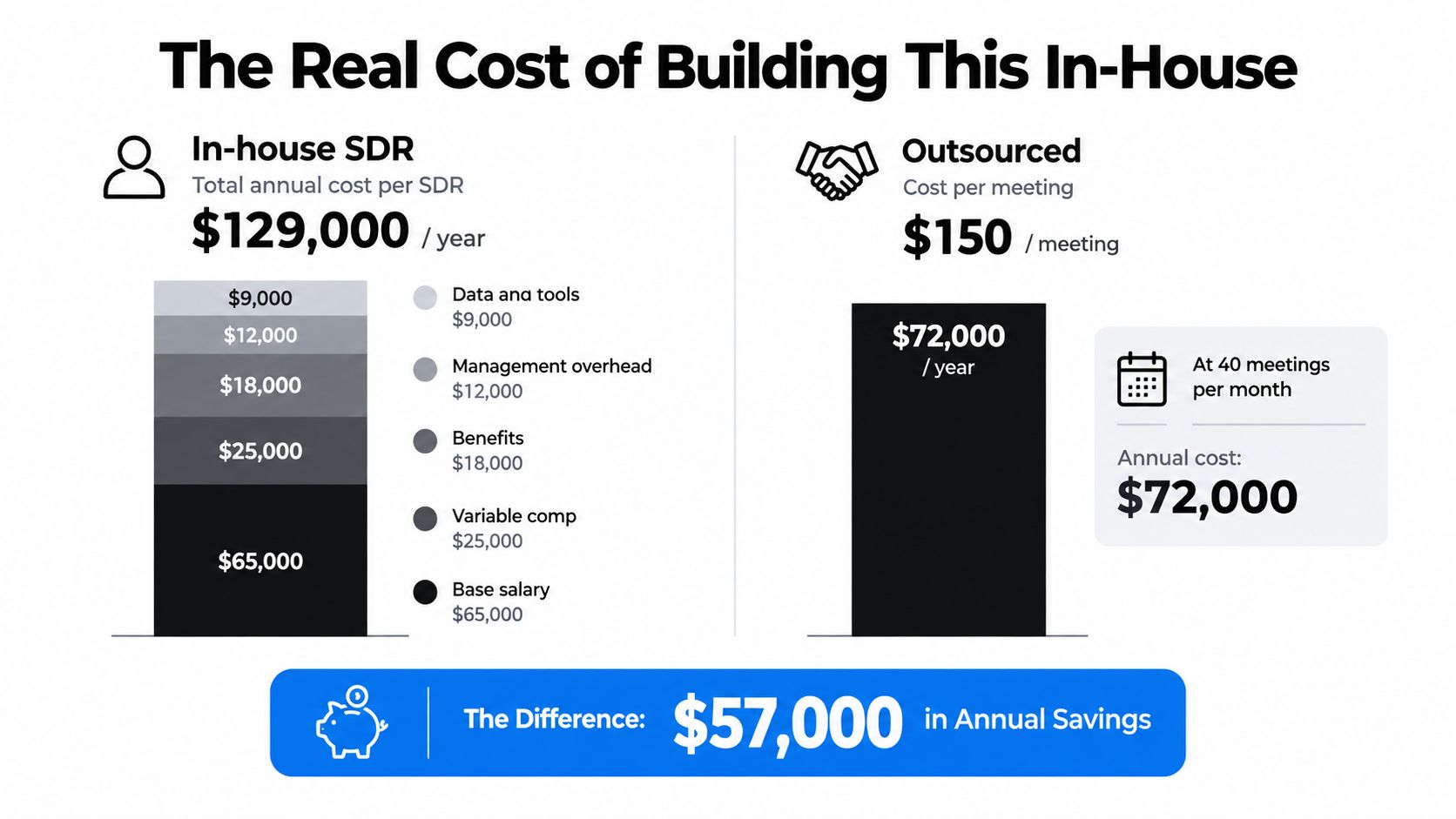
The Fully Loaded Cost of Building This In-House
An in-house SDR is not a salary line. It is a staffing model with ramp time, turnover risk, tool costs, and management drag attached.
A 2025 benchmark across 351 B2B companies put median U.S. SDR on-target earnings at $80,000, with about $55,000 base and $25,000 variable compensation. The same benchmark reported an average three-month ramp, only 60% of SDRs at quota, and 40% median annual attrition. Those numbers matter because they turn a simple hiring decision into an operating-cost decision. Source benchmark
What the internal stack really includes
Compensation is only the visible piece. You also pay for benefits, sales management time, prospect data, sequencing tools, CRM administration, and the output you do not get while a rep is still learning the market. If you compare outsourced meetings against base salary, you will understate internal cost and overstate vendor pricing.
Use a stricter comparison. Measure in-house economics against fully loaded operating cost, then judge output by meeting quality, not just calendar volume. A booked meeting, an attended meeting, and a sales-qualified meeting are not the same asset.
Turnover makes this sharper. Every replacement restarts recruiting, onboarding, training, account context, and the ramp to useful productivity. That resets your cost per qualified conversation even if the salary band stays flat. Outsourced appointment setting can shift some of that execution risk off your team, which is why a higher sticker price can still be the cheaper model.
If you want a clear view of what the internal role covers, review this appointment setter job description. It shows the job for what it is: list work, qualification, follow-up, coordination, and persistence, not just dialing or emailing.
That is why buyers should anchor the comparison to contract economics and qualified outcomes, not the lowest nominal cost per meeting.
Calculating What You Should Actually Pay Per Meeting
Your acceptable meeting price starts with your sales economics, not a vendor’s rate card. Set the ceiling using average contract value, gross margin, and your opportunity-to-close rate. A meeting that cannot plausibly create profitable pipeline is overpriced, regardless of how polished the provider’s presentation sounds.
Use a buyer-side ceiling, not an industry average
Estimate the profit you can justify from one qualified opportunity. Divide that amount by the number of meetings required to create it. The result gives you a practical ceiling for sustainable cost per attended meeting.
Apply the ceiling to attended, qualified meetings rather than booked meetings. If attendance is weak, reduce the amount you are willing to pay. Booked-to-occurred rates were 85.2% in North America, 74.5% in EMEA, and 65.4% in APAC. Company size also affected attendance, with rates of 90.5% for enterprises, 63.5% for midsize firms, and 68.9% for small businesses, according to this attendance benchmark.
Before setting a ceiling, map how meetings move through your pipeline. This sales process flowchart shows how to structure that path from initial contact to revenue.
The FOMOchat on mastering target CPA makes the same point from a broader acquisition perspective: your ceiling must come from the economics of the sale, not an arbitrary market average.
Two short examples
A SaaS team selling a mid-priced product with healthy gross margin can support a higher meeting cost than a team selling a low-ticket service. One qualified conversation carries more downstream value. If the close process is strong and sales follow-up is disciplined, a higher fee can still produce profitable pipeline.
A modest deal size, slow follow-up, or weak close rate demands a lower ceiling. Paying near the upper end of the market in those conditions can consume the profit before an opportunity reaches close.
Your ceiling is whatever still leaves room for profit after attendance, qualification, and close rates are applied. Spend above it is activity, not acquisition. Use that figure in vendor discussions, then compare providers on attended and sales-qualified outcomes rather than calendar volume alone.
How to Compare Proposals Without Getting Burned
Proposals become expensive in the fine print. A loose qualification definition, no-shows counted as delivery, and silence on replacement meetings can double the effective price of a useful conversation. Compare the contract terms before comparing the headline fee.
The clauses that actually move the number
Start with the definition of a qualified meeting. It should state the required seniority, geography, industry, and buyer fit. Vague language lets a provider claim delivery for calls your sales team cannot use.
Attendance needs its own rule. Confirm whether a no-show receives a replacement or credit, and whether a meeting with the wrong prospect qualifies for the same protection. Require the proposal to define qualified, attended, and replaced in writing before you sign.
Data ownership belongs in the agreement too. Your team should retain the contacts, call notes, and outcomes in its CRM, including records created during the engagement. Check exclusivity as well. A provider may perform better as the only outbound team addressing a segment, while overlap with internal reps can create duplicate outreach and confused ownership.
A simple scoring lens
Score every proposal against the same five criteria:
- Qualification clarity: Does the vendor define seniority, geography, industry, and buyer fit in writing?
- Attendance protection: Are no-shows and weak-fit meetings replaced or credited?
- Reporting depth: Do reports separate booked, attended, and qualified outcomes from raw activity?
- Ramp expectations: Does the vendor state how the learning period affects early volume and quality?
- Exit terms: Can you leave without losing your data, account history, or sales momentum?
Use the scores to expose trade-offs, not to create a false sense of precision. A lower fee is poor value when your reps spend time on weak calls or chase missing records. If two quotes are close, choose stricter qualification, clearer attendance protection, and cleaner reporting. Volume can increase later. Wasted sales time cannot be recovered, and booked meetings alone are not pipeline.
A Real-World Pricing Scenario in Two Versions
A mid-market SaaS company hired a provider on a straightforward pay-per-meeting structure. The target was clear, the offer was simple, and the buyer was already used to outbound conversations. Meetings came in at a price that sat comfortably inside the market bands, and the team saw the vendor as efficient because the meetings were attended and relevant.
A later-stage company hired the same provider and paid the same headline rate. This buyer wanted senior enterprise contacts in a new region, with tighter qualification and longer decision cycles. The meetings looked similar on the invoice, but the economics weren’t similar at all. The provider had to do more research, more personalization, and more follow-up, and the buyer had fewer attended meetings relative to bookings.
That contrast is the point. The nominal price did not change, but the actual cost per useful conversation did. A quote that works for a familiar mid-market ICP can become a trap when you move upmarket or expand into a harder geography.
The attendance benchmark explains why the gap matters. If your booked meetings don’t show at a strong rate, the hidden cost rises fast, especially when you’re paying for premium targeting. That’s why the same monthly retainer or per-meeting fee can be a good deal in one program and a bad one in another.
The lesson is straightforward. Mid-market SaaS buyers should be careful about overbuying enterprise-style pricing when their ICP doesn’t justify it. Enterprise teams, on the other hand, should stop shopping for the lowest visible quote and focus on the provider who can secure the right people in the room.
Choosing the Right Model and Your Next Step
Choose the model that matches your stage and your risk tolerance. If your deal size is high and your target buyer is hard to reach, a retainer or hybrid model usually makes more sense because the provider needs room to research, test, and adapt. If your ICP is narrow and your qualification criteria are crisp, pay-per-meeting can work well because the output is easier to verify.
If you’re early and still refining the offer, don’t pretend you need scale. You need clarity. Use a smaller pilot, lock down the definition of a qualified meeting, and compare vendors only on attended and sales-usable conversations.
Put three things in your brief before you ask for quotes. First, define the buyer. Second, define the meeting. Third, define what happens when a meeting doesn’t show or doesn’t fit. If a vendor can’t work from those inputs, they’re not ready for your business.
A good procurement process should leave you with one answer, not ten vague estimates. Compare proposals on quality-adjusted cost, not headline price, and make the vendor prove they understand your economics before you sign.
Fypion Marketing offers pay-per-qualified-meeting appointment setting for B2B teams that want pricing tied to booked, qualified conversations rather than vague calendar volume. If you’re evaluating this model, visit Fypion Marketing to see how their outbound service is structured and decide whether that fit matches your sales motion.