
Quota Attainment: How to Measure and Improve It

The most popular advice for fixing missed quotas is also the least reliable. Coach harder, add activity, buy another tool. That sequence assumes sellers caused the miss and skips the harder questions about whether the target, territory, and pipeline ever gave them a fair chance. Quota attainment is useful only when you treat it as a diagnostic signal, not a verdict.
Why Quota Attainment Needs Context
A seller who misses quota hasn’t automatically sold poorly. The quota may have been set from a top-down growth plan that ignored territory potential. The rep may still be ramping, selling a new product, or working accounts with sales cycles longer than the measurement period.
Pipeline creates the same problem. If qualified opportunities arrive late, in the wrong segments, or at values too small to support the target, strong execution still produces a miss. Blaming effort in that situation leads to more activity, more pressure, and the same constrained inputs.

Ask a Better First Question
Instead of asking only who hit the number, ask what conditions the number reflects. Was the denominator realistic for a fully ramped rep in that territory? Did pipeline coverage exist early enough to close within the period? Did opportunities convert at the rate and value assumed in the plan?
Those questions change the intervention. A design problem calls for recalibrating quotas or territories. A pipeline problem calls for better targeting and qualification. A conversion problem may justify coaching, deal inspection, or process changes.
Practical rule: Don’t assign a seller-level cause until you’ve checked quota design, ramp status, territory potential, and qualified pipeline supply.
Quota attainment connects planning to execution. Read it in that context and you’ll know whether to change the target, fix upstream demand, support the rep, or address all three. Read it as a standalone scorecard and you’ll keep treating symptoms while the underlying constraint stays in place.
Understanding Quota Attainment Fundamentals
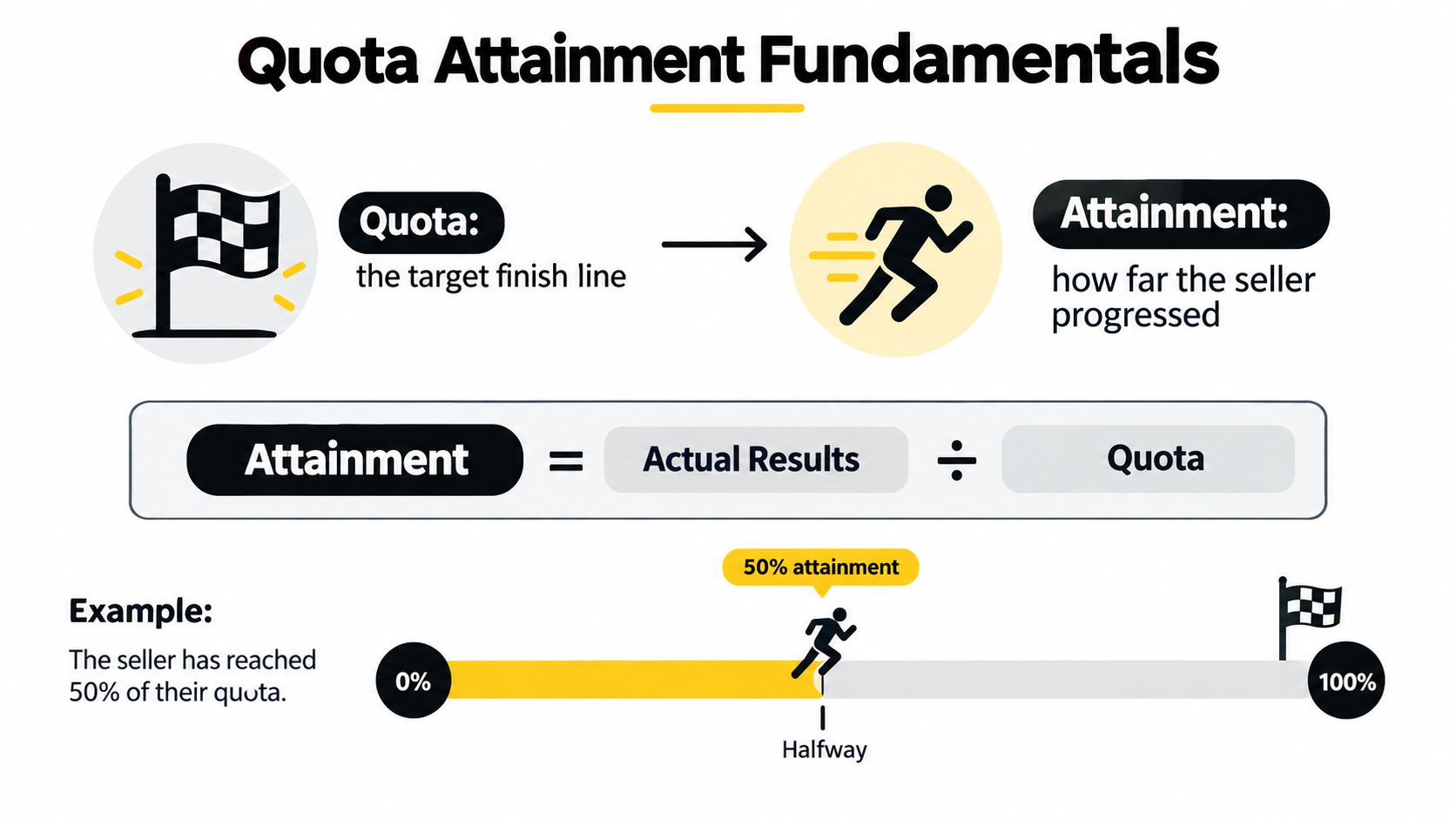
Think of quota as the finish line and attainment as how far the seller progressed toward it during a defined period. The calculation is simple, but it’s only meaningful when the numerator and denominator describe the same thing, over the same period, for the same person or team.
The Core Calculation
Use this formula consistently:
Quota attainment = (Actual results ÷ Quota) × 100
If a seller closes exactly half the assigned quota, attainment is 50%. If actual results equal quota, attainment is 100%. The formula can apply to revenue, bookings, units, new logos, meetings, or profit, but you can’t mix units. A quota set in annual contract value shouldn’t be measured against monthly recognized revenue without an explicit conversion.
Teams that struggle with this alignment often benefit from reviewing frameworks for aligning team objectives before they set individual targets, because unclear objective definitions usually surface later as disputed attainment.
Three Views You Should Not Confuse
- Individual attainment: One person’s actual results divided by that person’s quota.
- Quota-dollar attainment: Total actual results divided by total assigned quota across a group.
- Attainment rate: The share of reps who reached at least 100% of their individual quotas.
These views can tell different stories. A team can reach its combined quota dollars because a few sellers overperform, even while most individuals miss. The reverse can also happen when many reps finish close to target but no one produces a large surplus.
For planning conversations, report fully ramped reps separately from new hires. A ramping seller measured against a full quota will depress the group result even when performance is on track for tenure. Clear definitions don’t make quotas fair by themselves, but they prevent arithmetic from hiding whether fairness is even possible.
Benchmarking Quota Attainment Without False Precision
Benchmarks help you sanity-check a sales plan, but they don’t define what your team should achieve. The long-term trend is concerning because an industry compilation of the decline in quota attainment reports attainment falling from 63% in 2012 to approximately 53% in 2018, 44% in 2022, and only 28% in 2024, even as CRM and sales-enablement spending grew approximately five to sixfold.
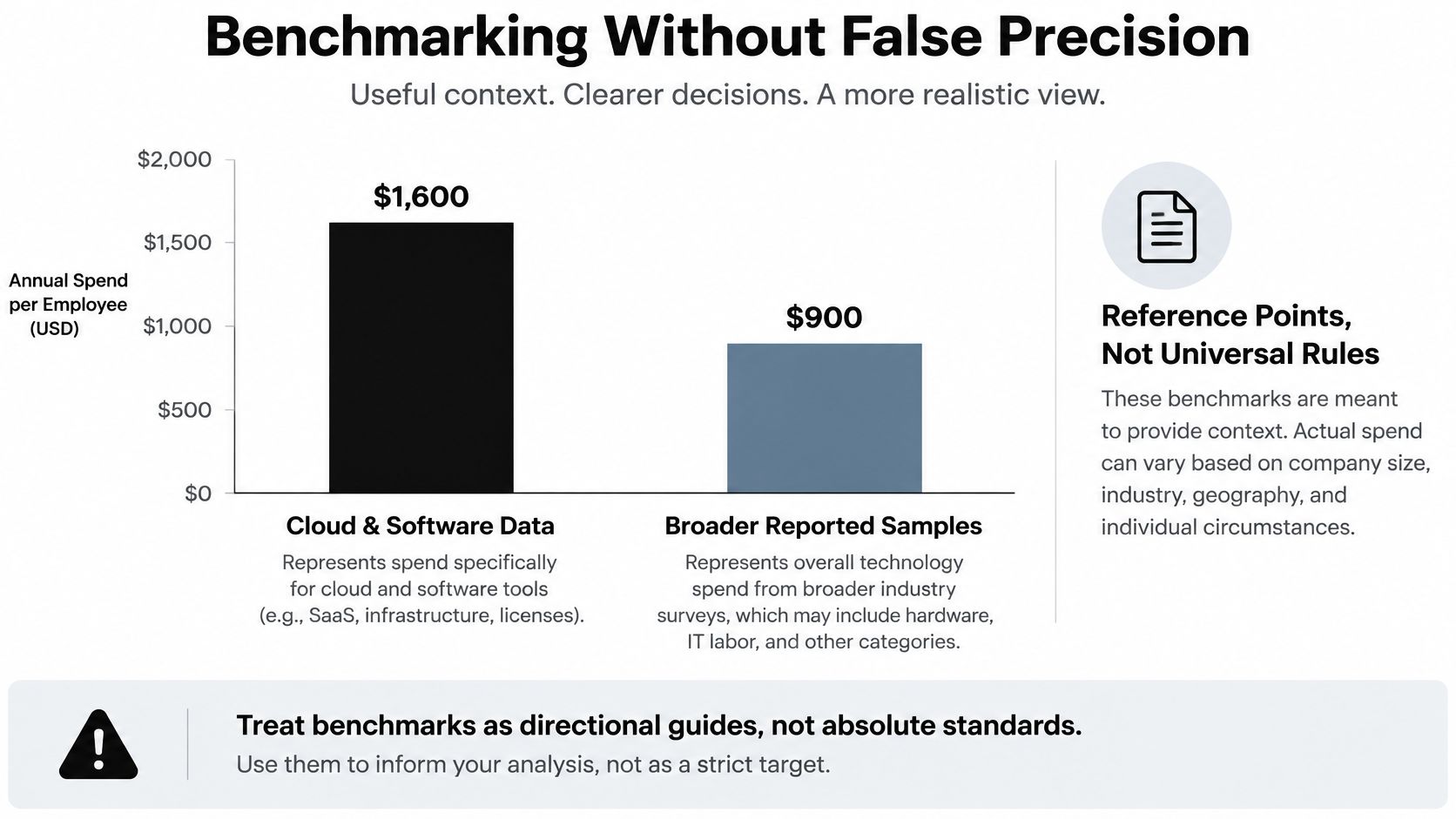
Recent cloud data points in the same direction, though not to the identical number. In RepVue cloud sales attainment data for Q2 2025, 42.69% of representatives achieved quota across approximately 47,000 ratings at 246 cloud and software companies, below the commonly cited SaaS planning benchmark of 50% to 60% of fully ramped representatives hitting quota.
Those figures aren’t interchangeable. Populations differ by role mix, geography, company maturity, weighting, period, and whether the dataset counts people, opportunities, compensation observations, or quota dollars. A practical guide to using industry benchmarking without copying incomparable targets should start with those methodological questions, not the headline percentage.
The measurement gap becomes clearer when you compare sources directly. A compensation benchmarking analysis of attainment measurement differences notes RepVue-based cloud figures around 42.69% in Q2 2025 and 43.24% in Q3 2025, while a broader compensation dataset reports a 74.3% median and only 28.7% of observations at or above 100%.
The video below is useful as a discussion prompt for separating a directional benchmark from an operating target.
Before you adopt any benchmark, ask whether it includes ramping reps, how it defines quota, and whether unusually high attainment could reflect sandbagged targets or an unusually favorable segment. Fewer than half of sellers reaching target has become a recurring pattern in major datasets, but that pattern doesn’t excuse an unrealistic plan or prove that your own percentage is healthy.
How to Report Quota Attainment Consistently
Consistent reporting starts with a written definition that sales leadership, finance, and sales operations all use. Define the period, credited result, quota unit, treatment of splits and cancellations, and whether attainment is capped for reporting. Then keep those rules stable long enough to compare cohorts.
Separate new hires from fully ramped reps, or label ramp status in every view. Segment results by role, territory, product, geography, and segment when those groups face different deal sizes or sales cycles. A single company average can hide a healthy established segment and a structurally impossible new segment in the same number.
That discipline also supports improving forecast accuracy with cleaner attainment inputs, because forecasts built on mixed denominators inherit the same distortion as the attainment report.
Quota Attainment Reporting Views
| Reporting view | What it measures | Primary use | Common limitation |
|---|---|---|---|
| Individual attainment | Actual results divided by one rep’s quota | Coaching, compensation, performance reviews | Ignores territory and ramp differences unless labeled |
| Share of reps at quota | Percentage of reps at or above 100% | Judging how broadly success is distributed | Treats a narrow miss and a severe miss as equivalent |
| Quota-dollar attainment | Total actual results divided by total quota | Revenue planning and team delivery | A few large overperformances can mask widespread misses |
| Median attainment | Middle result when individual attainments are ranked | Understanding the typical rep experience | Doesn’t show total revenue delivered |
| Fully ramped attainment | Results for reps beyond their ramp period | Evaluating quota realism for productive capacity | Excluding new hires can hide onboarding or hiring problems |
A Repeatable Reporting Sequence
- Freeze the denominator: Confirm assigned quota, ramp adjustments, territory changes, and period boundaries.
- Reconcile the numerator: Confirm credited bookings or revenue use the same unit as quota.
- Report distribution, not just average: Show median, share at quota, and quota-dollar attainment together.
- Segment before interpreting: Compare like roles, territories, and ramp cohorts.
- Document exceptions: Flag placeholder quotas, manager rollups, currency mismatches, and mid-period transfers.
An average can look acceptable while the typical rep struggles. Always pair it with median attainment and the share of fully ramped reps who reached quota.
Diagnosing the Causes of Low Attainment
Two teams can report the same weak attainment and need opposite fixes. One team receives plenty of qualified opportunities but loses late-stage deals on weak discovery and poor multi-threading. Another converts opportunities at a healthy rate but never receives enough qualified pipeline early in the period.
The scale of recent misses makes that distinction important. In 2025 B2B sales performance benchmark data, 76% of sellers missed quota in the first half of 2025, but the headline doesn’t reveal whether demand generation, conversion, or quota design caused the gap.
Trace the Problem in Order
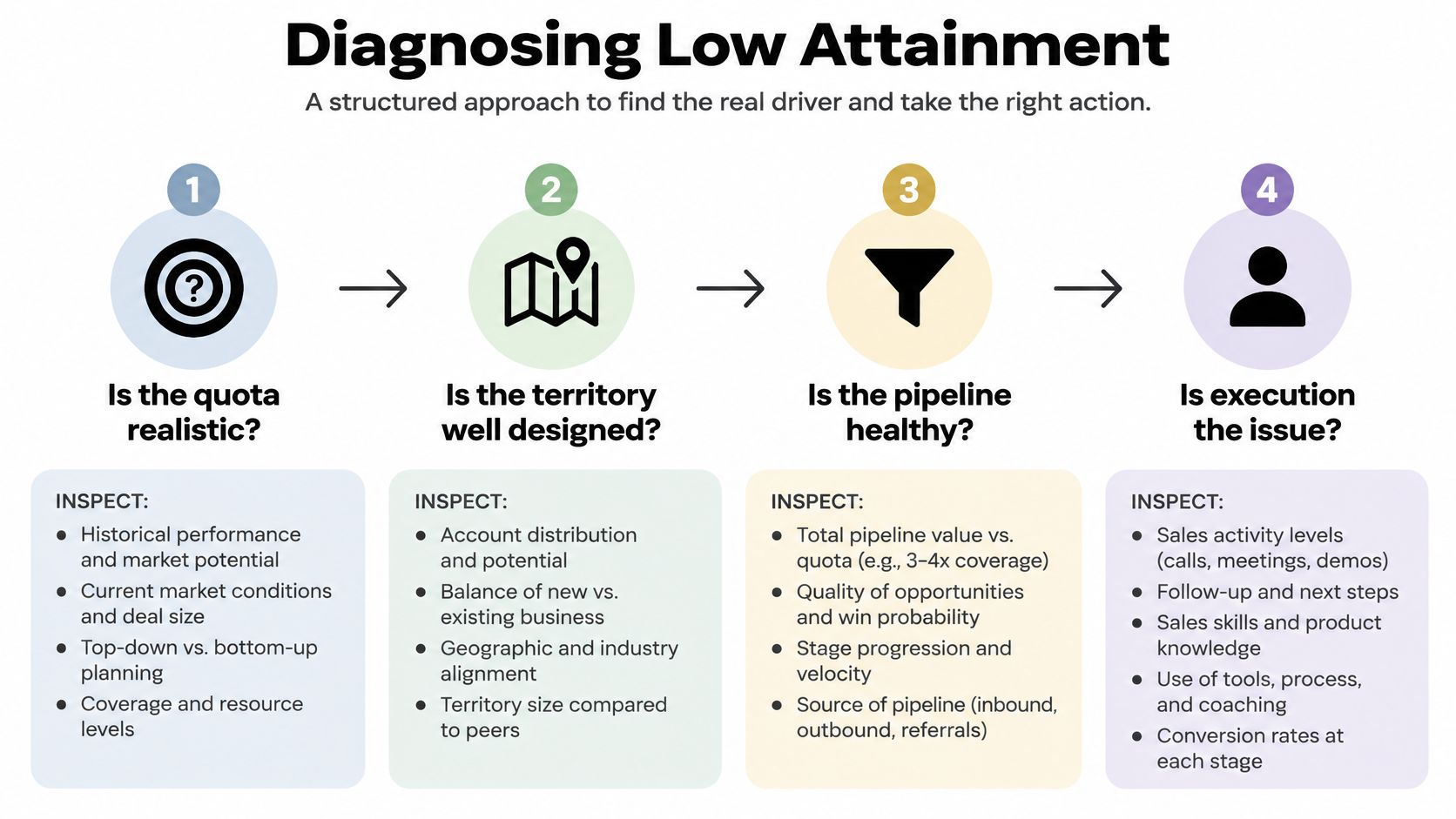
Start with quota realism. Compare assigned quota with territory potential, historical production by ramped reps, available accounts, and expected capacity. If even strong historical performance wouldn’t reach the new target, coaching isn’t the first answer.
Next inspect pipeline coverage using your own conversion assumptions. Required pipeline depends on opportunity creation, win rate, average contract value, and sales-cycle length. A detailed review of sales conversion rates by funnel stage helps you locate where expected revenue leaks instead of treating the full funnel as one problem.
Then examine input quality. Low-intent meetings can fill calendars while reducing opportunity conversion and consuming seller time. Finally, inspect execution through stage progression, deal age, next-step quality, stakeholder access, and loss reasons for comparable opportunities.
Evidence to Request Before Acting
- Quota evidence: Territory potential, prior ramped-rep production, capacity assumptions, and quota changes.
- Pipeline evidence: Qualified opportunities created early enough to close, by segment and source.
- Conversion evidence: Stage-to-stage movement, win rate, deal value, and cycle length by cohort.
- Capacity evidence: Ramp status, book size, meeting load, and time spent on unqualified activity.
Don’t recommend more outreach, new tools, or intensive coaching until that evidence points to a constrained stage. Otherwise you may increase activity around the wrong bottleneck and make attainment harder to interpret next period.
Improving Quota Attainment With Better Pipeline Inputs
Sellers can’t close revenue that never entered the pipeline as a qualified opportunity. Improvement therefore starts upstream, with the chain from targeted accounts to qualified meetings, accepted meetings, opportunities, wins, and revenue. Each stage needs its own definition and owner.
A booked meeting is an input, not proof that acquisition works. The meeting matters only if the right person attends, the account fits the target profile, the problem is relevant, and the seller accepts it as worth pursuing. From there, opportunity creation and progression show whether initial interest had commercial substance.
Use a shared standard for how to qualify sales leads before they reach account executives so marketing, outbound teams, partners, and sellers don’t apply different thresholds to the same account.
Measure the Chain, Not Just Bookings
- Targeting quality: Accounts and contacts match the ideal customer profile, buying context, and territory rules.
- Meeting acceptance: Sellers accept meetings because fit, seniority, timing, and stated need meet agreed criteria.
- Opportunity creation: Accepted meetings become real opportunities with a problem, stakeholders, and a next step.
- Progression and revenue: Opportunities advance, close at expected value, and close within a realistic cycle.
Review these outcomes by source and segment. One source may produce many meetings but few accepted opportunities. Another may produce fewer meetings with stronger conversion and larger deal value. The second source usually supports attainment better, even if its top-of-funnel volume looks smaller.
Run a Focused Improvement Loop
- Identify the constrained stage: Use cohort data to find where qualified demand drops, stalls, or arrives too late.
- Set one measurable outcome: Improve meeting acceptance, opportunity creation, progression, deal value, or cycle length, not everything at once.
- Test one change: Tighten account criteria, revise messaging, change qualification questions, or adjust handoff timing.
- Wait for the sales cycle: Judge downstream results after enough time has passed for opportunities to progress.
- Keep or discard the change: Scale what improves qualified pipeline and revenue, not what only increases bookings.
More meetings only help when sellers accept them, opportunities progress, and deals close at values that support quota.
This loop also protects rep capacity. Every weak meeting consumes preparation, follow-up, and pipeline-review time. Better inputs improve attainment by giving sellers fewer, stronger chances to create revenue before the period closes.
Using Targeted Outreach and Pay-Per-Meeting Models
Targeted outreach fits when diagnosis shows insufficient qualified pipeline, not when sellers already have enough opportunities and lose them during evaluation. Adding meetings to a conversion problem increases workload without addressing why deals stall. Adding qualified meetings to a supply problem can give ramped sellers the inputs their quotas assume.
The model works best with a defined ideal customer profile, market research, relevant contact lists, customized messaging, and pre-agreed meeting criteria. Campaign infrastructure, inbox monitoring, personalized copy, and ongoing optimization matter because outreach quality determines whether meetings come from accounts that can buy.
Payment for booked, qualified meetings can reduce upfront financial risk compared with paying a retainer before any meetings occur. It doesn’t remove commercial risk entirely. You still need to measure acceptance, opportunity creation, progression, and revenue, because a paid booking that never becomes pipeline hasn’t improved attainment.
Before choosing a provider or internal model, review B2B appointment setting pricing and performance terms against clear definitions for attendance, fit, rescheduling, replacements, and disqualification.
Decide Whether the Model Fits
- Strong fit: Proven offer, clear target accounts, available seller capacity, and too few qualified opportunities.
- Weak fit: Unclear positioning, poor close rates on qualified opportunities, no follow-up discipline, or quotas that exceed realistic territory potential.
- Required controls: Shared qualification criteria, seller feedback on every meeting, source-level opportunity tracking, and regular list and message reviews.
- Success measures: Accepted meetings, opportunities created, pipeline progressed, revenue closed, and seller time consumed.
Compare the model against building internal outbound capacity or improving inbound qualification. The right choice depends on speed, internal expertise, management time, and how predictably each option produces accepted pipeline. Treat pay-per-meeting outreach as one pipeline input within the revenue system, not as a substitute for quota design, sales execution, or product-market fit.
Building a Quota Attainment Review Rhythm
A useful review rhythm brings quota, capacity, pipeline, and conversion into the same conversation. Reviewing attainment alone at quarter-end tells leaders who missed, but it arrives too late to change inputs. Reviewing leading indicators during the period gives managers time to correct coverage, qualification, or deal progression.
Weekly reviews should focus on current pipeline movement and near-term actions. Monthly reviews should examine cohort attainment, ramp status, quota coverage, meeting quality, opportunity conversion, deal economics, and sales-cycle changes. Quarterly reviews should challenge the plan itself, including territory design, segment assumptions, and whether quotas still match productive capacity.
Leadership Checklist for Each Review
- Denominator: Are quotas, ramp adjustments, territories, and credited results defined consistently?
- Distribution: What do median attainment and the share of ramped reps at quota show beyond the team average?
- Coverage: Is there enough qualified pipeline, created early enough, for expected win rates and deal values?
- Quality: Are meetings accepted and converted into progressing opportunities by source?
- Economics: Are average contract value, discounting, and cycle length moving toward or away from plan assumptions?
- Capacity: Do sellers have time to work qualified opportunities properly, or are weak inputs consuming the calendar?
- Intervention: What’s the smallest evidence-based change we can test before the next review?
Ask those questions before raising quotas, changing compensation, demanding more activity, or replacing tools. Changes to targets and incentives alter behavior, so they need stronger evidence than a disappointing headline number.
Operating principle: Change the constrained stage first. Don’t rebuild the whole sales motion because one lagging metric looks bad.
Start the next cycle by calculating attainment consistently, separating ramped from ramping reps, and tracing missed revenue back through opportunity quality and conversion. Then choose one intervention, assign an owner, and review its downstream effect after a realistic sales cycle. That’s how quota attainment becomes an operating diagnostic rather than a quarterly argument about effort.
If your diagnosis shows that fully ramped sellers lack enough qualified pipeline, Fypion Marketing can help through performance-driven cold email outreach where you pay only for booked, qualified meetings that meet pre-agreed criteria, without upfront fees, retainers, or setup costs. Visit the site to discuss your target accounts and meeting criteria, then judge the program by accepted meetings, opportunities created, and revenue progressed toward quota.