
Send Time Optimization: A Step-by-Step Cold Email Guide
You’ve sent a carefully written cold email sequence, scheduled it for a convenient time, and watched the campaign produce opens without qualified conversations. The problem may not be your copy. It may be that you’re optimizing for the wrong outcome, using the wrong time zone, or changing several variables at once.
Send time optimization is more than choosing Tuesday morning. For B2B cold outreach, it means testing when a recipient is most likely to notice, consider, and respond to a message, while protecting deliverability and measuring the effect on qualified replies and meetings. Opens can provide context, but pipeline outcomes should decide the schedule.
Understanding Send Time Optimization
Send time optimization is the practice of choosing delivery windows based on recipient behavior, geography, work patterns, and campaign context rather than applying one universal schedule. A prospect who checks email before a meeting may behave differently from an executive who reviews messages after lunch. A first-touch email may also need a different window from a follow-up sent inside an active conversation.
Timing affects whether a message gets seen before it is buried. It can influence clicks and replies by placing the email closer to a recipient’s natural inbox routine. It can’t rescue irrelevant targeting, weak positioning, or poor deliverability, but it can determine whether a useful message receives attention at all.
Large-scale benchmark data supports the basic principle that engagement varies by weekday and hour. In 2021, Moosend analyzed approximately 10 billion emails and reported that Thursday generated the highest open rates, with Tuesday ranking second, as summarized by Hunter’s review of best email send times. That finding is useful as a starting hypothesis, not as a permanent rule for every B2B audience.
Practical rule: Treat benchmark windows as test candidates. Treat qualified replies and meetings as the verdict.
For a cold email team, the difference becomes clear in a simple scenario. You send the same message to two comparable groups, one during a broad weekday morning window and one during the afternoon. The morning group opens more often, but the afternoon group produces more relevant replies. If your goal is pipeline, the afternoon slot may be the better choice even though its open rate looks weaker.
That’s why click behavior should be interpreted alongside inbox engagement. A useful click-through open rate analysis can help distinguish messages that were merely opened from those that encouraged deeper action. The optimization question isn’t “When do people open?” It’s “When does this audience produce the business outcome we need?”
Preparing Your Campaign for Optimization
A timing test is only as reliable as its inputs. Record the delivery timestamp, recipient location, campaign type, persona, buying stage, opens, clicks, replies, meetings, bounces, and unsubscribes. Keep timestamps in one system format, then convert them to each recipient’s local time for analysis. This lets you compare timing without confusing sender time with prospect time.
Audit the time-zone field before scheduling variants. Check CRM location data against company headquarters, prospect profiles, and known working geography. Flag uncertain records rather than assigning them automatically to the sender’s time zone. A wrong conversion can make an effective slot look weak and can distort qualified-reply or meeting results.
Build segments that preserve relevance
Use an email list segmentation process that separates recipients by factors affecting inbox behavior and buying context:
- Geography: Group prospects by actual location and local working hours.
- Role: Separate operational users, technical evaluators, executives, and procurement contacts.
- Industry: Account for sectors with different schedules, compliance requirements, or customer-facing routines.
- Buying stage: Keep first-touch prospects separate from engaged contacts and active opportunities.
- Message type: Separate introductions, follow-ups, event invitations, and meeting confirmations.
Segmentation must balance relevance with enough recipients for a meaningful comparison. Over-segmentation creates small cohorts with unstable results. Under-segmentation combines unlike audiences and can hide a timing effect. Guidance on building actionable segments can help teams turn a crowded CRM into a usable operating model.
Use timing benchmarks to select initial test windows, not to declare a winner. A survey of more than 150 U.S. marketing and advertising professionals found engagement concentrated in the 9 a.m. to 12 p.m. and 12 p.m. to 3 p.m. windows. The same research reported that 47.9% of B2B marketers saw their strongest results between 9 a.m. and noon, but reported patterns do not establish the best slot for a specific cold audience (HubSpot timing research).
Define exclusions before launch. Remove invalid addresses, suppress recent complainers, separate existing customers from cold prospects, and prevent one person from entering multiple timing cohorts. Clean data protects deliverability and helps qualified replies and meetings, rather than database noise, determine the winning send time.
Designing an A/B Testing Framework
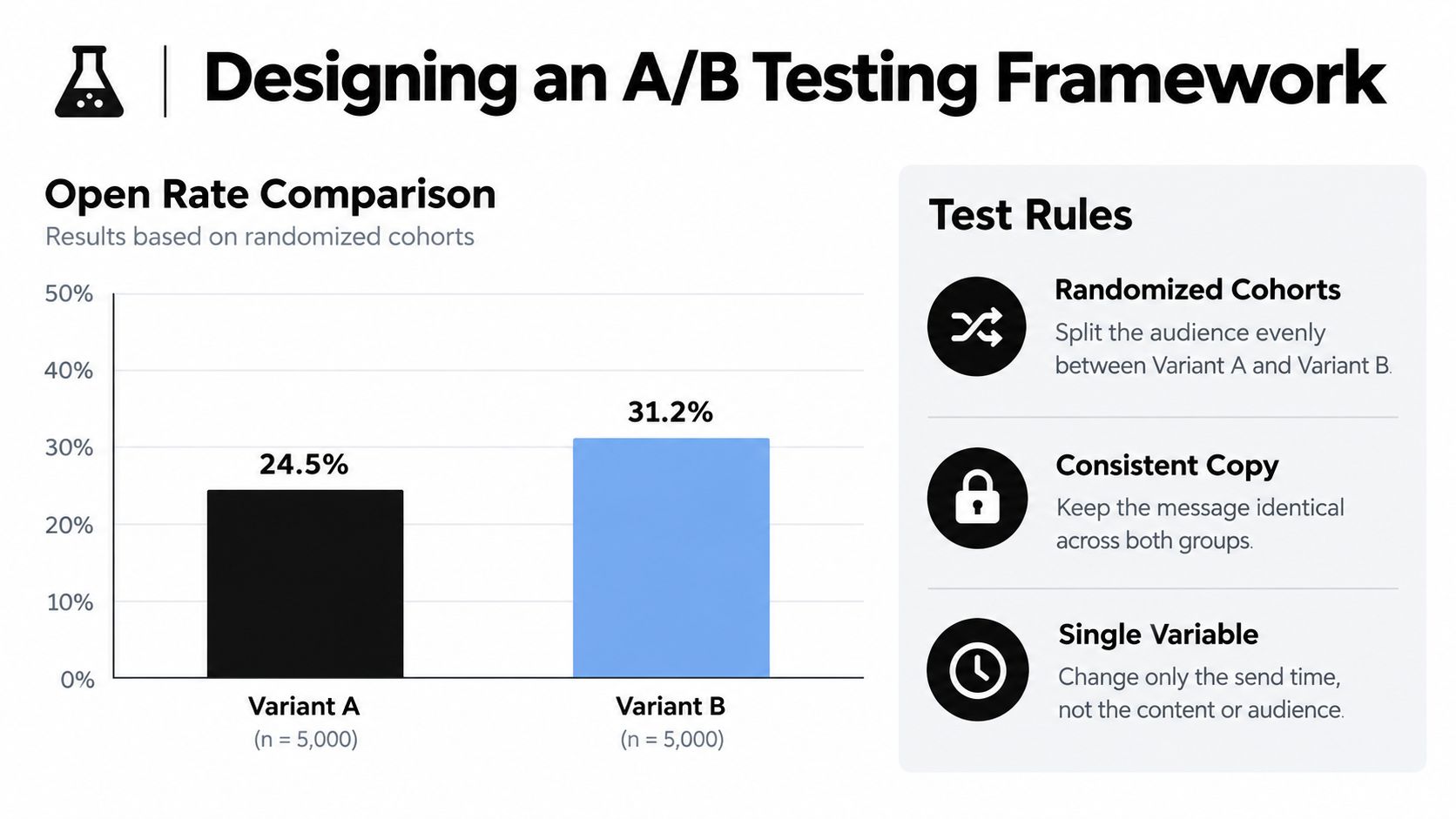
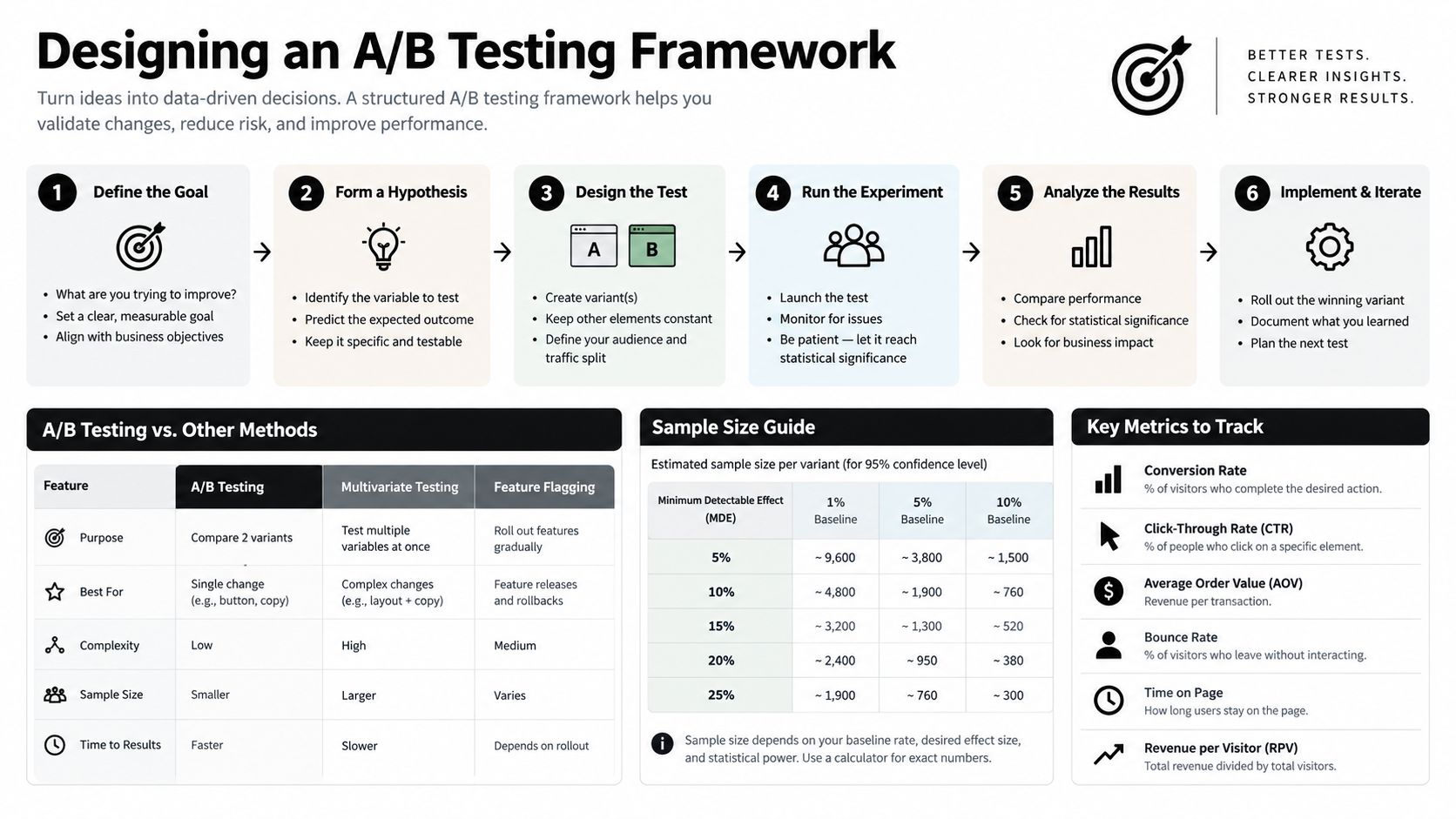
A send-time test earns its place only when it isolates timing. Keep the subject line, body copy, design, offer, audience rules, sequence logic, sender identity, and follow-up behavior unchanged. Randomly assign comparable recipients to cohorts, then compare weekday and time-slot combinations in each recipient’s local time. The commercial goal is a qualified reply or meeting, not an attractive open-rate chart.
A useful starting design could compare weekday mid-morning, afternoon, and an off-hours control. The control may perform well. That result can show whether the current schedule is already competitive or whether another condition only appears stronger because of the comparison set.
Choose the decision metric before launch
For cold B2B outreach, rank outcomes by commercial value:
- Primary metric: Qualified meeting rate or positive-reply rate.
- Secondary metrics: Click-to-open rate, unsubscribe rate, bounce rate, and median time to reply.
- Diagnostic metrics: Open rate, delivery rate, and click rate.
Use a holdout group where possible. Judge each cohort across a complete response window, rather than selecting a winner from early opens. A controlled timing study with 14 treatment paths compared delivery at 3:00 a.m. and 3:00 p.m. It reported a 13.5% increase in click-through rate for the afternoon condition and Sunday outperforming Tuesday by 23.2% on click-through rate (MarketingExperiments timing test). These findings support testing weekday assumptions, not copying a universal schedule.
Set the minimum detectable lift, test duration, stopping rule, and primary outcome before viewing results. One analysis estimates that detecting a 2-percentage-point open-rate difference with 80% power at a 0.05 significance level requires approximately 3,900 emails per condition. Meeting rates are lower than open rates, so cold-outreach tests may need a different sample size.
Testing many windows raises false-positive risk. Apply a correction or repeat the strongest candidate with a new cohort before broad rollout. A practical A/B test calculator can help you estimate required sample size and significance before launch, including how Polish picks winning variants.
Setting Up Automation and Maintaining Deliverability
Automation should translate the test design into recipient-local delivery, rather than merely accelerate batch sending. Configure the campaign to read each contact’s time-zone value, apply a defined delivery window, and route unknown or conflicting records into a fallback schedule. Keep daylight-saving changes, public holidays, hybrid work, and regional calendars in mind.
Global B2B campaigns create a harder problem than “send at 9 a.m. locally.” One account may include stakeholders across several countries, and the recorded location may reflect a company office rather than the buyer’s actual working location. Bloomreach’s discussion of local-time email optimization highlights why recipient geography and working patterns require more careful treatment.
Scale gradually
Avoid sudden sending bursts when a new timing rule distributes messages into the same narrow period. Use controlled daily limits, maintain clean suppression rules, and monitor bounce and complaint signals after every schedule change. Deliverability comes first. A later send can’t improve replies if the message is throttled or filtered before the prospect sees it.
Your automation should also protect sequence logic. If a prospect replies, remove them from scheduled follow-ups. If a contact bounces, suppress the address. If a meeting is booked, stop cold outreach and move the record into the appropriate sales workflow.
Review infrastructure and inbox placement through an email deliverability audit before interpreting timing results. That audit should cover list hygiene, bounce patterns, complaint signals, authentication health, sending consistency, and provider-specific throttling. Timing is a performance variable only after delivery is dependable.
Measuring Results and Tracking KPIs
A timing dashboard should connect send windows to commercial outcomes. Open rate indicates possible visibility, but it should not determine which schedule receives more volume. In cold B2B outreach, positive replies, qualified meetings, and opportunity creation provide stronger decision signals.
Track results by cohort, recipient-local time slot, weekday, persona, industry, buying stage, sender, and campaign type. A blended report can hide different patterns, such as one schedule performing well with technical evaluators while another suits executives. Compare delivered emails rather than assigned contacts, and apply the same response window to every cohort.
| KPI | What It Measures |
|---|---|
| Positive-reply rate | The share of delivered emails that produce a relevant response |
| Qualified meeting rate | The share of delivered emails that result in a meeting meeting your criteria |
| Click-to-open rate | The share of open events that lead to a click, used as an engagement diagnostic |
| Bounce rate | The proportion of messages that fail to reach the recipient |
| Unsubscribe rate | The proportion of recipients who opt out after delivery |
| Median time to reply | The middle response time, useful for understanding follow-up urgency |
| Open rate | Reported opening activity, useful for directional diagnosis rather than final decisions |
Read patterns, not isolated winners
One slot may produce more opens, another more positive replies, and a third fewer meetings but faster responses. Choose according to the sales process and team capacity. If representatives can respond quickly, median time to reply may matter more than a small difference in opens. If qualification limits growth, qualified meeting rate should carry more weight.
A timing test also needs a clear decision rule. Set a primary KPI before reviewing results, then use bounce rate and unsubscribe rate as safeguards. A schedule that generates replies while harming delivery quality is not a successful schedule.
Apple Mail Privacy Protection can register activity without proving that a person consciously viewed the message. Treat opens as a diagnostic signal and give downstream outcomes greater weight, as discussed in Sopro’s B2B email statistics overview.
Teams using several reporting tools can compare measurement solutions by cohort analysis, CRM integration, attribution, and alerting. Keep the dashboard practical. It should show which timing rule to test next, which segment needs review, and whether a change improved qualified pipeline rather than surface engagement.
Attribution matters when a reply follows several touches. Use multi-touch attribution so the first open or final email does not receive all the credit. Timing can affect several stages of a sequence, so evaluate the complete path from delivery through qualified meeting and opportunity creation.
Sample Timing Experiments and Email Templates
Use examples as test designs, not as proof that one schedule works everywhere. The following experiments keep the message stable while changing the delivery window and outcome definition.
Experiment one, weekday morning versus afternoon
Split a persona-specific list into two randomized cohorts. Send the identical first-touch email during recipient-local weekday mid-morning for one cohort and during recipient-local afternoon for the other. Compare positive replies, qualified meetings, median time to reply, bounces, and unsubscribes over the full response window.
Subject: A practical idea for [company]
Email:
Hi [Name],
I noticed [specific business context]. Teams in that position often run into [relevant problem].
We help [type of company] address it by [plain-language outcome]. Is improving [specific result] on your roadmap this quarter?
If it is, would a short conversation be useful?
Best, [Sender]
Don’t change the subject or call to action between cohorts. If you alter the opening at the same time as the send time, you won’t know which change caused the result.
Experiment two, first touch versus follow-up
Keep the initial email schedule fixed and test only the reminder. Send one follow-up during a local-time morning window and another during an afternoon window, with identical copy and a suppression rule for anyone who has replied.
Subject: Re: A practical idea for [company]
Hi [Name],
Following up on the note below. Should [specific problem] be a priority, or is someone else better placed to discuss it?
Best, [Sender]
The best time to begin contact may not be the best time to remind someone who has already seen the thread. Keep these audiences separate. For more sequence ideas, use the cold email follow-up templates as starting points, then test timing without changing the underlying message.
Common Pitfalls and Optimization Cadence
A single campaign cannot establish a permanent “best time.” Recipient behavior shifts by geography, role, workload, holidays, hybrid schedules, and buying stage. A schedule that works for new prospects may underperform with engaged contacts, while broad benchmarks can hide differences between segments.
Avoid these failure modes:
- Open-rate fixation: Privacy-related activity can raise opens without showing genuine attention.
- Timezone confidence: A populated location field may be wrong or outdated.
- Variable mixing: Changing copy, sender, audience, and timing together makes the result impossible to interpret.
- Premature decisions: Early opens may not predict later replies or meetings.
- Deliverability neglect: Unequal throttling or filtering can invalidate a timing comparison.
- No replication: A single winner may be random, particularly after several uncorrected comparisons.
Apple Mail Privacy Protection can inflate reported open rates by up to 25%. Give greater weight to positive replies and qualified meetings when judging pipeline impact, as discussed in Sopro’s analysis of B2B email trends.
Review timing quarterly or twice yearly, then retest after major market, list, or deliverability changes. Before each comparison, check unknown locations, suppressions, bounce patterns, segment definitions, and inbox placement. Keep the A/B framework narrow: change send time while holding the audience, message, and sender constant. For timing based on buying signals rather than a static calendar, Fypion Marketing manages signal-based cold outreach and measures results against qualified meetings.
Fypion Marketing can research target markets, build segmented contact lists, manage cold email infrastructure, and test recipient-local timing against qualified replies and booked meetings. Visit Fypion Marketing to discuss a performance-focused outreach program.