
Vendor Selection Process: A Step-by-Step B2B Playbook

You’re staring at three agency proposals, and the cheapest one promises twice the meetings. Your sales director wants a name by Friday. The inbox is already full of “quick intro” emails that never mention your buyers.
That rush is how teams pay for calls that never match the profile. A workable vendor selection process starts with one written definition of a qualified meeting, then tests every stage, score, and clause against it. If you can’t measure the output, you can’t pay for it fairly.
I would not award on the first call, even when the quote looks generous. Price is one input. The question is whether both sides will count the same meetings.
Vendor Selection Process at a Glance
Say a sales director signs a cheap agency after one call. Two months later, half the booked meetings are with people who were never in the buyer profile. The fee was low. The wasted sales time was not.
Treat vendor selection as a structured decision, not a price shootout. A 2018 literature review in the Journal of Industrial Engineering and Management identified three basic stages: defining the criteria used to evaluate suppliers, determining how candidates will be assessed against those criteria, and selecting suppliers from the resulting scores. That review classified 17 methods for designing or prioritizing criteria, and the ones most often ranked highly included the Analytical Hierarchy Process (AHP), interpretive structural modeling, DEMATEL, and principal-component or factor analysis. You don’t need a full academic model. You do need the split those methods enforce. Decide what matters before you open the quotes, then apply identical scoring rules to every finalist.
For an outsourced meeting program, put the qualified-meeting definition, reporting standards, data-protection practices, campaign performance, and commercial risk on that first list. Service capability, delivery reliability, financial stability, security, technical fit, and total cost belong on the same scorecard so the lowest opening quote doesn’t run the room.
Eight stages and who signs each one
Run the work in this order. Each stage has one output and one owner.
| Stage | Main output | Sign-off owner | Typical duration |
|---|---|---|---|
| 1. Define outcomes and requirements | Requirements brief with meeting definition | Sales and operations leads | 1-2 weeks |
| 2. Market discovery | Longlist beyond the incumbent set | Procurement lead | 2-3 weeks |
| 3. Issue standard RFP | Identical RFP packet and Q&A log | Procurement lead | 2-4 weeks |
| 4. Prequalify vendors | Shortlist of 3-5 finalists | Finance and compliance | 1-2 weeks |
| 5. Score proposals | Weighted scorecard with evidence | Evaluation panel of 3 | 1 week |
| 6. Validate claims | Reference notes, demo notes and pilot results | Sales director | 3-8 weeks |
| 7. Negotiate and contract | Signed agreement with SLAs and exit terms | Legal and procurement | 2-4 weeks |
| 8. Monitor performance | KPI review pack | Revenue owner | Monthly, then quarterly |
Those durations add up to 12 to 24 weeks when you run them in sequence. Overlap discovery with drafting, and start pilot logistics while scoring wraps, and the calendar shrinks. Don’t skip a stage or reorder them. Scoring before the meeting definition exists, or contracting before a pilot, is how the cheap quote wins by default.
How to Define Needs and Write an RFP Agencies Can Answer
Most agency disappointments trace back to a vague brief, not a bad agency.
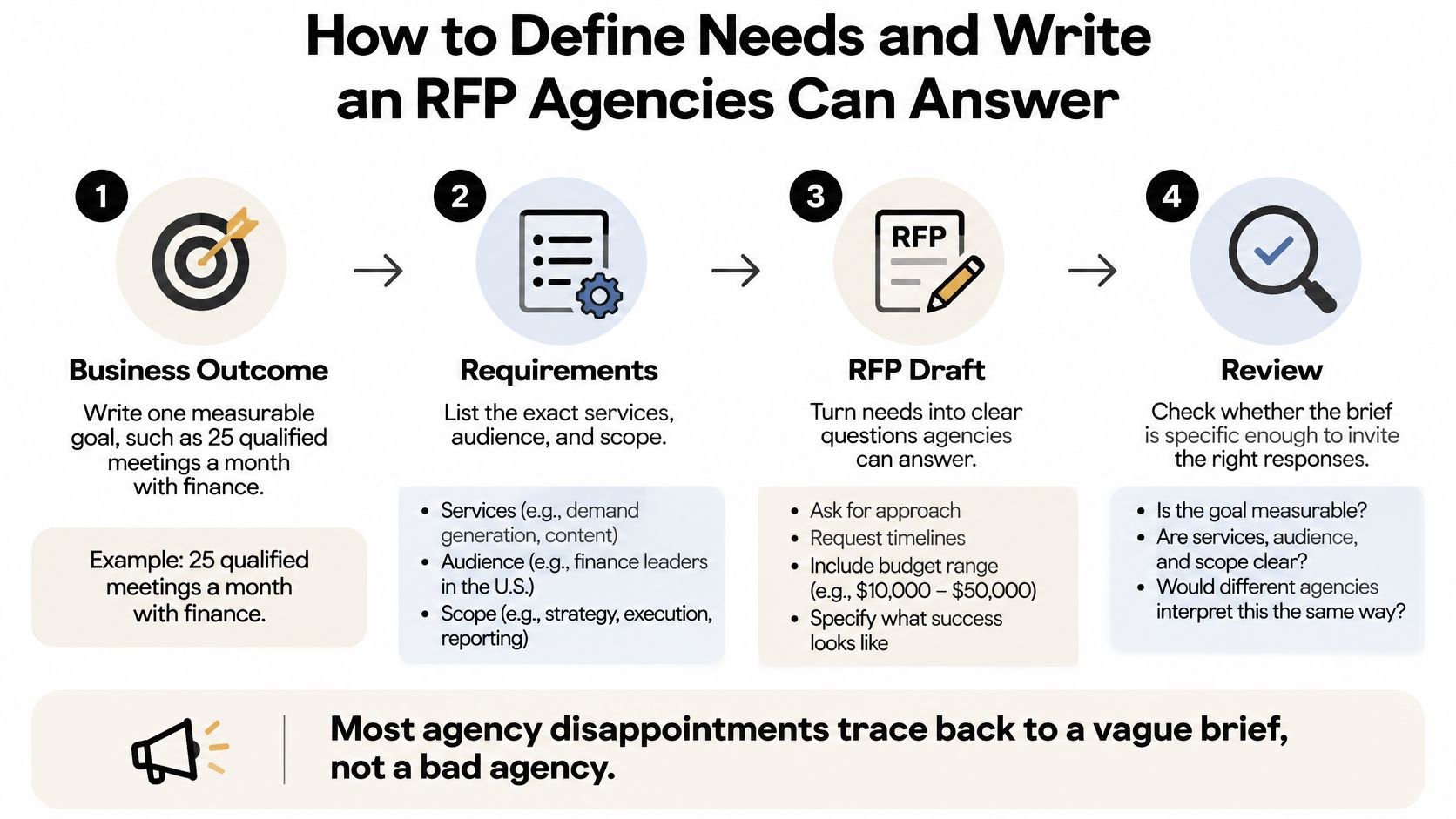
Four steps before you invite proposals
-
Write one business outcome as a number. Use something you can audit, such as 25 qualified meetings a month with finance directors at companies of 200 to 2,000 staff. One number stops each bidder from inventing a private success story.
-
List the mandatory requirements. Name the segments, the geographies, the consent and data-protection rules, and who owns the sending domains and the lead lists. Teams comparing outsourced marketing services should treat ownership as a gate. If it’s fuzzy now, it becomes a fight at exit.
-
Set total-cost assumptions. Count the monthly fee, setup charges, data costs, and about 5 to 10 hours a week of internal time for reviews and handoffs. A low retainer that eats a manager’s week isn’t a cheap program.
-
Define a qualified meeting in writing. Spell out job title, company size, a stated need, a confirmed calendar slot, and a no-show rule. Both sides use that sentence when a meeting is disputed. If it isn’t written, the agency’s judgment becomes the contract.
Seven parts in the packet
- Company context: what you sell, who buys, and what a bad-fit meeting looks like.
- Scope and target outcomes: the monthly number and the segments in scope.
- Response format: page limits and the evidence you want attached.
- Pricing form: one structure for every bidder, so fees line up row by row.
- Security and data handling: lawful basis, retention, subprocessors, and opt-out.
- Reporting standards: which numbers arrive weekly, and who can see raw replies.
- Timeline: question deadline, submission date, and the pilot window.
Send an identical packet to every vendor. Log every question and every answer, and share that log with the whole field so nobody gets a private hint.
Practical rule: If two agencies could read your brief and mean different things by “qualified,” the brief isn’t finished.
Evaluation Criteria and a Weighted Scoring Matrix
Agency A charges less per meeting but counts any connected call as a meeting. Its proposal documents neither show rate nor fit against your qualification criteria, so it scores 2 for track record. Agency B costs more, but its references document stronger attendance and closer matches to the written definition. Weighted scoring puts B ahead. The lower fee is not the better buy if sales spends time on meetings that do not qualify.
A study of 170 purchasing managers associated with the U.S. National Association of Purchasing Managers identified quality, cost, and delivery performance as leading purchasing criteria (study of purchasing-manager responses). A review of 74 prior articles in that source ranked quality first, followed by delivery performance and cost. Those criteria offer a useful starting point, not a template: for lead generation, the buyer’s definition of a qualified meeting should determine the weights. Use industry benchmarking for context, then judge each agency on evidence that its promised output meets your definition.
A 100-point matrix you can defend
| Criterion | Weight | What to verify | Score of 5 looks like |
|---|---|---|---|
| Qualified meeting track record | 25% | Show rate, qualification rate, and meetings held against booked | Documented show rates above 70% with named references |
| Targeting and messaging approach | 20% | ICP research depth, segment logic, and sample personalization | Named segments with tested angles and reply data |
| Infrastructure and deliverability | 10% | Sending domains, warm-up process, and bounce and spam monitoring | Documented domain setup and set bounce ceilings |
| Reporting transparency | 10% | Dashboard access, weekly reports, and raw reply data | Live access to sequences and replies |
| Commercial model and risk | 15% | Fee structure, setup costs, and remedy if meetings underdeliver | Fees tied to agreed meeting criteria with clear refund terms |
| Team and responsiveness | 10% | Named account lead and response time in the RFP and pilot | Named lead who replies within one business day |
| Data protection and compliance | 10% | Lawful basis for contact, retention periods, subprocessors, and opt-out handling | Written data processing agreement and documented opt-out process |
Score each criterion from 1 to 5. Give a 0 when the agency provides no evidence. Calculate the weighted total by multiplying each score by its weight, then adding the results and dividing by 5. A score of 5 on the 25% criterion contributes 0.25; a score of 2 contributes 0.10.
Calibration and the commercial check
Have two reviewers score each proposal independently. Discuss any gap greater than one point before agreeing on a score. Set the weights before reviewing proposals and keep them fixed through the shortlist.
Compare cost per qualified meeting, calculated as total monthly cost divided by qualified meetings delivered. Use the same written qualification criteria for every agency, so a high reply rate cannot disguise a low yield of meetings that sales will accept.
For infrastructure, check the agency’s bounce and spam monitoring rather than relying on claims about clean data. If it buys lists, ask how it checks addresses. Use a consistent yardstick, such as this guide to compare email verification API providers, when assessing what its verification process covers.
A low fee paired with a loose meeting definition can win on paper and lose once sales takes the calls.
Interview Questions and Paid Pilot Design
Every score on that matrix needs evidence, and claims are cheapest to test before you sign. A polished deck is not a track record.
Eight questions and a strong answer
- How do you define a qualified meeting, and what happened when the last client fell short? A strong answer uses criteria close to yours and names a credit, a pause, or a rewrite, not a shrug.
- Which segments underperformed, and why? You want a specific vertical and a cause, such as title mismatch or a dead offer, not “every account is different.”
- Who owns the sending domains, and what happens to them at exit? The buyer should be able to take them over. “We keep the infrastructure” is a no.
- How do you handle a bounce spike? Look for a pause rule, a list hold, and a named person who watches it the same day.
- Which metrics do you report every week? Show rate, qualification rate, and meetings held against booked should be on the list, with raw replies available.
- How much of the work does the named lead do? Ask for hours, not a job title. A lead who only appears on the sales call is a risk.
- What would you change in our brief? A useful answer challenges one assumption in your ICP or your offer. Pure agreement is a tell.
- Which clients in our vertical can we call? You want two names who will take a 20-minute call, not a logo slide.
Pilot rules that keep the test fair
- Run 2 to 3 finalists, not the whole longlist. More than that and your team can’t read the replies with any care.
- Give each finalist the same ICP segment. Different slices make the winner a function of the list, not the work.
- Match contact volume at 300 to 500 records per vendor. Equal volume is what makes reply counts comparable.
- Fix the window at 4 to 6 weeks. Shorter tests reward whoever already had a warm domain.
- Write the success thresholds before the first send. Positive reply rate, qualified-meeting rate, and cost per qualified meeting, agreed in writing.
- Review at day 14 and again at the close. The midpoint is for fixing a broken segment. It isn’t a chance to move the bar.
Say one finalist posts a 2.1 percent positive reply rate and zero qualified meetings out of six conversations. Treat that as a failed pilot. Encouraging replies that never become the meeting you defined are not a win.
Contract and SLA Checklist Before You Sign
A strong score means little if the contract lets the agency keep the lead lists, the sending domains, or the campaign history when you leave.
| Clause | What to require | Red flag |
|---|---|---|
| Fee structure | Itemized setup, monthly and per-meeting fees with caps | Bundled fees with no breakdown |
| Qualified meeting definition | Written criteria matching the RFP, with a dispute process | Qualification left to the agency’s judgment |
| Service levels | Response times, report frequency and reporting formats | No response-time commitment |
| Data ownership | Buyer owns lead lists and campaign data, usable after exit | Agency retains lists or data |
| Sending domains | Buyer owns or can take over sending domains | Domains registered only in agency name |
| Data processing terms | Signed data processing agreement and list of subprocessors | Standard terms only, no subprocessor list |
| Remedies for missed KPIs | Fee credits, refunds or a right to pause | No remedy for underperformance |
| Audit and reporting rights | Access to sequences, reply data and suppression logs | Dashboard access withheld |
| Termination and exit | 30 days’ notice, full data return, and at least 14 days of exit assistance | Auto-renewal with long notice or no exit support |
Governance after the signature
Before award, run a short risk-to-serve review with sales, legal, and finance. Cover data exposure, continuity if the agency stalls, concentration on one channel, and what switching would take. Turn anything material into a clause and a named owner.
After award, keep at least one credible fallback agency for a critical channel. Define the service-level indicators before you sign, review performance monthly during onboarding and quarterly after that, and recheck financial health and compliance at each renewal gate. Gartner’s sourcing and procurement guidance notes that performance measurement remained a major challenge for 57% of sourcing and procurement executives, and a Deloitte 2025 survey of more than 250 CPOs across 40 countries, covered in that same guidance, found 74% considered active alternative sources the most effective risk-mitigation strategy.
A fee that looks low beside published B2B appointment setting pricing can still hide switching costs that show up only when you try to leave.
Red Flags and Negotiation Tips
Your own inbox is the first test. In 2025, 73% of B2B buyers actively avoided suppliers that sent irrelevant outreach, and 61% preferred an overall representative-free buying experience, according to Gartner’s survey of 632 B2B buyers. An agency that pitches you with generic, badly targeted emails is showing you the method your prospects will receive.
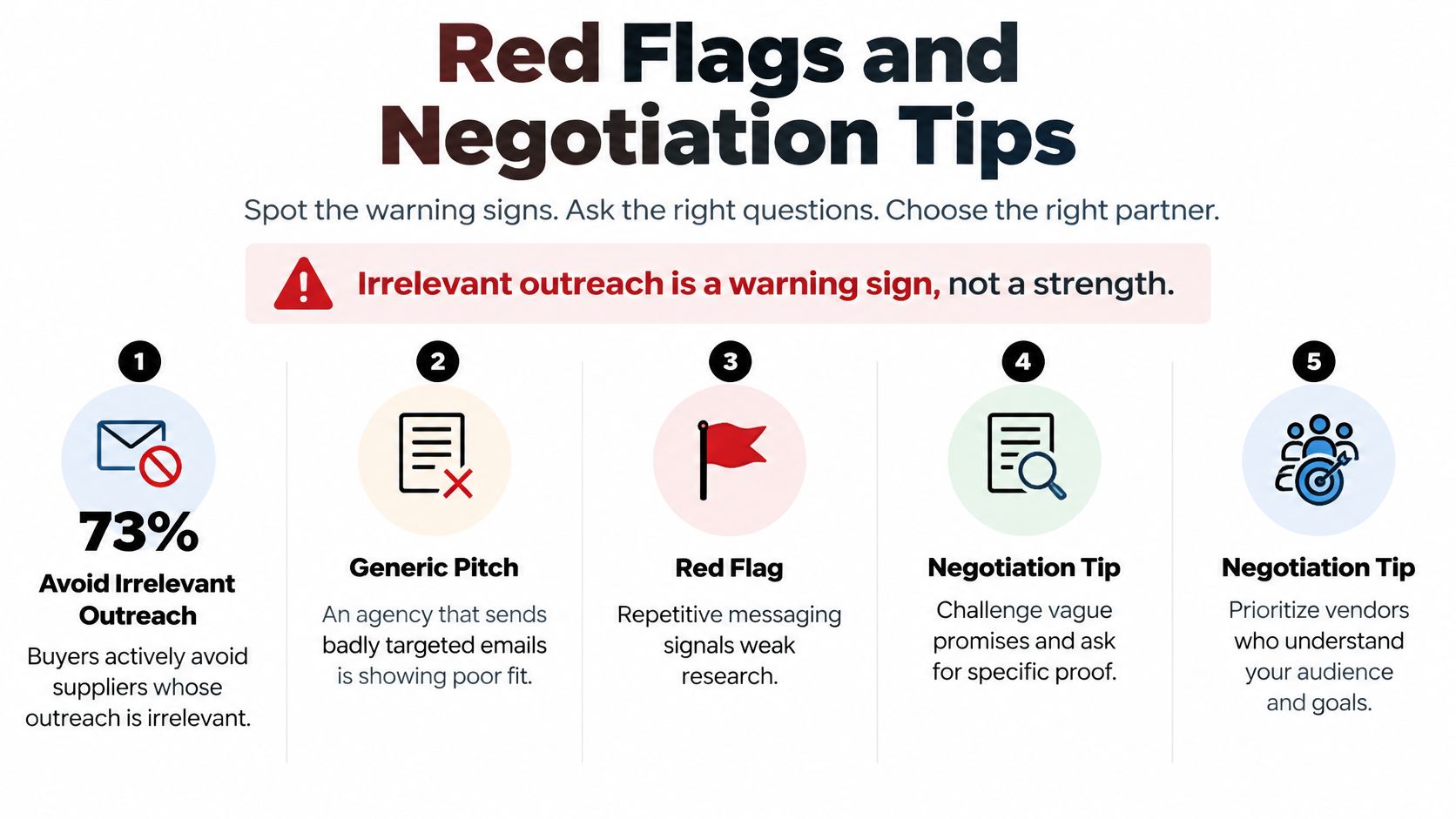
Flags that sit outside the contract table
- Guaranteed meeting numbers before any ICP discussion. A promise made with no look at your buyer profile is a sales line, not a plan.
- References that sit outside your vertical, or that won’t take a call. Logos you can’t speak to don’t count.
- A refusal to run a pilot, or to write the success thresholds down. If they won’t test it, they don’t want it measured.
- Outreach sent from your primary corporate domain. One bad sequence can damage the domain your whole company sends from. Keep tests on separate domains you control.
A careful lead generation agency will accept a written test. One that pushes you to skip it is protecting a claim.
Five moves while you still have leverage
- Ask for a paid pilot credited against the first retainer month. You pay for real work, and a failed test doesn’t lock you into a year.
- Hold back 10 to 20 percent of fees until the agreed meeting criteria are met. The holdback makes the definition operational.
- Tie a bonus to beating the qualified-meeting target. Reward the outcome you want, not raw send volume.
- Request tiered per-meeting pricing that drops at higher volumes. You keep upside if the channel scales.
- Insist on a 90-day review clause. It gives you a scheduled exit if the early months miss the thresholds.
Your influence is greatest before signing and decreases significantly afterward. Negotiate every term while the pen is still on your side of the table.
Confirm Your Shortlist Before You Sign
Award only to a vendor that passes every prequalification gate, then rank the qualified vendors by weighted total. A high score doesn’t rescue a failed finance or compliance gate.
The shortlist meeting is where the paperwork either holds or it doesn’t.

If the top two finalists land within five points, don’t guess. Run a second round of reference calls with clients in your vertical, or extend the pilot by two weeks using the same thresholds and the same segment. A coin flip between close scores is how familiarity sneaks back in.
Three checks, then a date on the calendar
Before anyone signs, confirm three things.
- The scorecard is complete. Every rating cites the evidence behind it, not a reviewer’s impression.
- The contract clauses are agreed. Meeting definition, data and domain ownership, remedies, audit rights, and exit assistance are in the draft, not in a side email.
- A fallback agency is named for the critical channel, even if you never call them.
Then book the first monthly review for 30 days after launch, stand up the KPI dashboard with the agreed metrics, and put the quarterly renewal gate on the calendar. Pay-per-meeting providers belong on that shortlist when they fit your criteria, scored on the same matrix as every other agency. Early-stage teams weighing a digital marketing agency for startups should use that same gate, not a lighter one.
A short walkthrough of how buyers compare vendors is worth fifteen minutes before the signature meeting.
If you want commercial terms built around meetings you defined in advance, Fypion Marketing runs cold email outreach for B2B teams with proven product-market fit and charges only for booked, qualified meetings, with no upfront retainer or setup fee. The work starts with a consultation and audience research, then infrastructure, copy, lists, and ongoing optimization aimed at appointments your sales team can take. Visit Fypion Marketing when you’re ready to put that meeting definition at the center of the contract.