
What Is a Third Party Sale: A B2B Guide

A third-party sale is a transaction where an independent seller sells goods or services through an intermediary that doesn’t own the inventory or hold the underlying customer contract. In mergers and acquisitions, the same phrase can instead mean selling a company to an unrelated external buyer.
But third party relative to whom: the producer, the platform, or the business owner? That’s the question to ask before negotiating a commission, agreeing to a reseller arrangement, or deciding who must handle a customer’s refund.
For a B2B founder, the label matters less than the allocation of responsibility. You need to know who makes the promise to the customer, who gets paid, and who must act when something goes wrong.
The Core Idea Behind a Third Party Sale
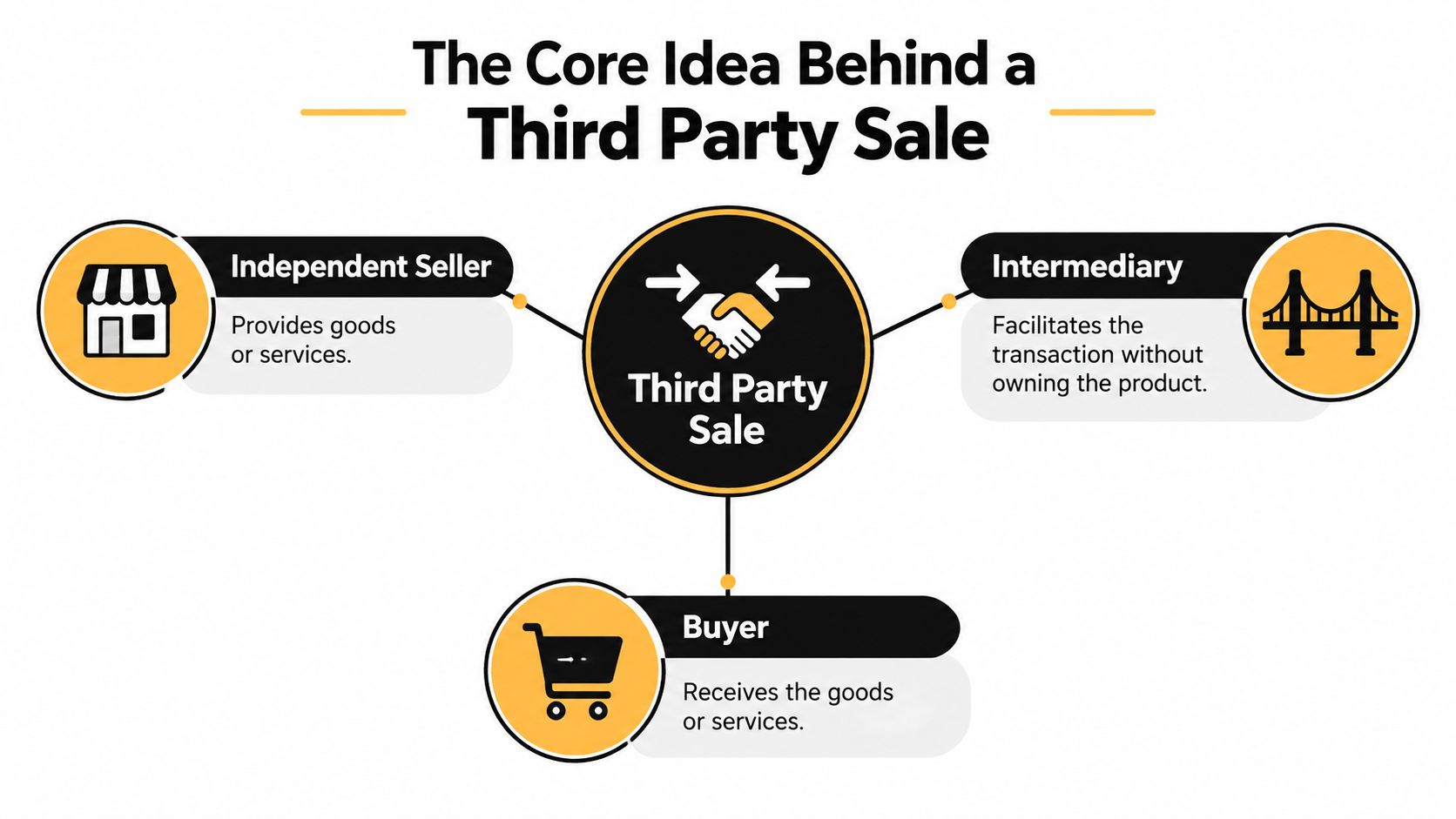
Think of a food hall rather than a restaurant chain. In this analogy, the food hall provides the location and shared facilities, while an independent stall prepares and sells your lunch. The hall helps the transaction happen, but the stall supplies the product.
A conventional marketplace arrangement works similarly. The independent seller supplies the goods, the intermediary provides transaction infrastructure, and the buyer receives the product. Services require closer attention because the platform may facilitate the purchase or sell access in its own name.
The diagram makes those relationships easier to separate.
Ownership matters more than the storefront
A familiar checkout page doesn’t necessarily identify the seller. Ask whether the intermediary purchased the product for resale or merely helped an independent merchant sell it.
Amazon illustrates the scale of that distinction: independent sellers’ share of physical gross merchandise sales grew from 3% in 1999 to 58% in 2018, according to its shareholder letter explaining third-party seller growth. Those purchases occurred through Amazon, but the independent merchants remained the sellers.
First-Party vs Third-Party Sale at a Glance
| Dimension | First-Party Sale | Third-Party Sale |
|---|---|---|
| Inventory ownership | Retailer buys and owns goods before resale | Independent seller generally retains ownership until sale |
| Customer-facing seller | Retailer | Independent merchant |
| Pricing | Retailer sets its resale price | Merchant generally chooses or influences price |
| Intermediary’s contribution | Purchasing and reselling goods | Access, payments, advertising, fulfillment, or other services |
| Merchant’s proceeds | Supplier receives payment from retailer | Seller receives sale proceeds after applicable fees |
For a SaaS analogy, consider a platform that introduces buyers to independent software vendors. A unified buying experience doesn’t tell you whether the vendor or platform supplies the subscription under the customer agreement.
Practical rule: Identify the seller in the contract, not just the logo above the checkout button.
So, what is a third party sale in practical terms? It’s a relationship you must inspect, not a universal operating model you can infer from a storefront.
Three Common Meanings of the Same Phrase
A founder discussing a channel partnership and an owner discussing an acquisition may use identical words for entirely different deals. Confusing those meanings can send negotiations toward the wrong questions.
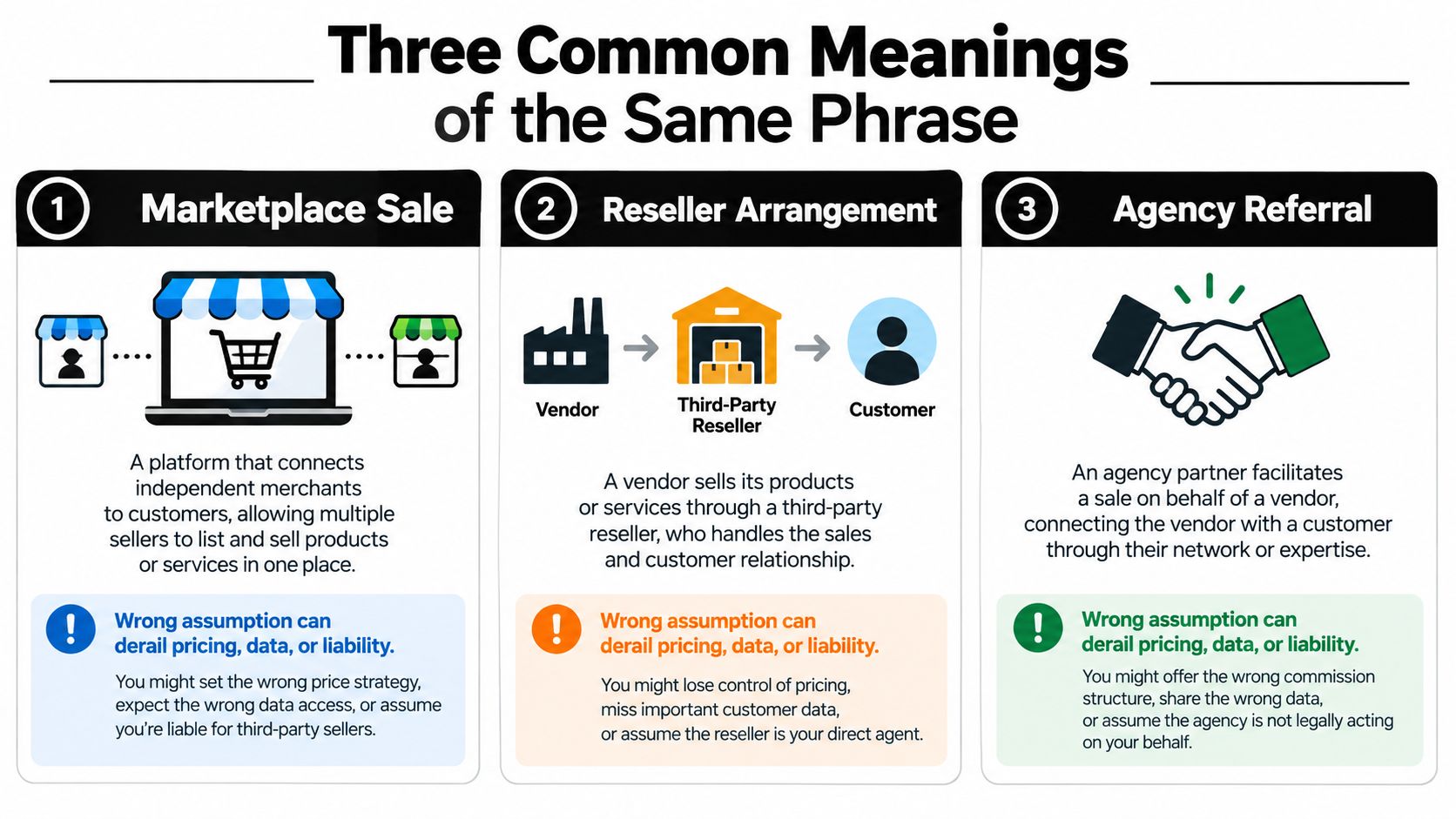
Within channel selling, the distinctions are also important. A marketplace, reseller, and referral agency can all participate in indirect selling without performing the same job.
This visual separates those channel arrangements.
Which ‘Third Party’ Are You Talking About?
| Context | Defining Question | Typical Parties | What Changes |
|---|---|---|---|
| Marketplace | Who sells through someone else’s platform? | Merchant, platform, customer | Listing access, transaction services, seller obligations |
| Distribution channel | Who stands between producer and end customer? | Producer, distributor, reseller, buyer | Margin, territory, selling authority, customer relationship |
| Business sale or M&A | Who is buying the business from its owner? | Owner, unrelated external buyer, advisers | Business ownership and negotiated transfer obligations |
A channel partner isn’t necessarily a reseller
In distribution, a producer can reach customers through wholesalers, retailers, resellers, or other intermediaries. Transactions can involve several participants while still being described as third-party sales, as discussed in LibreTexts’ explanation of third-party distribution channels/12:_Place-_Distribution_Channels/12.03:_Reading-_Third-Party_Sales).
Consider a hypothetical software company evaluating different partners. A referral partner might introduce a prospect while the vendor negotiates and signs the deal. A reseller might instead purchase access for onward sale, subject to its agreement.
Hiring a sales outsourcing service is another distinction worth checking. Delegating prospecting or sales activity doesn’t, by itself, answer who contracts with the buyer.
The video provides an additional visual reference for the topic.
For an acquisition discussion, put the channel vocabulary aside. You’re evaluating the sale of the business itself, not just how its products reach customers.
Before drafting terms, write a plain-language description of the proposed transaction. If the parties can’t agree on that description, they aren’t ready to agree on pricing, liability, or control.
Roles, Relationships, and Legal Thresholds
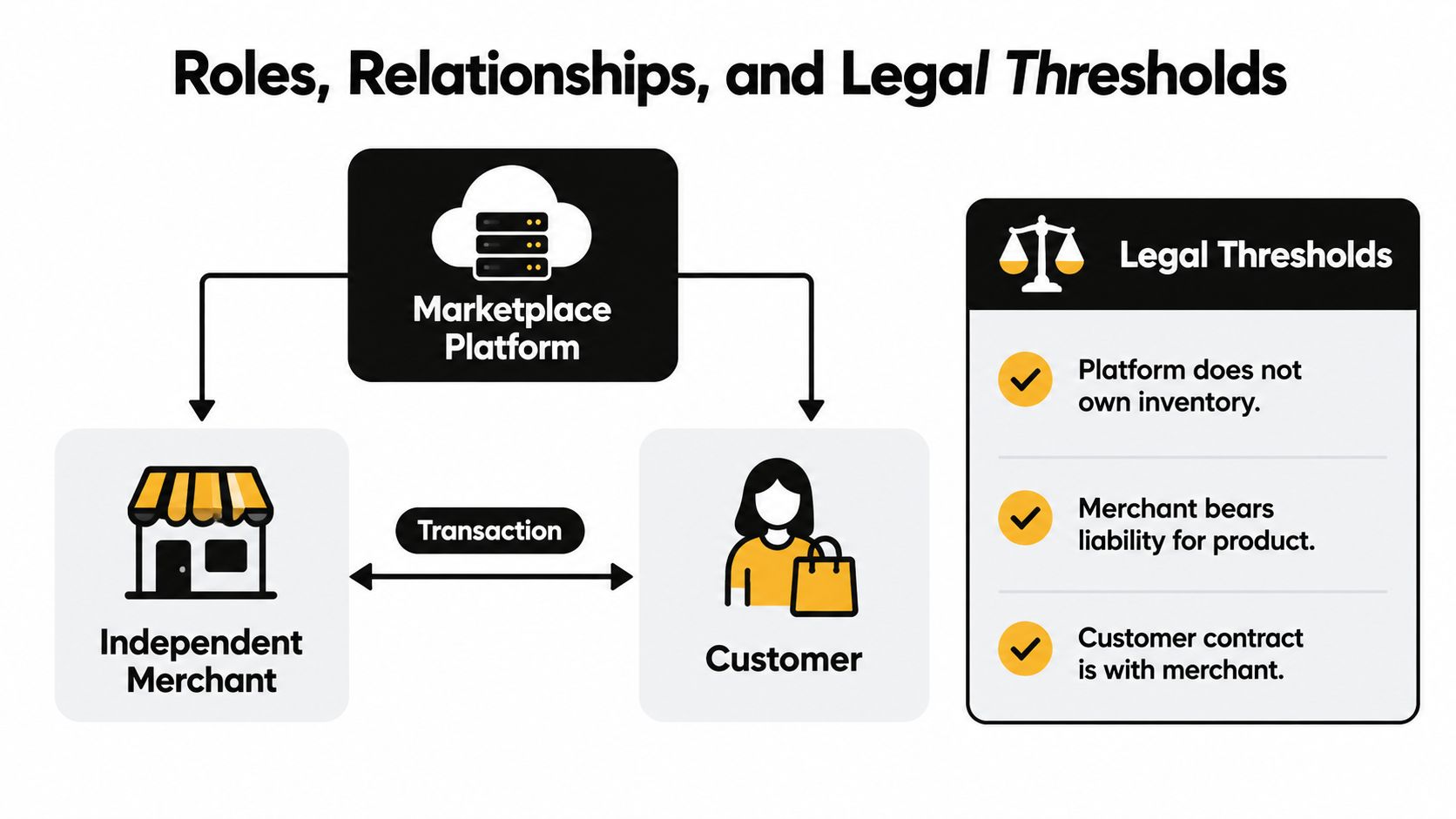
A marketplace transaction involves distinct responsibilities, even when the buyer experiences a single checkout. The platform operates the environment, the merchant supplies the product, and the customer purchases it.
The legal significance depends on the activity involved. Don’t assume that every marketplace account, product category, or sales volume receives identical treatment.
The relationship map below is a starting point, not a substitute for checking the applicable contract and law.
What the INFORM Consumers Act threshold means
The U.S. INFORM Consumers Act defines a high-volume third-party seller using both transaction activity and revenue. The seller must complete at least 200 separate sales or transactions of new or unused consumer products and generate at least $5,000 in gross revenues during a continuous 12-month period within the preceding 24 months, as explained in the FTC’s guidance for third-party sellers.
That definition concerns specified consumer-product activity. Don’t automatically apply it to a SaaS reseller because the reseller uses a platform.
Meeting the definition brings the seller into the law’s verification and disclosure framework. Operationally, the merchant should be prepared to cooperate with marketplace information requests, while the marketplace must assess its own statutory duties.
- Platform responsibility: Determine which accounts fall within the applicable legal requirements and administer the required processes.
- Merchant responsibility: Maintain reliable business information and respond to relevant verification requests.
- Customer relationship: Make the seller’s identity and available support routes understandable rather than hiding them behind platform branding.
B2C and C2C aren’t interchangeable
A business selling to an individual is a business-to-consumer, or B2C, arrangement. An individual selling used goods to another individual is a consumer-to-consumer, or C2C, arrangement.
Those descriptions identify the participants, not a complete compliance answer. Product condition and the nature of the seller’s activity still matter when assessing a particular rule.
For B2B teams, record these distinctions in your account structure. Planning CRM integration should include separate fields for the partner, contracting customer, and end user so employees don’t mistake one relationship for another.
How a Third Party Sale Works in a B2B SaaS Channel
Consider a hypothetical SaaS vendor that authorizes a regional reseller to sell subscriptions. The reseller finds a prospect and runs the commercial conversation, while the vendor supplies the application.
That description still leaves the deal unfinished. The parties must decide whether the reseller contracts with the customer or merely arranges a vendor contract.
A signed partnership should follow those decisions, not substitute for them.

Follow the deal from introduction to renewal
At first contact, specify who registers the opportunity and what evidence establishes the partner’s involvement. If your own sales team already knows the account, resolve the overlap before anyone promises exclusivity.
During the demo and proposal, define what the partner may say about functionality, implementation, discounts, and warranties. A suggested control is to require written approval for commitments outside standard terms.
At signature and billing, name the contracting supplier, invoice issuer, and payment recipient. Don’t assume that the business receiving payment also owes every service obligation.
For support and renewal, assign initial triage, technical escalation, renewal outreach, and cancellation handling. Map these handoffs in a sales process flowchart that employees can follow.
A customer shouldn’t have to interpret your partner agreement to discover who will fix a service problem.
For a location-specific starting point, RNC Group’s guide for channel partners entering Israel is a resource to review alongside local legal advice. Use jurisdiction-specific guidance rather than assuming a familiar agreement works unchanged elsewhere.
Clauses to settle before renewal season
- Renewal entitlement: State who may approach the customer and whether partner compensation continues after the initial term.
- Account transition: Explain what happens to customer access, open tickets, and commercial records if the partnership ends.
- Promise boundaries: Identify who may approve service commitments, warranty language, credits, and exceptions.
These are proposed negotiating priorities, not a universal template. A referral arrangement may need different provisions from a reseller agreement.
Test the arrangement against an uncomfortable scenario: the customer cancels while disputing an implementation promise. Your contracts should tell the vendor and partner who responds, who approves a remedy, and who bears the resulting cost.
Tax, VAT, and Accounting Implications
A marketplace checkout can look local while the seller, platform, and customer operate in different jurisdictions. Finance teams need the transaction’s legal and operational details before deciding how to treat tax or revenue.
The marketplace facilitator or deemed-supplier model can place VAT or GST collection and remittance duties on the platform. The OECD’s report on digital platforms and VAT/GST collection discusses these approaches and the challenges created by cross-border platform selling.
Collection responsibility isn’t the whole tax position
Under an applicable platform-liability model, the platform may calculate tax at checkout, collect it, retain transaction records, and remit it. The underlying merchant may still have registration, reporting, or documentation obligations depending on the jurisdiction.
Where the relevant rules don’t shift responsibility, the merchant may need to handle those obligations itself. A platform’s commercial promise to simplify billing isn’t enough to establish the legal result.
Build a transaction record that finance can inspect:
| Field | Question to Resolve |
|---|---|
| Seller of record | Which entity makes the underlying sale? |
| Customer location | Where is the customer established or located? |
| Delivery destination | Where are the goods delivered or services supplied? |
| Tax nexus | Which jurisdictions require further assessment? |
| Invoice issuer | Whose legal details appear on the invoice? |
| Payment recipient | Who receives the customer’s payment? |
| Return responsibility | Who authorizes and funds refunds or credits? |
Service businesses also need activity-specific advice. For a separate service-sector example, Bookkeeping and Accounting of Florida Inc. provides cleaning business tax compliance help, a reminder to investigate the actual service and jurisdiction rather than borrow assumptions from another industry.
Assess the service before deciding gross or net
For SaaS, the accounting question isn’t whether the agreement calls someone a reseller. Under an ASC 606-style principal-versus-agent analysis, finance should identify the specified service and assess whether the intermediary controls it before transfer.
That assessment informs whether the intermediary presents the relevant revenue gross as principal or its fee net as agent. It requires a separate accounting conclusion, not an automatic inference from who sends the invoice.
- Document the service: Specify what the customer is entitled to receive.
- Examine control: Review the contractual and operational evidence before transfer.
- Reconcile the outcome: Ensure contracts, billing records, and accounting treatment tell a consistent story.
Treat tax classification and revenue presentation as related but separate reviews. Have the appropriate advisers approve each before launching the channel.
Risks Most Buyers and Sellers Underestimate
Broader distribution doesn’t automatically make an arrangement low risk. You may reduce the work of reaching customers while accepting less control over how someone else represents your business.
Independent consumer-protection analysis identifies exposure involving counterfeit goods, product safety, privacy, manipulative selling practices, weak seller verification, and inadequate remedies in its report on online marketplace shopping risks. For B2B founders, the useful question is how comparable weaknesses could appear in their own channel.
Test partner conduct, not just partner reach
A software reseller won’t present the same physical-product risks as a goods merchant. But you should still investigate whether it can misrepresent capabilities, overpromise implementation, or leave customers without a clear escalation route.
Consider a hypothetical agency that promises a feature the vendor hasn’t approved. The vendor may then face a dissatisfied customer even if the agreement limits the agency’s authority.
Decision test: Would you still accept the partner’s sales approach if the customer assumed every promise came directly from your company?
That test matters because customers may interpret platform presence as endorsement even when the merchant is legally independent. Set explicit brand and messaging controls instead of relying on customers to understand your internal structure.
Treat data sharing as its own decision
In privacy contexts, a third party can mean a separate business receiving personal information. That classification can differ from a service provider or processor, so a commercial partner label doesn’t settle the privacy analysis.
Before sharing prospect or customer records, ask counsel to assess the recipient’s role and permitted uses. Avoid granting broad access merely because a partner helped originate the relationship.
Recommended channel controls include:
- Verification: Confirm the partner’s identity, capabilities, and authority.
- Data limits: Define permitted fields, purposes, access, retention, and deletion.
- Incident ownership: Assign notification, investigation, and customer communication.
- Quality monitoring: Track complaints, cancellations linked to mis-selling, unresolved tickets, and unauthorized commitments.
Add those measures to your sales pipeline management practices. Judge the partner on the quality of the business it introduces, not just the volume entering the pipeline.
A Practical Checklist Before You Sign or Sell
Before committing to a channel, ask the founder, sales lead, finance lead, and operational owner to review the same transaction. Each should be able to describe what happens from the first introduction through cancellation.
Use the agreement to resolve disagreements between those descriptions. Don’t leave employees to negotiate responsibility after the customer has already encountered a problem.
Turn commercial intentions into explicit terms
Third Party Sale Contract Checklist
| Clause | What to Confirm | Why It Matters |
|---|---|---|
| Authorization | Products, services, territory, permitted buyers, and selling authority | Prevents activity beyond the intended mandate |
| Commission or margin | Calculation basis, payment trigger, deductions, and clawbacks | Makes the commercial exchange understandable |
| Lead ownership | Registration evidence, conflicts, existing accounts, and expiry | Reduces competing claims over opportunities |
| Customer relationship | Contracting entity, account access, and renewal rights | Identifies who may act at each stage |
| Support and refunds | Triage, escalation, approval authority, and funding | Gives employees a usable resolution process |
| Data access | Permitted purposes, restrictions, retention, and deletion | Limits unnecessary or unauthorized use |
| Audit rights | Records available, review process, and corrective action | Lets each party verify compliance |
| Brand controls | Approved claims, materials, and exception handling | Restricts unsupported promises |
| Termination | Triggers, notice, outstanding payments, and customer transition | Supports an orderly exit |
These are negotiating prompts, not clauses to paste into an agreement without review. Ask legal and finance advisers to translate them into terms suited to the actual arrangement.
Decide whether you need a channel at all
My recommendation is to pursue a third-party channel when you have proven product-market fit, a clear partner profile, and people who can monitor the relationship. Stay direct when you’re still changing the offer or can’t reliably support the handoffs.
Separate a distribution problem from a prospecting problem. If you need more qualified conversations rather than another business reselling your product, compare referral arrangements and outsourced outreach using a B2B appointment-setting pricing guide.
Before signing, run a transaction walkthrough covering a successful purchase, a disputed promise, and a cancellation. Require a named owner for every decision, customer communication, and payment adjustment.
The final question isn’t whether this qualifies as a third-party sale. It’s whether every participant understands the responsibilities they’re accepting, and whether the extra reach justifies the control you’ll give up.
If you need qualified introductions rather than a reseller taking over the customer relationship, Fypion Marketing offers B2B cold email outreach with payment tied to booked, qualified meetings that meet pre-agreed criteria. Visit the team to discuss your target accounts, qualification requirements, and the handoff from an introductory meeting to your own sales process.