
What Is Social Selling and How B2B Teams Use It

Social selling is a relationship-led method in which sellers use social networks to find relevant prospects, understand their needs, share useful insights, and build trust before asking for a meeting. You’ve probably seen the opposite happen. A seller sends a polished message, waits, and hears nothing, not because the offer is weak, but because the buyer has no reason yet to trust the person behind it. That quiet checking process is where social selling earns its place.
Why Buyers Check You Out Before They Reply
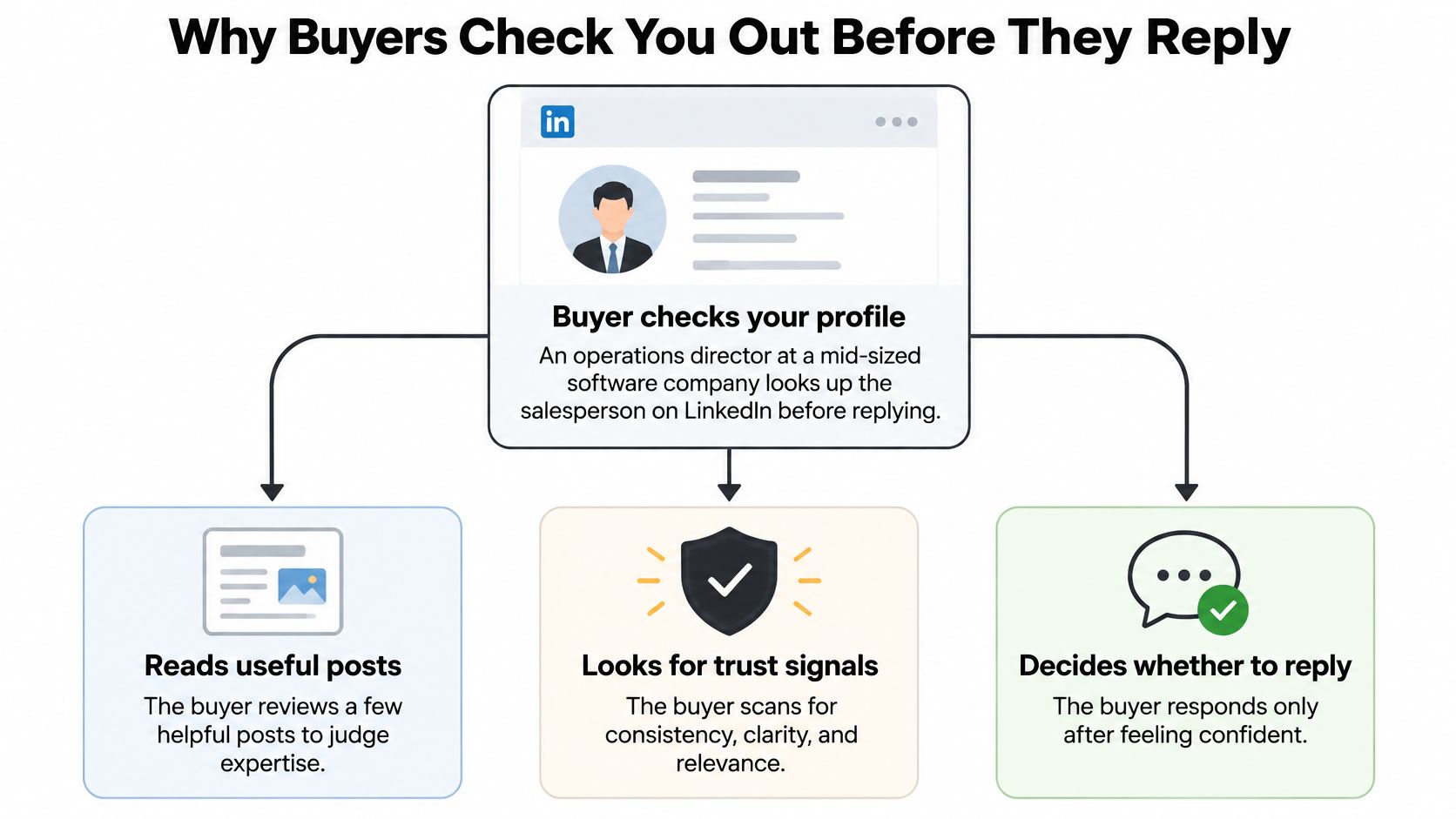
An operations director at a mid-sized software company hears your company’s name from a colleague. She doesn’t book a call. She opens the salesperson’s LinkedIn profile, scans the headline, reads two or three recent posts, and checks whether the comments sound informed or generic. Only after that small test does she decide a reply is worth her time.
That moment captures what is social selling in practice. It’s a relationship-led sales method that uses social networks to identify relevant prospects, understand their needs, share useful insights, and develop trust before asking for a purchase or meeting. A 2022 study summarized in the social selling overview identified insight generation, connecting, and engagement as the three measurable activity dimensions behind that process.
Here’s a simple analogy. Think of a neighbor who’s known for giving sensible advice about contractors, roofers, and local prices long before anyone on the street decides to sell a house. When that day comes, people already know who to talk to. The seller hasn’t pitched for months. She’s been present, relevant, and credible.
The Three Core Activities in Plain Language
- Monitoring conversations: You watch what target accounts announce, complain about, hire for, and invest in, so your outreach reflects their world.
- Coordinating internally: You share that account intelligence with colleagues in your CRM or chat tools, so three sellers don’t send three disconnected messages.
- Contributing usefully: You post or comment with evidence, examples, and questions that help buyers think, rather than slogans that help nobody.
This is also where confusion starts. Publishing posts to chase reach isn’t social selling. Neither is placing ads in front of an audience. Both can support awareness, but neither builds a one-to-one relationship with a named buyer. If you want the deeper human side of that distinction, you can explore the art of relationship selling for background on trust as a sales asset.
A useful profile and a relevant comment often answer the buyer’s first question before you ever ask for time. Can I trust this person’s judgment?
For B2B and SaaS buyers who do substantial due diligence online before speaking to anyone, that early impression isn’t decoration. It’s the first round of evaluation, and it happens whether you plan for it or not.
Social Selling Compared with Social Media Marketing and Cold Outreach
Teams often mix these three activities together, then wonder why the results look messy. They’re related, but they’re not the same job, and they shouldn’t share the same scorecard.
Social Selling, Social Media Marketing, and Cold Outreach Compared
| Approach | Who Initiates | Primary Goal | Main Success Signal |
|---|---|---|---|
| Social selling | A named seller or advisor | Build relevance and trust with a defined set of buyers | Qualified conversations and meetings with target accounts |
| Social media marketing | A brand or marketing team | Reach a broad audience and shape perception | Reach, engagement, and follower growth |
| Cold outreach | A seller or outbound team | Start a direct conversation with someone who hasn’t signaled interest | Replies and booked meetings |
Social media marketing is a broadcast. Your company page shares a product launch, a webinar clip, or a customer story, and success means more of the right market saw it and remembered it. That’s valuable, but no individual buyer feels personally understood because a logo posted a video.
Cold outreach is direct. You email or message a prospect who may not know you, and success means they reply. If you’re weighing channels, this comparison of cold email versus LinkedIn outreach for B2B prospecting helps separate the strengths of each route. The risk is obvious. Without prior context, even a well written message can feel like an interruption.
Social selling sits between broadcast and interruption. Suppose a target account announces an expansion into a new region. A seller who serves similar companies comments with a specific observation about hiring and onboarding challenges during expansion, then later shares a short post on that same problem. When she finally sends a note, she’s not a stranger. She’s a familiar name attached to a relevant point of view.
A Quick Test for Which Activity You’re Running
- If the audience is everyone: You’re doing marketing, so judge reach and recall.
- If the first touch asks for a meeting: You’re doing cold outreach, so judge replies and qualification.
- If a named seller builds familiarity first: You’re doing social selling, so judge progression into qualified conversations.
Practical rule: Don’t blame social selling for low reach, and don’t credit a viral post with pipeline it never created.
Used well, social selling makes cold outreach warmer and more relevant. It doesn’t have to replace it.
Business Benefits for B2B and SaaS Teams
The core mechanism is risk reduction. A B2B purchase can affect budgets, workflows, and reputations across a committee, so buyers look for reasons to feel safe before they invest attention. A credible person who understands their context lowers that perceived risk in a way a generic pitch can’t.
The survey evidence supports that logic. LinkedIn’s 2017 State of Sales research found that 64% of B2B decision-makers would not engage with a salesperson when communication was not personalized. The same source reports later findings that 82% of buyers were more likely to consider a brand when the salesperson had an informative LinkedIn profile, and 37% of top performers said LinkedIn produced a high conversion to opportunity rate compared with 20% of average performers.
Read those figures carefully. They show associations between personalization, credible profiles, and stronger outcomes. They don’t guarantee that posting more often will produce the same result for your team, your market, or your price point. That’s an important distinction when you’re building a business case and don’t want to overpromise.
Why This Matters More in Long B2B Cycles
- Committees research: Several people may check your profile before one person replies.
- Trust transfers: A champion who’s seen your thinking can forward a post internally more easily than a cold pitch.
- Relevance compounds: Each useful interaction gives the buyer another small reason to include you in evaluation.
That’s why follower counts are the wrong yardstick. A seller can gain followers outside the buying market and create no commercial value at all. The better question is whether target accounts engage, accept conversations, and move toward qualified opportunities.
For a SaaS team, realistic benefits look like this. You get more relevant conversations because outreach follows observed priorities. You get better qualified meetings because disinterested accounts reveal themselves earlier. You also get stronger trust during evaluation because buyers have seen consistent expertise, not just a polished demo.
Judge the program by whether the right buyers take a next step, not by whether the internet applauded.
Those benefits are meaningful, but they’re progression benefits. They improve the quality of the path into pipeline rather than magically manufacturing demand from nothing.
Building a Social Selling Program Step by Step
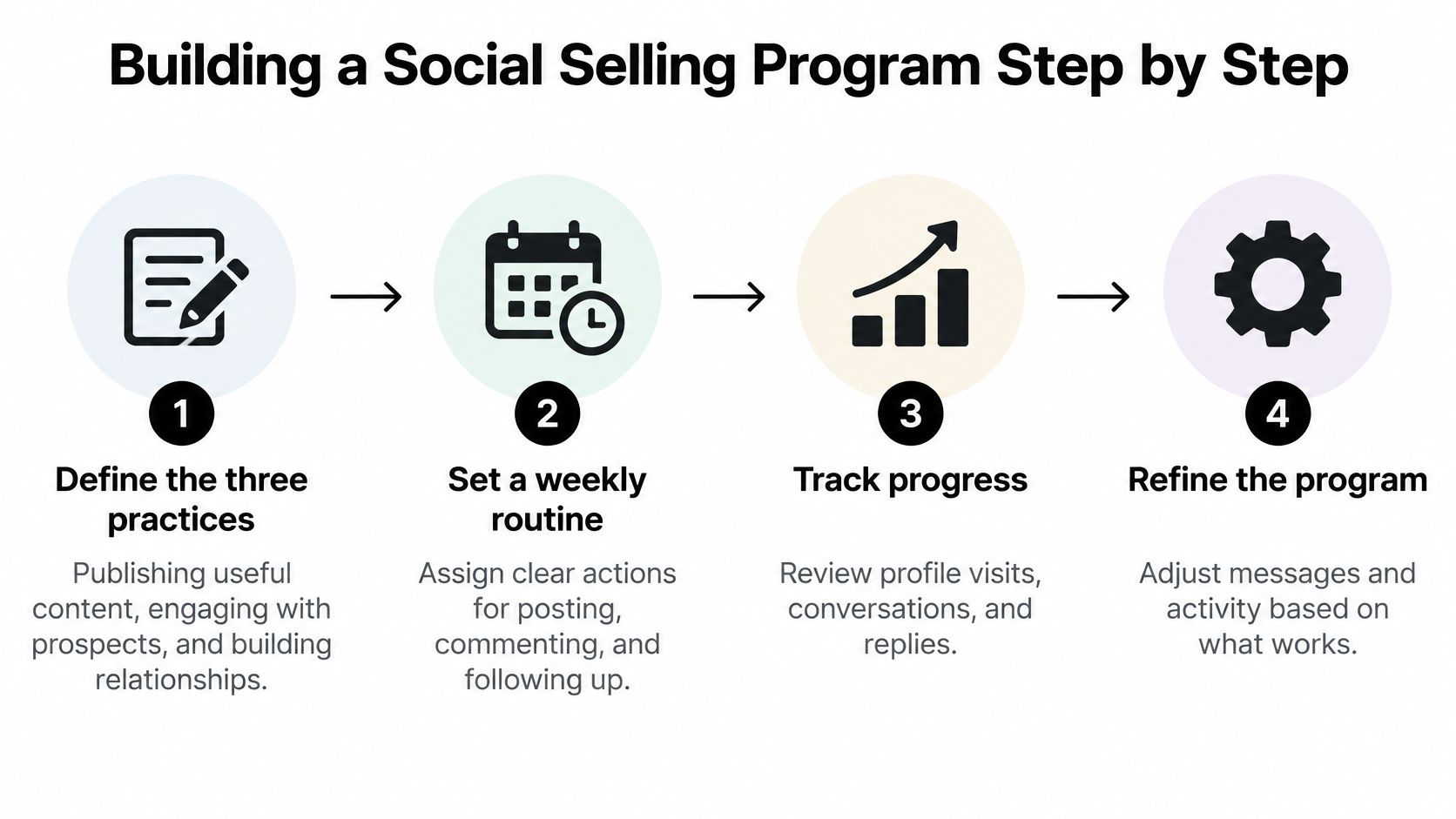
A workable program starts with three practices. You monitor external conversations about target accounts, coordinate account intelligence with internal tools, and contribute useful posts or commentary. The routine below turns those practices into weekly work a small team can realistically sustain.
The visual below maps the basic operating rhythm before we get into ownership and inputs.
Step 1. Map the Buying Committee
For each target account, list the likely economic buyer, technical evaluator, day to day user, and internal champion. The input is your ideal customer profile plus current org charts or CRM records. The owner is usually the account seller, with marketing helping on segmentation.
Step 2. Monitor Priorities and Triggers
Track funding news, leadership changes, hiring patterns, product launches, and posts from committee members. Save one business trigger per account in a shared note so follow up doesn’t rely on memory. If your team needs the systems side explained, this guide to CRM integration for connecting sales activity and account data covers why those records need to live in one place.
Step 3. Publish and Comment with Evidence
Write short posts that answer a real buyer question, break down a trade off, or explain a mistake you see often. Comment where your buyers already talk, adding a specific point rather than praise. Teams active on other platforms can adapt the same listening habit when they convert Twitter engagement into leads by treating replies as signals, not trophies.
Step 4. Follow Up on Signals
Profile visits, thoughtful comments, repeated content interactions, and new role changes tell you who deserves a personal note and when. Keep that note short, cite one relevant business reason, and offer one clear next step.
The short walkthrough below gives a practical companion view of setting up that seller routine.
Setup decisions decide whether this survives busy weeks. Name one program owner, optimize each seller profile for the buyer rather than the résumé, limit each seller to an account list she can genuinely follow, and run a brief weekly review of signals, conversations started, and meetings created.
On outcomes, stay candid. A university review summarizes findings that social selling users can achieve 10-20% higher win rates, 20-30% faster sales cycles, and 10-15% higher revenue. Treat those ranges as correlational benchmarks, not guarantees, because stronger sales organizations may be more likely to adopt the method in the first place.
Measuring Whether Social Selling Creates Pipeline
A dashboard can look busy while proving very little. That’s the central measurement problem, and it’s why you need to separate attention signals from commercial evidence before you celebrate or cancel anything.
Two Buckets That Should Never Be Confused
- Intermediate signals: Profile views, new connections, likes, comments, shares, and content engagement from target accounts.
- Commercial evidence: Qualified meetings, qualified opportunities, win rate, sales cycle length, and revenue from accounts exposed to the activity.
Intermediate signals aren’t useless. They tell you whether the right people noticed you and which topics earned a response. They just can’t prove revenue on their own. A finance leader at a target account commenting twice is more meaningful than broad applause from peers, but it’s still not pipeline.
Attribution claims need the same caution. HubSpot’s 2024 State of Sales report found sales professionals attributed 33% of their highest-quality leads to social media, on par with referrals from existing customers. That figure is self-reported. It doesn’t prove the social activity caused those leads, and it doesn’t show whether the revenue was profitable after the time invested.
That’s why the most useful framing is trust and intent layer. Social selling helps buyers recognize you, understand your point of view, and signal interest through engagement. Outbound, referrals, or inbound demand often convert that familiarity into a meeting. Your attribution model should reflect that shared path, which is why multi-touch attribution for B2B buyer journeys matters more here than last click thinking.
A Minimum Evidence Test You Can Run
- Define the audience: Choose comparable target accounts and split them into an activity group and a control group.
- Run the activity consistently: The activity group gets monitoring, relevant engagement, and signal based follow up. The control group doesn’t.
- Agree meeting criteria first: Write down what counts as qualified before anyone sees results.
- Compare over a fixed period: Track meetings, opportunities, win rate, and cycle length for both groups.
If you can’t name the control group, you don’t have evidence yet. You have activity and a hopeful story about it.
That test won’t answer every brand question, but it will answer the commercial one. Did exposed accounts convert better than similar accounts that weren’t exposed?
Common Mistakes and Privacy Limits to Respect
The most common failure isn’t bad writing. It’s a program built on volume. Leaders count posts, sellers chase easy engagement, and generic connection requests arrive with a pitch attached. Buyers recognize the pattern quickly and stop responding.
Another mistake is ignoring how many buyers want to research without a rep in the room. A 2025 study found salespeople’s social media use increases information sharing and responsiveness, while 75% of B2B buyers reportedly prefer a rep-free purchasing experience even for complex purchases. The same research makes privacy expectations strategically important, which should change how far personalization goes.
Where Relevant Ends and Surveillance Begins
Use the principle of minimum necessary relevance. That’s enough context to show you understand a business situation, and no more. Stick to business relevant, publicly shared information, state why you’re reaching out, and make declining easy.
Compare two openers.
- Over-researched: You mention a prospect’s holiday photo, a child’s school event from a personal post, and the exact time she viewed your profile. She now wonders how closely she’s being watched.
- Restrained: You mention her company’s new regional office and ask whether onboarding capacity is a current concern. One public business fact, one relevant question, no creepiness.
Vanity metrics feed the first style. When sellers feel pressured to prove hyper personalization, they dig deeper than the relationship justifies. When they’re judged on qualified conversations, restraint becomes easier.
Rules also vary. Platform terms, privacy law, and electronic marketing rules in the recipient’s jurisdiction can all affect what you may collect, store, and use. Build consent and opt out handling into the workflow, and review your approach against a clear consent management process for outbound marketing before scaling it.
A simple test: If you’d feel uneasy explaining exactly how you learned a detail, leave that detail out.
More personalization isn’t always better. The right amount feels helpful and easy to decline.
Combining Social Selling with Cold Email and Paid Outreach
Social selling alone builds familiarity, but it can move slowly and reach only people who are active in public. Cold email alone moves faster, but it often arrives without context. The combined motion is stronger because each channel fixes a weakness in the other.
Here’s how the mechanism works. Social signals show which accounts are hiring, expanding, changing leadership, or engaging with a problem you solve. That evidence refines account selection and messaging. A well timed email then converts a warmed, contextually relevant prospect into a direct conversation. Paid outreach can reinforce familiarity in the background, but it shouldn’t be mistaken for a relationship.
Three Setups and When Each Fits
- Social selling alone: Best for a small set of high value accounts where relationships and timing matter more than speed.
- Cold email alone: Best when you need broader coverage quickly and your offer can be explained clearly without much prior familiarity.
- Combined motion: Best for most B2B teams, because social research sharpens targeting while email creates a direct path to a meeting.
LinkedIn messages can bridge the two when someone is outside your network, and understanding the mechanics of using InMail beyond your LinkedIn connections helps you choose whether a social message or an email is the better next step. If you do move to LinkedIn first, a structured cold LinkedIn message template for relevant outreach keeps the note short and specific.
The workspace below reflects that blended reality, where social engagement and email performance need to be reviewed together rather than in separate silos.

This is also where Fypion Marketing fits for teams that want the email side handled on performance terms. It’s a B2B lead generation agency specializing in cold email outreach, with no upfront fees, retainer, or setup costs, and payment only for booked, qualified meetings that meet pre-agreed criteria. Its process runs from a free consultation and market research into technical infrastructure, personalized copy, curated contact lists, and ongoing optimization. The company reports a 4.7-star rating from 17+ clients and 220% month-over-month lead growth among its documented results.
Start smaller than you think. List your top target accounts, note one public business trigger for each, assign one seller to follow their committee members, and decide which signal will trigger an email. That simple sheet turns social selling from a content habit into a pipeline routine you can test and improve.
If you want social insight to turn into booked conversations rather than busy profiles, Fypion Marketing can run the cold email side on a pay per qualified meeting basis while your team builds familiarity with target accounts. Book a free consultation, bring your top account list and one trigger per account, and leave with a clear view of how the combined motion could work for your market.