Generation Lead B2B: Your Ultimate Guide to Success
- Prince Yadav
- Jul 10, 2025
- 16 min read

Let's be honest, the old way of generating B2B leads is dead. The days of blasting out thousands of generic emails and hoping something sticks are long gone. It was a numbers game, and a losing one at that.
What we're talking about now is something different. It's about building a systematic, data-driven engine that creates a predictable pipeline of qualified leads. It's less about casting a wide net and more about precision-guided fishing.
This guide isn't another fluffy list of "top 10 tips." It’s a complete roadmap. We're going to walk through the entire process, from the ground-up work of figuring out who your best customers are to the nitty-gritty technical setup that actually gets your emails opened.
The goal? To move from a feast-or-famine lead flow to a reliable system that consistently puts qualified meetings on your calendar. This is the shift that separates businesses that struggle from those that scale.
Why You Can't Afford to "Wing It" Anymore
Random acts of outreach get you random results. Simple as that. A systematic approach, on the other hand, turns lead generation from a guessing game into a science. It gives you the power to measure what’s working, fix what isn’t, and make smart decisions based on real data.
This isn’t just a nice-to-have; it's becoming a core business necessity. The global B2B lead generation market was valued at around $2.66 billion and is expected to explode to $7.33 billion. Why? Because businesses are desperate for effective, efficient ways to find new customers that actually deliver an ROI. You can dig into more of that research on the B2B services market on Business Research Insights.
A predictable pipeline is the ultimate prize. It gives you the confidence to hire new people, invest in your product, and scale your company without lying awake at night wondering where the next customer is coming from.
The Core Pillars of a Modern B2B Lead Generation Engine
Building this kind of robust system means focusing on a few key components that all have to work together. If one pillar is weak, the whole structure can come crashing down. We'll dive deep into each one, but first, here's a quick look at the foundational pieces we're going to build.
These are the essential components we'll cover, providing a clear framework for building your strategy.
Pillar | Core Objective | Essential Tools & Platforms |
|---|---|---|
Audience & List Building | To find the exact companies and decision-makers who feel the pain your solution solves. | |
Technical Infrastructure | To make sure your outreach emails actually land in the primary inbox, not the spam graveyard. | Custom Domains, Email Warm-up Tools |
Compelling Copywriting | To write personalized messages that get prospects to stop, think, and actually reply. | A/B Testing Software, AI Assistants |
Campaign Management | To track performance, double down on what works, and scale your outreach intelligently. | Outreach Platforms, CRM Systems |
By getting these pillars right, you're not just sending emails—you're building a powerful, self-improving engine for growth. If you're hungry for more ideas to layer on top of this foundation, check out our other article on effective B2B lead generation strategies for business growth.
Now, let's get into the details.
Before you write a single word of your email or even dream up a subject line, you need to do the most important work of all. It's the foundation of any successful lead generation campaign, and skipping it is a recipe for failure.
Why? Because sending a killer message to the wrong person is just a waste of everyone's time. Real success in B2B starts with a deep, almost obsessive understanding of who you're actually trying to reach.
This isn't about vague ideas like "we sell to tech companies." That's not good enough. You need to build a crystal-clear Ideal Customer Profile (ICP). An ICP is basically a detailed spec sheet for the perfect company to buy your product or service.
Think about your absolute best customers right now. The ones who get the most value, are a joy to work with, and stick around for the long haul. What do they all have in common? That's where you start. Analyzing them is the key to building a powerful ICP. For a much deeper dive, check out our complete guide to building a B2B Ideal Customer Profile for your success.
Turning Your Profile Into a Prospect List
Once you have that solid ICP, it's time to turn those characteristics into a simple checklist. This checklist is your blueprint for building a high-quality list of prospects. You're no longer just spraying and praying; you're hunting with a laser sight.
Your ICP checklist might include things like:
Industry: Get specific. Not just "SaaS," but maybe "MarTech SaaS" or "FinTech SaaS."
Company Size: Pick a clear range, like 50-200 employees.
Location: Target specific countries, states, or even major cities.
Tech Stack: Do your best customers use specific tools like Salesforce or HubSpot?
Recent Funding: Has the company recently closed a Series A or B round? This is often a huge buying signal.
A well-defined ICP does more than just help you build a list. It shapes your messaging, your value proposition, and your entire outreach strategy. When you know exactly who you're talking to, you can speak their language and hit on their most urgent pain points.
This detailed profile makes the next part—actually finding these companies and the right people inside them—infinitely easier. You’re no longer searching for a needle in a haystack; you’ve built a powerful magnet.
Using Platforms to Build Your List
With your ICP criteria locked in, it's time to put it into action. Let's use some powerful tools to find companies that fit your profile and then pinpoint the key decision-makers within them.
The undisputed king for this job is LinkedIn. Its massive professional database is an essential tool for any B2B pro. I mean, the platform has grown to over one billion users across 200 countries. It's no wonder the vast majority of B2B marketers are on there hunting for prospects. You can find more stats on how LinkedIn dominates B2B lead generation on sopro.io.
But for serious B2B lead generation, a free LinkedIn account just won't cut it. You need the power of LinkedIn Sales Navigator. Its advanced filters are what make all the difference.
Let's walk through a real-world example. Imagine you're selling a project management tool to mid-sized tech companies in the US. Here’s how you'd use Sales Navigator:
Filter by Company: You'd start by filtering for companies in the "Software Development" industry, with an employee count between "51-200," and a headquarters in the "United States."
Filter by People: Next, you'd layer on lead filters to find the right contacts. You’d search for job titles like "Head of Engineering," "VP of Engineering," or "Director of Product Management."
Use Keywords: To get even more specific, you can add keywords to find profiles that mention terms like "Agile," "Scrum," or "Roadmap Planning."
This process creates a hyper-targeted list of people who work at the right kind of company and hold the exact roles that feel the pain your tool solves. This level of precision is the secret sauce behind a high-performing outreach campaign that actually books qualified meetings.
Building a Bulletproof Outreach Infrastructure
You can have the best prospect list in the world and email copy that could sell ice to an Eskimo, but none of it matters if your emails land in spam. I’ve seen it happen. The success of any modern B2B lead generation effort relies on a technical foundation that most people ignore.
Getting this part right isn't just a "best practice"—it's non-negotiable.
This infrastructure is what keeps you off blacklists. It's what protects your main business domain and ensures the emails you spend so much time crafting actually get seen. It’s the behind-the-scenes grunt work that makes everything else possible.
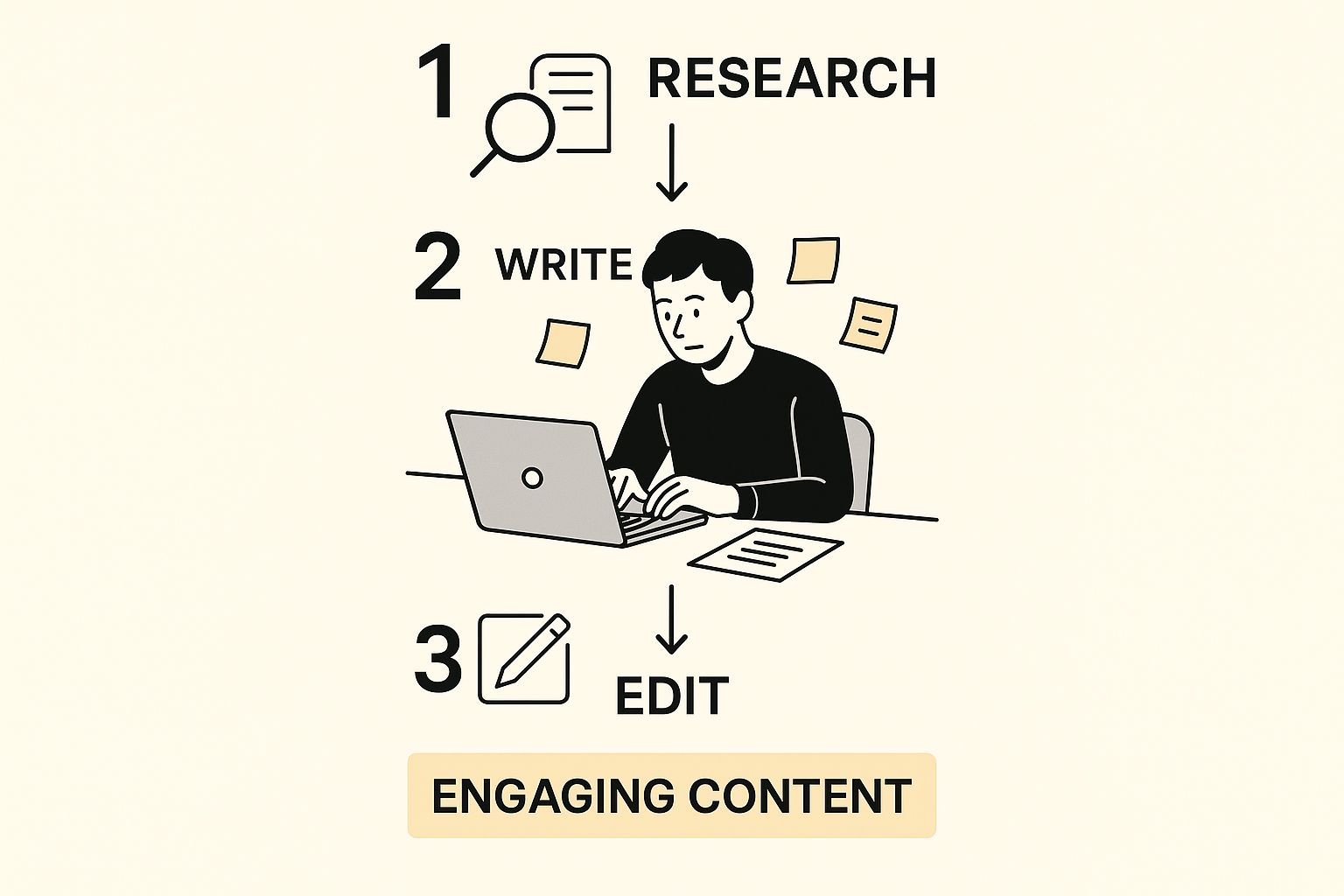
This visual captures the essence of it all—even the creative parts, like writing, are just one piece of a bigger, more structured system built to connect with real people.
Protect Your Main Domain at All Costs
Let me be crystal clear: never send high-volume cold outreach from your primary business domain. If your website is , do not send campaigns from . This is the single biggest—and most catastrophic—mistake you can make.
Think about it. If your outreach gets flagged as spam, it could cripple your entire company's email deliverability. Suddenly, critical day-to-day emails like invoices, client updates, and internal communications stop getting through.
The solution is simple and cheap: buy separate, but similar, domains just for your outreach.
Here’s exactly how to do it:
Find Lookalike Domains: If you own , go out and buy a few variations like , , or .
Create New Inboxes: For each new domain, set up dedicated email inboxes, like .
This move completely isolates your outreach. If one of your sending domains gets a bad reputation, your core business is totally unaffected. It’s a small price to pay for peace of mind.
The Art of the Email Warm-Up
Okay, so you've got your new domains and inboxes. You can’t just flip a switch and start firing off hundreds of emails. New email accounts are like new hires—they have no track record, which makes email providers like Google and Microsoft incredibly suspicious. You have to earn their trust first.
This is where the email warm-up process comes in. We use specialized tools that automate this by sending and replying to emails from your new accounts in a controlled, human-like pattern.
The whole point of warming up is to gradually build a positive sender reputation. It’s how you signal to the big email providers that you’re a legitimate sender, not a spammer. Your "sender score" depends on it, and that score is everything for deliverability.
A proper warm-up usually takes about 2-3 weeks. During this period, the daily email volume slowly ramps up, just like a real person would. I can't stress this enough: skipping this step is the fastest way to kill a campaign before it even starts.
Your Digital Passport: Essential Authentication Records
To really seal the deal and prove you are who you say you are, you need to configure three technical records for your sending domains. I like to think of these as a digital passport for your emails.
SPF (Sender Policy Framework): This record is a public list of the servers you’ve authorized to send emails for your domain. It’s basically you telling the world, "Only trust emails coming from these specific servers."
DKIM (DomainKeys Identified Mail): This adds a unique digital signature to every single email you send. When the email arrives, the receiving server checks this signature to make sure nothing was forged or tampered with along the way.
DMARC (Domain-based Message Authentication, Reporting & Conformance): DMARC ties SPF and DKIM together. It gives instructions to receiving mail servers on what to do if an email fails the SPF or DKIM checks—whether to quarantine it, reject it outright, or let it through.
Setting these up is a one-and-done task that dramatically increases your chances of hitting the primary inbox. It’s a fundamental part of any professional setup for a serious generation lead b2b strategy. Don’t skip it.
Writing Outreach That Actually Gets Replies
This is where the rubber meets the road. All that foundational work—your Ideal Customer Profile, your meticulously built prospect list, and your technical setup—all leads to this moment. It’s time to write the actual message. A winning generation lead b2b strategy lives or dies on your ability to craft outreach that feels personal, offers immediate value, and compels a busy decision-maker to actually hit "reply."
Let's be honest, we all know the kind of emails that get instantly deleted. They're the generic, self-centered templates flooding every B2B inbox: "Hi [Name], I'm from [MyCompany], and we do [Vague Service]." Your job is to be the exact opposite. Your copy has to prove you’ve done your homework and that you're showing up in their inbox for a specific, relevant reason.
It's a tricky balance between personalization and scale, but it's absolutely achievable. You don't need to write every single email from scratch. The secret is building a solid framework that you can then inject with hyper-specific details.
The Anatomy of a High-Performing Cold Email
An effective email isn't just one big block of text. It's a series of strategic components, each with a specific job, working together to guide the reader from your subject line right down to your call-to-action. Nailing this structure is half the battle.
A proven framework usually breaks down like this:
The Personalized Opener: A sentence that instantly shows you're not just another spammer.
The Value Proposition: A crystal-clear statement of what you do and for whom.
The Problem & Solution: A quick mention of a pain point they likely feel and how you help.
The Low-Friction Close: An easy-to-say-yes-to call-to-action that starts a conversation.
Let's dig into how to execute each of these pieces perfectly.
Crafting the Hyper-Personalized Opening Line
The first one or two sentences are your most valuable real estate. This is where you prove you’re a real human who did their research. Your only goal here is to make the prospect think, "Okay, this person actually knows who I am."
Here are a few real-world examples of personalized hooks that work:
"Saw your recent post on LinkedIn about the challenges of scaling engineering teams—your point about technical debt really resonated."
"Congratulations on the recent Series B funding for [Company Name]. It's impressive to see your growth in the FinTech space."
"I noticed on your company's career page that you're hiring several new Account Executives. Scaling a sales team often brings challenges with onboarding and ramp-up time."
Notice how these openers are specific, timely, and directly tied to the prospect's world. This isn't just empty flattery; it's a strategic move. You're building instant credibility and earning the right to their attention for the next 30 seconds. You can find more ideas by checking out some effective cold email examples to boost your outreach.
A powerful opening line immediately separates you from the 95% of outreach that gets ignored. It shifts the dynamic from an unwanted interruption to a potentially valuable conversation.
This personal touch is becoming non-negotiable. As automation gets smarter, the only thing that truly cuts through the noise and builds trust is an authentic human voice. It's the key differentiator that separates the pros from the amateurs.
Nailing the Value Proposition and Call-to-Action
Right after your personalized opener, you need to get straight to the point. Your prospect is busy. Be incredibly clear about who you help and what problem you solve. For example: "We help VPs of Engineering at mid-sized SaaS companies cut down on repetitive code reviews by 30%." It’s specific, targeted, and focuses on the benefit.
Finally, you need to close with a low-friction call-to-action (CTA). Asking for a 30-minute demo right out of the gate is like asking for marriage on the first date—it's too big of a commitment.
Instead, go for a soft, interest-based CTA.
Bad CTA: "Are you free for a 30-minute demo next Tuesday?" Good CTA: "Is improving code review efficiency a priority for you right now?"
The good CTA is a simple yes/no question that is much, much easier for them to answer. It doesn’t ask for their time; it asks for their opinion. This small shift dramatically increases reply rates because it opens a conversation instead of demanding a meeting. That’s how you turn a cold outreach into a warm lead.
Optimizing Your Campaigns for Predictable Growth
So you’ve launched your campaign. That’s a huge milestone, but it’s definitely not the finish line. Honestly, it’s just the starting gun. The real work—the stuff that turns a promising campaign into a predictable growth engine—happens now, in the day-to-day grind of managing and optimizing your outreach.
Leaving your campaigns to run on autopilot after launch is like planting a garden and never watering it. You’ve got to keep a close eye on performance, figure out what's not working, and make smart, data-backed tweaks. This constant feedback loop is what separates a flash-in-the-pan success from a scalable, long-term lead machine.

Decoding Your Campaign Data
Your outreach software is spilling data all over the place, but it's incredibly easy to get distracted by vanity metrics. To make moves that matter, you have to zero in on the numbers that actually tell you if you're getting closer to a qualified lead.
These are the core metrics that reveal the true health of your campaign. Think of them as a diagnostic funnel that helps you pinpoint exactly where things are going right—or wrong.
Key Campaign Metrics to Track
Metric | What It Tells You | Target Benchmark |
|---|---|---|
Deliverability Rate | Are your emails actually hitting the inbox? | Above 98% |
Open Rate | Is your subject line and preview text doing its job? | 50-70%+ |
Reply Rate | Is your email body compelling enough to get a response? | 2-5% |
Positive Reply Rate | Is your message sparking genuine interest? | 1-2% |
A low deliverability rate is almost always a technical problem with your domain setup. But a high open rate paired with a low reply rate? That’s a glaring sign that your message missed the mark. Your subject line got them to open, but the email itself fell flat.
Focus on that Positive Reply Rate. A 5% reply rate means nothing if they're all "not interested" or "unsubscribe." The whole point is to start real conversations, and this is the metric that tracks that progress.
By breaking down your campaign at each stage of this funnel, you can stop guessing and start making targeted, meaningful improvements.
Troubleshooting Common Campaign Issues
Every campaign, and I mean every campaign, hits a wall eventually. The secret is knowing how to read the data to spot the problem quickly and fix it without hesitation. This proactive approach stops small hiccups from derailing your entire strategy.
Here’s a practical guide to tackling the most common roadblocks:
Low Open Rates (Below 50%): This is your subject line, nine times out of ten. Start A/B testing different angles. Try asking a question, name-dropping their company, or going for something short and mysterious. It could also signal a deliverability issue, so it never hurts to double-check that your domains are properly warmed up.
Low Reply Rates (Below 2%): They opened the door, but didn't like what they saw inside. Time to revisit your copy. Is your personalized opener actually personal? Is your value prop crystal clear? Is your call-to-action asking for too much, too soon?
High Unsubscribe or "Not Interested" Replies: This is a classic targeting problem. You're barking up the wrong tree. It’s time to go back to the drawing board and refine your Ideal Customer Profile and list-building criteria. Make sure you’re only reaching out to people who genuinely feel the pain your solution solves.
This systematic approach turns campaign management from a chore into a strategy. You’re not just putting out fires; you're building a better, more resilient system. For more ideas, it's always good to see what else is working. Our guide on 9 proven B2B lead generation strategies for 2025 provides some other angles to consider.
Handling Positive Replies and Nurturing Leads
The second a positive reply hits your inbox, the clock starts ticking. How fast and how well you respond can make or break the entire opportunity. Your only goal at this stage is to smoothly transition from an email exchange to a booked meeting.
You need a prompt, professional response that answers their question directly and gently nudges them toward the next step. Don't hit them with a wall of text. Keep it short, sweet, and focused on one thing: booking that call.
Example Positive Reply Workflow:
Prospect Replies: "Yes, this sounds interesting. Can you tell me more about how it works?"
Your Immediate Response: "Great to hear! The easiest way to show you is with a brief 15-minute call where I can walk you through it and answer any specific questions you have. Does Tuesday or Thursday afternoon work for you?"
Include a Calendar Link: Always, always provide a booking link like Calendly to make scheduling dead simple for them.
This process removes all the friction and keeps the momentum going. When you master campaign analysis, troubleshooting, and lead handling, you’re no longer just sending emails—you’re building a predictable system for B2B success.
Common B2B Lead Generation Questions
As you start building out your outreach engine, questions are going to pop up. That’s a good thing—it means you’re getting into the nitty-gritty and thinking critically about your strategy. Here are some straightforward answers to the questions I hear most often from people running their own generation lead b2b campaigns.
How Long Until I See Real Results?
This is always the first question, and the honest answer is: it takes time. Patience is non-negotiable here, and having a realistic timeline from the get-go is the best way to manage expectations and not get discouraged.
First off, you have the technical setup. Buying new domains, creating the inboxes, and properly warming them up is an essential first step that takes about 2-3 weeks. If you try to rush this, you’ll just get your domains blacklisted before you even send a single real email.
Once you launch your campaign, you might see the first few replies trickle in within a couple of days. But to make smart, data-backed decisions, you need to let the campaign run for at least 4-6 weeks. This is your learning phase, where you figure out what’s hitting the mark and what’s falling flat.
The real prize—consistently booking qualified sales meetings—usually takes somewhere between 1-3 months of sustained, optimized outreach. This can change depending on your industry's sales cycle, the price of your offer, and how dialed-in your targeting and messaging are.
What Are the Most Important Metrics to Track?
It’s incredibly easy to get lost in a sea of data. To keep your head on straight, you need to zero in on the handful of metrics that actually point toward revenue. Chasing vanity metrics is a surefire way to waste time and energy.
For any generation lead b2b campaign, these are the five metrics that truly matter:
Deliverability Rate: Are your emails actually landing in the inbox? If this number is low, nothing else matters. It's the foundation.
Open Rate: Is your subject line and first sentence good enough to earn a click? This is your first impression.
Reply Rate: Is your email body compelling enough to make someone hit "reply"? This is a direct test of your message's power.
Positive Reply Rate: Are you getting real interest, or just a bunch of "unsubscribe" requests? This metric separates the wheat from the chaff.
Meetings Booked: This is the ultimate KPI. Are your conversations turning into real sales opportunities? This is the bottom line.
There are dozens of other things you could track, but these five will give you the clearest, most actionable view of your campaign's health from top to bottom.
Is Buying a B2B Lead List a Good Idea?
Let me be blunt: No. I can't stress this enough—avoid buying lead lists at all costs. It feels like a shortcut, I get it. But it almost always creates more problems than it solves.
Why? For starters, these pre-packaged lists are almost always packed with old, outdated contact information. This leads to sky-high bounce rates, which is a massive red flag for email providers and the fastest way to kill your domain’s reputation and land on blacklists.
On top of that, these lists are sold to hundreds of other companies. The people on them are getting hammered with generic pitches all day long, making them completely numb to outreach. Most importantly, these contacts weren't built for your specific Ideal Customer Profile (ICP). You’ll just be wasting resources on people who were never going to be a good fit in the first place. Building your own targeted list is the only way to do this right.
How Many Follow-Up Emails Should I Send?
Honestly, the real magic happens in the follow-ups. A massive chunk of positive replies come from the second, third, or even fourth email. A campaign without a solid follow-up sequence is leaving a ton of money on the table.
A well-designed sequence usually has 4-6 emails total, spread out over a few weeks. This hits the sweet spot between being persistent and just being annoying. The first email introduces your value, and the follow-ups are just short, polite, value-add nudges.
A good cadence is to space them 3-5 business days apart at the start, then slowly increase the time between messages. This feels more natural and respects their inbox. And always, always make sure your automation is set to stop the sequence for anyone who replies—whether it’s a yes, a no, or a "maybe later." This prevents you from sending awkward follow-ups after a conversation has already started.
Feeling overwhelmed by the complexity of building a lead generation engine from scratch? Fypion Marketing specializes in taking this entire process off your plate. We handle the technical setup, list building, copywriting, and ongoing optimization—all on a pay-per-meeting basis. You only pay for qualified appointments that show up on your calendar. If you're ready to scale your pipeline without the operational headache, learn more and book a free consultation at https://www.fypionmarketing.com.
Comments