
Lead Generation B2B: Your Guide to Sustainable Growth
B2B lead generation is the lifeblood of your company. It’s the structured process you use to find potential business customers, spark their interest, and ultimately guide them toward a sales conversation. This isn’t just a line item in the marketing budget; it’s the engine that drives sustainable growth.
Why B2B Lead Generation Is Your Growth Engine
Without a consistent flow of potential customers, your business is dead in the water. It can’t grow. It’s that simple.
Think of it like this: your company has a solution on one side of a river, and your ideal client has a problem on the other. B2B lead generation is the art and science of building a solid bridge to connect them, turning complete strangers into genuinely interested prospects.
In the B2B world, this whole process is a lot more complex than selling directly to consumers. Sales cycles drag on for months, purchasing decisions require buy-in from multiple stakeholders, and the value of a single deal can be massive. A spray-and-pray approach just won’t cut it. You need a deliberate, repeatable system to keep your sales pipeline full.
This isn’t just a “marketing task” - it’s the core function that drives revenue. A well-oiled lead generation machine creates predictability. It lets you forecast sales, allocate resources smartly, and scale your business with confidence.
The Financial Impact of Lead Generation
The numbers really drive home how critical this is. Roughly 50% of marketers see lead generation as their top priority. The most successful companies aren’t just winging it; they bring in an average of 1,877 leads every single month.
Of course, this effort isn’t free. The average cost per lead across different industries is about $198. That’s a significant investment, which is exactly why you need an efficient strategy that delivers a real return. You can dig deeper into these lead generation statistics and trends to see the full picture.
The B2B Lead Generation Funnel Stages
At its heart, a solid B2B lead generation strategy follows a logical path, often visualized as a funnel. You start by figuring out who you want to reach, create something valuable to get their attention, and then nurture that initial spark of interest into a real sales opportunity. Each stage moves a prospect closer to becoming a customer.
Here’s a breakdown of what that journey typically looks like:
| Stage | Description | Example Goal |
|---|---|---|
| Awareness (TOFU) | Prospects become aware of your brand and the problem you solve. They’re not ready to buy yet. | Attract website visitors through a blog post or social media. |
| Consideration (MOFU) | Prospects are now evaluating different solutions. They show interest by downloading gated content. | Capture a prospect’s email with an in-depth ebook or webinar. |
| Conversion (BOFU) | Prospects are ready to make a decision and are comparing vendors. | Get a highly qualified prospect to request a product demo or consultation. |
This funnel isn’t just a marketing concept; it’s a practical framework. It transforms the abstract idea of “getting more customers” into a clear, step-by-step process.
This visual flow shows how these stages fit together to build a complete lead generation system.
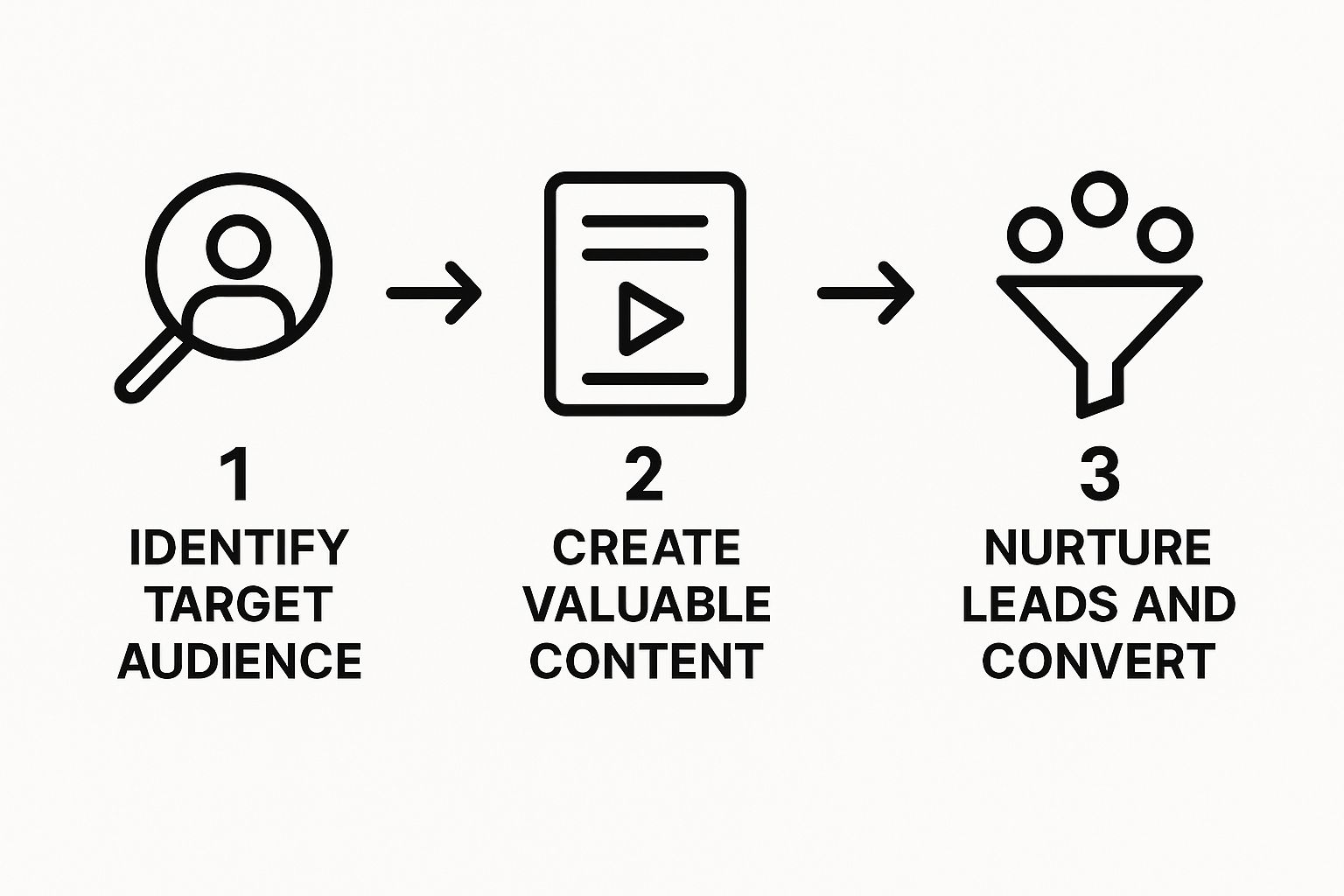
The key takeaway is that lead generation isn’t a one-off event. It’s a journey that methodically turns awareness into tangible business opportunities. Each stage builds on the last, creating a reliable pathway from that first “hello” to a closed deal. Ultimately, this is how you stop chasing random opportunities and start building a predictable engine for growth.
Navigating the Modern B2B Buying Journey
Let’s be honest, the way businesses buy things has completely changed. The old, straight-line sales funnel we all knew? It’s been replaced by a much more complex dance between new technology and good old-fashioned human connection. This shift forces us to rethink what successful B2B lead generation even means today.
On one hand, you have automation and AI giving us superpowers. We can now find, segment, and start conversations with potential customers at a scale that was pure science fiction just a few years ago. We can sift through data to spot buying signals long before our competitors even know a prospect is in the market.
But there’s a catch. This explosion in technology has created an equally strong craving for authenticity. When every inbox is drowning in automated, cookie-cutter messages, a real, personal interaction doesn’t just stand out - it builds trust.
The Authenticity Challenge in an Automated World
The real challenge here isn’t about choosing technology or people. It’s about finding the perfect balance between the two. You absolutely need powerful tools to work efficiently, but you also have to double down on the kind of trust-building conversations that a robot simply can’t have.
This is the tightrope walk of modern B2B marketing. The goal isn’t to replace your team with software. It’s to arm them with tools that free them up to do what they do best: build real, lasting business relationships.
The rise of AI-generated content has made this even more critical. With so much information out there, buyers are naturally more skeptical. They’re actively looking for signs of true expertise and trustworthiness. As some experts point out, misinformation can quickly destroy credibility if businesses aren’t careful. That’s why creating genuine, high-value content is now the main way to build that crucial trust. You can discover more insights about B2B lead generation trends to see just how this is playing out across the market.
This means your B2B lead generation strategy needs to have two distinct parts:
-
Automate the Mechanics: Use technology for the repetitive, data-heavy lifting like building lists, sending initial outreach, and scoring leads.
-
Humanize the Moments: Focus your team’s energy where it truly counts - on personalized follow-ups, strategic conversations, and building genuine rapport with qualified leads.
Adapting Your Strategy for Today’s Buyer
Getting your head around this new environment is the first step to building any effective strategy. The modern B2B buyer is more informed and self-reliant than ever. They do a huge chunk of their research on their own, often before they even think about talking to a salesperson.
Your strategy has to meet them where they are. This means creating valuable resources that actually help them solve their problems, engaging in real discussions on platforms like LinkedIn, and making sure every touchpoint feels personal and relevant.
This approach respects the buyer’s intelligence and positions your brand as a helpful advisor, not just another vendor trying to make a sale. To see how this philosophy translates into real-world tactics, you can explore these 9 proven B2B lead generation strategies for 2025.
Ultimately, winning in today’s market is all about blending the raw efficiency of automation with the irreplaceable value of a human touch. It’s about using technology to spark more meaningful interactions, not to get rid of them.
Proven Channels for High-Quality B2B Leads

Trying to be everywhere at once is a classic rookie mistake. Spreading your efforts across a dozen platforms sounds productive, but it’s really just a recipe for burnout, not actual results. A winning lead generation B2B strategy is all about focus. You need to zero in on the few proven channels where your Ideal Customer Profile (ICP) is already spending their time.
And these channels don’t operate in a vacuum. The most successful companies I’ve seen weave them together into a powerful system. Think about it: a fantastic piece of content can fuel your paid ad campaigns and give your outreach team something valuable to share. It’s about making each channel work harder by supporting the others.
Let’s break down three of the most reliable pillars for generating high-quality B2B leads.
Build Authority With Value-Driven Content Marketing
Content marketing is the long game in B2B. This isn’t about scoring quick wins; it’s about patiently, systematically building trust and cementing your company’s reputation as the go-to expert in your niche.
The goal is refreshingly simple: create resources so genuinely helpful that your ideal customers want to give you their contact information to get them. We’re not just talking about blog posts here. We’re talking about high-value, gated assets - powerful lead magnets that solve a real problem.
-
In-Depth Whitepapers: Take a deep dive into a nagging industry problem, backing it up with hard data and original research.
-
Actionable Case Studies: Don’t just tell, show. Walk prospects through exactly how you helped a client achieve measurable results. This is social proof in its most powerful form.
-
Exclusive Webinars: Host sessions that teach a specific skill or share unique insights your audience can’t just Google.
The trick is to give away real value, no strings attached. When a prospect downloads your whitepaper on supply chain efficiency, they aren’t just another name on a list. They’ve just raised their hand and told you, “I have the exact problem your business solves.”
Start Conversations With Strategic Outreach
While content marketing is fantastic for pulling prospects toward you, strategic outreach lets you go straight to your most-wanted accounts. This is the modern, intelligent evolution of cold calling. It’s less about brute force and volume, and all about precision, personalization, and starting genuine conversations.
Platforms like LinkedIn are an absolute goldmine for this. You can pinpoint key decision-makers at your target companies and engage with them directly. But be warned: a generic, copy-and-pasted message will be ignored 99% of the time. Success here means doing your homework.
The goal of outreach isn’t to close a deal in the first message. It’s to start a relevant conversation. A great outreach email feels less like a sales pitch and more like a helpful peer reaching out with a genuinely interesting idea.
For example, skip the lazy “I’d love to connect” message. Try something specific: “Hi [Name], I saw your company just launched [New Product]. We helped a similar firm in the [Industry] space tackle [Specific Challenge] with their launch. Might be worth a brief chat?” This shows you’re paying attention and have something immediately relevant to offer. If you want to go deeper, you can learn more about crafting effective outbound lead generation strategies that convert.
Drive Immediate Results With Paid Media
When you need to turn on the lead tap - quickly and with a predictable budget - paid media is your best friend. Platforms like Google Ads and LinkedIn Ads let you put your message directly in front of a hyper-targeted audience that’s either actively looking for what you sell or fits your customer profile to a T.
The real magic of paid media is in the targeting.
-
Google Ads: This is all about capturing intent. You can target the exact keywords people use when they’re actively researching a solution (e.g., “best crm for small business”).
-
LinkedIn Ads: Here, you can target people based on their job title, industry, company size, and professional interests. It’s the most direct way to ensure your ads reach the right decision-makers.
Your focus must always be on ROI, not vanity metrics like clicks or impressions. A successful paid campaign is one that generates qualified leads at a profitable Cost Per Lead (CPL). This requires relentless testing and tweaking of your ad copy, landing pages, and audience targeting to make sure you’re not just spending money, but investing it for a clear, measurable return.
Winning High-Value Deals with ABM Strategy
https://www.youtube.com/embed/4oNnyyjdtVI
Stop casting a wide, hopeful net just to see what you catch. What if you could fish with a spear instead? That’s the entire idea behind Account-Based Marketing (ABM), a precision-guided approach to B2B lead generation. This strategy flips the classic marketing funnel completely on its head.
Instead of broadcasting your message to a huge audience to rake in as many leads as possible, ABM has you laser-focus your sales and marketing firepower on a handpicked list of high-value accounts. It’s a game of quality over quantity, designed from the ground up to land bigger, more strategic deals.
Think about it like this: you could host a massive, open-invitation party, or you could organize an exclusive dinner for a few key people. That dinner party demands more research and a personal touch, but the connections you forge are far deeper and much more likely to turn into something meaningful.
ABM treats individual accounts as their own unique markets. It’s about creating hyper-personalized campaigns that speak directly to the specific needs and pain points of the key decision-makers within those target companies.
This is where ABM really shines. It stops being just a marketing function that generates leads and becomes a true partner in driving sales.
The Core Steps of an ABM Program
Pulling off a successful ABM strategy isn’t magic; it’s a systematic process that demands your sales and marketing teams work as one cohesive unit. They need to be in lockstep, agreeing on which accounts to go after and exactly how to engage them.
A solid ABM program generally moves through these key stages:
-
Identify and Select High-Value Accounts: This is a joint effort with sales. You’ll build a list of “dream clients” - companies that are a perfect match for your Ideal Customer Profile (ICP) and have the potential to deliver massive, long-term value.
-
Research and Map Key Stakeholders: Once you have your targets, it’s time to do your homework. Dig deep to identify every key player in their buying committee, from the ultimate decision-makers to the influencers and end-users. You need to understand their roles, their biggest challenges, and what truly motivates them.
-
Create Personalized Content and Campaigns: Armed with that research, you can develop messaging and content that hits home. This isn’t generic stuff. It could be a custom report, a landing page built just for them, or even a webinar addressing their industry’s unique problems.
-
Execute Coordinated Outreach: Now, you launch a synchronized, multi-channel attack. This might involve personalized emails from the sales team, highly targeted LinkedIn ads, and maybe even some old-school direct mail - all delivering a consistent and highly relevant message.
This visual really captures the cyclical nature of ABM. When you successfully engage with key accounts, they become advocates. That advocacy, in turn, helps you pinpoint new opportunities within their network. It becomes a self-reinforcing loop that drives sustainable growth.
Why ABM Is So Effective Today
Modern data and analytics have given ABM some serious superpowers. With AI and predictive analytics, marketers can now identify high-value accounts with startling accuracy, and this data-driven approach is delivering real results. Companies implementing ABM have seen pipeline conversion rates increase by up to 14% and the rate of MQLs becoming sales-accepted leads jump by 25%.
The beauty of this strategy is that it stops you from wasting time on leads that were never going to be a good fit. By focusing only on pre-vetted accounts, you’re automatically improving lead quality right from the start.
Of course, a critical piece of the puzzle is making sure the leads you do pursue are actually ready for a sales conversation. To nail this part, check out our guide on how to qualify B2B leads using proven strategies. This is how you stop chasing small wins and start closing the strategic, company-defining deals that truly move the needle.
The B2B Lead Generation Metrics That Actually Matter

Data can either be your North Star or a blinding fog. In the world of B2B lead generation, it’s incredibly easy to get lost chasing vanity metrics like social media impressions or the raw number of leads you’ve collected. These numbers might look good on a slide deck, but they don’t tell you if your efforts are actually making the company money.
To prove your marketing’s value and make smarter decisions, you have to zero in on the key performance indicators (KPIs) that connect what you’re doing directly to business results. This isn’t just about tracking numbers; it’s about measuring what truly matters to the bottom line.
Moving Beyond Raw Lead Count
The first big shift you need to make is moving from a quantity-first to a quality-first mindset. Let’s be honest: a list of 1,000 unqualified names is practically worthless compared to 10 highly qualified leads who perfectly match your Ideal Customer Profile. The real health of your pipeline is measured by how efficiently you can guide someone from initial curiosity to becoming a paying customer.
Your goal is to build a dashboard that tells a story - a story about cost, efficiency, and, most importantly, profit. Each metric should answer a critical business question, helping you spot what’s working and what needs fixing.
Don’t just track data; interpret the story it tells. An increasing Cost Per Lead might be a bad sign, or it could mean you’re successfully targeting higher-value accounts. Context is everything.
Core Metrics For Your B2B Dashboard
To get a clear, actionable picture of your performance, you don’t need dozens of metrics. You just need the right ones. These KPIs work together to give you a complete view of your funnel’s health, from the first touchpoint all the way to a closed deal.
Here are the essentials you should be tracking:
Essential B2B Lead Generation KPIs
This table breaks down the most critical KPIs that every B2B marketing and sales team should have on their radar. These aren’t just numbers; they are the vital signs of your growth engine.
| Metric (KPI) | What It Measures | Why It’s Important |
|---|---|---|
| Cost Per Lead (CPL) | Total campaign spend divided by the number of leads generated. | Answers the basic question: “How much are we paying for each lead?” It’s your foundational efficiency metric. |
| MQL to SQL Conversion Rate | The percentage of Marketing Qualified Leads (MQLs) that the sales team accepts as Sales Qualified Leads (SQLs). | This is your lead quality barometer. A low rate signals a disconnect between marketing’s targeting and what sales actually needs to close deals. |
| Customer Acquisition Cost (CAC) | The total sales and marketing cost required to acquire one new customer. | Measures the profitability of your growth. If your CAC is higher than your customer lifetime value (LTV), your business model is unsustainable. |
| Lead-to-Close Ratio | The percentage of total leads that ultimately become paying customers. | Shows the overall effectiveness of your entire sales and marketing machine, from top to bottom. |
By focusing on these metrics, you can get a holistic view of your performance, identify bottlenecks, and make data-informed adjustments to your strategy.
Tying Metrics To Revenue
The final - and most crucial - step is connecting your lead generation efforts directly to the cash register. This is how marketing proves its ROI and earns its seat at the strategic table. For any serious B2B team, these two metrics are non-negotiable.
Customer Acquisition Cost (CAC) is the all-in cost of your sales and marketing machine to land a single new customer. For a healthy business, your CAC needs to be significantly lower than the Lifetime Value (LTV) of a customer. It tells you point-blank if your growth is profitable.
Your Lead-to-Close Ratio reveals how effective your entire process is. It calculates the percentage of total leads that become paying customers. Improving this ratio means you’re not just bringing in more leads, but better leads that your sales team can actually close.
Focusing on these core numbers allows you to ditch the guesswork and build a predictable engine for growth. For a much deeper dive into these KPIs and how to apply them, check out our complete guide on mastering lead gen KPIs for business growth.
Assembling Your High-Performance B2B Tech Stack

A brilliant strategy is just a nice idea without the right tools to bring it to life. Your B2B lead generation tech stack is the real backbone of your entire program, turning manual grunt work into a scalable, data-driven machine. Investing wisely here isn’t about collecting flashy software logos; it’s about building the infrastructure that fuels your growth.
Think of it like building a high-performance race car. You need a powerful engine, a sharp navigation system, and detailed telemetry to see exactly what’s happening on the track. In B2B marketing, these parts are your core software, and each one plays a critical role in helping you win.
Don’t fall into the trap of just buying tools because they’re popular. The goal is to choose software that fits together seamlessly and serves a clear purpose in your lead generation process.
The Three Pillars of B2B Lead Generation Tech
To build a solid foundation for your lead generation B2B efforts, you need to cover three essential functions. Each category of technology solves a unique piece of the puzzle, from managing customer relationships to automating your communication at scale.
-
Customer Relationship Management (CRM): This is your command center, your single source of truth. A CRM like HubSpot or Salesforce is where all your lead and customer data lives. It tracks every single interaction, giving your sales and marketing teams a complete history to work from.
-
Marketing Automation Platforms: Think of these tools as your tireless workhorses. Platforms like Marketo or Pardot handle the repetitive but crucial tasks - things like email nurture sequences, lead scoring, and segmenting your audience. This frees up your team to focus on strategy and real conversations.
-
Lead Intelligence and Enrichment Tools: These are your private investigators. Tools such as ZoomInfo or Clearbit dig up and add valuable details to your lead data - like company size, specific job titles, and buying signals. This ensures your outreach is always sharp and relevant.
Your tech stack should empower your strategy, not complicate it. Start with what you need to solve your most pressing problems and build from there. A simple, well-integrated stack is far more powerful than a bloated, disconnected one.
Choosing the Right Tools for Your Business
Let’s be clear: the “best” tech stack is the one that actually fits your specific needs. A small startup has completely different requirements than a massive enterprise, so your choices should be guided by your current situation and where you want to go.
When you’re looking at different options, ask yourself these questions:
-
Company Size and Team: How many people need to use this? Do you have a dedicated person to manage the software, or does it need to be dead simple and intuitive?
-
Budget: The costs can run from a few hundred bucks to tens of thousands per month. Be realistic about what you can afford and focus on the tools that will give you the highest return on that spend.
-
Goals: Are you all-in on inbound content marketing? Are you planning aggressive outbound outreach? Or are you aiming for a mix of both? Your main strategy will tell you which tools are mission-critical.
Making these decisions can feel overwhelming, especially with so many tools flooding the market. If you need help finding a partner to manage this for you, our breakdown of the top 7 B2B lead generation company choices for 2025 is a great place to start.
At the end of the day, the right technology stack gives you the power to execute your plans with precision and confidence.
Of course. Here is the rewritten section, adopting the voice, tone, and style of the provided examples.
Common Questions About B2B Lead Generation
As you get your hands dirty building out a lead generation B2B program, you’re going to hit some bumps and have questions. It’s unavoidable. Here are some clear, no-fluff answers to the things that trip up most teams.
What’s the Difference Between a Lead and a Prospect, Really?
Getting this right is absolutely critical - it shapes your entire sales motion. Think of it like this: a lead is just someone who has raised their hand. They’ve shown a flicker of interest, maybe by downloading a guide or clicking around your pricing page. That’s it. They’re an unknown quantity.
A prospect, on the other hand, is a lead who’s been properly vetted. Your team has looked them over and confirmed they match your Ideal Customer Profile (ICP). This means they have the budget, the authority to make a decision, and a genuine need for what you sell. The whole point of lead generation is to filter through the noise and turn those raw leads into real, qualified prospects.
How Long Until I Actually See Results from B2B Lead Gen?
This is the million-dollar question, and there’s no single answer. It boils down to your strategy and the industry you’re in.
-
Content Marketing & SEO: This is the long game. You’re building an asset. It can easily take 6 to 12 months of consistent effort before you build enough authority and organic traffic to get a steady stream of leads.
-
Paid Ads & Outreach: Looking for speed? This is where you’ll find it. A sharp paid media campaign or a well-crafted cold email sequence can start pulling in leads within just a few weeks.
The trick is to have realistic expectations. Don’t just stare at sales numbers in the early days. Keep an eye on leading indicators like reply rates and engagement to see if you’re getting traction.
The smartest strategies don’t pick one or the other. They blend short-term wins with long-term growth. Use paid ads to get leads in the door now while your content engine slowly builds momentum in the background. This creates a much more stable and resilient system over time.
Should I Go All-in on Inbound or Outbound?
Honestly? You need both. The most successful B2B companies don’t put all their eggs in one basket. They build a machine where inbound and outbound work together, feeding each other.
Inbound marketing, like your blog or webinars, is about attraction. It pulls people toward you by being genuinely helpful, building trust and authority piece by piece.
Outbound lead generation, like personalized cold email or hitting people up on LinkedIn, puts you in the driver’s seat. It lets you go after a specific list of high-value accounts you want to work with, instead of just waiting for them to stumble upon you. A balanced playbook gives you the steady pull of inbound and the targeted push of outbound.
Ready to stop worrying about where your next meeting will come from? At Fypion Marketing, we specialize in performance-based cold email outreach that fills your calendar with qualified sales appointments. You only pay for results - no retainers, no setup fees. Book your free consultation with Fypion Marketing and start scaling your pipeline today.