
Corporate Decision Makers: Who They Are and How They Buy
74% of organizations surveyed by Deloitte in 2025 reported investing in artificial intelligence or generative artificial intelligence during the preceding year, according to its survey of 548 business and technology decision-makers across five industries. That’s an organizational investment, not merely an executive preference. To understand who decides, a supplier needs to identify who controls the money, owns implementation, validates risk, and will use the result.
That distinction matters far beyond AI. Corporate decision makers are defined by their authority over a purchase, not their position on an organization chart. A senior executive might authorize spending while an IT director can reject the proposed implementation. Effective outreach starts by separating those powers rather than treating every senior contact as an interchangeable buyer.
Corporate Decision Makers by Role and Buying Authority
A corporate decision maker is anyone whose input can approve, shape, block, or define a business purchase, whether or not their title says buyer.
Use the following role map as a starting hypothesis, not as proof that a particular title carries a particular authority. Confirm responsibilities through discovery before treating a contact as the final approver.
Decision roles, typical titles and buying authority
| Role | Typical titles | Buying authority | What they need to see |
|---|---|---|---|
| Economic buyer | CFO, CEO, VP Finance, division president | Approves budget and signs off | Payback period, financial impact, risk exposure |
| Operational owner | Head of Operations, department head | Owns the problem and defines requirements | Process fit, time saved, team adoption |
| Technical validator | CIO, CTO, IT director, security lead | Holds a technical veto | Integration, security, data governance |
| Procurement and legal gatekeeper | Procurement manager, General Counsel | Negotiates terms and approves contracts | Pricing structure, liability, compliance |
| End-user champion | Team lead, power user | Shapes adoption, rarely signs | Ease of use, workflow fit |
In its 2025 survey of 1,169 B2B decision makers, G2 found that software buying committees were increasingly composed of 3 to 4 people rather than 5 to 8, with IT participating in nearly 50% of purchase decisions. These findings make a title-only targeting strategy difficult to defend: technical evaluation belongs inside the buying process, not after the commercial conversation.
Read authority rather than rank
The table separates decisions that suppliers can mistakenly collapse into a single approval. Agreeing that a problem matters isn’t the same as accepting a proposed solution, approving its architecture, or releasing its budget.
Say a department head wants a workflow platform. The finance leader accepts the business case, but the security lead rejects how the platform handles customer data. The opportunity hasn’t failed because the supplier targeted someone too junior. It has failed because the supplier didn’t resolve a separate approval requirement.
A smaller organization may assign several roles to the same person. A complex purchase may distribute one role across several departments. Record the actual arrangement rather than forcing the account into a standard committee diagram.
For help developing the underlying role profiles, Big Moves Marketing’s B2B persona guide is a useful companion to authority mapping. Use a persona to describe the person’s goals and concerns, then add the specific decisions they can make.
Practical rule: Before writing outreach, name who can release money, define requirements, reject the implementation, approve terms, and support adoption.
If those names are missing, mark the gaps explicitly. An incomplete map is more useful than a confident but untested assumption that the most senior contact decides everything.
How Buying Committees Reach Consensus
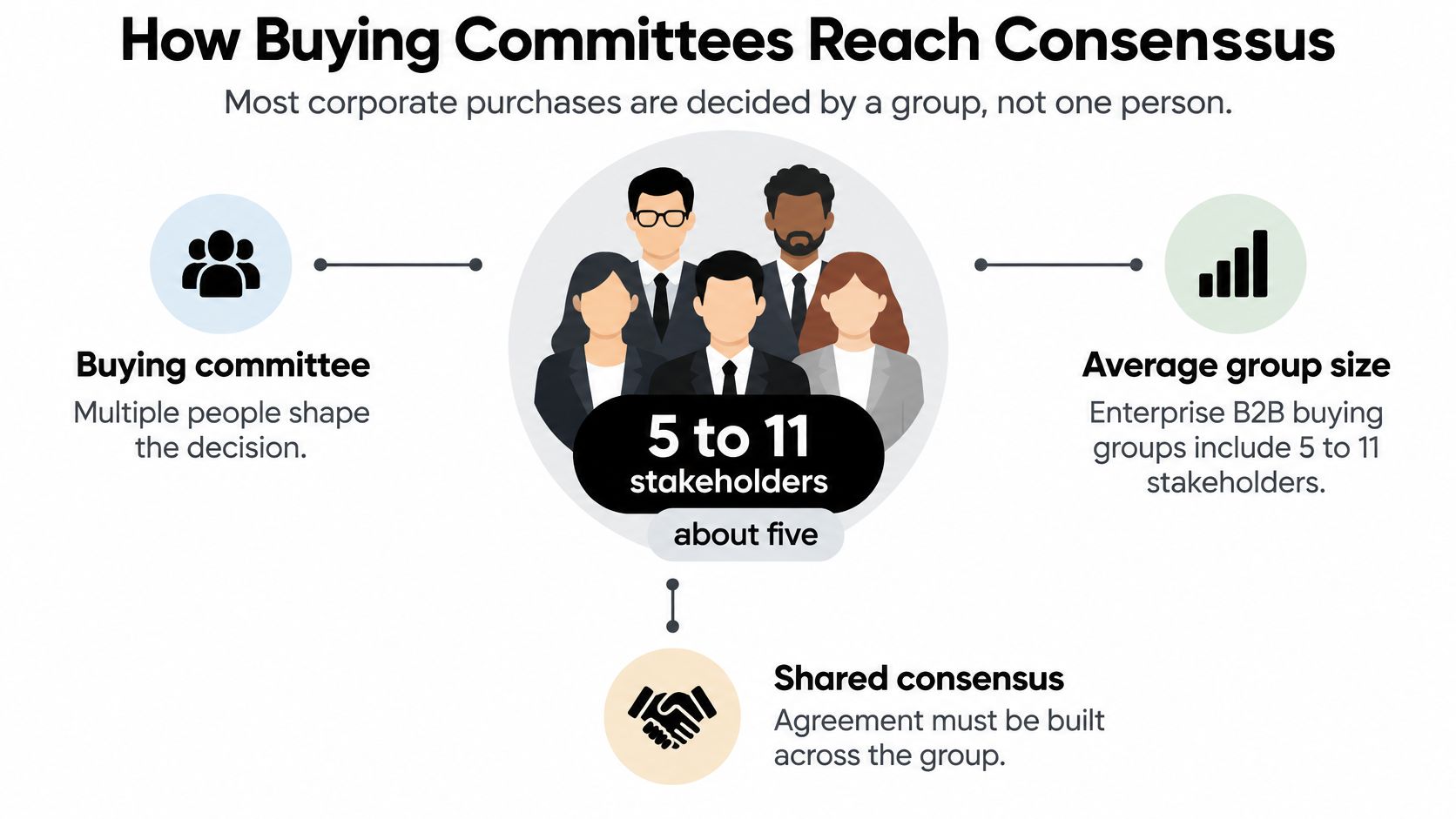
Enterprise B2B buying groups include 5 to 11 stakeholders representing approximately five business functions, and groups reaching consensus were 2.5 times more likely to describe their purchase as a high-quality deal, according to Gartner’s B2B buying report. The relevant outcome is how buyers described the deal, not a guaranteed improvement in financial performance.
The enterprise findings and the software committee findings describe different populations. Don’t turn either into a universal headcount. Map the actual purchase, especially when its scope crosses departmental boundaries.
The committee view makes those separate interests visible.
Build agreement around a shared decision
Consensus shouldn’t mean every stakeholder likes the same feature. It should mean the participants accept the problem, the evaluation criteria, the risks, and the conditions for proceeding.
Finance needs a defensible financial case. IT needs an acceptable implementation and support model. Legal needs workable obligations and remedies. End users need to understand how the proposed workflow will affect their work.
These aren’t separate sales stories. They’re different tests of the same proposal. If the financial case assumes immediate adoption while the implementation plan requires a lengthy transition, the committee has a contradiction to resolve.
Give your internal contact material they can circulate without translating your pitch. A shared evaluation document should state the desired outcome, essential requirements, unresolved questions, and the person responsible for each answer. A documented vendor selection process can turn those questions into explicit evaluation and approval stages.
Find the missing participants
Use a short discovery test to uncover authority that isn’t visible in the initial conversation:
- Who signs? Identify the person authorized to approve the commitment, not just the person requesting a proposal.
- Who can block? Ask whose objections must be resolved before implementation or contracting.
- Who uses it daily? Find the people who must change their work for the expected benefit to materialize.
Then ask your contact to validate the map. Don’t bypass them by approaching colleagues without context; agree on who should join and what that person needs to evaluate.
An enthusiastic contact is evidence of interest, not organizational approval. Treat progress as the resolution of named decision requirements, rather than the number of people who attended a presentation.
What Triggers a Purchase and Why Budgets Stay Put
An organizational change can create a reason to buy without creating permission to spend. A new operating model, a digital-transformation program, or a deteriorating business metric gives an operational owner a problem to solve. The budget holder still needs a reason to redirect resources.
That distinction helps explain the tension in McKinsey’s guide to decision-making biases for CFOs: spending allocations across business units showed an average year-to-year correlation above 90%, while a study of 1,509 U.S. companies covering 1990–2010 found approximately 30% higher annual total shareholder returns among organizations in the top third for resource reallocation than among those in the bottom third.
The comparison doesn’t prove that moving budget causes superior returns. It does challenge the assumption that preserving last year’s allocation is automatically the safer decision.
Turn a business problem into a review trigger
A supplier’s useful question isn’t whether an account has budget. Ask what evidence would justify reviewing the allocation.
Customer acquisition cost, retention, gross margin, and forecast variance can support that conversation. Choose the metric connected to the proposed solution, not whichever number makes the largest headline.
Establish a review rule before the next difficult allocation discussion:
- Pick the metric. Specify its definition and reporting source so finance and operations aren’t debating different calculations.
- Set a threshold. Use the organization’s approved operating range, rather than a supplier-invented benchmark.
- Name the owner. Assign someone to explain the change and assess its causes.
- Agree on the consequence. A breach should open a budget review, not automatically authorize a purchase.
For example, a software supplier could help an operations leader assess whether rising support costs reflect avoidable manual work. The case should distinguish a temporary workload spike from a persistent process problem before proposing replacement software.
A buying trigger opens an investigation. It doesn’t establish that your product is the answer.
Time outreach to the decision
Account size alone won’t tell you how to approach the review. When planning enterprise versus SMB outreach, establish whether the relevant person can redirect an existing budget or must obtain approval from another function.
Lead with the observed change and a question about its operational consequence. Avoid declaring that an organization urgently needs your solution based on a hiring announcement or technology rollout alone.
Time outreach to a credible trigger, not merely to the calendar. A year-end message about unused budget is weaker than a well-supported conversation about a problem the buyer is already responsible for investigating.
Pain Points and Decision Biases That Stall Deals
Only 28% of executives in a survey of 2,207 respondents rated their company’s strategic-decision quality as generally good; 60% said bad decisions occurred about as often as good ones, and 12% said good decisions were infrequent, according to McKinsey’s analysis of behavioral strategy. The same publication’s separate analysis of 1,048 major decisions found that strong analysis alone didn’t reliably produce strong outcomes.
The practical challenge is therefore broader than supplying another spreadsheet. Buyers need a process for questioning the assumptions behind it.
The meeting itself should make those assumptions open to challenge.

Address uncertainty without disguising it
Watch for confirmation bias, where participants favor information supporting an existing preference; anchoring, where an initial number frames later comparisons; and overconfidence, where forecasts receive more certainty than the assumptions warrant.
Don’t diagnose a buyer’s psychology in an email. Instead, design material that makes these errors easier to detect.
An unclear return on investment calls for visible assumptions and sensitivity ranges. Implementation concerns call for dependencies, responsibilities, and acceptance criteria. If a contact mentions a failed purchase or an earlier vendor’s overpromising, ask what evidence would make the current evaluation different.
Your objection-handling approach should distinguish a missing answer from a genuine limitation. If the product can’t meet an essential requirement, acknowledge that rather than treating the objection as something to overcome.
Send a decision record, not another pitch
Prepare a concise document with:
- Facts and assumptions. Separate measured conditions from forecasts and estimates.
- Alternatives. Include keeping the current approach or improving it without a new purchase.
- Risk ranges. Explain how outcomes change under less favorable adoption or implementation conditions.
- Dissenting views. Record unresolved objections and what evidence could resolve them.
- Review commitments. Agree how the buyer will compare forecasts with realized results after implementation.
Ask someone outside the proposal’s sponsorship group to challenge the assumptions before a major commitment. Agreement reached after scrutiny is more useful than agreement produced by avoiding difficult questions.
Use the following video as a discussion prompt alongside that written record.
The outreach implication is straightforward: help the buyer make a defensible decision. A document that survives internal questioning gives your contact something more useful than persuasive language they must defend alone.
Channels and Messages That Reach Each Role
Buyers use an average of 10 interaction channels during the purchasing journey, compared with 5 in 2016, according to McKinsey’s survey of nearly 4,000 B2B decision makers across 13 countries. The survey also identified a rule of thirds at each stage, with roughly one-third preferring in-person interaction, one-third remote communication, and one-third digital self-service; more than half wanted to switch channels without losing continuity.
The implication isn’t that every supplier needs every possible channel. It’s that buyers should be able to change how they interact without restarting their evaluation.
Channel preferences and typical touchpoints at each buying stage
| Preference | Share of buyers | Typical touchpoints | Best used for |
|---|---|---|---|
| In-person | About one-third | Site visits, trade events, face-to-face negotiation | Relationship building and final commercial talks |
| Remote | About one-third | Video calls, live demos, webinars | Technical validation and committee meetings |
| Digital self-service | About one-third | Documentation, calculators, case studies, research pages | Early research and internal sharing |
Treat the touchpoints as planning options, not rigid assignments. A buyer may research independently, request a live explanation, and then circulate documentation internally.
Match the material to the decision task
For an economic buyer, prepare an ROI summary showing the baseline, expected financial effect, assumptions, and exposure if the forecast is wrong. Offer a short meeting to examine the disputed assumptions rather than repeating the full product demonstration.
For a technical validator, provide architecture and integration documentation before the technical call. Give security questions a named owner and record which answers are confirmed, conditional, or still outstanding.
An operational owner needs a proposed workflow and implementation responsibilities. Show which tasks change, which remain, and who must contribute to the transition.
An end-user champion needs a focused demonstration of an actual task. Use a relevant, permissioned peer example when available, but don’t substitute a customer logo for an explanation of workflow fit.
For procurement and legal, make the pricing structure, renewal terms, responsibilities, and contractual limitations easy to locate. Don’t require another discovery call to obtain basic commercial information.
Keep the trigger specific and the account consistent
At Fypion Marketing, we tailor professional-services messaging to what triggers the buying conversation: compliance deadlines for accounting, case load for legal, and engagement cycles for consulting. The message names the situation that makes the discussion relevant, rather than relying on a generic promise of business growth.
Build a messaging framework that keeps the core problem, proposed outcome, and evidence consistent while changing the emphasis for each role. Different recipients should recognize the same proposal when they compare notes.
To anticipate independent product research, use MyMentions’ six prompt types for product discovery as a planning resource. Turn the resulting questions into clear research pages, comparison material, and documentation rather than assuming every question requires salesperson involvement.
Continuity test: If a buyer moves from your website to a technical call, can the next person see what they’ve already reviewed and what remains unresolved?
Record the answer in the CRM. Channel coordination is a working practice, not a larger collection of outreach tools.
Prioritizing Decision Makers and Building the Account Map
Rank accounts before contacts. A reachable executive at a poor-fit company shouldn’t outrank a less visible operational owner at an account with a relevant problem and a credible path to approval.
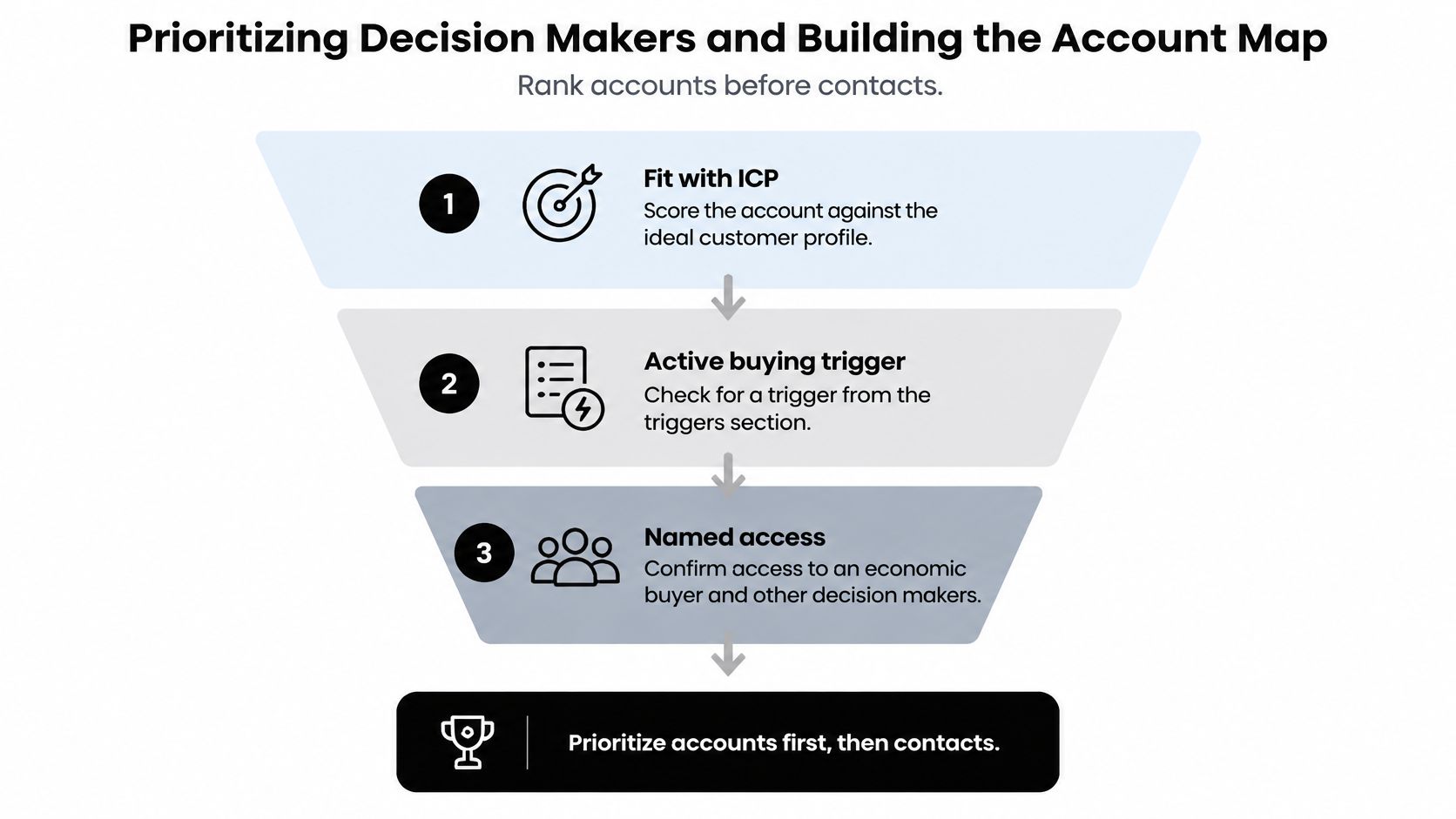
Evaluate accounts against ideal customer profile fit, an active buying trigger, and named access to economic and technical authority. Keep those criteria separate so a strong score on company size doesn’t conceal the absence of an actual buying reason.
Use the funnel as a screening sequence rather than a prediction of which accounts will close.
Decide where human attention belongs
Give immediate attention to accounts with a credible trigger, a named economic buyer, and a route to technical evaluation. Next, investigate good-fit accounts where the committee is known but the buying reason needs validation. Keep the remainder in a slower educational sequence, or remove them if they don’t meet the profile.
A contact’s engagement should change your understanding of the account, not automatically promote it to a qualified opportunity. A reply asking for information and a conversation confirming a funded evaluation are different signals.
For CollegeRecon, a military and veteran education platform, we targeted admissions directors, VPs of Enrollment Management, and military student services coordinators directly. We led with CollegeRecon’s organic military traffic and SEO reach, rather than a generic pitch. The useful lesson is the match between the audience’s responsibilities and the evidence used to begin the conversation, not just the selection of senior titles.
Build the working account record
Use this checklist before launching outreach:
-
Filter for fit. Define the business characteristics that make the problem relevant and remove accounts outside them. A clear ICP in sales gives researchers a consistent inclusion rule.
-
Assign the decision roles. Enter names against economic, operational, technical, contractual, and user authority. Label unverified assignments as hypotheses; don’t let an inferred title appear as confirmed approval power.
-
Validate the committee boundary. Use signing, blocking, and daily-use responsibilities to identify missing participants. Ask whether regional, parent-company, or shared-service approval is required for this specific purchase.
-
Record the buying trigger. Include the supporting evidence, its date, and the question it raises. Distinguish an observed company change from your interpretation of what that change means.
-
Plan a human touch and a self-service resource. Choose an appropriate in-person or remote interaction for each role, supported by material the contact can review or share independently. Don’t send every participant the same attachment.
-
Define qualification before sending. Specify what makes a meeting useful to the client’s business, including fit and the purpose of the conversation. A calendar acceptance alone isn’t a sufficient definition.
At Fypion Marketing, every engagement starts with an agreed definition of a qualified meeting before outreach begins. A meeting counts only when it matches the ICP and the client’s team explicitly confirms after the call that it was a good fit. An ICP match alone doesn’t count.
Make the map usable after the first reply
Log role, authority type, trigger, last channel used, unresolved questions, and the next agreed action in the CRM. Keep confirmed facts separate from researcher assumptions so the salesperson knows what still needs validation.
For the broader operating context, Revenue Nomad’s resource to explore the elements of GTM planning can help connect account selection with positioning and execution.
Build the map for your highest-priority accounts this week. Start with the accounts your team can investigate properly, and resolve missing authority before increasing outreach volume.
Fypion Marketing offers B2B outreach, decision-maker identification, and meeting qualification built around your ideal customer profile and agreed fit criteria. Visit Fypion Marketing to discuss which accounts to prioritize, which decision roles to reach, and what should count as a qualified conversation for your business.