
Boost Sales with Outsourcing Lead Generation Strategies

So, what does it actually mean to “outsource lead generation”?
At its core, it’s a strategic move where you hire a specialized outside agency to take over the entire grind of finding, warming up, and qualifying potential customers. This frees up your in-house sales team to do what they do best: focus on closing deals with people who are already interested and ready to talk. They get to skip the prospecting drudgery and jump straight to the high-value conversations.
Why Smart Businesses Outsource Lead Generation
Let’s be honest, keeping a sales pipeline full of genuinely qualified leads is tougher than ever. Sales has gone digital, and many internal teams just don’t have the specific skills, the expensive tech, or simply the time to keep up. This is exactly where outsourcing lead generation stops being a simple cost-cutting trick and becomes a serious growth strategy.
Think of it this way: you wouldn’t ask your family doctor to perform open-heart surgery. You’d bring in a specialist. The same logic applies here. You hire a lead generation agency - a team that lives and breathes this stuff - to handle the delicate, time-consuming work of building a healthy pipeline. You get instant access to top-tier experts without the pain and expense of hiring and training your own team from scratch.
In-House vs Outsourced Lead Generation at a Glance
Deciding whether to build an in-house team or partner with an agency can feel like a big decision. Both have their place, but they serve very different strategic needs. Here’s a quick breakdown to help you see the key differences.
| Factor | In-House Team | Outsourced Partner |
|---|---|---|
| Cost Structure | High fixed costs (salaries, benefits, software) | Variable, performance-based costs |
| Expertise | Limited to the skills of your hires | Access to a team of specialized experts |
| Technology | Requires purchasing and managing a full tech stack | Leverages the agency’s advanced, pre-existing tools |
| Time to Results | Slower ramp-up (hiring, training, testing) | Faster implementation and quicker results |
| Scalability | Difficult and slow to scale up or down | Flexible and easily scalable to match goals |
| Focus | Divides internal resources and management attention | Allows your team to focus on core competencies |
Ultimately, the choice depends on your resources, timeline, and long-term goals. For companies looking for rapid, efficient growth without the heavy upfront investment, outsourcing often provides a clearer path to results.
Access Specialized Expertise and Technology
One of the biggest reasons businesses look to outsource is to immediately tap into expertise they just don’t have in-house. A top-tier agency lives and breathes lead generation. It’s all they do.
They are masters of:
-
Advanced Prospecting Tools: They’re already using sophisticated software for digging up data, verifying contacts, and tracking buying signals that you might not even know exist.
-
Compelling Outreach Copy: They spend their days crafting and A/B testing email and social media messages that actually cut through the noise and get a response.
-
Scalable Processes: They have battle-tested workflows that can be cranked up or dialed back depending on your growth targets and what the market is doing.
The market data backs this up. It’s estimated that by 2025, a staggering 80% of B2B sales interactions will happen in digital channels. This digital-first reality is what’s driving so many companies to outsource - they simply can’t build and manage the required tech stack and multi-channel strategies on their own.
A huge advantage of outsourcing is turning a major fixed cost - like salaries and software subscriptions - into a flexible, performance-based expense. You’re paying for results, not just for someone to show up.
Focus on Core Business Functions
At the end of the day, outsourcing your lead generation gives you back your most precious resource: your team’s time.
Instead of your best salespeople burning hundreds of hours on cold calls and follow-up emails that go nowhere, they can pour all that energy into what they were hired for - building relationships and closing deals. This is the bedrock of efficient growth. To see how this fits into the bigger picture, check out our **guide on lead generation in B2B**.
By handing off the top-of-funnel grunt work, your business can hit the accelerator on revenue while you focus on what really matters: making your product or service the best it can be.
The Strategic Benefits of an Outsourced Pipeline

Let’s move past the basics. The real magic of outsourcing lead generation happens when you start thinking of it not just as getting leads, but as building a high-performance pipeline. This isn’t about just adding names to a list; it’s about engineering a faster, more efficient path from a prospect’s first flicker of interest to a qualified meeting on your calendar.
A specialized partner acts as an accelerator. They move prospects through your funnel at a speed that most in-house teams, bless their hearts, just can’t match on their own.
One of the most immediate wins is accelerated pipeline velocity. Picture your sales funnel as a highway. Your internal team might be cruising along in a reliable sedan - making steady, respectable progress. An outsourced partner, on the other hand, pulls up in a Formula 1 car. They’ve got the high-octane fuel (data), the finely tuned engine (tech), and the expert driver (specialist) to blast past all the usual traffic jams.
This boost is a game-changer for growing businesses. A 2024 report highlighted that a lack of internal resources was the top reason 56% of B2B companies decided to outsource their lead generation. It’s not just a hunch; that same report found companies taking this route see an average 43% improvement in pipeline velocity. That translates directly to faster revenue. You can dig into more of the data and learn about the impact of outsourcing on sales cycles for B2B companies.
Drive Down Costs and Improve ROI
The cost savings here go way beyond what you see on the surface. When you hire an in-house sales development representative (SDR), you’re not just paying a salary. You’re on the hook for benefits, payroll taxes, hefty recruitment fees, and the shocking cost of the sales tech they need to even function.
An outsourced partner rolls all of those expenses into one predictable fee. You get to sidestep the five-figure annual price tags for the essential sales tools because the agency has already made those big investments.
By outsourcing, you’re not just hiring a person; you’re renting an entire, fully-equipped lead generation department. This includes the team, the technology, the data subscriptions, and the proven processes, all for a fraction of the cost of building it yourself.
This completely flips the financial risk. Instead of a heavy, fixed operational cost that weighs you down, you have a flexible, variable expense you can tie directly to the results you’re getting.
Gain Unmatched Strategic Agility
Markets change. Business goals pivot. New opportunities pop up out of nowhere. To survive and grow, you have to be agile. Building an internal team is a slow, rigid commitment, but an outsourced partnership gives you incredible flexibility.
Imagine your company wants to test a new market - say, you’re a North American software company with an eye on Europe. Building an in-house team for that is a massive undertaking:
-
Hiring: You’d need to find and recruit local talent who get the region’s business culture and speak the language.
-
Investment: This means a huge financial gamble with absolutely no guarantee of a payoff.
-
Time: The whole process could easily take six months to a year before you see a single meaningful result.
Now, think about the outsourced approach. You can partner with an agency that already has a foothold and experience in the European market. They can get a targeted campaign up and running in a few weeks, giving you real-world data on whether the market is viable with minimal financial exposure.
If the test is a hit, you scale up the engagement instantly. If it’s a dud, you pull back without any messy HR fallout or sunk costs. That ability to pivot on a dime is a massive competitive advantage.
Choosing the Right Lead Generation Partner

Picking a partner to handle your lead generation is a make-or-break decision for your sales growth. Get it right, and the agency becomes a seamless extension of your team, consistently feeding your pipeline with quality opportunities. Get it wrong, and you’ll burn through your budget and watch your brand’s reputation get torched by sloppy outreach.
Your success isn’t just about what the agency does, but how they do it. You need a practical playbook to vet potential partners, looking past their polished sales pitch to see their actual process and philosophy.
Align on the Definition of a Qualified Lead
The single biggest reason these partnerships implode is a fuzzy definition of a “good lead.” If your idea of a qualified prospect and your partner’s don’t match perfectly, you’re just signing up for frustration and wasted cash. A calendar full of meetings is worthless if none are with people who can actually buy your stuff.
Before you sign anything, you have to get granular. A true Sales Qualified Lead (SQL) isn’t just a name and an email. It’s a real person who checks a specific, pre-agreed set of boxes.
You need to dig into these areas together:
-
Firmographics: What’s the target company size, industry, and location?
-
Technographics: Do they need to be using a specific technology (or, just as important, not using a competitor’s)?
-
Job Titles: Who is the real decision-maker you need to talk to? The one with budget authority?
-
Buying Intent: What signals or pain points tell you they’re ready for a sales call now?
A solid partner will welcome this conversation and roll up their sleeves to build a detailed lead profile with you. They should be able to clearly explain how their process weeds out everyone who doesn’t meet these strict criteria.
Scrutinize Their Process and Technology
Once you’re aligned on the “who,” you have to get into the “how.” A great agency is an open book about its methods and the tech it uses. If you hear vague answers about a “proprietary process,” that’s a massive red flag.
You need to know exactly how they plan to represent your brand out in the wild. Ask them direct questions about their tech stack, their approach to personalization, and what their reporting looks like. A partner worth their salt will proudly show you the tools they use to find prospects, enrich data, and run campaigns.
A huge part of vetting is seeing how a partner measures success. Insist on a peek at a sample dashboard. If it’s full of vanity metrics like open rates and clicks, run. You want a partner focused on what actually impacts your bottom line: booked meetings, cost per qualified lead, and show-up rates.
Watch for Red Flags and Vet for Cultural Fit
Finally, you’re looking for a true partner, not just another vendor. A partner is invested in your success, operates with total transparency, and treats your brand like their own. A vendor just checks off tasks on a list.
Keep an eye out for these classic warning signs:
-
Outrageous Promises: Guarantees like “100 appointments in your first month” are almost always unrealistic. It signals they’re chasing quantity, not quality.
-
No Case Studies: An experienced agency will have a portfolio of success stories, ideally from companies that look a lot like yours.
-
High-Pressure Sales Tactics: If they’re rushing you to sign a contract without doing a deep dive into your business first, walk away. Fast.
Beyond dodging red flags, look for a good cultural fit. Do you like their communication style? Do their values align with yours? The whole point of outsourcing is to build a team that feels like an extension of your own.
Taking the time to choose carefully ensures you’re building a powerful engine for long-term growth. For more on this, you can learn about some of the most effective B2B lead generation strategies for business growth that any good partner should be using.
Implementing Your Outsourced Strategy
Picking the right partner is a massive step, but let’s be real - the real work starts after you’ve signed on the dotted line. Rolling out an outsourced lead generation strategy isn’t something you can “set and forget.” It’s a hands-on partnership, and building a strong foundation from day one is what separates the massive successes from the frustrating failures.
The whole thing kicks off with a discovery and onboarding phase. Think of this as a total immersion program for your new partner. They need to get way past your website’s homepage and truly get inside your head. They have to understand your brand’s voice, where you sit in the market, and most importantly, the real-world pains and goals of your ideal customer.
A great partner will act like a sponge, soaking up every little detail. Why? So their outreach doesn’t sound like it came from a robot. It has to feel authentic and actually connect with the people you’re trying to reach.
Aligning on Strategy and Communication
Once your partner is up to speed on your world, it’s time to turn that knowledge into an actual plan. This is where you sit down together and map everything out. You’ll co-create the strategy, define what a “win” actually looks like, and set up a communication rhythm to keep everyone on the same page.
Skipping this step is a recipe for disaster, leading to wasted effort and mismatched expectations.
Here’s what this stage needs to cover:
-
Defining Key Performance Indicators (KPIs): Forget vanity metrics. You need to focus on what actually moves the needle - we’re talking booked meetings, lead quality scores, and the all-important cost per qualified opportunity.
-
Establishing a Communication Cadence: Get a schedule on the books. Will you have a quick tactical call each week? A bigger strategic review once a month? Who are the main people to talk to on both sides? Iron this out now.
-
Creating a Feedback Loop: The feedback from your sales team is pure gold. You have to set up a simple, non-negotiable process for them to rate the quality of every single lead and meeting. This is what allows the agency to quickly adjust their aim and get better results, fast.
This visual really nails how the core pillars - defining objectives, vetting providers, and tracking KPIs - form the backbone of any successful outsourcing plan.
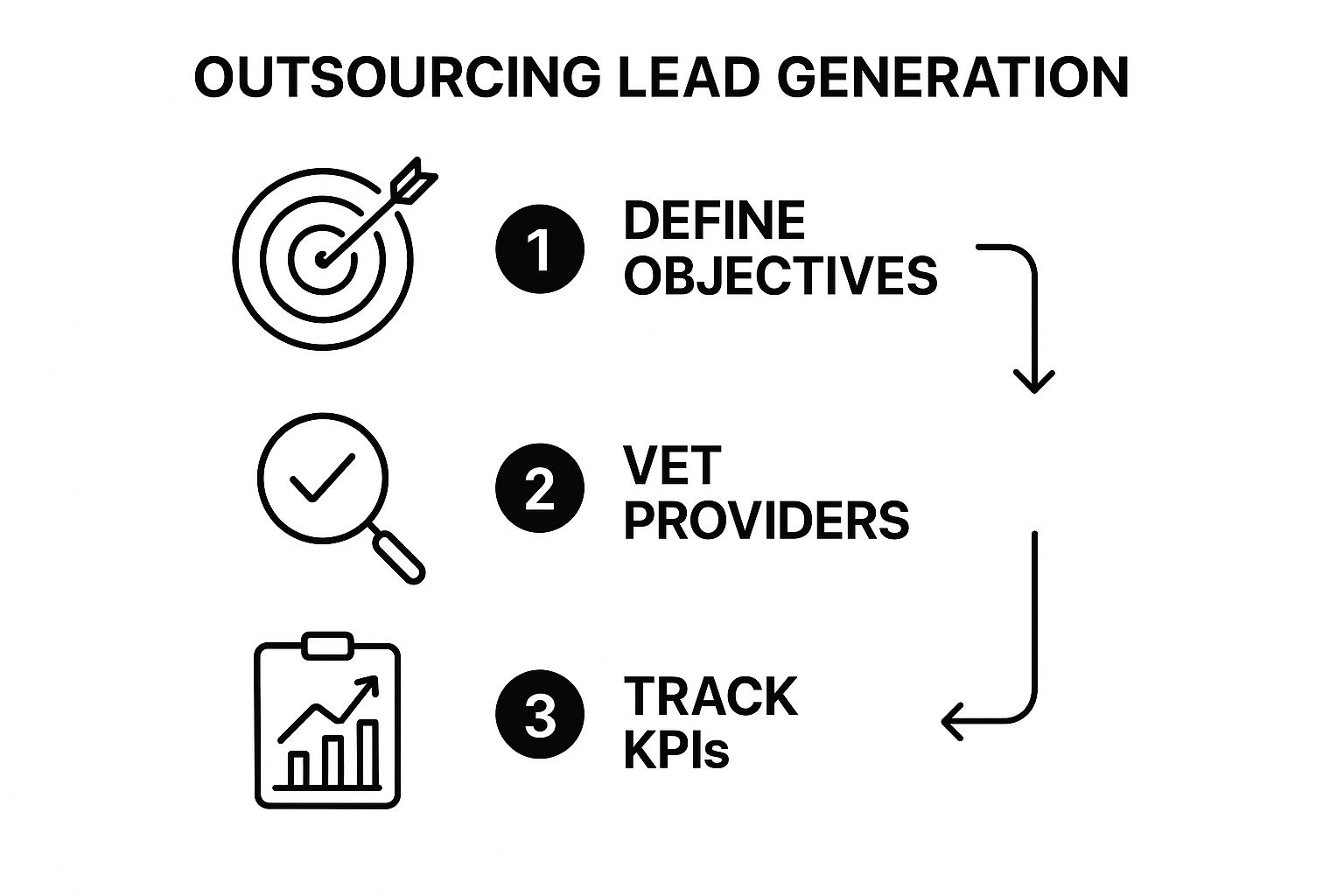
As the graphic shows, success isn’t a one-and-done deal. It’s a continuous process built on clear goals, smart selection, and keeping a close eye on performance.
Managing the Technical Setup
With the strategy locked down, it’s time to connect the plumbing. The technical setup is all about making sure data flows smoothly from your partner’s systems into yours, especially your Customer Relationship Management (CRM) platform. A sloppy handoff is how perfectly good leads fall through the cracks, wasting all the hard work that went into finding them in the first place.
Your partner should do the heavy lifting here, but you need to be involved to make sure it’s done right. This usually means integrating their outreach tools directly with your CRM. The goal? New leads, booked meetings, and all the juicy details get logged and assigned to the right salesperson automatically.
When the technical integration is done correctly, it should be completely invisible. A lead just appears in your CRM with all the context, notes, and contact info needed for your sales rep to pick up the conversation without missing a beat.
Launching and Optimizing for Early Wins
It’s go-time. The first campaigns are live. These initial weeks aren’t really about hitting huge numbers; they’re about learning. Data will start rolling in, giving you the first real-world test of the strategy you built together. This is where that collaborative feedback loop you created becomes absolutely essential.
Your partner will be digging into open rates, reply rates, and positive responses. At the same time, your sales team will be giving you the real story on the quality of the meetings. It’s the combination of these two data sets that leads to early wins and paves the way for long-term growth.
This cycle of launching, getting feedback, and tweaking the approach is the engine that drives a high-performing outsourced program. For more ideas on refining your tactics, you can also check out our guide on **effective outbound lead generation strategies that convert**.
It’s this constant improvement that turns a good partnership into a great one, transforming your lead generation from a headache into a predictable, scalable source of revenue.
How AI and Tech Give Outsourced Teams an Unfair Advantage
Modern lead generation is all about the tech. Partnering with an agency that’s on top of its tech game isn’t just a nice perk anymore - it’s absolutely critical if you want to stay competitive and grow. When you decide to outsource your lead generation, you’re not just hiring a few extra hands. You’re plugging into a powerful technology stack that’s already built to drive efficiency and get results.
Think of it this way: an expert chef with a state-of-the-art kitchen is always going to cook better food, faster, than someone trying to make do with a single pot and a dull knife. It’s the exact same principle here. Your outsourced partner uses specialized tools to take the tedious work off their plate, enrich prospect data, and run highly personalized outreach campaigns that actually get a response.

Unlocking Efficiency with AI and Automation
Artificial intelligence is the engine that keeps a modern lead gen team humming. It handles all the repetitive, time-sucking tasks that would otherwise bog down your team, freeing them up to focus on high-level strategy and building real relationships with your best prospects.
AI-powered tools can sift through mountains of data to find companies that perfectly match your ideal customer profile with scary accuracy. From there, they can pinpoint the right people inside those companies, verify their contact info, and even pull contextual details to make that first touchpoint feel personal and relevant.
This isn’t about replacing people with robots. It’s about augmenting them. AI does the heavy lifting - the data gathering and initial filtering - so human experts can apply their strategic thinking where it counts: crafting killer messages and navigating complex sales conversations.
For example, some tools are smart enough to pick up on “intent signals,” like when a company downloads a whitepaper on a specific topic or spends time on a competitor’s pricing page. This lets your outsourced team jump on opportunities with prospects who are actively looking for a solution like yours, which drastically improves the odds of getting a positive reply.
Driving Productivity and Filling Gaps
The operational boost from integrating technology is real and measurable. Recent surveys show that about 25% of companies say AI tools have helped them fill critical workforce gaps. This allows them to keep their lead generation efforts going - or even ramp them up - without the massive overhead of hiring more full-time staff.
It also directly impacts how much your sales pros can get done. Reports show that 43% of sales representatives saw their productivity climb when they were supported by AI-powered lead generation tools. This really highlights how a tech-savvy partner can deliver better results by working smarter, not just harder. You can dive deeper into these findings and the impact of technology on lead generation outsourcing in recent industry studies.
Core Technologies in a Modern Lead Gen Stack
Any top-tier outsourced partner will come to the table with a full suite of powerful tools designed to manage the entire lead generation process from start to finish. The exact stack will vary, but you can expect it to include these core components:
-
Sales Intelligence Platforms: These are the tools that give deep insights into target accounts, from company size and revenue to the specific tech they’re already using.
-
Contact Data Providers: This is all about having access to huge, constantly updated databases of professional contacts. It’s the foundation for any successful outreach campaign.
-
Outreach Automation Software: This tech is what makes it possible to send personalized emails and social media messages at scale while tracking every single interaction.
-
Predictive Analytics Tools: By crunching historical data, these systems can actually predict which prospects are most likely to convert, helping the team focus their energy where it will have the biggest impact.
When you invest in outsourcing your lead generation, you’re not just buying appointments. You’re tapping into a sophisticated, pre-built tech infrastructure that directly translates into more efficient operations, higher-quality leads, and faster sales growth for your business.
Measuring ROI and Optimizing for Growth
Once you’ve handed over the reins and your outsourced campaign is live, the big question looms: is this actually working? Answering that means looking beyond the surface-level numbers and focusing on what truly impacts your bottom line.
Success isn’t about how many emails were opened. It’s about the hard data, the cold numbers that prove your investment is paying off. You need to know that every dollar you’re spending on outsourcing is fueling real, measurable growth for your business.
Focusing on Sanity Metrics, Not Vanity Metrics
It’s incredibly easy to get distracted by metrics that look great on a dashboard but mean absolutely nothing for your revenue. We call these vanity metrics. They feel good, but they don’t pay the bills.
Instead, a successful partnership is built on sanity metrics - the KPIs that tell the real story of your pipeline’s health and financial return.
Think of it this way: a vanity metric shows activity, while a sanity metric shows results. One looks busy, the other proves business impact.
Tracking Metrics That Actually Matter
Here’s a quick breakdown of the numbers you should be obsessed with versus the ones that are mostly noise.
| Vanity Metric (Looks Good) | Sanity Metric (Drives Business) |
|---|---|
| Email Open Rates or Impressions: This just shows how many people saw your message, not if they cared. | Cost per Qualified Lead (CPL): This tells you exactly how much you’re spending to get one genuinely interested prospect. |
| Website Clicks: Clicks indicate initial curiosity, but they don’t signal any real intent to buy. | Lead-to-Customer Conversion Rate: This is the big one. It measures how many of those leads actually became paying customers. |
| Number of Leads Generated: A high volume of junk leads is worse than useless - it wastes your sales team’s time. | Pipeline Value Generated: This shows the total potential revenue your outsourced leads have created. |
When you focus the conversation on sanity metrics, you shift the entire dynamic with your partner. The question is no longer “How much activity did you create?” but “How much real business value did you drive?” This alignment is the key to a healthy, productive relationship.
A great partnership lives and dies by transparent data. Your outsourced team should be providing clear, regular reports that spotlight these bottom-line metrics, making it dead simple to see how their work is hitting your revenue goals.
Creating a Cycle of Continuous Improvement
Measuring ROI isn’t something you do once and then forget about. It’s an ongoing process of analysis, feedback, and tweaking. The best partnerships have a regular rhythm for performance reviews, creating a feedback loop that makes the campaigns smarter and more effective over time.
This collaborative cycle usually looks something like this:
-
Dig into the Data: Sit down with your partner - weekly or bi-weekly - and go through the KPI dashboard together. What’s working? What’s not? What trends are popping up?
-
Get Sales Team Feedback: Your sales reps are on the front lines. Their real-world feedback on the quality of the leads is just as crucial as any number on a spreadsheet. Are the leads a good fit? Are they ready to talk?
-
Make Smart Adjustments: Use all these insights to make specific, actionable changes. Maybe the email copy needs a refresh, the target audience needs refining, or your definition of a “qualified lead” needs an update.
This constant loop of review, feedback, and optimization turns raw data into powerful intelligence. It ensures you’re always doubling down on what’s working and quickly fixing what isn’t, transforming your outsourced lead gen from a hopeful experiment into a predictable engine for growth.
If you’re ready to go even deeper, check out our complete guide on mastering lead gen KPIs for business growth to build a truly data-driven sales machine.
Answering Your Outsourcing Questions
Even when you see the potential, diving into outsourcing lead generation can feel like a leap of faith. It’s totally normal to have questions swirling around about cost, quality, and whether an outside team can really get your industry.
Let’s clear the air and tackle the most common questions we hear from businesses just like yours.
How Much Is This Going to Cost Me?
It’s always the first question, and the honest answer is: it depends. The price tag can swing wildly, from a few thousand dollars a month to well over $10,000. But fixating on that number is a classic mistake.
The real math isn’t about the monthly fee; it’s about the return on your investment. You have to weigh the cost against what you’re saving - no in-house salaries, no benefits packages, no recruiting fees, and no pricey software licenses. More importantly, what’s the value of getting revenue in the door faster because your pipeline is humming? Always insist on a detailed breakdown of what you’re actually paying for.
Will They Even Understand My Niche?
This is the big one. It’s a deal-breaker. The best lead generation agencies don’t try to be everything to everyone; they specialize in specific verticals like SaaS, manufacturing, or healthcare. When you’re talking to potential partners, your number one job is to find one with a proven track record in your world.
Don’t just take their word for it. A great partner will be excited to show you case studies and introduce you to happy clients who look just like you. They should also have a rock-solid discovery and onboarding process. If they aren’t willing to invest serious time upfront to learn your product, your customers, and your unique place in the market, walk away.
How Do I Make Sure the Leads Are Actually Good?
Controlling lead quality comes down to one thing: setting crystal-clear expectations from the get-go. You need to formalize this in a Service Level Agreement (SLA). Before a single cold email goes out, you and your partner must agree on the precise definition of a Sales Qualified Lead (SQL).
This definition isn’t vague. It should be specific and include criteria like:
-
Firmographics: Company size, industry, and location.
-
Job Titles: The exact roles you need to be talking to.
-
Buying Intent Signals: What actions or needs indicate a prospect is truly ready for a sales conversation?
From there, you need a tight feedback loop. Your sales team has to consistently rate the leads they receive. This isn’t about micromanaging; it’s a collaborative process that keeps the agency perfectly calibrated to your standards. For a deeper dive, check out our guide on real strategies for B2B lead generation that actually works.
Ready to build a predictable sales pipeline without the upfront costs? Fypion Marketing operates on a pay-per-meeting model, meaning you only pay for qualified appointments. Schedule your free consultation today and see how we can fuel your growth.