
A Guide to Enterprise Email Marketing for B2B Growth
When people hear “enterprise email marketing,” they often think it just means sending a massive number of emails. But that’s missing the point entirely. It’s not about volume; it’s about managing complexity, data, and brand reputation on a huge scale, often across different business units and global markets.
What Is Enterprise Email Marketing Anyway?
Think about the difference between a local bike courier delivering a few dozen packages versus a global logistics network like FedEx managing millions. That’s the leap from standard email marketing to what we do at the enterprise level. For a small business, email is a newsletter. For an enterprise, email is core business infrastructure.
This isn’t just about sending more promotions. We’re talking about a centralized system designed to support long, multi-stage B2B sales cycles, intricate customer journeys, and coordinated communication across an entire organization. It stops being a simple campaign tool and becomes a predictable engine for driving revenue and building lasting relationships.
At the end of the day, enterprise email is the system that lets a massive company speak to thousands - or millions - of people with a single, unified brand voice, while still making every message feel personal and relevant to the person reading it.
To really get a sense of the shift in thinking, let’s compare the two approaches side-by-side.
Standard vs Enterprise Email Marketing At a Glance
The table below breaks down the fundamental differences in scale, infrastructure, and strategic goals. It highlights how enterprise email isn’t just a bigger version of standard email, but a completely different discipline.
| Aspect | Standard Email Marketing | Enterprise Email Marketing |
|---|---|---|
| Primary Goal | Drive immediate conversions, clicks, and opens | Build long-term relationships, nurture complex sales cycles |
| Scale | Hundreds to a few thousand contacts | Tens of thousands to millions of contacts |
| Infrastructure | Shared servers, basic authentication | Dedicated IPs, advanced authentication, multiple domains |
| Team Structure | A single marketer or small team | Centralized team serving multiple business units |
| Key Metrics | Open rates, click-through rates | Pipeline influence, customer lifetime value, revenue |
| Compliance | Basic CAN-SPAM/GDPR awareness | Deep focus on global regulations and brand reputation |
As you can see, the focus moves from simple campaign metrics to true business impact. This requires a much more robust and strategic framework.
From Marketing Channel To Business Function
In a large B2B company, email stops being just a promotional tool and becomes the connective tissue linking sales, marketing, and customer success. A solid enterprise strategy is absolutely essential for navigating the long decision-making process common in B2B deals, where you have to build trust over months or even years.
This strategic approach is what powers several critical business activities:
-
Scalable Lead Generation: Systematically reaching out to thousands of potential accounts with personalized messages.
-
Sophisticated Nurturing: Guiding prospects through a complex buying journey with targeted, educational content.
-
Customer Lifecycle Management: Onboarding new clients, boosting product adoption, and spotting upsell opportunities.
-
Brand Reputation Management: Making sure every single email - transactional or promotional - reinforces brand authority and trust.
To really make this work, you first need a solid handle on the fundamental B2B email marketing best practices that everything is built on.
The Strategic Imperative for B2B
For any large B2B company trying to own its market, mastering enterprise email marketing is non-negotiable. It gives you the control, security, and analytical depth needed to make smart decisions and actually prove ROI.
Unlike standard email tools that just show you opens and clicks, an enterprise framework connects what you do directly to revenue, like booked meetings and pipeline growth. You can dive deeper into building a plan for this by exploring a modern B2B email marketing strategy that converts in our other guide. Ultimately, this discipline ensures you stay consistent and compliant at a scale where even small mistakes can have huge financial and reputational costs.
Building a Technical Foundation for Flawless Deliverability
Let’s get one thing straight: your technical setup is the absolute bedrock of any enterprise email program. You can have the most brilliant, creative campaigns, but if the foundation is cracked, your emails will never even reach the inbox. It’s a hard truth.
Think of your sending domain’s reputation like a credit score. Every single action you take either builds it up or chips away at it. And the “credit bureaus” in this analogy? They’re the big Internet Service Providers (ISPs) like Google and Microsoft. They are constantly scrutinizing your sending behavior, deciding whether you’re trustworthy enough for the primary inbox or destined for the spam folder. Building that high “credit score” isn’t just a best practice - it’s everything.
This image really captures the shift from a simple, one-track email setup to the kind of robust, multi-channel network you need at the enterprise level.
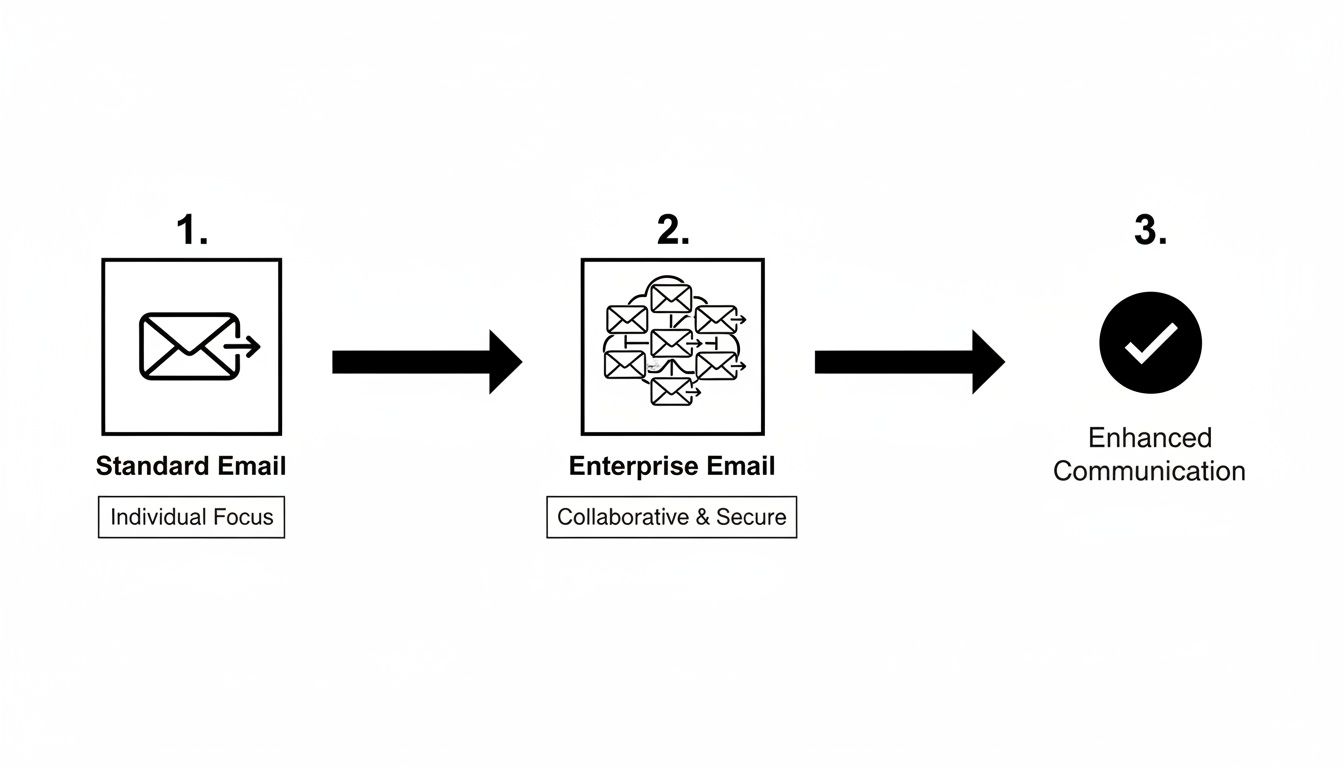
The takeaway here is that you can’t rely on a single point of failure. Enterprise deliverability is all about having a distributed, specialized infrastructure.
Your Domain’s “Financial Records”: SPF, DKIM, and DMARC
To build a solid sending reputation, you have to prove you are who you say you are. This is where email authentication protocols come into play. I like to think of them as your domain’s financial records - they verify your identity and build trust with ISPs.
You absolutely must have these three core standards in place. There’s no way around it.
-
Sender Policy Framework (SPF): This is basically your official list of authorized senders. It tells ISPs which IP addresses are allowed to send emails for your domain, stopping others from spoofing your address.
-
DomainKeys Identified Mail (DKIM): Think of this as a tamper-proof digital signature. DKIM adds an encrypted signature to your emails that receiving servers can check. This proves the message is legitimate and hasn’t been altered.
-
Domain-based Message Authentication, Reporting, and Conformance (DMARC): DMARC is the enforcer. It works with SPF and DKIM, telling ISPs exactly what to do with emails that fail the authentication checks - either send them to spam (quarantine) or block them entirely (reject).
A properly set up DMARC policy is not optional anymore. The major ISPs now expect it. Not having one is a massive red flag that will tank your deliverability.
Getting authentication right is the first major step. But it’s only one piece of the puzzle. A huge part of building a flawless technical setup is knowing how to automate cold email without landing in spam.
Mastering Your Sending Infrastructure
Beyond just authentication, the infrastructure you use to send emails plays a massive role in whether they get delivered. At the enterprise level, this means getting your hands dirty with IP management and strategically separating your email traffic.
Warming Up Dedicated IPs
When you get a new dedicated IP address, it has zero reputation. It’s a blank slate. You can’t just blast 100,000 emails from a “cold” IP; ISPs will see that as suspicious and shut you down immediately.
You have to “warm it up.” This means you start by sending a small volume of email and gradually increase it over several weeks. It’s a process that shows you’re a responsible sender and builds that crucial trust over time. If you need a detailed playbook on this, we’ve put together step-by-step instructions for technical setup for cold emailing over on our blog.
Separating Email Streams
This is one of the biggest and most costly mistakes I see large companies make. They send everything - marketing campaigns, cold outreach, and transactional receipts - from the same IP address. It’s a recipe for absolute disaster.
Think about it: if one of your marketing campaigns gets a high complaint rate, it poisons the reputation of that IP. Suddenly, your critical transactional emails, like password resets or purchase confirmations, start bouncing.
At the enterprise level, you must separate your email streams. No exceptions.
-
Transactional Stream: Put all your critical, system-generated emails on their own dedicated IP. Protect this IP’s reputation like it’s gold.
-
Marketing & Nurture Stream: Use a different IP (or a pool of them) for your newsletters and nurture sequences going to your opted-in contacts.
-
Cold Outreach Stream: Cold outreach must always come from entirely separate domains and IPs. This completely isolates its reputation from your main corporate and marketing domains, protecting them from any potential fallout.
This strategic separation is a core discipline of successful enterprise email marketing. It isolates your risk and makes sure that a problem in one area doesn’t bring your whole operation crashing down.
Advanced Segmentation for High-Value B2B Audiences
Anyone can blast out emails to a list based on company size or industry. That’s the old way. In enterprise B2B, where you’re chasing six or seven-figure deals, that approach is just noise. Your real job is to become a data detective, piecing together clues to build an airtight case for why a specific company needs you, right now.
Forget mass outreach. We’re aiming for something that feels like a one-on-one conversation, even if it’s sent at scale. This is how you earn the attention of busy decision-makers. It all comes down to layering different kinds of data to paint a crystal-clear picture of your ideal customer.

The 3 Key Data Layers for B2B Segmentation
Building these laser-focused segments means looking beyond the surface. You’ll need to pull together a few different types of information. Each one gives you a unique angle on the account and the people inside it. When you stack them, the magic happens.
These are the three main data points you’ll be working with:
-
Behavioral Data: This is all about what they do. It’s a record of their direct interactions with your brand - the pages they browsed on your site, the whitepapers they downloaded, or the webinars they registered for.
-
Technographic Data: This tells you what they use. It’s a map of their current tech stack. Knowing the software and tools they already have gives you huge clues about their infrastructure, capabilities, and where your solution might fit in.
-
Intent Data: This reveals what they’re looking for. These are signals from across the web showing an account is actively researching solutions like yours. They’re telling you, indirectly, that they’re in a buying cycle.
When you combine these, you stop targeting broad categories like “tech companies” and start zeroing in on segments that are primed to convert. For a much deeper dive into this, check out our guide on B2B customer segmentation as your growth blueprint.
Turning Raw Data into Hyper-Targeted Segments
Let’s make this real. Say your company sells a project management tool that integrates with a niche coding language API. A basic, old-school segment would be “software development managers.” Not very exciting.
Now, let’s layer on our data. We can build a segment that’s exponentially more powerful:
Segment Example: VPs of Engineering at Series B FinTech companies in North America that are actively hiring developers, currently use a competitor’s project management tool, and whose company recently visited your API integration pricing page.
See the difference? This isn’t a guess. It’s an educated, data-backed hypothesis that your message will hit home. This level of detail completely changes the game for enterprise email.
Writing Emails That Actually Get a Reply
With a segment this specific, you can stop writing generic marketing copy. You can now craft a message that speaks directly to their world, their problems, and their immediate needs.
Think about the angles you now have for that segment we just built:
-
Reference Their Growth: Open your email by mentioning their recent funding or hiring push. It shows you’ve paid attention and aren’t just spamming them.
-
Point Out a Likely Problem: Mention their current project management tool and ask about the headaches of integrating it with their specific API. This proves you understand their technical reality.
-
Offer the Perfect Fix: Introduce your tool as the one platform built to solve that exact integration issue, maybe even referencing the pricing page they viewed.
This stops being a cold email and starts being a helpful, relevant conversation. You’re respecting their time and intelligence. This is the kind of email that doesn’t just get opened - it gets a response. That’s the real goal of enterprise email marketing: using data to make every single touchpoint count.
Designing and Scaling High-Impact B2B Email Campaigns
Once you’ve got your technical house in order and your audience segments are razor-sharp, the real work begins: crafting emails that actually get a response. At the enterprise level, this isn’t about blasting out thousands of generic messages. It’s about precision, scalability, and understanding the two fundamental types of campaigns that drive B2B growth.
First, you have cold outreach. This is your playbook for cracking into new accounts and generating meetings from a standing start. The second is the nurture sequence, which is all about guiding prospects who are already interested through what is often a very long and winding buying journey. You need a distinct strategy for each, and both have to be built for scale.

The Cold Outreach Playbook for Generating New Leads
Cold outreach in the enterprise world is a delicate art. It’s about making a first impression that feels personal and relevant, not like it came from a robot. The goal here is simple and direct: book a qualified meeting with a decision-maker.
It all starts with solid account research. Before you write a single word, your team needs to know what the target company is up to, what challenges they’re facing, and what their strategic priorities are. This is the only way to write copy that actually connects with their world.
A solid cold outreach cadence usually looks something like this:
-
A Personalized Opener: The first email has to show you’ve done your homework. Reference something specific - a recent company announcement, a new executive hire, or a common pain point in their industry.
-
Value-Driven Follow-Ups: Don’t just send emails “bumping this to the top of your inbox.” Every follow-up needs to offer something new. A relevant blog post, a short case study, or a different perspective on the problem you solve.
-
A Clear, Low-Friction Ask: Your call to action needs to be dead simple. You’re trying to book a discovery call, not close a six-figure deal in the first email. Keep it easy.
At its core, enterprise cold outreach is all about relevance at scale. You’re combining deep personalization with smart automation to stay on their radar without driving your team - or your prospects - crazy.
When you get this right, you can turn a simple list of contacts into a predictable stream of qualified sales meetings.
The Nurture Sequence Playbook for Guiding Prospects
Once a lead is in your world - maybe they replied to a cold email, downloaded a whitepaper, or met you at an event - the nurture sequence kicks in. In B2B, a single purchase can involve a whole committee of people and take months to close. Nurture campaigns are how you build trust and stay top-of-mind during that entire process.
The goal here is completely different from cold outreach. You’re focused on education and relationship building, not asking for a meeting right away. These are often called drip campaigns, and they deliver the right info at the right time. For a full breakdown, check out our guide on what a drip email campaign is and how it works.
Great nurture sequences are value-packed and multi-touch, often mixing in content like:
-
Educational Content: Send them high-value guides, articles, and webinars that help them understand their problem better.
-
Relevant Case Studies: Show them how you’ve solved the exact same problem for other companies in their space. This builds massive credibility.
-
Tailored Invitations: Invite them to exclusive webinars or demos that align with where they are in the buying process.
The trick is to map your content directly to the buyer’s journey. Start with top-of-funnel awareness content and slowly move them toward middle-of-funnel consideration and comparison.
A Modular Design for Maximum Efficiency
Trying to manage all these different campaigns without a system is a recipe for disaster. That’s why top enterprise teams use a modular design approach. Think of it as creating a library of pre-approved, on-brand email templates and content blocks.
Instead of building every single email from the ground up, your marketers can just pull from this library, mixing and matching modules to build campaigns quickly. This keeps everything on-brand while still leaving room for personalization. For instance, a sales rep could grab a standard case study block, write a personal intro, and have a powerful, customized email ready in minutes.
This framework is the secret sauce for balancing personalization with the operational speed you need in enterprise email marketing.
Navigating Compliance and Reputation Management at Scale
When you’re running an enterprise email program, you’re not just a marketer. You’re the guardian of your brand’s reputation and the keeper of your customers’ trust. At this level, one small slip-up can have massive consequences. The stakes are way too high to treat compliance like a checkbox you tick off at the end.
It’s not just about sidestepping fines. It’s about building a program that lasts. Think of it this way: compliance is the hidden foundation of a skyscraper. You can’t see it from the penthouse, but without it, the whole thing comes crashing down. For big-league email, that foundation is built on regulations like GDPR, CCPA, and CAN-SPAM.
But you don’t need a law degree. You just need to translate their core ideas into clear, everyday practices that protect your brand and show respect for your audience.
Building Your Compliance Framework
At its heart, compliance is about two things: permission and transparency. When you’re sending millions of emails, you can’t rely on good intentions. You need rock-solid systems. Your framework has to be built on a few non-negotiable rules.
Here are the operational best practices you have to get right:
-
Maintain Pristine Email Lists: Your lists are gold. Clean them relentlessly to get rid of invalid addresses, contacts who never engage, and anyone who has opted out. A high bounce rate from a messy list is a giant red flag for mailbox providers.
-
Honor Opt-Outs Universally: An unsubscribe isn’t a suggestion - it’s a direct order. You have to make sure that when someone opts out, they are gone from every marketing list across your entire system, from your CRM to your outreach tools. This has to be instant and automated. No excuses.
-
Craft Honest, Transparent Messaging: Every single email has to say who it’s from, loud and clear. Your subject lines need to be straight to the point and actually reflect what’s inside the email. Don’t get cute or try to trick people into opening.
At the enterprise level, your brand reputation is your most valuable currency. Every email you send either makes a deposit or a withdrawal. A single poorly managed campaign can undo years of trust.
Being this transparent isn’t just a legal hoop to jump through; it’s a strategic move that builds authority and keeps you in business for the long haul.
The Art of Reputation Management
Beyond the black-and-white rules of compliance is the “soft skill” of managing your reputation. This is all about making sure your brand comes across as a trusted advisor, not an inbox pest. This is especially true in crowded B2B markets where your relationships are everything.
Managing your reputation means you have to obsess over the quality of your sends, not just the quantity. It’s about delivering real value every time you hit “send.” For instance, instead of another product pitch, why not share a genuinely insightful industry report or a case study that helps a prospect solve a real-world problem?
This way, even your automated nurture sequences feel thoughtful and respectful of the other person’s time. A great reputation has a direct impact on your deliverability, too. Mailbox providers are far more likely to put emails from senders they trust into the primary inbox.
Ultimately, in enterprise email marketing, compliance keeps you out of trouble, but a stellar reputation is what drives real growth and keeps you welcome in the inbox.
Measuring What Matters and Optimizing for Revenue
Let’s be real - vanity metrics like open and click-through rates might look good on a weekly report, but they don’t impress the C-suite. In the world of enterprise email, the only thing that gets you a seat at the table is connecting your work directly to revenue.
If you can’t prove your program is moving the needle on sales, it’s always going to be seen as a cost center. You need to shift the conversation from “how many people opened our email?” to “how much pipeline did our email program influence last quarter?” This isn’t just a minor change; it’s a fundamental shift that turns email from a simple marketing task into a strategic revenue engine.
Building a Data-Driven Feedback Loop
The most successful enterprise teams don’t just report on data - they live in it. They operate within a continuous feedback loop where performance metrics actively inform and improve every single part of the strategy, from segmentation and messaging right down to the technical setup.
Think of it this way: if a nurture sequence for a specific industry segment is falling flat, the data should be your alarm bell. It’s the trigger to dig in and figure out what’s wrong. Is the messaging off? Is the content irrelevant? Or is the audience we’re targeting just plain wrong? This cycle of measuring, analyzing, and adjusting is what builds predictable, scalable growth.
A data-driven feedback loop is your program’s nervous system. It sends signals from your audience back to your team, allowing you to react, adapt, and optimize in near real-time, ensuring your efforts are always aligned with revenue goals.
This approach means you have to start tracking a different class of metrics. You need the ones that resonate with sales leaders and executives.
KPIs That Actually Matter to the C-Suite
To prove your email program’s worth, you have to speak the language of the people who sign the checks: sales and customer value. While old-school metrics are fine for campaign diagnostics, they don’t tell the whole story. These are the numbers that demonstrate real business impact.
Here are the key performance indicators that should be on your main dashboard:
-
Meeting Booking Rate: For any cold outreach, this is the end goal. It tracks the percentage of contacts who actually book a qualified meeting with your sales team. This KPI is a direct measure of how effective your lead generation is.
-
Pipeline Velocity: This measures how fast your nurtured leads are moving through the sales funnel. If your velocity is increasing, it means your emails are doing their job - educating prospects and speeding up their decision to buy.
-
Email-Influenced Revenue: This is the gold standard. It assigns a hard dollar amount of closed-won deals back to contacts who engaged with your email campaigns. It requires tight CRM integration, but it provides undeniable proof of ROI.
-
Customer Lifetime Value (CLV) Contribution: By tracking how email engagement impacts customer retention and upsells, you can show how your program drives long-term profitability. For example, you might find that customers who engage with onboarding emails have a 25% higher CLV.
When you focus on these KPIs, you change the entire conversation. For a deeper look into this, check out our complete guide to email marketing KPIs that actually drive business growth. By speaking the language of revenue, you position your email program as an indispensable part of the business.
Frequently Asked Questions
When B2B leaders start scaling their email programs, the same few questions always pop up. Here are some straight answers based on what we’ve seen work in the real world.
How Many Dedicated IPs Do I Really Need?
This isn’t about hitting some magic number. It’s all about strategic separation. For most large-scale operations, the smartest move is to isolate your different types of emails to protect your overall sender reputation.
Think of it this way: you need at least two separate IP setups.
-
One IP (or a pool of them if you send a ton of emails) for your marketing and outreach. This is where your newsletters, nurture sequences, and cold campaigns live.
-
A separate, heavily protected IP just for critical transactional emails. This covers things like password resets, purchase confirmations, and essential account alerts.
Why the split? If a marketing campaign hits a snag - say, an unexpected spike in complaint rates - it won’t drag down your transactional IP. Your customers will still get the vital information they need, no matter what.
What Is the Main Difference Between an Enterprise ESP and a Tool Like Mailchimp?
The big differences boil down to control, complexity, and sheer scale. A tool like Mailchimp is fantastic for smaller businesses, but it hits a hard ceiling when you start dealing with enterprise-level demands.
Enterprise Email Service Providers (ESPs) are built from the ground up to handle massive contact lists, deep CRM integrations with platforms like Salesforce or HubSpot, and highly advanced automation.
These platforms give you things simpler tools can’t, like granular permissions for different teams and direct control over your technical setup. You get to manage your own dedicated IPs and dive into detailed deliverability analytics, which is crucial for operating at scale.
Is It Legal to Use Enterprise Email for Cold Outreach?
Yes, it is, as long as you do it responsibly. In the B2B world, both the US CAN-SPAM Act and the EU’s GDPR (under “legitimate interest”) allow for cold outreach, provided your offer is genuinely relevant to the person’s professional role.
This isn’t a free pass to spam, though. The key is targeted, valuable communication. To stay compliant and, frankly, get results, you absolutely must:
-
Clearly identify yourself and your company in every single message.
-
Provide a valid physical mailing address.
-
Offer a simple, one-click unsubscribe that you honor immediately.
The entire game is about being relevant and respectful. Nail that, and you’re in the clear.
Ready to scale your pipeline without the guesswork? At Fypion Marketing, we specialize in performance-based lead generation. You only pay for qualified meetings that meet your exact criteria - no retainers, no setup fees. Book a free consultation and let us build your predictable sales engine. Learn more at Fypion Marketing.