
Your Guide to Enterprise Email Marketing Solutions
So, you’ve outgrown your basic email marketing tool. What’s next?
Enterprise email marketing solutions are the answer. Think of it this way: if a tool like Mailchimp is a reliable sedan for your daily commute, an enterprise solution is a full-blown logistics fleet. It’s an entire ecosystem built for massive scale, deep customer intelligence, and airtight security, designed to manage millions of contacts and drive real revenue.
Beyond The Mailchimp Mindset
If your team still thinks about email marketing in terms of simple newsletter blasts, you’re almost certainly leaving money on the table. Tools like Mailchimp or MailerLite are fantastic for small businesses and getting started, but they have a very real ceiling. As you grow, you hit that ceiling hard.
Moving to an enterprise-level system isn’t just about sending more emails. It’s a fundamental shift in strategy. You’re moving away from one-off campaigns and building a central communication engine that powers your entire business.

To help illustrate the difference, here’s a quick breakdown of where standard tools stop and enterprise solutions take over.
Table: Standard Tools vs Enterprise Solutions
| Feature | Standard Email Tool | Enterprise Email Solution |
|---|---|---|
| Scale | Best for thousands of contacts; may struggle with high volume. | Engineered for millions of contacts and high-frequency sends. |
| Integration | Basic, often requires third-party connectors (e.g., Zapier). | Deep, native integrations with CRM, BI, and data warehouses. |
| Personalization | Limited to merge tags like . | Advanced dynamic content, behavioral triggers, and AI-driven recommendations. |
| Security | General security features, limited user roles. | Granular permissions, dedicated IPs, and advanced compliance controls (GDPR, CCPA). |
| Reporting | Basic open/click rates and campaign-level data. | Multi-touch attribution, revenue tracking, and full-funnel analytics. |
This table just scratches the surface, but the core takeaway is clear: enterprise platforms are built for complexity and revenue impact, not just sending emails.
From Simple Blasts To A Revenue Engine
The real magic happens when an enterprise platform plugs directly into your tech stack, especially your Customer Relationship Management (CRM) system. This connection is what turns a siloed marketing channel into a core part of your sales and customer success strategy.
It’s the difference between sending a generic monthly promotion and automatically triggering a personalized follow-up after a prospect has a call with one of your sales reps. One is a shot in the dark; the other is a guided conversation.
This isn’t just a nice-to-have anymore. The market for these platforms is booming - it was valued at USD 2.13 billion in 2024 and is on track to hit USD 6.05 billion by 2033. For B2B marketers, the stakes are even higher, as 79% say email is their most effective channel for distributing content.
When Do You Need An Enterprise Solution?
Knowing when you’ve hit the tipping point is key. You’ve probably outgrown your current setup if your team is constantly running into these walls:
-
Scalability and Performance: Your platform chokes when you try to send to your full list, causing delays or deliverability headaches.
-
Data and Integration Gaps: You can’t get your email tool, CRM, and analytics platforms to talk to each other, leaving you with a messy, incomplete picture of your customer.
-
Limited Personalization: You’re stuck at and can’t use real-time behavioral data or dynamic content blocks to make your messages truly relevant.
-
Security and Compliance Risks: Managing who can do what across different teams is a manual nightmare, and you’re constantly worried about staying compliant with rules like GDPR or CCPA.
If any of that sounds painfully familiar, it’s time to start looking at what a true enterprise solution can do for you. Making this jump is a critical part of building a modern B2B email marketing strategy that converts.
The Core Pillars of a True Enterprise Platform
While your standard email tool gets the basic job done, a real enterprise solution is playing a completely different game. It’s built around a few core pillars that are designed to handle complexity, drive serious revenue, and protect your brand on a global scale. These aren’t just extra features; they’re the fundamental capabilities that separate a simple tool from a strategic asset.
Getting a handle on these pillars gives you a solid checklist for vetting any platform. Think of them as the non-negotiables your organization needs to graduate from simple email blasts to running a sophisticated communication engine that can actually support complex B2B sales cycles and global operations.
Advanced Segmentation and AI Personalization
The days of thinking counts as personalization are long gone. True enterprise platforms let you get incredibly granular, allowing you to segment customers effectively based on a deep mix of data - firmographics, website behavior, CRM data, and purchase history.
Think about a global software firm. Instead of sending a generic “your trial is ending” email, they can build a segment of trial users who’ve engaged with a specific feature but haven’t upgraded. The platform can then trigger a message that spotlights case studies relevant to that specific feature, which massively boosts the chance of converting them.
AI takes this a step further by:
-
Predicting Churn Risk: Identifying at-risk accounts by spotting declining engagement.
-
Optimizing Send Times: Automatically sending messages when each individual is most likely to open them.
-
Recommending Content: Suggesting the most relevant blog post or whitepaper for a particular user segment.
This highly targeted approach is why enterprise adoption is through the roof. Cloud-based platforms now hold 60% market share, and by 2024, over 50% of providers had rolled out AI features. For B2B firms, where 80% of marketers see email as their top channel, these capabilities are no longer a nice-to-have.
Unmatched Scalability and Deliverability
An enterprise-level solution needs to send millions of emails without blinking. But sending is only half the job; the real test is making sure those emails actually land in the inbox. This blend of scalability and deliverability is what separates the serious platforms from the rest.
Deliverability is the bedrock of email marketing ROI. If your emails don’t reach the inbox, your message, strategy, and investment are all worthless.
This is where you see features like dedicated IP addresses, automated IP warming, and proactive reputation management come into play. Enterprise systems are constantly working to keep a clean sending reputation with ISPs like Gmail and Microsoft. They give you detailed reports on inbox placement, spam complaints, and authentication status so you have full control. For a deeper dive, check out our guide on email deliverability best practices to master.
Complex Automation and Journey Orchestration
Basic autoresponders just don’t cut it for a complex B2B buyer’s journey. Enterprise platforms offer advanced workflow builders that map out multi-step, multi-channel customer journeys. These aren’t simple, straight lines; they’re complex, branching paths that change in real-time based on what a customer does.
For instance, a prospect who downloads a whitepaper might enter a nurture sequence. If they click a link about a specific product, the journey can automatically branch off to send them a targeted case study. If they go dark for a week, the system can ping a sales rep to make a personal follow-up call.
Ironclad Security and Global Compliance
For a large organization, a data breach or compliance slip-up can be disastrous. Enterprise email solutions are built with security at their very core, offering features that protect both your data and your brand’s reputation.
Key security and compliance components include:
-
Granular User Roles: Precisely controlling who can create, edit, approve, and send campaigns.
-
Global Compliance Tools: Built-in features to manage consent and stick to rules like GDPR, CCPA, and CAN-SPAM across different regions.
-
Auditable Logs: A complete history of every action taken in the platform, which is critical for security audits and troubleshooting.
For a manufacturer operating in Europe and North America, this means the platform can automatically apply GDPR consent rules for EU contacts while using different standards for US contacts - all from one secure place. It takes the manual guesswork out of the equation and seriously reduces risk.
Choosing Your Operational Model
Picking a powerful enterprise email marketing solution is a big win, but the software is just the engine. You still need a skilled driver and a roadmap to actually get anywhere. This is where your operational model comes into play - it’s how you’ll run your email program day in and day out.
This is a strategic choice that directly hits your costs, your speed, and, most importantly, your return on investment.
You essentially have three paths. You can build an in-house team, hire a traditional agency, or partner with a performance-based firm. Each route has its own set of pros and cons, and the right one for you depends entirely on your company’s resources, goals, and how much risk you’re willing to take on.
The In-House Team Approach
Managing your enterprise platform with an in-house team gives you the ultimate level of control. Your people live and breathe your brand every day. They get the nuances of your product and are already plugged into other departments like sales and product. This connection can spark some incredibly authentic and well-integrated campaigns.
But this model comes with a hefty price tag. Building a team that knows what it’s doing means hiring specialists - strategists, copywriters, data analysts, and deliverability experts. That gets expensive, and it takes time. You’re also on the hook for all the software licenses, training, and keeping everyone up-to-date.
Key Considerations for an In-House Model:
-
Total Control: You have direct command over every message, every campaign, and every piece of data.
-
High Upfront Cost: Expect a significant investment in salaries, benefits, and continuous training.
-
Deep Brand Integration: The team has an unmatched understanding of your company’s culture and what you’re trying to achieve.
-
Slow to Ramp Up: Just finding and hiring the right talent can take months, which pushes back your timeline for seeing any real ROI.
The Traditional Agency Model
Outsourcing to a traditional agency can definitely get you to market faster. These agencies come with a ready-made team of experts who can step in and manage your strategy and execution. This lets you offload the headache of hiring and training, giving you instant access to broad industry experience.
The standard deal here is a monthly retainer - a fixed fee you pay every month, no matter what the results look like. While you’re getting expertise, your goals and the agency’s goals can start to drift apart. You end up paying for effort and services rendered, not necessarily for the outcomes you actually need, like pipeline growth or revenue.
The real problem with the retainer model is a misalignment of incentives. You pay for activity, but your business needs results.
The Performance-Based Partner Model
There’s a third, more modern path: partnering with a performance-based firm. This model tackles the biggest drawback of traditional agencies head-on by tying payments directly to results. Instead of a flat retainer, you pay only for specific, agreed-upon outcomes.
For many B2B companies, this means paying for qualified sales meetings booked right onto their calendars.
This pay-for-performance structure completely de-risks the investment. You’re no longer throwing money at a monthly fee and hoping for the best; you’re guaranteeing a return. The partner only makes money if you do, which creates a true partnership where everyone is laser-focused on the same goal: generating measurable revenue.
For businesses that want a straight line between marketing spend and sales outcomes, learning more about hiring a cold email marketing agency that delivers on a performance basis is a smart move.
Comparing Email Marketing Operational Models
To really nail down the best decision for your business, it helps to see these models laid out side-by-side. Each has a different impact on your budget, risk, and speed.
| Factor | In-House Team + SaaS | Traditional Agency | Performance-Based Partner |
|---|---|---|---|
| Cost Structure | High fixed costs (salaries, software) | Fixed monthly retainer fee | Pay-per-result (e.g., per meeting) |
| Financial Risk | High (all costs are upfront) | Medium (paying for effort, not results) | Low (only pay for success) |
| Speed to ROI | Slow (hiring and training) | Medium (agency onboarding) | Fast (experts focused on one goal) |
| Alignment | High (internal team) | Variable (focused on deliverables) | High (shared financial incentive) |
At the end of the day, deciding on your operational model is just as critical as choosing your technology. It’s a decision that defines how you invest, how you manage risk, and how you’ll drive growth with your enterprise email marketing efforts.
How to Select the Right Enterprise Vendor
Picking an enterprise email marketing solution isn’t like buying a new pair of shoes. It’s more like choosing a long-term business partner. You have to look past the flashy feature lists and slick sales demos to find a vendor that will actually help you grow, not just cash your checks.
A great partnership is about the entire ecosystem you’re buying into. Think about how the platform plugs into the tools you already use, the quality of help you’ll get when something inevitably goes wrong, and where the vendor is headed in the future.
Evaluate Core Technical and Support Capabilities
First things first, let’s get practical. Can this platform slide into your daily workflow without causing a massive headache? A good starting point is a broad email marketing platforms comparison to see what’s out there, but your own internal needs have to come first.
Your vetting process must dig into these core areas:
-
Integration Capabilities: The platform needs to play nice with your existing tech, especially your CRM (like Salesforce or HubSpot), data warehouse, and business intelligence tools. Ask for a live demo showing exactly how it syncs data - don’t let them get away with showing you a PowerPoint slide.
-
Customer Support and Training: What’s the plan when you have a critical deliverability problem at 2 AM on a Saturday? You need to understand their support model. Is it 24/7? Are you talking to real experts or just a basic call center? Solid, accessible support is non-negotiable.
-
Future-Proofing and Innovation: The email game changes fast. Ask about their product roadmap. Specifically, find out what they’re doing with AI for things like personalization, smart segmentation, and send-time optimization. A vendor that isn’t heavily investing in AI is already falling behind.
Ask Sharp Questions During Demos
Sales demos are your chance to cut right through the marketing fluff. Come armed with a list of pointed, scenario-based questions that force the vendor to show you how their system works, not just tell you.
Don’t let a vendor control the demo with their standard pitch. Bring specific challenges from your own business and make them prove how their platform solves them. This is your best shot to see how the system holds up under real-world pressure.
Here are a few questions to get you started:
-
Data and Migration: “Show me exactly how you would migrate our contact data, suppression lists, and engagement history from our current system. What are the risks of data loss?”
-
Performance and Deliverability: “What’s the average inbox placement rate for your customers, and how do you measure it? Can you show me the deliverability reports for an account that looks like ours?”
-
Security and Compliance: “Walk me through your user permission settings. How can I lock down our platform so a regional marketing team can only see and email contacts in their specific territory?”
Insist on a Pilot Program Before Committing
Finally, and this is a big one, never sign a long-term contract without running a pilot program first. A pilot is a small-scale, real-world test using a slice of your own data and team. It’s the ultimate test to see if a vendor’s claims hold up.
A good pilot should have clear goals, like hitting a specific inbox placement rate or running a complex automation successfully. This trial period protects your investment and ensures the platform you choose will actually deliver before you go all in.
Navigating Platform Implementation and Migration
So, you’ve picked your new enterprise email marketing solution. That’s a big decision, but the platform itself is only half the battle. Even the best tool on the market will fail if the switch from your old system is a chaotic mess.
This is where your strategy meets reality. A poorly managed migration can disrupt your business, tank your deliverability, and burn your team out before you’ve even sent a single campaign.
Think of it like a space mission. You wouldn’t build a rocket and just hope for the best on launch day. You’d have a pre-flight checklist, a technical launch sequence, and a crew that knows exactly what to do. The same level of discipline is needed here to get your new email program off the ground smoothly.
This process isn’t a single, terrifying event but a structured journey. You move from evaluation to a hands-on pilot, proving the value at each step before you commit completely.
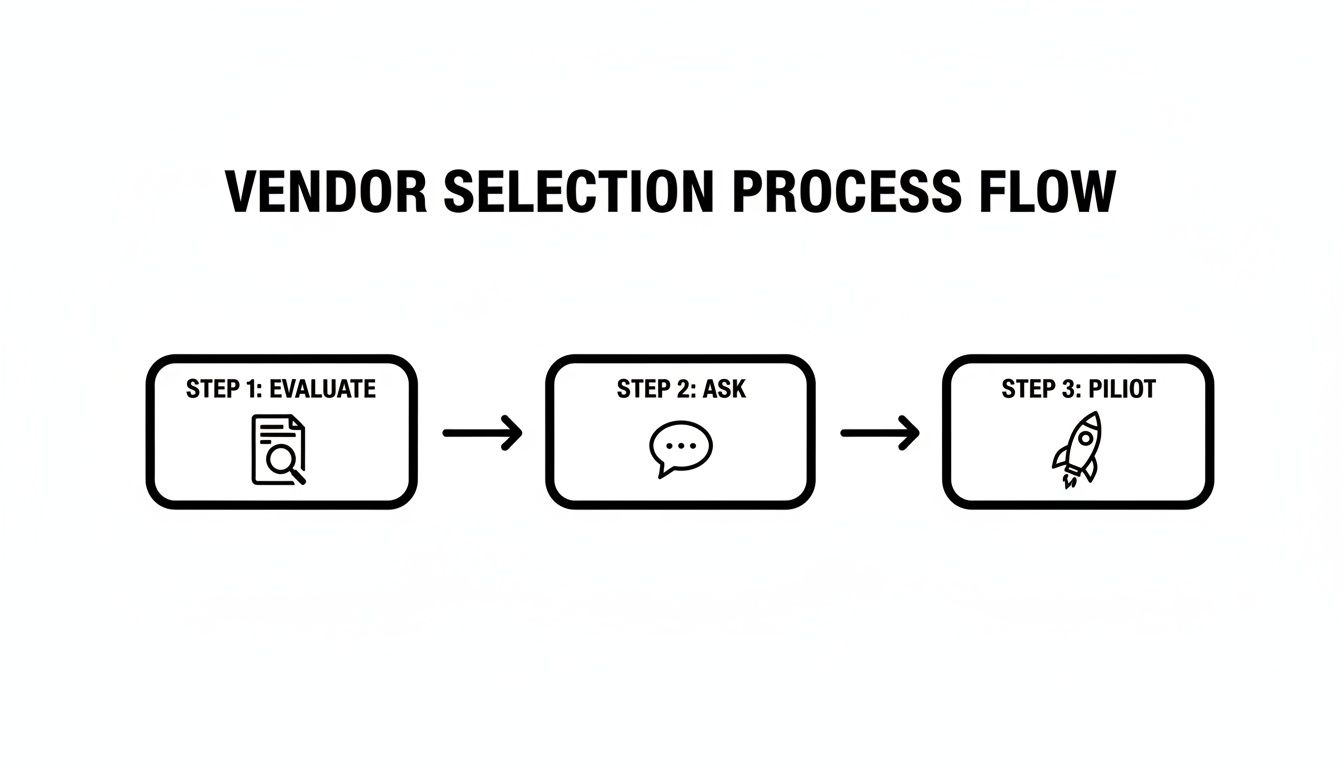
The key is to de-risk the entire process. You prove it works at each stage before you’re all-in.
The Pre-Flight Audit and Data Preparation
Before you touch anything, you need to run a full audit of your current email setup. This is your “pre-flight check.” The goal is to figure out what’s coming with you and, just as importantly, what you’re leaving behind.
Start by cataloging everything you have:
-
Contact Lists and Segments: Get a clear picture of all your active, inactive, and suppressed contacts. This is the perfect time to clean up your lists and ditch the dead weight.
-
Email Templates and Creative Assets: Round up every approved template, image, and brand asset.
-
Automation Workflows: Map out every single automated journey, from your simple welcome series to those complex, multi-branch nurture sequences you built two years ago.
-
Historical Performance Data: Make sure you archive key performance metrics from your old platform. You’ll need this for benchmarking later.
Doing this audit stops you from losing critical assets in the move. More importantly, it ensures you start fresh on the new platform with a clean, organized foundation. Skipping this step is asking for trouble.
Executing the Technical Setup and IP Warming
With your assets mapped, the technical work begins. This is the most sensitive part of the launch, where one wrong move can destroy your sender reputation. The single most important job here is IP warming.
IP warming is how you gradually build a positive sending reputation on a new IP address. Rushing this is like walking into a party and screaming for attention - ISPs will see you as a threat and send your emails straight to spam.
A proper warming schedule means sending a small number of emails to your most engaged subscribers first. Then, you slowly ramp up the volume over several weeks. This proves to inbox providers like Gmail and Microsoft that you’re one of the good guys.
Many of the same principles apply to any new sending infrastructure. You can check out our guide for more on the technical side with these step-by-step instructions for technical setup for cold emailing.
Migrating Assets and Training Your Crew
Once your new IP is warm, it’s time to move your templates, data, and workflows. Don’t try to do it all at once. Move everything in phases, starting with your most business-critical automations and templates.
Test everything. And then test it again. Make sure all your links work, dynamic content is populating correctly, and your integrations are talking to each other without any issues.
Finally, train your team. Your “mission control crew” has to feel completely confident using the new system. A good vendor will offer training, but you also need to build your own internal playbooks. Make sure every person who touches the platform understands the new workflows and reporting dashboards before you shut down the old system for good.
Measuring Success and Proving Your ROI
Dropping serious money on an enterprise email platform is a big move. Once you’re live, you can bet your leadership team will have one question on their minds: what’s our return on this thing?
To give them a real answer, you have to look past the easy metrics and start tracking the numbers that actually matter to the business.
Vanity metrics like open rates and click-throughs are fine for checking the health of a single campaign, but they don’t mean much to a CFO. You need to draw a straight line from your email efforts to the company’s revenue. That means measuring KPIs that show real, tangible business impact.
Moving Beyond Vanity Metrics
If you want to prove your worth, your reports have to speak the language of sales and finance. The good news is that enterprise-level platforms are built for this. Their analytics let you track and report on the metrics that tie directly to the bottom line.
Here are the key business-focused KPIs you should be watching:
-
Email-Attributed Revenue: This is the big one. It tracks the sales and revenue that came directly from a specific email campaign or automated flow.
-
Pipeline Value Generated: For B2B, this is crucial. It measures the total value of all sales opportunities you created through your email marketing.
-
Customer Acquisition Cost (CAC) Impact: This shows how your email efforts are making it cheaper to bring in new customers.
-
Customer Lifetime Value (CLV) Growth: This demonstrates how your targeted email nurturing is making each customer more valuable over the long haul.
Getting a handle on these metrics is non-negotiable. You can get a deeper dive into choosing the right ones by looking at these email marketing KPIs that actually drive business growth. This is the kind of data-driven approach that separates a world-class marketing function from a cost center.
Setting Benchmarks and Demonstrating Impact
Once you know your KPIs, it’s time to set some realistic benchmarks. Before you flip the switch on the new system, pull your historical data to see where you stand. This gives you a clear “before and after” picture, so you can show just how much things have improved.
For instance, you might set a goal to lift email-attributed revenue by 15% in the first six months. Or maybe you aim to slash the email channel’s contribution to CAC by 10%. These are concrete targets that prove your strategy is more than just talk.
An investment in an enterprise platform is an investment in a revenue engine. Your job is to provide the dashboard that shows exactly how powerful that engine is.
When you run it right, the financial impact is undeniable. Email marketing consistently delivers an incredible ROI, pulling in an average of $36 to $42 for every $1 spent. Some 18% of B2B companies even push that past $70 by getting smart with automation.
With 55% of firms now using automation to trim their overhead, the argument for focusing on performance gets stronger every day. You can discover more insights about email marketing ROI on charleagency.com to see just how powerful this channel is.
Leveraging AI for Continuous Optimization
Proving your ROI isn’t a one-and-done report. It’s a constant cycle of testing and improving. This is where the AI built into many enterprise platforms really comes into play.
AI-powered testing lets you optimize every piece of your campaigns on a scale that a human team could never manage. You can A/B test hundreds of variations of subject lines, calls-to-action, send times, and content blocks - all at the same time.
The system then figures out what’s working and automatically sends the winning combination to the rest of your list. This creates a non-stop optimization loop, ensuring you’re always squeezing more performance out of your efforts, driving down costs, and delivering a stronger ROI month after month.
Frequently Asked Questions
Got questions about making the leap to an enterprise email solution? It’s a big move, and it’s smart to have them. Here are some straight answers to the most common things we get asked.
When Does My Business Need an Enterprise Email Solution?
You’ll know it’s time when your current email system starts feeling less like a tool and more like an obstacle. The signs are usually painful and hard to ignore.
Is your platform choking every time you try to send a large campaign? Are you struggling to get it to talk to your CRM or other sales tools in a meaningful way? Maybe you’re finding that your personalization options are just too basic for what you need to do now.
Another big one is security and compliance. If managing different teams and keeping everything locked down has turned into a full-time headache, that’s your cue.
Bottom line: if your list has grown into the hundreds of thousands, or you’re pushing out millions of emails a month, you’ve outgrown your starter kit. It’s time for a platform built for that kind of scale.
What Is IP Warming and Why Is It So Important?
IP warming is how you carefully build up a good reputation for a new email-sending IP address. It’s probably the single most important step when you switch to a new platform. Rushing this can absolutely wreck your deliverability.
Think of it like this: you wouldn’t meet someone for the first time and immediately ask to borrow their car. You build a little trust first. IP warming is you building trust with inbox providers like Gmail and Outlook.
You start by sending a small number of emails from your new IP, then gradually increase the volume over a few weeks. This shows the big providers you’re a legitimate sender, not a spammer trying a smash-and-grab. This one process is what makes sure your emails actually land in the inbox, protecting your campaign results and your ROI.
How Is a Performance-Based Model Different From a Retainer?
The difference is all about incentives and who carries the risk. When you pay a traditional agency retainer, you’re paying a flat fee every month for their time and effort, whether you get results or not.
A performance-based model flips that entire idea on its head. You only pay when a specific, agreed-upon result happens - like a qualified sales meeting getting booked right onto your calendar. All the financial risk is gone, and you’re paying for a real business outcome.
This model makes your partner’s goals the same as yours. They only win when you win. It’s less of a client-vendor relationship and more of a true partnership focused on generating ROI you can actually measure.
Ready to scale your B2B pipeline without the risk of retainers? Fypion Marketing specializes in performance-based lead generation, where you only pay for qualified meetings. Book a free consultation today and see how we can fill your sales calendar.