
Email Marketing Lead Generation Playbook
Let’s be honest. In a marketing world obsessed with the latest social media trends and algorithm hacks, good old-fashioned email can feel a bit… dated. But here’s the secret that top B2B companies know: email isn’t just relevant, it’s the undisputed champion of generating a predictable sales pipeline.
It’s how you systematically find, engage, and convert total strangers into qualified sales meetings. It’s not about spamming a purchased list; it’s about building a machine that delivers high-value leads directly to your sales team.
Why Email Is Still the King of B2B Lead Gen
While new channels pop up every year, email marketing remains the bedrock of B2B growth for one simple reason: it delivers unparalleled control and return on investment. You’re not at the mercy of a social media algorithm deciding who sees your message. You have a direct, unfiltered line of communication to your ideal prospect.
For high-growth SaaS and tech companies, mastering this isn’t just another marketing task - it’s a fundamental business strategy. The financial case for email is impossible to ignore.
When it comes to ROI, nothing else comes close. On average, email marketing delivers a staggering $36 for every $1 invested. That’s a 3600% return. It’s no wonder 59% of marketers report that email is more than twice as effective for lead generation than paid search or social media. If you’re curious, you can read the full research on these email marketing statistics to see how the top performers are blowing even these numbers out of the water.
When you look at the ROI across different channels, the data speaks for itself.
Email Marketing ROI vs. Other Digital Channels
This quick comparison highlights why email remains a top-tier investment for businesses focused on tangible results.
| Channel | Average ROI (Return per $1 Invested) | Primary Use Case |
|---|---|---|
| Email Marketing | $36 | Lead Generation, Nurturing, Customer Retention |
| SEO | $22 | Inbound Lead Generation, Brand Authority |
| PPC Advertising | $2 | Immediate Traffic, Bottom-of-Funnel Conversion |
| Social Media Marketing | $2-$3 | Brand Awareness, Community Engagement |
While other channels are essential for a well-rounded strategy, email provides the direct-response muscle needed to consistently generate pipeline.
The Power of Owning Your Audience
Having a direct line to someone’s inbox gives you a strategic advantage that platforms built on rented attention simply can’t offer.
Here’s what that really means in practice:
-
Laser-Focused Targeting: You aren’t just shouting into the void. You can build hyper-specific lists based on job titles, company size, industry, or even the tech they use. This ensures your message lands with the right person, every time.
-
Real Personalization: Forget “Hi {first_name}.” True personalization is referencing a prospect’s recent company milestone, a blog post they wrote, or a challenge specific to their role. This turns a cold email into a genuine, one-to-one conversation starter.
-
Crystal-Clear Metrics: Every open, click, and reply is a data point. This feedback loop is gold. It tells you exactly what’s resonating with your audience so you can stop guessing and start making data-driven improvements to your outreach.
-
Unbeatable Cost-Efficiency: The cost to send an email is negligible. When you combine that with the high conversion rates for valuable B2B deals, the economics are simply unbeatable for acquiring customers at scale.
This is precisely why B2B leaders continue to invest heavily in their email infrastructure. The game has also changed. It’s no longer about paying a massive retainer and hoping for the best. With the rise of performance-based models, you can partner with experts and only pay for tangible results - like qualified meetings booked - which completely de-risks the entire process.
Before a single word of your email copy is written, your entire campaign’s fate is decided by something most people overlook: the technical setup. It’s a common mistake. Teams spend weeks crafting the perfect message, only to have it land straight in the spam folder.
Building a solid sending infrastructure isn’t just an IT chore; it’s the foundation of any successful email marketing lead generation strategy. Get this part wrong, and even the most compelling offer is dead on arrival.
Protect Your Primary Domain at All Costs
Here’s the first rule, and it’s not negotiable: Never send cold email campaigns from your primary business domain.
Think about it. Your main domain (e.g., ) is a critical asset. It’s used for everything from internal HR communications to closing deals with your biggest clients. If you start blasting thousands of outreach emails from it and get flagged as spam, you risk destroying your domain’s reputation. Suddenly, your team’s regular, crucial emails start getting blocked. It’s a catastrophic and entirely avoidable scenario.
The solution is to create a firewall. We set up separate, dedicated domains just for outreach. For example, if your main site is , we would buy a few variations like:
Any deliverability hiccups are now contained to these outreach domains, leaving your primary pristine. From there, we create new sending mailboxes, like , to run the campaigns.
The Technical Trifecta: SPF, DKIM, and DMARC
Once you have your new domains, you have to prove to Google, Microsoft, and all the other email gatekeepers that you’re a legitimate sender. This comes down to correctly configuring three critical records for each domain: SPF, DKIM, and DMARC.
SPF (Sender Policy Framework): This is basically a public list of who is allowed to send emails on your behalf. It tells a receiving server, “Emails from should only come from these specific servers. If you see one from anywhere else, it’s not from us.”
DKIM (DomainKeys Identified Mail): Think of this as a digital, tamper-proof seal on every email you send. It adds a unique signature that receiving servers can verify, confirming the message is authentic and wasn’t altered along the way.
DMARC (Domain-based Message Authentication, Reporting & Conformance): DMARC is the policy enforcer. It ties SPF and DKIM together and tells servers what to do if an email fails either check - for example, “quarantine it” or “reject it outright.” It also sends back reports, giving you crucial visibility into your email deliverability.
Simply put, setting up these records is the technical price of admission to the inbox. It’s what separates you from the spammers in the eyes of the world’s email providers.
The Slow Burn: Warming Up Your New Accounts
Okay, your new domains are authenticated. Time to launch the campaign, right? Not so fast.
If a brand-new domain suddenly starts sending hundreds of emails a day, it screams “spam” to email providers. You can’t go from zero to one hundred. You have to earn their trust by “warming up” your accounts.
This involves starting slow, sending just a few emails per day, and gradually increasing the volume over several weeks. The goal is to generate positive engagement (opens and replies) that signals to providers that you’re a good sender. Manually, this is a slow, painstaking process that can easily take 4-6 weeks before an account is ready for a full-scale campaign.
Getting this foundation right is what enables the kind of massive returns email is known for. It’s an upfront investment of time and technical know-how that pays off exponentially.
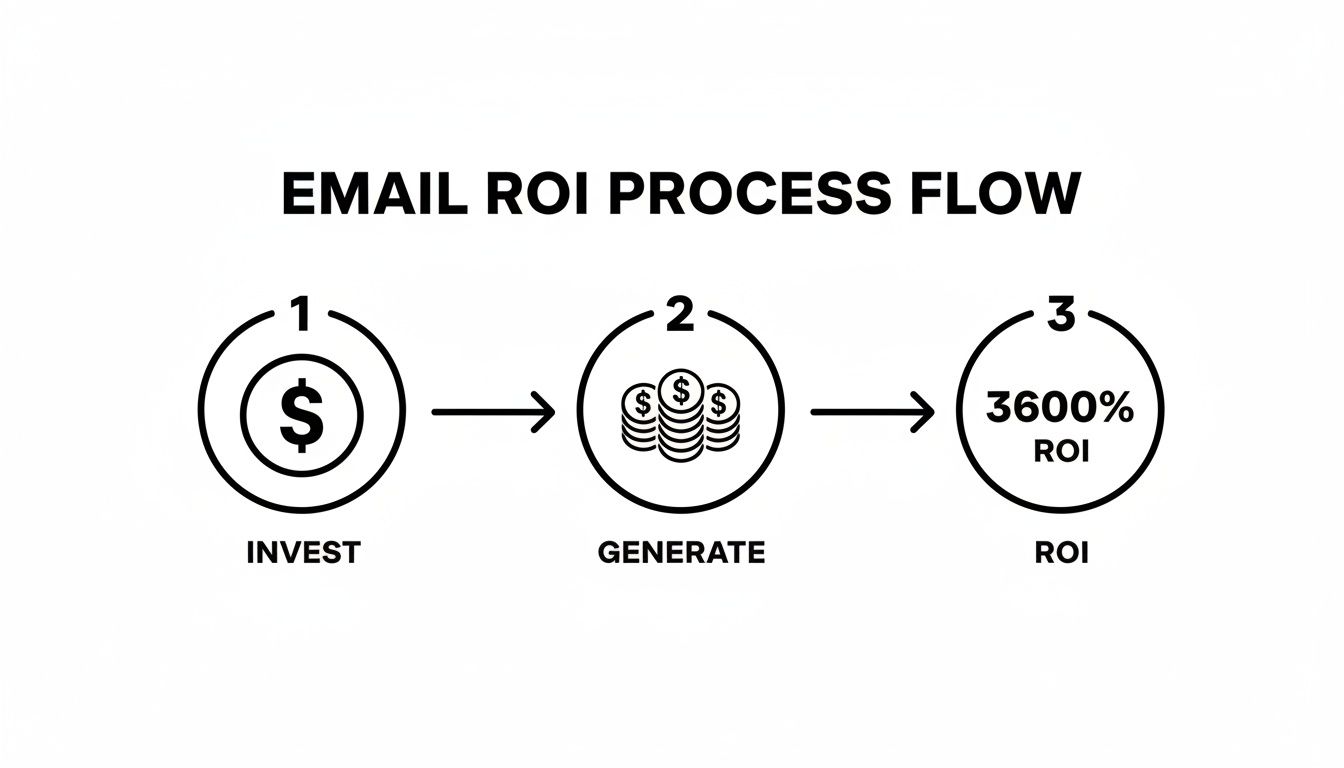
That staggering 3600% ROI doesn’t happen by accident. It’s the direct result of a strategy built on a solid technical foundation.
This is where working with a performance-based agency like Fypion Marketing flips the script. We handle this entire infrastructure and warm-up process for you, using our automated systems to build a positive sender reputation safely and quickly. Instead of you waiting over a month, we get your campaigns ready to launch so you can focus on the only thing that matters: taking the meetings we generate for your sales team.
Finding and Qualifying Your Ideal Prospects
Alright, you’ve done the hard technical work. Your sending domains are warmed up and ready to go. Now comes the part that actually determines whether you book meetings or get ignored: figuring out who you’re going to email.
Let’s be blunt: a beautifully written email sent to the wrong person is just well-dressed spam. Your campaign’s success is decided long before you ever write a single subject line. It’s won or lost when you build your prospect list.
Get Crystal Clear on Your Ideal Customer Profile
Before you even open a tool like ZoomInfo or Apollo, you need to get razor-sharp on who your ideal customer is. This isn’t just a vague notion like “tech companies.” A true Ideal Customer Profile (ICP) is a detailed blueprint of the company that feels the most pain and, therefore, gets the most value from what you sell.
Imagine you’re running a fintech SaaS that automates compliance reporting. A weak, useless ICP would be “banks in the US.”
A strong ICP, the kind that actually works, is far more specific. It’s a checklist of verifiable attributes.
-
Industry: Credit Unions, Regional Banks.
-
Geography: United States only.
-
Company Size: 50-500 employees. This is the sweet spot - big enough to have a real compliance headache, but small enough that the Head of Compliance is still hands-on and feels that pain directly.
-
Job Titles: Head of Compliance, VP of Risk, Compliance Manager, Chief Compliance Officer.
-
Tech Stack: They’re currently using an outdated version of a legacy system like Fiserv or, even better, a mess of in-house spreadsheets. You can actually find this information using tech-tracking tools.
Getting this granular isn’t optional. It turns list-building from a shot in the dark into a precision strike. You’re no longer hunting for “people”; you’re hunting for specific individuals who match a profile you know you can help.
I see this all the time. The single biggest mistake in B2B lead generation is prioritizing list size over list quality. A hand-picked list of 200 perfect-fit prospects will always crush a generic list of 20,000 maybes.
How to Source and Actually Verify Your Data
With your ICP defined, it’s time to go find these people. This is where data providers come into play. Tools like Apollo.io, ZoomInfo, and LinkedIn Sales Navigator are your starting point for building highly targeted lists.
Let’s stick with our fintech example. Inside Apollo, you’d apply filters that mirror your ICP perfectly: set your personas to “Compliance Leaders,” plug in the exact job titles, select “Banking” and “Credit Unions” for the industry, narrow the employee count to 50-500, and filter the location to the United States.
Just like that, you have a list. But here’s the critical part most people skip: the raw data from these platforms is never 100% accurate. Emails go stale, people change jobs, and titles get inflated. Sending to a list with a high bounce rate is the fastest way to torch your domain reputation, undoing all the infrastructure work you just did.
This is why data verification is non-negotiable. Before you send a single email, you must run that list through a service like NeverBounce or ZeroBounce. These tools ping each email to confirm it’s a valid, deliverable address. It’s a simple step that protects your entire operation.
Look for the “Why Now?” Buying Signals
Good outreach targets the right people. Great outreach targets the right people at the right time. The most effective campaigns go beyond static data (like company size or industry) and hunt for dynamic buying signals - events that suggest a prospect is actively feeling a pain you can solve right now.
What do these signals look like in the wild?
-
Recent Funding: A company that just announced a Series A has fresh cash and pressure to grow. They’re buying things.
-
Hiring Sprees: Is a target company suddenly hiring a team of compliance analysts? That’s a huge flag that they’re investing heavily in that area and are likely overwhelmed.
-
Negative Competitor Mentions: A prospect complaining on LinkedIn or G2 about their current provider is practically raising their hand for you.
These signals give you the perfect “why now?” for your outreach. Mentioning a recent, relevant event in your opening line is the difference between a generic blast and a message that shows you’ve done your homework.
Combine a tight ICP with verified data and a timely buying signal, and you’ve got the recipe for a list that doesn’t just get opens - it starts conversations.
Crafting Email Sequences That Earn a Reply

Getting your list and technical setup right is just getting your foot in the door. The real work starts now. The words you choose, the story you tell, and the strategy behind it all are what will convince a busy executive to actually open that door and invite you in for a conversation.
Let’s be realistic. The average decision-maker is drowning in more than 120 emails every single day. Just landing in their inbox is meaningless. You have to earn their attention in the split second it takes them to decide “archive” or “read.” That battle is won or lost with your subject line.
Forget the tired, lazy standbys like “Quick Question” or “Intro to [Your Company].” They’re a one-way ticket to the trash folder. Your goal is to spark genuine curiosity or hint at a very specific, relevant solution to a problem they’re actually facing.
The Anatomy of an Irresistible First Email
That first email carries all the weight. If it fails, the rest of your sequence probably doesn’t matter. It has to do three things almost instantly: prove you’re relevant, show you have value, and give them a clear, easy reason to hit reply.
The biggest campaign killer I see? A weak opening line. Starting with “My name is John, and I work at XYZ Corp” is a classic mistake. Honestly, they don’t care who you are yet. They only care about what you can do for them.
This is where all that research you did pays off. Lead with a buying signal you uncovered.
-
Don’t do this: “I came across your company and wanted to introduce our automated compliance software…”
-
Do this instead: “Noticed on LinkedIn your team is hiring several new compliance analysts. Scaling a team while managing manual reporting must be a huge challenge.”
See the difference? The second one isn’t about you at all. It’s about their world, their problems. It shows you’ve done your homework and have a shred of empathy.
The body of your email has to keep that same energy. Resist the temptation to vomit a list of your product’s features. Nobody signed up for a product tour in their inbox. They want to know if you can make a painful part of their job disappear. So, talk about outcomes, not features.
The core principle is simple: Pitch the result, not the process. Instead of saying, “Our software integrates with multiple data sources,” say, “Imagine having a single source of truth for all compliance data, cutting your reporting time in half.”
Finally, nail the call to action (CTA). “Let me know your thoughts” is too vague and puts all the work on them. On the other hand, “Can you hop on a 30-minute demo tomorrow?” is way too aggressive for a first date.
You’re looking for a low-friction, interest-gauging question. Something like, “Is streamlining compliance reporting something on your radar for Q3?” is perfect. It’s a simple yes/no question that opens the door to a real conversation.
Building a Multi-Touch Sequence That Adds Value
Firing off one email and praying is not a strategy. It’s a lottery ticket. The real results come from the follow-ups. In my experience, and the data backs this up, over 70% of positive replies come from a follow-up email, not the first one.
The key is that each follow-up needs to add new value. Don’t just “bump” your last email. That’s just annoying. A sequence of 4-6 emails spread across three weeks is a great place to start.
Here’s what a value-driven sequence can look like:
Your first email (Day 1) is the personalized hook we just discussed, referencing a pain point and asking an interest-based question.
A few days later, on Day 4, you can follow up with some social proof. It could be as simple as, “I was thinking about your situation - a company in your space, [Client Name], actually used this approach to cut their audit prep time by 40%. We put together a short case study on it here if you’re curious.”
By Day 9, you can offer a genuinely helpful resource. Maybe it’s a blog post, a whitepaper, or an industry report - it doesn’t even have to be your own content. “Saw this article on the new regulatory changes and thought of you. The section on data privacy has some great insights for compliance leaders.”
Around Day 15, it’s time for a more direct, but still soft, CTA. You can re-state your value prop from a slightly different angle. “Just checking in one last time. If you’re spending more than 5 hours a week on manual reporting, a quick 15-minute chat might be worthwhile. If not, no worries at all.”
If you still hear crickets, the “break-up” email around Day 21 is surprisingly effective. “Hey, I haven’t heard back, so I’ll assume this isn’t a priority for you right now. I’ll stop reaching out, but please feel free to connect if that ever changes.” This polite, respectful closing often gets a reply because it removes all pressure.
This kind of thoughtful nurturing can deliver up to 10 times more engagement and lift ROI by 45%. It works because the vast majority of B2B leads - around 73% - are not ready to buy when you first contact them. With personalization boosting open rates by as much as 50%, a well-crafted sequence is your best bet for turning a cold contact into a qualified meeting. You can dig into more stats on how lead nurturing impacts B2B marketing success if you’re a data nerd like me.
Using Data to Optimize Your Outreach Campaigns

Getting your first campaign out the door feels like a victory, but it’s just the starting line. The pros in email marketing lead generation know that the real work begins after you hit “send.” You have to trade your strategist hat for a lab coat, treating every email as an experiment and every response as a crucial piece of data.
It’s easy to get overwhelmed by all the numbers. The trick is to ignore the vanity metrics and zero in on the handful of data points that actually tell you what’s working and what’s broken.
The Only Metrics That Really Matter
Think of these as the vital signs for your campaign’s health. They’re the first place we look to diagnose any problem.
-
Deliverability Rate: What percentage of your emails actually made it to the inbox? If this number drops below 95%, alarms should be going off. It points to a technical issue with your domain setup or a serious problem with your contact list’s quality.
-
Open Rate: This is a direct grade on your subject line. A low open rate (anything under 15%) often means your subject lines are missing the mark, or a deliverability problem is sending you straight to the spam folder.
-
Reply Rate: This is the big one. It shows whether your core message is compelling enough to make someone stop and respond. A healthy cold campaign should be pulling in a 1-5% reply rate.
-
Positive Reply Rate: Here’s where the rubber meets the road. This metric filters out the polite “no thank yous” and shows you how many genuinely interested prospects you’re finding. It’s the ultimate measure of your campaign’s quality.
These numbers don’t exist in a vacuum; they tell a story. A low open rate, for example, is a clear mandate to start A/B testing your subject lines immediately. Are they too generic? Too much like a marketing blast? A simple test will give you a clear winner.
On the other hand, if you have a fantastic open rate but a terrible reply rate, the problem is your email copy. Your subject line did its job and got them to open the door, but the message inside failed to hold their interest. This usually means your value proposition is weak or your call-to-action is asking for too much, too soon.
The Discipline of A/B Testing
In a high-performance outbound system, there’s no room for “I think this will work.” A/B testing, or split testing, is how you replace guesswork with hard data. It’s a beautifully simple process: pit two versions of a single element against each other and see which one comes out on top.
The golden rule is to test only one thing at a time. If you change both the subject line and the call-to-action in the same test, you’ll never know which change actually made the difference.
Let’s look at a real-world example. A SaaS client of ours was targeting VPs of Sales. They were getting a respectable 25% open rate, but the positive reply rate was a dismal 0.8%. We immediately suspected the call-to-action was the culprit.
-
Version A (The Control): “Would you be open to a 30-minute demo next week to see how it works?”
-
Version B (The Challenger): “Is improving sales team performance on your radar for this quarter?”
We set up a test, sending each version to a list of 500 prospects. The results were night and day. Version A, the high-friction “book a demo” ask, scraped by with only 4 positive replies. Version B, the low-commitment interest-based question, brought in 11 positive replies.
By changing a single sentence, the team more than doubled their pipeline of qualified leads from that campaign. This is the engine of optimization - small, data-driven tweaks that create massive results over time.
While industry benchmarks for cold email are a good starting point - typically 15-25% open rates and 1-5% reply rates - the real gains come from strategic testing. Studies show that methodical A/B testing can increase ROI by 86%, and deep personalization can lift it by an incredible 260%. With 91% of B2B marketers focused on lead generation and 81% of small businesses using email for customer acquisition, a data-driven approach is non-negotiable. You can discover more insights about these lead generation statistics and see how they’re shaping modern outreach.
This constant cycle of testing, learning, and iterating is the very heart of successful lead generation. It’s the daily work that turns an unpredictable channel into a machine that reliably fills your sales pipeline.
Your Top Questions About Email Lead Generation, Answered
Even with the best playbook in hand, diving into email lead generation can bring up some tough questions. It’s one thing to read a guide; it’s another to actually navigate the path from setting up domains to seeing qualified meetings pop up on your calendar.
Let’s cut through the theory and tackle the most common concerns I hear from leaders just before they pull the trigger on a cold outreach strategy. These are the real-world, no-fluff answers you need to move forward.
How Many Follow-Up Emails Is Too Many?
There’s no magic number here. But if you’re looking for a starting point, a sequence of 3-5 emails spread across two or three weeks is a solid, field-tested benchmark.
The real secret, though, isn’t the number. It’s the content. If your follow-ups are just “checking in” or “bumping this to the top of your inbox,” then even one is too many. You’ve already lost.
Each email has to bring something new to the table. Think of it as a mini-campaign in itself.
-
Email 2: Hit them with a powerful case study that mirrors their potential challenges.
-
Email 3: Share a link to a fresh industry report or a third-party article that adds context to the problem you solve.
-
Email 4: Pivot your value proposition. If you first talked about saving money, now talk about saving time or reducing risk.
You’re aiming for professional persistence, not becoming a pest. The data will be your guide. If you see your unsubscribe rate jump after email number four, that’s your audience telling you exactly where their tolerance ends. Listen to them and trim your sequence.
Is Cold Emailing Still Legal?
Yes, B2B cold email is absolutely compliant with major regulations like CAN-SPAM (U.S.) and GDPR (Europe) - but only if you do it right. The laws don’t outlaw cold outreach, but they have very specific rules you have to play by.
For CAN-SPAM in the United States, every single email must have:
-
A subject line that isn’t deceptive and accurately reflects your email’s purpose.
-
Your company’s valid physical mailing address.
-
A dead-simple, one-click way for people to opt out of future emails.
Under GDPR, the key concept is “legitimate interest.” This means you need a logical, business-related reason for contacting someone. You’re targeting them based on their professional role (e.g., Head of Marketing at a SaaS company) because your service could genuinely help their business. Don’t guess here - always run your specific strategy by a legal professional to ensure you’re fully compliant.
What’s a Realistic Meeting Book Rate?
This is the big one, and the only honest answer is: it depends. Your results will swing wildly based on your offer, your industry, and how good your list is. Selling a commoditized service to a broad market is a much tougher grind than selling a niche solution that solves an urgent, expensive problem.
With that caveat, a healthy, well-executed campaign should aim for a 1-3% positive reply rate. Note that I said positive reply rate - we’re only counting the people who show genuine interest, not every “no thanks” or “unsubscribe” message.
From that point, turning interested replies into booked meetings is all about the skill of the person handling those responses. It’s a sales function.
We’ve seen hyper-personalized campaigns for niche markets soar past these numbers. On the flip side, a generic, spray-and-pray approach will be lucky to break 1%. The game is won by setting a realistic baseline and relentlessly optimizing from there.
Should I Use My Main Company Domain for Outreach?
Never. Absolutely not.
This is the single most important rule of cold email, and it’s non-negotiable. Sending cold outreach from your primary corporate domain () is like betting your entire house on a single hand of poker. If your campaigns get flagged, you risk destroying your main domain’s reputation.
When that happens, your regular business emails - from your CEO, your support team, your salespeople - start landing in spam folders or getting blocked entirely. The fallout is catastrophic, and it’s 100% avoidable.
The professional way to do this is by setting up separate, lookalike domains exclusively for outreach. Think or . These domains act as a firewall, protecting your primary digital asset. Before you send a single campaign, these new domains must be “warmed up” for several weeks by slowly ramping up sending activity to build a positive reputation with Google and Microsoft. It’s a critical, foundational step.
At Fypion Marketing, we sweat the details of email lead generation so you can do what you do best: talk to interested prospects and close deals. We build the infrastructure, design the campaigns, and optimize everything to deliver a steady stream of qualified meetings to your calendar. See how a pay-per-meeting model can de-risk your growth at https://www.fypionmarketing.com.