
Top 7 LinkedIn Marketing Agencies for 2026 Growth
Your team has proven it can sell. The problem now isn’t product-market fit. It’s feeding the pipeline fast enough with leads your reps want to talk to.
That’s why LinkedIn keeps coming up in growth conversations. The platform is large enough to matter at enterprise scale, with more than 1 billion members worldwide, over 1.6 billion monthly visits, and more than 2 billion engagements per month on LinkedIn Pages according to Hootsuite’s LinkedIn statistics roundup. For B2B teams, that makes LinkedIn less of a niche channel and more of a serious media and demand environment.
The catch is execution. LinkedIn punishes sloppy targeting, weak creative, and loose handoffs between marketing and sales. It also isn’t the cheapest channel, which is why many companies turn to LinkedIn marketing agencies instead of trying to build the motion from scratch.
Some buyers need a classic retainer-based agency to manage ads, content, and reporting. Others are better served by performance-based alternatives that only charge when qualified meetings land on the calendar. That distinction matters more than most vendor shortlists admit.
If you’re actively comparing options, this guide gets to the point. These are seven LinkedIn marketing agencies worth considering, plus the trade-offs behind each model. I’m also framing them against outbound alternatives, because if your real goal is pipeline, not platform activity, you should compare LinkedIn retainers against every other path to booked conversations, not just against each other.
One quick note before you invest in optics over outcomes. If someone on your team is tempted to solve credibility with vanity signals, keep that separate from demand generation strategy. If you need that route for social proof, buy LinkedIn followers is a different decision than hiring an agency to build pipeline.
1. Impactable
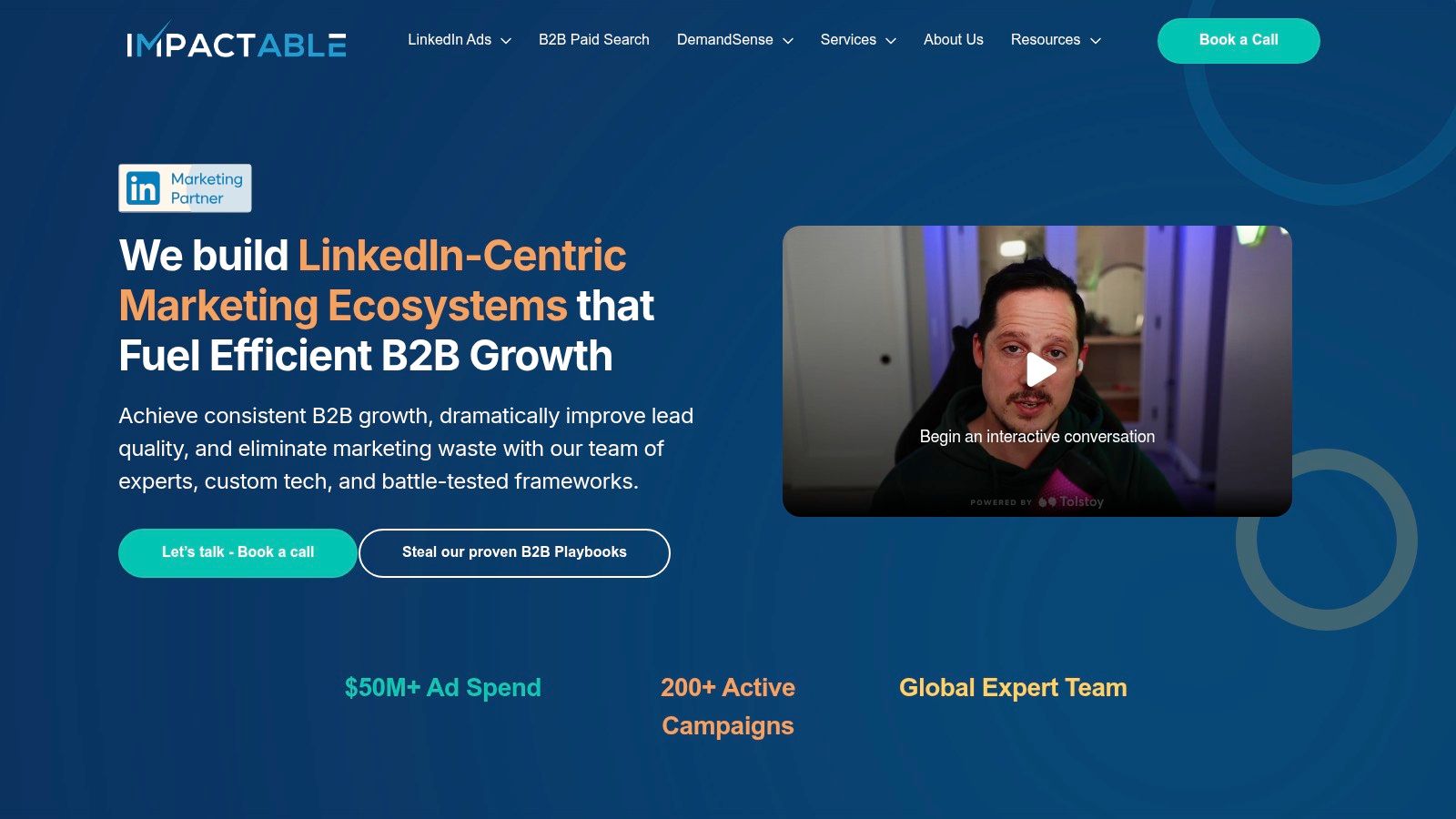
Pipeline slows down, paid search gets more expensive, and leadership asks whether LinkedIn can produce qualified demand without handing budget to a generalist paid social shop. That is the buying moment where Impactable tends to enter the conversation.
Impactable is built for LinkedIn first. That focus matters because LinkedIn usually rewards precision and punishes sloppy setup. Clicks are expensive, audiences can fatigue fast, and weak retargeting structure burns budget before sales sees any value. A specialist agency has a better chance of controlling for that than a team spreading the same playbook across Meta, Google, and LinkedIn.
Where Impactable fits best
Impactable fits companies that have already decided LinkedIn deserves budget and attention. B2B SaaS firms, agencies, consultants, and service businesses are the clearest match, especially when they need tighter audience control, better campaign structure, and clearer visibility into which segments are producing pipeline.
That last point matters because a LinkedIn retainer solves a different problem than a performance model. If your team needs paid strategy, creative testing, retargeting logic, and reporting tied back to opportunity quality, a specialist agency can be a rational choice. If the immediate goal is more meetings with a defined ICP, compare that retainer against a performance-based cold outreach agency before you commit. The cheaper option is not always better. The better option is the one that produces qualified conversations at an acceptable acquisition cost.
Impactable’s differentiation is its operating system as much as its media buying. The agency pairs campaign management with its DemandSense toolkit, which focuses on ad scheduling, exclusions, and person or company-level insight. On LinkedIn, cutting wasted impressions often improves account efficiency faster than expanding reach.
One practical filter helps here. If an agency leads with impressions and click-through rate, keep pressing. The stronger conversation covers exclusion logic, retargeting by buying stage, sales handoff quality, and how paid LinkedIn fits against outbound and other pipeline channels.
A few strengths stand out:
-
LinkedIn-specific paid execution: Impactable is built around LinkedIn demand generation, not broad paid social account management.
-
DemandSense controls: Scheduling and exclusion features can reduce wasted spend.
-
Consistent testing: The model appears designed for ongoing optimization rather than a one-time campaign launch.
-
Weekly reporting: Video updates help teams understand what changed and why.
Trade-offs to know
Impactable is easier to justify when budget is large enough to support testing, audience refinement, and retargeting over time. Smaller programs often generate noisy data, which makes it harder to judge whether the agency, the offer, or the market is the constraint.
Pricing is the other trade-off. Like many specialist agencies, Impactable does not publish every scope detail upfront, so buyers should expect a sales process before the full cost is clear. Review the agency directly at Impactable.
2. Cleverly
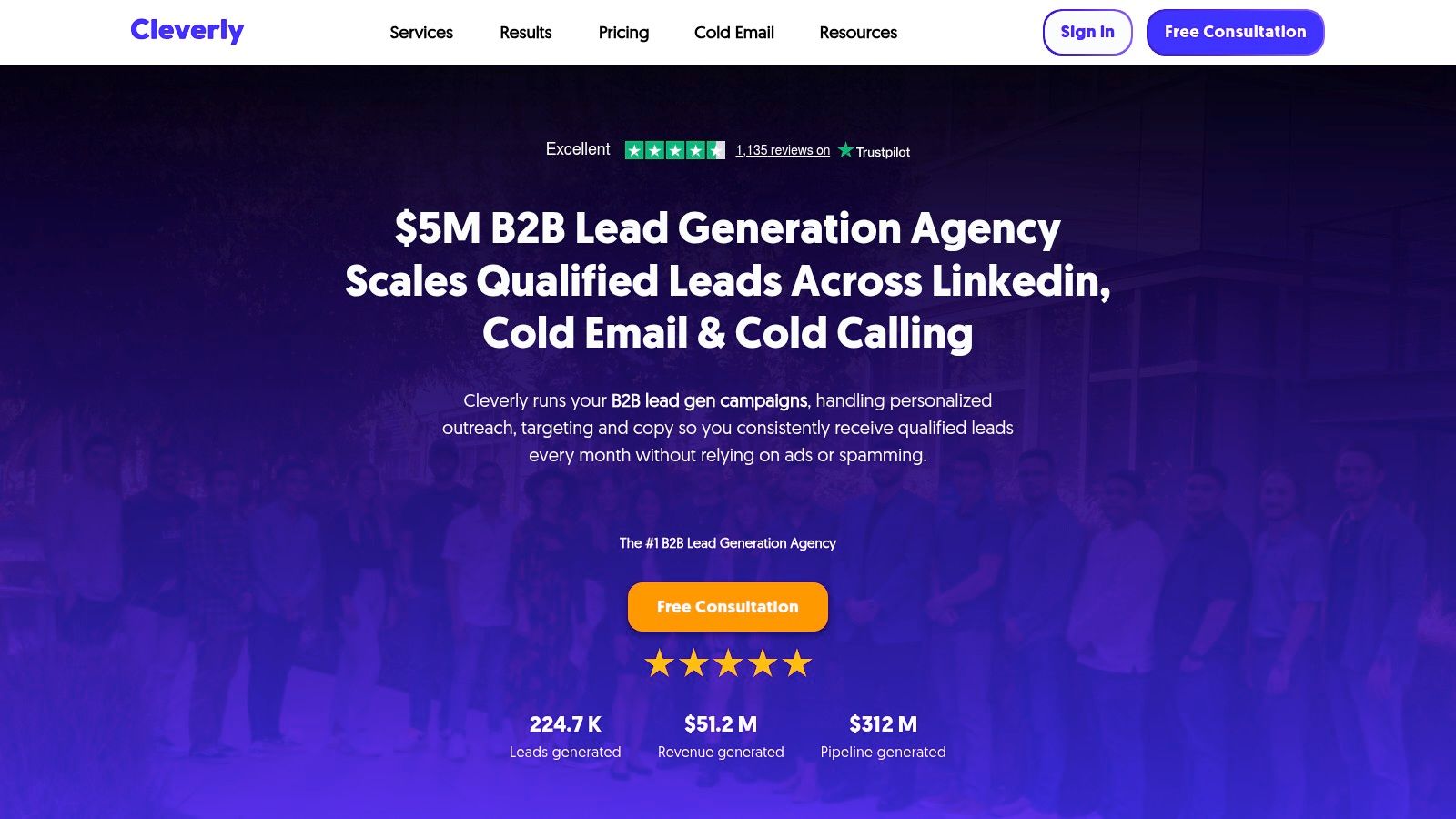
Cleverly sits in a different bucket from ad-focused firms. It’s built around LinkedIn outreach volume. If your team wants outbound activity without hiring and managing an in-house SDR function, Cleverly is one of the more recognizable done-for-you options.
That distinction matters because many buyers searching for LinkedIn marketing agencies don’t need ad management. They need conversations with target accounts. Cleverly addresses that through prospect list building, copywriting, message sequencing, inbox support, and CRM integrations.
What Cleverly does well
The biggest practical advantage is packaging. Cleverly is relatively transparent compared with agencies that insist on custom scoping for everything. For companies that want a faster buying process, public pricing lowers friction.
It also suits teams that care about throughput. If your outbound strategy is built on steady list coverage and ongoing message testing, Cleverly’s model makes sense. It’s not trying to be a bespoke ABM consultancy. It’s trying to create reliable outreach motion.
That can work well when your ICP is clear and your offer is easy to explain. It can struggle when the market is saturated or when positioning is still fuzzy. In those cases, even strong outreach execution won’t rescue weak market-message fit. For a useful perspective on that challenge, this guide on LinkedIn B2B leads is worth reading alongside agency evaluations.
The best LinkedIn outreach agency won’t fix an offer that doesn’t spark replies. Agencies can improve targeting and copy. They can’t manufacture demand where the pitch is off.
Where the model breaks down
Cleverly is less attractive if you want executive-led social selling, highly customized account research, or a highly consultative ABM motion. Its structure favors scalable process.
That’s not a flaw. It’s just a buying consideration. If your sales team needs a predictable top-of-funnel system, Cleverly can be a practical choice. If your market requires heavy personalization at the account level, you may outgrow the model or need to pair it with another partner.
One more strategic note. Independent marketing coverage cited by Transmission Agency’s LinkedIn numbers analysis says LinkedIn produces the highest lead conversion rate among major social networks at 2.74%, and some agencies now price monthly retainers from $2,000 to $10,000+ while others sell managed lead generation or outreach programs with performance-based pricing. That’s the lens to use with Cleverly. Compare it not only to other LinkedIn shops, but also to pay-per-meeting outbound vendors.
You can explore the service directly at Cleverly.
3. Ironpaper
Ironpaper is for companies that are tired of channel silos. If LinkedIn is just one touchpoint in a longer, messier buying journey, this type of agency is often a better fit than a narrow execution specialist.
Its approach is revenue-system oriented. LinkedIn, content, website conversion, sales enablement, ABM, and analytics all connect. For mid-market and enterprise teams, that structure is often more useful than a vendor who only tunes campaigns inside Ads Manager.
Why buyers choose Ironpaper
The strongest reason to hire Ironpaper is integration. A lot of LinkedIn programs underperform because the agency can launch ads but can’t influence the landing page, CRM stages, lead handling, or sales follow-up. Ironpaper appears designed to solve that coordination problem.
That’s especially relevant in B2B because the platform is already widely adopted. Brenton Way’s LinkedIn marketing stats roundup cites that 89% of B2B marketers use LinkedIn for lead generation and 62% say it produces leads effectively. When most serious competitors already use the channel, advantage comes from operational execution, not merely showing up.
A few practical strengths stand out:
-
Connected funnel work: Messaging, media, content, and conversion paths can be adjusted together.
-
ABM compatibility: Better fit for complex buying groups than high-volume outreach vendors.
-
Revenue-minded reporting: More likely to talk in terms of opportunities and pipeline contribution.
-
Sales alignment: Useful when marketing and sales both need one outside partner.
Trade-offs before you sign
This kind of agency can be overkill if all you want is LinkedIn ad execution or outbound prospecting. You’re paying for a broader operating model, not just a task specialist.
It also usually means custom retainers and multi-month commitments. That’s normal for revenue-accountable agency work, but it changes the ROI math. If your main bottleneck is getting qualified meetings onto rep calendars, compare that against a narrower outbound partner. This overview of a cold outreach agency is a useful contrast because it frames the alternative operating model clearly.
Ask Ironpaper one hard question early. “What exactly will you own between first click and qualified opportunity?” The sharper the answer, the easier it is to justify the retainer.
You can review the agency at Ironpaper.
4. Directive
A SaaS team has decent demand, a real paid budget, and pressure to prove pipeline by channel. LinkedIn is in the mix, but so are Google Ads, retargeting, landing pages, and attribution questions. That is the kind of environment where Directive fits.
Directive is built for companies that want LinkedIn measured inside a larger acquisition system. The agency combines paid social, search, creative, analytics, and RevOps support, which makes it easier to judge whether LinkedIn is influencing qualified pipeline or just filling the CRM with soft conversions.
Where Directive fits best
Directive makes sense when channel comparison is part of the job. Teams that need to decide how much budget belongs in LinkedIn versus search, or whether paid social should support demand capture or demand creation, usually need more than campaign management.
That matters because LinkedIn often looks expensive if the only lens is CPC or lead volume. In practice, the channel can still earn its keep when it reaches the right accounts, supports higher-value offers, and gets measured against sales outcomes instead of top-of-funnel efficiency alone.
Its strengths are clearest in a few areas:
-
Cross-channel decision-making: Helpful when LinkedIn needs to be evaluated next to search, retargeting, and other paid programs.
-
Creative tied to performance: Offer, ad, and landing page decisions are treated as part of conversion performance, not separate workstreams.
-
Revenue-focused reporting: Better fit for teams that care about opportunity quality, pipeline influence, and CAC discipline.
-
Enterprise-ready process: A stronger match for SaaS companies with established reporting, internal stakeholders, and channel budgets.
The trade-off
Directive is usually too heavy for simple appointment setting or early-stage testing. If the immediate goal is booked meetings, not channel orchestration, a retainer with this much strategic depth can be hard to justify.
That is where the comparison gets useful. A LinkedIn agency like Directive can improve paid performance across multiple systems, but a performance-based option can be easier to defend when leadership only cares about sales conversations. If you are weighing those models, this breakdown of a lead generation agency is a useful contrast because it frames the ROI question more directly.
Use one filter before signing. Ask whether your bottleneck is channel efficiency or meeting volume. If it is channel efficiency, Directive belongs on the shortlist. If it is meeting volume, a narrower provider may produce payback faster.
You can evaluate the firm directly at Directive.
5. Sculpt
A common B2B scenario looks like this. Paid LinkedIn campaigns generate clicks, the sales team follows up, and then prospects check the CEO’s profile, the company page, and recent content before they agree to talk. Sculpt is built for that buying behavior.
Its value is the blend. Sculpt combines LinkedIn ads with executive presence, social content, and community support, which makes it a better fit for companies that need credibility and demand generation working together. Pure media shops can drive traffic. Pure content shops can build authority. Sculpt sits between those models.
That matters most in longer sales cycles, where paid acquisition rarely does the whole job on its own. Buyers often convert after several touches across ads, posts, comments, and profile visits. If your team already knows LinkedIn is influencing deals beyond the click, this type of agency structure can make sense.
A few strengths stand out:
-
Paid and organic in one program: Useful for teams that want campaign execution without splitting strategy across multiple vendors.
-
Executive visibility support: Stronger fit for founder-led or expert-led brands where buyer trust affects conversion.
-
Community and content capability: Helpful if LinkedIn is part of a broader category education effort, not just a lead capture channel.
-
More context for outreach: Organic activity can improve response rates when sales reps follow up with a relevant cold LinkedIn message template for B2B outreach.
The trade-off is cost clarity. Sculpt still operates as a retainer partner, so ROI can be harder to defend if leadership wants a simple answer to one question: how many qualified meetings did this create?
That is the comparison point in this roundup. An agency like Sculpt can improve brand trust, ad performance, and executive visibility at the same time. A performance-driven model such as a pay-per-meeting cold email service is easier to measure when the only target is booked conversations. If your board or CFO is focused on pipeline creation this quarter, that difference matters.
Sculpt also makes less sense for companies that already have strong internal content and only need meeting volume. In that case, a narrower appointment-setting model may get to payback faster. This explanation of what appointment setting is and how qualified meetings work is useful context before you compare full-service social retainers.
You can learn more at Sculpt.
6. BAMF (Be A Marketing Fan)
BAMF is not the agency to hire if your only brief is “run LinkedIn ads.” It’s for founder brands, executive teams, and consultants who want LinkedIn to function as an inbound trust engine.
That’s a different growth motion. Instead of buying attention through media, BAMF helps leaders earn attention through consistent posting, profile positioning, and ghostwritten thought leadership. For some companies, especially in services and founder-led sales, that’s the right call.
When BAMF makes sense
If your buyers vet the founder before they book the meeting, content matters. If your sales cycle depends on authority, point of view, and familiarity, content matters even more.
BAMF packages that work into a subscription model with strategist, writer, and designer support. The appeal is speed and consistency. Founders who know they should publish but never do finally get a repeatable system.
This kind of service works best when a personal brand is already close to revenue. It works less well when leadership expects organic posting alone to replace a real outbound or paid acquisition engine.
Organic LinkedIn content can warm the market and improve conversion. It rarely replaces direct pipeline creation on its own.
A few practical considerations:
-
Profile revamp: Important if the founder profile currently reads like a resume instead of a positioning asset.
-
Ongoing posting cadence: Consistency is the core product, not one-off strategy.
-
Voice-driven content: Better fit for teams with opinions and real market insight.
-
Analytics support: Useful, but content analytics should never be mistaken for revenue proof.
The limitation buyers should be honest about
BAMF is a branding and content play first. It doesn’t replace paid media execution, and it doesn’t function like a meeting-guaranteed outbound service.
That’s why this model often pairs well with direct lead generation. If you’re comparing personal-brand investment against stricter pipeline programs, this guide to choosing a lead generation agency helps clarify where each model fits.
You can review the service at BAMF.
7. Lead Cookie
Lead Cookie is a good reminder that not all LinkedIn marketing agencies are ad agencies. Its model is outbound-heavy, with hand-researched contact selection, personalized LinkedIn outreach, email follow-up, retargeting support, and newsletter management.
For companies that care more about target-account specificity than mass outreach volume, that’s appealing. The service appears designed for teams that want LinkedIn-centered prospecting without turning the whole process into automation theater.
Where Lead Cookie stands out
The biggest strength is specificity. Hand-researched contacts and custom messaging usually produce better strategic fit than spray-and-pray sequencing. That doesn’t mean effortless success. It means the agency is putting more weight on targeting quality.
The included retargeting and page optimization also make this feel more complete than a simple outreach vendor. It recognizes that replies and meetings often come from repeated exposure, not a single message.
One notable inclusion from the service description is contact research volume, with 500 to 800 hand-researched contacts per month. That’s a useful operational detail because it signals this is still a managed outbound program, not a fully bespoke consultancy.
What to be careful about
Lead Cookie requires commitment. The six-month program structure means it’s not ideal for buyers who want a one-month experiment. That can be a strength or a drawback, depending on your patience and sales process.
It also requires client participation. Agencies like this can generate replies and conversations, but your team still has to define qualification properly and close well. If sales follow-up is weak, the campaign will look worse than it is.
One practical comparison point is messaging quality. If your internal team is still learning what good outreach looks like, reviewing examples like this cold LinkedIn message template can sharpen your evaluation of agency copy before you buy.
You can look at the firm directly at Lead Cookie.
Top 7 LinkedIn Marketing Agencies Comparison
| Service | Implementation Complexity 🔄 | Resource Requirements ⚡ | Expected Outcomes 📊⭐ | Ideal Use Cases 💡 | Key Advantages ⭐ |
|---|---|---|---|---|---|
| Impactable | Medium - High, campaign + retargeting frameworks and iterative tests | Mid budgets + ongoing retargeting spend; agency fees scoped post-discovery | Higher pipeline quality, reduced wasted spend, improved CPL | SaaS/tech teams wanting deep LinkedIn Ads expertise and retargeting | LinkedIn-first playbooks + proprietary DemandSense toolkit for audience/company-level insights |
| Cleverly | Low - Medium, plug-and-play managed outreach and sequencing | Lower entry pricing with predictable monthly packages; needs quality lists | Consistent high-volume outreach and predictable meeting flow (quality varies) | Teams that want predictable outbound without building in-house SDRs | Transparent pricing, scalable throughput, US-based account management |
| Ironpaper | High, multi-channel system-led programs tying marketing, sales, and data | Significant retainer and multi-month commitment; enterprise-level resources | Measurable, revenue-tied pipeline impact for complex buying groups | Mid-market/enterprise revenue-accountable teams needing full-funnel integration | Strong analytics, ABM + content + sales enablement under one roof |
| Directive | High, enterprise-grade cross-channel performance and analytics | High budget and custom engagement (likely higher minimums) | Qualified pipeline growth and cross-channel performance improvements | B2B/SaaS teams seeking revenue-focused paid social combined with search/analytics | Certified LinkedIn practice, RevOps integration, cross-channel measurement |
| Sculpt | Medium, combined paid LinkedIn, executive social, and content programs | Mid retainers; some published sample price ranges for content services | Improved paid results plus stronger executive presence and thought leadership | Brands wanting both LinkedIn ads and executive content/community programs | Early LinkedIn Ads certification and integrated content + paid expertise |
| BAMF | Low - Medium, turnkey ghostwriting and executive content engines | Subscription pricing, higher than entry-level writers; content-focused investment | Faster executive visibility and inbound demand through consistent content | Founders/executives seeking high-volume thought leadership and profile revamps | Dedicated ghostwriting teams, fast time-to-first post, turnkey content cadence |
| Lead Cookie | Medium - High, hand-researched outreach plus multi-channel follow-ups | Requires 6‑month commitment; collaborative client involvement; included retargeting spend | High-specificity replies and meetings with authentic outreach (quality over volume) | Companies needing ICP-targeted outbound with multi-channel execution centered on LinkedIn | Transparent multi-channel pricing, authentic researched outreach, email + ads + newsletter integration |
From Shortlist to Scaled Pipeline Your Next Move
A shortlist is only useful if it changes the way you buy. That means choosing an agency based on the constraint you have, not the one that sounds nicest in a kickoff call.
If your problem is paid LinkedIn efficiency, a specialist like Impactable makes sense. If your problem is outreach throughput, Cleverly or Lead Cookie may be closer to the mark. If your problem is full-funnel coordination across CRM, content, landing pages, and sales handoff, Ironpaper or Directive will usually fit better. And if trust in the market depends heavily on executive presence, Sculpt or BAMF can be worth the spend.
The mistake I see most often is treating all LinkedIn marketing agencies as if they sell the same outcome. They don’t. Some sell media execution. Some sell outbound activity. Some sell content and authority. Some sell integrated demand systems. If you evaluate them all with the same scorecard, you’ll overpay for the wrong model.
A better framework is simple.
-
If you need pipeline quickly: Compare agencies against performance-based meeting models, not against each other alone.
-
If you need better lead quality: Ask how they define qualification after the form fill, reply, or booked call.
-
If you need channel efficiency: Judge them on qualified opportunities and sales acceptance, not CPC or CTR.
-
If you need strategic lift: Make sure they can influence messaging, landing pages, and CRM attribution, not just campaign settings.
LinkedIn is powerful, but it’s also expensive enough to punish vague accountability. Industry commentary in the verified data noted a major gap in the market: many firms talk about ad formats, posting cadence, and engagement, but don’t answer the harder question of whether the work improves meetings, opportunities, and revenue. That’s the right pressure test.
So when you interview agencies, ask for proof at the pipeline stage. Ask how they measure qualified demand. Ask what happens when LinkedIn engagement rises but revenue doesn’t. Ask what they’ll change if the first offer misses. Good partners will have real answers. Weak ones will redirect the conversation back to reach, impressions, and platform activity.
Also compare retainers against alternatives with cleaner incentives. A pay-per-meeting model can be easier to justify when leadership wants direct accountability. That won’t replace every agency use case, especially if you need brand building or paid media management, but it often beats a broad retainer when the only KPI that matters is sales conversations.
If you want a broader procurement lens while evaluating agency partners, this buyer’s guide to agency software is a useful companion because operational fit matters after the contract is signed, not just before.
Fypion Marketing is one relevant option if you’re less interested in hiring a classic LinkedIn retainer and more interested in paying for qualified meetings through a performance-driven outbound model. That’s a different commercial structure from most agencies on this list, which is exactly why it belongs in the comparison set.
Your pipeline won’t build itself. Pick the model that matches your bottleneck, set hard qualification rules, and move.
If you want a partner whose incentives are tied to booked conversations instead of a monthly retainer, Fypion Marketing is worth a look. Their model is built around qualified B2B meetings, which makes them a practical alternative for SaaS and B2B teams that care more about sales-ready pipeline than managing another agency scope.