
Outbound Sales Outsourcing: Models, Costs and Fit

83% of executives surveyed by Deloitte in 2024 reported using artificial intelligence as part of their outsourced services. Buying access to automation isn’t much of a differentiator anymore. For outbound sales outsourcing, the harder question is whether an external team can reach relevant buyers with accurate claims and turn their attention into sales conversations worth taking.
Treat it as a controlled revenue system, not cheaper SDR labor. That means agreeing on who deserves outreach, what the provider can promise, what counts as a qualified meeting, and when sending must stop.
What Outbound Sales Outsourcing Covers
Outbound sales outsourcing means paying an external team to identify target accounts, find relevant contacts, qualify interest, and book conversations. In a development-focused engagement, your internal seller keeps discovery and closing.
Think of a dock crew bringing in the catch. The kitchen still decides what’s worth cooking. An agency can bring prospects to the calendar, but your account executive must determine whether there’s a real opportunity.
Separate the scopes before buying
Providers sometimes use the same label for substantially different work:
- Appointment setting secures a calendar slot. Qualification may be limited unless the agreement specifies otherwise.
- Sales development screens prospects against an ideal customer profile, relevant problems, and explicit disqualification rules.
- Broader inside-sales coverage includes more early objection handling and sales conversations before handoff. Define its boundaries rather than assuming the label includes closing.
The operating split should be visible before a campaign starts.
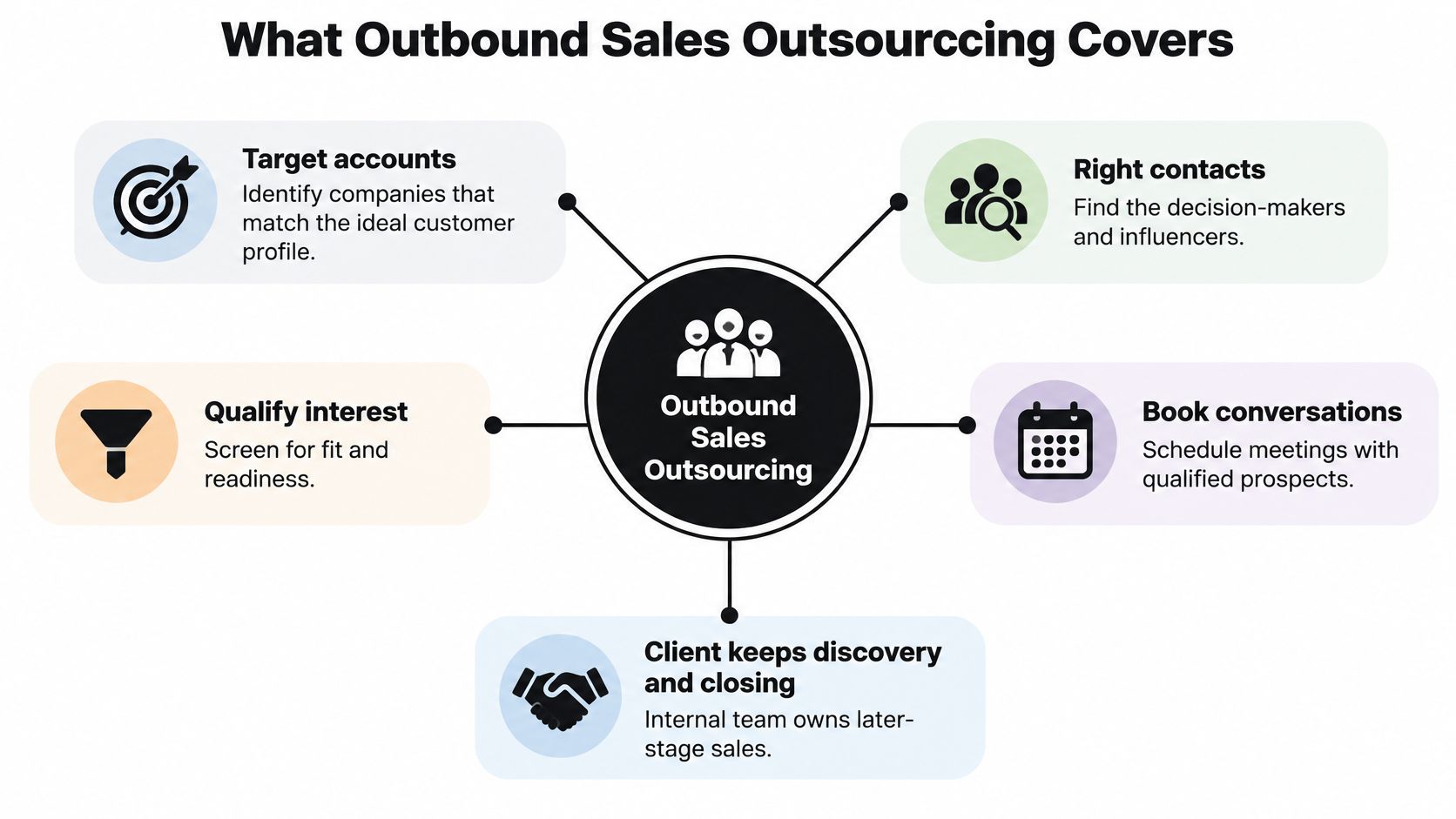
A capable provider usually owns list research and verification, persona-specific sequences, reply handling, qualification, and booking. Email can work alongside phone or LinkedIn when the buyer and message justify those channels. ICP development should be collaborative, not a targeting exercise performed without your sales team’s input.
The client retains authority over the offer, pricing, product capabilities, security statements, discovery, and commercial commitments. Outsourcing execution doesn’t transfer accountability for what prospects hear.
If you only need calling capacity, LatHire’s resource on the best place to hire cold callers offers a staffing route to assess alongside managed outbound. Hiring a caller and buying a managed qualification program are different decisions.
For market context, Dataintelo valued the global B2B sales outsourcing services market at USD 10.7 billion in 2025. Research labels such as sales outsourcing and lead-generation outsourcing don’t describe identical markets, so that headline isn’t a pricing benchmark for SDR work. Your actual buying decision starts with the scope and payment unit.
Pricing Models and Cost per Meeting
Outbound sales outsourcing models and cost ranges
| Model | You pay for | Cost range | Ramp | Best fit |
|---|---|---|---|---|
| Pay per qualified meeting | Meetings passing agreed fit rules | Tight-SaaS-ICP benchmark below | Outsourced-program benchmark below | Testing a segment without fixed headcount |
| Dedicated outsourced SDR | A managed representative or seat | Annual seat benchmark below | Outsourced-program benchmark below | Steady coverage without hiring |
| In-house SDR | Salary, tools, management, and overhead | Fully loaded benchmark below | Hiring-and-ramp benchmark below | Full control of brand and process |
| Growth retainer | A monthly managed program | Negotiate against channels, staffing, and deliverables | Set a readiness-based launch schedule | Proven product-market fit and ongoing volume |
| Revenue share or commission | An agreed percentage of closed revenue | Negotiate the percentage and attribution rules | Tied to the sales cycle | Long cycles where meetings alone mislead |
HireSDRs’ benchmark summary places cost per meeting for a tightly defined SaaS ICP at approximately $400–$1,200, outsourced SDR economics at roughly $42,000–$96,000 per representative annually, and fully loaded in-house costs at an estimated $125,000–$162,000 per representative annually; it also reports first outsourced meetings in approximately 2–6 weeks, compared with about 3–6 months for an in-house hire to ramp.
Read those figures as planning bands, not quotes. The ramp comparison also measures different milestones: an initial outsourced meeting isn’t equivalent to a fully productive internal representative.
Pay for qualification, not calendar acceptance
Under a properly defined pay-per-meeting arrangement, payment follows a meeting that satisfies written conditions. Those conditions might include company fit, the attendee’s role, an acknowledged problem or trigger, and attendance.
A calendar invitation alone proves very little. A prospect can accept because they’re curious, misunderstood the offer, or want information that belongs on your website.
Commercial rule: A cheap meeting is expensive when your account executive rejects it and still loses preparation and discovery time.
Define how disputes work before launch. If the prospect doesn’t fit the agreed company profile, is the meeting replaced, not billed, or reviewed? Does a no-show count? Can the provider substitute a junior attendee for the named decision-maker?
Use a detailed B2B appointment-setting pricing comparison to examine those billing boundaries, not just the headline rate.
Choose the financial exposure you can manage
A dedicated seat buys capacity, which makes sense when you need continuing coverage and can supply regular feedback. An internal SDR gives you direct coaching and process control, but the fully loaded comparison must include tools, management, and ramp, not salary alone.
A retainer needs explicit deliverables and staffing commitments. Revenue share needs equally precise definitions of attributable revenue, renewals, payment timing, cancellations, and overlapping sales activity.
There’s no defensible single rate for either arrangement here. Negotiate them against scope and risk.
For a segment test, I would favor a tightly bounded qualified-meeting arrangement. For steady coverage, a dedicated or retainer model can be easier to manage. Neither escapes the influence of offer strength, list quality, market maturity, and sales-cycle length.
Benefits and Trade-offs Worth Measuring
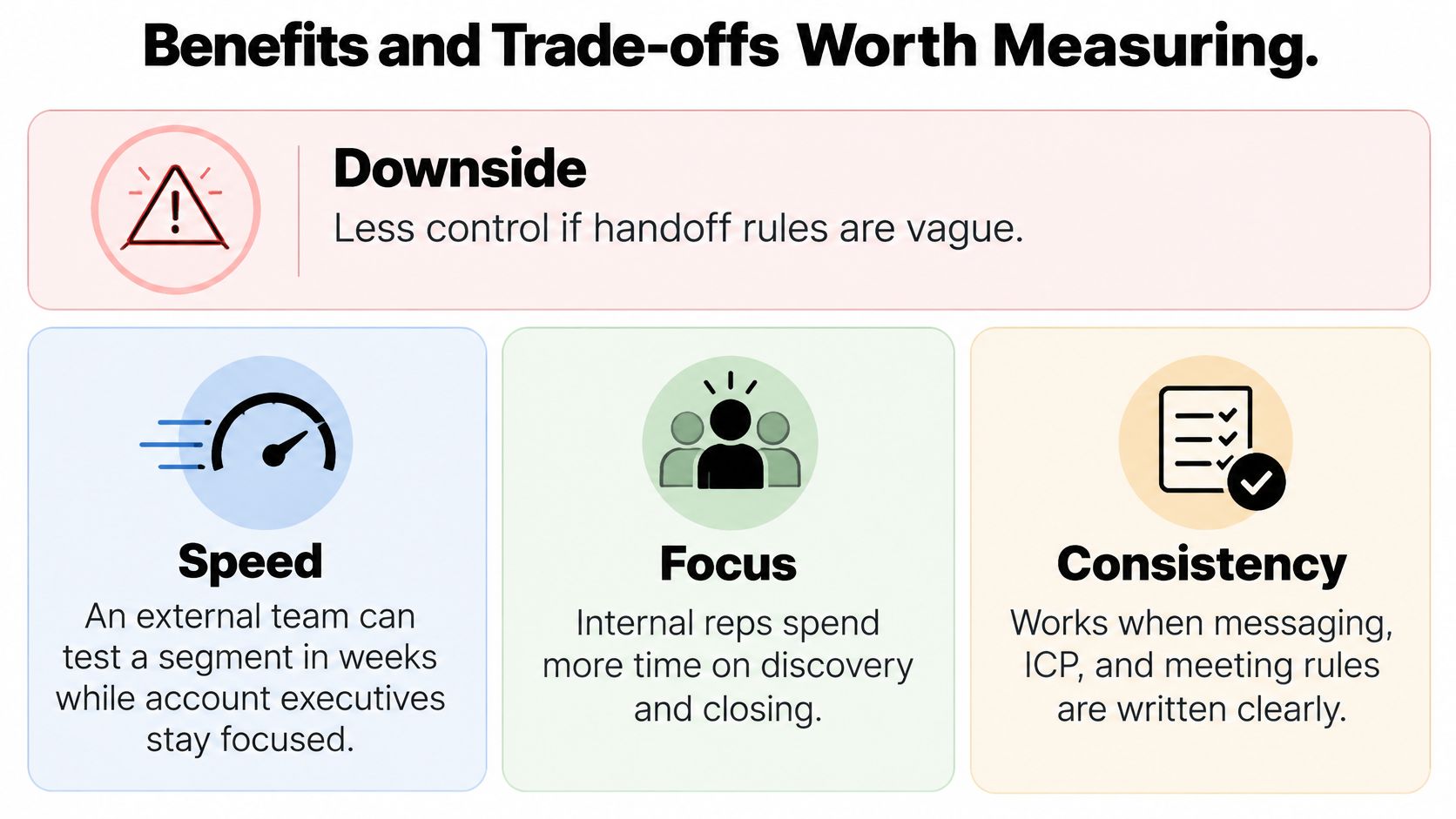
The downside is less control at the point where buyers first encounter your company. If the provider misunderstands the offer, your team inherits the objection after the prospect has already formed an opinion.
Gartner found that 73% of B2B buyers actively avoid suppliers sending irrelevant outreach, while 61% prefer an overall rep-free buying experience. More activity isn’t automatically more coverage. It can mean more people deciding not to consider you.
The useful benefits all have operating conditions.
What makes the benefits real
- Speed requires a written ICP. An external team can begin testing without an internal recruiting project, but unclear targeting produces irrelevant feedback faster.
- Flexibility requires contractual freedom. Capacity is only flexible if you can reduce scope, pause a segment, or exit without paying for unwanted activity.
- Specialist skill requires shared context. List building and sequence management help when the team has an approved offer sheet and understands why buyers choose you.
- Internal focus requires a clean handoff. Closers gain useful time only when they receive qualification notes instead of having to reconstruct the conversation.
Brand trust is the cost that doesn’t appear on the invoice. Inaccurate personalization, an invented business problem, or persistent follow-up after a clear rejection can make competent execution look careless.
Watch what disappears at cancellation
There’s another trade-off: you can rent pipeline production without retaining the learning. If the provider keeps the targeting logic, reply taxonomy, and tested messaging, your next team starts without that knowledge.
Require usable exports and a maintained playbook. Capture why prospects decline, not just which subject lines get replies, so product marketing can distinguish a weak message from a weak offer.
The operating discussion should include focus and handoff, not just activity.
A meeting-only incentive can encourage the provider to pursue curious calls rather than useful conversations. Give the team permission to disqualify, and review whether those decisions were sensible.
The question that matters is specific: what evidence shows that a booked meeting was timely and relevant, rather than merely accepted?
Vendor Checks Beyond Meeting Volume
Score the provider’s operating system, not its pitch deck. Use the first call to request artifacts: a qualification sheet, anonymized handoff, reporting example, and claim-approval workflow.
Vendor evaluation scorecard
| Check | What to ask for | Pass signal | Red flag |
|---|---|---|---|
| ICP and triggers | Industries, size, titles, exclusions, timing trigger | Trigger tied to a dated signal | Static list sent on a schedule |
| Contact sourcing | Who builds and verifies contacts and handles bounces | Named process with bounce rules | Unnamed or unauditable purchased lists |
| Claim control | Source-of-truth library and approval path | Client signs off technical and regulated lines | Provider invents pricing or security claims |
| Reporting | Delivered, inboxed, replied, qualified, booked, attended, AE-accepted | Stage-by-stage breakdown | Dashboard shows emails sent only |
| Meeting ownership | Who handles objections before and owns the call after | Written split of duties | Guaranteed volume without disqualification rights |
| Sending infrastructure | Sending domains and authentication status | Named campaign domains with authentication verified | Refusal to identify sending domains |
| References | Cases in similar deal size and cycle | Results beyond meeting count | Logos without a meeting standard |
Ask how targeting becomes timely
Which industries and company sizes qualify? Which titles influence the purchase, and which should never enter the sequence?
Then ask what makes the contact timely. A hiring announcement or technology installation is useful only if the seller can explain its connection to the proposed problem. A signal isn’t permission to invent a pain point.
Who verifies contacts? Who suppresses invalid addresses? Are sequences written for distinct personas, or does everyone receive the same pitch?
Put claim accuracy in the middle
Forrester reported that 94% of business buyers used AI in their buying process in its 2025 survey. Assume prospects may arrive with independently assembled information, then make your own messaging easy to verify.
Ask who approves claims and who withdraws stale copy after a product change. Maintain a source-of-truth library containing approved product descriptions, pricing language, security statements, and links to current documentation.
The provider mustn’t improvise technical assurances. Client approval should be mandatory for regulated language and claims about integrations, certifications, or contractual protections.
A meeting generated by an inaccurate promise isn’t qualified demand. It’s a correction your seller now has to make.
Use a structured vendor selection process to record evidence and unresolved gaps rather than relying on a convincing call.
At Fypion, we ask about the ICP, current pipeline, and outbound setup, then share a relevant case from the prospect’s vertical. Apply the same standard to references: comparable sales conditions matter more than recognizable names.
Pass only when targeting, claim control, and downstream reporting are explicit in writing.
Contracts Claims and Inbox Controls
Lock the operating agreement before approving campaign copy. At Fypion, our website Terms of Service cover the website only; paid outbound and lead-generation services are governed by a separate service agreement that takes precedence in a conflict.
For any engagement, make the document hierarchy explicit. The statement of work should identify the ICP, meeting definition, replacement rules, data ownership, approval responsibilities, and exit process.
Put enforceable responsibilities on paper
- Meeting disputes: State the evidence needed to reject an off-definition meeting and the remedy.
- Data handling: Document processing responsibilities, regional contact rules, suppression procedures, and access controls with appropriate legal review.
- List provenance: Prohibit lists the client can’t audit and require suppression of do-not-contact records.
- Claim changes: Name the client approver and the route for withdrawing outdated messages.
- Exit delivery: Specify which lists, suppression records, copy, and campaign findings the client receives.
Treat CAN-SPAM compliance as part of the review, not a substitute for checking the rules applicable to each recipient region.
Document review should include both commercial obligations and launch controls.

Make authentication a launch gate
Braze’s guide to Gmail and Yahoo’s 2024 deliverability updates describes bulk-sender requirements including SPF and DKIM authentication, DMARC publication, applicable one-click unsubscribe functionality, and spam-complaint rates below 0.3%, with Gmail identifying 0.1% as a safer target.
SPF identifies authorized sending infrastructure. DKIM cryptographically signs messages. DMARC connects authentication to the visible From domain and publishes a handling policy.
Missing authentication or excessive complaints can lead to filtering or rejection before prospects evaluate the message. That’s why copy testing cannot compensate for broken sending infrastructure.
Use clearly branded campaign domains separate from core transactional sending. Confirm alignment, increase volume cautiously, and reduce or pause sending when complaint or bounce signals worsen. Domain separation isn’t permission to evade suppression requests or conceal who’s contacting the buyer.
Require complaint monitoring and a documented escalation owner before launch. These mailbox controls follow the recipient’s provider, regardless of where the sender operates.
Daily send capacity isn’t a success metric. Protecting the ability to reach legitimate prospects is an operating constraint.
Handoff Checklist and Sample KPIs
Run the initial handoff as a readiness sequence. Don’t let a calendar integration become the signal to launch before the targeting and approvals are complete.
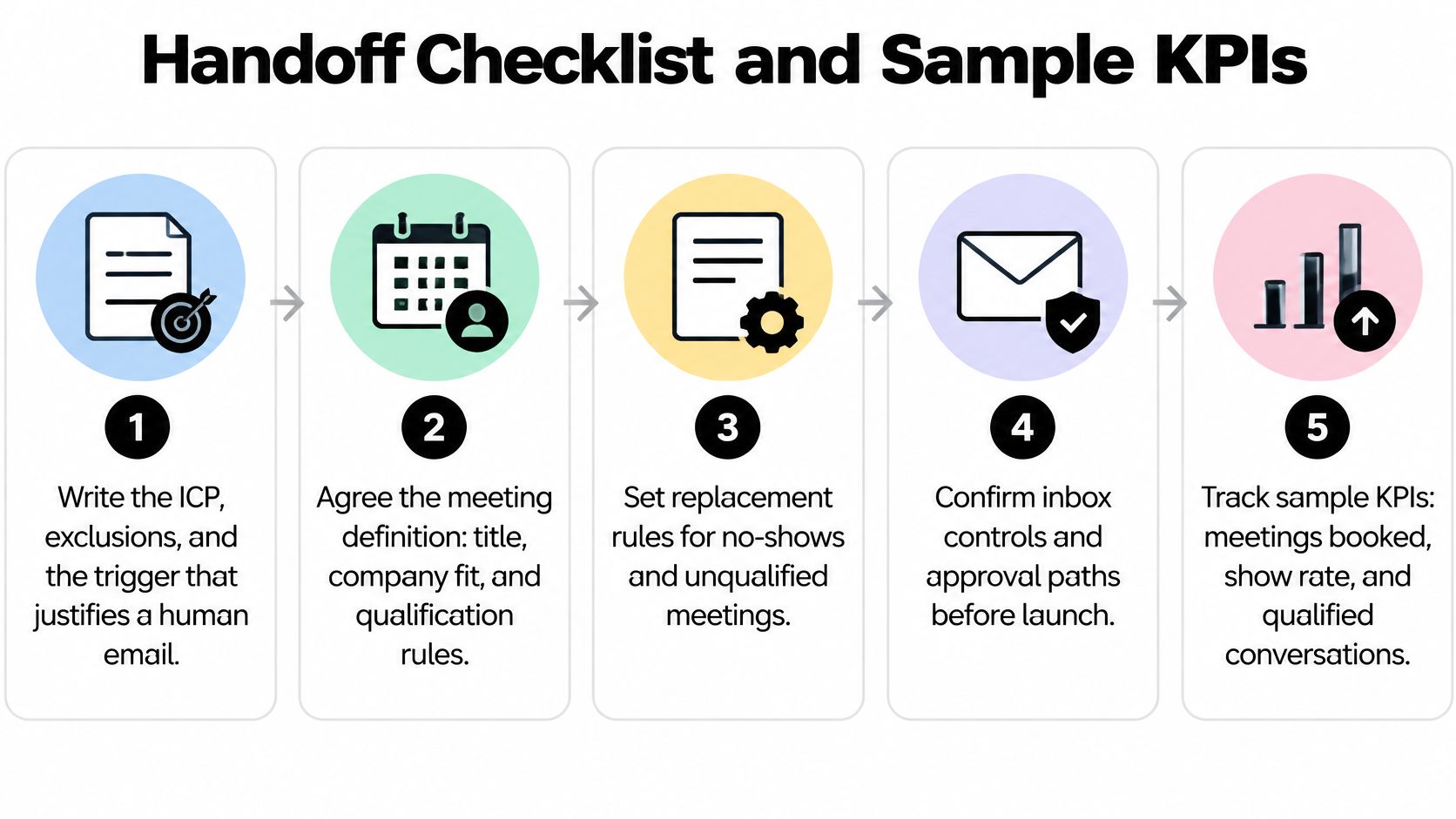
- Write the outreach rationale. Document the ICP, exclusions, and observable trigger that justifies human contact.
- Agree on billable qualification. Include role, company fit, relevant problem, and the conditions that make a meeting unacceptable.
- Approve a claim sheet. Reconcile campaign language with the live website, pricing materials, and security documentation.
- Connect the calendar. Set territory routing, availability, ownership, and the discovery-call owner.
- Verify launch controls. Confirm sending domains, authentication, suppression, complaint monitoring, and approval access.
- Release a narrow segment. Read actual replies before expanding the audience. Correct assumptions while the test remains contained.
- Review progression weekly. Inspect attendance, seller acceptance, qualification evidence, and rejection reasons instead of celebrating sends.
Use a shared sales-lead qualification framework so the external team and account executives apply the same definitions.
The handoff should be simple enough to inspect without opening several disconnected dashboards.
Write targets with their denominators
Sample outbound KPIs for a defined SaaS ICP
| KPI | Sample target | What it protects |
|---|---|---|
| Show rate | An agreed attendance floor, measured against booked meetings | Whether bookings become real conversations |
| AE acceptance | An agreed acceptance floor, with documented rejection reasons | ICP fit and qualification |
| SQL conversion | An agreed progression band using a shared SQL definition | Whether conversations become pipeline |
| Spam complaint rate | Operate below mailbox-provider limits with an earlier pause trigger | Inbox reputation and sending health |
| Off-definition meetings | Replaced or not billed under the agreement | Paying only for meetings that fit |
Set numerical targets against the actual segment and measurement method, not a generic agency promise. Define whether SQL conversion uses booked, attended, or accepted meetings as its denominator. Otherwise, identical labels can conceal different performance.
In our SDR Management workflow, the SDR team handles outbound outreach, qualification conversations, top-of-funnel objections, booking, and pre-call reminders. The client runs discovery and owns the sales process once a meeting is booked.
Our Stage 04, Day 30 onward, places qualified prospects directly on the client’s calendar, with ongoing pipeline delivery over the three-month engagement. That’s our engagement structure, not a universal ramp guarantee.
Give the agreement a practical response to failure: reject or replace off-definition meetings, pause sending before complaint limits are reached, and reopen targeting when seller rejection persists. Attach the resulting scorecard to the statement of work.
Illustrative Outsourced Program Scenarios
Illustration one with a hard-to-reach senior buyer
Assume a specialist B2B company sells a complex offer to senior operational buyers. Ordinary contact databases don’t reliably identify the person responsible, procurement is formal, and the sales cycle requires patient follow-up.
The provider starts by mapping the buying role rather than collecting the largest possible list. Subject lines use recognizable industry language, and the message connects the offer to a verifiable business circumstance.
A reply asking for information doesn’t trigger an aggressive closing sequence. The SDR shares approved material, clarifies responsibility, and establishes whether a conversation would be useful.
Success means accepted meetings and credible opportunities, not a busy sending dashboard. If the contact can’t influence the purchase, the provider should identify the correct stakeholder or disqualify the account.
Illustration two with a SaaS segment test
Assume a SaaS company has an established offer and wants to test a new, narrowly defined segment. It chooses pay per qualified meeting to limit fixed staffing exposure.
Before outreach, the sales lead writes an acceptance standard and supplies examples of customers that benefit. The provider tests a focused audience while the client records attendance, acceptance, and subsequent opportunity creation.
If the first conversations reveal weak problem fit, the team revises targeting instead of buying more of the same meetings. A low booking price doesn’t rescue a segment whose attendees consistently fail discovery.
| Observation | Operating response |
|---|---|
| Right company, wrong attendee | Refine persona and influence criteria |
| Right attendee, no relevant problem | Reassess the trigger and offer |
| Accepted meeting, misleading expectations | Correct campaign claims |
| Strong discovery, slow progression | Examine the buying process before blaming prospecting |
These are illustrations of fit, not forecasts. Both depend on identifying the actual buyer, matching their communication expectations, and measuring what happens after booking.
For context, we’ve been AdTribe’s outbound partner for three years and booked 100+ meetings for the eCommerce performance marketing company. That credential doesn’t establish the economics of a different vertical.
Evaluate a case by its qualification standard, deal conditions, and downstream evidence. A logo wall without those details can’t tell you whether the provider can support your sales motion.
Decide If Outsourcing Fits Then Start
Outsource now if the offer has proof, an internal seller can run discovery, and the ICP is narrow enough to write meaningful exclusions. Without those foundations, additional outreach mainly produces more ambiguous feedback.
Choose the payment model according to the job:
- Test a segment: Prefer qualified-meeting pricing with explicit rejection rights.
- Maintain coverage: Consider dedicated capacity or a retainer with an internal feedback owner.
- Keep control during change: Stay in-house if the offer changes constantly or nobody can reliably attend calls.
If your real problem is capturing existing demand rather than creating new conversations, compare inbound versus outbound leads before funding another channel.
Start with a diagnostic
Fypion Marketing is one performance-based option for B2B teams with proven product-market fit. Our SDR service is paid only for meetings the client confirms were a good fit; confirm the current qualification and commercial terms in writing.
We manage outbound for 20+ active clients. A prospect can start with a free 15-minute call covering their ICP and current outbound setup, a relevant vertical case study, and the engagement structure if there’s a fit.
Before that conversation, write your meeting definition. Include who should attend, which companies qualify, what problem makes the discussion worthwhile, and what would make you reject the meeting. If you can’t write it, fix the ICP before purchasing outsourced volume.
Fypion Marketing offers managed B2B outbound outreach, qualification, and calendar booking so your sellers can concentrate on discovery and closing. Visit Fypion Marketing to book a free introductory call, bring your meeting definition, and assess whether a qualified-meeting engagement fits your sales process.