
A Guide to Business Marketing B2B
So, what is B2B marketing, really?
At its core, business marketing B2B is the entire process of selling your products or services to another company or organization. It’s not about flashy ads or quick, impulse buys. Instead, it’s all about building long-term, logic-driven relationships with a whole team of decision-makers, often over a much longer sales cycle.
What B2B Marketing Is Really About
Let’s cut through the jargon. Think of B2B marketing less like a storefront and more like building a bridge. You’re not just selling something; you’re meticulously constructing a connection, piece by piece, between your solution and another company’s deep-seated operational needs. This makes it fundamentally different from selling a pair of shoes directly to a consumer (B2C).
The sheer scale of this world is staggering and it’s only getting bigger as more businesses move online. The global B2B eCommerce market was valued at around $13.29 trillion back in 2019 and is on track to hit $36.16 trillion by 2026. This growth, fueled by huge sectors like manufacturing and healthcare, shows just how vital a solid marketing plan is for any company in the B2B space. If you’re curious, you can dig deeper into these B2B market trends on sellerscommerce.com.
B2B vs. B2C: The Core Differences
While both types of marketing want the same thing - growth - they operate in completely different universes. B2C marketing often plays on emotion and the desire for instant gratification. Someone buys a new pair of sneakers because they look cool, feel good, or they saw their favorite celebrity wearing them.
In contrast, a B2B purchase is a calculated business decision. A company doesn’t buy new project management software on a whim. They invest in it to boost team productivity by 20% or to slash operational costs. The decision is analytical, driven by data, and usually needs a sign-off from multiple people across different departments - finance, IT, and the folks who will actually use the software. This dynamic turns the B2B buyer’s journey into a much more complex, consultative process.
The B2B sale is a strategic investment for the buying organization. Marketing’s role is not just to generate a lead but to educate, build trust, and demonstrate tangible ROI throughout a prolonged decision-making process.
To really nail down these differences, let’s look at what separates the two worlds.
Key Differences Between B2B and B2C Marketing
This table breaks down why you can’t just apply B2C tactics to a B2B audience and expect it to work.
| Characteristic | B2B Marketing | B2C Marketing |
|---|---|---|
| Target Audience | Specific roles within companies (e.g., CTOs, HR Managers) | Broad consumer segments (e.g., millennials, parents) |
| Decision Driver | Logic, ROI, efficiency, and long-term value | Emotion, desire, brand status, and immediate need |
| Sales Cycle | Long (weeks, months, or even years) | Short (minutes, hours, or days) |
| Relationship Focus | Building long-term partnerships and trust | Driving single, often transactional, purchases |
| Key Messaging | Educational content focusing on features and benefits | Aspirational content focusing on lifestyle and identity |
As you can see, business marketing b2b demands a completely different mindset. You aren’t just selling a product; you’re selling a concrete solution to a complicated business problem. Your job is to prove its value every step of the way.
The image below gives a great visual snapshot of some of the key numbers that define the B2B landscape, like typical deal sizes and how long a sale can take.
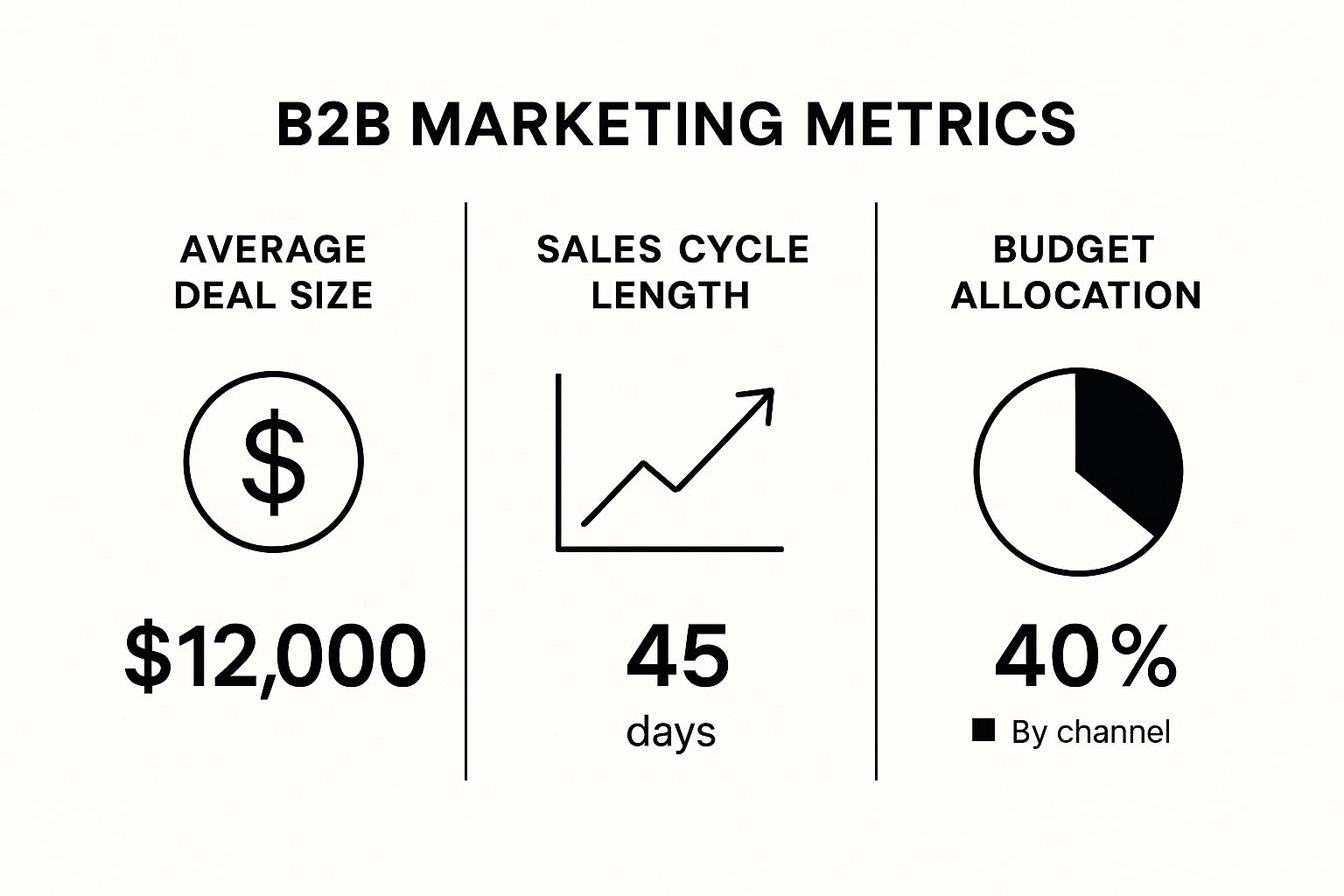
The data really drives the point home. The hefty deal sizes and long timelines common in B2B mean you need to be patient, persistent, and laser-focused on building genuine relationships. Getting a handle on these foundational differences is the first real step to building a B2B marketing engine that actually works.
Defining Your High-Value B2B Customer

Let’s get one thing straight: effective business marketing b2b is not about casting the widest net you can. It’s about precision. It’s about fishing in the right ponds with the perfect bait. Before you write a single word of copy or spend a dollar on ads, you have to know exactly who you’re talking to.
And in B2B, you’re not just talking to a person - you’re talking to a whole company.
This is where your Ideal Customer Profile (ICP) comes in. Think of an ICP as a detailed blueprint of the perfect company for your product. It’s the difference between guessing and knowing. An ICP helps you identify the clients who will get the most value from what you offer and, just as importantly, who will bring the most value back to your business.
Trying to do B2B marketing without a clear ICP is like shouting into a packed stadium and hoping a fan of your team hears you. When you have one, you’re having a direct conversation with the companies most likely to buy.
From Vague Ideas to a Concrete Profile
Building a solid ICP means getting specific about company-level attributes. While B2C marketers focus on an individual’s personal demographics, B2B requires a different toolkit. We look at firmographics, technographics, and the big-picture pain points of the organization.
-
Firmographics: These are the “demographics” of a company - their industry, size, revenue, and location. This is your first filter for finding companies that are even in your ballpark.
-
Technographics: This is all about the technology a company already uses. Knowing their tech stack tells you about their current workflows, what they can integrate with, and where they might have gaps you can fill.
-
Organizational Pain Points: These aren’t just one person’s frustrations. They are the strategic roadblocks, business goals, and operational headaches the entire company is dealing with.
When you blend these elements, you go from targeting “tech companies” to targeting “SaaS companies with 50-200 employees, using Salesforce, and struggling with lead attribution.” See the difference? That’s focus.
Building Your ICP Step-by-Step
Your ICP shouldn’t be a work of fiction. It’s a research project. The goal is to find the common threads that tie your best customers together.
-
Analyze Your Best Customers: Who are your happiest, most successful clients right now? Dig into the data. Look at their industry, company size, revenue, and location. What makes them a perfect fit?
-
Conduct Customer Interviews: Data only tells you part of the story. Get on the phone with these top clients. Ask them about their goals, the challenges they had before they found you, and what success looks like for them.
-
Use Research Tools: You don’t have to guess. Tools like LinkedIn Sales Navigator are goldmines for this kind of work. You can filter companies by countless firmographic data points to find similar businesses and gut-check your assumptions.
Your Ideal Customer Profile isn’t a “set it and forget it” document. Think of it as a living guide. It needs to be revisited and tweaked as your business grows, your product changes, and the market shifts.
This is a fundamental piece of the puzzle. For a complete walkthrough, check out our guide on how to create a **B2B Ideal Customer Profile**.
The Power of Knowing Your Audience
Once you have a sharp ICP, you’ll feel its impact everywhere. It dictates your content strategy, telling you what blog posts, case studies, and whitepapers will actually resonate. It makes your ad targeting laser-focused, so you stop wasting money on companies that can’t even buy from you.
Most importantly, a solid ICP allows you to speak your customer’s language. When you truly get their strategic goals and the pressures they’re under, your marketing stops being about your product’s features. It becomes about their company’s success. That’s the cornerstone of any B2B marketing strategy that actually works.
Building Your B2B Marketing Engine

Okay, you’ve done the hard work of defining your Ideal Customer Profile (ICP). Now what? It’s time to build the engine that’s going to drive your growth. This isn’t about just trying a few random tactics here and there. We’re talking about creating a real, interconnected system where every piece makes the others stronger.
Think of it like building a high-performance car. You can’t just drop a massive engine in and call it a day. You need a responsive steering system, a solid chassis, and brakes that can handle the speed - all working in perfect harmony.
In the world of B2B marketing, your engine is built on three strategic pillars. These aren’t siloed tactics you can pick and choose from; they’re integrated strategies that build your authority, pull in qualified leads, and guide them through what’s often a long and complicated buying process.
Pillar 1: Content Marketing is Your Fuel
Content marketing is the high-octane fuel for your entire B2B engine. And no, I don’t just mean writing a few blog posts. It’s about creating genuinely valuable assets that solve real-world problems for your ideal customers. B2B buyers are researchers. They dig deep. Your content needs to be the resource they can’t stop coming back to.
Forget the generic sales pitches. The real goal is to create content that educates and builds trust. This is how you prove you know your stuff long before you ever ask for the sale.
Some of the most powerful content assets in B2B include:
-
Whitepapers and Ebooks: These are deep dives into industry challenges and your unique solutions, positioning you as a thought leader, not just another vendor.
-
Case Studies: Nothing sells like proof. Case studies show exactly how you delivered real, tangible results for a client, giving buyers the social proof they absolutely need.
-
Webinars and Demos: These are your interactive playgrounds. They let you show off your solution in action and have a direct conversation with potential customers.
The aim here is simple: make your content so good that your target audience actively seeks it out. This becomes the bedrock of your SEO and gives you something valuable to share in your outreach.
Pillar 2: SEO is Your GPS
If content is your fuel, then Search Engine Optimization (SEO) is the GPS that guides the right people straight to your digital doorstep. Your ICP isn’t just scrolling through social media feeds for fun. They’re on Google, actively searching for solutions to their biggest business headaches. Your job is to be the answer they find.
B2B SEO plays by a different set of rules than B2C. You’re not chasing massive volumes of broad keywords. Instead, you’re targeting highly specific, long-tail queries that signal a real problem.
A B2B buyer isn’t likely to just search for “best CRM software.” They’re searching for things like “how to shorten sales cycle for SaaS teams” or “integrating marketing automation with Salesforce.” Your SEO strategy has to nail that intent.
When you align your content with these specific search terms, you’re not just getting traffic - you’re getting traffic that’s incredibly likely to turn into a qualified lead. It’s all about quality over quantity. Attracting the right 100 visitors is infinitely more valuable than getting 10,000 of the wrong ones.
Pillar 3: Account-Based Marketing is Your Precision Targeting
Think of Account-Based Marketing (ABM) as your laser-guided targeting system. While old-school marketing casts a wide net hoping to catch a few individual leads, ABM flips that entire model on its head. With ABM, you treat each high-value target company as a “market of one.”
This approach just makes sense for B2B. You’re almost never selling to just one person. Decisions are made by a committee - you might have the CTO, the finance director, and a department head all weighing in. ABM lets you coordinate your marketing and sales efforts to engage all those different people within a single company, hitting each one with a message that’s relevant to them.
This strategy is a game-changer for businesses with a clear ICP and a high customer lifetime value. It shifts the focus from just racking up a high volume of leads to strategically opening doors at the specific companies you really want to work with. This focused approach is a cornerstone of modern lead generation in B2B because it gets sales and marketing perfectly aligned on the biggest prize.
These three pillars - Content, SEO, and ABM - don’t work in isolation. Your amazing content fuels your SEO, making you discoverable. Your SEO attracts potential high-value accounts. And those accounts become the perfect targets for a personalized ABM campaign. Together, they create a powerful, self-sustaining engine for predictable B2B growth.
Picking the Right B2B Marketing Channels
Having a powerful marketing engine is one thing; choosing the right roads to drive on is another story entirely. Selecting the right channels for your B2B strategy isn’t about being everywhere at once. It’s about being in the right places with the right message, meeting your ideal customers where they already are.
Think of it like this: if you’re trying to sell high-end surgical equipment, you wouldn’t advertise during a primetime sitcom. You’d go to medical conferences, publish in industry journals, and connect with hospital administrators. The same focused logic applies here. Each channel serves a distinct purpose in the long and often complex B2B buyer’s journey.
LinkedIn: The Professional Networking Powerhouse
LinkedIn is so much more than just another social media site; it’s the undisputed hub for professional networking and an absolute goldmine for B2B marketers. This is where your Ideal Customer Profile (ICP) lives and breathes professionally. It’s the perfect spot for building top-of-funnel awareness and running highly targeted Account-Based Marketing (ABM) campaigns.
With LinkedIn, you can:
-
Target by Job Title and Company: Get your message directly in front of the specific decision-makers within your target accounts.
-
Establish Thought Leadership: Share valuable content like case studies, white papers, and industry insights to build authority and trust.
-
Engage Directly: Jump into relevant conversations and connect with prospects in a natural, professional context.
For any serious B2B effort, LinkedIn is non-negotiable. It’s where you build your brand’s professional credibility and lay the groundwork for future sales conversations.
Email Marketing: The Relationship Nurturing Champion
While social platforms are great for that initial handshake, email is where you build and nurture meaningful relationships. It’s the workhorse of B2B communication, perfectly suited for guiding prospects through the crucial mid-funnel stages of their journey. Once someone shows interest, email gives you a direct, personal, and educational line of communication.
And this isn’t just a hunch; the data backs it up. A staggering 81% of B2B marketers rely on email newsletters as a primary tool. On top of that, 79% of B2B firms consider it their most successful content distribution channel. This effectiveness is fueling massive growth, with global email marketing revenue projected to leap from $7.5 billion in 2020 to $13.69 billion by 2025. You can dig into more of these B2B marketing trends on dbswebsite.com.
Niche Forums and Communities: The Authenticity Hub
Beyond the massive platforms are specialized online communities and industry-specific forums. Think of these as the digital “water coolers” where professionals gather to discuss challenges, share solutions, and seek advice from their peers. Showing up here isn’t about a hard sell; it’s about establishing genuine expertise.
The screenshot below breaks down how B2B marketers view the effectiveness of different content distribution channels, with email clearly taking the top spot.
This data just confirms that while many channels play a part, email remains a vital, direct line for moving prospects closer to a decision.
The key to winning in places like industry forums is to provide real value without an agenda. When you consistently answer questions and share useful insights, you build a level of trust that traditional advertising simply can’t buy. Over time, you become a recognized authority, and people will naturally start seeking you out. This kind of deep engagement is one of many effective B2B lead generation strategies that prioritizes quality over sheer quantity.
By strategically weaving these channels together - LinkedIn for broad reach, email for deep nurturing, and niche forums for credibility - you create a comprehensive approach that supports the entire buyer’s journey from start to finish.
Winning With B2B SEO and Mobile Strategy
Think of your website as your digital storefront. It’s also your top salesperson and your solutions catalog, all rolled into one. For most potential customers, the first time they “walk in” is through a search engine - and more often than not, they’re using their phone.
Ignoring SEO and mobile is like locking your front door during business hours. It just doesn’t make sense. A solid strategy here isn’t just another checkbox; it’s the foundation of modern business marketing b2b. This is how you show up the second your ideal customer starts looking for a solution.
SEO The B2B Way: Stop Selling, Start Solving
B2B SEO plays a different game than B2C. While a B2C brand might target broad searches like “running shoes,” your world is far more specific. Your ideal clients aren’t googling “cool software.” They’re searching for things like “how to reduce customer churn in a SaaS model” or “best practices for data security compliance.”
The trick is to build your content around these specific, problem-focused keywords. Your blog posts, whitepapers, and case studies should be direct answers to their most painful questions. This approach delivers two huge wins:
-
You attract the right people. The traffic you get is from businesses actively trying to solve a problem you can fix.
-
You build instant authority. By giving them genuinely useful answers, you become a trusted expert long before you ever talk about pricing.
This is a fundamental shift. You have to move from a “product-first” to a “problem-first” mindset. It’s what separates B2B SEO that actually works from all the noise.
B2B buyers are researchers first and purchasers second. Your SEO strategy must cater to their need for information and expertise. The goal is to become their go-to resource, building trust long before a sales conversation begins.
The Undeniable Power of Mobile
The old idea of a B2B buyer chained to a desktop in a corner office is completely outdated. Today’s decision-makers are always on the move. They’re researching solutions between meetings, on their commute, or from their couch at home. Your mobile experience has to be flawless.
The data backs this up, and it’s not even close. Nearly 50% of all B2B ad spend is now aimed at mobile platforms. On top of that, around 60% of B2B buyers use their phones for work-related research. Digging deeper, buyers conduct an average of 12 online searches before they even engage with a specific brand’s website. You can find more compelling data in these must-know B2B marketing statistics from Coalition Technologies.
A clunky mobile experience - slow load times, tiny text, confusing menus - is a lead killer. If a busy executive can’t figure out your site on their phone in 30 seconds, they’re gone. They’ll just tap over to a competitor who makes it easy for them.
The screenshot below drives home just how critical mobile is in the B2B buying journey.
This data isn’t just a trend; it’s a reality. A huge chunk of your target audience is looking at you through a mobile screen first.
Getting mobile right isn’t just a technical task for your developer. It’s a core part of your customer experience strategy. You need to focus on:
-
Responsive Design: Your site has to look great and work perfectly on any device, from a giant monitor to a small smartphone.
-
Page Speed: Mobile users have zero patience for slow sites. Every extra second it takes to load costs you potential leads.
-
Simple Navigation: Menus and calls-to-action need to be obvious and easy to tap with a thumb.
Ultimately, a strong SEO and mobile game makes sure your business is visible, credible, and easy to engage with. It’s how you grab attention during that crucial research phase and smoothly guide prospects toward becoming customers.
Measuring What Matters in B2B Marketing
Running a campaign is one thing, but proving it actually worked? That’s the other half of the battle in business marketing b2b. You have to move past the feel-good vanity metrics like social media likes and start digging into the numbers that really matter to the business’s bottom line.
Think of it like this: every dollar you put into marketing is an investment. And like any good investor, you need to know what kind of return you’re getting. When you shift your mindset from just “doing the work” to “proving the value,” you suddenly have the power to make smarter decisions, justify your budget, and show the C-suite exactly how your team is driving revenue.
Core Metrics That Drive Business Decisions
In the world of B2B, there are three foundational metrics that tell the complete story of your performance. They track everything from the initial cost to grab someone’s attention all the way to the long-term value of that new customer relationship. Getting a handle on these isn’t just for data nerds; it’s essential for any marketer who wants to make a real impact.
Here are the big three:
-
Cost Per Lead (CPL): This is straightforward - it’s how much money you spend to get one single lead. It’s your go-to metric for judging how efficient your campaigns are.
-
Customer Acquisition Cost (CAC): Taking it a step further, CAC calculates the total cost to bring in one new paying customer. This isn’t just marketing spend; it includes sales costs, too, giving you a much more holistic view.
-
Customer Lifetime Value (CLV): This is the holy grail. It’s a projection of the total revenue a customer will bring to your business over the entire time they’re with you.
A healthy B2B marketing engine is one where your CLV is significantly higher than your CAC. That simple ratio is the ultimate proof that your strategy isn’t just creating noise, but generating real profit.
The real goal of measurement in B2B is to draw a clear, undeniable line from your marketing budget to company revenue. When you can walk into a meeting and say, “We invested $X in this campaign, and it directly produced $Y in new business,” you hold all the cards.
To give you a clearer picture, here’s a breakdown of some essential KPIs and what they tell you.
Essential B2B Marketing KPIs and What They Measure
| Metric (KPI) | What It Measures | Why It’s Important |
|---|---|---|
| Leads/MQLs | The number of new contacts or marketing-qualified leads generated. | Measures top-of-funnel effectiveness and campaign reach. |
| Cost Per Lead (CPL) | The average cost to generate a single lead from a specific campaign. | Helps you understand the efficiency of your marketing spend. |
| Conversion Rate | The percentage of leads that take a desired action (e.g., become a customer). | Shows how effectively you’re turning interest into revenue. |
| Customer Acquisition Cost (CAC) | The total sales and marketing cost to acquire one new customer. | Provides a clear view of the real cost of winning new business. |
| Customer Lifetime Value (CLV) | The total projected revenue a customer will generate for your business. | Puts acquisition costs into context and guides long-term strategy. |
| Return on Investment (ROI) | The overall revenue generated from your marketing efforts versus the cost. | The ultimate measure of profitability for your marketing initiatives. |
Tracking these metrics gives you the data-backed story you need to prove your value and make smarter, more profitable decisions for the business.
Tying It All Together for Growth
Looking at these metrics in isolation is helpful, but the real magic happens when you see how they influence each other. A super low CPL might feel like a win, but if none of those cheap leads ever convert, your CAC will shoot through the roof, and you’ve just wasted a bunch of time and money.
On the flip side, a high CAC might be perfectly fine if the CLV of those customers is massive - think enterprise software deals or high-ticket consulting. It’s all about context.
By constantly monitoring these KPIs, you can fine-tune your campaigns on the fly, allocate your budget where it will have the biggest impact, and build a predictable engine for growth. If you want to go deeper, exploring resources on mastering lead gen KPIs can give you the advanced insights you need to take your performance to the next level.
Common B2B Marketing Questions Answered
Even with a killer strategy in place, let’s be honest - the B2B marketing world can feel like a maze. I get asked a lot of the same questions, so let’s break down some of the most common hurdles marketers face.
My goal here isn’t just to give you textbook answers, but real, practical insights that build on everything we’ve covered so far.
What Is the Single Biggest Challenge in B2B?
Without a doubt, the most persistent headache for B2B marketers is generating a steady stream of high-quality leads. It’s not about just getting names into a spreadsheet; it’s about attracting prospects who actually fit your Ideal Customer Profile and have a real problem you can solve. This one issue impacts every other part of your marketing and sales process.
Great lead generation comes down to truly understanding your audience’s pain points, creating genuinely helpful content that speaks directly to those problems, and getting it in front of them on the right channels. It’s the engine that powers your entire sales pipeline. If this is a struggle for you, our in-depth guide explains exactly how to qualify B2B leads so your sales team spends their time talking to people who can actually buy.
How Can Small Businesses Compete with Industry Giants?
Good news: smaller businesses can absolutely punch above their weight and win against massive competitors. The trick is to stop trying to out-spend them and start out-maneuvering them.
Here’s the game plan:
-
Target a Niche: Don’t try to be the solution for everyone. Instead, find a specific, underserved corner of the market and completely own it. Become the go-to expert for that group.
-
Offer Superior Customer Service: Big corporations are often slow, bureaucratic, and impersonal. Use your size as a superpower. Build real relationships and provide a level of personal care they can’t match.
-
Move Faster: You can launch a new idea, test a campaign, or adapt to customer feedback while a big company is still stuck in committee meetings. Agility is your secret weapon.
Your unique selling point isn’t just your product; it’s the focused, nimble, and personal experience you deliver.
A small business’s greatest competitive advantage is its focus. By hyper-specializing in a specific problem for a specific audience, you can build deeper expertise and stronger relationships than any large, generalized competitor.
Is Social Media Just for LinkedIn?
While LinkedIn is the undisputed king of the B2B world, thinking it’s the only platform is a mistake. Other social networks can be incredibly powerful, but it all depends on your specific industry and audience.
For example, an architecture firm or a high-end design agency can get massive traction on Instagram by showcasing their stunning visual work. A cybersecurity company might use X (formerly Twitter) to jump into real-time discussions with journalists and industry analysts.
The key is to be strategic. Don’t just plant a flag everywhere. Find the one or two other places where your ideal customers actually hang out and talk shop. It’s all about meeting them where they are.
Are you ready to stop worrying about lead quality and start focusing on closing deals? At Fypion Marketing, we specialize in booking qualified meetings directly onto your sales calendar. You only pay for performance - no retainers, no setup fees. Book a free consultation today and let us build your predictable sales pipeline.