
How to Identify Target Market for B2B Precision

If you really want to pinpoint your best-fit customers, you have to dig a lot deeper than the usual B2B data points. It’s about building a complete, multi-layered profile that goes way beyond surface-level details. This means weaving together firmographics (the company stats), psychographics (the human motivations), and buying intent signals (their digital footprint). Getting this mix right gives you a crystal-clear picture of not just who your customers are, but why they buy and when.
Going Beyond Simple B2B Demographics

Years ago, you could get by targeting companies based on their industry and employee count. That was good enough. Not anymore. Today’s B2B buyers have done their homework long before you ever reach out. They have more options than ever, so a generic, one-size-fits-all approach is a surefire way to get ignored.
Answering the question “how do I find my target market?” now demands a much smarter answer. You’re not just looking at a flat photo; you’re building a 3D model of your ideal customer. It’s about understanding the complete context - the business, the people, and their immediate needs.
The Three Pillars of Modern Market Identification
To truly get who you’re selling to, you need to blend three key types of data. This combination is what turns basic information into actionable intelligence. It’s the foundation of any modern B2B marketing strategy that actually works.
To get a clearer picture of how these pieces fit together, let’s break down the modern pillars for identifying a high-value target market.
| Pillar | What It Reveals | Why It’s Essential for B2B |
|---|---|---|
| Firmographics | Quantifiable company data like industry, revenue, employee count, and location. | This is your starting point. It answers the basic question: “What do my ideal customer companies look like?” |
| Psychographics | The human elements behind business decisions - company culture, values, and the specific pain points decision-makers have. | This adds critical depth. It answers the question: “Why would this specific company need my solution?” |
| Buying Intent Signals | Digital behaviors that show a company is actively researching solutions like yours (e.g., keyword searches, competitor site visits). | This is your timing indicator. It answers the crucial question: “Are they actually looking to buy right now?” |
Combining these pillars is where the magic happens, giving you a powerful, multi-dimensional view of your market.
So, instead of just targeting “SaaS companies with 50-200 employees,” you can get much sharper. Now you’re targeting “SaaS companies with 50-200 employees that have a company culture focused on operational efficiency and are actively researching new project management tools.” See the difference?
Here’s the key takeaway: Firmographics tell you who is in the market. But psychographics and intent data tell you who is ready to buy and what message will actually hit home.
Nailing this integrated approach is non-negotiable. It’s what allows you to run hyper-targeted campaigns that speak directly to a prospect’s immediate problems, setting the stage for a predictable and qualified pipeline.
Getting Practical with Your Market Research
Okay, enough with the theory. Knowing what to do is one thing, but actually getting your hands dirty with real-world data is how you’ll find the customers you’re meant to serve. The trick is to gather actionable intel without getting bogged down in endless spreadsheets.
You need a data-backed picture of your market, and you need it now.
The single best place to start is with your own wins. Your current customers are the clearest, most honest reflection of who truly needs your solution.
Start by Analyzing Your Best Customers
Your happiest, most successful customers didn’t find you by accident. There’s a pattern there - common threads that connect them. Your job is to pull on those threads.
Take a hard look at your top 10-20 clients. Get forensic. Ask yourself:
-
Who are the key players? What are the job titles of the people who championed your solution internally? Who actually signed the check?
-
What’s their world? Are they all lumped into one broad industry, or do they share a very specific niche?
-
What fire did you put out? What exact problem did you solve for them? If you have their exact words from an email or a call, even better.
We had a B2B SaaS client who thought they sold to “software companies.” After this exercise, they realized their best customers were actually “Series A and B funded startups struggling to scale customer support.” That one insight completely changed their messaging and outreach, leading to a massive jump in qualified leads.
This is exactly the kind of deep dive we cover in our guide on how to find ecommerce brands that are a perfect fit for your services.
The goal isn’t just to find out who they are. You need to uncover why they chose you over everyone else. That “why” becomes the bedrock of your value proposition and a critical piece of the puzzle for figuring out how to identify your target audience effectively.
Dissect Your Competitors’ Playbook
Once you’ve looked inward, it’s time to look at the competition. They’re already spending a ton of money to attract an audience - it’s basically free market research for you.
Put on your detective hat and analyze their marketing to find the gaps you can drive a truck through.
-
Look at their messaging. What benefits are they shouting about on their homepage and in their ads? This tells you which pain points they think are most valuable to their audience.
-
Check their content. What topics are they covering on their blog or in webinars? This shows you the exact audience they’re trying to attract and educate.
-
Read their reviews. Go to sites like G2 or Capterra and read the good, the bad, and the ugly. The negative reviews are pure gold - they highlight the unmet needs and frustrations just waiting for a solution.
By studying their game plan, you’ll spot the customer segments they’re either serving poorly or ignoring completely. Those overlooked corners of the market are where your best opportunities are hiding.
Segmenting Your Market for Precision Targeting
Once you’ve done your research, you’re no longer just throwing spaghetti at the wall to see what sticks. You have real data. The next move is to slice that data into specific, actionable groups. This is market segmentation.
It’s the difference between looking at a faceless crowd and seeing individual people with unique problems. Instead of a blurry, one-size-fits-all approach, you start to identify distinct clusters of potential customers who share common needs, pain points, and buying habits. This is how you craft messaging that gets noticed.
Moving Beyond Basic Buckets
Good segmentation is more than just sorting companies by size or industry. While those firmographics are a decent starting point, the real magic happens when you layer in behavioral and psychographic details. This is where raw data becomes a serious competitive edge.
Here are the key segmentation models we use to nail down a target market:
-
Firmographic Segmentation: This is your foundation. Think company size, industry, annual revenue, or even the tech stack they use. Are your best customers mid-sized SaaS companies or massive manufacturing firms?
-
Geographic Segmentation: Where are these companies? This can be as wide as a country or as narrow as a specific business park. It’s crucial for tailoring sales territories, navigating local regulations, and understanding cultural differences.
-
Behavioral Segmentation: This one is all about actions. It tracks buying signals like who is visiting your pricing page, downloading your whitepapers, or engaging with your ads. It shows you who is already interested.
Combining these layers gives you a much richer picture. For instance, we had a SaaS client who was targeting “all US-based companies with over 500 employees.” After a deep segmentation analysis, their new focus became “US-based logistics companies with 500-2,000 employees that are actively researching supply chain optimization software.” The boost in campaign performance was immediate.
You can get a more granular look at this process in our guide on B2B customer segmentation.
The Power of Intent Targeting
The sharpest tool in the segmentation shed is intent targeting. This is a type of behavioral segmentation that focuses on one thing: identifying companies that are actively looking for a solution to a problem you solve. It’s about finding buyers right in their moment of need.
The old way of targeting based on static job titles and industries is failing. Buyer journeys aren’t linear anymore. Today’s buyers complete 73% of their research before ever speaking to a sales rep, and they do it quietly online.
Intent targeting is quickly becoming the standard for finding these active buyers. Recent B2B analysis shows it can lead to 35-60% higher lead-to-opportunity conversion rates and a 40% lower cost-per-lead. Why? Because it puts timing and relevance above everything else. This shift is a big deal, and you can read more about why intent targeting is replacing old methods.
When you segment your market properly, you stop shouting into a void. You start having relevant conversations with people who are actually ready to listen, turning your marketing spend into predictable growth.
Crafting Actionable Buyer Personas
All the market research and segmentation you’ve done has given you a fantastic map. Now, it’s time to populate that map with real people by creating buyer personas.
Think of these as the human stories behind the data - detailed profiles that represent your ideal customers. These aren’t just fluffy descriptions; they are practical tools that should guide everything you do, from product development to your sales emails.
From Data Points to Human Stories
A solid persona is way more than just a job title and company size. You need to get into the weeds of your customer’s day-to-day life. What are their biggest headaches? What makes them look like a rockstar at work? What KPIs are they actually measured on?
To build this story, pull from your research and start asking the right questions:
-
Role & Responsibilities: What’s their title, and what do they really spend their day doing?
-
Goals & KPIs: What specific numbers define their success? Are they trying to cut costs, drive revenue, or make their team more efficient?
-
Challenges & Frustrations: What’s the stuff that keeps them up at night? Outdated software, clunky workflows, or constant pressure from their boss?
-
Information Sources: Where do they go for new ideas? Are they reading industry blogs, sitting in on webinars, or trusting what their peers say on LinkedIn?
Answering these questions transforms a generic “IT Manager” into “Alex, an IT Manager at a mid-sized tech firm, who’s drowning in manual security patching and needs a way to automate compliance reports to finally impress his CIO.” That kind of detail is pure marketing gold.
If you want to go even deeper on this, our complete guide to the B2B ideal customer profile has you covered.
Mapping the Modern B2B Buying Committee
In the B2B world, you’re almost never selling to just one person. Decisions aren’t made by lone wolves anymore; they’re made by complex committees. This is a reality you have to account for when identifying your target market.
A single persona just doesn’t cut it. Recent data shows that 72% of B2B purchases now involve high-complexity groups with an average of 11 different decision-makers. You’re selling to a whole network of people, each with their own priorities. You can read more on these B2B buying trends and benchmarks.
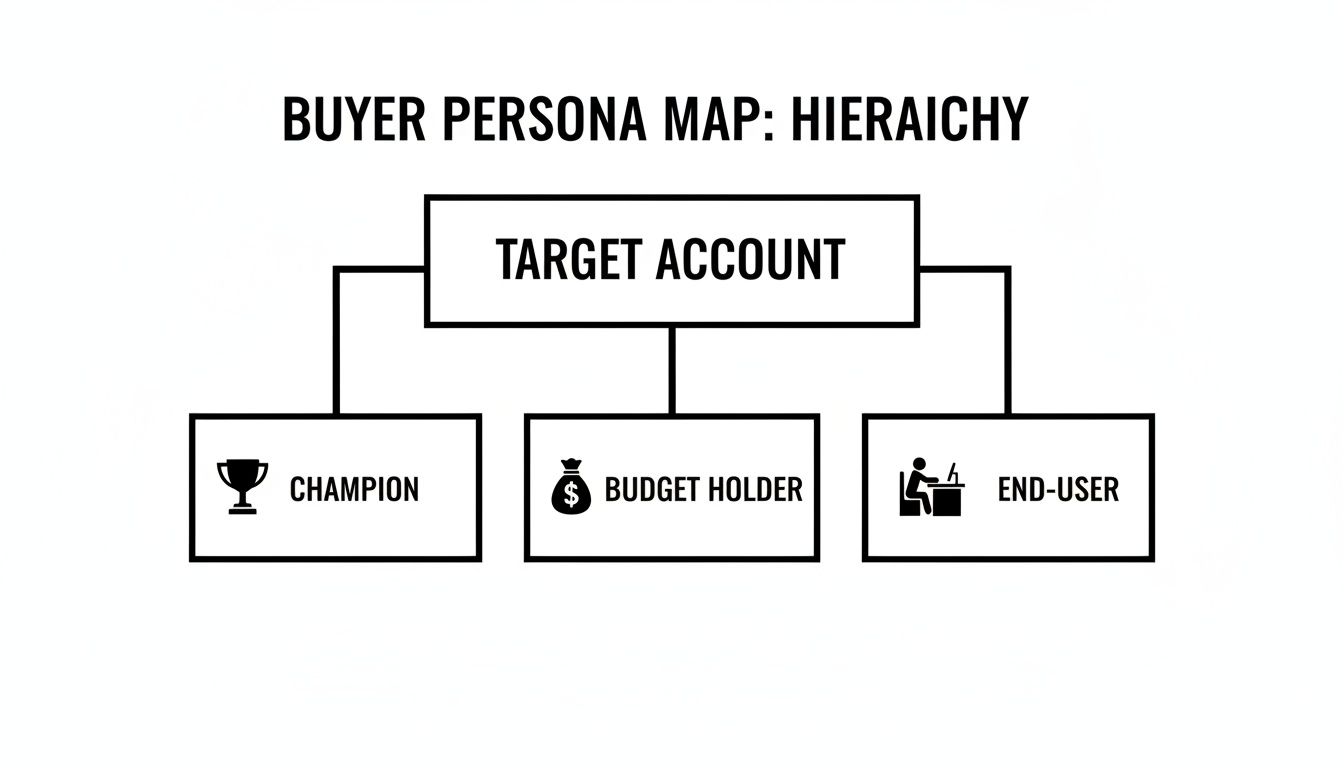
To handle this, you need to map out the entire buying committee for a typical target account. Here are the key players you’ll usually find:
-
The Champion: This is your person on the inside. They feel the pain you solve most directly and will fight for your solution internally.
-
The Budget Holder: Often in finance or a leadership role, this person holds the purse strings. They care most about ROI and whether this fits their budget.
-
The End-User: These are the folks who will have their hands on your product every day. They just want something that works well and makes their job less of a headache.
-
The Influencer/Gatekeeper: This is often someone from IT, security, or legal. They don’t have the final say, but they can absolutely kill the deal if your solution doesn’t meet their compliance or integration standards.
By building out a persona for each of these roles, you can tailor your message to what each person actually cares about. This lets you speak directly to their individual goals and objections, making your whole sales process infinitely more effective.
Activating Your Strategy With Precision Outreach
You’ve put in the hours on research, segmentation, and building out your personas. Now for the part that actually matters: turning all that insight into action. This is where you stop just identifying your target market and start actively engaging them with outreach that feels personal, not like another piece of junk mail.
Effective outreach is all about alignment. The message you send, the content you share, and the channels you use have to sync up perfectly with the personas you’ve worked so hard to create. A message that hits home with a finance director will completely miss the mark with a hands-on end-user.
Aligning Your Outreach With Persona Priorities
Think about your buying committee map. Each person on it has different goals, different pressures, and a completely different idea of what “success” looks like. A one-size-fits-all email blast is just a lazy way to burn through your list.
Instead, you need to tailor your approach for each key player. It shows you’ve done your homework and actually understand their world.
-
For the Champion: Your message needs to focus on solving their most immediate pain point. Use language that shows you get their daily grind and offer a clear, simple way to make their job easier.
-
For the Budget Holder: This person lives and breathes the bottom line. Frame everything around ROI, cost savings, and long-term business value. Case studies with hard numbers are your best friend here.
-
For the End-User: They just want their work to be less frustrating. Your communication should be all about usability and efficiency. Show them how you can simplify their workflow and get rid of daily headaches.
This buyer hierarchy is a great way to visualize how different roles in the same company need completely different angles.
When you get this right, you can craft messages that speak directly to everyone involved - from the person who will use your product every day to the one signing the check.
Speaking the Language of Modern B2B Buyers
The people making buying decisions have changed. This isn’t some future trend; it’s happening right now. A massive 71% of business buyers are now Millennials and Gen Z. These are digital natives, born between 1981 and 2012, and they have zero patience for old-school, stuffy sales pitches. They expect authenticity and want tech-first solutions. For a closer look at this shift, you can check out the latest B2B marketing statistics.
This generational shift means your outreach needs a major update. These buyers are 75% more likely to engage with brands that give them personalized content, but almost no one is actually delivering it.
Your outreach has to be hyper-personalized and deliver real value from the very first email. The goal isn’t to trick someone into a meeting. It’s to start a real conversation by proving you understand their problems.
For example, don’t send a generic email about your software. Instead, send a targeted message to an engineering manager that brings up a specific challenge you know they face, like “struggling with technical debt in a scaling startup.” That shows immediate relevance and respect for their time.
If you’re looking for the nuts and bolts of how to do this, our guide on B2B cold outreach for pipeline growth breaks down the practical steps. By closing the gap between your research and your execution, you turn your strategy from a document on a shelf into a real engine for booking qualified meetings.
Common Questions About Identifying a Target Market
Even with a solid game plan, you’re going to have questions pop up when you start digging into how to identify your target market. Let’s walk through some of the most common ones I hear from businesses.
How Often Should I Review My Target Market?
Your target market isn’t a “set it and forget it” deal. Markets change, new competitors show up, and your customers’ needs are always evolving. A quarterly or bi-annual review is a smart habit to get into.
This regular check-in keeps your strategy from getting stale. For example, a new piece of technology might completely change your customers’ priorities, or a shift in the economy could suddenly make them hyper-focused on price. Sticking with an old profile is like trying to navigate with an outdated map - you simply won’t get where you need to go.
Don’t treat market identification as a one-and-done task. It’s an ongoing process of refinement. The most successful companies are always listening and adjusting.
What Are the Biggest Mistakes to Avoid?
It’s surprisingly easy to get this wrong. I see so many businesses make the same predictable mistakes that completely undermine all their hard work.
Here are the top three blunders I run into most often:
-
Going Way Too Broad: Trying to be everything to everyone is a surefire way to be nothing to anyone. A target market of “all small businesses” is just too vague to do anything with.
-
Ignoring Negative Feedback: Customer complaints and deals you lost are a goldmine of information. They tell you exactly where your product, messaging, or process is missing the mark. Listen to them.
-
Relying Only on Demographics: Things like company size and industry are just the start. If you don’t understand the why (their motivations and pains) and the when (their buying signals), you’re basically flying blind.
Can a Small Business Do Effective Research on a Budget?
Absolutely. You don’t need a massive research budget to get powerful insights. In fact, some of the best methods are low-cost or even completely free.
Start with these practical, budget-friendly strategies:
-
Talk to Your Customers: Just call your existing clients. Ask them why they chose you, what problems you genuinely solve for them, and what their day-to-day work life looks like.
-
Listen on Social Media: Keep an eye on keywords and conversations on platforms like LinkedIn. You’ll see what your potential customers are talking about, asking for, and complaining about.
-
Use Free Industry Reports: A lot of industry publications and consulting firms give away free reports packed with data and trends. Use them.
These simple steps can give you a surprisingly clear picture of who you should be targeting, all without breaking the bank.
Ready to stop guessing and start engaging the right B2B customers? Fypion Marketing specializes in finding your ideal market and booking qualified meetings for you, all on a pay-per-meeting basis. Learn how we can build your sales pipeline.