
A Modern Playbook for B2B Cold Email Outreach
Cold email outreach involves reaching out to prospects who’ve never heard from you before. The goal is simple: start a conversation, build a relationship, and hopefully, land a qualified sales opportunity. Done right, it’s a core strategy for B2B growth.
Building Your Foundation for Modern Cold Email Outreach
Let’s be real - most cold email is just spam. The old “spray and pray” playbook is dead, and anyone still using it is just burning their domain and annoying potential customers.
Success in modern cold email outreach isn’t about volume. It’s about precision, performance, and treating your outreach like a high-value communication channel. The days of blasting generic templates to a massive, unverified list are long gone. Top-performing teams know that relevance is the only currency that matters.
This shift has given rise to performance-based models like pay-per-meeting, which forces you to reverse-engineer your entire process for one thing: results.
The Performance-Driven Mindset
When your compensation is tied directly to booking qualified meetings, you stop caring about vanity metrics. Every single part of your strategy has to be ruthlessly optimized.
This means:
-
True Personalization: We’re not talking about just using a tag. This is about referencing specific details - a prospect’s company news, a recent LinkedIn post, or challenges unique to their role.
-
Quality Over Quantity: It’s far better to have a small, hyper-targeted list of high-intent prospects than a sprawling, low-relevance one. You can get laser-focused by creating a B2B ideal customer profile to guide your targeting.
-
Value-First Messaging: Your email needs to earn the right to ask for a meeting. Offer a genuine insight, a solution to a real problem, or a unique perspective they haven’t heard before.
This approach flips cold email from a numbers game into a predictable revenue driver. You stop celebrating open rates and start celebrating actual appointments with decision-makers who want to talk to you.
To put this shift into perspective, here’s a breakdown of how the old way of thinking stacks up against a modern, performance-driven strategy.
Modern Outreach Versus Traditional Methods
| Component | Traditional Approach | Performance-Driven Approach |
|---|---|---|
| Strategy | Volume-based “spray and pray” | Precision-targeting and relevance |
| List Building | Large, unverified, broad lists | Small, curated, high-intent lists |
| Messaging | Generic, self-serving templates | Hyper-personalized, value-first copy |
| Goal | High open/reply rates | Qualified meetings booked |
| Model | Activity-based (emails sent) | Results-based (pay-per-meeting) |
| Mindset | ”It’s a numbers game." | "It’s a relationship game.” |
As you can see, the entire philosophy has changed. The focus is no longer on simply making contact, but on making the right contact in the right way.
Here’s a simple rule of thumb: if you wouldn’t say it to a prospect face-to-face at a conference, don’t put it in an email. Your outreach should feel like the start of a valuable business relationship, not a digital interruption.
Understanding this evolution is critical. The days of getting by with generic email blasts are over, a point echoed in A Modern Playbook to Win Any Import Export Firm, which details how to apply a contemporary strategy.
This disciplined, results-first framework is what separates campaigns that consistently beat benchmarks from those that just add to the noise. It’s how you turn completely cold prospects into warm, qualified meetings.
Mastering the Technical Setup for Maximum Deliverability
Look, you can write the most world-changing email ever, but it’s completely useless if it lands in spam. With cold email outreach, your success hinges just as much on the behind-the-scenes tech as it does on your clever copy. Getting your technical foundation right isn’t just some “best practice” - it’s the whole game.
Nailing this setup turns deliverability from a constant headache into a real strategic edge. It’s how you methodically prove to Google and Microsoft that you’re a legitimate sender, which is the only way your emails will ever get seen.
Why Your Sending Infrastructure Matters
Every time you send an email, service providers act like bouncers at an exclusive club. They’re checking dozens of signals to decide if your message gets in or gets tossed into the spam folder. Your job is to give them every reason to let you through.
It all starts with your sending domain. Never, ever use your primary business domain (like ) for cold outreach. One bad campaign or too many spam complaints can get your main domain blacklisted. If that happens, you’ve just crippled your entire company’s internal and operational email. It’s a rookie mistake with catastrophic consequences.
The right way to do it is to set up separate, dedicated sending domains. These are just slight variations of your main domain that you buy specifically for your outreach campaigns.
A smart play is to buy domains that feel like natural extensions of your brand. For instance, if you’re , you could grab domains like or . This keeps your brand front and center while shielding your core domain from any risk.
Setting Up Your Authentication Protocols
Once you have your new sending domains, you need to configure three crucial authentication records: SPF, DKIM, and DMARC. Think of these as a digital passport for your emails. They prove to receiving servers that you are who you say you are and that you’re not an imposter.
-
SPF (Sender Policy Framework): This is a simple record that lists all the IP addresses authorized to send emails for your domain. It basically tells the world, “Only emails from these servers are legit.”
-
DKIM (DomainKeys Identified Mail): This adds a digital signature to your emails, verifying that the content hasn’t been messed with on its way to the inbox. It’s a seal of integrity.
-
DMARC (Domain-based Message Authentication, Reporting & Conformance): This is the enforcer. It builds on SPF and DKIM and tells servers what to do with emails that fail the check - either quarantine them or reject them outright. It also sends you reports on your domain’s activity.
Getting these records configured correctly is absolutely essential. Emails without them are practically begging to be flagged as suspicious. We’ve seen it time and time again. For a deeper, more granular look, check out our step-by-step instructions for the technical setup for cold emailing.
This technical piece is the bedrock of any modern, performance-based outreach process. It has to come first.
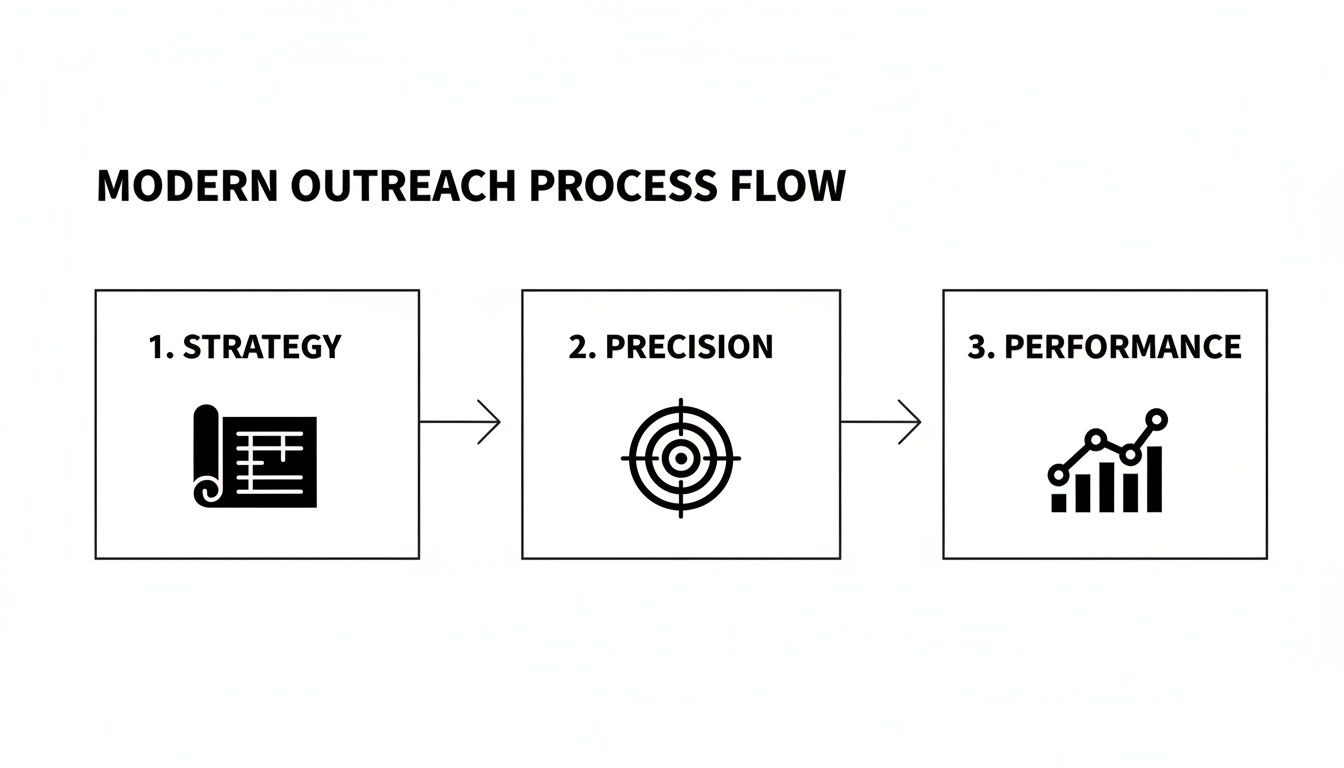
As you can see, a solid strategy - which absolutely includes the technical setup - is the foundation. Without it, the precision and performance you’re aiming for just won’t happen.
The Art of the Domain Warm-Up
Here’s another thing you can’t do: set up a new domain and immediately start firing off hundreds of emails. That’s a massive red flag for spam filters and a surefire way to get your new domains burned. You have to “warm them up” first by gradually increasing your sending volume over several weeks.
This process is designed to mimic how a real person would start using a new email account. You start slow, sending just a handful of emails per day to high-engagement contacts - think friends, colleagues, or other inboxes you own. Slowly ramp up the volume day by day, making sure you’re getting positive signals like opens and replies. This is how you build a positive sender reputation from the ground up.
Don’t underestimate this. Inbox placement is a huge hurdle. Nearly 20% of cold emails get flagged as spam even when they’re perfectly legitimate. That means one out of every five messages you send might never get a chance, purely because of deliverability problems. As inbox filters get smarter, you have to treat deliverability as a constant, ongoing part of your operations.
By getting your technical setup right and patiently warming up your domains, you build the trust required to slip past those aggressive spam filters. That’s how you make sure your hard work actually pays off and your emails land where they belong: right in your prospect’s inbox.
How to Build Hyper-Targeted Prospect Lists

Let’s be blunt: you can have the best email infrastructure in the world, but if you’re sending to the wrong people, it’s all for nothing. Your email might land in their inbox, but it’s going straight to the trash. The quality of your prospect list is, without a doubt, the biggest factor in whether your campaign sinks or swims.
Good cold email outreach isn’t about blasting a huge list of contacts. It’s about finding the right people in the right companies who have a problem you can actually solve. This all starts with getting crystal clear on who you’re targeting by building a detailed Ideal Customer Profile (ICP).
Your ICP isn’t just a vague idea of your target market. It’s a data-driven blueprint of the accounts that benefit most from what you sell - the ones who stick around and are most profitable. To build one, you need to look at your best existing customers.
Define Your Ideal Customer Profile
Start by talking to your sales team and digging into your CRM. Who are your happiest clients? Which ones closed the fastest? Who brings in the most revenue over time?
Once you have that list of all-star customers, it’s time to figure out what they have in common. Go beyond the obvious.
-
Firmographics: Sure, you need the basics. What’s their industry, company size (both revenue and employee count), and where are they located?
-
Technographics: What’s in their tech stack? Are they using a specific CRM, a marketing automation tool, or a cloud provider that makes them a perfect fit for your solution?
-
Organizational Structure: How are their teams built? A flat organization might mean you go straight to a C-level exec, whereas a company with more layers means a director or manager is your best bet.
-
Business Signals: Are there specific triggers? Maybe they just got a round of funding, announced a major expansion, or are hiring for key roles (like a “VP of Sales”).
By answering these questions, you build a sharp, multi-dimensional profile of the exact account you need to be talking to. This ICP is the North Star for all your list-building efforts.
Pro Tip: Your ICP isn’t a “set it and forget it” document. The market changes constantly. You need to review and tweak your ICP at least every quarter based on new customer wins and campaign results.
Pinpoint High-Potential Accounts and People
With a clear ICP, you can finally start finding the companies that fit the bill. This is where you put modern tools to work. For B2B, LinkedIn Sales Navigator is indispensable - it’s the gold standard for a reason.
You can filter companies with an incredible amount of precision, using all the criteria from your ICP: industry, employee count, growth rate, and even keywords from their company profiles. We save these as dynamic “Account Lists,” which gives us a constantly updating feed of new prospects.
Once you’ve identified your target accounts, you have to find the actual decision-makers. This part is more art than science. Your ICP gives you target job titles like “Director of Marketing,” but you need to find the specific human being holding that title.
Using Sales Navigator again, you can drill down to find people with those exact titles within your target accounts. But don’t just grab a name. Look at their recent activity, how long they’ve been in the role, and their connections. A newly hired executive, for instance, is often eager to make their mark and is 3x more likely to buy new solutions.
Finding the email address is one thing, but verifying it is another. Sending emails to bad addresses will destroy your sender reputation faster than anything. Always run your lists through a combination of email verification tools to keep your bounce rate below 3-5%. It’s a non-negotiable step that protects your domain and ensures your emails actually get delivered. To dig even further into this process, you can read also about how to identify your target market for B2B precision, which goes hand-in-hand with these list-building tactics.
When you nail this process - combining a sharp ICP with the right tools and a focus on real decision-makers - your list becomes a strategic asset, not just a spreadsheet. Your outreach becomes so relevant that it’s almost impossible to ignore.
Writing Compelling Emails and Follow-Up Sequences

You’ve done the heavy lifting - the technical setup is flawless and your list is dialed in. Now comes the part where your strategy really comes to life. Because let’s be honest, perfect deliverability means nothing if your message falls flat.
Writing great cold email outreach is an art. It’s a delicate balance of personalization, brevity, and pure value. Your goal isn’t just to get an open; it’s to earn a reply. That means respecting your prospect’s time, proving you’ve done your homework, and making it dead simple for them to say yes to a conversation.
Crafting a Subject Line That Demands an Open
Think of your subject line as the gatekeeper. If it doesn’t spark curiosity or scream relevance, your email is getting deleted. Forget the clickbait or the tired, generic phrases like “Quick Question” - executives see those a mile away and hit archive without a second thought.
The subject lines that actually work usually fit into a few buckets:
-
Hyper-Personalized: Mention something specific to them. “Your recent post on AI” or “Idea for [Company Name] + [Their Competitor]” shows you’ve paid attention.
-
Curiosity-Driven: Keep it short and intriguing. Something as simple as “Marketing at [Company Name]” can be shockingly effective because it feels internal and makes them wonder what it’s about.
-
Value-Oriented: Hint directly at the benefit. Think “Scaling your SDR team.”
The best ones are short, usually just 3-5 words, and look like they were typed by a human, not a marketing bot. They’re personal and steer clear of salesy jargon, ALL CAPS, or weird punctuation.
Writing Body Copy That Actually Gets Read
Once you’ve earned that open, your very first sentence is the most valuable real estate in the entire email. It has one job: prove this message is for them and only them. This is where you drop your “personalization hook.”
A solid opening line could reference things like:
-
A recent company win or funding announcement.
-
A challenge you spotted in their latest annual report.
-
A piece of content they wrote or shared online.
-
A mutual connection or a shared experience (like attending the same conference).
This one move instantly separates you from the mass emailers. It shows you’re a pro who invested time to understand their world. And if you’re looking to get creative, it helps to understand how to prompt AI to write like a human to get more natural-sounding copy.
After the hook, get straight to the point. Your entire email should be under 150 words. Your prospect is busy, and chances are they’re reading this on their phone between meetings. Use short, scannable paragraphs (1-2 sentences max).
The structure is simple:
-
Personalized Hook: Show you know who they are.
-
Problem Statement: Briefly touch on a problem you know their role/company faces.
-
Value Proposition: Hint at your solution without dumping a list of features.
-
Call-to-Action (CTA): Make a low-friction ask.
Instead of the classic “Can I get 15 minutes on your calendar?” - which feels like a big commitment - try an “interest-based” CTA. Something like, “Is this a priority for you right now?” or “Open to learning more?” is much easier to say yes to. It shifts the goal from booking a meeting to simply starting a conversation.
This approach filters for genuine interest, which is exactly what you need when you’re being paid for performance. For more concrete examples, check out our guide with 7 B2B cold email templates to boost your outreach.
The Power of a Strategic Follow-Up Sequence
Here’s a secret: most replies don’t come from the first email. The real magic happens in the follow-ups. A smart sequence can easily double your response rate, but only if you do it right. Just “bumping” your original email to the top of their inbox is lazy and it doesn’t work.
Each follow-up has to add new value. Think of it as a mini-campaign where every touchpoint offers a fresh angle or a helpful resource.
A Sample 4-Step Sequence We Use:
-
Email 1 (Day 1): The initial, highly personalized outreach.
-
Email 2 (Day 3): Share a short, relevant case study or one powerful data point that backs up your claim.
-
Email 3 (Day 7): Give them something useful, like a link to an industry report or a blog post that addresses one of their core challenges. No strings attached.
-
Email 4 (Day 12): The polite “break-up” email. Let them know you won’t be in touch again but keep the door open for the future.
This multi-touch strategy is what cuts through the noise. The data doesn’t lie. The average cold email reply rate hovers around 3.43%, but teams using a sequence with 3-5 follow-ups see that jump to 8.3%. That’s more than double the 4.1% rate for single-message campaigns. While the first email gets the most action (79.4% of replies), that persistent, value-driven follow-up is what captures the rest. You can dig into more numbers from the latest cold email benchmarks on Mailshake.
This kind of thoughtful persistence shows you’re a serious professional, not a spammer. It’s the engine that turns cold outreach into a predictable pipeline of qualified meetings.
Optimizing Campaigns and Embracing Performance Models
Hitting ‘send’ on your campaign isn’t the finish line; it’s the starting gun. The real work, the part that separates wildly successful campaigns from the ones that fizzle out, begins the moment those first emails land.
Thinking you can just “set it and forget it” is a one-way ticket to an empty pipeline. Modern outreach is a living, breathing process. You have to be constantly tweaking, testing, and refining based on the data that comes back. Your first campaign is really just your best-educated guess. Every open, click, and reply is feedback telling you how to make the next one better.
Focusing on Metrics That Actually Matter
First things first, you need to stop obsessing over vanity metrics. Open rates, for instance, are becoming less and less reliable thanks to privacy updates from providers like Apple. Chasing a high open rate can feel good, but it doesn’t pay the bills.
Instead, your energy should be laser-focused on the numbers that signal genuine buying intent - the actions that show a prospect is moving closer to a conversation.
Here’s what we track obsessively:
-
Interested Reply Rate: This is your north star. It’s the percentage of people who write back with a positive or inquisitive response. A high interested reply rate is the purest signal that your targeting, messaging, and offer are all perfectly aligned.
-
Meetings Booked: The ultimate goal. This is the bottom-line metric that tells you if your outreach is actually generating qualified appointments for your sales team. It’s the number that translates directly to pipeline.
-
Click-Through Rate (CTR): This shows you who’s engaging with your content, whether it’s a link to a case study, a demo video, or a valuable resource. It tells you if your copy is compelling enough to earn a click and pull them deeper into your world.
These metrics give you a true diagnosis of your campaign’s health. A great open rate but a terrible reply rate? Your subject line is working, but your email body is failing to deliver on the promise.
A low interested reply rate isn’t a failure. It’s a flashing red light telling you there’s a disconnect between your audience and your message. It’s valuable data pointing you exactly where you need to start fixing things.
To get a clearer picture of what to track, here’s a breakdown of the key metrics for optimizing any cold email campaign.
Key Metrics for Cold Email Campaign Optimization
A breakdown of the essential KPIs to track for diagnosing and improving the performance of your cold email outreach.
| Metric | What It Measures | Good Benchmark | How to Improve It |
|---|---|---|---|
| Interested Reply Rate | Percentage of positive responses to your emails. The best indicator of message-market fit. | 1-3% | A/B test your offer, call-to-action, and opening lines. Refine your ICP and targeting. |
| Meetings Booked Rate | Percentage of prospects who book a meeting. The ultimate conversion metric. | 0.5-1% of total prospects | Streamline the booking process. Test a softer CTA. Improve lead qualification. |
| Click-Through Rate (CTR) | Percentage of prospects who click a link in your email. | 2-5% | Make your link compelling. Offer a high-value resource (case study, tool, report). |
| Open Rate | Percentage of recipients who open your email. Increasingly unreliable but still useful. | 40-60% | Test different subject lines. Improve sender reputation and deliverability. |
| Bounce Rate | Percentage of emails that couldn’t be delivered. | < 3% | Use a high-quality, verified email list. Set up technical infrastructure correctly. |
Tracking these numbers gives you the insights needed to make smart, incremental improvements that compound over time.
A Practical Playbook for A/B Testing
Systematic A/B testing is how you turn those insights into results. The trick is to be methodical. Test one - and only one - variable at a time. That’s the only way to know for sure what caused the change in performance.
Always start by testing the elements that have the biggest impact. Small tweaks to these can lead to major shifts in your results.
Our A/B Testing Priority List:
-
Subject Lines: This is your first impression. Test a personalized approach against a curiosity-based one. Try a short, punchy subject line versus something a bit more descriptive. This is your biggest lever for open rates.
-
Call-to-Action (CTA): This is where you ask for the conversion. Experiment with a direct, “hard” CTA like “Are you free for 15 mins next week?” against a softer, interest-based question like “Is improving X a priority for you right now?”
-
Opening Line: The first sentence has one job: prove you’ve done your homework. Test an opener that references a specific company trigger (like a new funding round) against one that mentions a personal accomplishment you found on their LinkedIn.
-
Value Proposition: How you frame your solution matters. In one version, focus on how you save teams time. In another, focus on how you help them grow revenue. See which pain point resonates more deeply.
Let each test run until you have enough data to make a confident call - usually a few hundred sends for each version. Once you have a clear winner, make it your new control and move on to testing the next element on your list. It’s a never-ending cycle of test, learn, and improve.
The Inevitable Shift to Performance-Based Models
This entire data-driven optimization process feeds directly into a pay-per-meeting model. When you only pay for a tangible result - a qualified meeting that shows up on your calendar - you instantly de-risk the entire investment.
You’re no longer paying for activities like “emails sent” or leads that don’t fit your criteria. Your incentives become perfectly aligned with your agency partner’s. They only get paid when you get in front of your ideal buyers.
This model forces an agency to:
-
Build hyper-targeted lists, because they can’t afford to waste time on poor-fit prospects.
-
Write incredibly sharp, personalized copy that actually gets replies.
-
A/B test relentlessly to squeeze every bit of performance out of a campaign.
-
Rigorously qualify every appointment to make sure it meets your exact standards.
Suddenly, cold email outreach transforms from a cost center with unpredictable ROI into a scalable, reliable engine for pipeline growth. You’re not just buying activity; you’re buying outcomes. Our full guide to performance-based lead generation dives deep into how this model can revolutionize your sales pipeline.
When you combine disciplined A/B testing with a performance-based partnership, you create a powerful feedback loop. The data from every send makes the next one smarter. This is how you stop gambling on leads and start building a true growth machine.
Your Cold Email Outreach Questions Answered
Even with the best playbook, you’re going to have questions once you’re in the trenches running campaigns. It’s just the nature of the beast. Making the right calls on the fly is what separates the pros from the amateurs, so let’s clear up some of the most common things we get asked by B2B leaders.
These are the straight-up, no-fluff answers you need to cut through the noise and get back to what actually drives results.
How Many Follow-Up Emails Should I Send?
This is all about finding that fine line between being persistent and just being a pest. From what we see across thousands of campaigns, the sweet spot is a sequence of 3-5 emails, counting your initial one.
Sending a single email and hoping for the best just doesn’t work anymore. The reality is, most of your replies will come from the follow-ups. A well-planned follow-up sequence can easily double your reply rates, taking them from a lackluster ~4% to a much healthier 8% or more.
The trick is to add new value with every single message. Never just “bump” your first email. Instead, try things like:
-
Sharing a relevant case study or a quick, insightful resource.
-
Presenting your value prop from a slightly different angle.
-
Referencing a recent company announcement or a new trigger event.
This shows you’ve put in the thought. It positions you as a potential partner, not just another automated blast clogging up their inbox.
Is Cold Email Still Effective?
Absolutely, but the game has completely changed. The old days of buying a massive list and blasting out thousands of generic templates are dead. Not only is that approach a waste of money, but it’s also a fast track to destroying your domain’s reputation.
Today, cold email is a precision instrument. It’s a game of quality, not quantity.
Success really boils down to three things:
-
Deep Personalization: You have to prove you’ve actually done your homework.
-
Rock-Solid Technical Setup: Your emails need to land in the primary inbox, period.
-
Value-First Messaging: Lead with an insight or a helpful idea, not a hard sales pitch.
While you’ll see average reply rates thrown around that seem pretty low, a well-run, strategic campaign will consistently hit 8-10% interested reply rates, and often much higher. When you do it right, it’s still one of the most scalable, highest-ROI channels for B2B.
What Is More Important: A Great Subject Line or Personalized Copy?
Ah, the classic chicken-or-the-egg debate. The honest answer? They’re completely dependent on each other. One is useless without the other.
A brilliant, curiosity-piquing subject line gets you the open. But that open means nothing if the email body is a generic template that feels completely irrelevant to the reader.
A great subject line gets your foot in the door. The personalized copy convinces them to let you stay for a conversation.
On the flip side, you could write the most persuasive email in history, but if the subject line is boring or screams “SALES,” it’ll never even get read. You can’t pick one to focus on; you have to nail both.
Think of it as a one-two punch:
-
Write a short, intriguing subject line that stands out and earns the click.
-
Make sure your first sentence immediately pays off that curiosity and proves the email was written specifically for them.
When both elements work together, you stop being an interruption and start a genuine conversation.
Ready to turn your cold email outreach into a predictable pipeline of qualified meetings? Fypion Marketing operates on a pay-per-meeting model, meaning you only pay for results. Learn more about how we can scale your sales appointments at https://www.fypionmarketing.com.